Field blewit
Lepista personatasyn. Lepista saeva, Tricholoma personatum, Tricholoma saevum, Clitocybe saeva, Clitocybe personata, Rhodopaxillus saevus
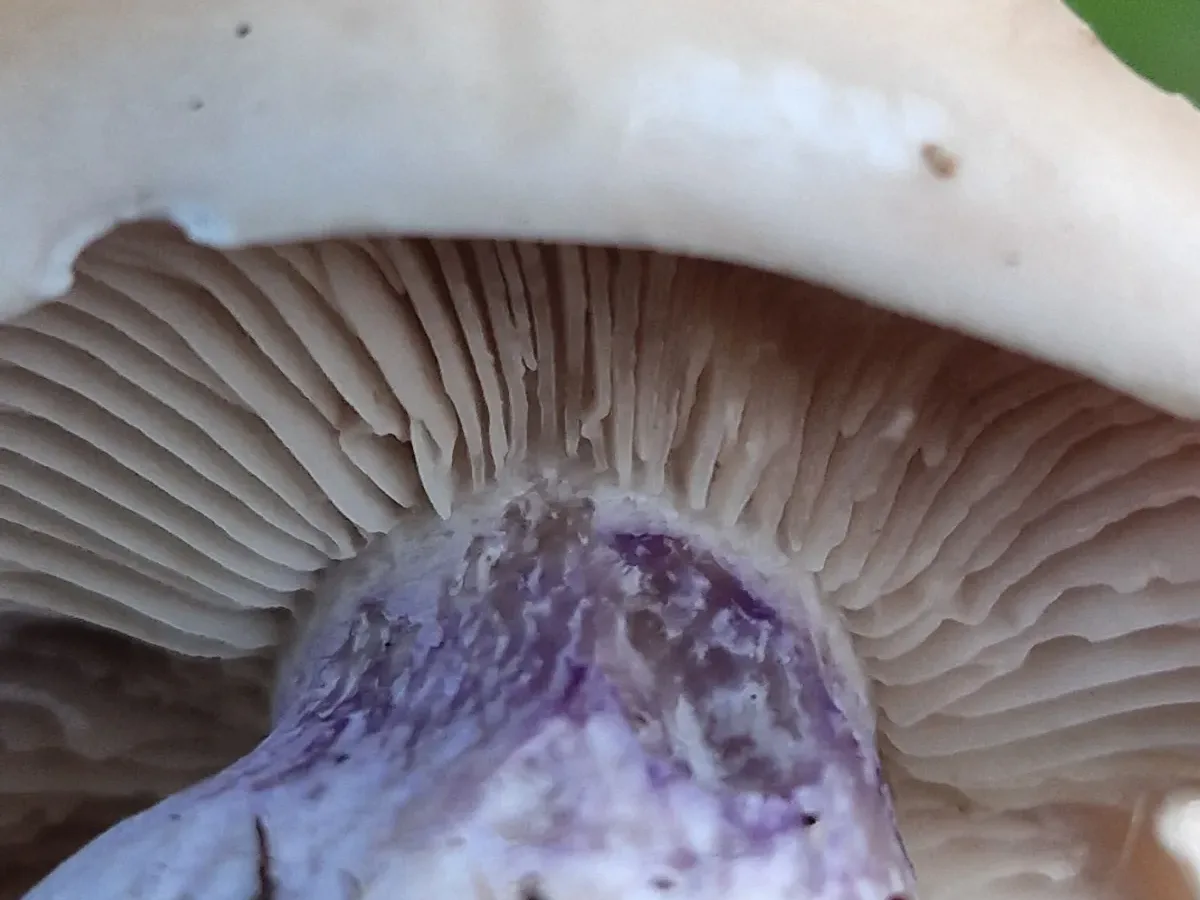 © Nina Lundberg (CC BY)
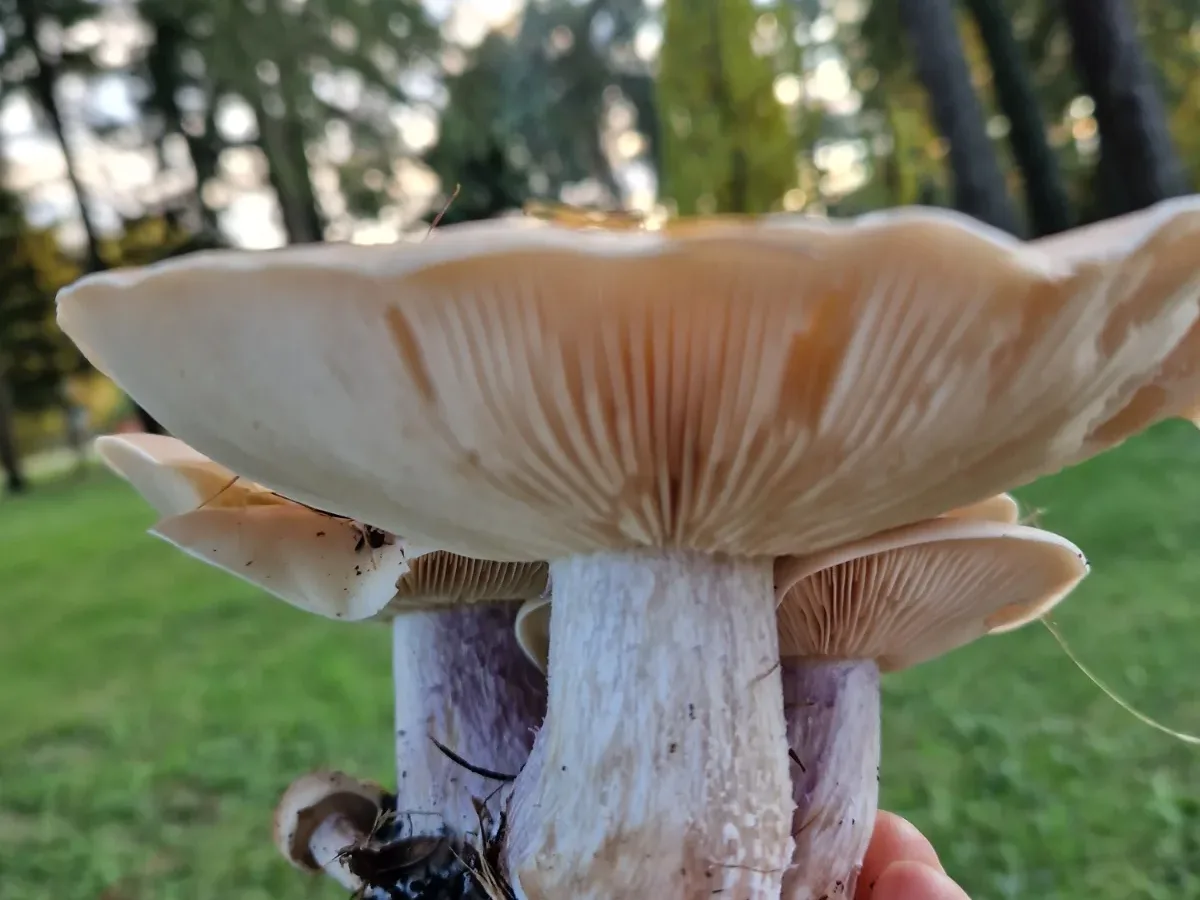 © Nina Lundberg (CC BY)
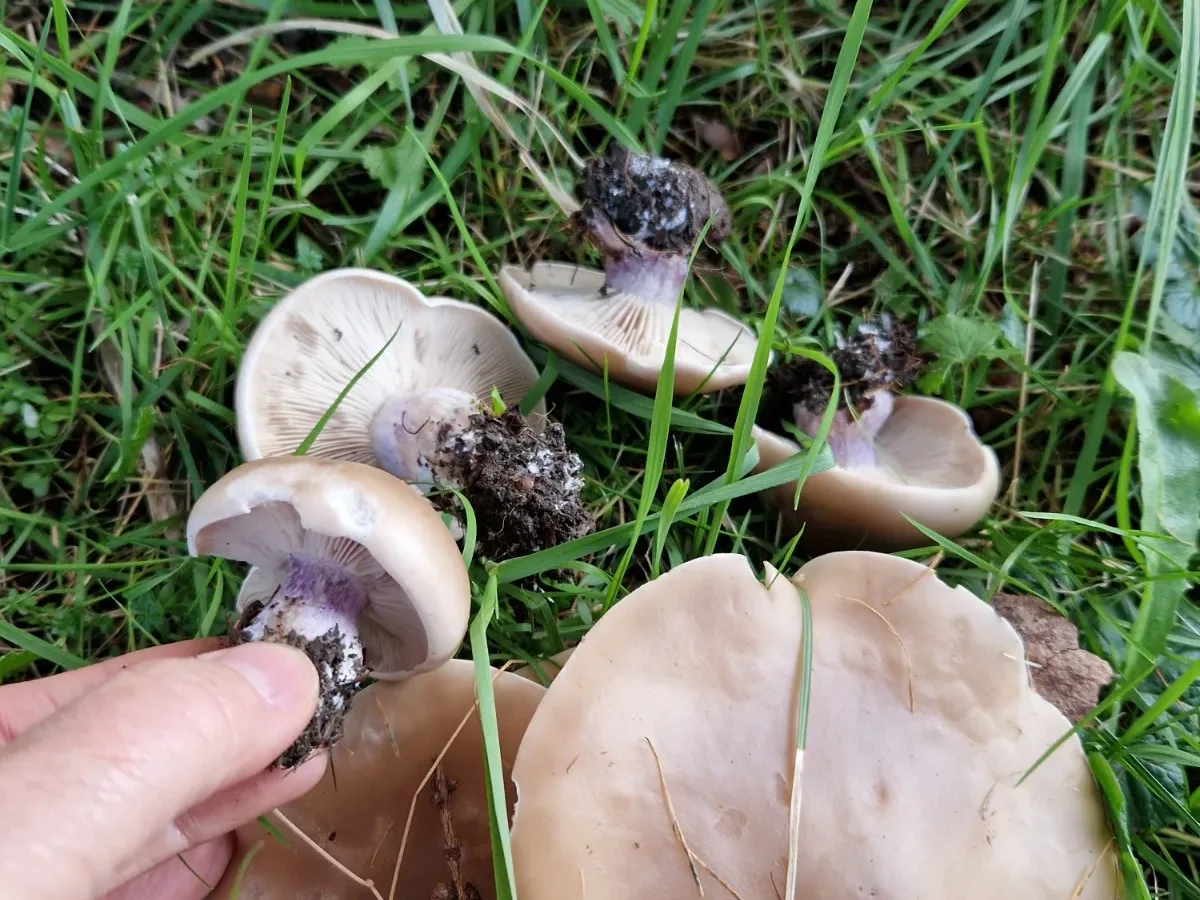 © Nina Lundberg (CC BY)© Nina Lundberg (CC BY)© Nina Lundberg (CC BY)
Good to eat, once you have identified it with certainty and cooked it through.
Never eat a mushroom you are not 100% sure of - check the look-alikes below, and always cook wild mushrooms.
How to recognise it
The field blewit is a robust, stocky mushroom most immediately recognised by the combination of a buff-coloured or brownish cap with a brilliantly lilac-violet stem - a colour scheme precisely opposite to its close relative the wood blewit (Lepista nuda), which has violet tones throughout including the cap.
Cap
The cap measures 5-15 cm across. Young specimens are strongly convex with a markedly inrolled margin, maturing to broadly umbonate or eventually flat and irregular, sometimes with a wavy or lobed edge in old age.
The surface is smooth and slightly greasy or viscid in wet weather, drying to a matt finish. Colour ranges from pale ochre-buff to mid greyish-brown, often with a darker centre, and remains resolutely non-violet at all stages - any violet tinge on the cap rules out this species.
Gills
The gills are crowded, adnate or slightly sinuate, cream to pale buff and ageing pinkish-cream; they too lack violet pigmentation.
Stem
The stem is the species' signature: 3-7 cm tall and 1.5-3.5 cm in diameter, stout and barrel-shaped, solid, fibrous, and coloured a vivid lilac to amethyst-violet, most intense near the apex and fading toward the base.
In aged or dried specimens the lilac fades to greyish-buff, so freshness is essential for confident identification.
Flesh
The flesh is firm, white throughout.
Smell & taste
A strong mealy (farinaceous) smell - persistently reminiscent of fresh flour, damp grain, or cucumber - which is a key identification character.
Spore print pale pinkish-buff (not white, not deep pink).
Where & when it grows
Habitat
The field blewit is a grassland specialist, found on permanent pastures, old hay meadows, commons, lawns, parkland, roadside verges, and garden borders - wherever there is well-matured, humus-rich turf that has been undisturbed for many years.
Unlike the wood blewit, it rarely ventures into dense woodland, though it may colonise woodland edges and rides. It is saprotrophic, breaking down accumulated organic matter in the soil.
A reliable indicator of ancient or long-established grassland, and often found in the same pastures year after year. It frequently fruits in large fairy rings or broad arcs.
In central and western Europe it is most at home on calcareous or neutral soils, and is associated with traditionally managed farmland.
When
Autumn to early winter is the prime time. October and November are peak months across most of central and western Europe and the British Isles, with fruiting continuing into December and occasionally January in mild Atlantic winters.
The field blewit tolerates light frost and is commonly found after the first ground frosts have passed, outlasting most other edible grassland species.
A characteristic feature is its tendency to appear in large numbers or ring-forming flushes after prolonged wet spells in late October-November, particularly when night temperatures have dropped to 2-8 °C.
How it grows
Saprotrophic, breaking down buried humus, decomposing grass roots, and organic debris in long-established turf.
The fungus spreads through the soil via rhizomorphs - white mycelial strands that thread outward year on year. In old, undisturbed pasture the same colony can be quietly expanding for decades before you see a single cap.
That slow underground spread is what produces the fairy rings and broad arcs field blewits are known for; a large ring is simply the advancing front of an ageing mycelium.
Fruiting bodies emerge singly, in loose groups, or as sudden dense flushes of dozens of caps at once - sometimes nearly completing a full circle overnight after the right autumn rain.
Fruiting conditions
Fruiting triggered by cool, wet autumn conditions; soil temperature dropping below 14 °C combined with sustained rainfall over 2 weeks is the key stimulus. Tolerates light frosts. Peak flushes typically follow the first significant October-November rain events in Atlantic Europe.
Look-alikes
Several dangerous species share the same grassland habitat.
- The most serious confusion risk is the Clitocybe dealbata / Clitocybe rivulosa complex (sweating mushrooms / ivory funnel): small-to-medium white or greyish-white species with no violet colouration and thin, brittle flesh. They contain muscarine in dangerous concentrations and can be fatal, and are found in exactly the same fairy ring habitats.
- The lilac fibrecap (Inocybe geophylla var. lilacina) is a small but deadly muscarine-containing species with violet tints on cap and stem. It is much smaller (cap 1-3 cm), has a silky fibrous cap texture, brownish gills, and a clay-brown spore print rather than the pale pink of the blewit.
- The entolomas (Entoloma sinuatum and related large grey-brown Entoloma species) share a buff-to-brownish cap and pinkish spores; they lack the violet stem and have a mealy or rancid smell. Entoloma sinuatum causes severe gastrointestinal illness and has caused deaths.
- The wood blewit (Lepista nuda) overlaps with the field blewit but has violet tones on the cap and gills as well as the stem, and grows in woodland or compost heaps; it is also edible.
- Clitocybe nebularis (clouded funnel) grows in leaf litter with decurrent gills, lacks the violet stem, and smells sweet-soapy; considered suspect and mildly toxic.
- The violet webcap (Cortinarius violaceus) is entirely violet but grows in woodland and has a rusty-brown spore print; many close relatives in the Cortinarius genus cause fatal kidney failure.
White to pale grey-white throughout with no trace of violet on stem or anywhere else; thin brittle flesh; mealy or soapy smell; gills slightly decurrent; grows in the same fairy ring grassland. Contains muscarine in high concentrations - causes severe cholinergic poisoning (profuse salivation, sweating, slow heartbeat) and can be fatal, particularly in children and the elderly. Field blewit always has a vivid violet stem.
Large greyish-buff cap with decurrent gills, sweet-soapy smell, white spore print; no violet on stem; grows in woodland leaf litter in rings. Considered suspect and mildly toxic to many people; should not be eaten.
Confusion is unlikely given the large size difference: cap 1-3 cm versus 5-15 cm in the field blewit. The lilac fibrecap has a radially silky-fibrous (not smooth) cap, brownish gills, a clay-brown spore print (never pale pink), and a spermatic smell (not mealy). Contains muscarine - causes serious cholinergic poisoning requiring medical treatment, though no deaths have been recorded specifically from this species. Distinguish by spore print colour and cap texture whenever violet tints are seen on a small grassland Inocybe.
Large, pale buff to greyish-white cap with crowded sinuate gills that turn salmon-pink at maturity; no violet colouration anywhere; smell mealy or rancid (not pleasant-floral); spore print deeper salmon-pink; angular spores visible under microscope. Causes severe gastrointestinal poisoning and can result in hospitalisation, but contains no established lethal toxin. Grows in open woodland and park grassland. Field blewit always has a vivid violet stem - no violet on the stem means do not eat.
Entire fruitbody (cap, gills, stem) deep violet-purple; cobweb-like cortina (veil) present in young specimens; rusty-brown spore print; grows in woodland (beech, birch); does not occur in open grassland. Not deadly itself but inedible; note that many close relatives in the Cortinarius genus (e.g. C. rubellus, C. orellanus) cause fatal kidney failure - any rusty-brown-spored violet fungus must be avoided.
Also edible when cooked, but has violet tones on cap and gills as well as the stem - all parts are violet when fresh. Grows in woodland, under conifers, in compost heaps and leaf litter, rarely in open grassland. Confusion between the two is of low safety significance as both are edible, but correct identification is still important.
In the kitchen
Picking & cleaning
Collect only firm, fresh specimens with vivid violet stems; faded, waterlogged, or insect-damaged examples deteriorate quickly.
- Cut at the base rather than pulling, to avoid disturbing the mycelium and the turf.
- Trim off soil and grass debris in the field.
- Refrigerate in paper bags and use within two days - field blewits have a short shelf-life.
- Photograph the fresh stem colour at the time of harvest, as all violet colouration fades quickly after picking.
They must be cooked thoroughly - consuming them raw causes gastric upset in many people.
Cooking
Field blewits must always be cooked before eating - raw consumption causes nausea, vomiting, and abdominal cramps in the majority of people, due to poorly understood heat-labile compounds in the raw flesh.
No amount of marinating, drying, or cold preparation makes them safe to eat raw. Thorough cooking (sustained heat sufficient to reach the centre of the flesh) neutralises these compounds completely, and properly cooked field blewits are highly regarded as table mushrooms in France, Britain, and the Netherlands.
Prepare by brushing off soil and trimming the stem base; avoid washing if possible, as the flesh absorbs water and softens. The texture is dense and firm, holding its shape well during cooking.
The strong mealy-farinaceous aroma mellows considerably with heat, transforming into a rich, nutty, pleasantly earthy flavour.
Sautéing in butter or olive oil over medium-high heat is the most reliable method: cook in a single layer without crowding, allowing moisture to evaporate fully before the mushrooms begin to brown (5-8 minutes). Crowding the pan causes steaming and leaves the texture soft and watery.
Season with salt, pepper, and fresh thyme. They pair well with cream sauces, shallots, garlic, and hard cheeses.
Field blewits work well in risottos, pasta sauces, omelettes, and as a filling for pastry cases or pies. They can also be added to soups and stews, where they contribute body and an earthy backbone.
Avoid cooking at very low heat for extended times, which produces a waterlogged result.
They can be frozen after blanching or sautéing, though the texture softens somewhat on thawing. Drying is less common but possible - use a dehydrator at 45-55 °C until fully crisp, then rehydrate in warm water or stock before use.
Good to know
Must be thoroughly cooked - raw consumption causes gastric upset in the majority of people.
The key identification character is the vivid lilac-violet stem on a non-violet cap in open grassland; confirm this combination before eating.
- Never collect pale or faded specimens without having first verified the stem colour on fresh material.
- Confirm the strong mealy-farinaceous smell (like flour or cucumber) - not sweet-floral, not rancid, not of soap.
The danger species sharing this habitat - Clitocybe dealbata, Clitocybe rivulosa, and large Entoloma species - all lack violet pigmentation entirely. If there is no violet on the stem, do not eat.
The lilac fibrecap (Inocybe geophylla var. lilacina) has violet tints but is far smaller (cap under 3 cm), has a silky fibrous cap, and gives a clay-brown (not pale pink) spore print - take a spore print when in doubt.
For beginners, an expert check is strongly recommended before eating any blewit.
A reference guide - never an edibility guarantee. When in doubt, leave it out.