Wood blewit
Lepista nudasyn. Clitocybe nuda, Collybia nuda
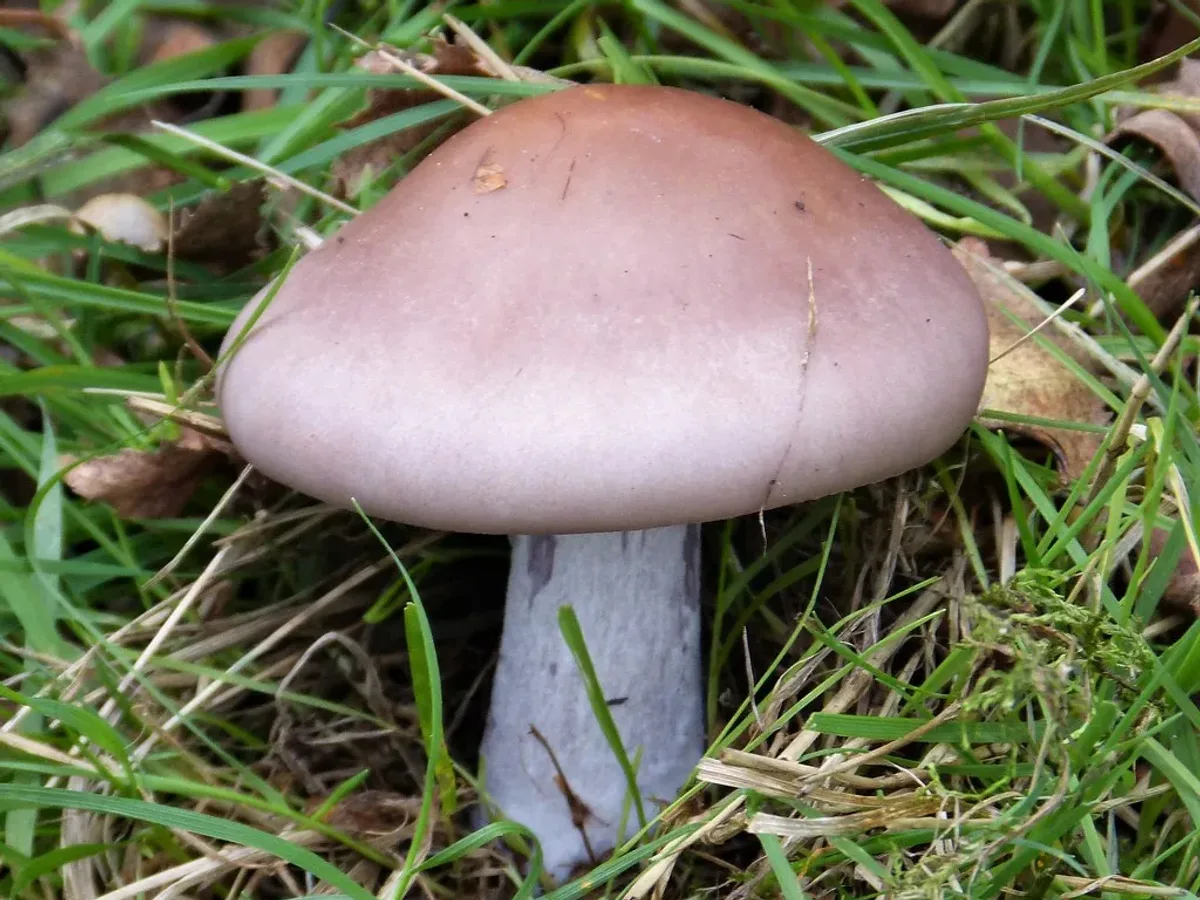 © gailhampshire (CC BY 2.0)
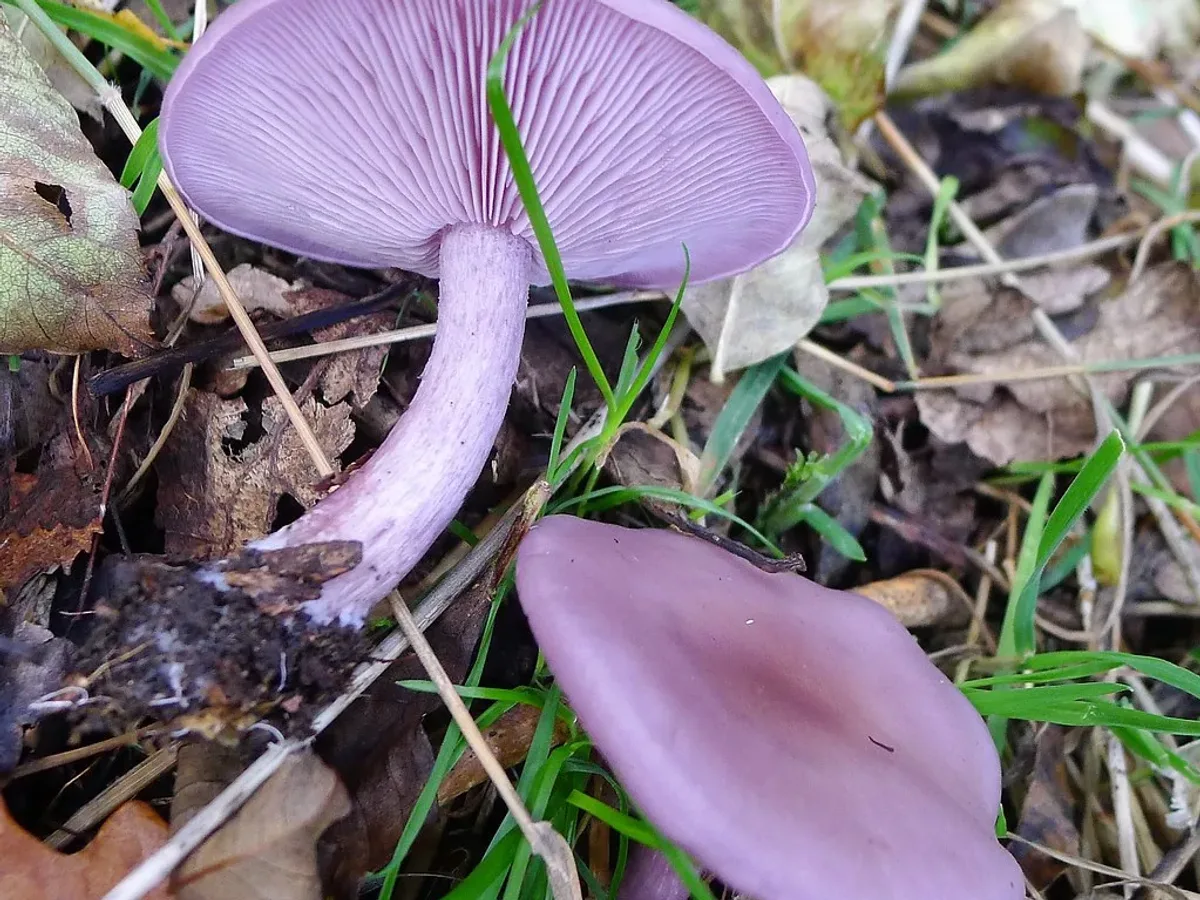 © gailhampshire (CC BY 2.0)
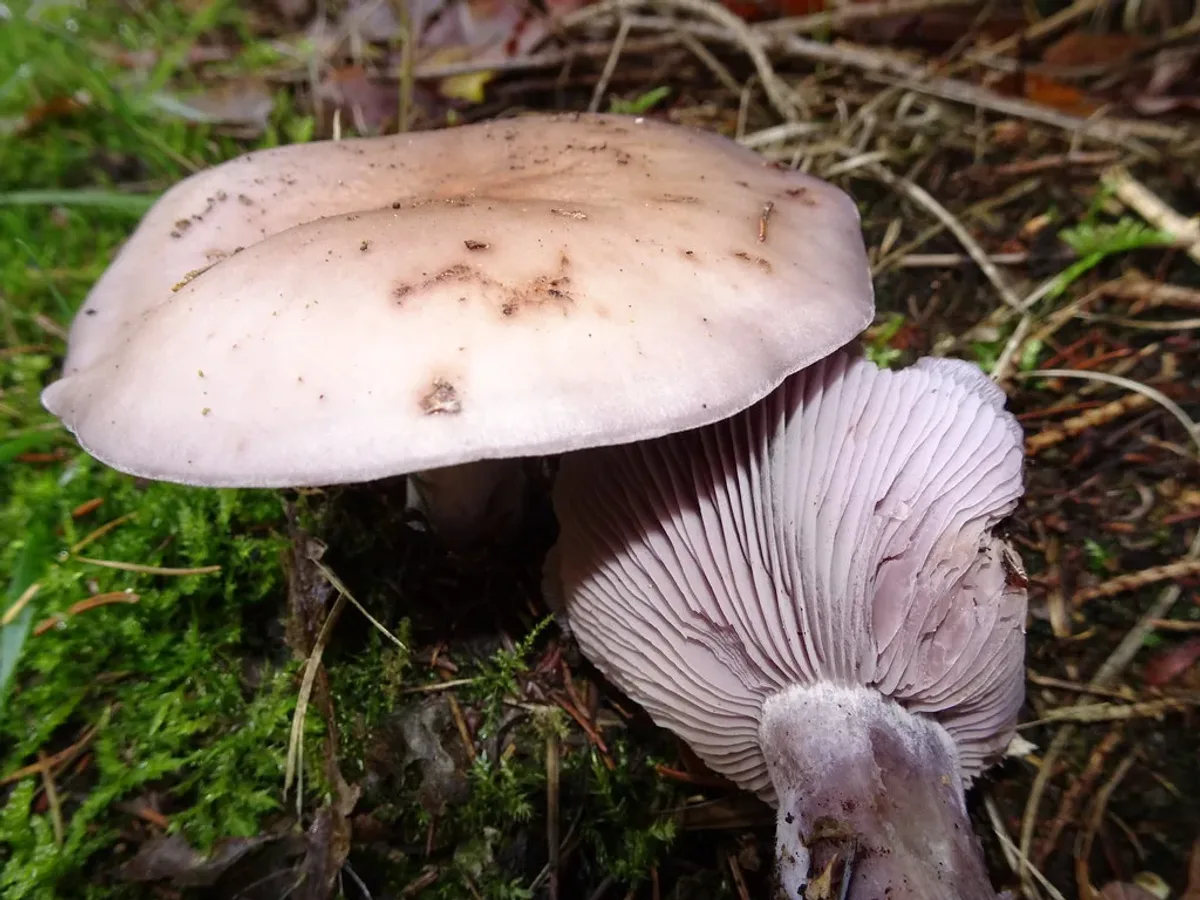 © Ephemeral Impressions (CC BY-SA 2.0)© gailhampshire (CC BY 2.0)© gailhampshire (CC BY 2.0)
Good to eat, once you have identified it with certainty and cooked it through.
Never eat a mushroom you are not 100% sure of - check the look-alikes below, and always cook wild mushrooms.
How to recognise it
Lepista nuda is one of the most visually striking species a forager will encounter in late autumn, and learning to read its colour-shifts is central to confident identification.
Cap
Young fruitbodies push up from the leaf litter with caps tightly convex and margins so firmly inrolled that the gills are almost entirely concealed. At this stage the cap is an intense, saturated violet-lilac, sometimes approaching the blue-purple of a ripe plum.
As the cap expands it flattens, then develops an irregular, wavy, sometimes centrally depressed outline with a margin that remains slightly down-turned even at maturity.
The colour fades centrifugally: the disc warms first to ochre or tawny buff while the rim stays lilac longest, giving a bicoloured appearance in mid-maturity.
Old or dry-weather caps can be almost entirely tan-brown, making colour alone an unreliable identifier. This hygrophanous behaviour is its own recognition feature, since the same cap that looked fully violet in morning rain may look buff and ordinary by afternoon.
Gills
The gills are crowded, broad, and initially run slightly down the stem. They start lavender and fade to pale buff with a pinkish tinge, remaining clearly pinkish relative to the cap even when old.
Stem
The stem is the most reliably violet part of the whole fruitbody: 4-10 cm tall, 1-3 cm thick, fibrous and solid, distinctly swollen at the base, clothed in fine violet fibrils that give it a silky, down-covered texture. Cut stem flesh is lilac-grey to pale buff and firm.
Smell & taste
The smell is characteristic once learned - a pleasant, faintly floury sweetness, sometimes described as frozen orange juice or ripe berry, overlaid with a subtle earthiness.
The spore print is the decisive checkpoint: a genuine pale pink to pinkish-buff, never white, never rust. Print a generous patch on white paper under good light and look at the true colour before committing.
Where & when it grows
Habitat
Lepista nuda is a saprotroph - it digests dead organic matter rather than partnering with living tree roots - and this frees it from the tight habitat specificity of mycorrhizal species.
It colonises the deepest layers of accumulated leaf litter, particularly where beech and oak leaves have been slowly composting for years. It also appears in mixed deciduous and coniferous woodland, overgrown hedgerows, garden borders, municipal parks, and the edges of compost heaps.
The common denominator is a thick, undisturbed organic substrate: the mycelium builds up an extensive network through decomposing leaves and woody humus, and the fruitbodies erupt from the base of this layer.
Fairy rings are a characteristic growth pattern - where the mycelium exhausts the nutrients at its centre and continues expanding outward, it leaves a circle of fruitbodies at the advancing edge. Arcs and full rings in beech leaf litter are one of the most reliable visual cues when scanning a forest floor for blewits.
Partial arcs and loose clusters are equally common where the substrate is less uniform. Individual fruitbodies can appear in isolation but are rarely far from others.
The species is widely distributed across central and western Europe and the UK, and is found in North America (sometimes listed as the same species, sometimes as the closely related Clitocybe nuda). It tolerates a wide range of soil pH and is not restricted to any single geological substrate.
When
Wood blewit occupies an ecological niche almost no other edible species fills. It is genuinely late-season, with peak fruiting in October and November and the capacity to continue well into December where the weather stays mild.
The mycelium does not fruit in summer heat. It waits through the warm months underground and activates only when soil temperatures drop into the 2-12 °C band and autumn rains have wetted the litter layer for at least a week. Cold alone is not enough - the trigger is the combination of cooling and sustained moisture.
Once started, a colony can produce multiple flushes in succession: pick the current crop and return a week later after rain to find fresh fruitbodies in the same spot.
The species is notably frost-tolerant. Light ground frosts seem to have little effect and may in fact synchronise a flush across a large mycelial mat, explaining why a ring that shows no sign of activity one morning can produce dozens of fruitbodies overnight after a cold, wet night.
This cold-tolerance is unusual for a gilled mushroom and makes blewit a season-extending find for experienced foragers who are willing to walk wet woodland in November. In sheltered spots in southern England and the Atlantic coast of France, fruiting occasionally extends to the first weeks of January.
How it grows
The mycelium of Lepista nuda is a saprotrophic decomposer, specialised in breaking down the recalcitrant structural polymers - cellulose, hemicellulose, and lignin - in dead leaves and partially rotted woody debris.
Unlike white-rot fungi that dismember lignin rapidly, the blewit mycelium works steadily through the mixed humus of a deep litter layer. It digests the organic matter and releases mineral nutrients back into the soil - a service that makes it a genuine contributor to forest nutrient cycling.
The mycelial mat can be extensive. A large ring may represent decades of outward growth from a single original colonisation point, expanding at a few centimetres per year.
The familiar fairy-ring structure emerges because the mycelium has exhausted the substrate at its centre and continues growing outward; the fruitbodies appear at the actively colonised margin.
Flush dynamics are responsive to weather. After adequate autumn rain the fruitbodies develop rapidly, emerging in three to five days from first pin to full size. A flush across a large ring can number in the dozens or hundreds of caps.
Between flushes the mycelium persists and waits. A colony in good habitat may produce fruitbodies reliably at the same location for many years, making blewit spots highly repeatable and worth recording in a foraging journal.
Fruiting conditions
Late-season fruiter triggered by cooling soil and autumn rains; often flushes after the first frost in cold-tolerant conditions.
Look-alikes
Two categories of lookalike represent serious hazards, and both must be excluded by means other than colour before eating anything identified as blewit.
The first and more dangerous category is the lilac and violet webcaps, several species in the genus Cortinarius. Cortinarius violaceus is a distinctive deep blue-violet that most experienced foragers would not confuse with blewit, but a range of lilac-tinged webcap species - C. camphoratus, C. traganus, and others - share the general colour palette at certain growth stages.
The critical anatomical differences are the cortina and the spore print. Cortinarius species produce a cobweb-like partial veil (cortina) that stretches between the cap margin and the stem when the fruitbody is young. It may collapse and leave only rust-coloured fibres on the stem upper zone in older specimens, but the rust-brown dust from the maturing spores will be visible on the stem even when the curtain itself is gone.
The spore print of any Cortinarius is a distinctly rusty ochre-brown - never pinkish, never white. Blewit has no cortina at any stage of development, and its spore print is pale pink.
The second category is the pale funnels, especially Clitocybe rivulosa (fool's funnel, sometimes listed as C. dealbata), which can grow in the same habitat and season. These are small to medium, whitish to pale buff or lilac-tinged funnels with crowded, decurrent gills and a white spore print; they contain muscarine and can be dangerous in moderate quantities.
A faded, rain-washed blewit with a raised or funnelling cap centre could superficially resemble a large pale funnel. The white spore print and the absence of any lilac in the flesh cross-section and stem are the diagnostic separators.
Never rely on colour alone; always check:
- stem structure (no cortina traces)
- flesh colour in cross-section
- spore print on both white and dark paper
White poisonous funnel caps with a white spore print (C. dealbata is widely treated as a synonym); pale, faded blewits must not be confused with them. Never rely on colour alone.
Rust-brown spore print and traces of a cobweb-like veil (cortina) over the gills when young, plus rust-coloured dust on the stem. Wood blewit lacks a cortina and has a pink spore print. Always take a spore print.
In the kitchen
Picking & cleaning
Wood blewit responds well to selective, careful picking.
- Choose fruitbodies with caps still somewhat inrolled at the margin and stems that feel solid and firm when gently squeezed - these are the youngest, densest specimens and will hold their texture through cooking. Soft, fully flattened caps with watery flesh are past their best and tend to release too much liquid in the pan.
- Cut or twist cleanly at the base rather than pulling the whole mycelial mat; leaving the stem base undisturbed minimises damage to the colony and helps the site produce subsequent flushes.
- Brush off adhering leaf litter and debris in the field - the crowded gills trap leaves and soil readily. A soft brush or folded cloth works better than a knife for this.
- Carry the harvest in an open basket rather than a sealed bag; the fruitbodies respire actively and will sweat and deteriorate quickly in a plastic bag.
- In the field, take a spore print from one representative specimen - place a cap gill-side-down on white card for 15-30 minutes - and confirm the colour is pale pink before processing any part of the harvest.
At home, the caps can be refrigerated for two to three days. They do not dry particularly well (the texture becomes very tough and the flavour flattens), so fresh use is strongly preferred.
Cooking
Wood blewit has a mild, faintly sweet, mealy flavour with a hint of anise or frozen-berry that it shares with a few other Lepista relatives, and a firm, dense flesh that holds its shape well in the pan provided it is not waterlogged.
The cardinal rule is that it must be cooked thoroughly - at least ten minutes at a proper frying temperature - both to neutralise the raw-toxin issue and because underdone blewit has an unpleasant soapy aftertaste.
- 1Begin in a dry, hot pan to drive off excess moisture before adding fat; the caps release a significant amount of liquid as they heat, and crowding them in cold butter steams rather than sautés them, giving a pallid and slippery result.
- 2Once the liquid has evaporated and the flesh is beginning to colour, add butter or good olive oil and continue cooking until the gills are dry and the edges show a little golden colour.
At this point the flavour is at its best - sweet and earthy without being pungent.
The mealy-sweet character pairs naturally with cream, aged cheese, leek, shallot, and mild white wine; it works beautifully in a cream sauce over fresh pasta, in risotto, folded into a cheese omelette, or alongside veal and pork. The flavour is gentle enough to be overwhelmed by heavy spices - keep the seasoning simple.
It freezes adequately after a full pre-cook sauté, though the texture softens on reheating. As noted, drying is not recommended; dehydrated blewit loses most of its character and becomes very tough.
Good to know
Raw wood blewit is toxic and must never be eaten uncooked. The species contains heat-labile compounds - not yet fully characterised but including some protein-reactive constituents - that cause gastrointestinal upset (nausea, vomiting, diarrhoea) when ingested raw.
Thorough cooking denatures these and renders the mushroom safe for the majority of people.
However, a small minority of individuals react to blewit even when properly cooked, experiencing mild GI symptoms. This appears to be an idiosyncratic sensitivity rather than a universal toxic response, but it means that anyone trying the species for the first time should eat a small portion and wait at least a few hours before eating more.
Do not serve it to people with known mushroom sensitivities as a first encounter.
The species has a long history of commercial sale and cultivation in France, the Netherlands, and other parts of continental Europe, which attests to its safety when cooked, but this should not be confused with it being safe raw.
The lookalike hazard (Cortinarius spp. in particular) is a separate, more serious concern. Some webcap toxins cause severe, delayed kidney damage (orellanine syndrome, with symptoms appearing days to weeks after ingestion), and there is no antidote.
Rigorous identification - spore print, cortina check, stem cross-section colour - is non-negotiable every single time, not just the first.
A reference guide - never an edibility guarantee. When in doubt, leave it out.