Slender dapperling
Lepiota subgracilissyn. Lepiota gracilenta var. subgracilis
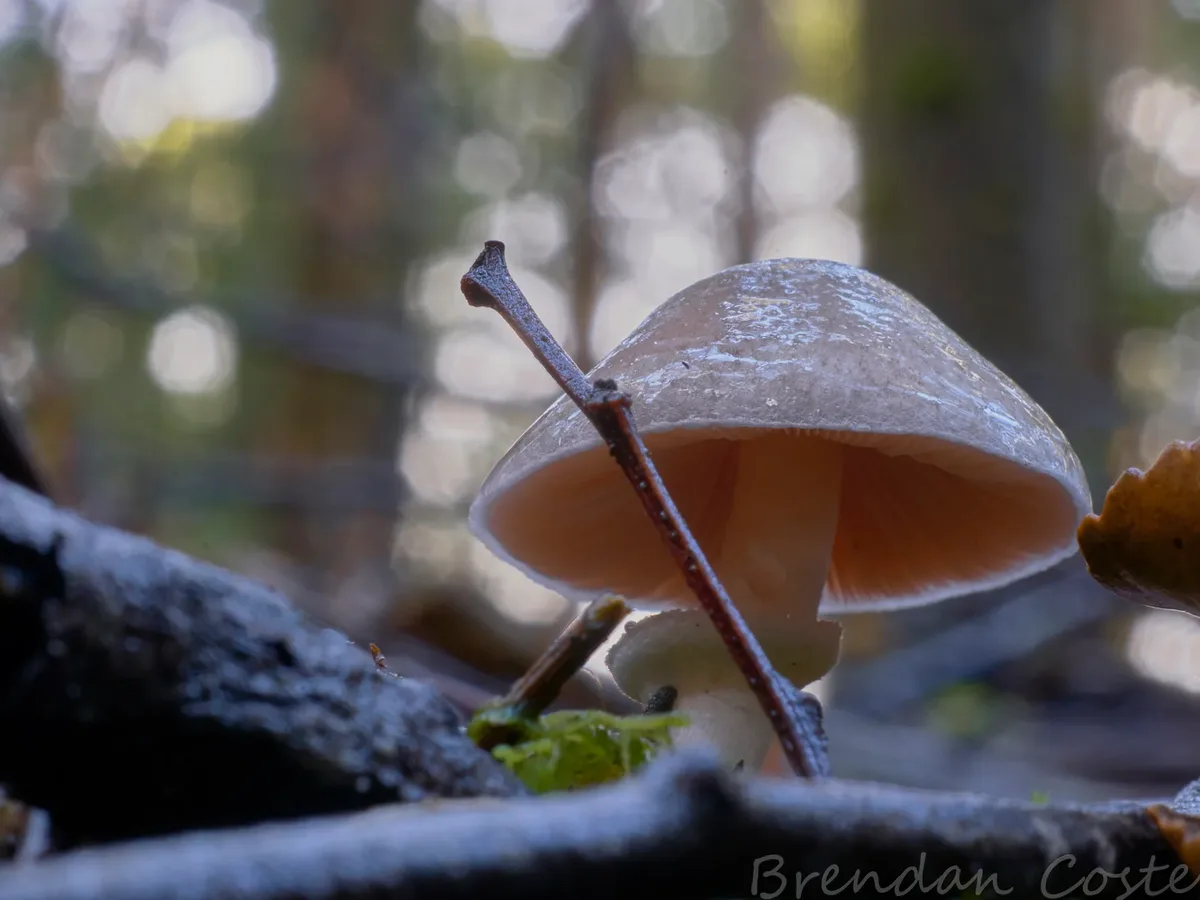 Atlas of Living Australia (CC0)
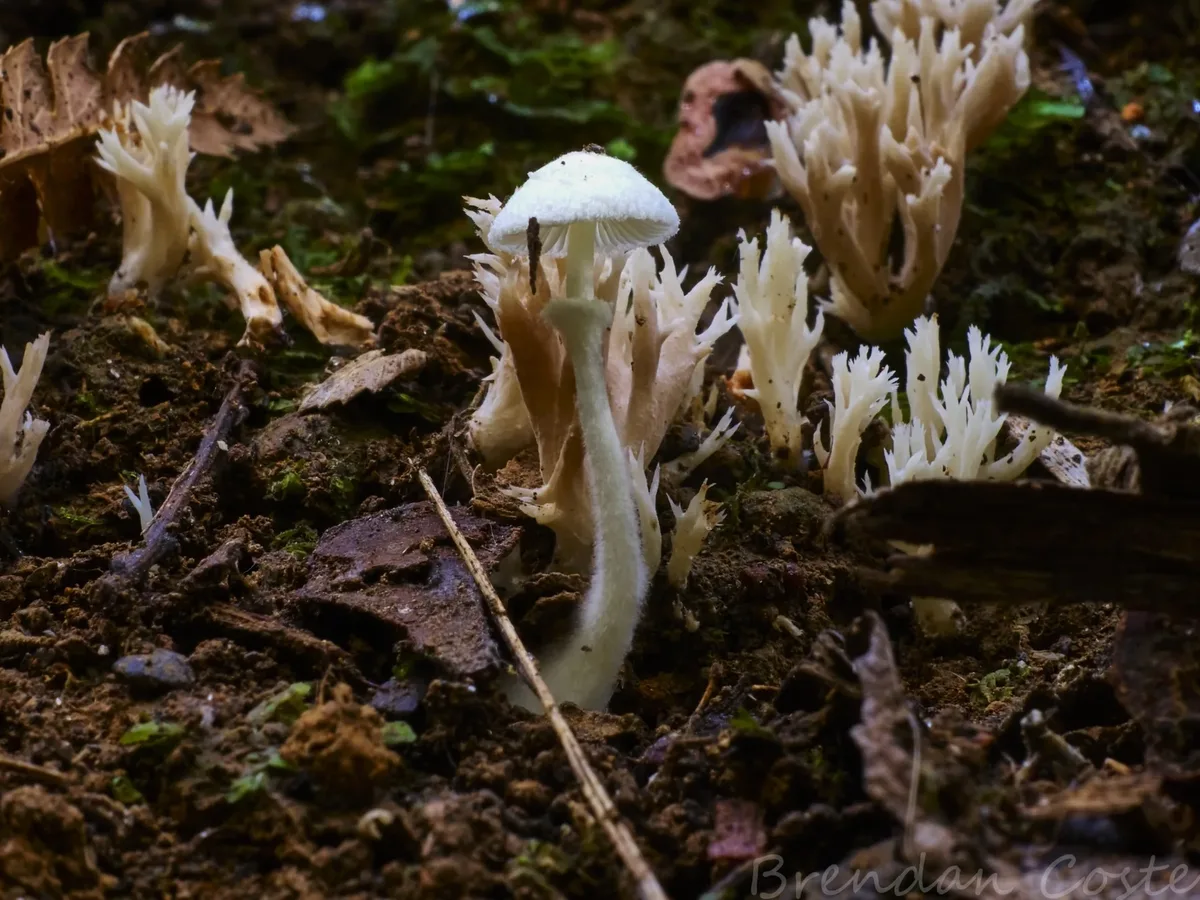 Atlas of Living Australia (CC0)
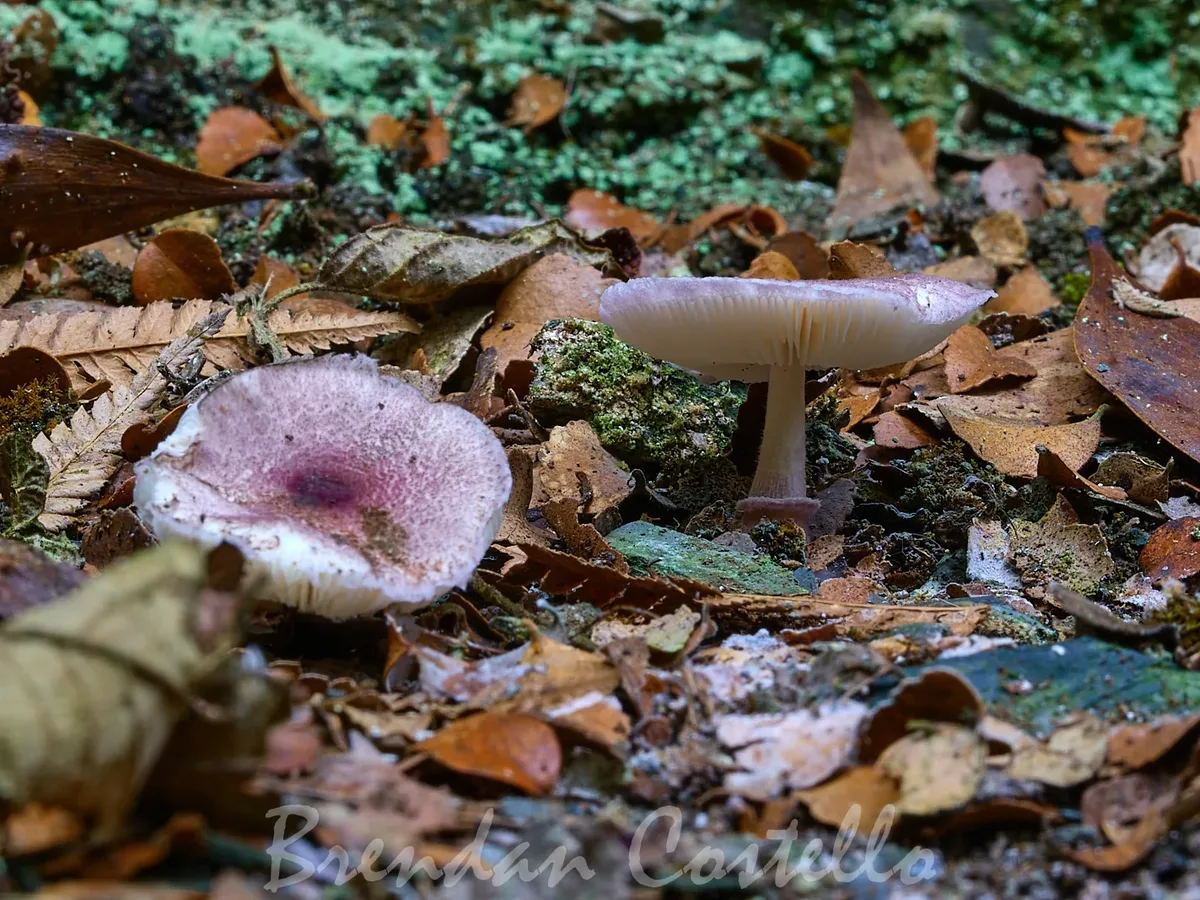 Atlas of Living Australia (CC0)Atlas of Living Australia (CC0)Atlas of Living Australia (CC0)
Toxic - and the most serious cases can be fatal. Never eat it, and wash your hands after handling.
Never eat a mushroom you are not 100% sure of - check the look-alikes below, and always cook wild mushrooms.
How to recognise it
A small, quietly elegant dapperling with a 2-4 cm cap that starts convex-bell-shaped and broadens with age to a gently domed form with a low central boss.
The cap surface is whitish at the margin, shading to pale ochre-brown at the centre, and overlaid with fine granular-fibrous scales of buff-brown - the classic Lepiota pattern of darker veil fragments arranged against a lighter background.
The key field characters are:
- persistently white, crowded, free gills (which never pink or brown)
- a notably slender whitish stem with a low, fragile ring that often falls away early
- white flesh that stays white when cut
The overall impression is of a daintier, more gracile version of the general small Lepiota form. Spore print white.
Without chemical tests or microscopy, Lepiota subgracilis is not safely distinguishable from deadly congeners in the field.
Why it's dangerous
The danger from Lepiota subgracilis is threefold:
- 1It belongs to a dangerous genus.
- 2It closely resembles confirmed lethal species.
- 3It is rare enough that it may be unfamiliar even to experienced foragers.
The principle that all small white-gilled Lepiota species must be avoided is the only safe policy.
If the species does contain amatoxins at concentrations comparable to its relatives, as few as one or two small fruitbodies may represent a lethal dose for an adult. Children are at significantly greater risk due to lower body mass.
Any suspected ingestion demands immediate emergency hospital attendance without waiting for symptoms.
Toxin
Lepiota subgracilis is presumed to contain amatoxins (alpha-amanitin, beta-amanitin) on the basis of its membership in the section of small Lepiota species in which amatoxins are phylogenetically widespread and have been chemically confirmed in multiple closely related taxa.
Direct analytical data for this specific species is sparse due to its rarity, but the precautionary identification of risk is consistent with established mycotoxicological guidance for the genus.
Alpha-amanitin acts by inhibiting RNA polymerase II in hepatocytes and kidney cells, causing progressive and often irreversible cell death. There is no known antidote.
Symptoms
If amatoxins are involved (the most likely scenario), poisoning follows the characteristic three-phase course of amatoxin syndrome:
- 1Phase 1 (latent): no symptoms for 6-24 hours after ingestion; the toxin is absorbed and already acting on target organs during this silent window.
- 2Phase 2 (gastrointestinal): sudden onset of severe watery diarrhoea, vomiting, abdominal cramps, and nausea lasting 24-48 hours, followed by apparent symptomatic improvement.
- 3Phase 3 (hepatorenal): 3-5 days after ingestion, progressive liver and kidney failure develops - jaundice, coagulopathy, hepatic encephalopathy, and renal failure.
Without aggressive medical intervention including possible liver transplantation, the outcome can be fatal 6-16 days after ingestion.
Staying safe
Every small Lepiota with white or cream gills must be treated as potentially lethal, without exception.
This rule exists because the genus contains multiple deadly species that are indistinguishable from one another in field conditions - including with a hand lens - and the consequence of misidentification is fatal amatoxin poisoning.
The amatoxins present in lethal Lepiota species (alpha-amanitin, beta-amanitin) are thermostable. Cooking, boiling, drying, dehydrating, and other domestic preparation methods do not degrade or neutralise these toxins.
The popular assumption that thorough cooking makes any mushroom safe is entirely and dangerously false for amatoxin-bearing species.
Lepiota subgracilis is a rare species with limited direct toxicological documentation, but it belongs to a clade of closely related small Lepiotas in which amatoxins are widespread, and it is morphologically inseparable from confirmed lethal species in field conditions.
Any forager who has collected or consumed what they believe to be L. subgracilis has effectively consumed an unverified small white-gilled Lepiota - which must be treated as potentially lethal.
If you have eaten, or suspect you have eaten, any small Lepiota: seek emergency medical treatment immediately.
- In Europe call 112
- In the UK call 999
- In North America call 911
Go to the nearest hospital emergency department. Do not wait for symptoms.
The latent phase of amatoxin poisoning lasts 6-24 hours - the patient feels completely normal while the toxin is already causing progressive, irreversible liver damage.
Attempting to confirm identification or waiting to see whether symptoms develop wastes the critical treatment window. If possible, bring a sample or photograph of the mushroom. Also contact a poisons centre in parallel.
Where & when it grows
Habitat
Found at the margins of deciduous and mixed woodland - the transitional strip where trees give way to open ground. It is a saprotroph, quietly recycling organic matter in the soil without any mycorrhizal partnership.
Characteristic haunts include:
- hedge banks with old oak or beech behind them
- the shaded edges of forest paths
- mature urban parks near broadleaved trees
- scrubby woodland margins on calcareous soils
The affinity for tree edges and dappled shade sets it somewhat apart from the more grassland-focused L. subincarnata and L. brunneoincarnata, though habitat overlap with those dangerous species does occur.
Across central-western Europe it is considered a relatively rare find.
When
Late summer to early autumn. First fruitbodies typically appear in July or August when warm, humid conditions follow adequate rain; the main flush runs through August and September, with occasional records into October.
Fruiting ceases with the onset of regular night frosts. This is not an early-spring or winter-active species.
How it grows
Scattered singly or in small, loose groups - not clustered. Individual fruitbodies rise at intervals in response to triggering rain and suitable soil temperatures.
Their small size and slender habit make them easy to walk past; the pale caps can disappear almost entirely among dry leaf litter at woodland margins until you are looking directly down at them.
Fruiting conditions
Late-summer saprotroph of woodland margins. Fruiting follows adequate rain when soil temperatures are in the 12-22 °C range. Peak occurrence is August to September across central-western Europe. Fruiting ceases with first hard frosts.
Look-alikes
Lepiota subgracilis is morphologically very close to several other small Lepiota species, multiple of which are confirmed as deadly.
- Lepiota brunneoincarnata (deadly dapperling) and Lepiota subincarnata (fatal dapperling): the most dangerous confusions - both share the same small size, pale cap with brownish scales, white gills, and slender stem. L. brunneoincarnata tends toward a more distinctly brownish-pink ground colour on the cap and slightly broader scales, while L. subincarnata has a more decidedly pinkish-flesh tone, but these distinctions are subtle and unreliable in field conditions.
- Lepiota castanea (chestnut dapperling): darker, more distinctly chestnut-coloured scales.
- Lepiota helveola: a distinctly honey-yellow to reddish-ochre cap tone.
- Lepiota cristata (stinking dapperling): sharper, redder scales and a distinctive unpleasant rubbery-garlic smell, and is also toxic though less certainly lethal.
None of these distinctions provides reliable enough separation for safe consumption decisions - the entire group of small white-gilled Lepiota must be treated as lethal.
Lepiota castanea has distinctly darker, chestnut-brown to cinnamon scales that are more sharply defined against a paler cream-white background. The colour contrast is stronger than in L. subgracilis. Also a confirmed amatoxin-containing species, lethal and not for consumption under any circumstances.
The most likely confusion species and equally lethal. Lepiota brunneoincarnata has a more distinctly brownish-pink ground colour on the cap, with slightly broader and more clearly defined pinkish-brown scales. In practice, the two are not reliably separable in field conditions and require microscopy or chemical analysis for confident determination. Treat any encounter as equally dangerous.
Lepiota subincarnata shares nearly identical size and stature; its cap ground colour is more distinctly flesh-pink to pinkish-buff. The scales are pinkish-brown rather than ochre-buff. Also confirmed to contain amatoxins at high concentrations and is responsible for multiple fatalities in Western Europe. Not safely distinguishable from L. subgracilis in field conditions.
Young Macrolepiota mastoidea before cap expansion can superficially resemble a small scaly-capped mushroom, but the stem of Macrolepiota is sturdier and carries a well-developed sliding double ring, and the overall fruitbody grows considerably larger. The stem lacks the even fibrous covering of small Lepiota and shows a more clearly formed snakeskin-like pattern in many individuals.
Lepiota cristata has sharper, more prominent reddish-brown to brick-red scales and a strongly unpleasant, distinctly rubbery or garlic-like smell that is absent or faint in L. subgracilis. Although not confirmed as lethal in the same way as the amatoxin species, L. cristata is toxic and not edible; it is also not a reliable comparison - neither species should be collected.
A reference guide - never an edibility guarantee. When in doubt, leave it out.