Shield dapperling
Lepiota clypeolariasyn. Agaricus clypeolarius, Lepiota clypeolaria (Bull.) P.Kumm., Lepiota eyrei, Lepiota fulvella
 Сергей (CC0)
 © Anastasiia Samokhvalova (CC BY)
 © Anastasiia Samokhvalova (CC BY)
 © Anastasiia Samokhvalova (CC BY)
 Sinaloa Silvestre (CC0)
 © Екатерина Гущина (CC BY)
 © Екатерина Гущина (CC BY)
 © Екатерина Гущина (CC BY)
 © Екатерина Гущина (CC BY)Сергей (CC0)© Anastasiia Samokhvalova (CC BY)
Edible only with the right preparation - or safe for some people but not others. Learn the caveats first.
Never eat a mushroom you are not 100% sure of - check the look-alikes below, and always cook wild mushrooms.
How to recognise it
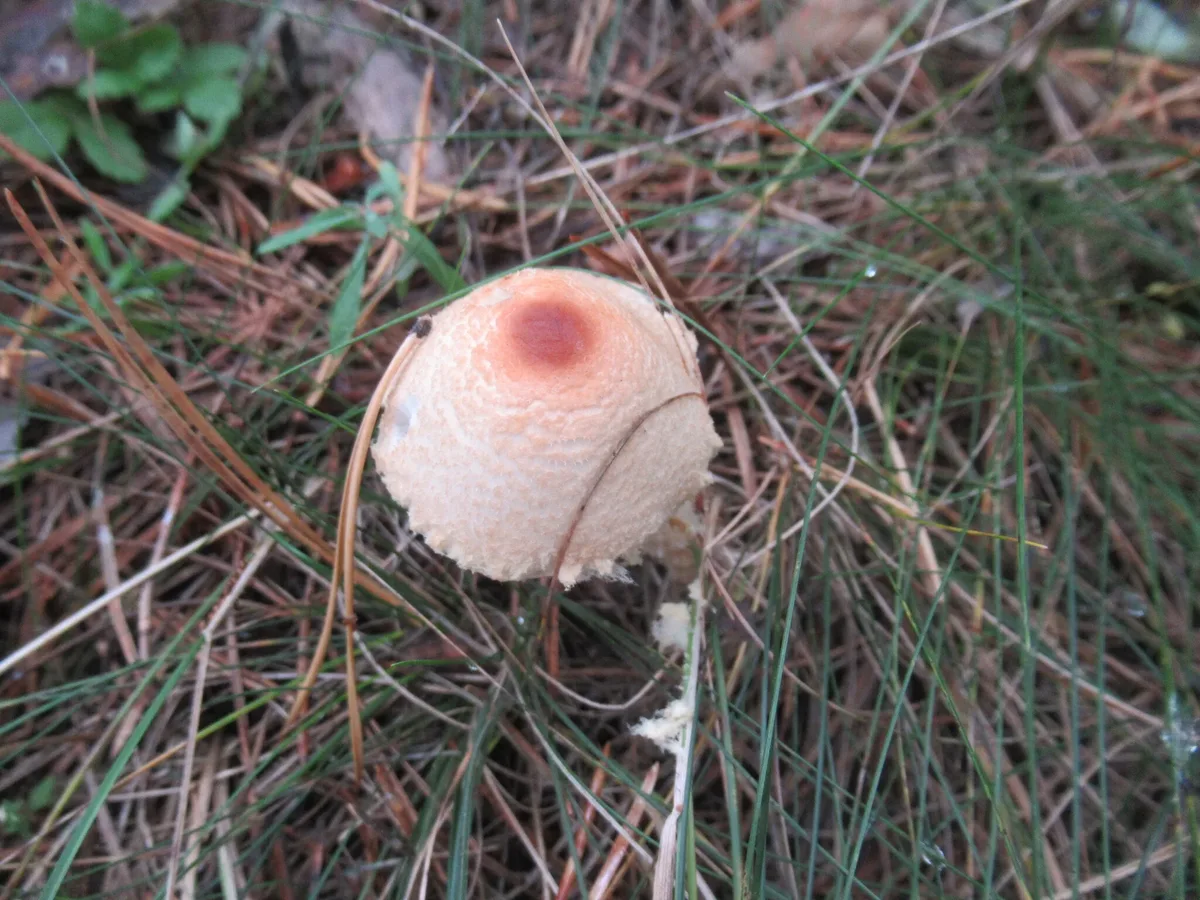
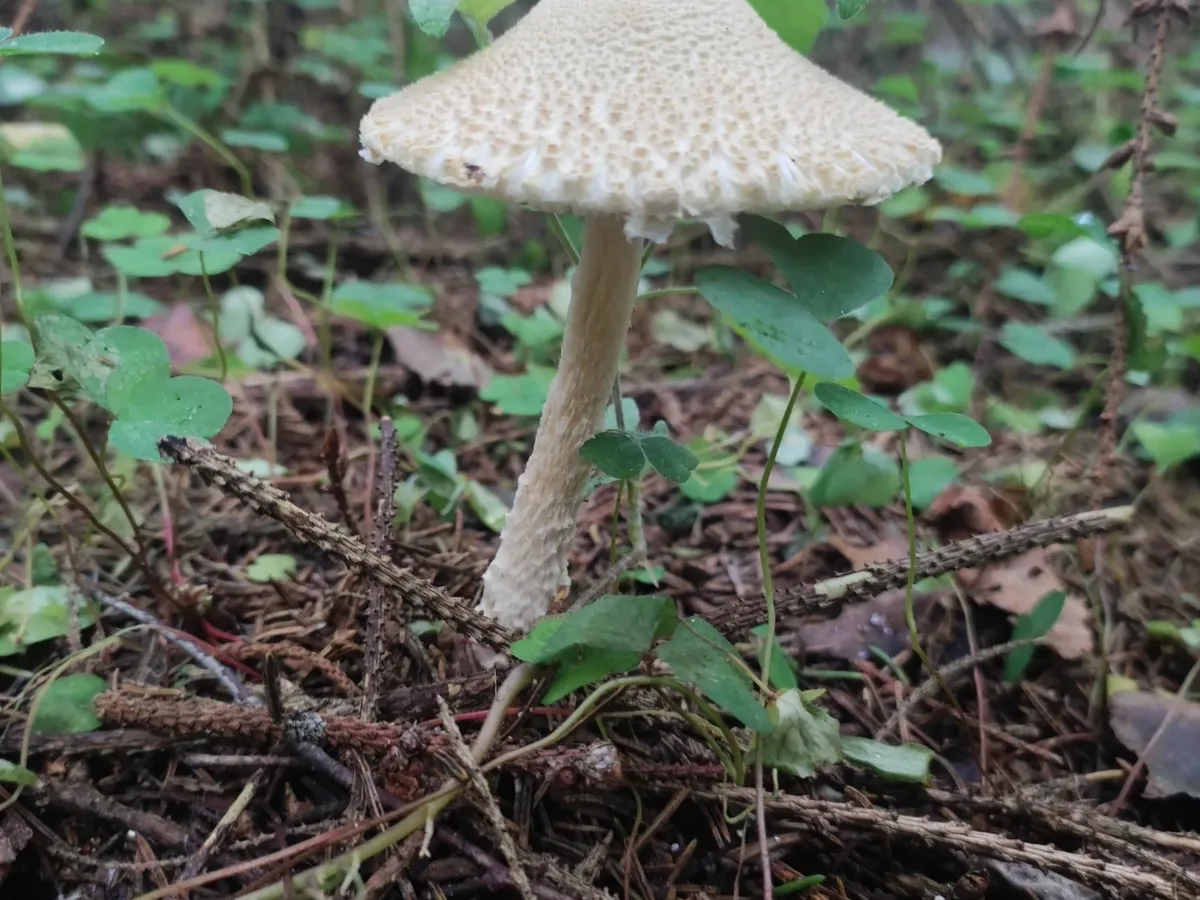
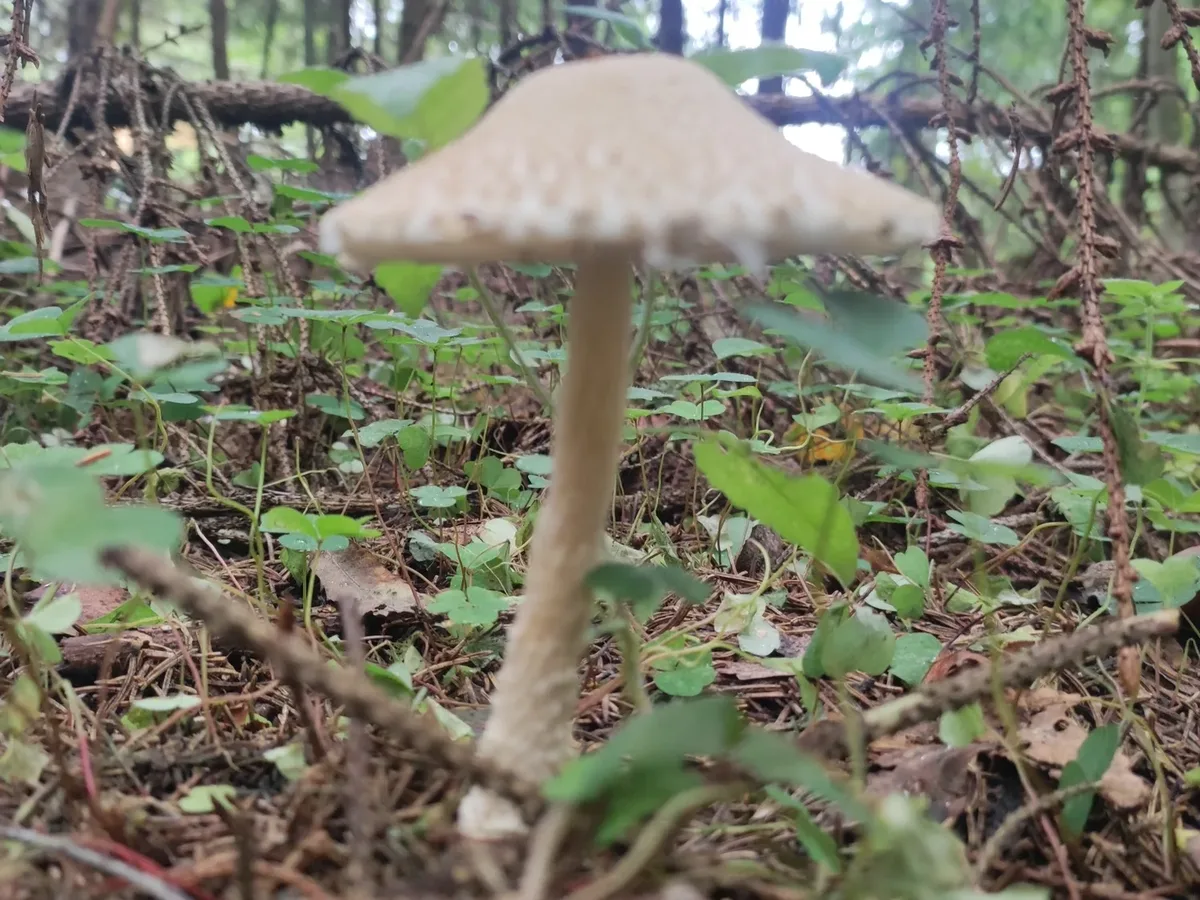
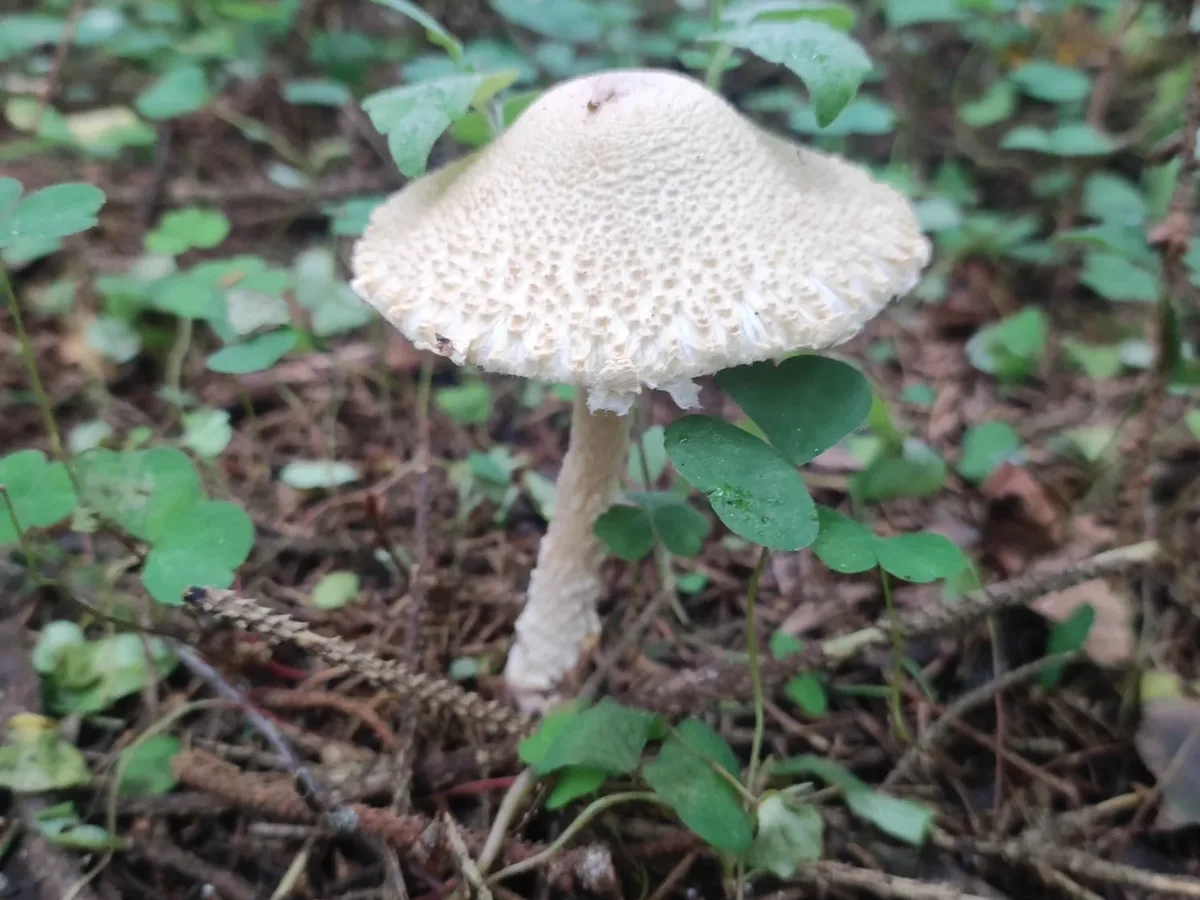
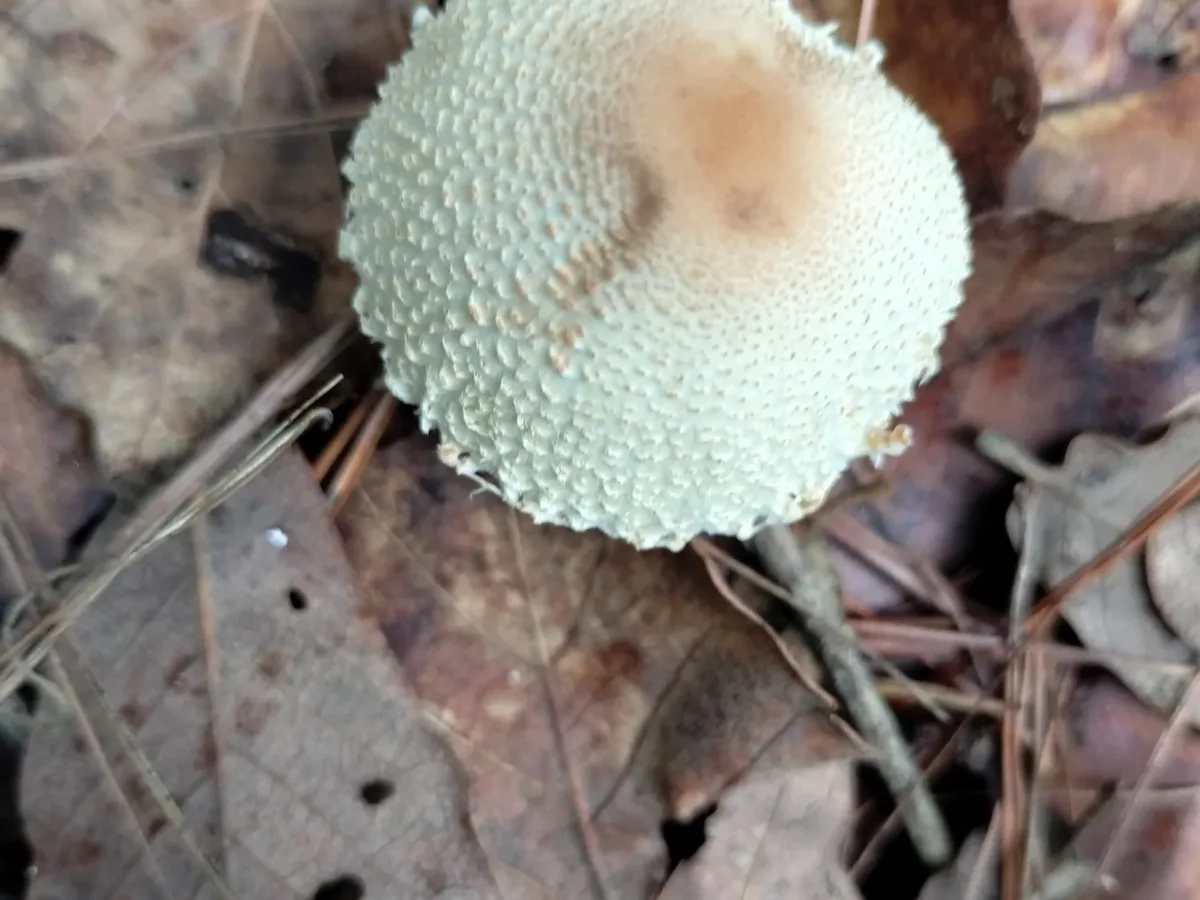
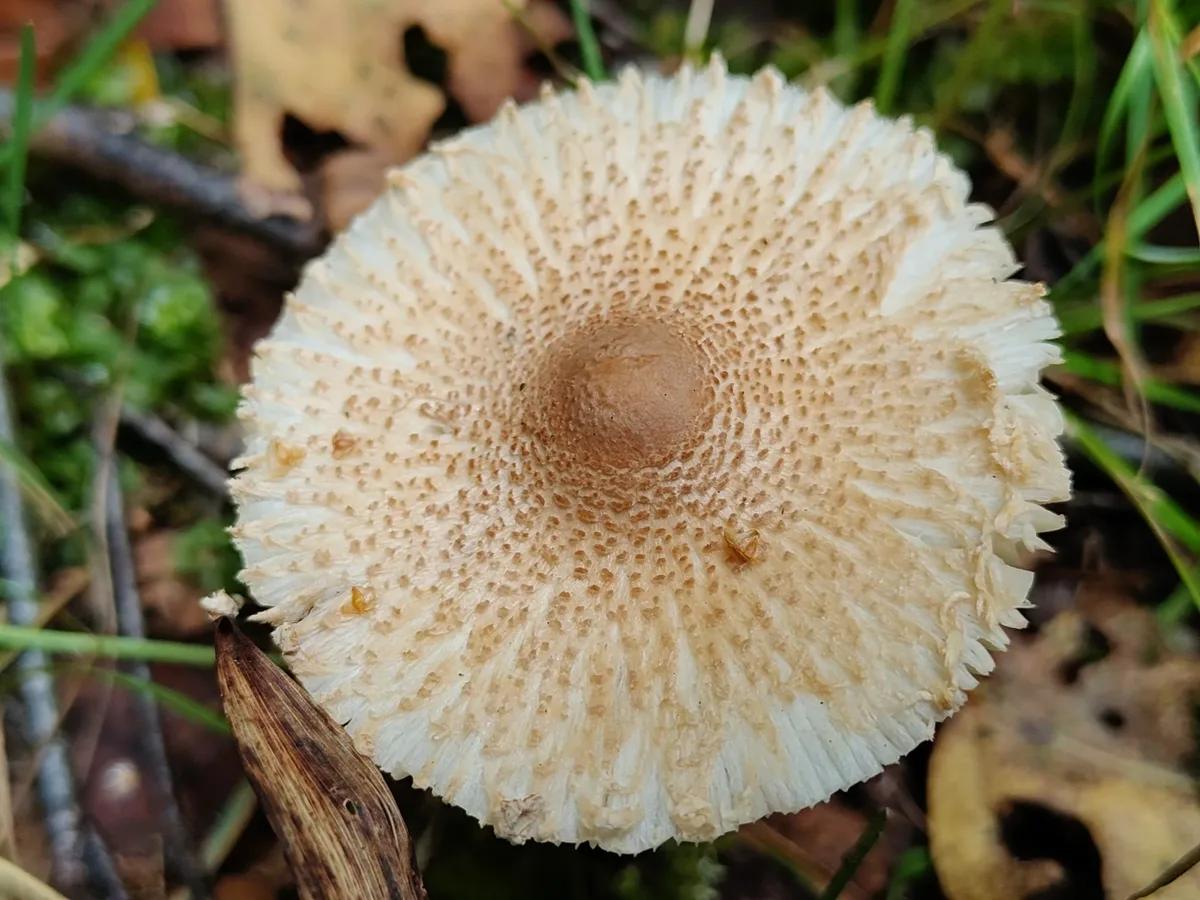
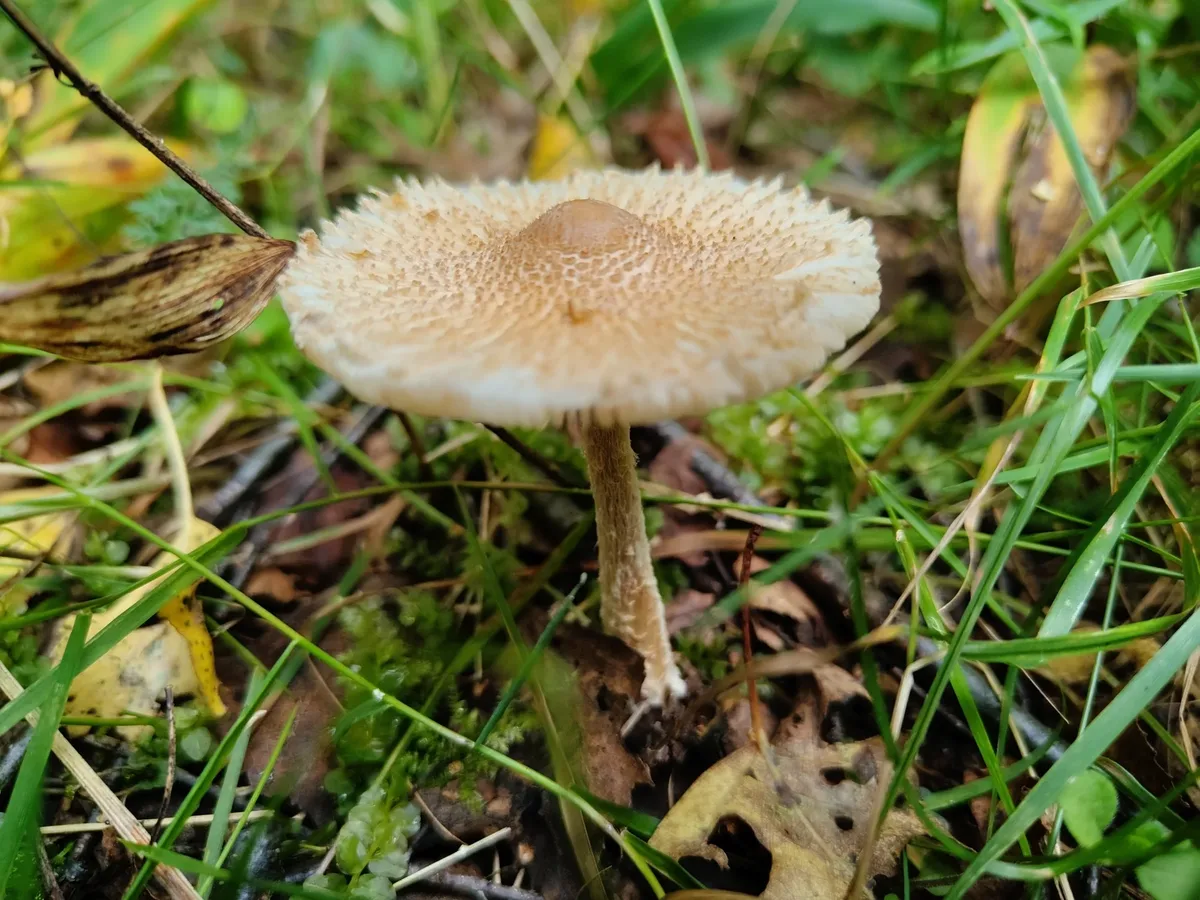
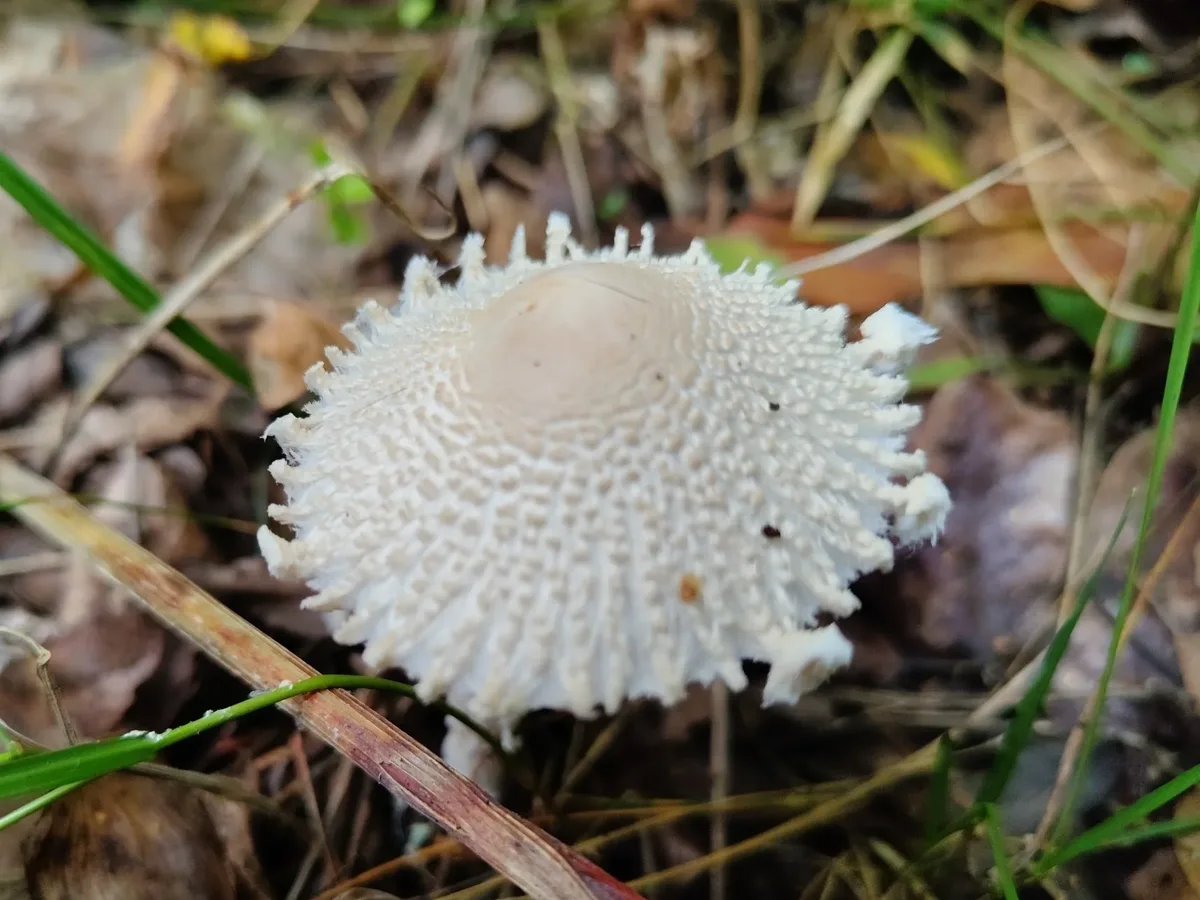
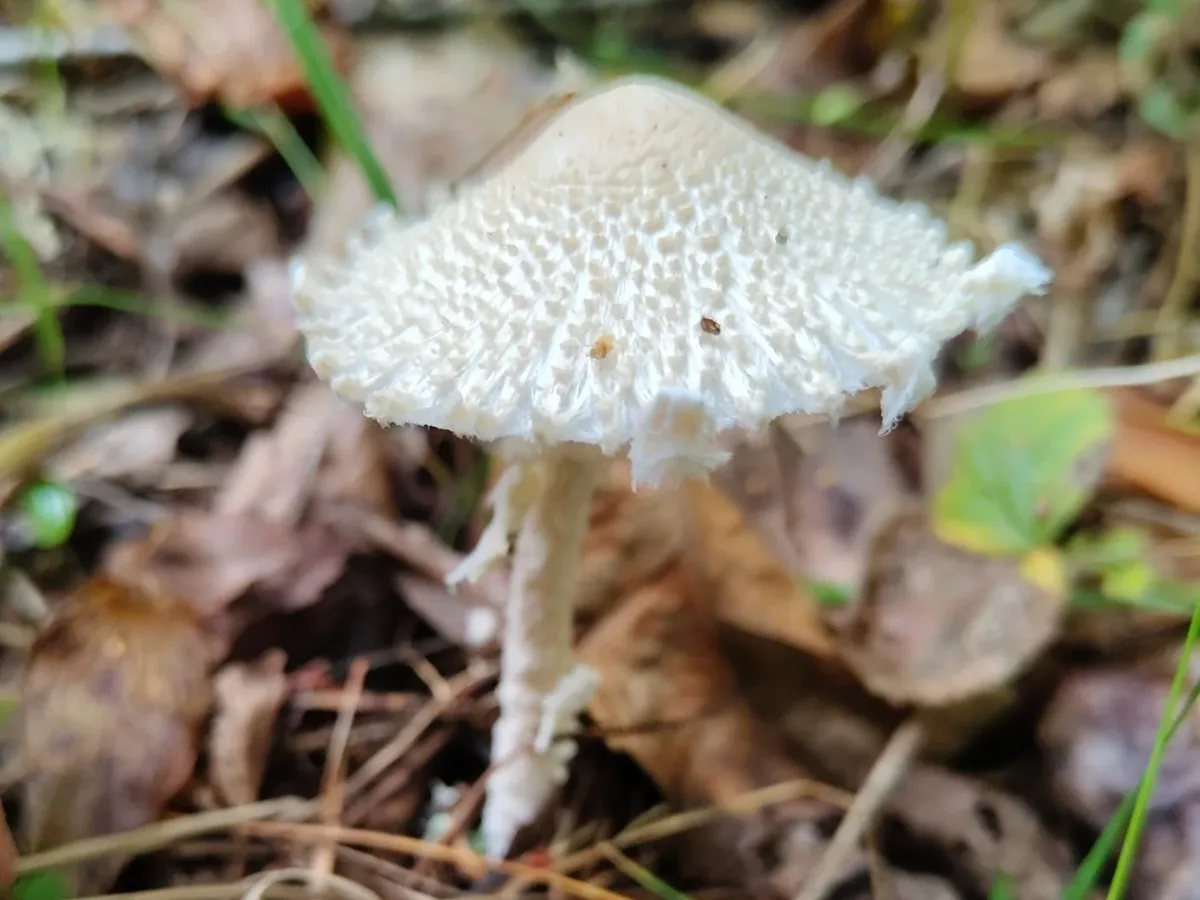
Lepiota clypeolaria is recognisable by the combination of a pale cream-to-ochre cap (3-8 cm) with brown fibrous scales arranged in concentric zones outward from a darker central disc, free white gills, a white spore print, and - crucially - a lower stem densely clothed in shaggy, woolly, cottony veil remnants.
Cap
The cap expands from bell-shaped to broadly convex with a persistent rounded umbo. The scales are flatter and less crisply defined than in L. cristata.
Gills
Free white gills. Spore print white.
Stem
The ring in the upper third of the stem is membranous and often ragged or torn by maturity.
The most reliable field character is the woolly, floccose lower stem: below the ring the stem looks as if it has been wrapped in loosely pulled cotton fibre or shredded gauze, in shades of cream to pale ochre. Above the ring the stem is smooth and white.
Flesh
The flesh is thin and white, unchanging when cut.
Smell & taste
The smell is mild - at most faintly radish-like - and clearly lacks the sharp chemical or rubber odour of Lepiota cristata.
Why it's dangerous
While Lepiota clypeolaria itself has not been reliably linked to fatal poisonings, the danger of eating any wild mushroom assumed to be L. clypeolaria is real:
- it can be confused with confirmed lethal species
- its own toxicity is incompletely characterised
- the margin for error with any Lepiota in the 3-10 cm cap-diameter range is essentially zero
Children, elderly individuals, and people with liver or kidney conditions face the highest risk.
Always consult a trained mycologist or poison control centre if ingestion is suspected.
Toxin
The principal documented toxic effects are caused by gastrointestinal irritants: uncharacterised heat-labile or heat-stable compounds that inflame the gastrointestinal mucosa.
Some analytical studies have reported the possible presence of amatoxin-related compounds in trace quantities, but this is not universally confirmed across populations and geographic ranges.
The toxin profile of L. clypeolaria is therefore treated conservatively as gastrointestinal irritant with an unresolved amatoxin question. This is in contrast to L. subincarnata and L. brunneoincarnata, where amatoxin content is thoroughly confirmed.
Symptoms
Reported poisonings have been characterised by gastrointestinal illness with onset typically within 30 minutes to 4 hours: nausea, vomiting, abdominal cramping, and diarrhoea. Most recorded cases resolve within 24 hours with supportive care.
However, manage a case as a potential amatoxin poisoning until proven otherwise if it involves any of:
- delayed onset (more than 6 hours to first symptoms)
- a prolonged gastrointestinal phase
- signs of liver involvement (jaundice, dark urine, raised transaminases)
This is because confusion with the confirmed deadly dapperlings cannot be excluded without careful specimen analysis.
Staying safe
Lepiota clypeolaria is listed as poisonous by major European mycological references and must not be eaten.
The documented toxic effects are primarily gastrointestinal - nausea, vomiting, cramps, and diarrhoea - typically appearing within 30 minutes to 4 hours of ingestion, consistent with gastrointestinal irritant-type poisoning.
Some analytical literature has suggested trace levels of amatoxins may be present in certain specimens or populations, though the evidence is inconsistent and amatoxin-type delayed liver failure has not been reliably attributed to L. clypeolaria in the clinical literature.
For this reason, standard conservative toxicological practice treats it as potentially more dangerous than a 'pure' gastrointestinal irritant, and it should be assumed that no specimen is safe to eat.
The most serious safety concern is not L. clypeolaria itself but the risk of misidentifying one of the definitely deadly amatoxin-bearing dapperlings (L. subincarnata, L. brunneoincarnata) as L. clypeolaria. The species are genuinely similar, and field conditions (rain, age, partial damage) further reduce reliability.
If any ingestion of L. clypeolaria or a similar dapperling is suspected, seek medical advice. If symptoms of delayed liver involvement appear (jaundice, elevated liver enzymes, prolonged gastrointestinal illness beyond 24 hours), treat this as a potential amatoxin emergency.
Where & when it grows
Habitat
A woodland saprotroph, most at home in the interior or margins of mature broadleaf and mixed woodland with well-developed humus layers, particularly under beech, oak, and hornbeam.
Unlike some smaller Lepiota species, L. clypeolaria rarely ventures far into open grassland or heavily disturbed urban sites. It is a species of semi-natural woodland, shaded forest paths, and parkland with mature trees.
It grows singly or in small scattered groups on or near buried leaf litter and woody debris, independent of any specific host tree.
When
Fruits in temperate Europe from July through November, with the main season in August-October. Fruiting is triggered by warm, humid conditions with adequate soil moisture.
In practice, the bulk of sightings occur after late-summer or early-autumn rain events when night temperatures have begun to cool. Fruitbodies are fragile and short-lived.
How it grows
Saprotrophic, growing singly or in small scattered groups on humus-rich woodland soil. Does not cluster on wood or form mycorrhizal associations.
Fruitbodies are fragile:
- the ring tears readily
- the cap scales detach
- the woolly stem material loosens
As a result, specimens found in the field are often partially damaged by rain or wind by the time they are noticed.
Fruiting conditions
A warm-season woodland humus saprotroph. Flushes after adequate rain once soil is warm (at least 10 °C), typically in late summer and autumn. Peak productivity follows the first significant rain events of August-September after any summer dry spell, with soil temperatures in the 12-18 °C range being optimal. Lag from rainfall to visible fruitbodies is approximately 5-12 days.
Look-alikes
The most dangerous confusion species are the amatoxin-bearing small dapperlings that occur in the same woodland habitat.
- 1Lepiota subincarnata (Fatal dapperling) is the gravest risk: it is similar in size, has pale ochre-buff to pinkish-buff cap scales, free white gills, and a white spore print, but its lower stem is less obviously woolly-shaggy and it has a more vinaceous or pinkish tone to the cap disc and scales. It contains high concentrations of amatoxins and has caused fatal poisonings across Europe.
- 2Lepiota brunneoincarnata (Deadly dapperling) is somewhat smaller (cap 2-5 cm), has a pinkish-brown cap with a more distinct pinkish-flesh background colouration, and a less developed woolly stem vestiture. Also deadly with confirmed amatoxins.
- 3Lepiota cristata (Stinking dapperling) is smaller (cap 2-5 cm), has more neatly concentric bright reddish-brown cap scales, and has a very distinctive strong, sharp rubber or coal-tar smell absent in L. clypeolaria. It is poisonous and possibly contains low levels of amatoxins but is less often lethal than L. subincarnata.
- 4Lepiota castanea (Chestnut dapperling) has darker, chestnut-rusty-brown scales on a white background, a smaller cap, and is also deadly.
- 5Macrolepiota procera (Parasol mushroom, edible) is dramatically larger when mature (cap 10-30 cm), has a distinctive double sliding ring and snakeskin-patterned stem banding; young buttons should never be picked at the small-cap stage.
The key distinction from L. clypeolaria that can be observed in the field is the woolly-cottony stem below the ring, combined with the mild smell - but neither feature alone overrides the general precautionary rule against eating any unknown small-to-medium dapperling.
Lepiota castanea has small (2-4 cm cap), densely packed chestnut-brown to dark rusty-brown scales on a white background - a colder, darker appearance than L. clypeolaria's warm ochre tones. Its stem may have reddish-brown scale remnants below the ring, but lacks the distinctly cottony-woolly vestiture of L. clypeolaria. It contains amatoxins and is deadly.
Lepiota brunneoincarnata is typically smaller (cap 2-5 cm), with a pinkish-brown to brownish-flesh cap background and coarser, more felty scales. It is primarily a grassland and garden species rather than a deep-woodland one, but habitat overlap occurs at woodland margins and in parkland. The stem below the ring is less conspicuously woolly than in L. clypeolaria. It is deadly due to high amatoxin content and is the Lepiota species most frequently implicated in European mushroom fatalities.
Lepiota subincarnata is the most dangerous confusion species: it is a similar size, shares the woodland habitat and season, and has pale ochre-pinkish cap scales and free white gills. Its lower stem is less distinctly woolly-shaggy, and the cap background often has a warmer pinkish or vinaceous tint. It contains confirmed high concentrations of amatoxins and has caused numerous fatal poisonings in Europe. Reliable field separation from L. clypeolaria requires careful comparison of stem vestiture and cap colouration in fresh material - in any ambiguous case, treat the specimen as deadly.
Young Macrolepiota procera buttons have a scaly cap and could theoretically be confused with L. clypeolaria at a small stage, but at any stage of development Macrolepiota has a stem with distinctive zigzag snakeskin-brown banding and a double-edged ring that slides freely on the stem - features never seen in Lepiota. Do not pick any small-capped (under 10 cm) putative 'parasol' from woodland edges without confirming these features.
Lepiota cristata is smaller (cap 2-5 cm), has more sharply defined reddish-brown concentric scale rings on a white background, and most importantly has a very strong, sharp, unpleasant rubber or coal-tar smell absent in L. clypeolaria. The stem below the ring in L. cristata may be finely fibrous but lacks the dense cottony-woolly vestiture of L. clypeolaria. Both are poisonous; L. cristata possibly contains amatoxins at low levels and should not be eaten.
A reference guide - never an edibility guarantee. When in doubt, leave it out.