Giant funnel Lentinus
Lentinus giganteussyn. Panus giganteus, Lentinus giganteus Berk., Macrocybe gigantea
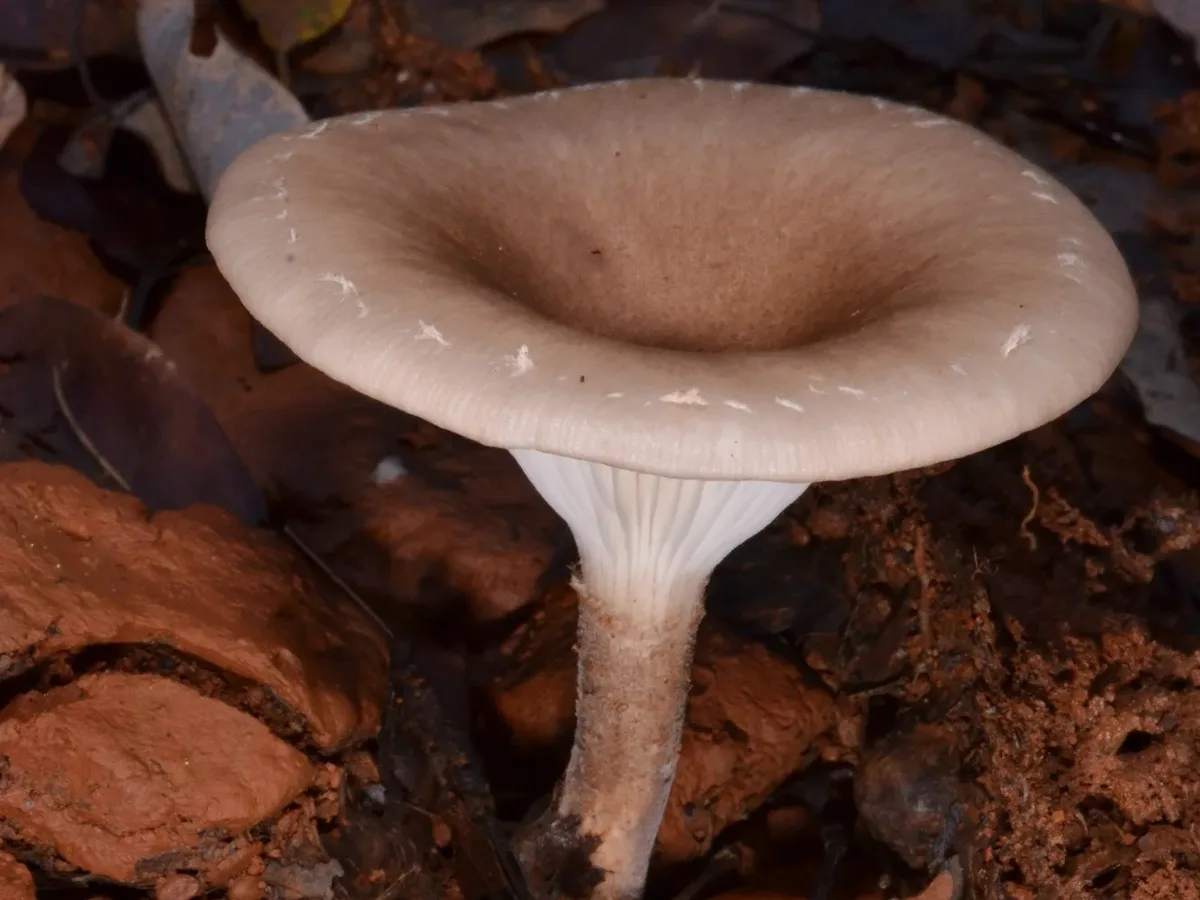 © Eugene Popov (CC BY)
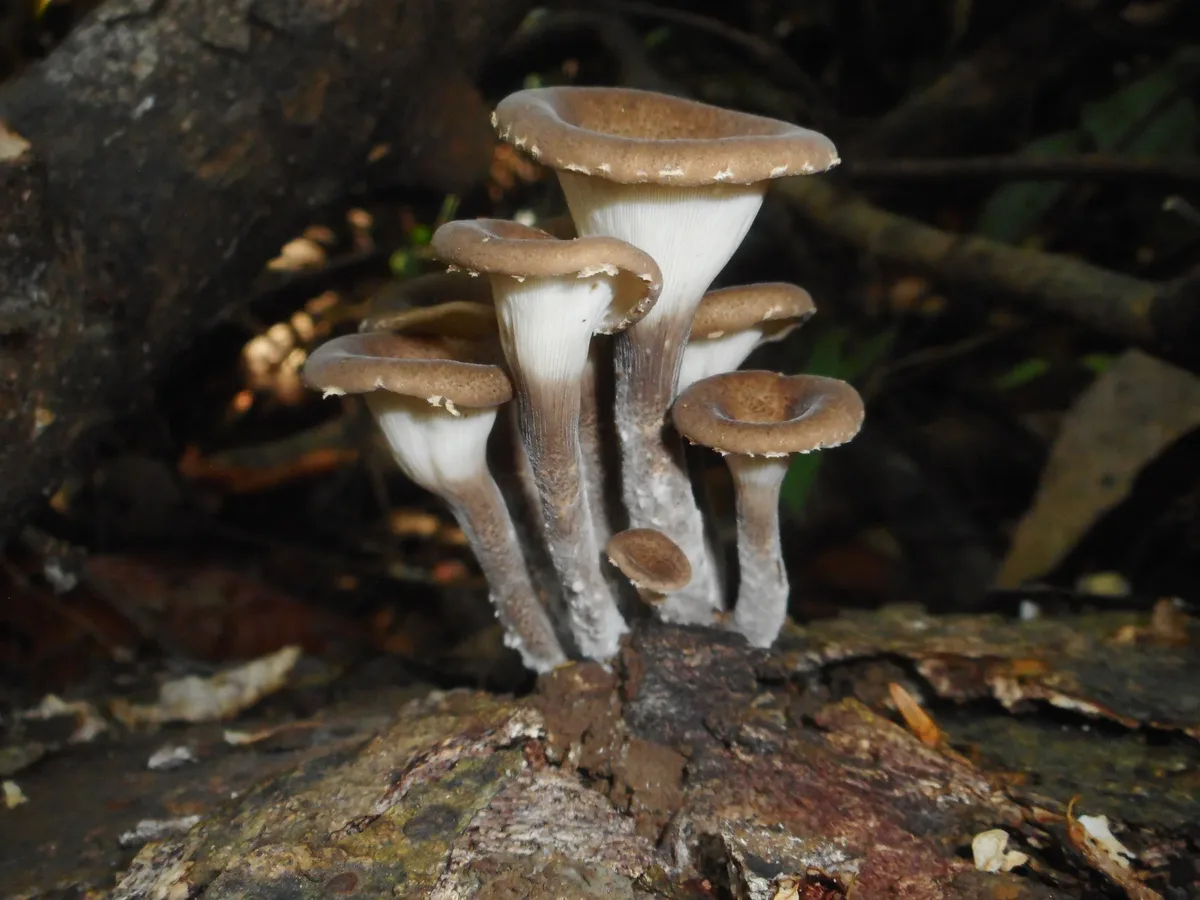 © Eugene Popov (CC BY)
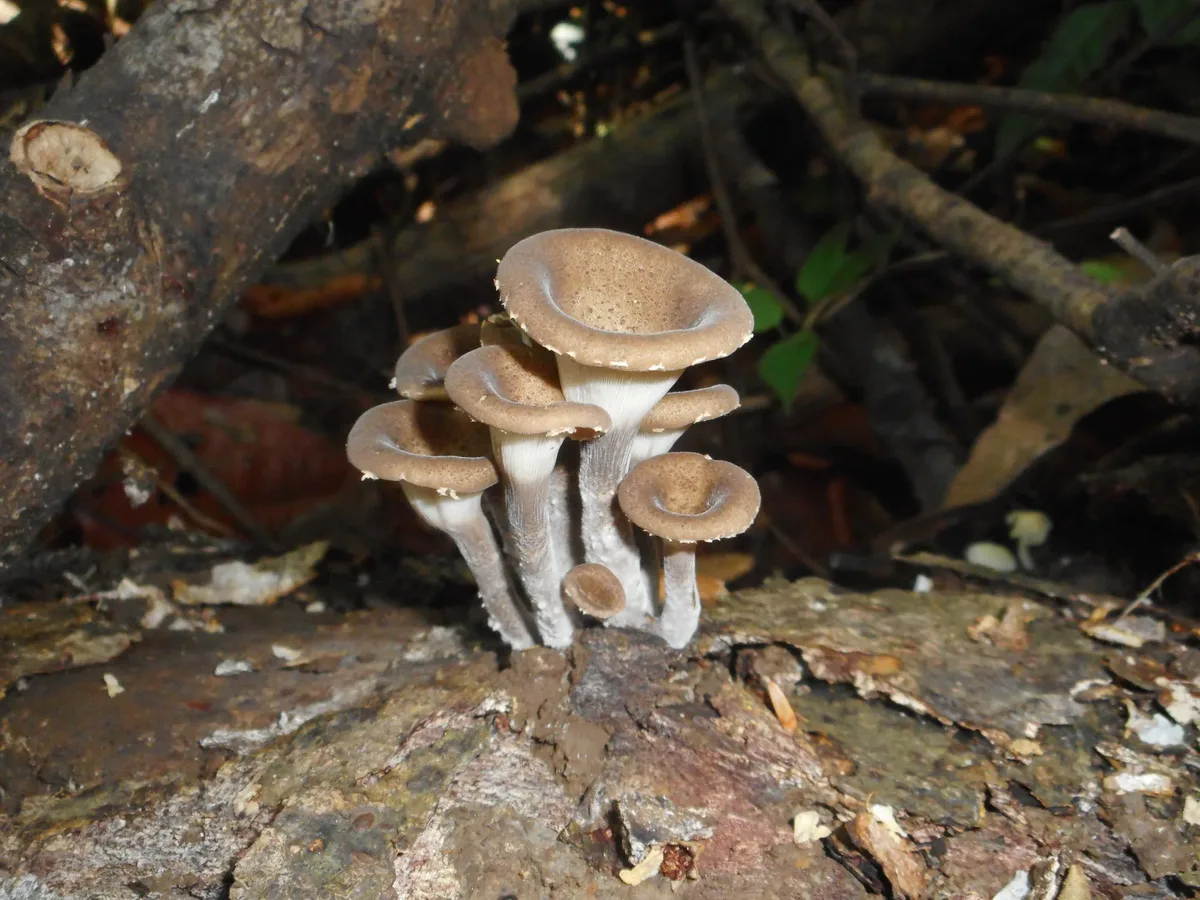 © Eugene Popov (CC BY)
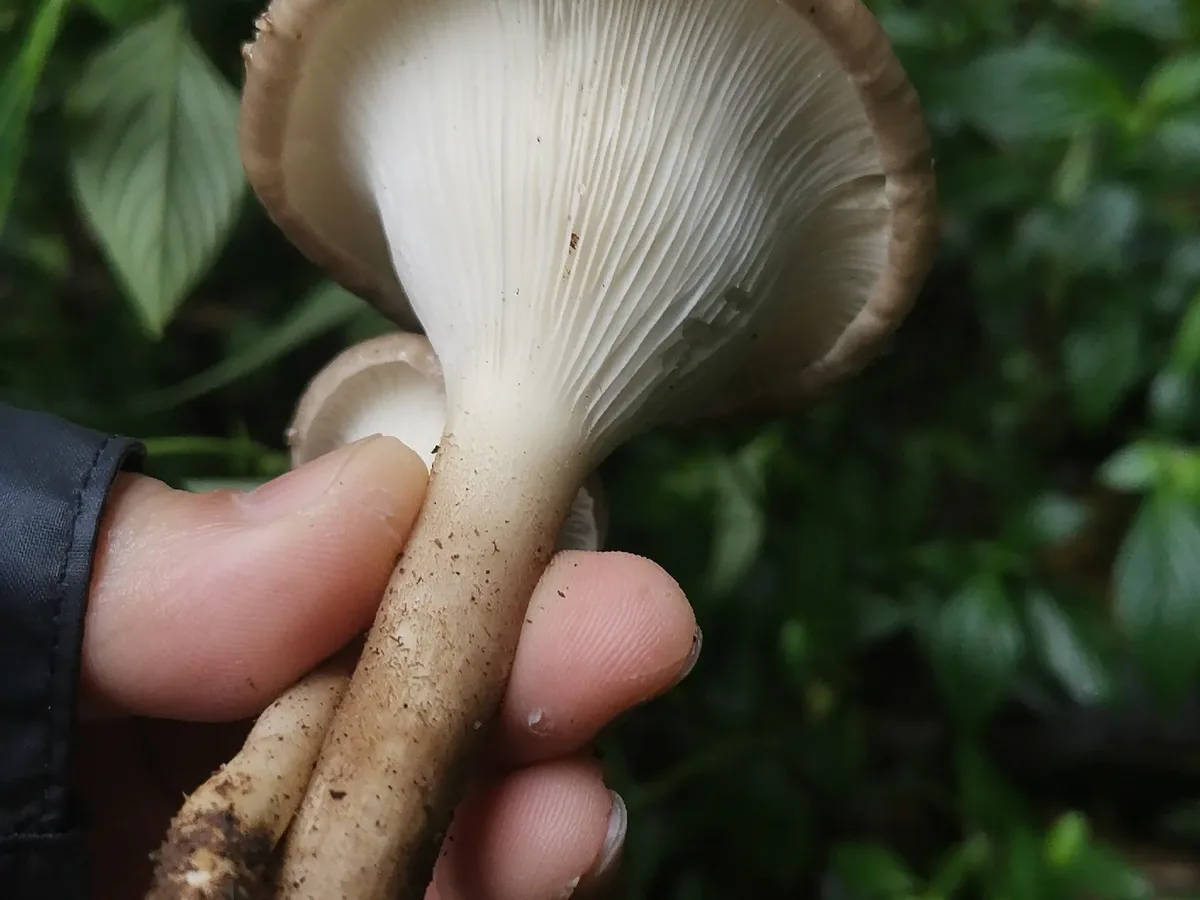 © Cheryl Stinchcomb (CC BY)
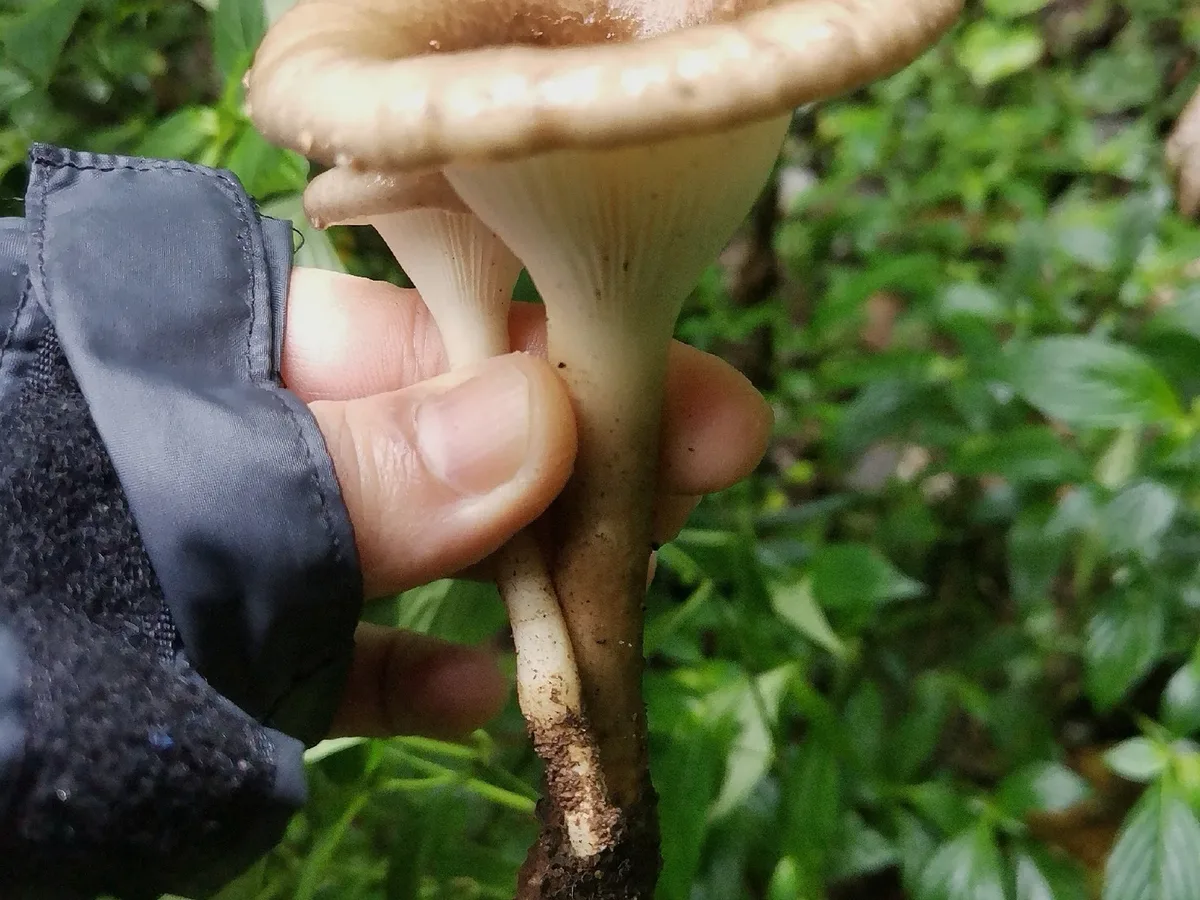 © Cheryl Stinchcomb (CC BY)
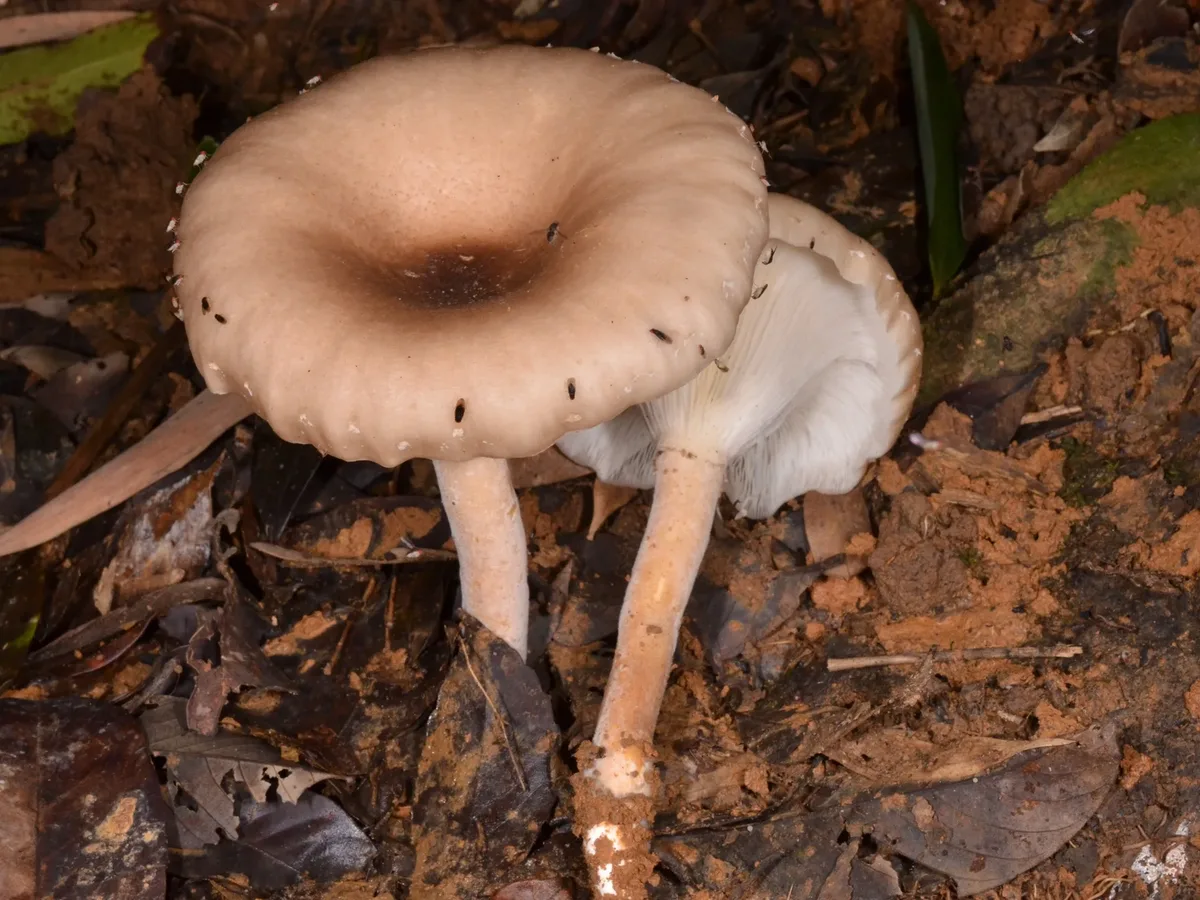 © Eugene Popov (CC BY)
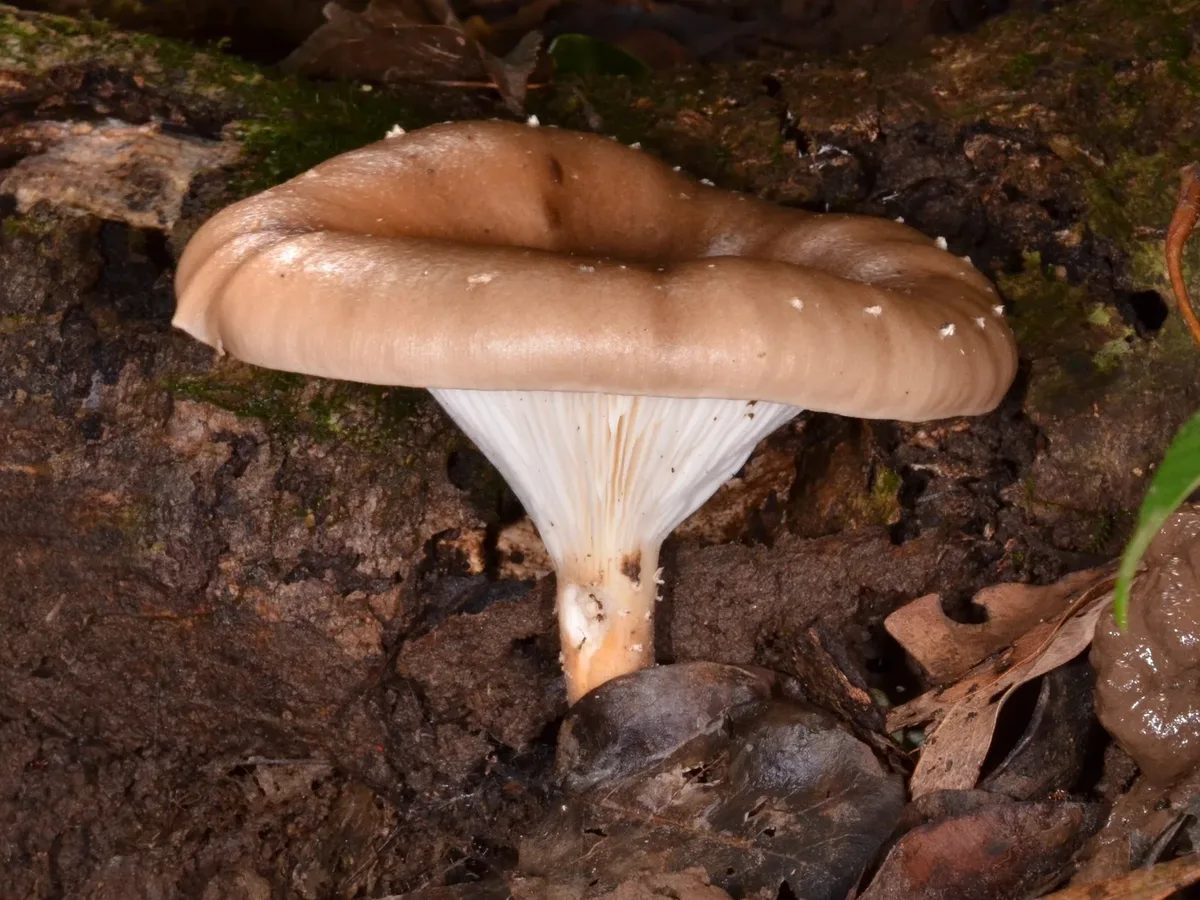 © Eugene Popov (CC BY)
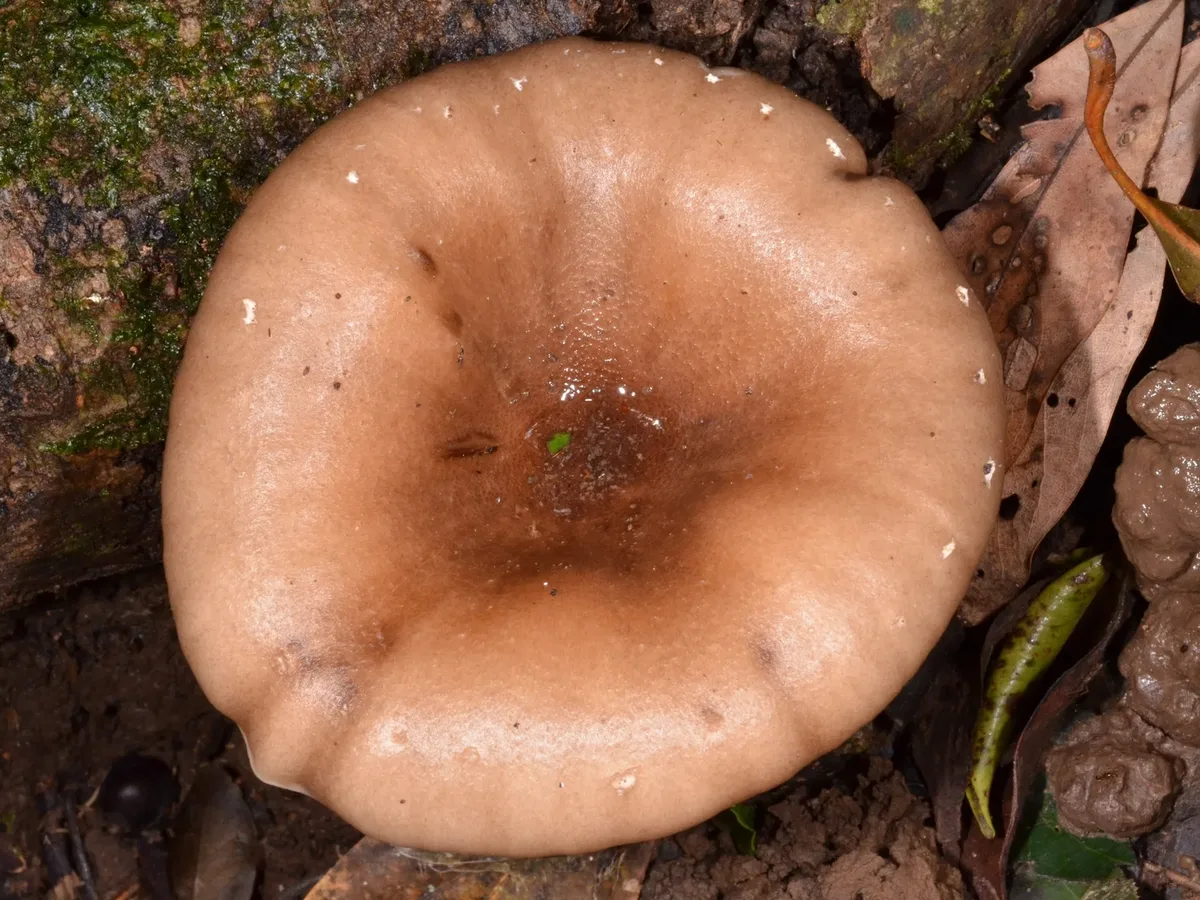 © Eugene Popov (CC BY)© Eugene Popov (CC BY)© Eugene Popov (CC BY)
Good to eat, once you have identified it with certainty and cooked it through.
How to recognise it
Lentinus giganteus earns its name honestly. Mature specimens can carry caps 20-60 cm across - large enough that a single mushroom can fill a woven basket - making them among the most visually striking finds in tropical forest.
Cap
The cap starts convex and roughly dome-shaped in youth, then flattens and progressively deepens into a wide funnel as it ages, the margin becoming wavy and sometimes splitting or crinkling at the edges.
The colour is subdued: off-white to pale cream-buff, often with a slightly darker ochre-brown centre, and the surface is dry and slightly silky rather than slimy.
Gills
Beneath the cap the gills run strongly down the stem (they are decurrent), are densely packed and narrow, white to cream, and carry a subtly serrated (toothed) edge - worth examining with a hand lens as this toothing is a defining feature of the genus Lentinus.
Stem
The stem is thick, solid, and tough, central, white to pale cream, without a ring or volva.
Flesh
The flesh is white, firm, and somewhat fibrous-tough, with a mild pleasant odour. Spore print white.
Overall the impression is of a grand, understated mushroom whose most remarkable quality is simply its size.
Where & when it grows
Habitat
Lentinus giganteus is a saprobe, meaning it feeds on dead organic matter rather than forming partnerships with living tree roots. It specialises in breaking down dead hardwood - logs, stumps, and buried woody debris - through white rot, digesting both cellulose and lignin.
It frequently appears to emerge straight from the ground because the decaying wood or root it is consuming may be deeply buried or fully decomposed to a substrate indistinguishable from soil.
Look for it in tropical and subtropical lowland forest clearings, along forest edges, in rubber and teak plantations, bamboo groves, and along roadsides and field margins where stumps and buried roots remain. Disturbed habitats with plenty of decaying hardwood substrate suit it especially well.
It grows singly or in small groups of two to five, rarely in large clusters.
When
Fruiting is driven by the monsoon.
In mainland Southeast Asia (Thailand, Vietnam, Laos, Myanmar, Cambodia) and in India and Sri Lanka, the main fruiting window follows the onset of the southwest monsoon in May-June, with flushes continuing through September-October and tapering off as the dry season arrives.
In equatorial Malaysia and Indonesia with bimodal rainfall, two fruiting peaks are possible each year.
The trigger is simple: prolonged heavy rain warming a soil already above 22-25 °C. After a substantial rain event, visible fruit bodies can appear within a week.
Seasons and timing will be familiar to local farmers and rubber tappers who know exactly which forest clearings produce the big mushrooms after the first rains.
How it grows
As a white-rot saprobe, Lentinus giganteus secretes enzymes into buried dead wood and decomposes it steadily before producing the conspicuous above-ground fruit bodies.
The mycelium can maintain itself in buried woody substrate for years, which is why the same clearings and forest margins produce the species reliably season after season at the same spots.
Fruit bodies develop rapidly after triggering rain events: pins can reach full size in 5-10 days. Because they arise from buried wood, they often emerge singly from open ground in clearings, which adds to their visual impact.
The tough, fibrous texture of the flesh reflects the mycelium's wood-decomposing lifestyle - the same enzyme-resistant structural proteins that help the fungus penetrate lignin also make the fruit body robust and slower to decay than more delicate species.
Fruiting conditions
Fruiting is triggered by sustained heavy rainfall on warm tropical soils. A minimum of approximately 40 mm over the preceding 14 days, combined with soil temperatures above 22 °C, provides the threshold for reliable flushes. Lag from rain trigger to visible fruit bodies is 5-10 days; full cap expansion takes a further 3-7 days. In equatorial zones with year-round warmth, rainfall is the sole limiting factor. The species does not require any cold shock or temperature drop and will not fruit below about 20 °C soil temperature.
Look-alikes
Because of its very large size and funnel-shaped mature form, Lentinus giganteus has a limited set of realistic lookalikes. The key genus-level feature is the toothed gill edge, combined with the white spore print and absence of a ring or volva.
- Macrocybe titans - a tropical giant mushroom also found in Southeast Asia and the Americas that can reach similar size; it has smooth gill edges (not toothed), a more robust stem, and a distinctly earthy-meaty odour; also edible.
- Clitocybe species - several large funnel-shaped Clitocybe or Infundibulicybe species can superficially resemble a mature Lentinus giganteus, but these are much smaller (rarely above 15-20 cm), grow in different habitats (soil in temperate forest or grassland), and lack the strongly toothed gill edges.
- Omphalotus nidiformis (ghost fungus) - an Australian species that glows in the dark and causes gastrointestinal poisoning; broadly funnel-shaped and grows on wood, but is much smaller (up to about 30 cm at most), orange to white-cream with a distinctly bioluminescent quality at night, and found in Australia/New Zealand rather than tropical Asia.
- Lentinus sajor-caju (sajor-caju mushroom) - a close relative also cultivated in Southeast Asia; distinctly smaller (cap usually 5-25 cm), with a more persistently umbrella-shaped cap and often a more noticeably off-centre stem. Edible and closely related, so confusion results only in finding another good edible.
None of the realistic lookalikes for this species are lethally dangerous.
Australian wood-rotting species with a broadly funnel-shaped white to cream-buff cap that can reach 30 cm; causes gastrointestinal poisoning (illudin toxins). Distinguished from L. giganteus by its bioluminescence (gills glow faint blue-green in darkness), its growth in Australia and New Zealand (outside the core range of L. giganteus), smooth gill edges, and smaller maximum size. If a funnelled white mushroom glows in the dark, do not eat it.
Large funnel-capped species can suggest a young Lentinus giganteus at first glance, but these fungi are typically much smaller (cap usually below 20 cm), grow from soil in temperate woodland or grassland (not on wood or buried tropical woody debris), have smooth (not toothed) gill edges, and frequently carry strong odours (aromatic or farinaceous). Some Clitocybe species contain muscarine and cause toxicity; however, none approach the size of L. giganteus in practice, and the toothed gill edge of L. giganteus is a reliable discriminator.
Another enormous tropical mushroom reaching similar cap dimensions (20-60 cm). Key distinctions: Macrocybe titans has smooth gill edges (not toothed/serrated as in Lentinus giganteus), a robust, stout stem often 4-8 cm thick, and a distinctly meaty-earthy odour. Also edible. Primary range is the Americas (Central America, Caribbean, Florida) with records from South and Southeast Asia; less common in core Lentinus giganteus territory. Check the gill edge carefully with a hand lens.
A close relative also cultivated and foraged across Southeast Asia. Distinctly smaller (cap 5-25 cm), with a more persistently umbrella-shaped to shallowly depressed cap rather than a deep funnel, often a more prominently off-centre stem, and typically paler flesh. Both have toothed gill edges and white spore prints. Fully edible; any confusion between the two produces a harmless outcome. Distinguish by the smaller stature and shallower cap depression of L. sajor-caju.
In the kitchen
Picking & cleaning
Harvest when the cap has flattened or just begun to develop the funnel shape but before the margin has split or become papery-thin - at this point the flesh is thickest and most flavourful. Very young, still-convex specimens are also excellent.
Older, deeply funnelled specimens with cracked or split margins and very tough fibrous flesh can still be edible but benefit from longer cooking.
Slice or twist the stem cleanly at the base; there is no need to excavate the substrate. Because of the large size, a single specimen can yield a substantial harvest. Trim away the very base of the stem, which may be hardened or soil-soiled.
The flesh is firm enough to transport well. Use within 1-3 days of picking, stored in a cool place or refrigerated; it also dries reasonably well for storage.
Cooking
The flesh of Lentinus giganteus is firmer and chewier than commercial button or oyster mushrooms, with a mild, pleasant, savoury-earthy flavour that deepens with long cooking.
In Thai cooking it is commonly used in curries, stir-fries, and soups where extended heat tenderises the fibrous flesh and allows it to absorb flavour from coconut milk, galangal, lemongrass, and chilli. In Indian and Sri Lankan cuisine it is incorporated into spiced vegetable dishes and gravies.
The large, funnel-shaped cap makes it well suited to slow-cooking methods - braising, slow-frying, or simmering in broth - that break down the tougher texture.
Young, smaller caps can be sliced and sautéed; mature specimens benefit from slicing thinly across the grain and cooking longer.
It pairs particularly well with bold, aromatic flavourings: garlic, ginger, fish sauce, oyster sauce, and curry pastes.
The mushroom can also be dried for long-term storage; dried slices reconstitute well in soups and braising liquids and concentrate the earthy flavour.
Good to know
Lentinus giganteus is a well-established, widely consumed edible mushroom across tropical Asia, with a long history of use in Thailand, India, Sri Lanka, Vietnam, southern China, Malaysia, and Indonesia. It is sold in rural markets and harvested for home consumption by local communities.
No serious toxicity has been documented in published literature. As with all wild mushrooms, raw consumption is inadvisable - cook thoroughly.
Individuals trying this species for the first time should start with a modest portion to assess personal tolerance, as rare individual gastrointestinal sensitivities to any wild mushroom are possible.
The key safety confirmation is:
- toothed gill edge
- white colour
- white spore print
- absence of a ring or volva
- saprotrophic growth on decaying wood or buried wood debris
If any unusual colouration, odour, or growth context raises doubt, do not eat the specimen.
A reference guide - never an edibility guarantee. When in doubt, leave it out.