Grey alder bolete
Leccinum schistophilumsyn. Boletus schistophilus (Lannoy & Estades), Leccinellum schistophilum (Lannoy & Estades) Bresinsky & Manfr.Binder
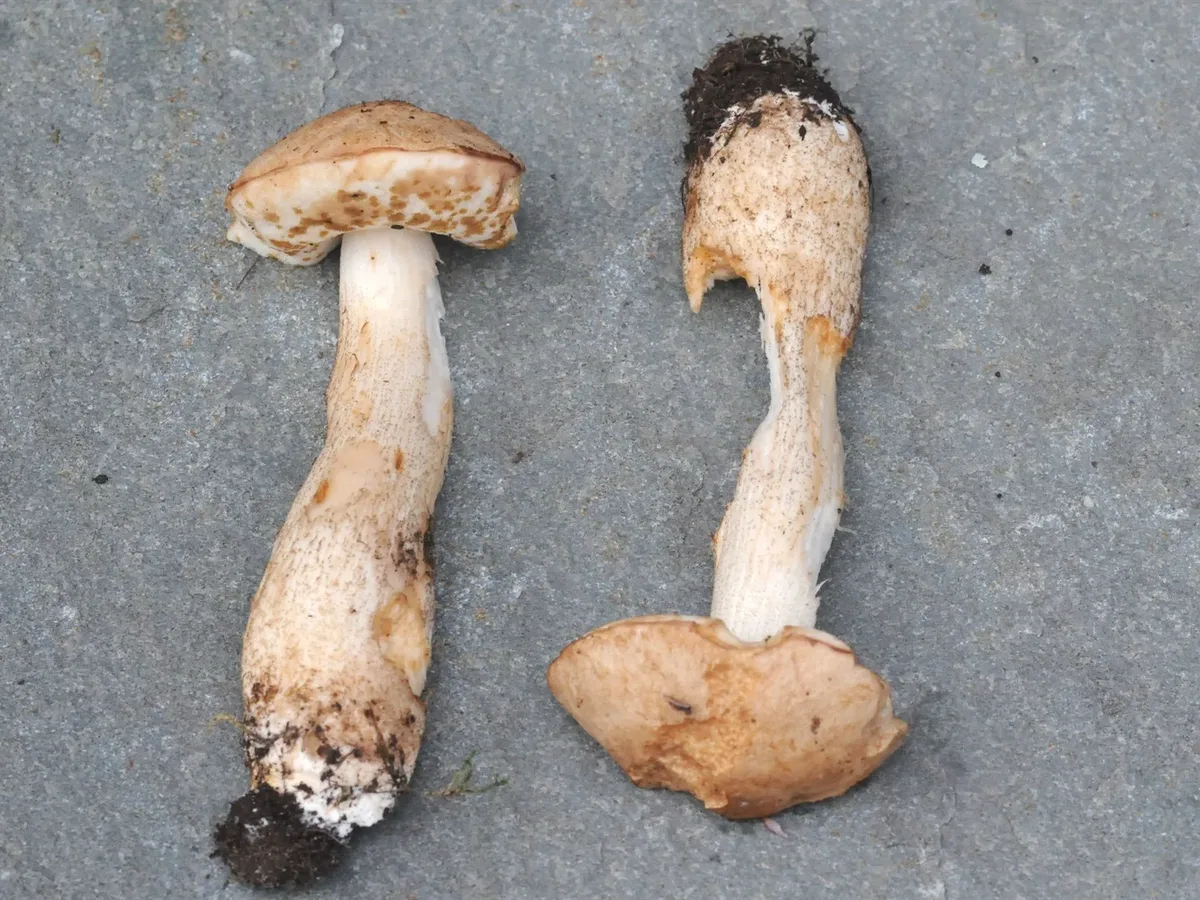 © Perry Gunnar Larsen (CC BY)
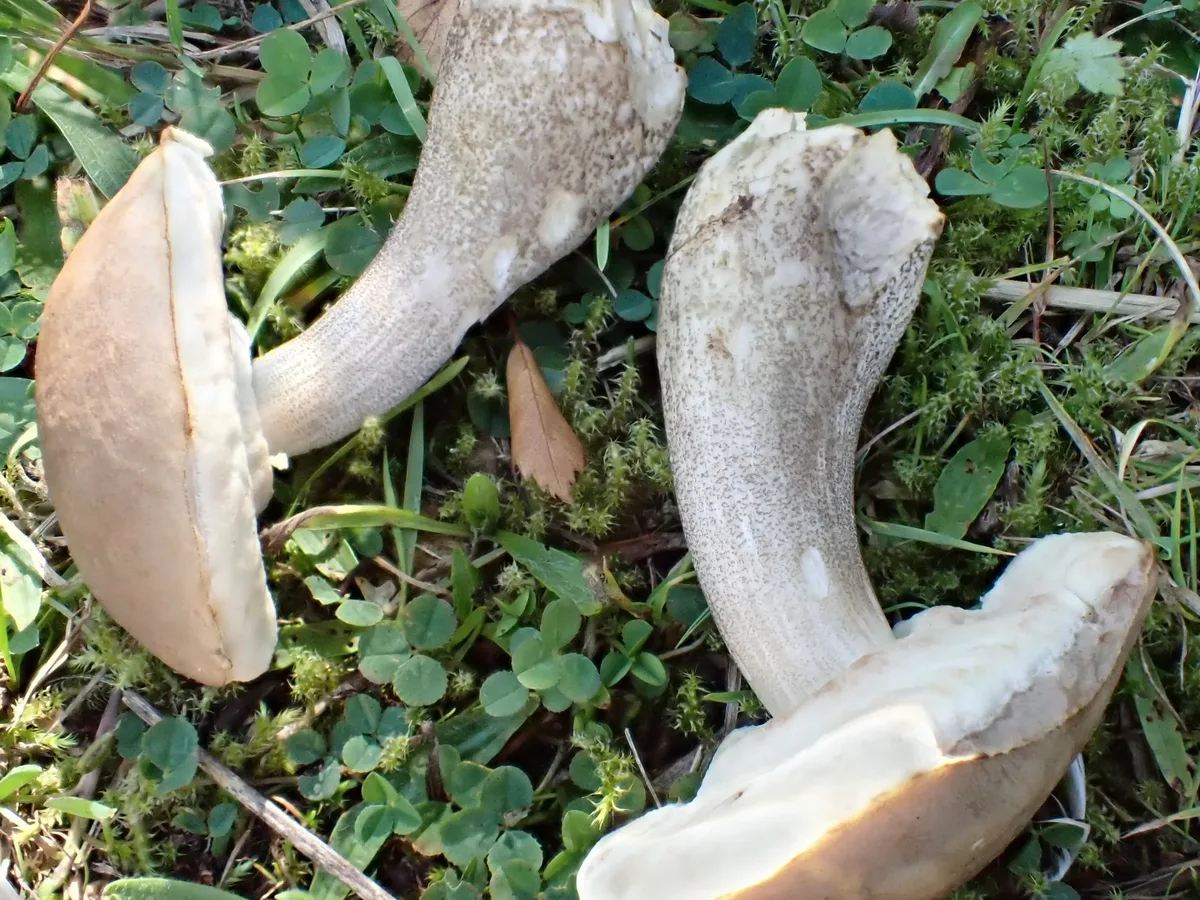 Jean-Paul Boerekamps (CC0)
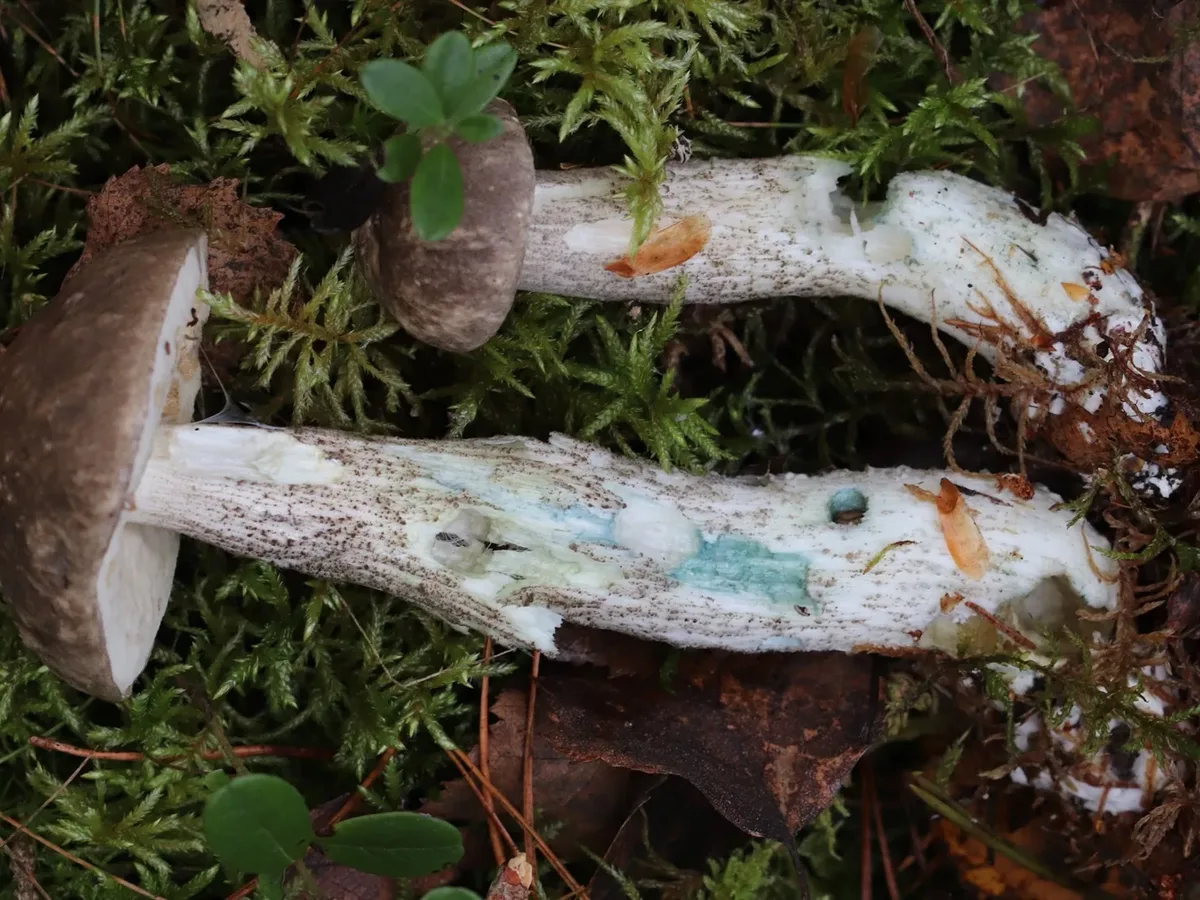 © Rob van Kruining (CC BY)
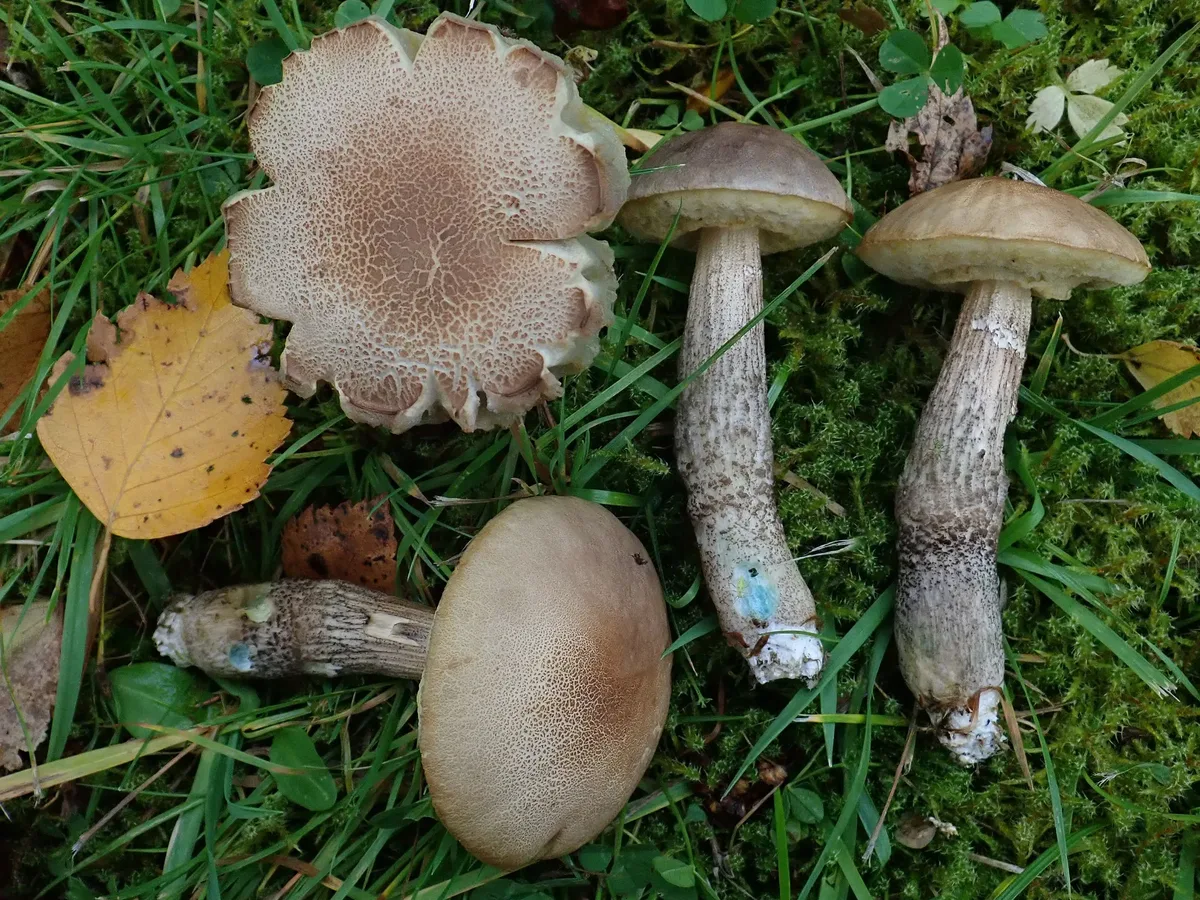 © Unknown (CC BY-SA)
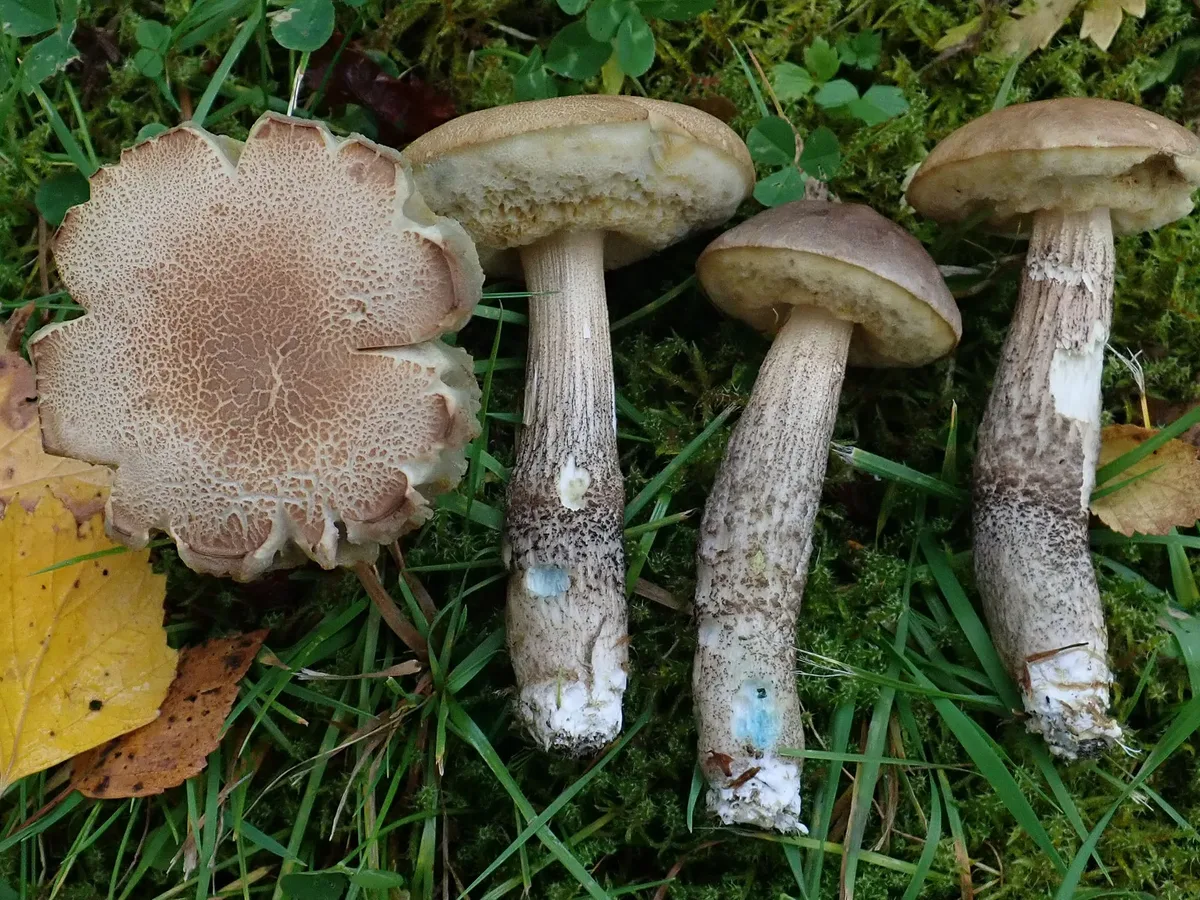 © Unknown (CC BY-SA)© Perry Gunnar Larsen (CC BY)Jean-Paul Boerekamps (CC0)
Edible only with the right preparation - or safe for some people but not others. Learn the caveats first.
How to recognise it
Leccinum schistophilum is a medium-sized bolete of unassuming appearance, easily passed over among the grey-brown litter of a riparian alder stand.
Cap
The cap ranges from 4 to 12 cm, starting tightly domed and firm before expanding to a broad, somewhat irregular cushion.
Its colour sits in the grey-brown to ochre-buff range - pale enough that it rarely catches the eye the way the bright orange-red Leccinum versipelle does.
The surface is dry to barely moist, slightly fibrous-felty when young, becoming smoother in age, and never viscid or slimy.
Stem
The most immediately distinctive feature shared by all Leccinum species, and the one that identifies this mushroom to genus in seconds, is the stem: it is covered from base to apex in dense, coarse scabers - tufted scales that start grey and deepen to slate-grey or black with age, giving the stem a rough, bristled appearance quite unlike any other bolete.
Gills / Pores
The pore surface is white to cream, ageing pale ochre-grey, with small, round pores that do not bruise blue.
Flesh
Cut the flesh and it delivers the genus's signature performance: the white interior first blushes pinkish, then turns progressively lilac-grey to dark slate-purple or near-black over the next ten to twenty minutes.
This flesh-darkening reaction is completely normal for Leccinum and is not a sign of toxicity, but it surprises many beginners.
The spore print is ochre-brown.
Why it's dangerous
The risk profile of Leccinum schistophilum is context-dependent.
When the mushroom is properly cooked - high heat throughout, sustained for at least fifteen minutes - the risk is low: the heat-labile irritant is destroyed and the mushroom is considered edible.
When consumed raw or undercooked, the risk is moderate to significant: gastrointestinal illness is likely rather than merely possible, and in vulnerable individuals or large quantities the severity can require medical attention.
The danger is gastrointestinal in nature: it is not systemic, not hepatotoxic, not nephrotoxic, and not neurotoxic. No confirmed fatalities are attributable specifically to Leccinum schistophilum.
However, the genus-level warning from Scandinavian mycological authorities applies to this species: treat every Leccinum as requiring full, thorough cooking before consumption. The Norwegian hospitalisation episodes linked to Leccinum aurantiacum - a closely related species with a similar heat-labile irritant - are the documented precedent that underpins this recommendation.
The practical rule is simple:
- never eat Leccinum raw or partially cooked
- verify that cooking is thorough (not just surface-hot)
- do not give raw or undercooked specimens to children or vulnerable individuals
The grey-black colour of properly cooked Leccinum flesh is not a warning sign and should not be confused with a sign of spoilage or poisoning.
Toxin
The toxic principle in Leccinum schistophilum - and across the Leccinum genus more broadly - is an uncharacterised, heat-labile compound present in raw and insufficiently cooked fruiting bodies. As of current mycological and toxicological literature, the responsible molecule has not been isolated, identified, or structurally characterised.
What is known is its thermal behaviour: the compound is destroyed when the mushroom flesh is subjected to high heat (above approximately 70-80 °C throughout the tissue) for at least fifteen minutes of sustained cooking. This is why thorough cooking at high heat renders Leccinum species safe to eat, while brief heating, undercooking, or eating specimens raw produces gastrointestinal illness.
The compound is not a classical alkaloid or peptide toxin in the manner of Amanita phalloides' amatoxins; it does not cause systemic organ damage.
Its mechanism of gastrointestinal action is unknown, but the clinical pattern - rapid onset, GI-localised symptoms, self-limiting course - is consistent with a local irritant or pro-inflammatory compound acting on the gut mucosa rather than absorbed systemic poisoning.
The flesh-darkening reaction (white to slate-grey-black on cutting and cooking) is a separate chemical process involving oxidation of catechol compounds and is not related to the toxic principle; it does not indicate the presence or absence of the irritant compound.
Symptoms
Ingestion of raw or undercooked Leccinum produces a gastrointestinal syndrome: nausea, vomiting, abdominal cramps, and diarrhoea, typically with onset between 30 minutes and 3 hours after eating.
The latency is short because the toxin acts locally in the gut rather than requiring systemic absorption and distribution.
Symptoms are generally self-limiting: in the majority of cases they resolve without specific treatment within 6-24 hours, requiring only supportive care (fluid replacement, rest, monitoring). No antidote exists or is needed.
Severity correlates with the amount consumed, the degree of undercooking, and individual susceptibility. Most cases are mild to moderate.
Severe cases - including hospitalisation - have been documented in Scandinavia, particularly following consumption of the closely related Leccinum aurantiacum (orange birch bolete) in Norway, where multiple individuals required intravenous fluid replacement. These severe outcomes reinforce the genus-level recommendation from Nordic mycological authorities that all Leccinum species must be thoroughly cooked before eating.
Children, the elderly, and immunocompromised individuals face greater risk of dehydration and complication from vomiting and diarrhoea and should be treated with extra caution.
If symptoms are severe, persistent beyond 24 hours, or accompanied by neurological signs (not typical for Leccinum), seek medical attention.
Staying safe
Leccinum schistophilum is edible, but it must be thoroughly cooked. This is not optional: Leccinum species - particularly the pale and orange-capped varieties - have caused gastrointestinal illness (nausea, vomiting, abdominal cramps) when eaten raw or undercooked or when consumed in very large quantities.
The toxic principle in raw Leccinum is not fully characterised but is heat-labile and destroyed by adequate cooking; the general recommendation from Scandinavian mycological authorities is to cook at high heat for at least fifteen minutes.
The flesh-darkening reaction (white turning grey-black on cutting and cooking) is alarming to newcomers but is chemically benign. Do not eat any Leccinum raw.
When collecting, confirm the host tree is grey alder: the species epithet and the ecology go together.
As a caution consistent with the genus: there is one historically documented episode of adverse reactions to Leccinum aurantiacum (orange birch bolete) in Norway, involving hospitalisations, which reinforced Scandinavian guidelines recommending prolonged cooking for all rough-stalked boletes. Apply the same caution here.
No deadly species can realistically be confused with a correctly identified Leccinum with dark-scalered stem and spongy pore surface.
Where & when it grows
Habitat
The grey alder bolete is one of the most ecologically faithful mushrooms in northern Europe: it grows with grey alder (Alnus incana) and essentially nowhere else.
Grey alder is the pale, rough-barked alder species of upland streamsides, river gorges, mountain scree slopes, and moist valley bottoms across Scandinavia and the boreal-alpine zone.
Where grey alder lines a stream bank or colonises a frost hollow, Leccinum schistophilum is the bolete most likely to appear.
The habitat is typically open or semi-open: the species does not seek dense canopy, preferring the dappled light of riparian corridors.
Soils are moist, moderately fertile, and slightly acidic to neutral - the type of ground where silt accumulates and organic matter is high.
It is a useful indicator species: finding it confirms both the host tree and the soil moisture conditions.
When
The species is a summer-to-autumn fruiter, appearing from July onwards once soil temperatures have warmed sufficiently and summer rain has fallen.
The main productive period in Scandinavia is August through September, coinciding with the late-summer rainfall that triggers most bolete species.
At higher altitudes or in northern latitudes the season compresses, beginning in late July and ending by early October when the first hard frosts arrive in mountain valleys.
Warm, humid weather following rain of at least 15-20 mm is the classic trigger; the grey-alder riverside habitat retains soil moisture well and can fruit longer into autumn than exposed hillside sites.
How it grows
Fruit bodies emerge singly or in small scattered groups among the leaf litter, mosses, and herbaceous vegetation beneath grey alder.
The mycorrhizal network is perennial, and productive sites can be harvested in multiple consecutive seasons provided the host trees remain healthy. Individual fruit bodies develop over a week to ten days after suitable rain and warmth.
The pale caps blend into the grey-brown duff and can be easily missed; the dark-scalered stems pushing through leaf litter are usually the first visual cue.
Like other Leccinum, the fruit bodies are attractive to dipteran larvae (fungus gnats and blow flies), which can tunnel extensively through the cap and stem, so young specimens are preferable.
Fruiting conditions
Fruiting is triggered by sustained late-summer rainfall (20 mm or more over 14 days) when soil temperatures are in the range 8-18 °C. Grey alder riparian habitats retain moisture well, extending the season relative to drier woodland. Fruiting ceases sharply with the first hard frosts, which arrive early in upland and northern valley-bottom sites where grey alder is common.
Look-alikes
Leccinum schistophilum shares the grey-brown, pale-capped bolete niche with several relatives, and correct identification relies on confirming the combination of host tree (grey alder), pale grey-brown cap, and dark scabers.
- Birch bolete (Leccinum scabrum) - the most likely confusion: a very similar pale grey-brown to buff cap with dark scabers, but grows under birch (Betula spp.), not alder; the two are ecologically separated and both are edible with the same preparation requirements.
- Leccinum holopus (white birch bolete) - paler still, almost white to creamy, and grows in wet, boggy birch woodland, not with grey alder.
- Leccinum melaneum and Leccinum piceinum - darker-capped, stouter boletes associated with conifers (spruce and pine), unlikely to be found in the grey-alder riparian habitat.
None of the realistic lookalikes for Leccinum schistophilum are deadly.
The class of truly dangerous mushrooms - Amanita phalloides (death cap), Amanita virosa (destroying angel) - are gill-fungi easily distinguished by their gills (not pores), white colour, and ring and volva; no bolete with a spongy pore surface, tube layer, and dark-scalered stem can be confused with them by anyone who takes a moment to look underneath the cap.
Very similar pale grey-brown cap and dark scabers, but grows under birch (Betula spp.) rather than grey alder. Edible with the same cooking requirements. The host tree is the decisive separator; confirming Alnus incana (grey alder) beneath your feet confirms L. schistophilum.
Stouter build, tougher flesh, darker brown cap, and associated with aspen (Populus tremula) rather than alder. The compact, firm flesh and different host tree distinguish it. Edible when cooked.
Darker, almost sooty-brown to dark grey-brown cap; associated with Norway spruce (Picea abies) in conifer forest rather than alder riparian zones. Edible when cooked.
Vivid orange to brick-red cap - very different from the pale grey-brown of L. schistophilum. Grows under birch. Edible when well cooked but has caused gastrointestinal illness in Norway when undercooked. Not a realistic confusion species in the field due to colour difference.
Paler, almost white to cream-coloured cap; grows in boggy, wet birch woodland, not in grey-alder riparian forest. Edible when cooked. Colour and habitat together distinguish it.
A reference guide - never an edibility guarantee. When in doubt, leave it out.