Black birch bolete
Leccinum melaneumsyn. Boletus melaneus, Krombholziella melaneï
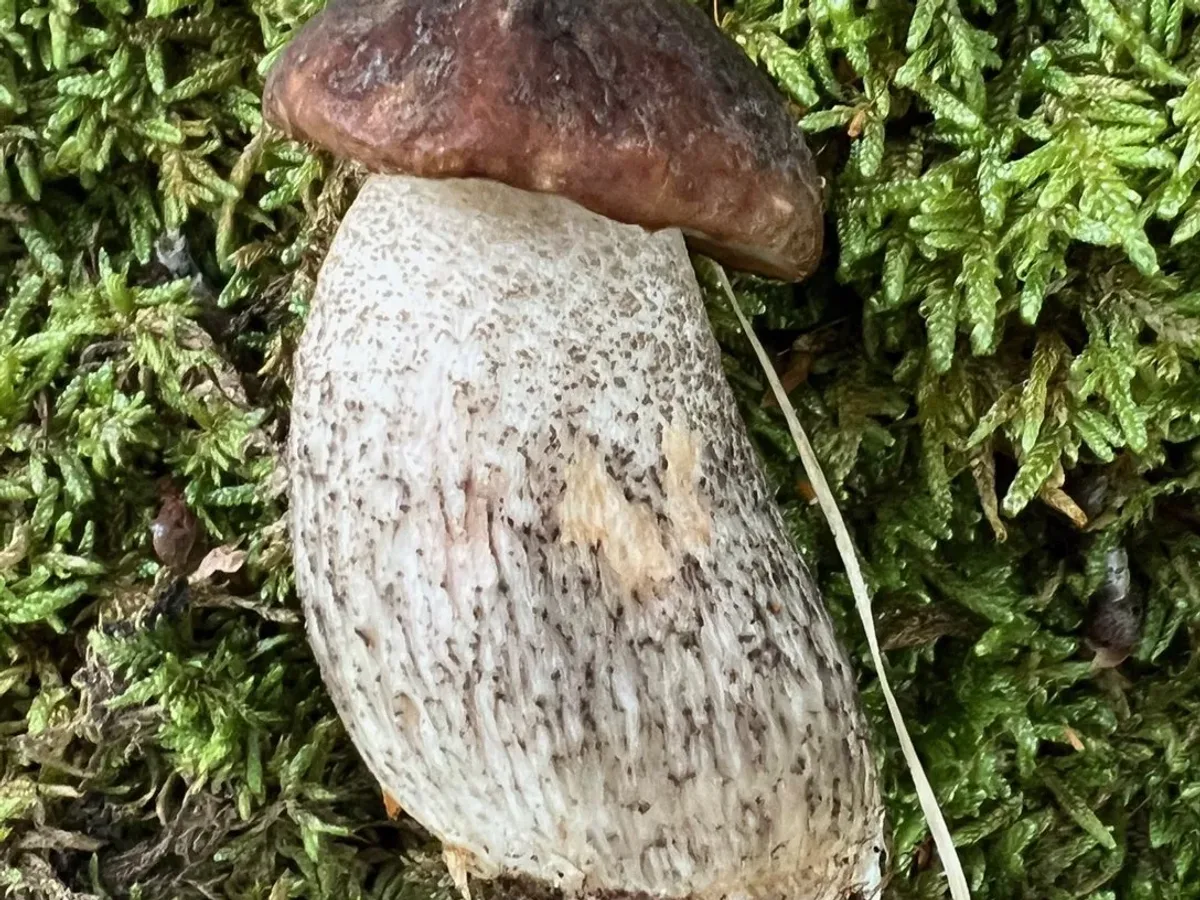 © Kirsti Anne Mandal (CC BY)
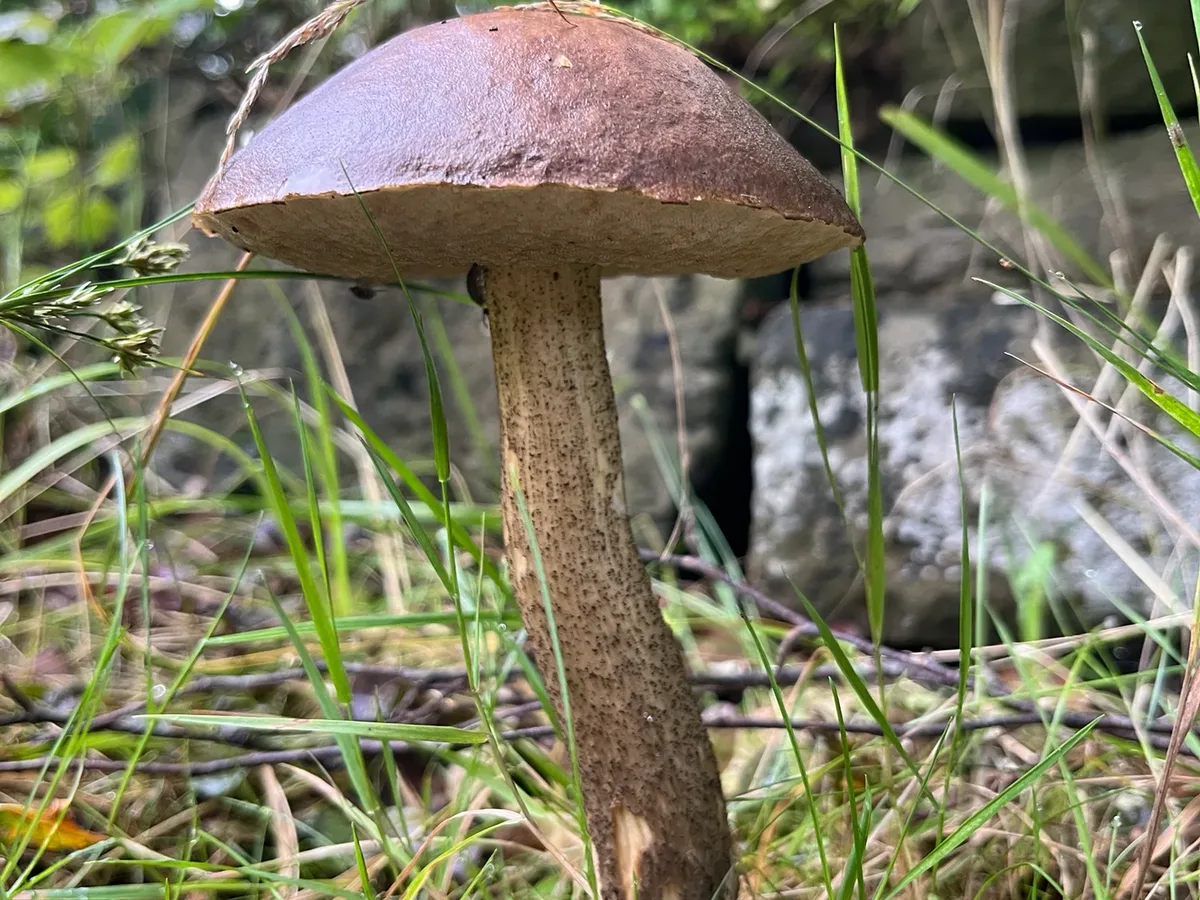 Jan Wegmann (CC0)
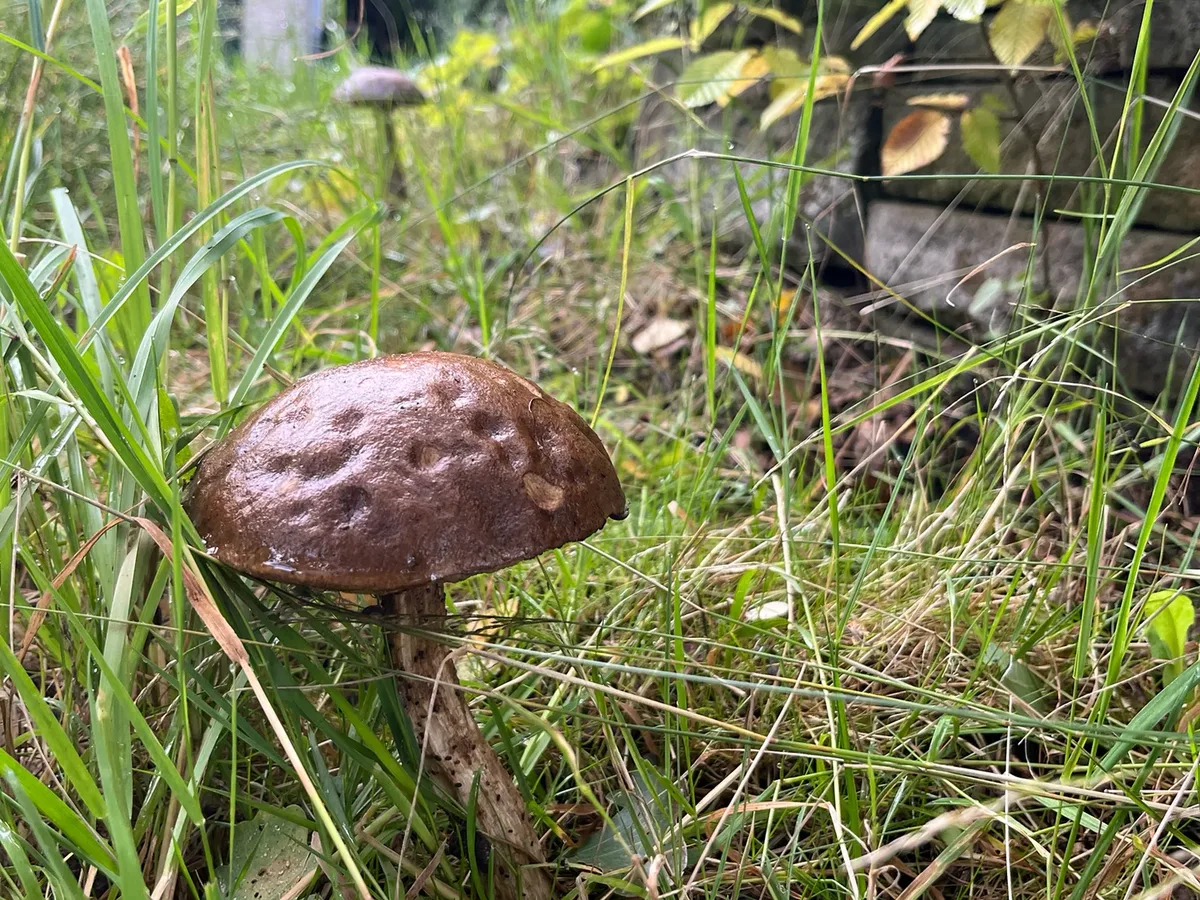 Jan Wegmann (CC0)
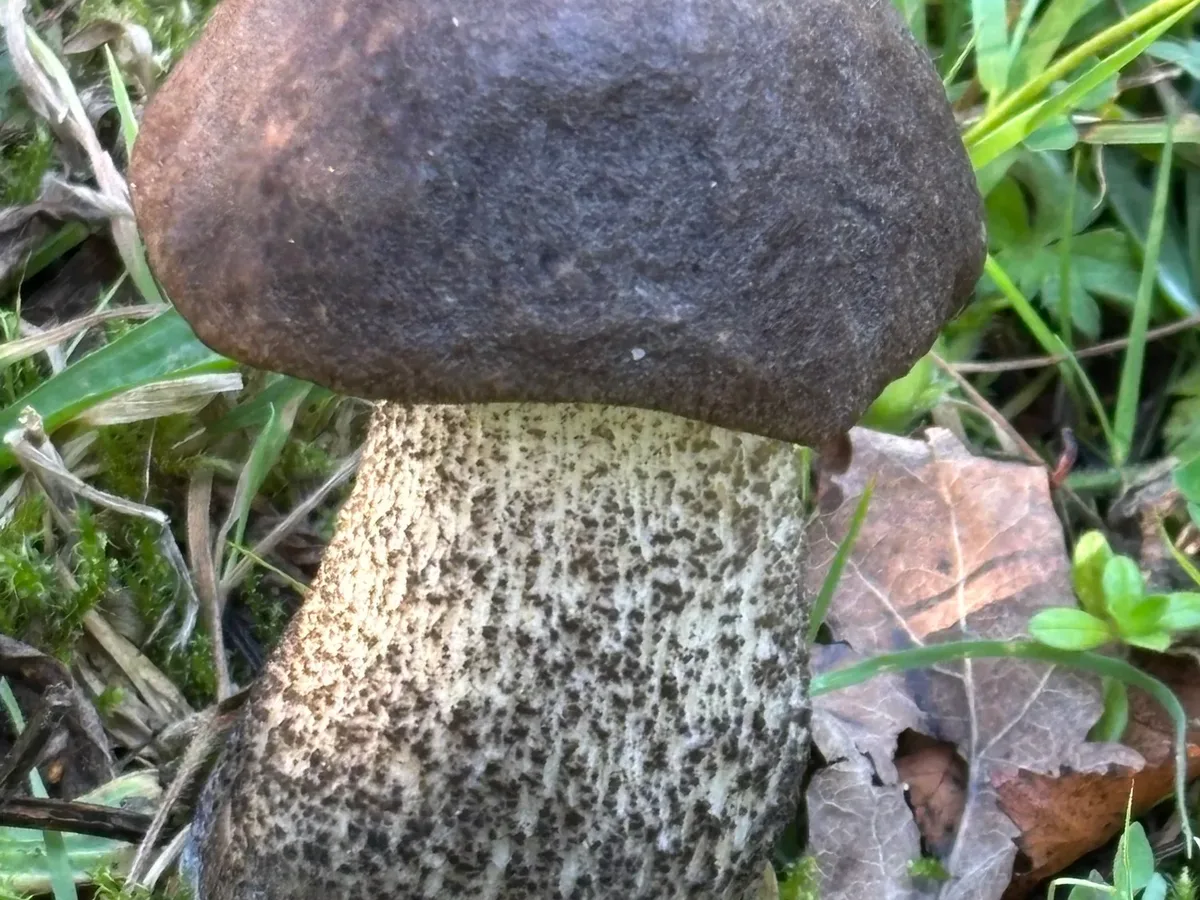 Jean-Paul Boerekamps (CC0)
 © pankral (CC BY-SA)© Kirsti Anne Mandal (CC BY)Jan Wegmann (CC0)
Edible only with the right preparation - or safe for some people but not others. Learn the caveats first.
How to recognise it
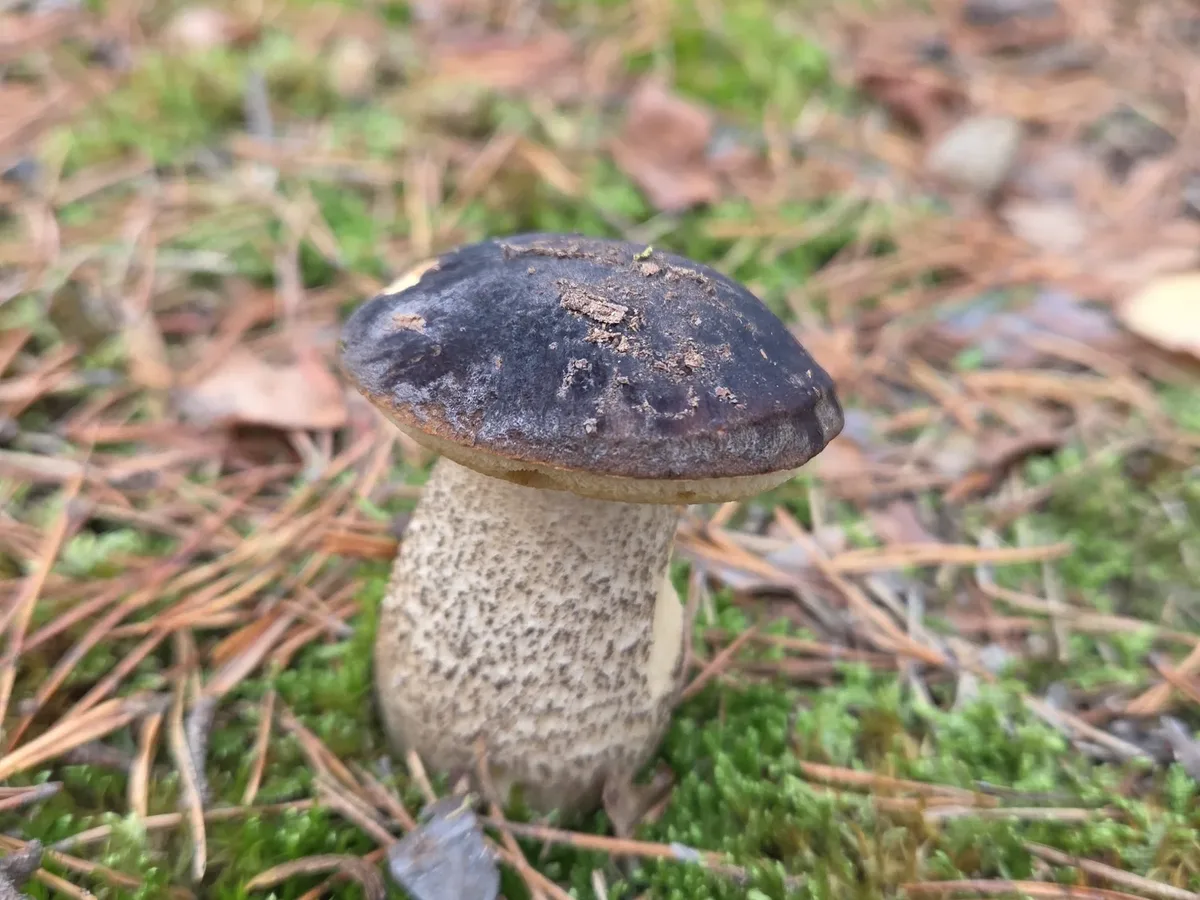
In a genus of boletes that can look frustratingly similar, Leccinum melaneum has one clear advantage: it is by far the darkest.
Cap
The cap (4-12 cm) opens as a firm hemisphere and broadens to a wide cushion, staying dry and matt throughout. Its colour - a consistent dark blackish-brown to near-black - sits well apart from the dull fawn-grey of Leccinum scabrum or the mottled grey-brown of L. variicolor.
Young caps carry a faint, fine downiness that wears away with age. The margin may appear very fractionally paler in dry conditions, but the overall impression never wavers: this is a dark mushroom.
Pores
The pores are white to cream when young, ageing to dirty grey-ochre, and bruise greyish when pressed - a quiet confirmation character worth checking. The tube layer beneath is correspondingly whitish-grey.
Stem
The stem (6-14 cm) is fairly slender for the genus. Its pale whitish-grey surface is almost entirely obscured by dense, erect scabers - rough, bristle-like projections - that are dark brown to blackish from the start and deepen further to near-black with age and handling.
The result is a stem that looks bristled and sooty. Very dark cap on a dark-scabered, slender stem - that pairing is the primary field character.
Flesh
Cut the flesh and you witness one of the most striking colour reactions in the Leccinum genus: white at first, then a rapid flush of pale pink-lilac, progressing through grey to a deep near-black - often complete within 10-15 minutes, most vivid in the lower stem base. It is a genuinely arresting change, though entirely normal.
Smell & taste
Smell mild and pleasant, taste mild. Spore print olivaceous brown.
Why it's dangerous
- LOW when properly cooked
- MODERATE when undercooked
- HIGH when consumed raw
The heat-labile toxins are reliably destroyed by thorough cooking (15-20 minutes of sustained high heat), making the risk manageable with correct preparation.
The primary danger is insufficient cooking or accidental raw consumption. No fatalities are on record.
Sensitive individuals - including children, the elderly, those with GI conditions and those trying the species for the first time - should start with a small well-cooked portion.
Toxin
Unidentified heat-labile compounds present throughout the fruit body, common to Leccinum species generally.
The exact chemical identity of the irritant fraction in Leccinum has not been fully characterised, but it is thermolabile - reliably destroyed by sustained cooking at high temperature (15-20 minutes at full cooking heat).
The same class of compounds is responsible for gastrointestinal incidents across the Leccinum genus.
Symptoms
Gastrointestinal syndrome with onset typically 30 minutes to 3 hours after ingestion of raw or inadequately cooked material.
Symptoms include:
- nausea
- vomiting
- abdominal cramps
- diarrhoea
Severity is directly related to the adequacy of cooking - thoroughly cooked specimens rarely cause problems in healthy adults, while raw or undercooked material produces pronounced reactions.
Symptoms are self-limiting and typically resolve within 12-24 hours. No systemic or organ toxicity has been attributed to Leccinum melaneum.
Staying safe
Leccinum melaneum is edible when thoroughly cooked but must not be eaten raw or undercooked.
Like all species in the Leccinum genus, it contains heat-labile compounds (unidentified thermolabile constituents) that cause gastrointestinal symptoms - nausea, vomiting, cramps and diarrhoea - when the mushroom has not been exposed to adequate cooking heat. These reactions are well-documented across Europe for the Leccinum genus as a whole and apply to L. melaneum in the same way.
The rule is simple:
- Cook fully at genuine sustained heat for at least 15-20 minutes before eating.
- Avoid rapid stir-frying, brief sautéing at low temperature, or raw preparations of any kind.
First-time foragers should try a small, thoroughly cooked portion first, as individual susceptibility to Leccinum compounds varies.
The striking blackening of the flesh - both on cutting in the field and during cooking - is a completely normal oxidation reaction and is not a toxicity signal.
No fatalities or serious systemic toxicity are on record for L. melaneum, and the risk profile is low once full cooking is ensured. People with pre-existing gastrointestinal conditions or children should approach Leccinum species with additional caution.
Where & when it grows
Habitat
Leccinum melaneum cannot fruit without birch nearby - it is a strict ectomycorrhizal partner of Betula, its mycelium woven into the roots of the tree in an exchange that may have been running for years before a single cap appears.
Positive tree identification is therefore an essential part of field verification: look for the distinctive white or silver bark, triangular leaves, and pendulous catkins of Betula pendula or the more rounded-leaved Betula pubescens.
Typical habitats include:
- birch scrub on heathland or upland moor
- open mixed conifer-birch forest
- boggy birch carr (though less tied to waterlogged ground than L. holopus)
- sheltered valley birch woods
- the birch-colonised edges of forest clearings
The species tolerates both sandy and mildly peaty soils given adequate moisture.
It is most frequent and predictable in Scandinavia and Finland - the boreal and hemi-boreal zones where birch is often the dominant deciduous tree - but extends south into northern Germany, Poland, the Baltic states, and the UK (especially Scotland).
Within a site, the same mycelial network fruits at the same spots year after year, so productive locations are worth recording.
When
The main fruiting season runs from July to October in Nordic latitudes, with the principal flush concentrated in late July through September.
Like most boletes, L. melaneum needs two things to come together:
- enough rain (typically 20 mm or more over one to two weeks)
- warm enough soil (8-18 °C at 10 cm depth)
When both conditions are met, flushes emerge 7-14 days later.
The season closes when autumn nights cool the soil below 7-8 °C, though in a warm autumn scattered fruiting can stretch into early October.
In a dry summer the species may lie low for weeks and produce only a brief late-season flush - patience and a wet September are often rewarded.
How it grows
Fruit bodies arise singly or in small scattered groups of two to five, pushing up through leaf litter and moss. Growth from pinhead to mature fruiting body takes approximately 7-12 days in warm, moist conditions.
The firm flesh of young specimens provides some resistance to insect infestation, but older caps are routinely attacked by fungus-gnat (Mycetophilidae) larvae that tunnel upward from the stem base.
Check firmness by pressing the stem gently - if it yields like a sponge rather than firm rubber, insect damage is advanced.
Known productive spots under established birch return reliably from year to year; recording GPS coordinates of good sites is worthwhile.
Fruiting conditions
Fruiting is triggered by adequate summer or early-autumn rainfall (20 mm or more over 14 days) with soil temperatures between 8-18 °C at 10 cm depth. Flushes appear 7-14 days after triggering rainfall. The season effectively closes when soil temperatures drop below 7-8 °C in autumn, typically in October in Nordic latitudes.
Look-alikes
Leccinum melaneum belongs to a complex of dark-capped, birch-associated boletes.
No deadly species closely resembles it; all realistic confusion species are also edible when thoroughly cooked and carry the same caution-level caveats.
- Leccinum scabrum (Brown birch bolete): The most common confusion species - also strictly birch-associated, also bearing scabers. However, L. scabrum has a substantially paler cap in dull fawn-grey to brown, and the scabers are light whitish-grey to pale brown rather than dark blackish. Flesh discolouration in L. scabrum is mild (pale pinkish-grey) and slow, contrasting with the rapid, deep blackening in L. melaneum.
- Leccinum variicolor (Mottled birch bolete): Also dark-capped and birch-associated, but the cap surface is irregularly mottled - patches of grey, brown and greenish - rather than uniformly very dark. The stem flesh at the base characteristically turns vivid blue-green when cut, a colour not typically seen in L. melaneum. Edibility caveats are identical.
- Leccinum cyaneobasileucum: A pale-capped birch bolete with strong blue-green discolouration in the stem base; the pale cap immediately distinguishes it from the very dark L. melaneum.
- Leccinum holopus (White birch bolete): Almost entirely white-capped; grows in very wet boggy ground. The pale cap is impossible to confuse with L. melaneum's near-black surface.
- Leccinum versipelle (Orange birch bolete): The cap is vivid orange to brick-red - unmistakably different from the dark brown-black cap of L. melaneum. Both are birch-associated.
The most frequent confusion - also birch-associated and scabered - but the cap is a much paler dull fawn-grey to brown, never the near-black of L. melaneum. Scabers are whitish-grey to pale brown rather than dark. Flesh discolouration is mild (pale pinkish-grey, slow) vs. the rapid deep blackening of L. melaneum.
Also dark and birch-associated but the cap is irregularly mottled in shades of grey, brown and greenish rather than uniformly very dark. The stem base flesh turns vivid blue-green when cut - a colour change not typical of L. melaneum. Edibility caveats are the same.
Vivid orange to brick-red cap, immediately and unmistakably different from the dark blackish-brown of L. melaneum. Both are birch-associated and share the same thorough-cooking requirement.
Cap is white to very pale cream - the polar opposite of L. melaneum's near-black cap. Found in very wet boggy birch ground. No risk of confusion in good light.
A reference guide - never an edibility guarantee. When in doubt, leave it out.