Tropical chicken of the woods
Laetiporus versisporussyn. Polyporus versisporus Pat., Grifola versispora, Laetiporus sulphureus var. versisporus
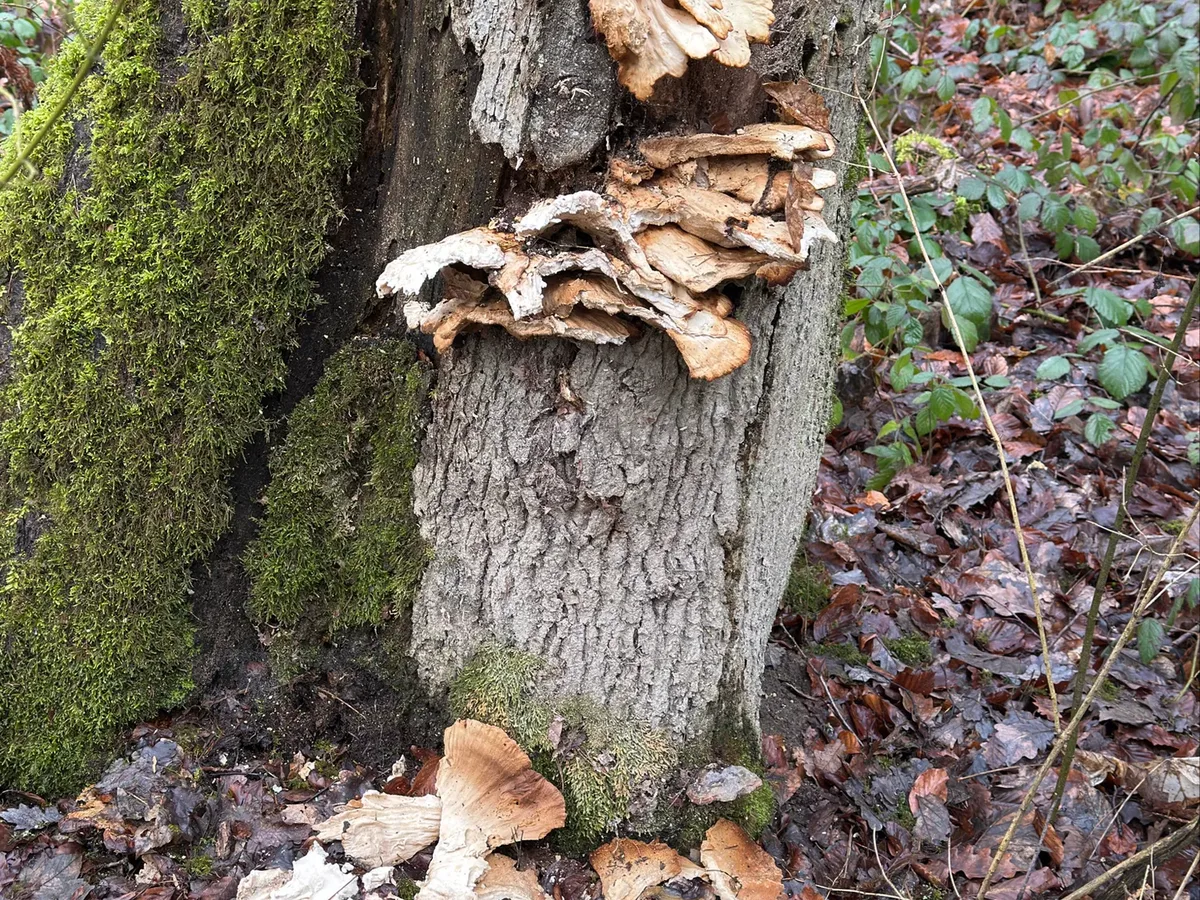 © Codrin Bucur (CC BY)
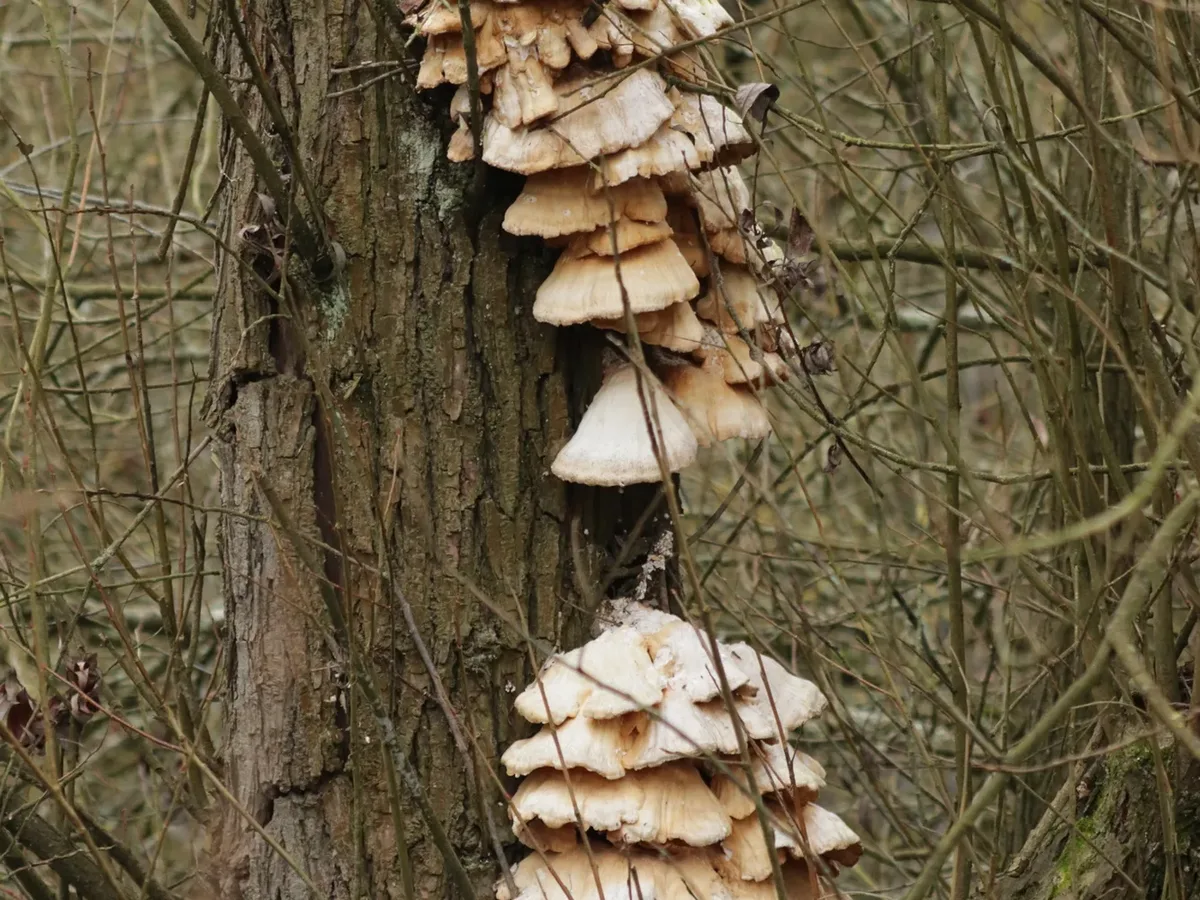 © Björn Sothmann (CC BY-SA)
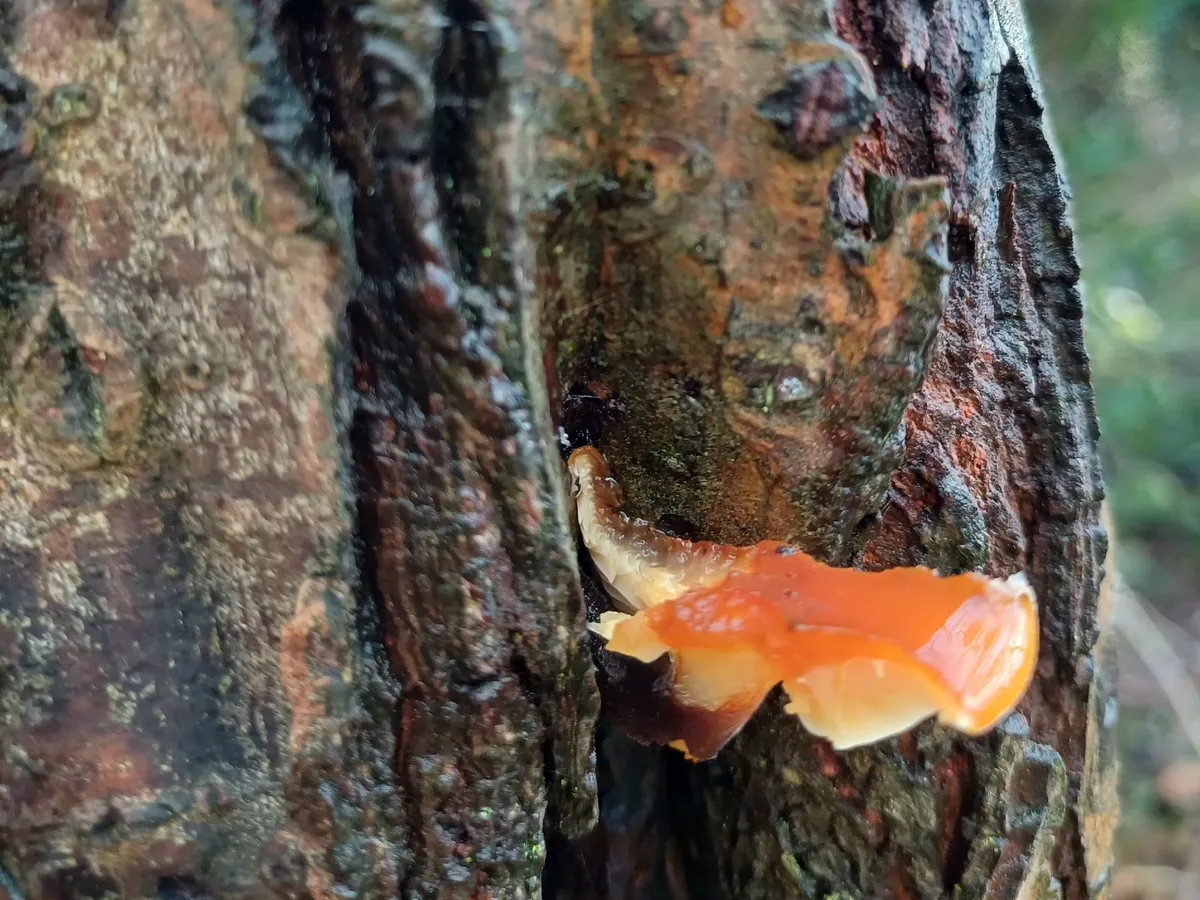 © e123456 (CC BY)
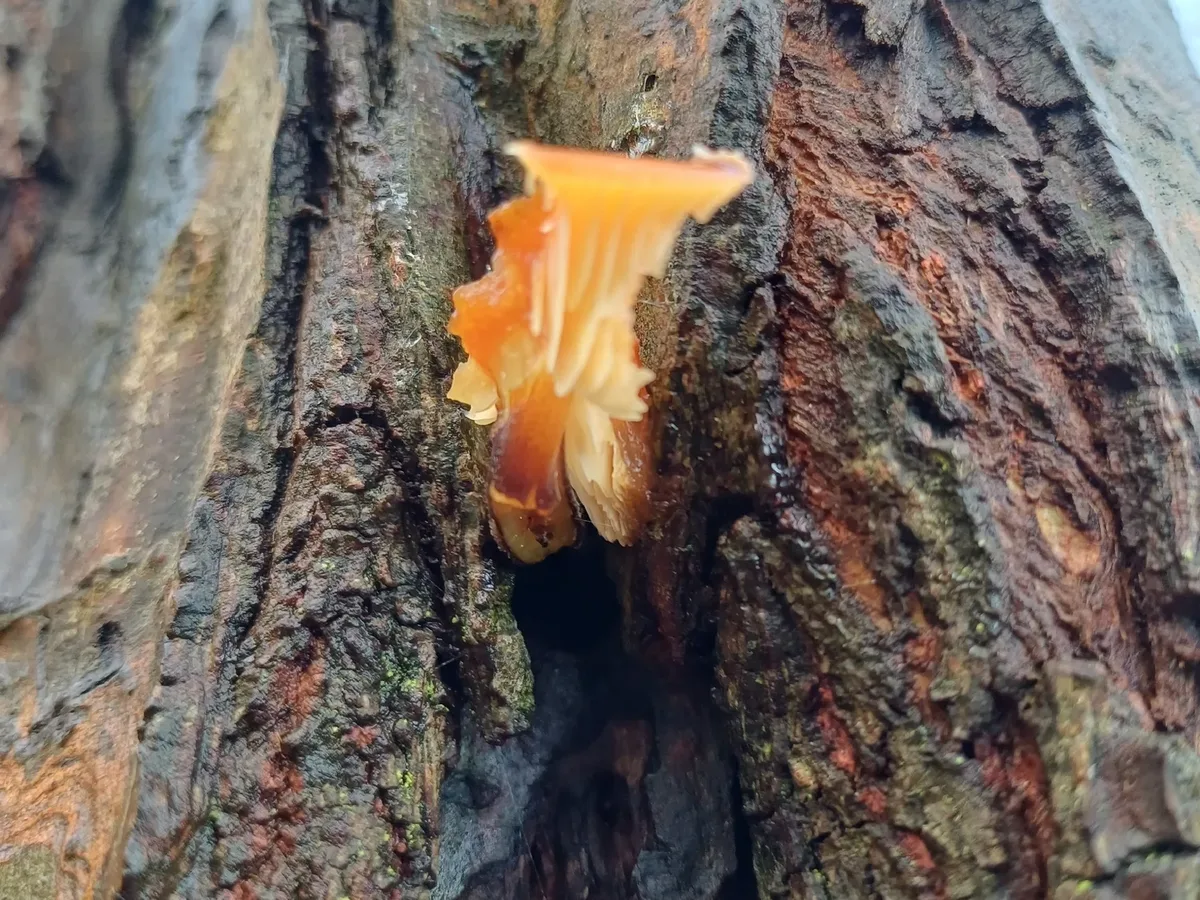 © e123456 (CC BY)
 Charles Joynson (CC0)
 Charles Joynson (CC0)
 Charles Joynson (CC0)
 © Sean Feirstein (CC BY)© Codrin Bucur (CC BY)© Björn Sothmann (CC BY-SA)
Edible only with the right preparation - or safe for some people but not others. Learn the caveats first.
How to recognise it
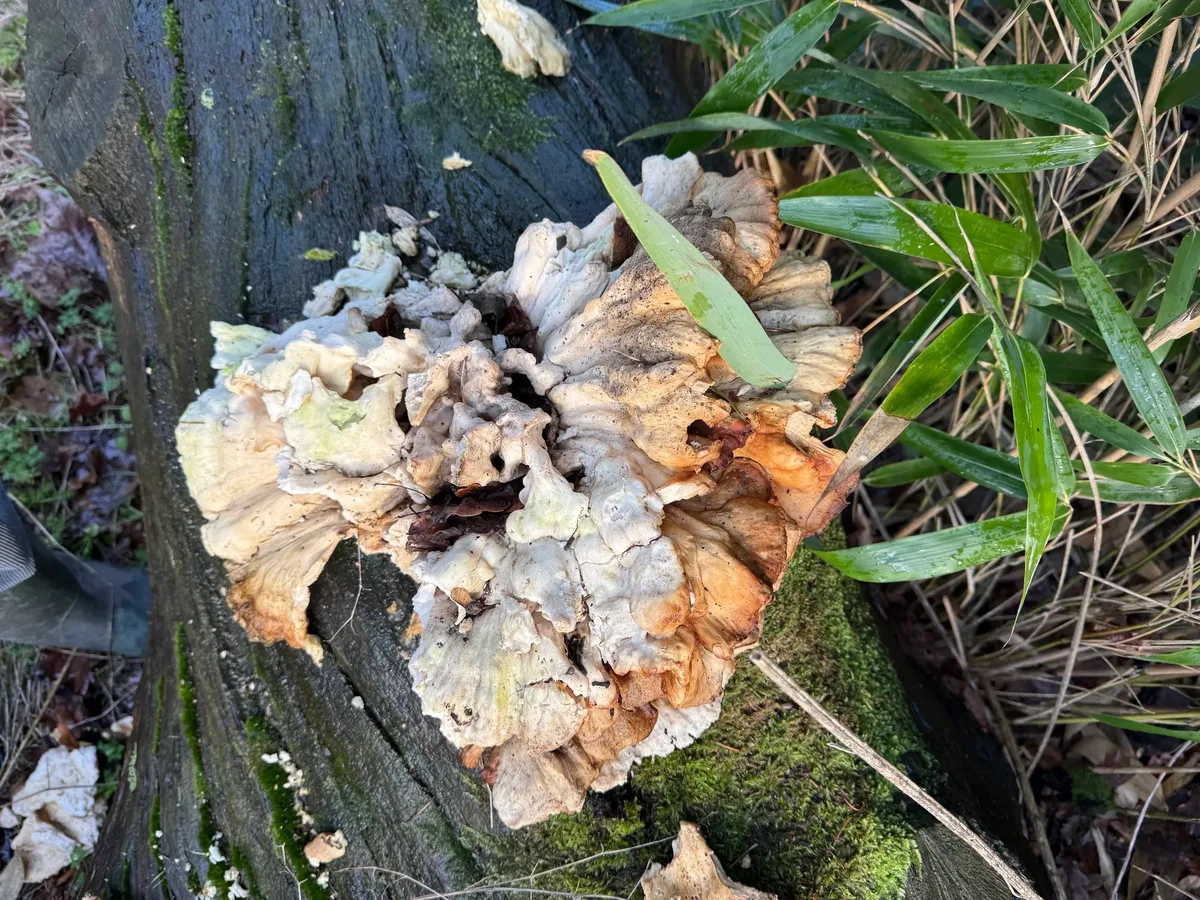
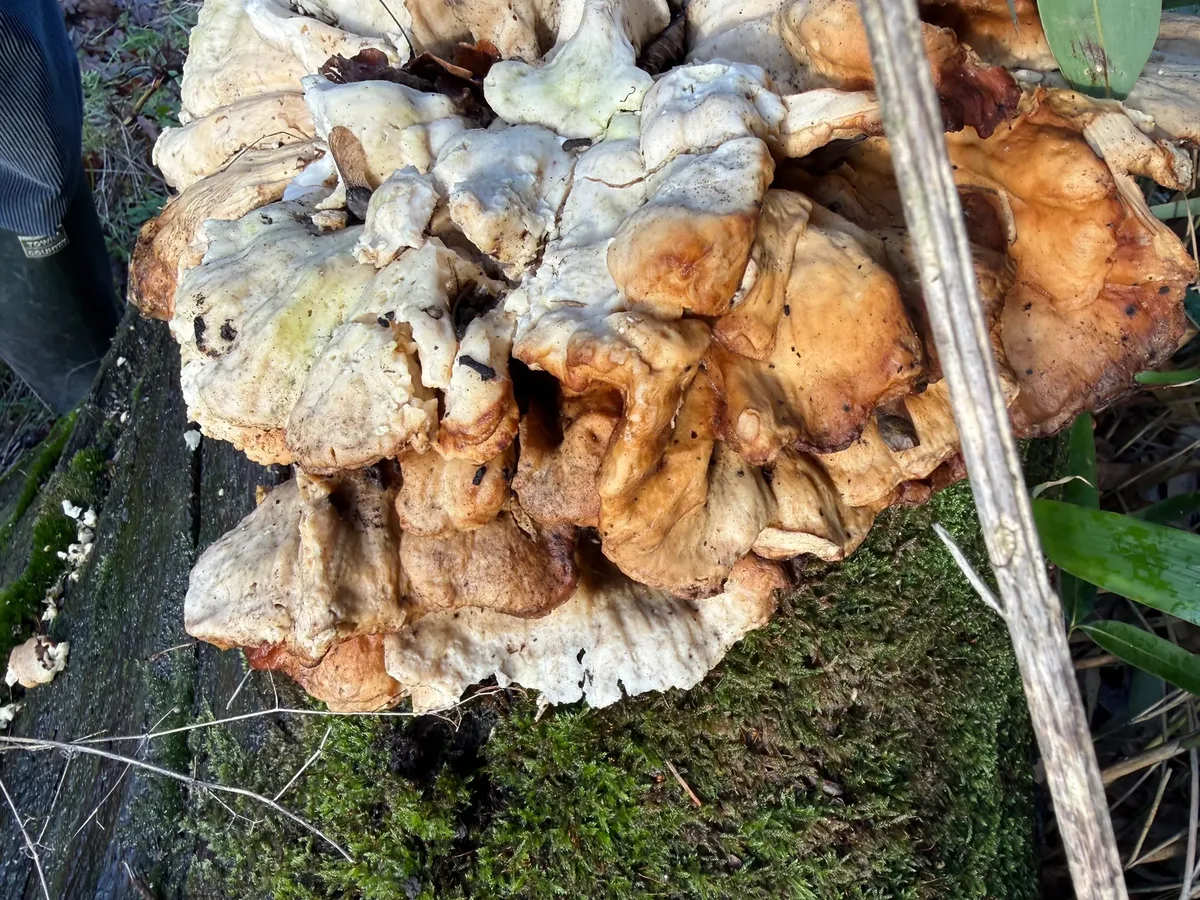
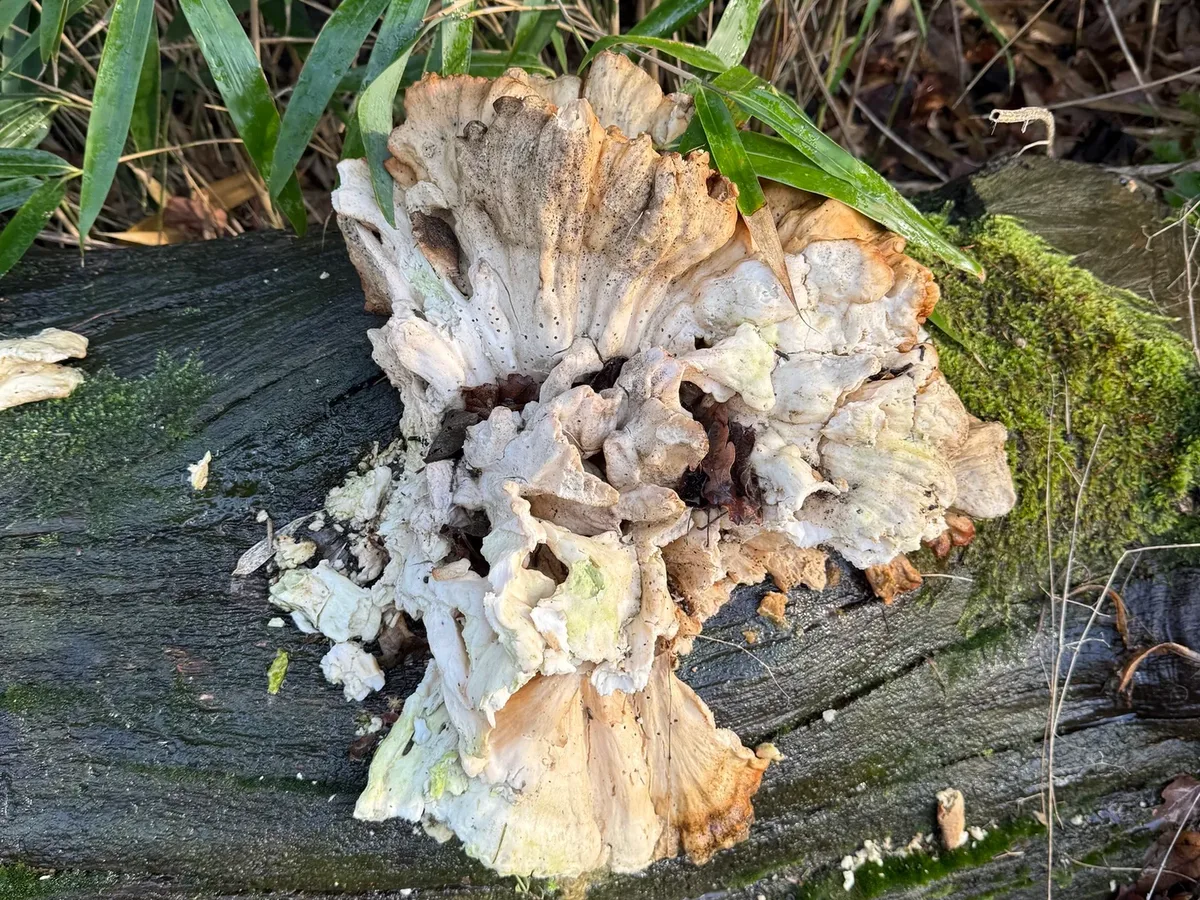
Laetiporus versisporus announces itself much the way its temperate cousins do - as a conspicuous cluster of overlapping orange to orange-yellow shelf brackets on the flank of a large dead or dying hardwood, vivid enough to be spotted from tens of metres away in the dappled light of a tropical forest. The fruiting body is a polypore, meaning spores are produced from a layer of tiny tubes (pores) on the underside rather than from gills.
Cap
The shelves are fan-shaped or kidney-shaped in outline, typically 5-25 cm across, overlapping in a shingled or tiled arrangement called imbricate growth.
The upper surface is smooth to faintly velvety when fresh and moist, most intensely coloured in the outer quarter - the actively growing margin - where the orange is clearest and most saturated, shading to paler apricot or salmon-orange toward the attachment point.
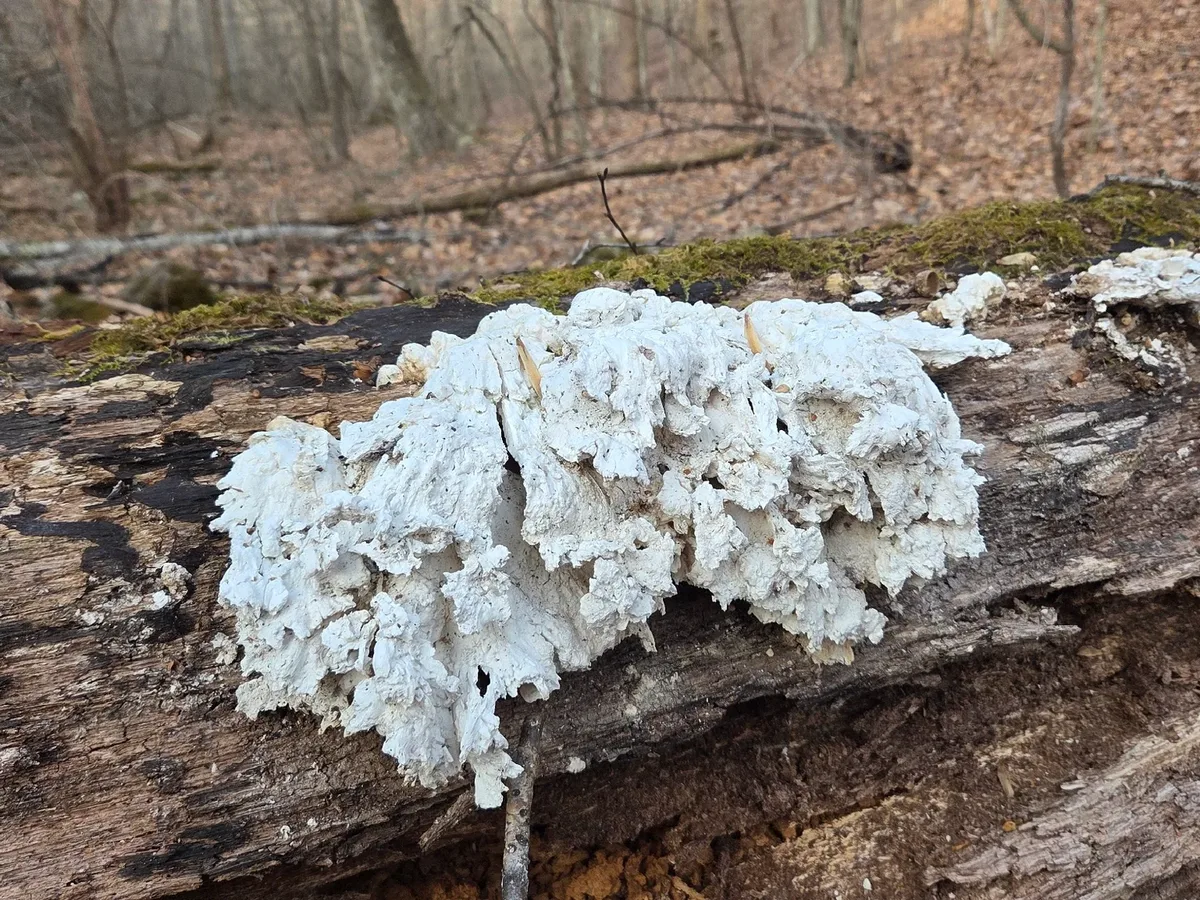
As the brackets age, all colouration fades to pale buff or cream and the tissue dries, stiffens, and becomes tough and ultimately brittle - the transition that marks the end of the edible window.
Pores
The critical underside character: the pores are white to cream in fresh young specimens, not sulphur-yellow. This white-pore character is one of the distinguishing features separating L. versisporus from the more familiar temperate L. sulphureus (yellow pores).
Flesh
When the outer margin is still bright, press it gently: young flesh dents slightly and springs back; the inner portions resist like wood. Take only what gives.
Slice through a fresh bracket and the cut face is white to cream, firm, faintly juicy, without colouration change on exposure to air.
The overall combination - orange shelves, white pores, white flesh, no gills, on dead hardwood - is essentially unmistakable in the tropical forest context.
Where & when it grows
Habitat
This is a wood-decay fungus of tropical and subtropical Asia, found wherever large hardwood trees die slowly rather than being removed immediately - in primary and secondary forest, at forest margins, in plantation settings, in parks, and in gardens where mature trees are present.
It is not mycorrhizal; it does not trade resources with living tree roots. Instead, it invades wounded, stressed, or dead hardwood and begins digesting the structural timber polymers from within, working outward from the heartwood.
The visible bracket is only the reproductive tip of a much larger internal mycelial network that may have been growing inside the host for months or years. Brown rot - the reddish-brown, cubically fractured wood that crumbles when pressed - is the signature of its handiwork.
Host identity in the tropics spans a wide range of large-timber hardwoods: dipterocarps (meranti, keruing), Ficus species, tropical oaks and stone oaks (Quercus, Lithocarpus), mango, teak, acacia, and others.
The fungus is recorded across the palaeotropics from the Philippines, Indonesia, Malaysia, and mainland Southeast Asia north into southern China (Guangdong, Hainan, Yunnan, Guangxi) and Taiwan.
Because it produces a conspicuous, large, colourful bracket, it is much easier to spot than most forest fungi - look upward along dead or dying trunks, fallen logs, and large cut stumps in areas with big-timber hardwood trees.
When
Laetiporus versisporus follows the monsoon rhythm of its tropical range.
In most of its distribution the productive season runs broadly from the start of the wet season (roughly May-June) through to the close of the monsoon (October-November), a much longer window than temperate Laetiporus species enjoy because tropical soil temperatures remain warm year-round.
Fruiting is triggered not by warming soil in spring - the soil is already warm enough - but by sustained rainfall: a flush of brackets typically appears 7-14 days after significant rain events of 25 mm or more over a two-week period.
In equatorial regions with bimodal or perennial rainfall (parts of Indonesia, Malaysia, the southern Philippines), the fungus can be found in any month of the year, though the largest and most vigorous crops track the main wet season pulses.
In the subtropical northern fringe of its range - southern China, Taiwan - the pattern converges on temperate Laetiporus: fruiting is concentrated in summer and early autumn (June-October) when summer monsoon rains combine with high temperatures.
Because the mycelium persists inside the host wood between seasons, productive trees often fruit in roughly the same spot year after year, as long as sufficient substrate remains. Once you find a well-colonised host, it is worth revisiting after rain events through the whole wet season.
How it grows
Like all Laetiporus species, L. versisporus is a saprotrophic and parasitic wood-decay fungus that causes a brown rot - digesting the cellulose and hemicellulose fractions of wood while leaving most of the lignin behind. The result is that the colonised heartwood turns reddish-brown, then chocolate-brown, and eventually fractures into small cuboidal blocks with a characteristic dry, crumbly texture.
This is worth understanding not only for identification but for timing: a large, vigorous bracket cluster usually signals a tree that has been significantly compromised for at least one to several years and whose structural integrity may be failing.
The mycelium grows inside the wood for an extended period before any surface brackets appear. A small crack or wound in the bark where the mycelium penetrates is often the only external sign before fruiting begins.
Once conditions are right - warmth plus moisture - the fruiting body expands rapidly, sometimes visibly adding centimetres of growth per day during a humid spell. The entire fruiting lifespan of a single bracket flush from appearance to decline can be as short as two to four weeks in the tropics, where warmth accelerates both growth and senescence.
Spores disperse as dry, white powder from the pore tubes on the underside; they are wind-carried and germinate wherever they land on suitable wounded wood. Because the substrate is gradually consumed, the colonised host eventually becomes unable to support another flush, but this can take many years for a large trunk.
Fruiting conditions
A wood-decay bracket fungus in tropical Asia; fruiting follows significant wet-season rainfall events (25 mm+ over two weeks) when ambient and wood temperatures are 20-33 °C. Unlike mycorrhizal species, soil temperature is less directly relevant than wood moisture and ambient warmth; the 14-day lag reflects the time needed to push new bracket tissue through bark after the mycelium is hydrated and active. Productive hosts tend to refruit across multiple wet-season events.
Look-alikes
Within its tropical Asian range, Laetiporus versisporus has no species that are simultaneously visually similar and deadly. The bracket-polypore growth form on wood, combined with the orange-to-apricot colouration and white pores, is not shared by any lethal fungus in the region.
The primary comparisons worth understanding:
- Other Laetiporus species in the overlap zone: the L. sulphureus complex has yellow pores and is primarily temperate; L. miniatus from tropical Asia is similar but tends toward more coral-red or pinkish-orange colouration.
- Omphalotus (jack-o'-lantern mushrooms), which cause severe gastrointestinal poisoning: orange-capped and able to grow in clusters near tree bases, but they produce individual cap-and-stem mushrooms with blade-like gills - not bracket shelves with pores - and the gill versus pore character is immediately obvious on inspection of the underside.
No Laetiporus species have gills; if the underside has radiating ridges rather than a spongy pore surface, the specimen is not a Laetiporus.
Ganoderma species (reishi and relatives) grow as shelf brackets on tropical hardwood and are also common in the region. They are tough, often varnished or lacquered in appearance, dark reddish-brown to purplish-black or pale cream (not orange), and though they have pores are immediately distinguishable from L. versisporus by colour, texture, and hardness.
Young Laetiporus in the early egg-like primordial stage before the shelves have opened can sometimes look like pale blobby masses on bark, but this stage is brief and the orange colouration appears almost immediately as the bracket expands.
Orange or yellow-orange and conspicuous, but produces individual capped mushrooms with a central stem and radiating blade-like gills on the underside - entirely unlike the bracket form and pore surface of Laetiporus. Omphalotus nidiformis (ghost fungus) of Australia/Southeast Asia is cream to white, bioluminescent at night, and also has gills. Inspect the underside of any suspected Laetiporus: if you see gills (sharp radiating ridges), it is not Laetiporus. The distinction is unambiguous and takes seconds to confirm. Omphalotus causes severe gastrointestinal poisoning.
Laetiporus miniatus is a closely related tropical Asian species with a more distinctly pinkish-red to coral-red or brick-red colouration (less orange-yellow), white pores, and is similarly recorded from Southeast Asia and southern China. The two species overlap in range and are edible with the same cooking requirements. Colour saturation and hue are the main field separators, though molecular work has clarified boundaries that the naked eye may not reliably distinguish. Both require cooking and carry the same individual-sensitivity caveats.
Ganoderma species are bracket polypores also found on hardwood trunks in tropical Asia, but they are immediately distinguished by their hard, woody, usually varnished or lacquered upper surface in reddish-brown, purplish, or dark shiny colours - never orange and never soft or juicy. Pore surface is cream to tan, quickly bruising brown. There is no realistic confusion with fresh L. versisporus for anyone who has handled both. Ganoderma is collected for medicinal use, not eating.
The classic temperate chicken of the woods has distinctly sulphur-yellow pores on the underside, whereas L. versisporus has white to cream pores. L. sulphureus is primarily a species of temperate forests (Europe, North America, East Asian temperate zones) and grows most frequently on oak and other deciduous temperate hardwoods. In areas of overlap in southern China or cool montane forest in Southeast Asia, the white versus yellow pore colour is the simplest separator. Both are edible when thoroughly cooked with the same sensitivity caveats.
In the kitchen
Picking & cleaning
The edible window is narrow and textural. Only the outer, actively growing margin of each shelf is worth picking - typically the outermost 3-6 cm, where tissue is brightly coloured, moist, and gives slightly to thumb pressure before springing back.
Older inner portions nearer the attachment point age and toughen first, becoming rubbery and then woody while the outer edge is still prime.
Use a knife to cut the soft outer shelves free; there is no benefit to removing the entire bracket cluster, and the mycelium inside the wood is not affected. Young, small clusters that have not yet reached full extent are often the finest eating, as all the tissue is simultaneously at peak tenderness.
Inspect the cut face: it should be uniformly white to cream, moist, and clean. Discard any section that is yellowed, slimy, insect-tunnelled, or has an unpleasant smell.
Clean harvested tissue with a dry or barely damp brush rather than soaking - waterlogged flesh steams in the pan rather than searing.
As with all Laetiporus, pay attention to the host tree; specimens growing on timber known to be naturally toxic (e.g., certain poisonous ornamental trees in urban settings) should not be eaten, as the host's compounds can influence the safety of the bracket.
Cooking
Young, fresh outer tissue of L. versisporus has a firm, meaty texture that earns it the same nickname as its temperate relatives - chicken of the woods - partly for the fibrous pull of the flesh when cooked. The flavour is mild, faintly savoury, and relatively neutral, accepting seasonings and sauces well rather than imposing a strong flavour of its own.
Thorough cooking is mandatory: every piece must be cooked through to the centre, not just browned on the outside.
Sliced about 1 cm thick and seared in a hot pan with oil until golden on both sides and fully cooked through, then finished with garlic, ginger, chilli, and a splash of fish sauce or soy sauce, it performs well as a meat substitute in Southeast Asian stir-fries.
It holds up in curries and braises and absorbs the surrounding sauce without disintegrating. In the Philippines and parts of Southeast Asia, foraged specimens are commonly cooked in coconut milk-based preparations or sautéed with local aromatics.
Do not crowd the pan - the flesh releases moisture as it heats, and overcrowding causes steaming rather than searing, which produces a pale, limp result.
Fresh harvested tissue should be cleaned and used within one to two days; blanching for two to three minutes and freezing is the most reliable preservation method. The species is not suitable for drying - dehydrated tissue rehydrates poorly and loses its characteristic texture.
Good to know
Laetiporus versisporus must be thoroughly cooked before eating - this is not optional. Raw or undercooked flesh causes gastrointestinal upset (nausea, vomiting, diarrhoea), and this effect is consistent across the Laetiporus genus worldwide.
Even with thorough cooking, a proportion of individuals experience adverse reactions: swollen lips, nausea, vomiting, or dizziness. The mechanism is not fully understood but appears to involve heat-labile compounds or residual bioactive proteins that are incompletely denatured in some preparations.
The reaction rate may be higher than in temperate Laetiporus species due to different secondary compound profiles in tropical wood-decay fungi, though well-controlled data for L. versisporus specifically are limited.
The host tree matters: specimens growing on trees whose wood or sap contains toxic compounds (certain ornamental species, euphorbs, or naturally insecticidal timber trees) should not be eaten, as bioactive compounds can accumulate in the bracket tissue.
There are no records of fatalities or serious long-term harm from properly cooked L. versisporus, and the species does not contain amatoxins, orellanin, or other life-threatening compounds.
Nonetheless, take these precautions:
- 1Start with a small serving (a few bites).
- 2Wait 24 hours before eating more.
- 3Repeat each time you try a new harvest from a different host tree or location.
Do not serve to children, pregnant women, or immunocompromised individuals without medical advice.
If significant nausea, vomiting, or swelling of the mouth or throat occurs after eating, seek medical attention and bring a specimen or photograph for identification assistance.
A reference guide - never an edibility guarantee. When in doubt, leave it out.