Lactifluus russulisporus
Lactifluus russulisporussyn. Lactarius russulisporus Cleland, Lactarius russulisporus (Cleland) Cleland
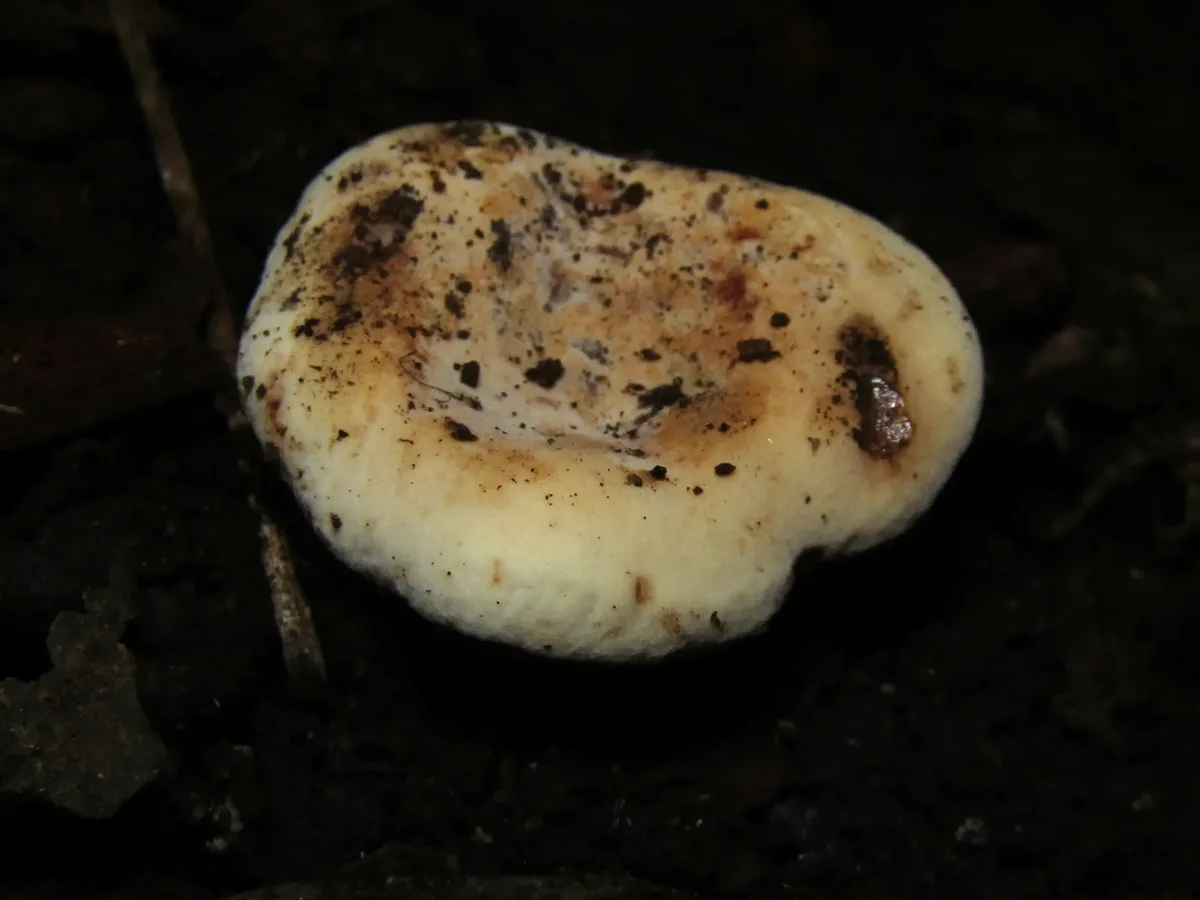 © Samuel Frankel (CC BY)
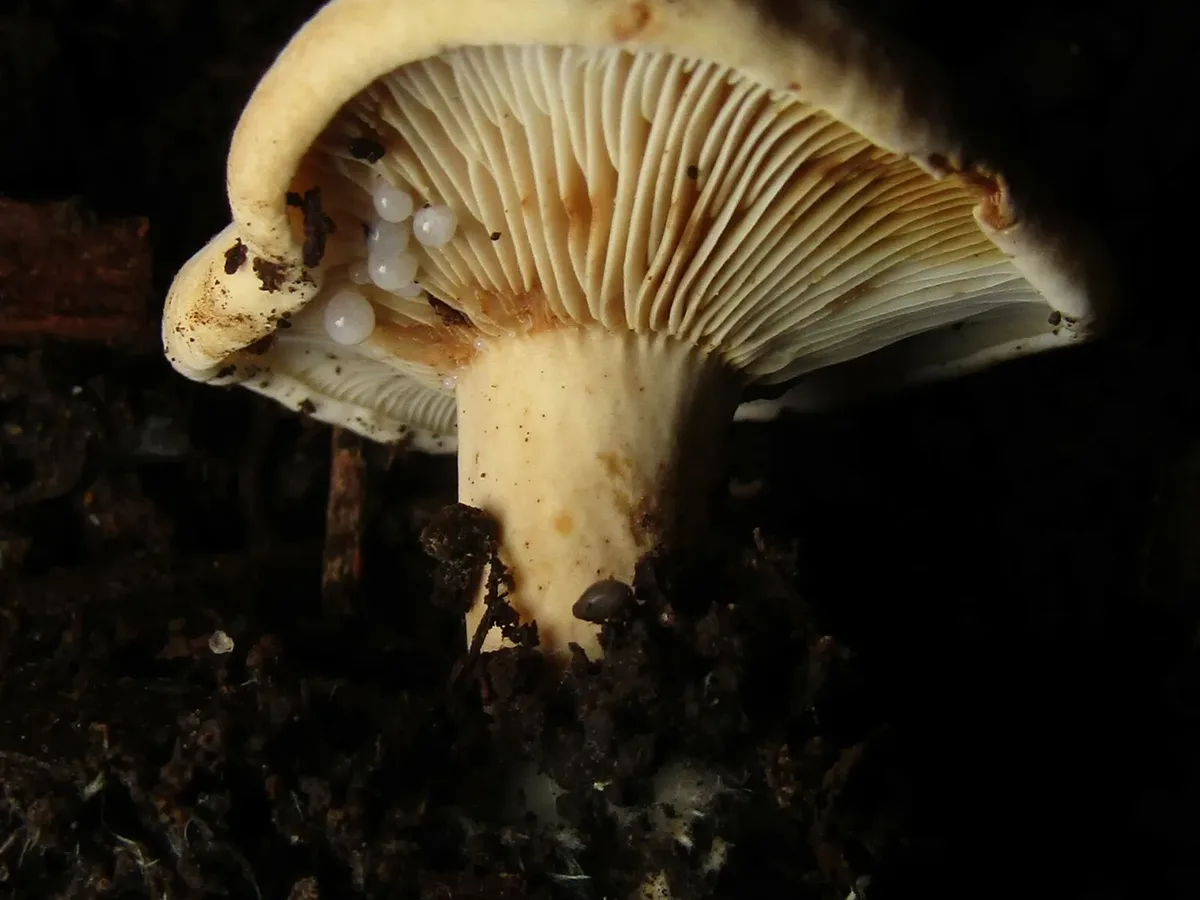 © Samuel Frankel (CC BY)© Samuel Frankel (CC BY)© Samuel Frankel (CC BY)
Edible only with the right preparation - or safe for some people but not others. Learn the caveats first.
Never eat a mushroom you are not 100% sure of - check the look-alikes below, and always cook wild mushrooms.
How to recognise it
Lactifluus russulisporus is a pale, robust milkcap. Its most obviously distinctive feature in the field is its white to cream coloration, dry cap surface, and the copious white latex that flows immediately when any part of the flesh or gills is cut or torn.
The latex is the key character: break off a piece of gill or nick the cap flesh, and white watery-white milk flows within seconds, is mild to taste, and dries without leaving a discoloured stain.
Cap
The cap starts out convex and may show a central bump, but gradually flattens and develops a central depression - typical of many funnel-developing milkcaps - while the margin unrolls from its initially inrolled position.
The surface remains dry and finely smooth throughout, distinguishing it from viscid or glutinous-capped species.
Colour ranges from clean white in young buttons to pale ivory or buff-tan in older specimens, occasionally with a faint pink-ochre tinge at the centre. Green or blue staining is absent, which distinguishes it immediately from the saffron milkcap group.
Gills
Gills are white to cream, closely spaced, and run slightly down the stem (decurrent). They do not stain blue, green, or orange when bruised.
Stem
The stem is white, firm, and solid - never hollow - with no ring and no volva at the base.
Spore print is white to pale cream. The species name honours the Russula-like (prominently ornamented, amyloid) spore surface, visible only under a microscope.
Where & when it grows
Habitat
This milkcap forms ectomycorrhizal partnerships with native Australian eucalypts and possibly sheoaks (Allocasuarina), meaning it grows only where those trees are present and cannot be separated from them. The mycelium threads through the soil in intimate association with the host root system, exchanging fungal mineral uptake for photosynthetically-derived carbon from the tree.
In practice, L. russulisporus is a species of southeastern Australian native woodland. Look for it on the ground beneath mature Eucalyptus trees in dry sclerophyll or grassy woodland settings, often in open or lightly canopied country with well-drained, slightly acidic, sandy or gravelly soils.
It does not colonise introduced tree species (pines, oaks, birches), and it is not found in gardens.
Sites that produce fruit bodies in one year tend to produce them again in subsequent years, because the perennial mycelial network persists underground regardless of whether visible mushrooms are present.
When
Fruiting follows the Southern Hemisphere autumn pattern. The bulk of the season runs from approximately March through June, with the peak typically in April and May.
The trigger is a combination of cooling soil temperatures following the Australian summer heat and the onset of significant autumn rainfall.
As soils cool from summer highs (often above 20 °C) down through the 14-18 °C range, and rain rehydrates the dried upper soil layers, the established mycelium is prompted to form fruit bodies.
A period of 15-30 mm of rainfall over one to two weeks is typically sufficient to bring on a flush, with mushrooms appearing approximately 7-14 days after the rain event.
In dry years, or years with very late or very light autumn rains, fruiting may be sparse or greatly delayed.
Higher-altitude sites and wetter southeastern Victoria and Tasmania may see fruiting continue into July.
How it grows
Fruit bodies arise singly or in small loose groups from the soil, never in tight clusters or from decaying wood.
Being strictly ectomycorrhizal, this species cannot grow without a living compatible host tree, and cannot be cultivated on logs, sawdust, or compost.
The mycelium forms a long-lived underground network - established associations may persist for decades. This explains why the same spot under a particular eucalypt may be productive season after season while nearby ground is bare.
The cap expands relatively slowly over several days, from a button stage through the funnel-shaped adult form.
Young, firm specimens that are free of insect larvae are the best quality for eating.
Fruiting conditions
Fruiting is triggered by autumn cooling of soil temperatures (from summer highs into the 12-18 °C range) combined with significant autumn rainfall of 15 mm or more over a 14-day period. Flushes typically appear 7-14 days after a qualifying rain event. Dry autumns or very warm conditions persisting late into autumn suppress or delay fruiting.
Look-alikes
Several species in southeastern Australian eucalypt woodland deserve close attention as potential confusions.
The most important danger comes from Omphalotus nidiformis (ghost fungus), a bioluminescent toxic species that can appear superficially similar to a pale milkcap at a glance but differs in every critical way:
- it grows in tight clusters at the base of dead or dying wood (including buried stumps)
- produces no latex whatsoever when cut
- has crowded gills that may be very faintly luminescent in complete darkness
- lacks the funnel-depressed cap of a mature milkcap
The complete absence of latex is the decisive test - cut any pale gilled mushroom and check for white milky sap; if none flows, it is not a milkcap.
Other Lactifluus species with white to pale caps and white latex may occur in the same habitat. These are broadly edible in the same category as L. russulisporus, and the practical distinction between them does not affect safety.
Clitocybe-type species (funnel-shaped, crowded gills, no latex) can be pale and funnel-shaped. Again, the absence of latex when cut distinguishes them from any milkcap; some Clitocybe and Clitocybe-relatives contain muscarine or other toxins and should not be eaten.
Amanita species, including the deadly death cap (Amanita phalloides), are white-capped and are present in Eucalyptus woodland in southeastern Australia, where A. phalloides was accidentally introduced with European trees. Amanitas are separated by:
- free (not decurrent) gills
- a ring on the stem
- a volva (often buried cup) at the base
- absolutely no latex - the latex test completely excludes them
A deadly amatoxin-bearing species that has established in southeastern Australian eucalypt woodland from introduced European plantings and now also occurs under native trees. It has a pale greenish-white to olive-white cap, free gills (not decurrent), a membranous ring on the upper stem, and a cup-shaped volva at the stem base (often buried - dig to find it). Produces absolutely no latex when cut. Any white or pale gilled mushroom from Australian bushland that lacks latex should be considered potentially Amanita and avoided.
A toxic bioluminescent species that can appear as a large pale funnel-shaped mushroom in eucalypt woodland. Critical differences: grows in tight clusters at the base of dead or dying wood or buried stumps (never singly from open soil), produces absolutely no latex when cut, has very crowded sharp gills that may faintly glow in complete darkness, and the cap tends to be cream to pale orange or ivory-buff with a wavy margin. Confirm the latex test - cut a gill and check for white milky sap. No latex means it is not a milkcap; do not eat it.
Several other pale-capped Lactifluus occur in Australian eucalypt woodland and share the white latex and dry cap. Differentiation often requires microscopic examination of spore ornamentation. From a foraging safety perspective, these species are in the same edible category as L. russulisporus; confusion among them does not affect safety.
Various pale, funnel-shaped gilled mushrooms in Australian woodland may superficially resemble a depressed milkcap. None produce latex - the latex test is fully diagnostic. Some Clitocybe and allied species contain muscarine or other compounds and can cause illness; do not eat any pale funnel-shaped mushroom that does not bleed white milk when cut.
In the kitchen
Picking & cleaning
Confirm identity before collecting by performing the essential latex test: break a gill or nick the flesh at the edge of the cap - white watery milk should flow within seconds.
Then confirm:
- 1the latex is mild-tasting and white (not orange, not rapidly staining green or blue)
- 2the cap is dry (not viscid or slimy)
- 3the gills do not stain orange, blue, or green when bruised
- 4the stem is solid with no ring and no cup (volva) at the base
- 5the mushroom is growing from soil under a native eucalypt, not from wood or soil near planted conifers or oaks
All five checks should be positive before collecting.
- Pick young to mid-aged, firm specimens.
- Cut the stem at ground level rather than pulling, which disturbs the mycelium.
- Carry in an open basket; avoid plastic bags that cause sweating and deterioration.
Cooking
The firm white flesh of Lactifluus russulisporus cooks well and holds its texture. The mild, slightly nutty flavor is not as pronounced as some prized northern hemisphere milkcaps, but the mushroom is pleasant and versatile in the kitchen.
Sauté in butter or olive oil over medium-high heat until the moisture driven off by cooking evaporates and the cut surfaces begin to brown; the browning develops depth of flavor.
Pairs well with garlic, thyme, cream sauces, scrambled eggs, and pasta. Can also be added to soups and stews, where the firm flesh resists overcooking.
Young, freshly picked specimens have the best texture; older specimens may soften and become less appealing.
Dry the surplus by slicing thinly and drying on a rack in a warm, ventilated space, or in a low oven; dried milkcap slices reconstitute well in soups and sauces.
Always cook before eating - raw consumption of milkcaps is not recommended.
Good to know
Lactifluus russulisporus is a genuine edible with mild, non-acrid latex and no known toxins.
The key safety principle is accurate identification. This species is only safe to eat if the full character suite is confirmed:
- white non-staining latex from cut flesh under a native eucalypt
- dry cap
- solid stem without a ring or volva
- growth from soil (not wood)
The latex test is non-negotiable: confirm visible white milk flows from a cut surface before considering any pale gilled mushroom for consumption.
The most dangerous species in the same environment - Omphalotus nidiformis and Amanita phalloides - produce no latex at all, so this single test provides very strong protection.
As with all wild fungi:
- cook thoroughly (do not eat raw)
- introduce new species one at a time in modest portions
- be confident in your identification before consuming
If in any doubt, consult a local mycological society (several active clubs operate in Victoria, New South Wales, South Australia, and Western Australia) or a competent expert before eating.
A reference guide - never an edibility guarantee. When in doubt, leave it out.