Medusa milkcap
Lactifluus medusaesyn. Lactarius medusae
 Atlas of Living Australia (CC0)
 Atlas of Living Australia (CC0)Atlas of Living Australia (CC0)Atlas of Living Australia (CC0)
Edible only with the right preparation - or safe for some people but not others. Learn the caveats first.
Never eat a mushroom you are not 100% sure of - check the look-alikes below, and always cook wild mushrooms.
How to recognise it
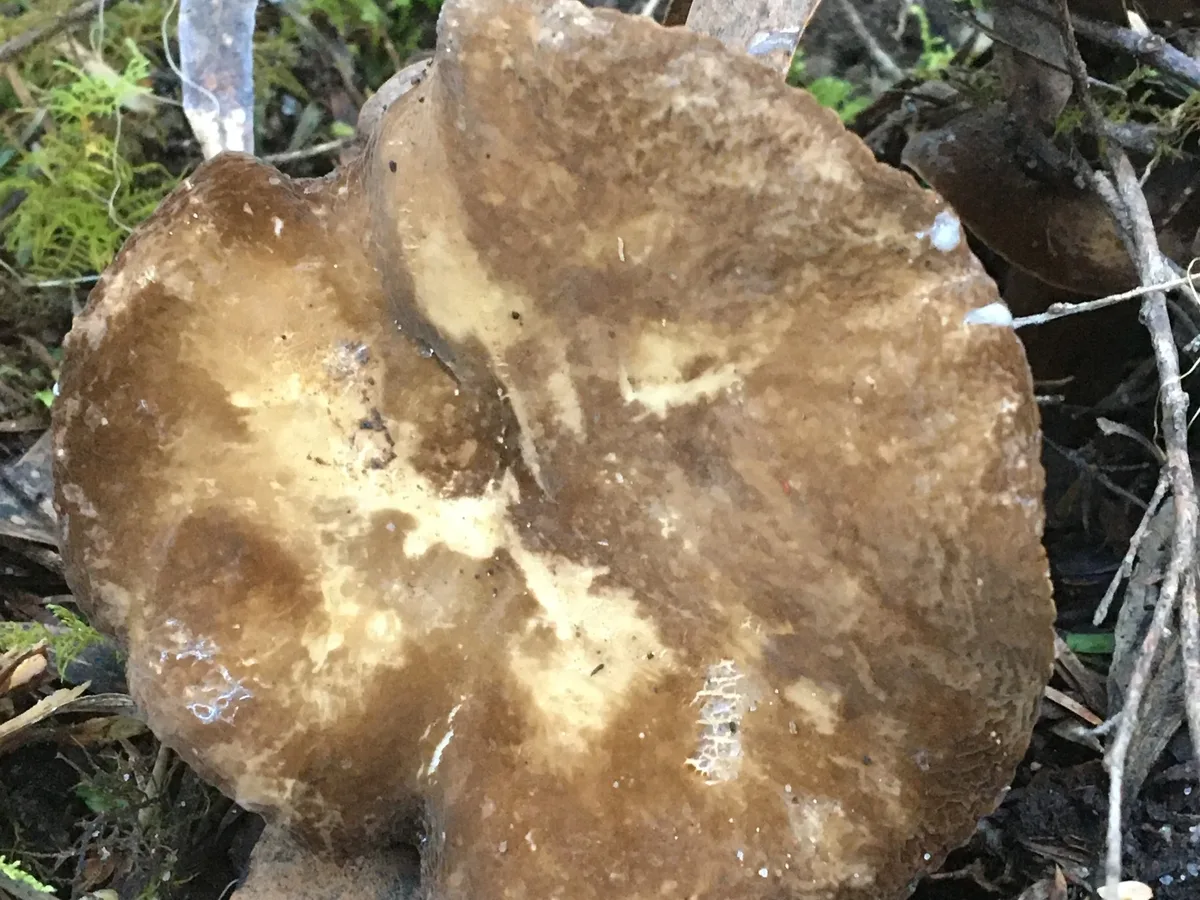
The most distinctive feature of Lactifluus medusae is the striking hairy cap surface - a dense mat of long, coarse, irregularly branching hair-like elements covering the entire pileus, evoking the serpentine locks of the mythological Medusa. No other common African milkcap approaches this degree of hairiness.
Cap
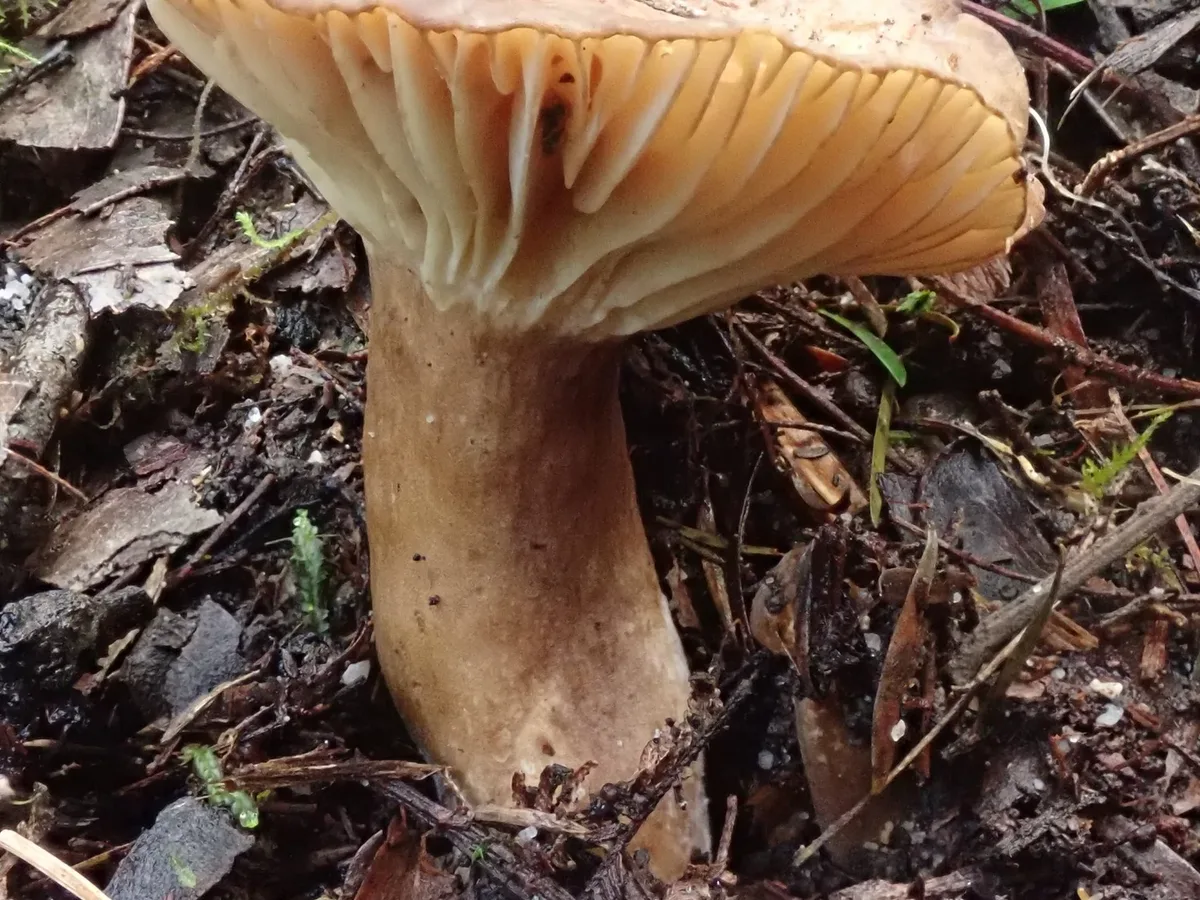
The cap ranges from 5-15 cm and starts convex, soon depressing centrally and becoming broadly funnel-shaped in age. The ground colour is pale buff to ochraceous-tan, partially obscured by the hair covering.
Gills
Crowded, decurrent, white to cream.
Stem
Stout, pale buff to white, solid, 3-8 cm high.
Latex
When any part of the flesh or gills is cut or broken, copious white latex flows immediately - this is the defining trait of the genus.
The latex of L. medusae is white and does not discolour on air exposure. It tastes mild to slightly bitter depending on collection location and season.
Why it's dangerous
Danger level is LOW when the species is correctly prepared using the mandatory parboiling step with the first cooking water discarded before the final preparation. This is the traditional processing method that local communities apply as standard practice, and it reliably removes the water-soluble sesquiterpene irritants.
Danger level rises to MODERATE if the mushroom is:
- consumed raw
- dried without prior parboiling
- cooked in a way that retains the first boiling water (e.g. added directly to a stew without a prior parboil and water discard)
Under those conditions, gastrointestinal irritation is probable. No known fatalities are attributable to this species.
The most important safety distinction to internalise: L. medusae is not to be confused with deadly Amanita species. Amanita species responsible for fatal poisonings (such as Amanita phalloides, which contains amatoxins causing irreversible liver and kidney failure) produce absolutely no latex when cut.
If you cut a gill or the flesh and no white milky sap flows, do not eat the mushroom - it is not a milkcap.
Toxin
The irritant compounds in Lactifluus medusae belong to the sesquiterpene lactone class - the same broad category of secondary metabolites responsible for the acrid, burning taste and gastrointestinal irritancy found across pungent milkcap species (Lactarius and Lactifluus).
The exact sesquiterpene compound(s) present in L. medusae have not been individually isolated and characterised for this species in the published literature. However, the acrid-latex phenotype and the documented irritancy pattern are fully consistent with the sesquiterpene lactone chemistry established for related acrid milkcaps.
The irritant is concentrated in the latex and, to a lesser degree, in the flesh.
Importantly, the irritant level is not fixed - it varies meaningfully depending on:
- collection site (soil chemistry, host tree species)
- season (time within the rainy season)
- developmental stage of the fruiting body
Specimens harvested early in the flush, or from certain soil types, can be noticeably more pungent.
This variability is why the mandatory parboiling step with first-water discard is non-negotiable - it removes the water-soluble irritant fraction regardless of how mild or strong any individual collection happens to be.
Symptoms
Consuming insufficiently prepared specimens - raw, lightly sautéed without pre-boiling, or parboiled but with the first water retained - can cause gastrointestinal irritation.
The typical symptom pattern for acrid milkcaps of this class is:
- nausea
- abdominal cramping
- vomiting
- diarrhea
Onset is generally within 30 minutes to a few hours of ingestion.
The irritant acts on the gastrointestinal mucosa locally. It is not a systemic poison, does not cause organ damage, and is not neurotoxic.
Symptoms are self-limiting - they resolve as the irritant is expelled and the gut lining recovers, usually within several hours.
Severe dehydration from prolonged vomiting and diarrhea is the main medical risk in vulnerable individuals (young children, elderly, immunocompromised), and oral rehydration is the appropriate supportive measure.
No fatalities from L. medusae specifically, or from correctly-identified acrid milkcaps of this type, are documented in the mycological or clinical literature.
Staying safe
Lactifluus medusae is consumed by local communities in Zambia and the DRC as part of the seasonal mushroom harvest, alongside other miombo milkcaps.
The standard processing practice is to boil the mushrooms, discarding the first water, then cook in relish or stew. This precaution eliminates any residual irritants that may be present in the latex.
The extreme shaggy hairiness of the cap makes this species essentially unmistakable when the full character suite is present:
- coarse Medusa-hair cap
- white non-staining latex
- miombo habitat
Never eat any wild mushroom without confirming white latex flow from a cut surface.
Where & when it grows
Habitat
Strictly mycorrhizal with miombo-woodland trees, most commonly Brachystegia and Julbernardia species.
The miombo biome spans a broad arc across central Africa - from Angola and southern DRC through Zambia, Malawi, Zimbabwe, and Tanzania - and L. medusae is documented throughout this range.
It grows on open woodland floor, often in lateritic soils with a deep leaf litter layer of miombo foliage.
Understanding this habitat dependence is key to correct identification: if you are not under a Brachystegia canopy, the probability of encountering this species drops sharply.
When
Fruiting is triggered by the onset of seasonal rains in the region's dry-summer tropical climate.
- The first substantial flush often appears in late November or early December, following the first heavy rains.
- It peaks through January and February, when cumulative rainfall is highest.
- It tapers in March-April as rains diminish.
In wetter years at higher elevations, isolated fruiting bodies may appear as early as October.
How it grows
Grows singly or scattered in small clusters on the woodland floor.
Being obligately mycorrhizal with miombo trees, the mycelium is part of a long-lived association with the host root network.
Individual mushrooms can be large and conspicuous given the pale shaggy cap against the dark leaf litter. Experienced local collectors know specific trees and patches that fruit reliably year after year.
Fruiting conditions
Fruiting is strongly linked to sustained rainfall totals during the tropical rainy season. Warm soil temperatures (20-30°C) and accumulated rainfall exceeding 30 mm over a 14-day window trigger flushes. First fruiting bodies typically appear 5-12 days after significant rain events.
Look-alikes
Within the genus Lactifluus, several species occur in the same miombo woodland and share the white latex and funnel-shaped cap:
- L. edulis and related taxa have smooth to only slightly hairy caps, lacking the extreme shaggy hairiness of L. medusae.
- L. velutissimus (the velvet milkcap) has a velvety but not coarsely hairy surface, is darker in colour, and produces an acrid latex.
Outside the genus, no deadly species in the African context has a coarsely hairy cap with copious white latex. However, pale Amanita species (including deadly taxa like Amanita phalloides where introduced, and native toxic Amanita in the region) lack latex entirely.
Always verify white latex flow before eating any suspected milkcap.
Pale Amanita species might superficially resemble a milkcap to the inexperienced. However, Amanita absolutely never produces latex (milky sap) when cut - always cut the gills and check for a white milky flow. Amanita also has free gills, a ring on the stem, and a volva (cup) at the base, none of which are present in Lactifluus.
L. edulis has a smooth to only finely hairy cap surface, lacking the dramatic coarse shaggy 'Medusa' hairs of L. medusae. Both are edible miombo milkcaps; L. edulis cap is noticeably smoother and often longitudinally wrinkled at the centre.
The velvet milkcap has a finely velvety surface that feels soft but is not coarsely hairy. It tends to be darker - brownish-grey to blackish-brown - and has a more acrid latex. Tell apart by colour, the finer velvet texture, and the sharper-tasting latex.
A reference guide - never an edibility guarantee. When in doubt, leave it out.