Clarke's milkcap
Lactifluus clarkeaesyn. Lactarius clarkeae Berk. & Broome, Agaricus clarkeae Berk. & Broome
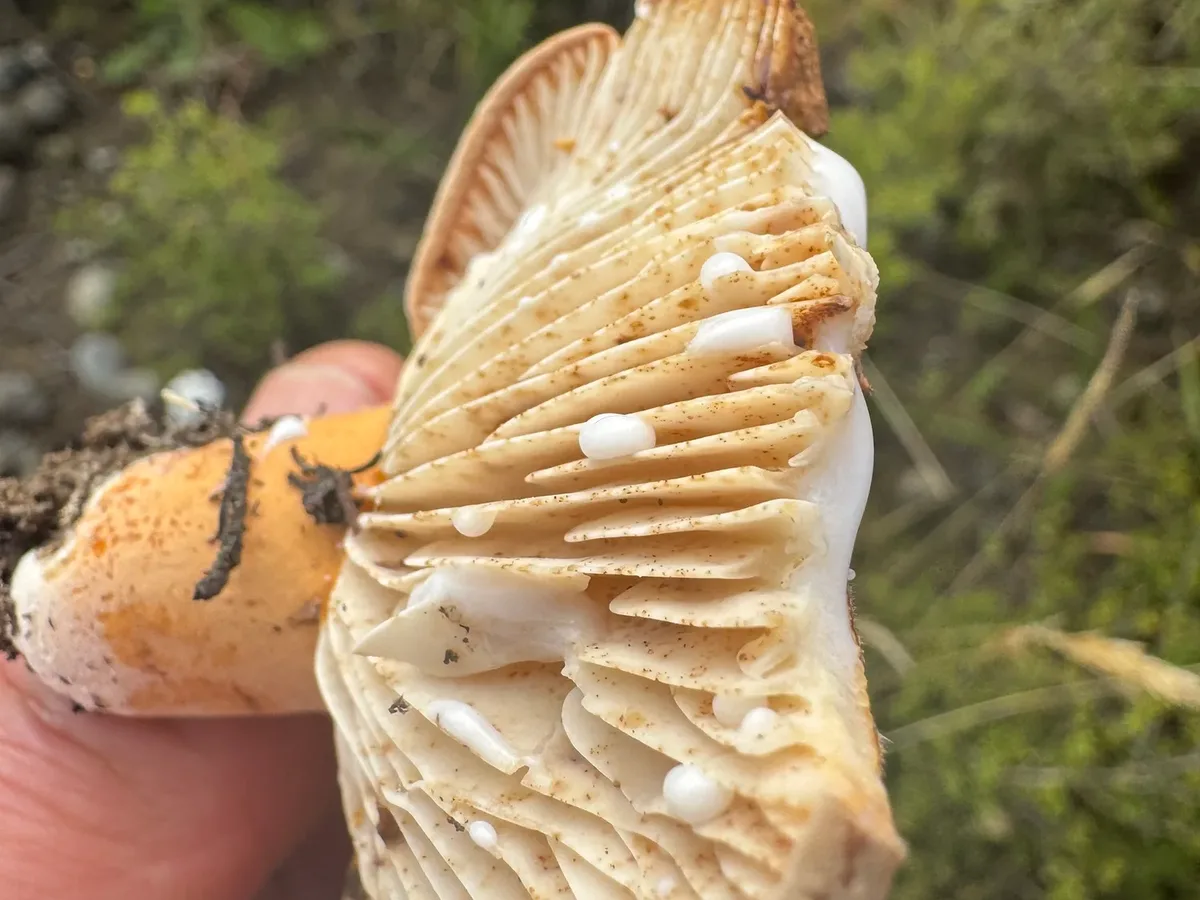 © Ian Dickie (CC BY)
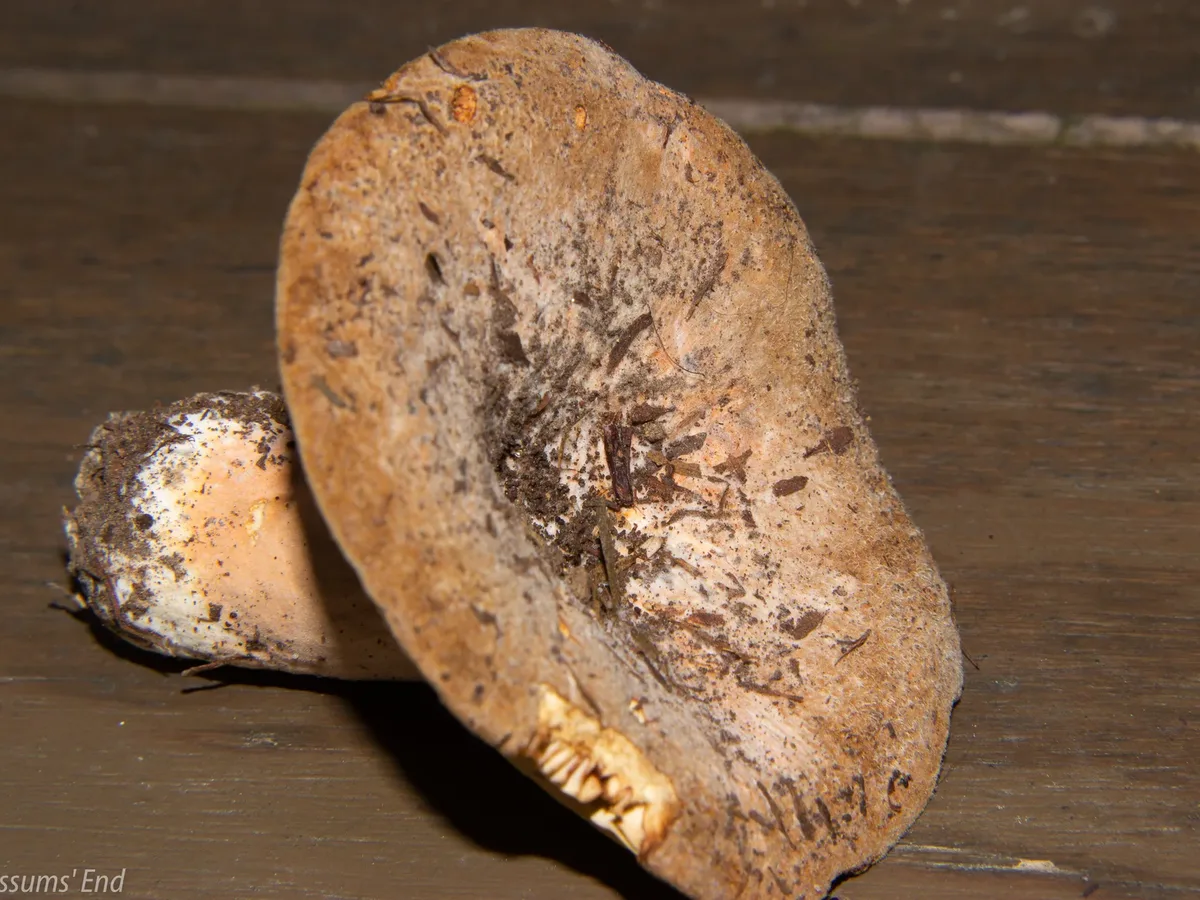 © Possums' End (CC BY 4.0)
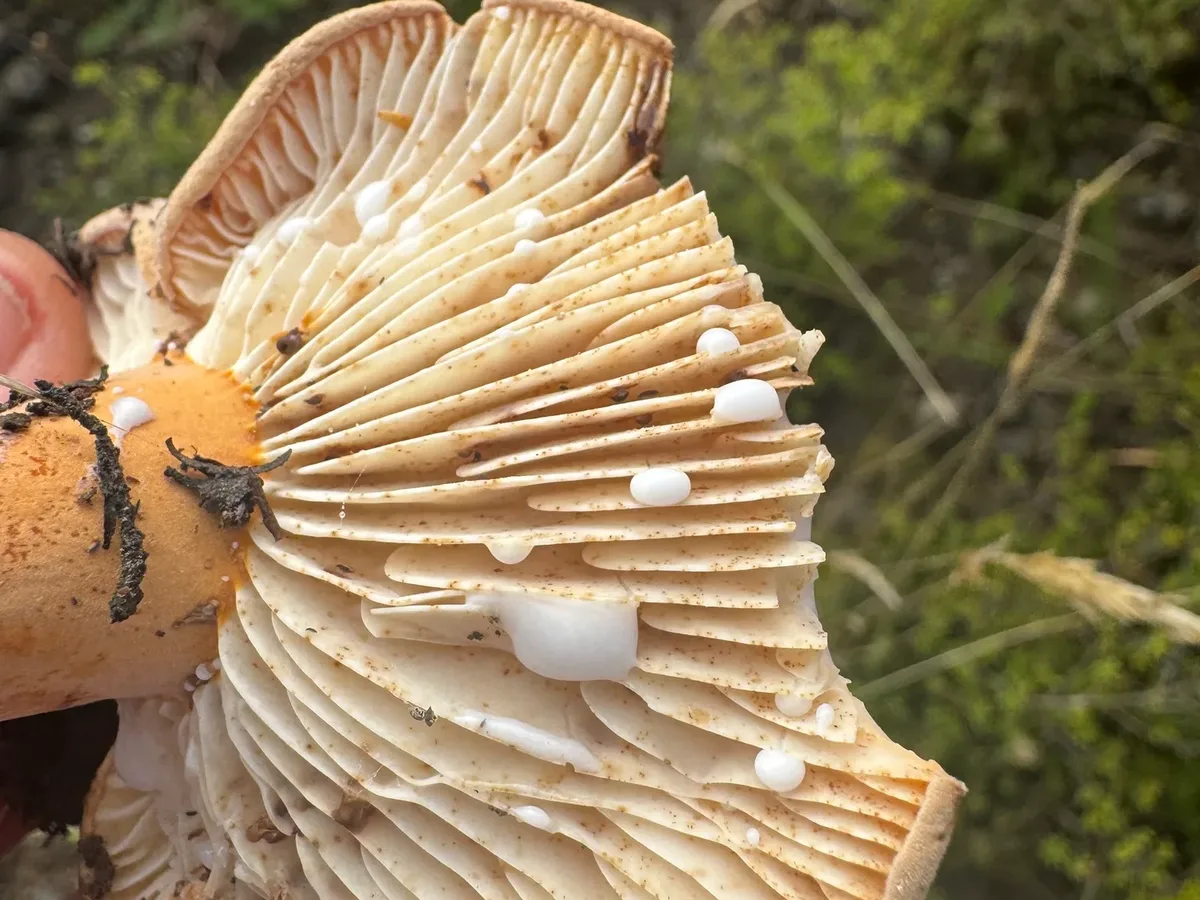 © Ian Dickie (CC BY)© Ian Dickie (CC BY)© Possums' End (CC BY 4.0)
Good to eat, once you have identified it with certainty and cooked it through.
Never eat a mushroom you are not 100% sure of - check the look-alikes below, and always cook wild mushrooms.
How to recognise it
Clarke's milkcap is a handsome, medium-to-large mushroom that is relatively conspicuous against the eucalyptus leaf litter of Australian sclerophyll forests.
Cap
The cap is a vivid orange-red to brick-red. Its surface is dry and non-slimy - unlike many European milkcaps, it does not become viscid even in heavy rain - and tends to retain its bright colouration until quite old, only fading to dull brownish-orange in senescence.
Gills
The gills begin cream-coloured but develop characteristic lilac-mauve staining wherever the latex touches them, which occurs naturally with age and wherever the fruitbody is handled or damaged.
Stem
The stem matches or is slightly paler than the cap and is firm and solid in fresh young specimens.
Flesh
The single most important identification character is the latex: when any part of the fruitbody is broken or cut, copious white milk immediately flows out. Left for two to three minutes, this latex undergoes a visible colour shift from white to lilac-mauve - a reaction driven by enzymatic oxidation of the latex compounds.
This colour change is rapid enough to observe in the field by cutting a small piece of gill and watching it on a white surface or white tissue. No other eucalypt-associated Australian mushroom has white latex that stains lilac. The flesh itself also eventually turns lilac-mauve at cut surfaces, confirming the reaction.
Taste
The mild (non-burning, non-acrid) taste of the latex distinguishes it from the acrid milkcaps of section Urentes such as the closely related Lactarius wirrabara.
Where & when it grows
Habitat
Clarke's milkcap is one of the most widespread and frequently collected native milkcaps of southeastern Australian sclerophyll forest. It is obligately mycorrhizal with Eucalyptus and cannot be found outside eucalypt-dominated woodland.
The richest collecting grounds are:
- the wet sclerophyll forests of Victoria's Dandenong and Otway Ranges
- the mountain ash (Eucalyptus regnans) forests of the Victorian Central Highlands
- the blue gum and peppermint-dominated forests of the lower ranges and foothills
In these habitats the fruiting bodies emerge from beneath the thin eucalyptus litter layer or from soil, often on sloped ground where water drains through the rooting zone without waterlogging.
The species appears able to associate with several eucalyptus species across a range of elevations from near sea level to approximately 1200 m, though it is most abundant in forests dominated by messmate (E. obliqua) and mountain ash (E. regnans) at mid-elevations.
It does not occur in rainforest (where ectomycorrhizal trees are largely absent) or under pure acacia or casuarina stands.
When
In southeastern Australia the fruiting season is anchored to the cooling of soils after the summer-dry period. April and May are the most reliable months across most of the range.
By April, daytime temperatures in the Victorian ranges typically fall below 15-18 °C, autumn rains have begun, and soil moisture at the 5-10 cm depth relevant to mycorrhizal networks starts to recover.
Well-established mycelia respond quickly to this moisture-and-temperature trigger, and once conditions are right the fruitbodies can appear within one to two weeks of the first meaningful autumn rains.
In lower-elevation or more northerly sites (northern NSW), the season may be delayed to May-June; in high-altitude Tasmanian sites, March collections have been recorded.
By July, soils in most locations have cooled below 6-8 °C - too cold for fruiting to continue - and the season winds down until the following autumn.
How it grows
Fruits singly to loosely scattered - usually one to five fruitbodies visible in a small area, occasionally more after particularly wet autumns.
The fruitbodies emerge directly from soil, sometimes with the base of the stem partly buried in leaf litter. They grow relatively slowly compared to saprotrophic species, taking five to ten days from pinhead to full maturity.
The cap edge tends to remain inrolled until the specimen is nearly fully expanded, giving young fruitbodies a distinctly globose appearance. Buttons are firm and tight; old specimens eventually become broadly bowl-shaped and are more prone to insect and slug damage.
Fruiting conditions
Responds to the first meaningful autumn rains following the summer-dry period in southeastern Australia; requires soil cooling below approximately 18 °C and a minimum of 15-20 mm rainfall over the preceding two weeks to initiate fruiting; peak flushes follow 10-14 days after sustained autumn rain events in April-May
Look-alikes
The combination of a dry orange-red cap, white latex turning lilac-mauve, and eucalyptus forest habitat is highly distinctive and rules out most look-alikes when all three features are confirmed together. The primary danger, however, comes from species that a forager might pick WITHOUT checking for latex.
In eucalyptus woodland Cortinarius species (webcaps) are abundant and diverse - they can have orange-brown, brick-red, or tawny caps similar in size and colour to Clarke's milkcap. Cortinarius differ in that they:
- produce no latex whatsoever
- have gills that start pallid then become rusty-brown as the spores mature
- may show remnants of a cobwebby (cortinate) veil on the stem when young
- have a spore deposit that is rust-orange to rust-brown rather than white
Crucially, some Cortinarius species in Australian eucalyptus forests contain orellanin, a potent nephrotoxin that causes irreversible kidney failure with a characteristically delayed onset (symptoms often absent for one to three weeks after ingestion). The latex test is the definitive safety check: no latex, not a milkcap, do not eat.
Other orange-capped milkcaps that occur in southeastern Australian eucalyptus forests, such as Lactarius eucalypti, are visually similar. Lactarius eucalypti has white non-staining latex (it does not turn lilac), which serves as the key distinction: if the latex stays white and does not change colour after three to four minutes on a tissue, it is not L. clarkeae.
The native Australian Amanita species - some of which are deadly (containing amatoxins) - are occasionally orange or reddish in the young button stage. However, Amanita species have free gills, a ring on the stem, a volva at the base, and crucially produce no latex whatsoever.
Field confusion with L. clarkeae is implausible: button-stage A. phalloides is a pale, volva-enclosed egg with no orange colouration, no latex, and no lilac-staining reaction, and in Australia it is restricted to urban and peri-urban plantings of exotic oaks and other introduced trees - a completely disjunct habitat from the native eucalyptus and Nothofagus forests where L. clarkeae occurs. The genus-level checks remain absolute regardless: Amanita produces no latex whatsoever; its gills are white and free from the stem; a skirt-like ring is present on the stem; and a cup-shaped volva encases the stem base and is visible when carefully dug up. Any candidate lacking copious white latex that turns lilac-mauve is not L. clarkeae.
DEADLY RISK - Australian eucalyptus forest Cortinarius species can have orange-red to brick-red caps of similar size and stature to Clarke's milkcap. They produce absolutely NO latex; their gills age to rusty-brown from a spore deposit rather than turning lilac; and some contain orellanin, which causes irreversible fatal kidney failure with delayed symptom onset of one to three weeks. Always break the flesh and gills and confirm copious white latex flows and turns lilac before collecting. If no latex appears - put it down.
A closely related Australian milkcap also associated with Eucalyptus; visually very similar, with an orange to reddish-ochre cap. The key distinction is the latex: Lactarius eucalypti produces white latex that does NOT turn lilac-mauve on exposure to air - it stays white. If the latex remains white after three to four minutes on a tissue or fingernail, it is not Lactifluus clarkeae. Edibility status of L. eucalypti is similar but it is a distinct species requiring its own evaluation.
Another Australian milkcap of similar sclerophyll habitats, but with an ochre-brown to clay-buff (not orange-red) cap. Its latex is white and remains white on exposure to air - it does not turn lilac-mauve. Importantly, the latex of L. wirrabara is intensely acrid-burning on the tongue, unlike the mild latex of Lactifluus clarkeae. The taste test (a tiny touch of latex to the tongue) combined with the colour-change test distinguishes the two: clarkeae has mild non-acrid latex that turns lilac; wirrabara has burning-acrid latex that stays white.
In the kitchen
Picking & cleaning
Select young to medium-aged specimens where the cap is not yet fully flattened and the gills are still cream with only slight lilac staining. Older, flattened, heavily mauve-stained specimens are edible but have a softer texture and are more likely to harbour insect larvae.
Perform the latex test before collecting: break a small piece of gill and observe the exuded liquid; it should be white, copious, and should begin turning lilac-mauve within two to three minutes. This confirms the identity.
If no latex flows, discard the specimen immediately - the absence of latex means it is not a milkcap and could be a dangerous look-alike.
Transport in a firm-bottomed basket, cut side up where possible, to limit latex staining. The mauve-staining latex will stain fabric, so avoid carrying loose specimens in pockets.
The flesh, once cut, will also develop lilac coloration during cooking; this is normal and does not indicate any problem.
Cooking
Clarke's milkcap is mild-flavoured with a firm, meaty texture that holds its shape well under heat - qualities that make it genuinely enjoyable in the kitchen.
The cooked mushroom will take on a lilac-mauve tint from the latex; this is completely normal and does not affect flavour or safety. Raw consumption is not recommended, as with most milkcaps.
The simplest preparations suit it best: slice and sauté in butter or olive oil over medium heat for five to eight minutes until golden, then season with salt, pepper, and fresh herbs.
Its firm texture stands up to pasta dishes, risotto, and stews, and it works well alongside grilled meats. If using in soups or stews, add it in the last ten minutes to keep the texture intact.
It does not dry or store as well as some European milkcap species, so plan to cook it fresh within two to three days of collection. Always cook it thoroughly - do not eat undercooked or raw.
Good to know
Lactifluus clarkeae is considered a well-regarded edible in Australian foraging literature, with no documented poisonings from correctly identified and cooked specimens. The latex is mild (non-acrid) and the species does not contain the sesquiterpene lactone irritants present in acrid milkcaps.
The primary safety rule: confirm white latex that turns lilac-mauve before collecting anything. This colour-change test is fast, reliable, and can be performed in seconds by breaking a small piece of gill or stem.
Do not consume a specimen as Clarke's milkcap if the latex:
- is absent
- stays pure white
- turns green (as in some Lactarius species)
- turns any colour other than lilac-mauve
CRITICAL WARNING: Cortinarius species growing in the same eucalyptus forest habitat can have very similar orange-to-brick-red caps and produce no latex. Some Australian Cortinarius species contain orellanin, which destroys kidney function irreversibly.
Symptoms of orellanin poisoning are delayed one to three weeks, meaning the forager feels fine initially and may not connect illness to the mushroom. Always apply the latex test. Do not rely on cap colour alone.
A reference guide - never an edibility guarantee. When in doubt, leave it out.