Vivid milkcap
Lactarius vividus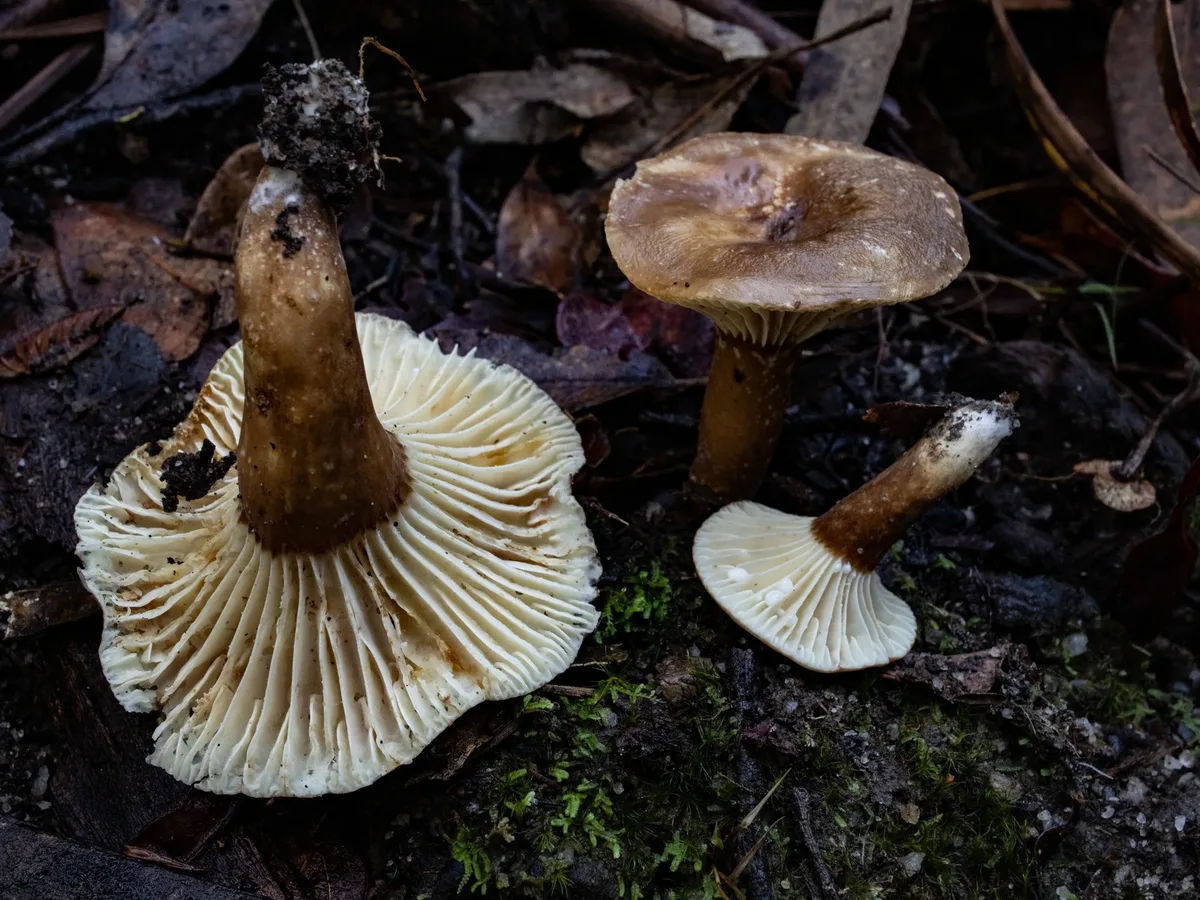 Atlas of Living Australia (CC0)
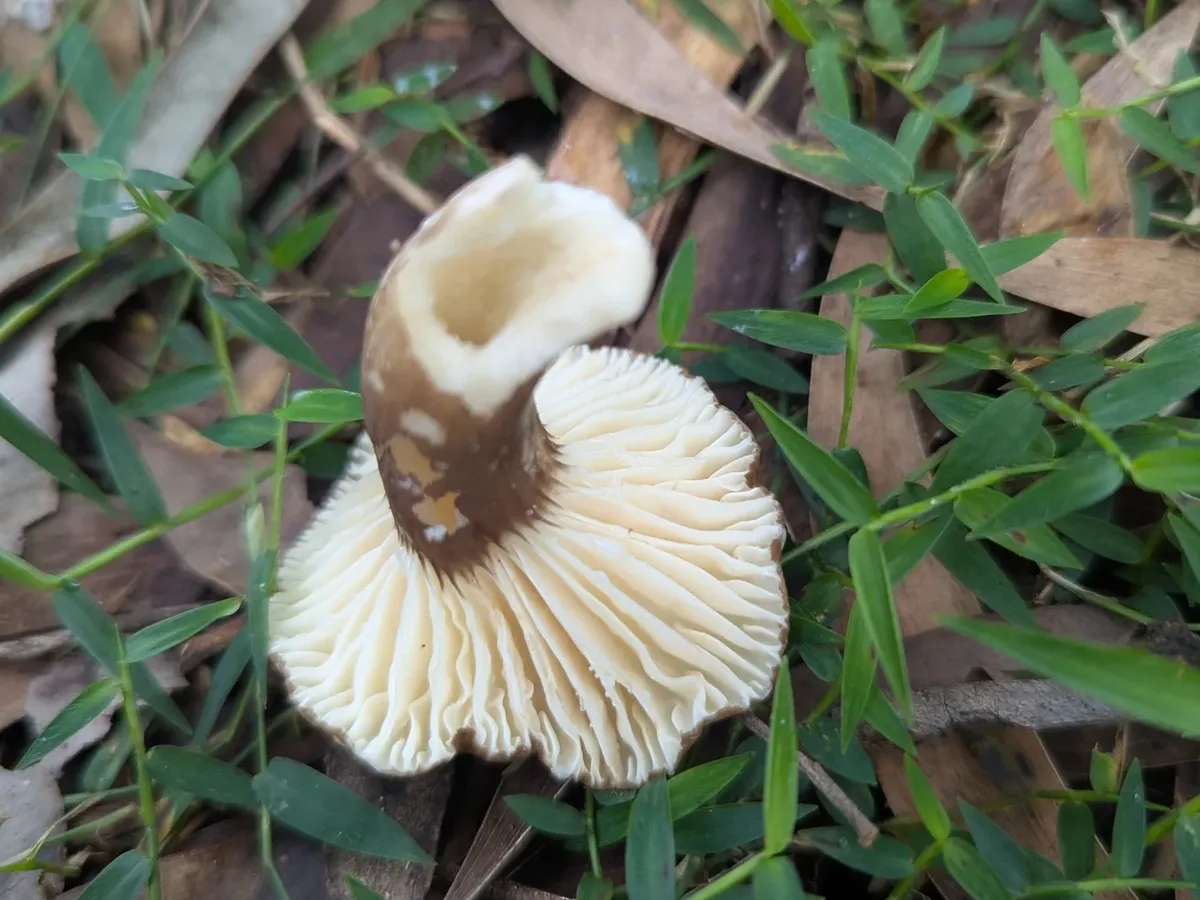 Atlas of Living Australia (CC0)Atlas of Living Australia (CC0)Atlas of Living Australia (CC0)
Good to eat, once you have identified it with certainty and cooked it through.
How to recognise it
The Vivid milkcap lives up to its name: the cap is a warm, clean tawny-orange to brick-buff that looks freshly lit against the dark forest floor. It starts out convex with a gently inrolled edge and broadens with age into a flat, then shallowly depressed or funnel-shaped disc.
The surface is smooth and lightly sticky in wet weather but otherwise dry - no slimy coating, no shaggy texture.
What distinguishes this species from the showier edible milkcaps is precisely what it does not do: the flesh stays white when cut, the gills stay pale cream, and nothing turns red or blue-green. The white latex, which bleeds freely from any cut surface, is mild to very faintly nutty - never producing the sharp burn of toxic acrid milkcaps.
Gills are adnate to slightly decurrent, moderately crowded, and noticeably paler than the cap, giving a clear contrast. The stem is firm and coloured much like the cap.
Because there are no dramatic colour-change reactions to rely on here, getting the identification right means paying attention to the whole picture: vivid tawny cap, white non-acrid latex, no staining, and the right habitat.
Where & when it grows
Habitat
This milkcap lives its whole life in partnership with broadleaved trees, threading its mycelium through the root systems of oaks (Quercus), beeches (Fagus), and the subtropical evergreen hardwoods - Castanopsis and Lithocarpus - that cloak the mid-elevation mountain forests of Yunnan, Sichuan, and neighbouring montane zones across East and Southeast Asia.
It favours humus-rich, well-drained, slightly acidic soils in shaded or semi-shaded forest - the same mixed hardwood ecosystems that produce matsutake and many celebrated boletes. In Japan it turns up in mixed deciduous and oak-dominated secondary woodland.
The ectomycorrhizal bond is obligate: no living host, no fruitbodies. If you are standing in a pine plantation with no hardwoods in sight, Lactarius vividus is not your mushroom.
When
Fruiting runs from mid-summer through mid-autumn, broadly July to October, nudged into action by the combination of warm soil, high humidity, and soaking rain.
Regional timing varies:
- In Japan the peak falls in late July through September, often arriving just after the main wet season.
- In Yunnan and southern China's highland forests, where monsoonal rains sweep in earlier, fruiting can begin in June and continue into October at altitude.
Like most milkcaps, this species fruits in flush-and-pause cycles rather than continuous production. A good flush typically appears 7-14 days after sustained rainfall, provided soil temperatures are still in the warm-but-cooling range of 15-22 °C. Dry spells stop fruiting quickly.
How it grows
Fruitbodies rise singly or in loose scattered groups from the mycelial network laced through hardwood roots beneath the soil. They are not gregarious; finding a small cluster in one spot is the most you can expect.
Because the mycelium is entirely dependent on living host trees, this species cannot be cultivated - it is a wild harvest only.
Young buttons emerge with rounded, inrolled caps and take several days to open into the characteristic flattened or depressed adult form. The latex-producing hyphae are active throughout all stages, so even a small button will bleed white when nicked.
Fruiting conditions
Summer-autumn fruiting triggered by soaking rain (25+ mm over 14 days) after which fruitbodies appear 7-14 days later, provided soil temperatures remain in the warm-but-cooling 14-22 degrees C range. In Yunnan the monsoon drives an earlier season (June-July); in Japan the peak follows the end of summer heat in August-September.
Look-alikes
Multiple white-latex milkcaps share the same habitat and superficially resemble Lactarius vividus. The critical safety distinction is the taste of the latex: L. vividus has mild, non-acrid latex, while acrid species cause a burning sensation on the tongue within seconds and must not be eaten.
- Lactarius vellereus (fleecy milk cap) is much larger, has a densely felty-woolly white cap, and intensely acrid white latex; easily separated by touch and taste.
- Lactifluus piperatus has very crowded, narrow gills and sharply peppery-acrid latex; edible only after extended boiling and water changes, a process requiring certainty of identification.
- Lactarius pubescens has a densely hairy cap margin and acrid latex; associated with birch.
- Lactarius chrysorrheus is common under oaks in East Asia and has latex that turns bright yellow within seconds of air exposure; this yellowing is an immediate disqualifier and distinguishes it from L. vividus.
In subtropical Asian forest, numerous other Lactarius species are present; among these, any with coloured, staining, or acrid latex should be treated as a different species.
No deadly species is considered a realistic direct lookalike for L. vividus under careful examination.
Cap margin is densely woolly-hairy (pubescent), and the latex is acrid; associated with birch rather than oak or castanopsis. The hairy margin and burning taste are the distinguishing features; also typically paler and more whitish in overall colour.
Much larger, with a densely felty-woolly, white to pale cream cap and intensely acrid white latex that burns the tongue immediately. Cap surface texture (felty vs. smooth) and the sharp acridness are the key differences; L. vividus is smaller, tawny-coloured, and has mild latex.
Has very crowded, narrow, forking gills and sharply peppery-acrid white latex. The densely crowded gill arrangement and immediately burning taste clearly separate it from L. vividus. Edible only after thorough cooking with water changes.
Also associated with oak in East Asia, but its white latex rapidly turns bright yellow within seconds of air exposure; this is an immediate, unmistakable distinguishing feature. L. vividus latex remains white throughout. L. chrysorrheus causes gastrointestinal irritation.
In the kitchen
Picking & cleaning
Harvest young to medium-aged fruitbodies in which the cap is still flat or only lightly depressed, before the margins have become ragged or wavy. Cut cleanly at the base with a knife to preserve the mycelial mat.
Before committing to collection, squeeze the flesh or nick the gills to confirm white, copious, non-acrid latex; this should be mild to very slightly nutty with absolutely no burning or sharp acrid sensation.
If the latex is white but sharply acrid, do not collect: several inedible or mildly toxic Lactarius species in the same habitat also have white latex.
Wipe or brush caps clean; do not soak in water before transport. Use within 1-2 days of picking for best flavour.
Cooking
As a mild, lightly nutty milkcap, L. vividus is best in preparations that complement rather than overwhelm its subtle flavour.
In Japan it is used in:
- soup stocks (dashi-style preparations)
- sauteed in butter or sesame oil with garlic and soy
- added to rice dishes
In Chinese cuisine it appears in stir-fries and hot-pot preparations alongside other wild mushrooms from the same forest.
The texture is firm and holds up well to heat. Avoid prolonged boiling in large volumes of water, which washes out flavour; gentle sauteing, grilling, or brief simmering in broth produces the best results.
Like all milkcaps, thorough cooking is essential; do not eat raw.
Good to know
Lactarius vividus is recorded as edible in Japanese and Chinese mycological literature and is consumed as a table mushroom in areas where it is common. It carries no known serious toxins, and white, mild, non-staining latex combined with the tawny cap places it in a relatively safe group of edible milkcaps.
Nevertheless, because it lacks the dramatic confirming colour changes of species such as L. deliciosus or L. hatsudake, identification demands close attention to latex taste.
The non-negotiable confirmation before eating any milkcap from this region: squeeze or nick the flesh and place a small amount of latex on the tip of your tongue. If any burning, sharp bitterness, or acrid sensation develops, do not eat it.
Always cook thoroughly; eating Lactarius species raw is never recommended regardless of species. If in doubt about identification, consult a local expert or a regional field guide before consuming.
A reference guide - never an edibility guarantee. When in doubt, leave it out.