Salmon milkcap
Lactarius salmonicolorsyn. Lactarius aurantiacus var. salmonicolor, Lactarius salmonicolor R. Heim & Leclair
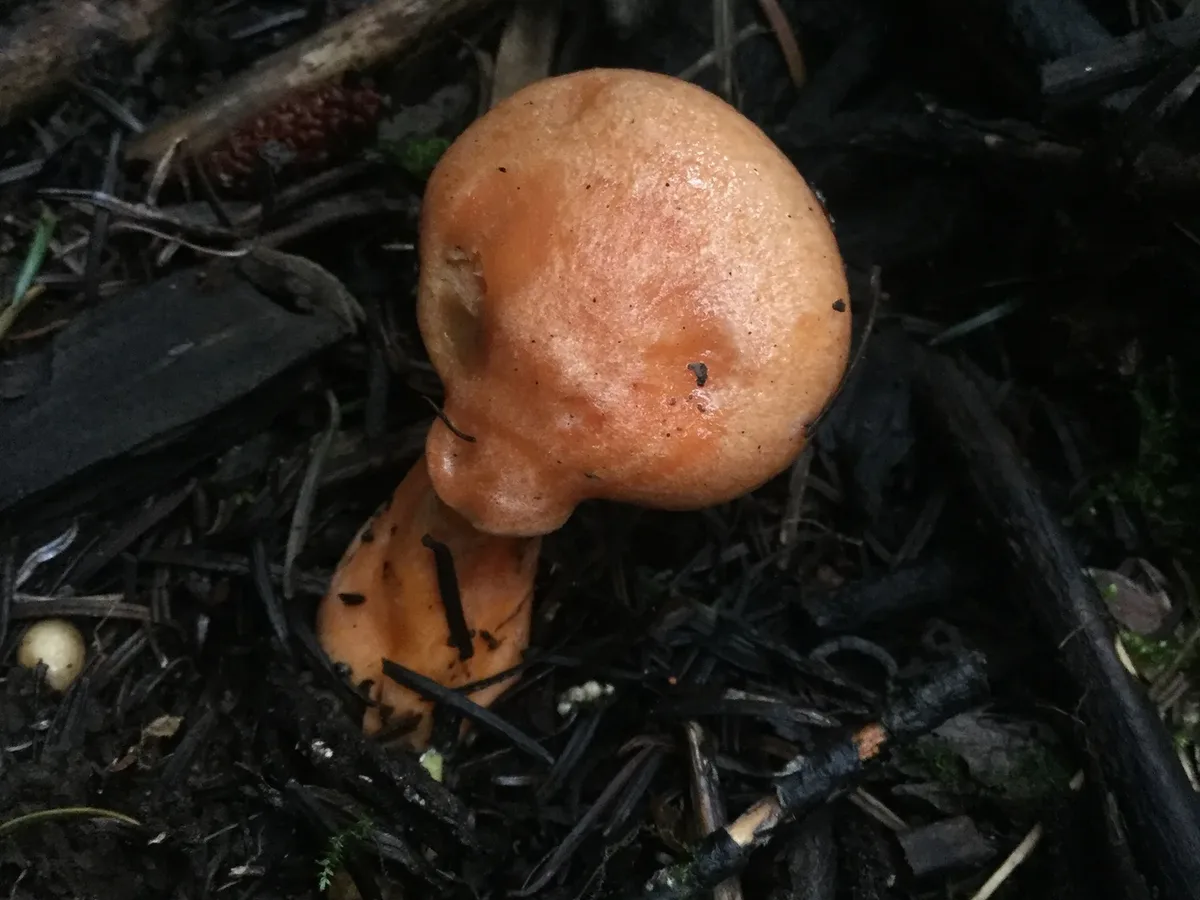 © Erick Vélez Sánchez (CC BY 4.0)
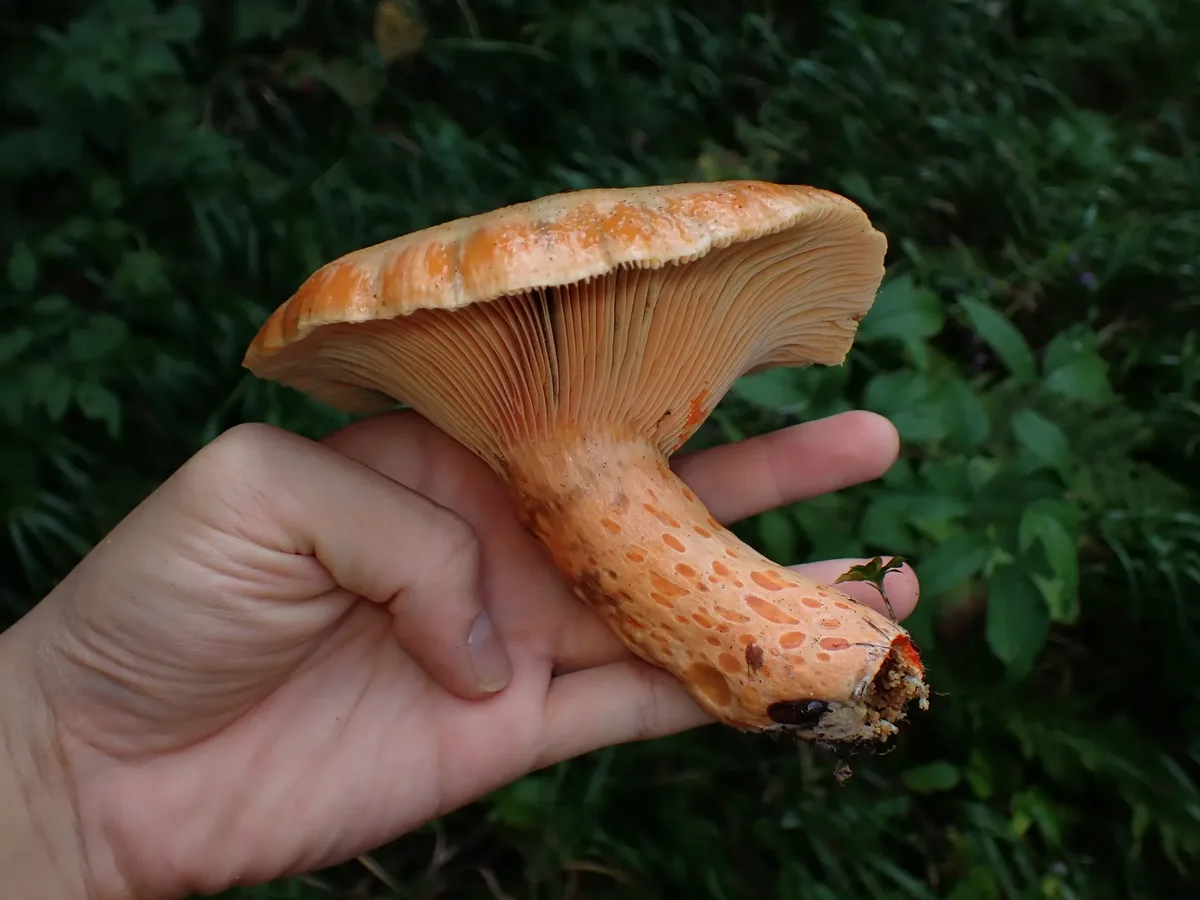 © W Rao (CC BY)
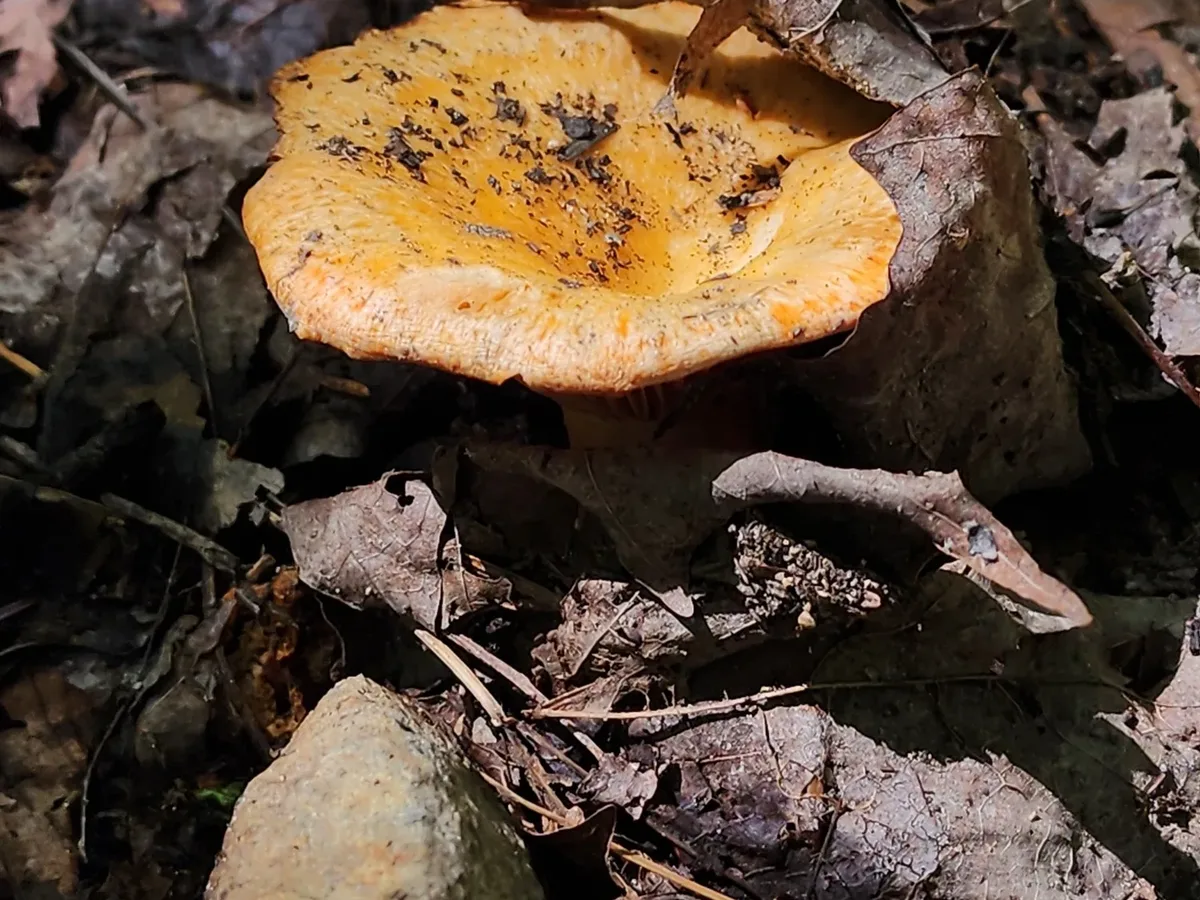 © Étienne Léveillé-Bourret (CC BY)
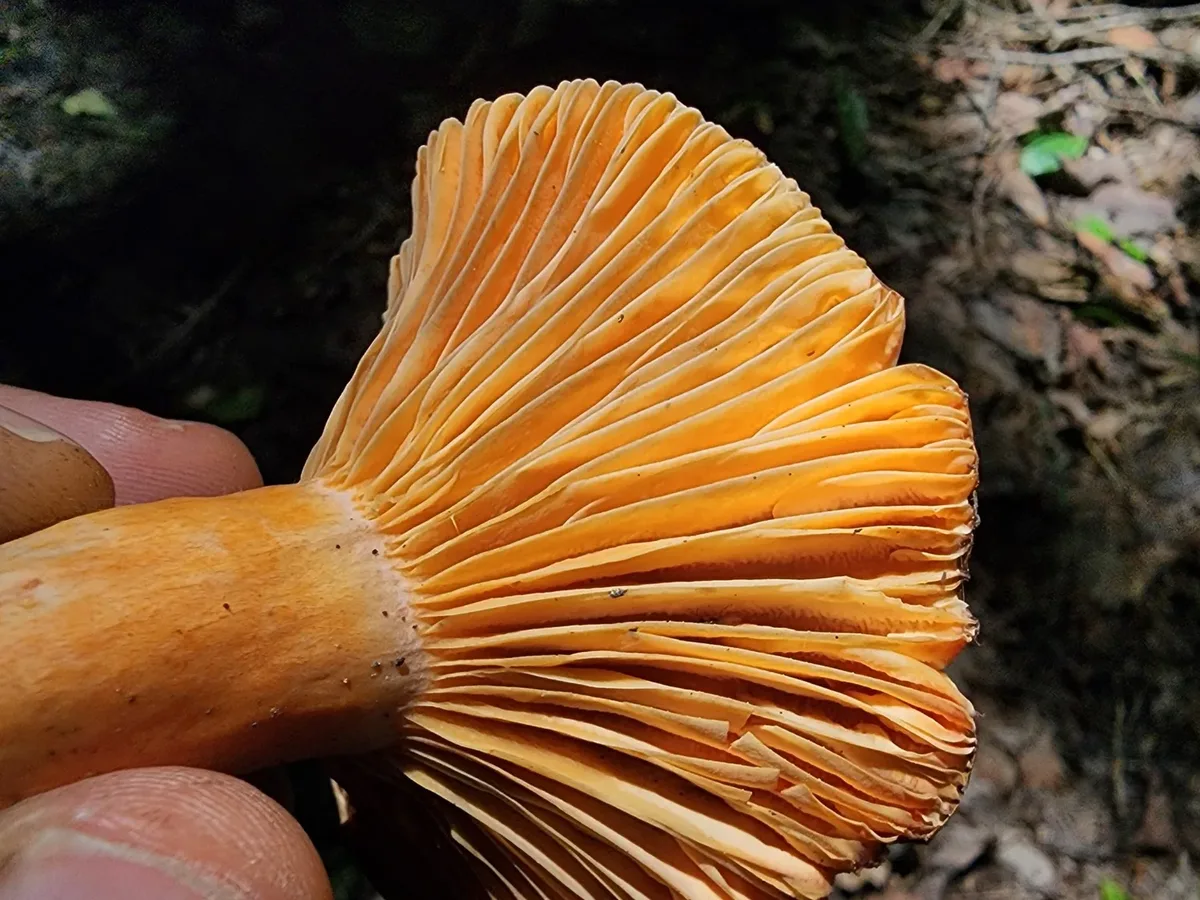 © Étienne Léveillé-Bourret (CC BY)
 © W Rao (CC BY)
 © W Rao (CC BY)
 © Simon Joly (CC BY)
 Tobias Schönberg (CC0)
 © nbasargin (CC BY 4.0)© Erick Vélez Sánchez (CC BY 4.0)© W Rao (CC BY)
Good to eat, once you have identified it with certainty and cooked it through.
How to recognise it
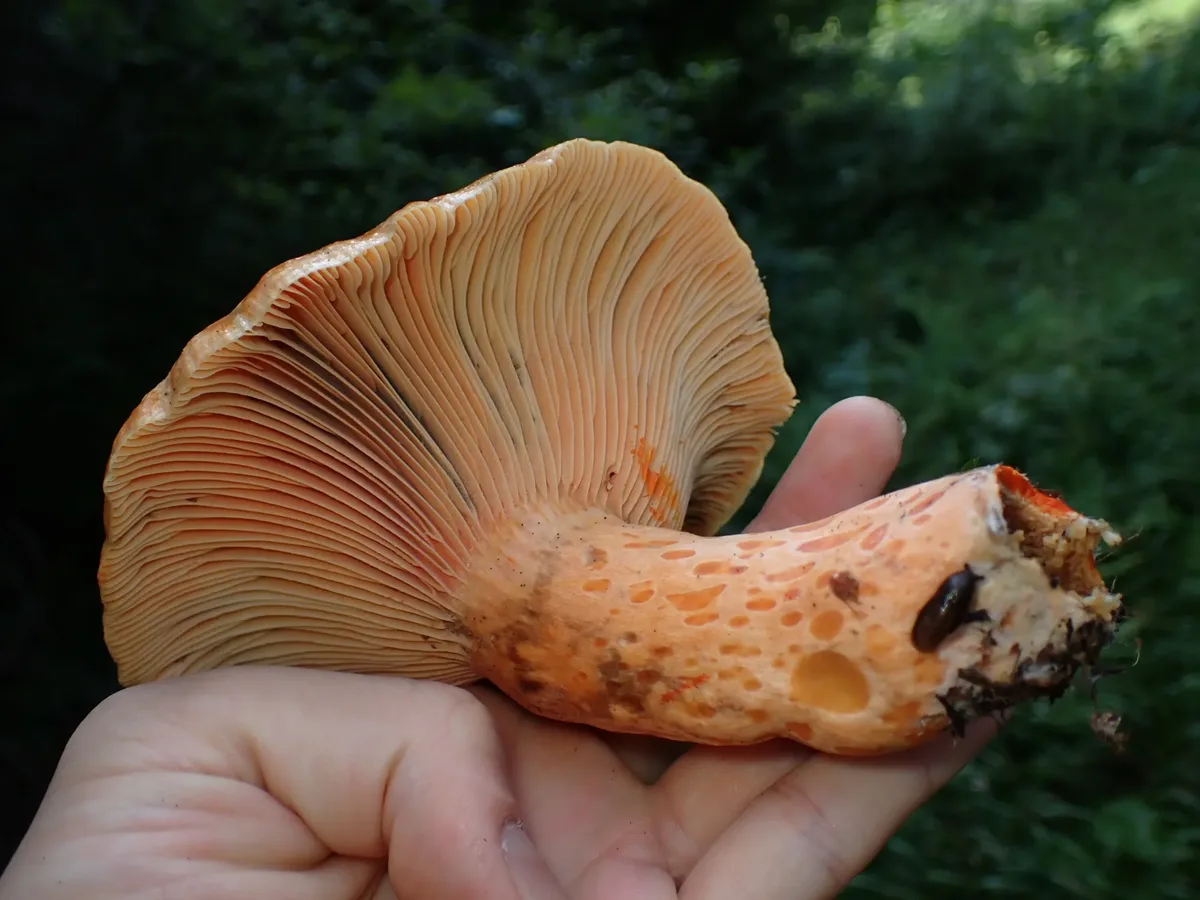
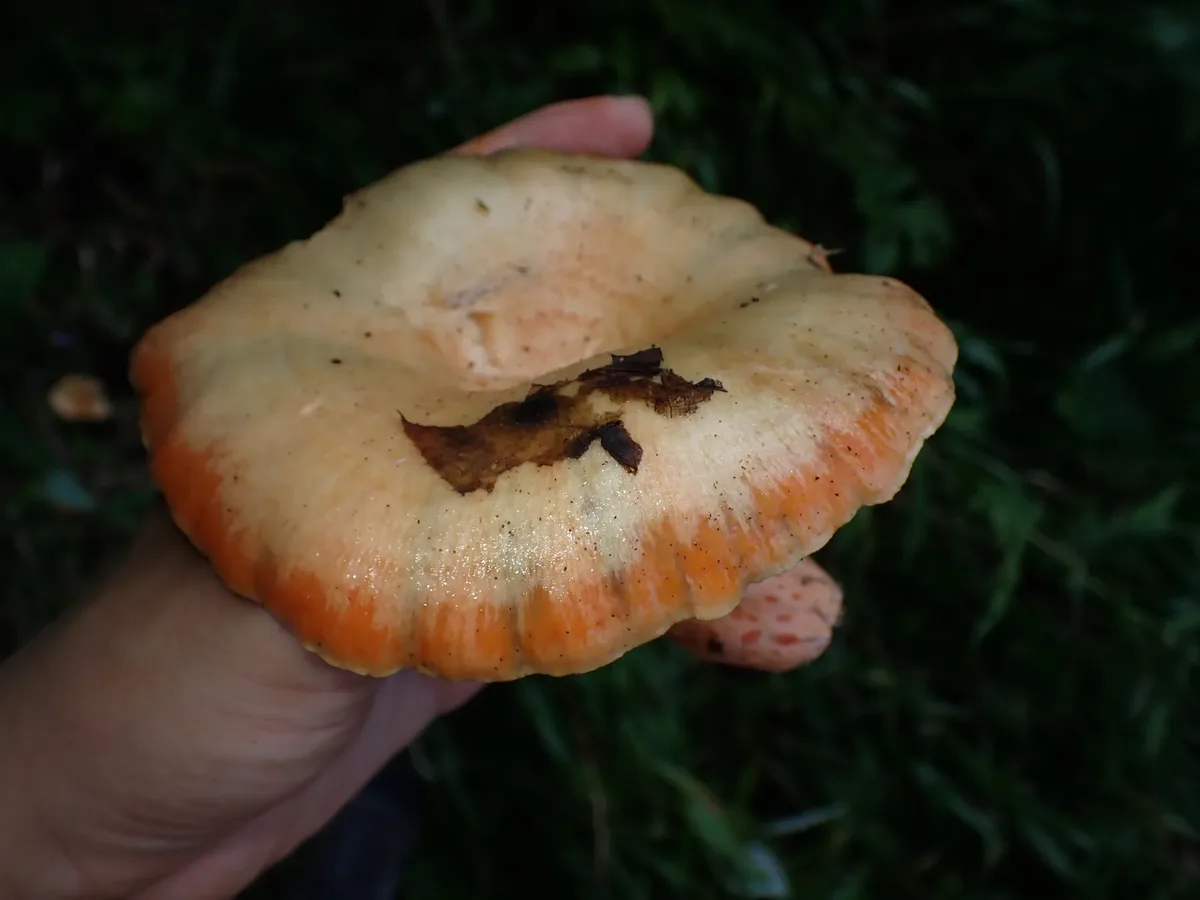
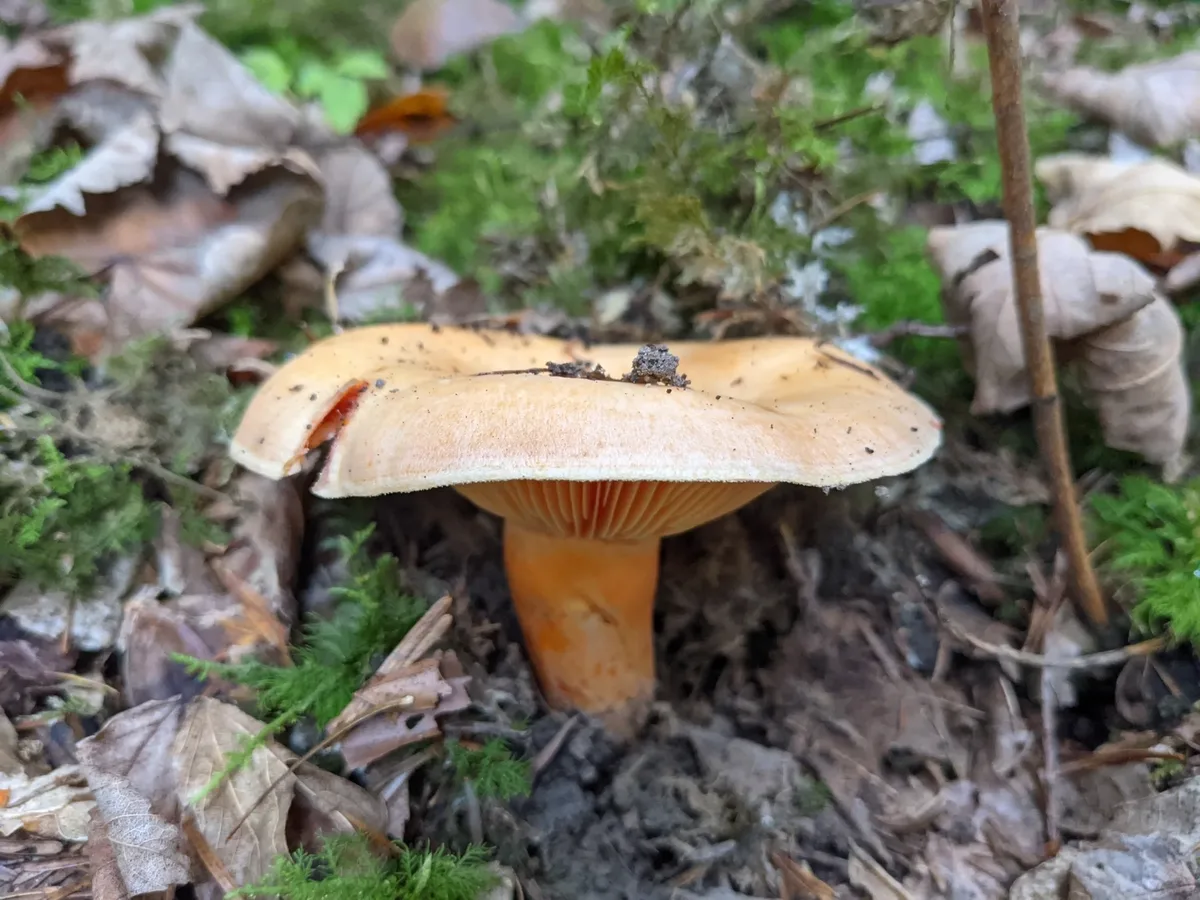
The salmon milkcap is a striking presence in the fir-forest understorey - uniformly dressed in warm salmon-orange to brick-apricot from cap to stem, with none of the blue-green staining that marks its close relatives.
Cap
The cap starts broadly convex with an inrolled margin, then settles into a gentle central depression; it rarely reaches the deep funnel shape of the saffron milkcap.
The surface is smooth and normally dry, sometimes slightly slick in rain, and may show faint concentric zoning near the margin in dry spells.
Gills
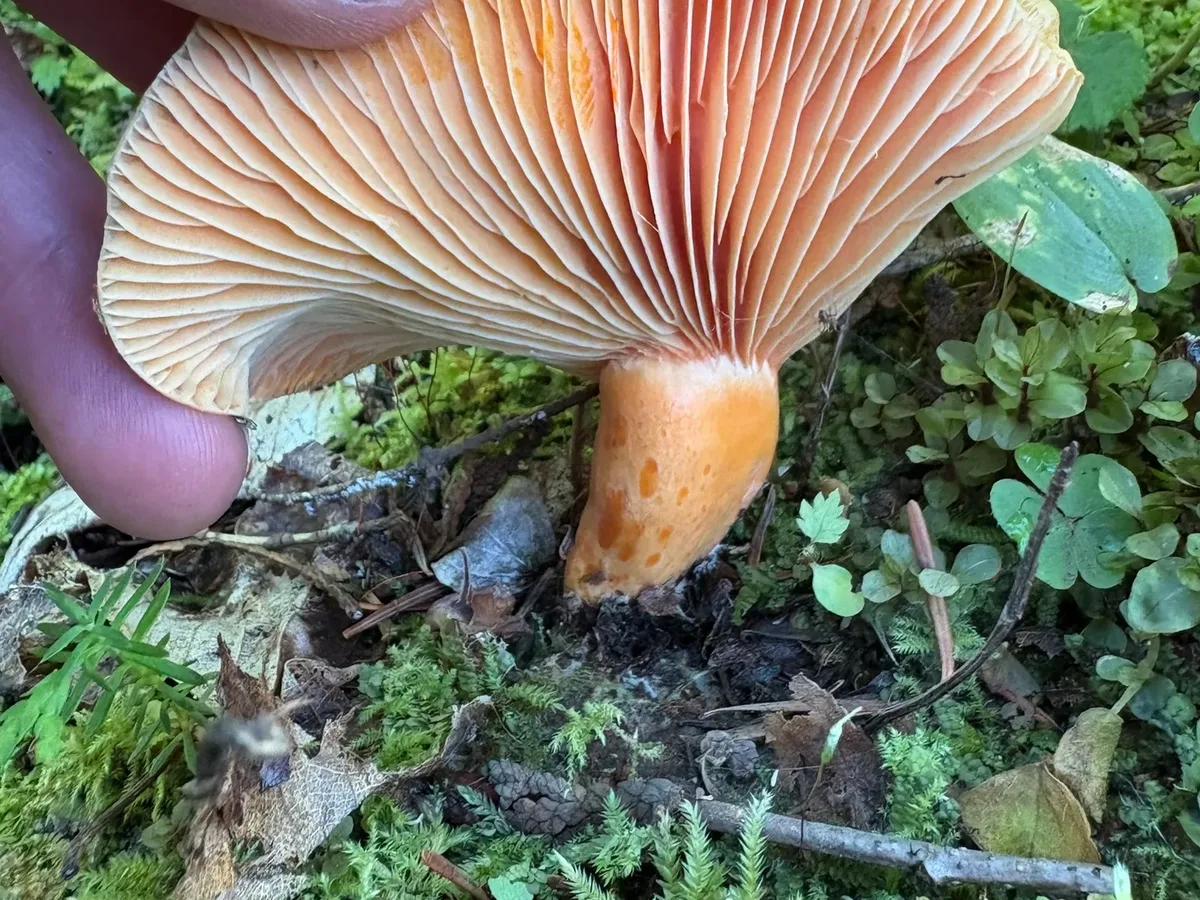
Gills are densely packed, slightly decurrent, and strikingly concolorous with the cap - that same bright salmon-orange deepens to carrot-orange where broken or bruised, but never shifts to green or blue-green.
Stem
The stem is robust and often dimpled with shallow scrobiculate pits, coloured like the cap or fractionally paler.
Flesh
Cut the flesh and it bleeds: a copious white latex that stays white on exposure to air. This non-colour-changing latex is the single most important identification character - in L. deliciosus the latex slowly turns carrot-orange then greenish, and the flesh stains visibly. In L. salmonicolor there is simply no green anywhere.
The flesh itself is cream-white to very pale salmon, firm, and odourless to mildly fishy when fresh. Spore print pale cream to pale ochraceous.
Where & when it grows
Habitat
L. salmonicolor is a loyal partner of silver fir (Abies alba) in the montane forests of central and southern Europe.
It belongs to the fir belt - the Alps, Jura, Pyrenees, Apennines, Carpathians - growing on calcareous or limestone-influenced soils where mature Abies stands dominate.
It does not turn up in lowland or boreal forests; without silver fir, it is simply absent.
Within those montane fir woods it favours moderately steep, well-drained slopes with deep humus, tucking itself among mosses and needle litter, often alongside Cantharellus cibarius and Hydnum repandum.
Where fir meets beech at lower elevations, L. salmonicolor tends to stay on the fir side of the ecotone. Planted silver fir elsewhere in temperate Europe occasionally hosts it too.
When
Fruiting is essentially restricted to the warmer months of the montane calendar, typically from July to October.
At lower montane elevations (600-900 m), the first fruitbodies may appear in mid-July after sufficient rain, but the main flush occurs August-September.
At higher elevations (1400-1800 m) the season is compressed to August-early October. Frosts at altitude end the season abruptly.
Unlike the saffron milkcap L. deliciosus, which may also fruit in autumn at sea level under planted pines, L. salmonicolor is rarely found below 500 m elevation in practice.
How it grows
L. salmonicolor is mycorrhizal, forming ectomycorrhizal associations with Abies (silver fir) and closely related firs.
Like all mycorrhizal fungi, the visible fruitbody is only the occasional expression of a perennial underground network. The same mycelium can thread the same patch of forest soil for years, surfacing again each August or September when rain and cooling temperatures give it cause.
Fruitbodies emerge singly or in small scattered groups, often half-buried in deep needle litter or moss cushions. They do not cluster densely.
Fruiting conditions
Requires a period of summer-to-autumn rainfall in montane fir forest; fruiting is strongly dependent on sustained soil moisture and cool night temperatures. Flushes typically appear 1-2.5 weeks after significant rainfall events when soil temperature is in the range 7-16 °C. High-altitude populations are more sensitive to the timing of autumn frosts.
Look-alikes
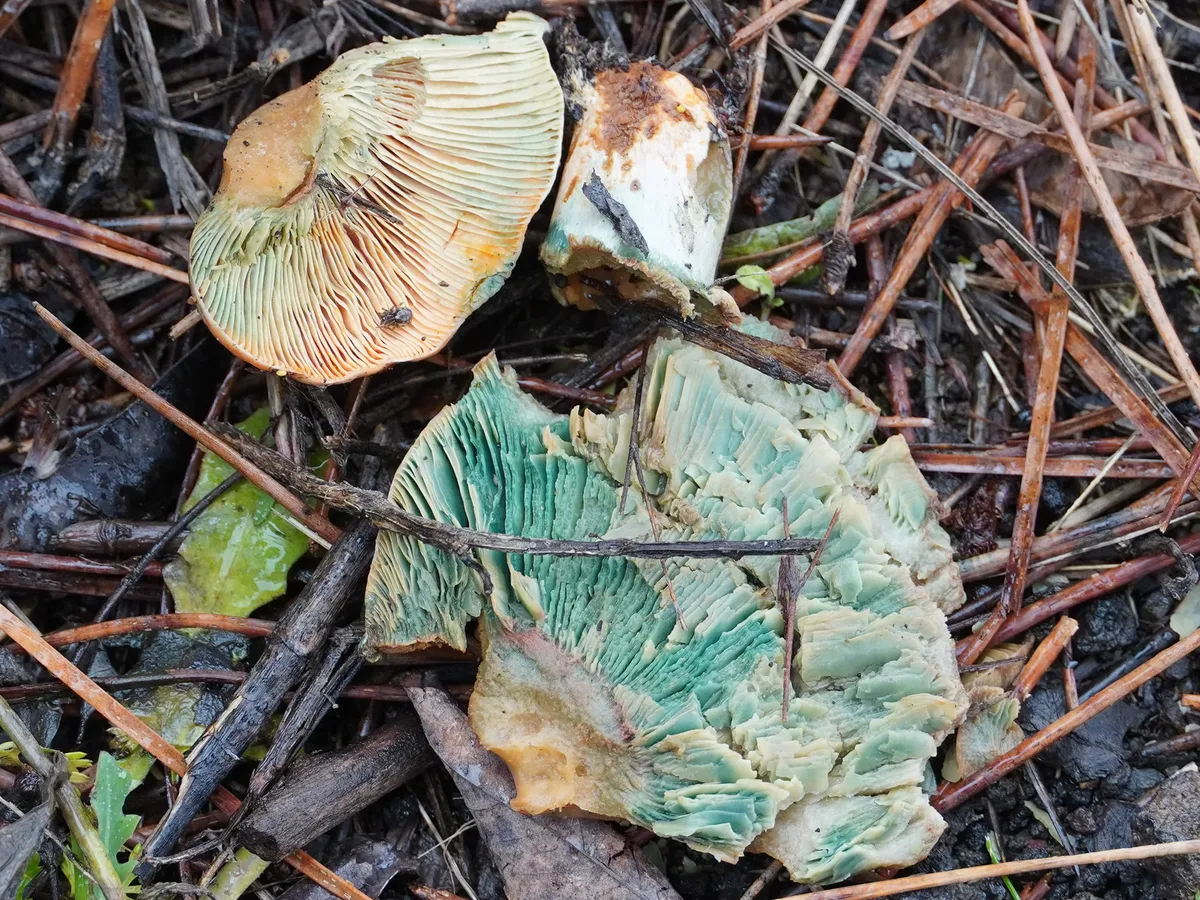
The most important lookalike is Lactarius deliciosus (saffron milkcap), which shares the same orange colouration and fir/pine habitat but differs critically in that its latex turns carrot-orange to dull greenish, and the flesh, gills, and stem all stain blue-green or at least green on handling and with age.
L. deliciosus is edible, so confusion is not dangerous, but misidentification is easy; fresh latex colour-change is the decisive test.
Lactarius deterrimus (false saffron milkcap) grows under spruce rather than fir, stains strongly green-blue, and has more obviously zoned and sometimes darker-tinged gills.
Lactarius sanguifluus (blood milkcap) is a Mediterranean pine-associated species with deep wine-red or purplish-red latex that immediately distinguishes it.
Lactarius semisanguifluus is a very similar fir-associated species whose latex starts orange and only slowly turns wine-red over several minutes - it too is edible, but the latex colour difference is clear.
Lactarius aurantiacus (orange milkcap) is smaller, thinner-fleshed, grows under birch or mixed deciduous trees rather than fir, has crowded yellowish-orange gills, and white non-staining latex, but is found in entirely different habitat.
No deadly lookalikes are known in the Lactarius section Dapetes.
Mediterranean pine-forest species with immediately distinctive wine-red to purplish-red latex - utterly unlike the white non-staining latex of L. salmonicolor.
Grows under spruce, not fir. The latex turns orange-red then rapidly wine-green to blue-green, and the flesh stains strongly green. Much more pronounced and rapid green staining than L. salmonicolor, which shows none.
Very similar fir-associated species; latex begins pale orange and only slowly (5-15 minutes) darkens to wine-red - never white as in L. salmonicolor. Also edible. Habitat and range overlap; latex colour on fresh cut is the key separator.
Much smaller and more slender, thinner-fleshed, grows under birch and mixed deciduous trees, not fir. White latex that does not stain. Habitat is the clearest separator.
L. deliciosus has latex that slowly turns carrot-orange then greenish, and the gills, flesh, and stem all stain blue-green with handling and age. L. salmonicolor latex stays white and tissue shows no green staining. L. deliciosus grows predominantly under pines rather than fir.
In the kitchen
Picking & cleaning
Collect young to mid-age specimens before the cap margin becomes ragged and before the gills develop insect larvae.
The robust flesh makes L. salmonicolor a good foraging species - slice the stem cleanly at the base to avoid disturbing the mycelium.
Confirm the white non-colour-changing latex by breaking a gill fragment; absence of any green or blue-green staining is essential for identification.
Avoid waterlogged, very old, or frost-damaged specimens. Clean in the field with a soft brush. The flesh is firm and travels well.
Cooking
Lactarius salmonicolor has firm, moist flesh and a mild, pleasant flavour when cooked, broadly comparable to L. deliciosus.
It is best suited to high-heat cooking methods: sautéed in butter or olive oil over high heat until any residual moisture evaporates and the edges caramelise. It pairs well with garlic, thyme, and parsley.
In Alpine cuisine it is used in risotto, pasta sauces, and omelettes, or served as a side dish to game. Pickling in vinegar and oil (sott'olio) is a traditional Italian preparation for surplus material.
The flesh holds its shape better than many milkcaps and does not disintegrate. Avoid boiling in large volumes of water, which washes out flavour. Drying concentrates flavour moderately.
Do not eat raw.
Good to know
Lactarius salmonicolor is considered a safe, edible species with no known toxic constituents.
However, some individuals experience mild gastrointestinal upset if the mushroom is eaten raw or undercooked, as is common in the genus Lactarius - always cook thoroughly.
Confirm identification by:
- 1strongly salmon-orange to brick-orange colouration throughout including gills;
- 2white latex that does not change colour;
- 3absolutely no blue-green staining anywhere on the fruitbody;
- 4fir-dominated montane habitat.
Any specimen showing green or blue-green discolouration in the flesh or latex belongs to a different species (L. deliciosus or L. deterrimus). Both of those are also edible, so misidentification within this group is not hazardous, but accurate identification is still good practice.
A reference guide - never an edibility guarantee. When in doubt, leave it out.