Salmon Milkcap
Lactarius quieticolorsyn. Lactarius quieticolor Romagn., Lactarius semisanguifluus var. quieticolor
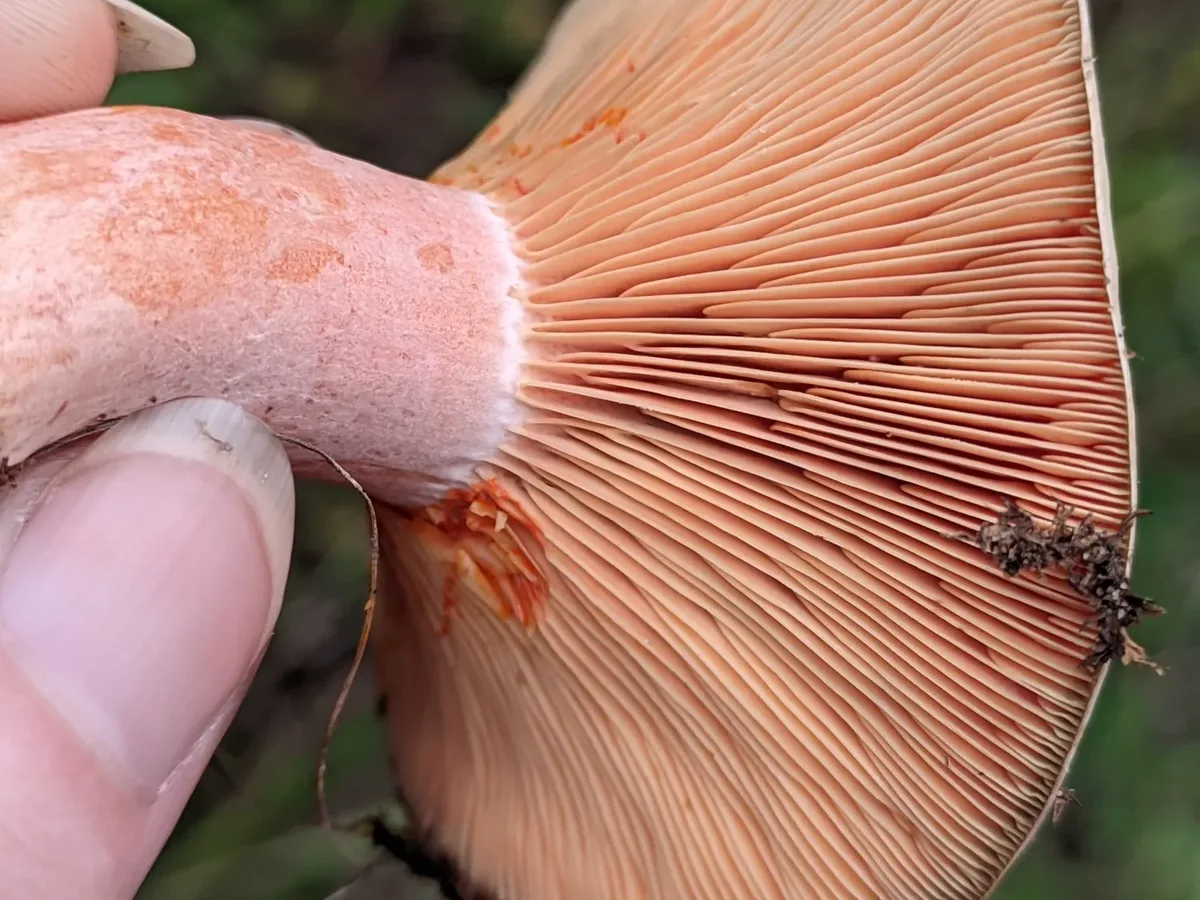 © Марина Давлетшина (CC BY)
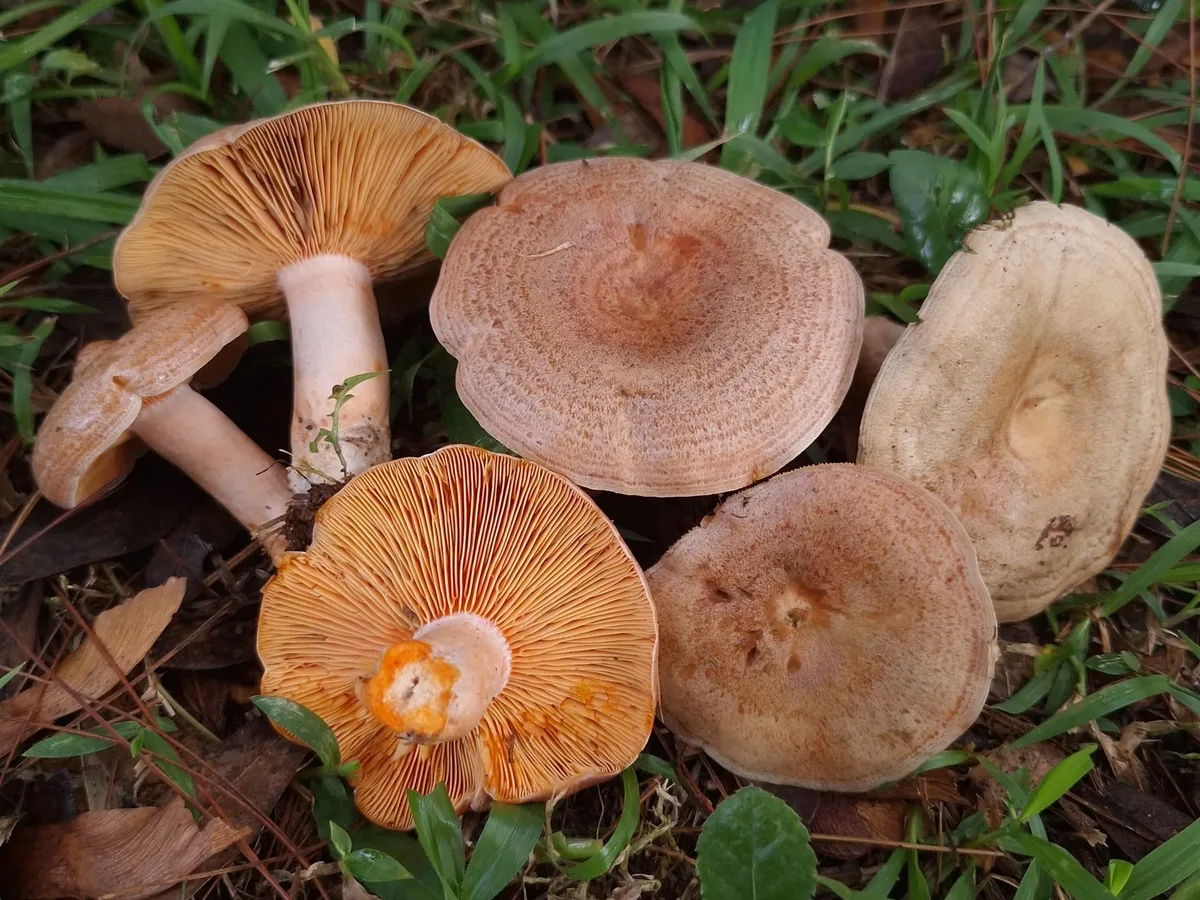 © Denis Zabin (CC BY)
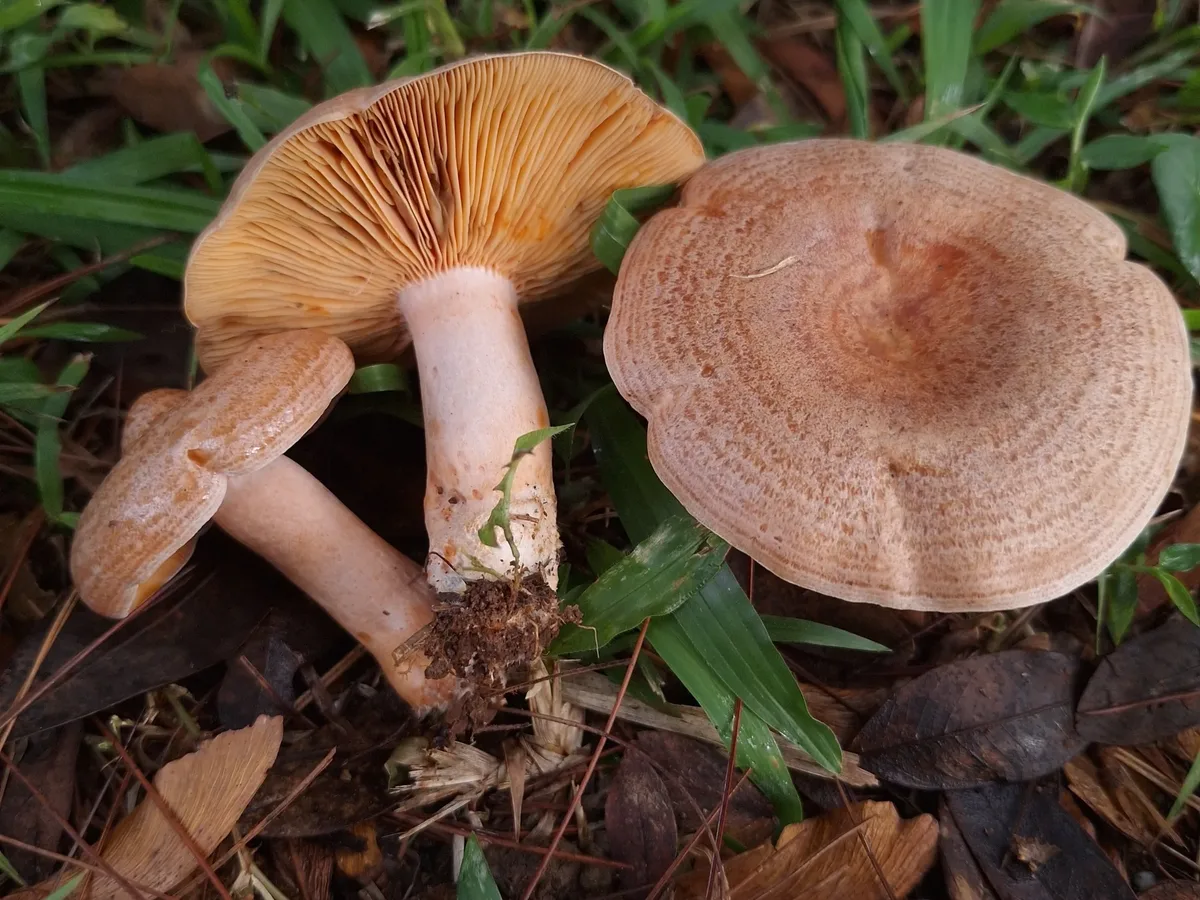 © Denis Zabin (CC BY)
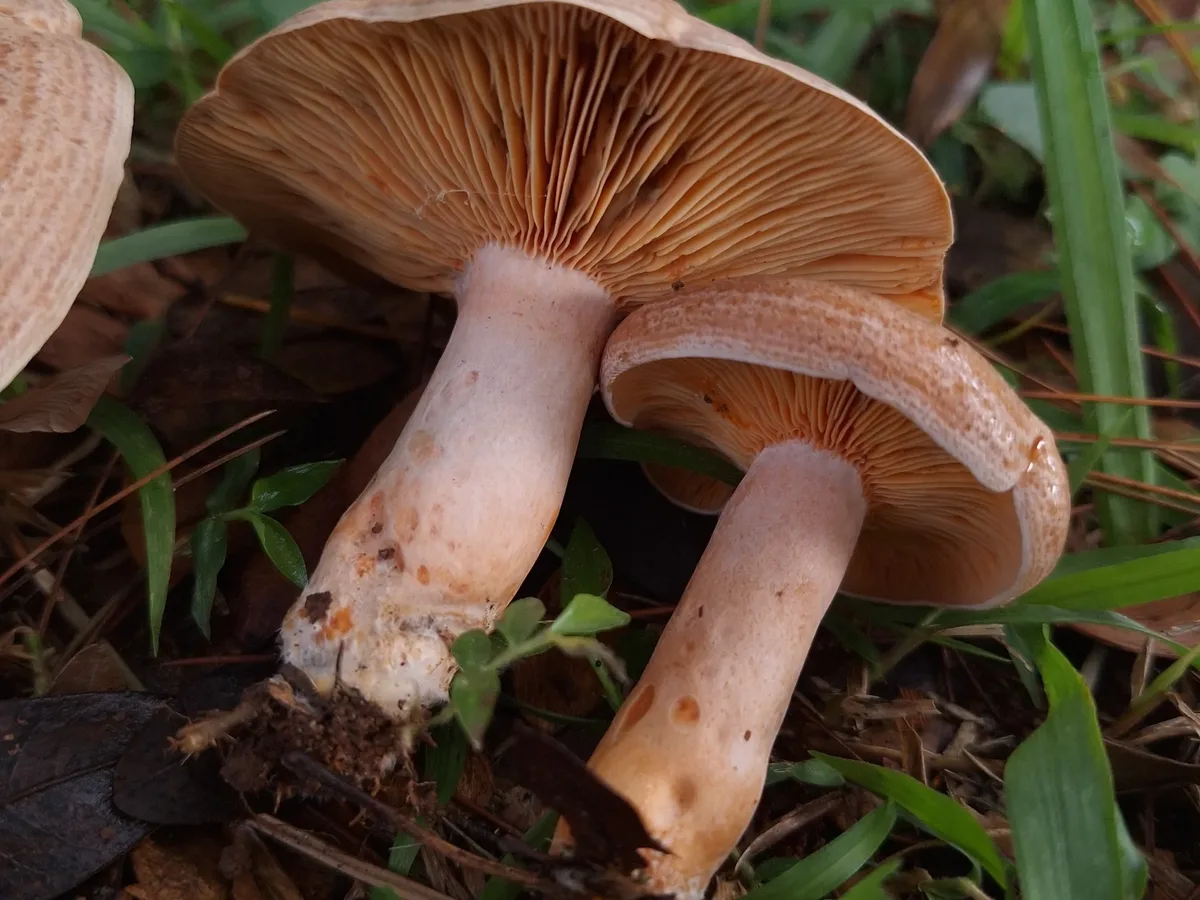 © Denis Zabin (CC BY)
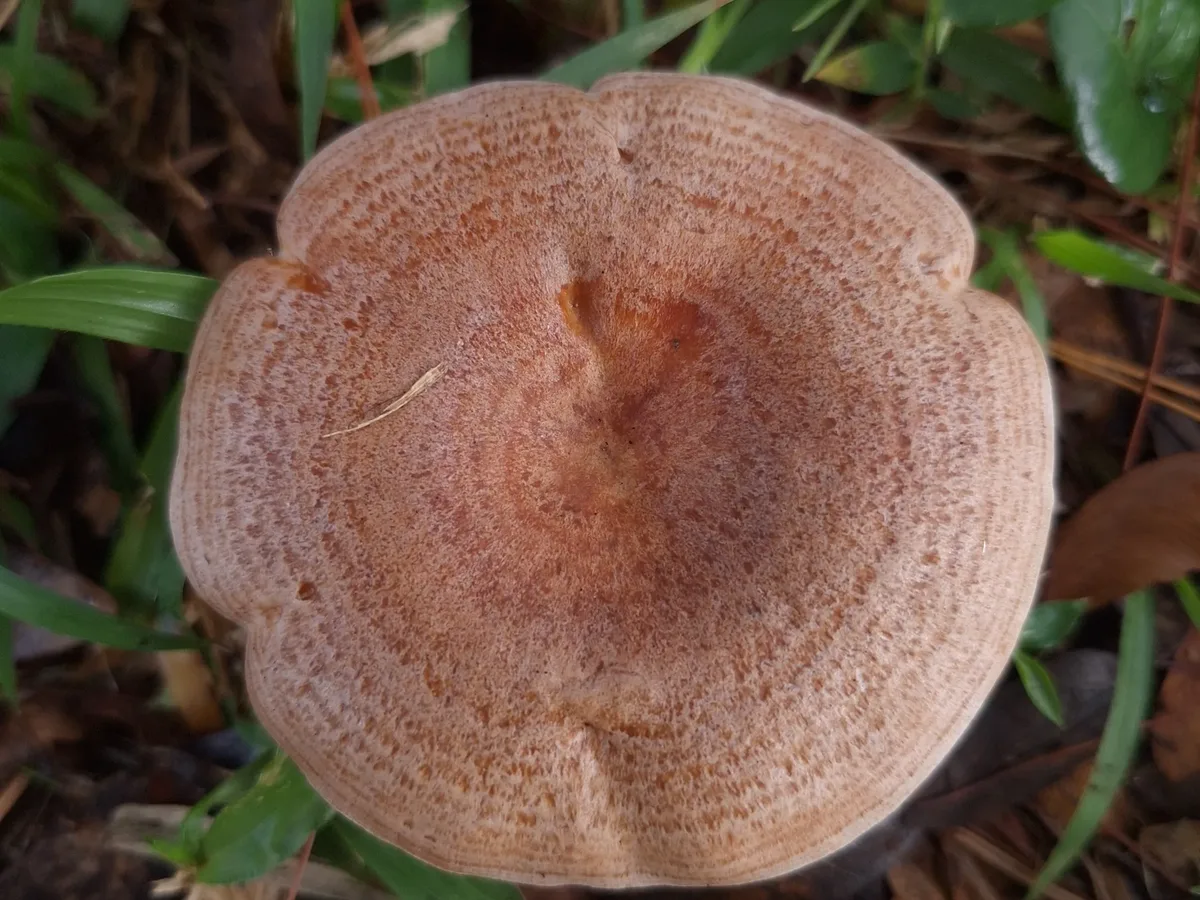 © Denis Zabin (CC BY)
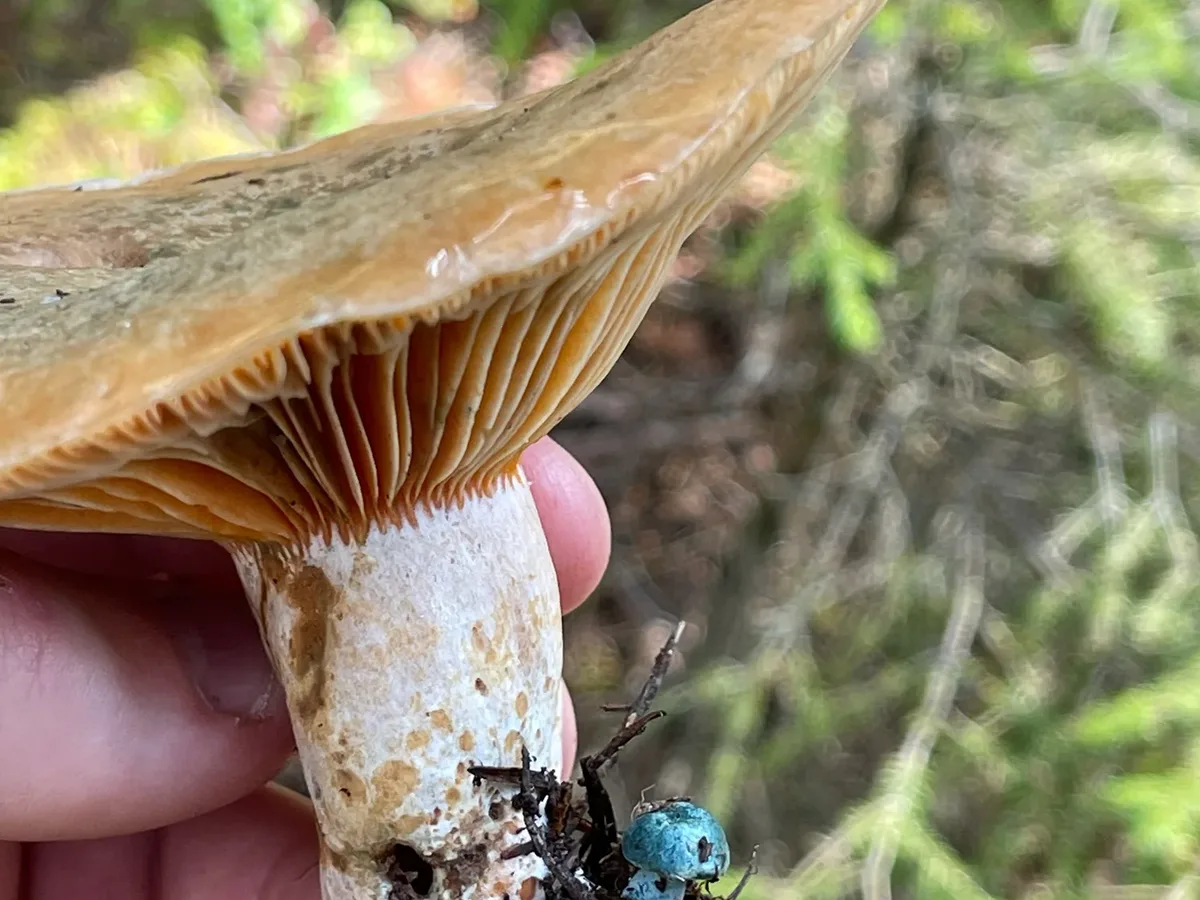 © wkee4ager (CC BY)
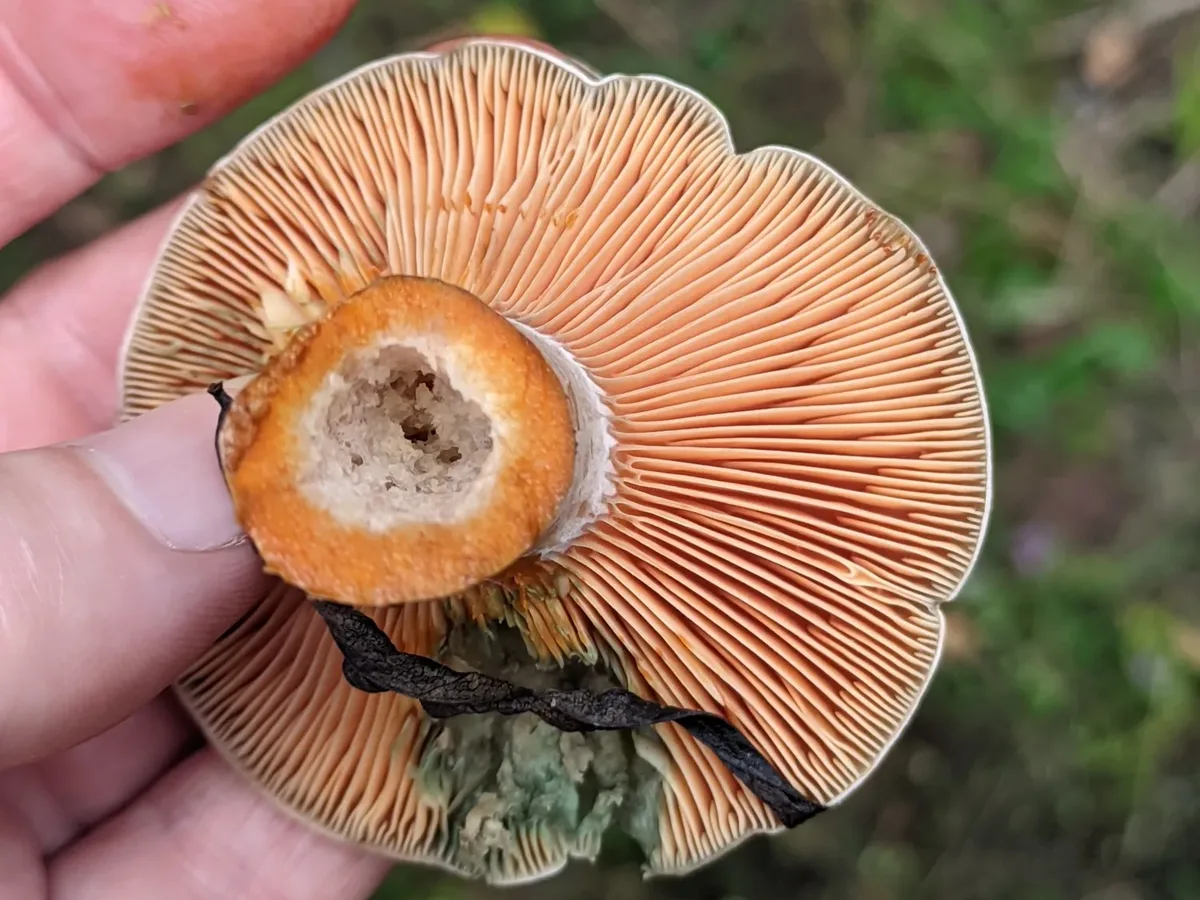 © Марина Давлетшина (CC BY)© Марина Давлетшина (CC BY)© Denis Zabin (CC BY)
One of the best mushrooms you can bring home - once you are certain of the identification.
Never eat a mushroom you are not 100% sure of - check the look-alikes below, and always cook wild mushrooms.
How to recognise it
Lactarius quieticolor is a medium to large milkcap of the celebrated saffron milkcap group (the Lactarius deliciosus complex). The key to understanding it is in its name: quieticolor means 'quiet colour' in Latin, a direct reference to the species' more subdued, muted colouration compared to the vivid carrot-orange of its close relatives.
Cap
The cap (5-14 cm) starts out convex and firmly inrolled at the margin when young, gradually expanding through plane to broadly funnel-shaped in mature specimens.
The upper surface is dry, smooth to finely velvety, and coloured in tones of dull ochre-salmon, pale apricot, or salmon-buff - noticeably less vivid and saturated than L. deliciosus.
Faint concentric banding is often present but can be nearly invisible in this species, another contrast with the clearly banded cap of the saffron milkcap.
Gills
The gills are tight, slightly decurrent, pale salmon-cream, and when cut or bruised they exude the diagnostic orange latex - but the colour-change behaviour is the crucial diagnostic detail.
The latex begins carrot-orange and then slowly, over several minutes, darkens to ochre-brown or dull wine-red. This is distinctly slower and less dramatic than in L. deliciosus (where the latex stays bright orange, never going red) and in L. sanguifluus (where the latex is immediately blood-red).
Prolonged bruising of the gills or cut flesh eventually produces a characteristic greenish-ochre staining - green discolouration that also appears in L. deliciosus but is present here as well, helping to confirm membership in the deliciosus group.
Stem
The stem is stout and solid, often decorated with shallow salmon-orange scrobiculate pits (small depressions characteristic of the deliciosus group).
Spore print pale cream-yellow.
Where & when it grows
Habitat
Like all members of the Lactarius deliciosus group, L. quieticolor is an obligate ectomycorrhizal partner of pines. It cannot live without its pine host.
The mycelium forms intimate sheaths around pine rootlets, exchanging mineral nutrients and water for sugars from the tree's photosynthesis. This interdependence means you will never find this species fruiting away from pines.
The ecological niche is the warm, dry or seasonally dry Mediterranean pine woodland: open garrigue, pinède, and mixed pine-holm oak scrubland on free-draining limestone, sandy loam, or rocky slopes.
The species is reported across the Mediterranean basin and into temperate southern Europe, with records from France (especially the south), Spain, Italy, and probably more widely distributed but historically lumped under L. deliciosus.
Particularly interesting is its documented occurrence in the Southern Hemisphere: in Chile and Argentina it has been introduced alongside commercial Pinus radiata plantations, where it has established self-sustaining ectomycorrhizal populations and is now encountered by local foragers.
It fruits from soil among fallen pine needles, singly or in loose troops, and does not form dense clusters.
When
In its European range, L. quieticolor is strictly an autumn species.
Fruiting is triggered by the first meaningful rainfall that breaks the Mediterranean summer drought, typically from late September through November. The sweet spot in most areas is mid-October to mid-November, when soil temperatures have dropped below about 15 °C but the ground still retains warmth from summer.
In cooler, higher-elevation pine forests of southern France and the Pyrenean foothills, the first specimens can appear in September. In warm coastal zones of southern Italy and the western Mediterranean, fruiting may extend into December.
The species is highly drought-sensitive: in dry autumns with insufficient rainfall the mycelium remains dormant and produces no fruitbodies even from well-established sites.
In Chile and Argentina (Southern Hemisphere), the season is reversed and fruiting occurs through the austral autumn and winter, generally April through July, with the main flush in May-June.
How it grows
Fruitbodies arise singly or in small scattered groups from ectomycorrhizal mycelium attached to pine rootlets, emerging through the loose layer of fallen pine needles.
The button stage is a small, rounded, firmly inrolled cap that can be difficult to spot in the duff - the salmon-ochre colour blends with fallen needles and dry leaf litter.
Growth from button to mature fruiting body is relatively rapid once triggering conditions are met, typically 5-10 days after adequate rainfall. But the mycelium itself is perennial and persistent: a productive spot under pines will often fruit again in subsequent years at the same location, as long as the trees remain healthy.
Established sites may produce fruitbodies for many consecutive years and are worth recording carefully.
Because of the ectomycorrhizal relationship, this species cannot be cultivated; it depends entirely on living pine roots.
Fruiting conditions
Fruiting is triggered by the first significant autumn rainfall (≥20 mm over 14 days) breaking the summer drought, when soil temperatures have cooled into the 7-17 °C range. In the Mediterranean range this is typically October-November. In the Southern Hemisphere (Chile/Argentina) this corresponds to austral autumn, May-June. Prolonged dry autumns (or austral autumns) suppress fruiting entirely. A flush typically appears 1-2.5 weeks after triggering rains.
Look-alikes
Lactarius quieticolor sits within the Lactarius deliciosus species complex, and all of its most important lookalikes are fellow members of this group - all edible and choice quality, so any confusion within the group is harmless from a safety standpoint. The key skill is distinguishing these milkcap relatives from each other and from unrelated species.
Lactarius deliciosus (Saffron Milkcap) is the most important comparison and shares exactly the same habitat and season. It is distinguished by its more vivid, clearly saturated carrot-orange cap with more obvious concentric banding.
Critically, the latex of L. deliciosus is carrot-orange and stays orange, never darkening significantly toward wine-red or ochre as in L. quieticolor. The green bruising and staining is also typically more vivid and rapid in L. deliciosus. In practice, exact separation of these two species in the field requires attention to the latex colour-change combined with the overall cap colour saturation.
Lactarius sanguifluus (Bloody Milkcap) has immediately and intensely blood-red latex on cutting - the colour change is instantaneous and dramatic, not slow and dull as in L. quieticolor - and the cap tends to be more saturated brick-red or wine-red.
Lactarius semisanguifluus is very closely related to L. quieticolor and may cause the most confusion. Its latex also starts orange and darkens to wine-red, but the colour change tends to be somewhat faster and more complete, and the cap is generally slightly more orange-toned. Taxonomically these two are very close, and some sources treat them as synonyms or varieties; both are equally edible.
Lactarius deterrimus (False Saffron Milkcap) grows under spruce rather than pine, which is the primary habitat separator. Its latex is also orange darkening to wine-red, but green staining is very strong and rapid, and its flavour is considerably more bitter and acrid than in L. quieticolor.
For foragers in Chile and Argentina working in commercial pine plantations, awareness of local Amanita species is important. Although none of the Chilean Amanitas that might appear in pine plantations are precisely the same as the deadly European ones, the principle of confirming copious orange latex before eating any orange-capped mushroom is essential.
Amanita species produce no latex of any kind: if there is no orange milk, it is not a milkcap. The deadly Amanita phalloides (Death Cap) and related species are white-capped and do not visually resemble L. quieticolor, but the general rule of the latex test is the critical safety net.
Deadly - contains lethal amatoxins. Grows under oaks and mixed woodland (also in Southern Hemisphere pine zones associated with co-introduced oaks). Usually white to pale greenish-white cap - very different in colour - but the universal rule applies: no latex of any kind, white gills, white spore print, ring and volva on stem. Any orange-capped mushroom in a pine plantation that exudes orange milk is not Amanita phalloides; any doubtful orange-capped mushroom that does NOT bleed latex is not L. quieticolor.
Produces immediately and intensely blood-red to wine-red latex - the colour change is instantaneous on cutting, not slow. Cap tends toward brick-red or wine-red tones rather than dull ochre-salmon. Also an excellent edible; confusion is harmless.
Almost always under spruce (Picea) rather than pine - the primary separator. Latex is orange darkening slowly to wine-red, but green bruising is very intense and rapid; flavour is distinctly more acrid and bitter than L. quieticolor. Edible but considered inferior.
Can occur in the same pine woodland. An orange-red form exists. Separated instantly: Amanita produces absolutely NO latex of any colour; gills are white (not salmon); the cap bears removable white wart remnants; stem has a prominent ring and a bulbous base with a volva. If there is no flowing orange milk on cutting, it is not a milkcap - do not eat it.
Very closely related and the most similar species; latex also starts orange and slowly darkens to wine-red. Generally considered to have a slightly faster and more complete colour change and a marginally more orange cap. Some authorities treat it as a synonym or variety of L. quieticolor. Also edible; confusion is harmless.
The most important comparison: same habitat and season. L. deliciosus has a more vivid, saturated carrot-orange cap with more clearly defined concentric banding. Crucially its latex is bright carrot-orange and stays orange - it does NOT darken toward ochre or dull wine-red as it does in L. quieticolor. Both are choice edibles; confusion is harmless.
In the kitchen
Picking & cleaning
Collect young to mid-maturity specimens with firm flesh and an inrolled or only slightly flattened cap margin. Fully aged, flattened, or pale-bleached caps are past their prime for the kitchen, though still technically edible.
Cut at the base with a knife rather than pulling, to leave the mycelium undisturbed.
Before picking, perform the latex test:
- Nick the cap flesh or a gill and observe the colour of the milk - it should be carrot-orange, not white and not immediately blood-red.
- Watch the colour for a minute or two: in L. quieticolor it slowly shifts toward ochre or dull reddish-brown.
- Confirm also that the bruised gill tissue eventually shows greenish-ochre staining.
The orange latex will stain fingers and baskets; use a dark-coloured or plastic-lined container. The firm, dense flesh transports well without damage.
Young buttons are especially valuable as they are firm throughout and rarely insect-infested.
Do not wash until just before cooking; a soft brush or damp cloth removes surface debris.
Cooking
A choice edible and an excellent culinary mushroom, less well-known than L. deliciosus but used in the same regional traditions wherever it occurs. The flesh is firm, dense, and holds its texture well under heat.
The classic Mediterranean preparation - grilling over charcoal or wood embers with olive oil, garlic, and coarse salt - showcases the rich, mildly resinous, meaty flavour to excellent effect. The orange-to-ochre latex caramelises pleasantly during grilling.
Sautéed quickly in butter or olive oil over high heat, the flesh browns and develops a deeper savour; pair with garlic, parsley, thyme, or rosemary.
The species is well suited to rice dishes (arroz con níscalos in Spanish cuisine), pasta, and omelettes. It can be pickled or preserved in olive oil for short-term storage.
The flesh turns from salmon to a grayish-brown or ochre colour during cooking - entirely normal and not a safety concern.
Like most milkcaps, it does not dry particularly well (the texture becomes tough and leathery), but blanching before freezing gives acceptable results for longer storage.
Always cook before eating; raw consumption is not recommended for any wild mushroom.
Good to know
Lactarius quieticolor is a choice edible with no known toxins and an excellent safety record. It is free of any documented poisoning attributable to correctly identified specimens.
The fundamental safety principle for any member of the saffron milkcap group applies here: confirm the presence of coloured (orange) latex before eating. Orange latex is produced by no deadly or seriously toxic species in any habitat where L. quieticolor occurs - it is a reliable positive indicator.
The key safety check is a three-second latex test:
- Nick the cap flesh or a gill with a fingernail or knife; orange milk should appear within seconds.
- If no latex appears, or if the latex is white rather than orange, do not eat the specimen.
When foraging in Southern Hemisphere pine plantations (Chile, Argentina) where this species occurs, exercise normal caution around all wild fungi and rely on the latex test as the primary confirmation.
Always try a small portion first when eating this species for the first time, as individual digestive sensitivities can occasionally occur with any novel wild food even from species known to be safe. Fully cook before eating.
A reference guide - never an edibility guarantee. When in doubt, leave it out.