Dense-gilled milkcap
Lactarius densifoliussyn. Lactifluus densifolius
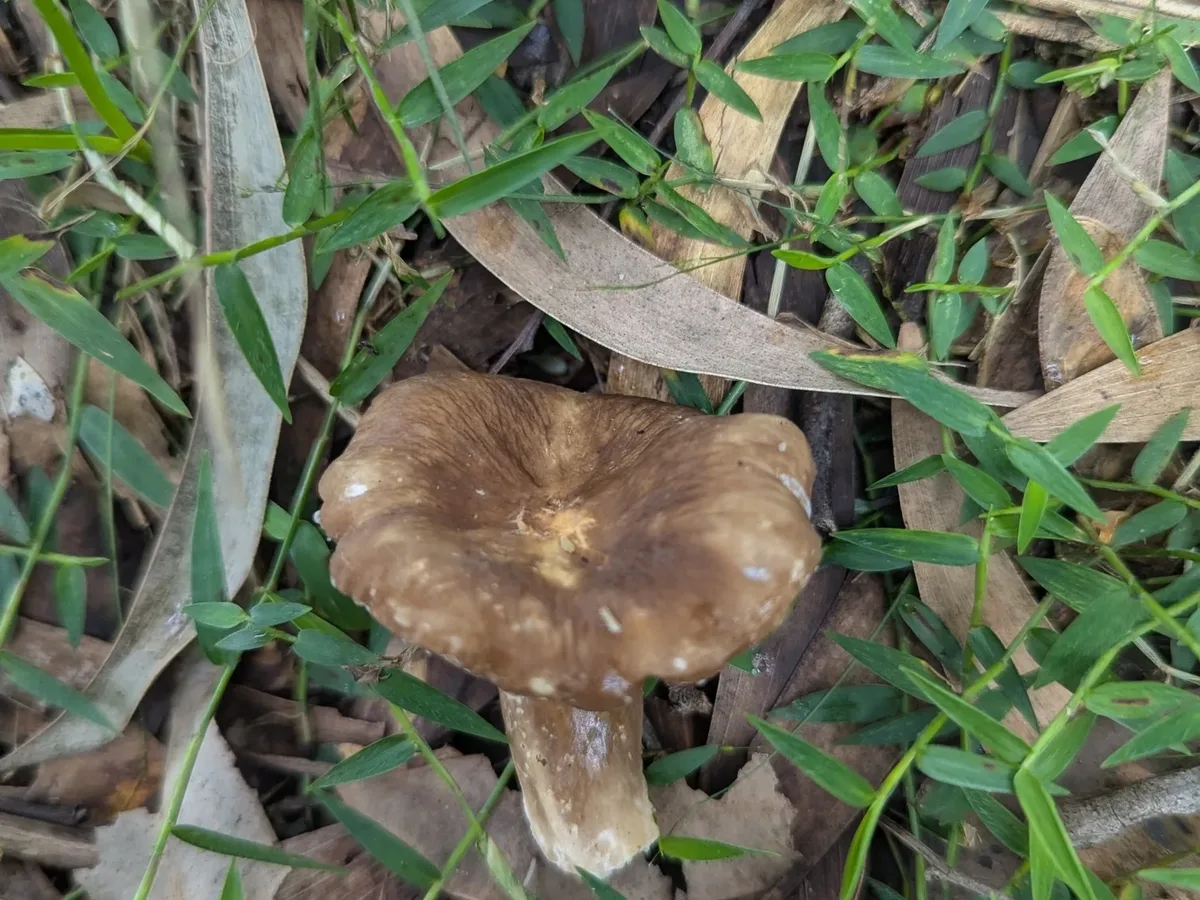 Atlas of Living Australia (CC0)
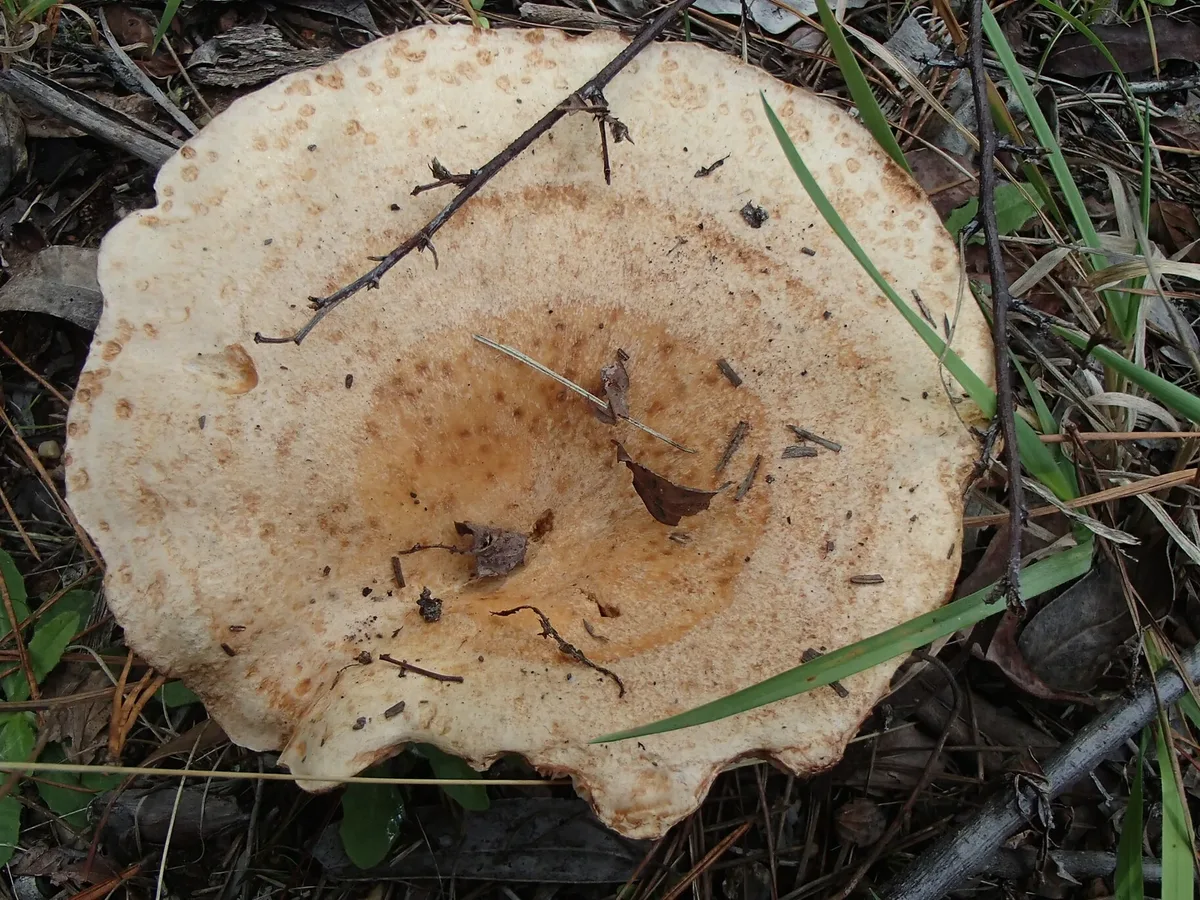 Atlas of Living Australia (CC0)Atlas of Living Australia (CC0)Atlas of Living Australia (CC0)
Good to eat, once you have identified it with certainty and cooked it through.
Never eat a mushroom you are not 100% sure of - check the look-alikes below, and always cook wild mushrooms.
How to recognise it
Lactarius densifolius is a medium to large milkcap, recognisable above all by its extremely dense, closely-packed, repeatedly-forking gills - unusually crowded even by Lactarius standards, which is the character encoded in its name.
The cap is broadly convex to shallowly funnel-shaped, ochre-brown to tawny, dry to slightly tacky in wet weather.
Cut the flesh anywhere and milky-white latex wells up immediately; this latex dries to a faint cream colour on the gill faces.
The stem is stout and solid, paler than the cap.
No ring or volva is present at any stage of development - an important safety anchor distinguishing it from all Amanita species.
Where & when it grows
Habitat
Like all milkcaps, this species is ectomycorrhizal - its mycelium is threaded through the roots of specific woodland trees in a partnership so close that it cannot fruit unless those trees are present.
In West Africa it grows primarily under Isoberlinia-dominated Guinea savannah woodland, and under Uapaca and related trees in the Guineo-Congolian transition zone.
Look for it on well-drained laterite and sandy loam soils under the tree canopy, most reliably near the base of mature trees where the root mat is densest.
When
Fruit bodies appear during the main wet season, typically from May onward in West Africa, peaking June to August and declining by October as rains ease.
The precise timing shifts by latitude: fruiting begins earlier (April-May) in the wetter southern Guinea zone, and later (June-July) further north in the Sudan-Guinea transition.
Timing is closely tied to cumulative rainfall - fruiting flushes typically follow 2-3 weeks of sustained rainfall after dry-season dormancy.
How it grows
Fruits singly or in loose groups near the base of host trees, sometimes in rings where the mycorrhizal root mat spreads outward from a mature tree.
For the rest of the year the fungus lives underground as mycelium - invisible, quietly exchanging sugars and minerals with its host trees. The mushrooms are just the brief, above-ground expression of that long relationship.
After heavy rain the fruiting bodies push up rapidly over 3-6 days.
The same spots reliably produce mushrooms year after year under the same trees, making them worth noting.
Fruiting conditions
Fruiting is triggered by sustained rainfall at the onset of the Guinea savannah wet season. A minimum of approximately 30 mm over 14 days combined with warm soil temperatures (20-30 °C) is typically required. Flush lag of 7-18 days after the triggering rain event is typical for mycorrhizal milkcaps in tropical conditions.
Look-alikes
Other Lactarius and Lactifluus species occur in the same woodland - some are edible, some are acrid or mildly irritating.
The key distinguishing feature of L. densifolius is its unusually dense, repeatedly-forking gills combined with freely exuding white latex.
Acrid milkcaps - such as the Lactarius tomentosus-group and other undescribed African Lactarius with a burning taste - share the latex but have fewer, more widely-spaced gills and a distinctly burning or peppery taste on the tongue. Always taste a small piece of latex before collecting an unfamiliar milkcap.
Russula species lack latex entirely; breaking the gill or cap of a Russula will not yield any milky sap.
Amanita species lack latex, have free (not decurrent) gills, and often carry a ring and/or volva - none of these features are present in L. densifolius.
No Amanita produces latex. Additionally, Amanita has free gills (not attached or running down the stem), frequently carries a ring on the stem, and emerges from a sac-like volva at the soil surface. L. densifolius has no ring, no volva, and decurrent to adnate gills with abundant white latex - these combined features rule out any Amanita. The presence of deadly Amanita species (including amatoxin-containing species) in African woodland makes confirming all three latex/no-ring/no-volva checks essential before eating any woodland mushroom in the region.
Other African Lactarius species share white latex but have more widely spaced gills and a distinctly burning, peppery or bitter taste in the latex. Always touch a tiny drop of latex to the tip of the tongue: L. densifolius has mild to only faintly acrid latex. Acrid milkcaps can cause gastrointestinal irritation if consumed without adequate parboiling.
Russula species lack latex entirely. Snapping a gill or piece of cap flesh will yield no milky sap - the decisive test. Russula flesh is also notably brittle-grainy ('soapstone' texture) compared to the firmer, more fibrous flesh of Lactarius.
In the kitchen
Picking & cleaning
Harvest caps with a gentle twisting motion at the base, avoiding pulling up the mycelium.
The very fresh, firm, dome-shaped caps are preferred; avoid specimens that have become water-logged, floppy, or insect-riddled. Clean field debris from the gills and cap surface.
This species is widely sold in West African markets from Nigeria to Côte d'Ivoire and Cameroon, where it is valued as a bulk protein source in season.
Cooking
Lactarius densifolius must always be cooked before eating - do not consume raw.
The standard preparation across West and Central Africa is to parboil or blanch the caps in salted water for 5-10 minutes, then discard the cooking water, which removes residual acridity from the latex.
After parboiling the mushrooms are typically:
- fried in oil with onions
- used in palm-oil stews
- added to groundnut or tomato-based soups
The firm, dense flesh holds up well to high-heat cooking without becoming mushy. Choose fresh, firm caps with intact gills for the best texture; discard water-logged or heavily insect-riddled specimens.
Good to know
Lactarius densifolius has an established record of safe consumption across its range, and no significant toxicity has been documented.
As with any wild mushroom, the critical step is accurate identification. Always confirm:
- the presence of white latex (milky sap), by cutting or breaking the flesh
- the very dense gill arrangement
- the absence of a ring or volva
If in doubt in the field, consult an experienced local picker - traditional knowledge of this species is strong in West and Central Africa. Do not eat without cooking.
A reference guide - never an edibility guarantee. When in doubt, leave it out.