Frosty fibrecap
Inocybe maculatasyn. Inocybe maculata var. maculata, Inocybe maculata Boud., Agaricus maculatus
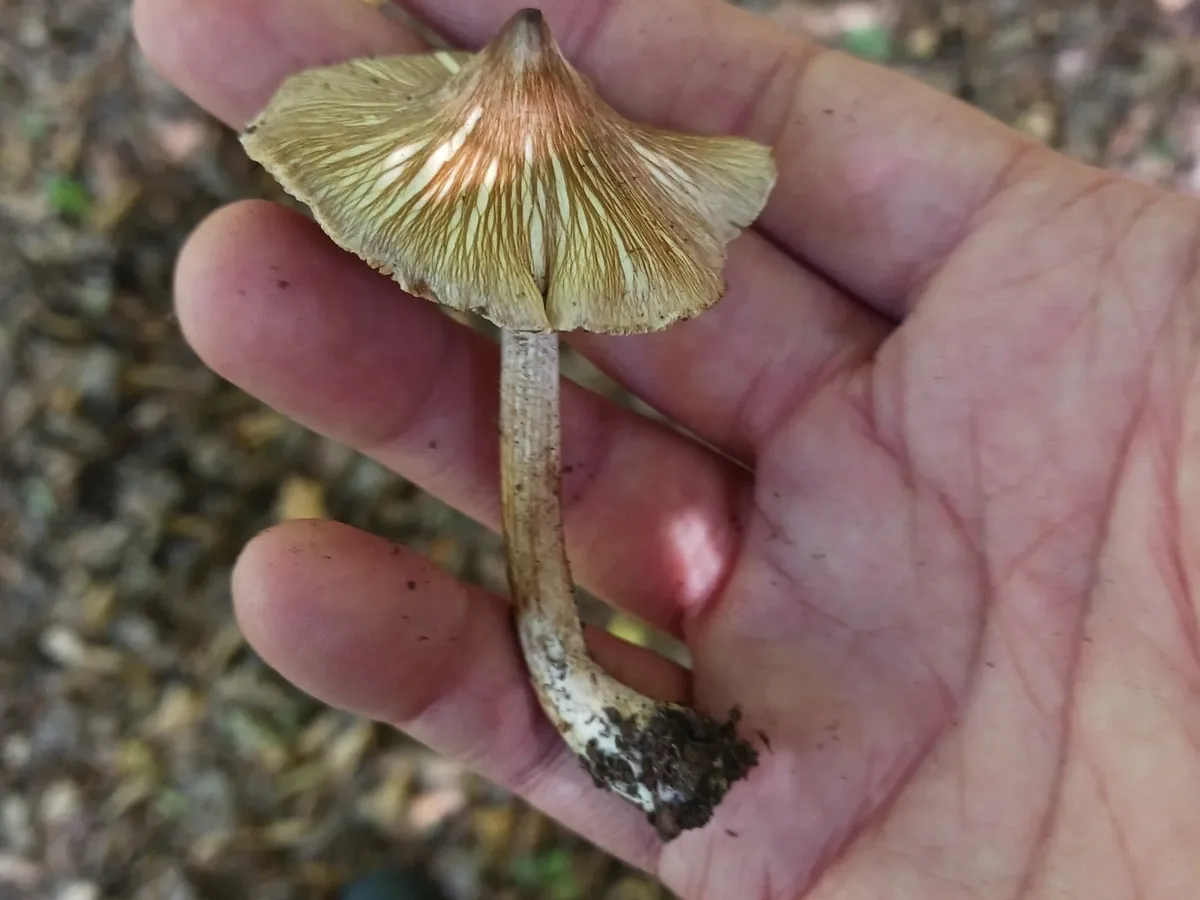 T. Pedro Hafermann (CC0)
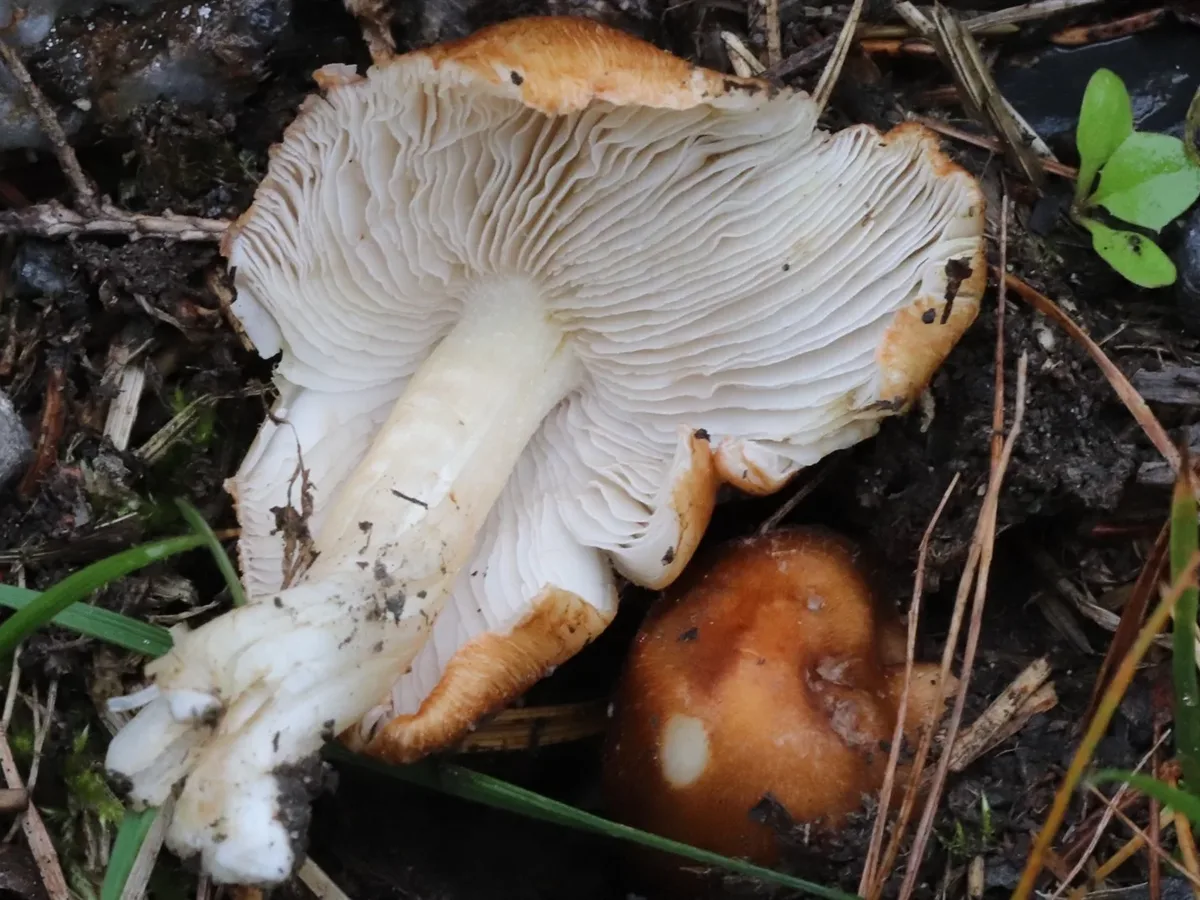 © Rob van Kruining (CC BY)
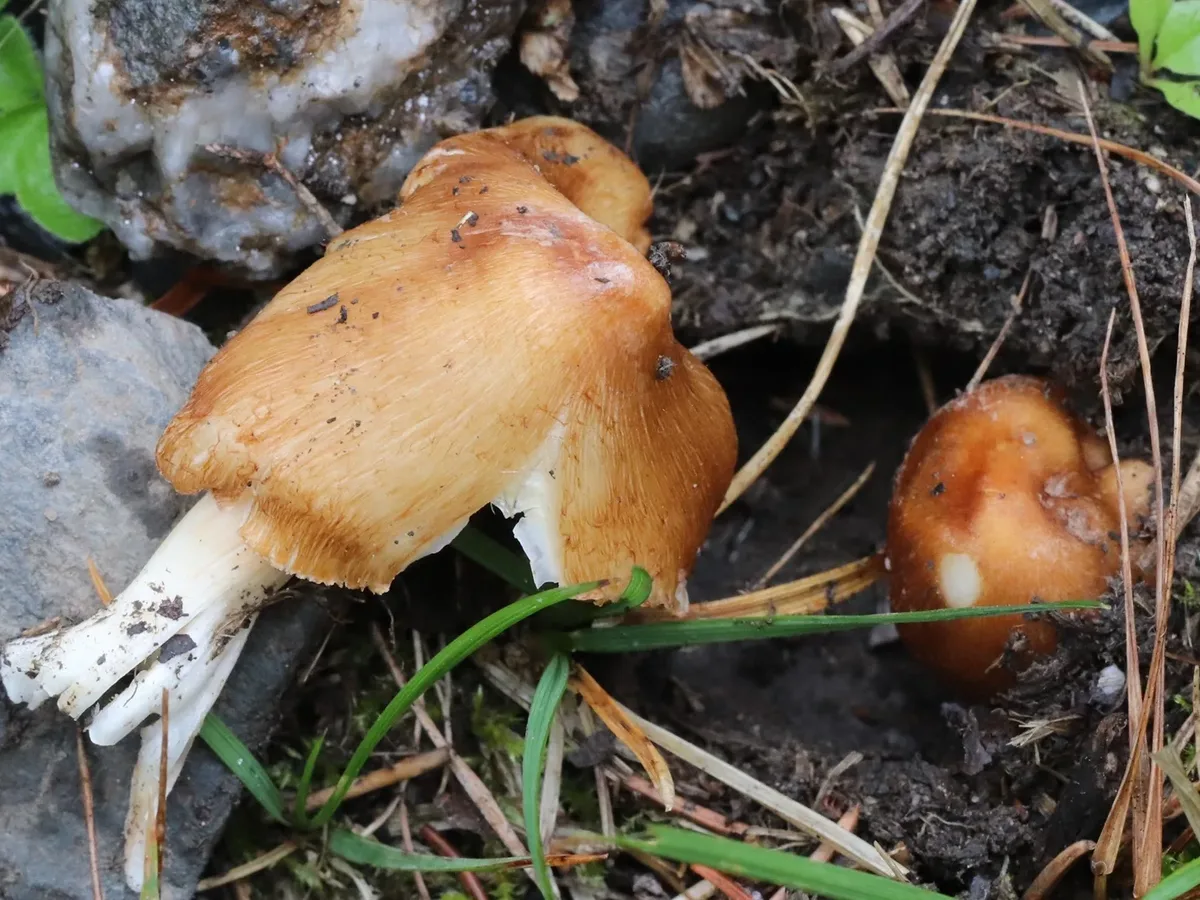 © Rob van Kruining (CC BY)
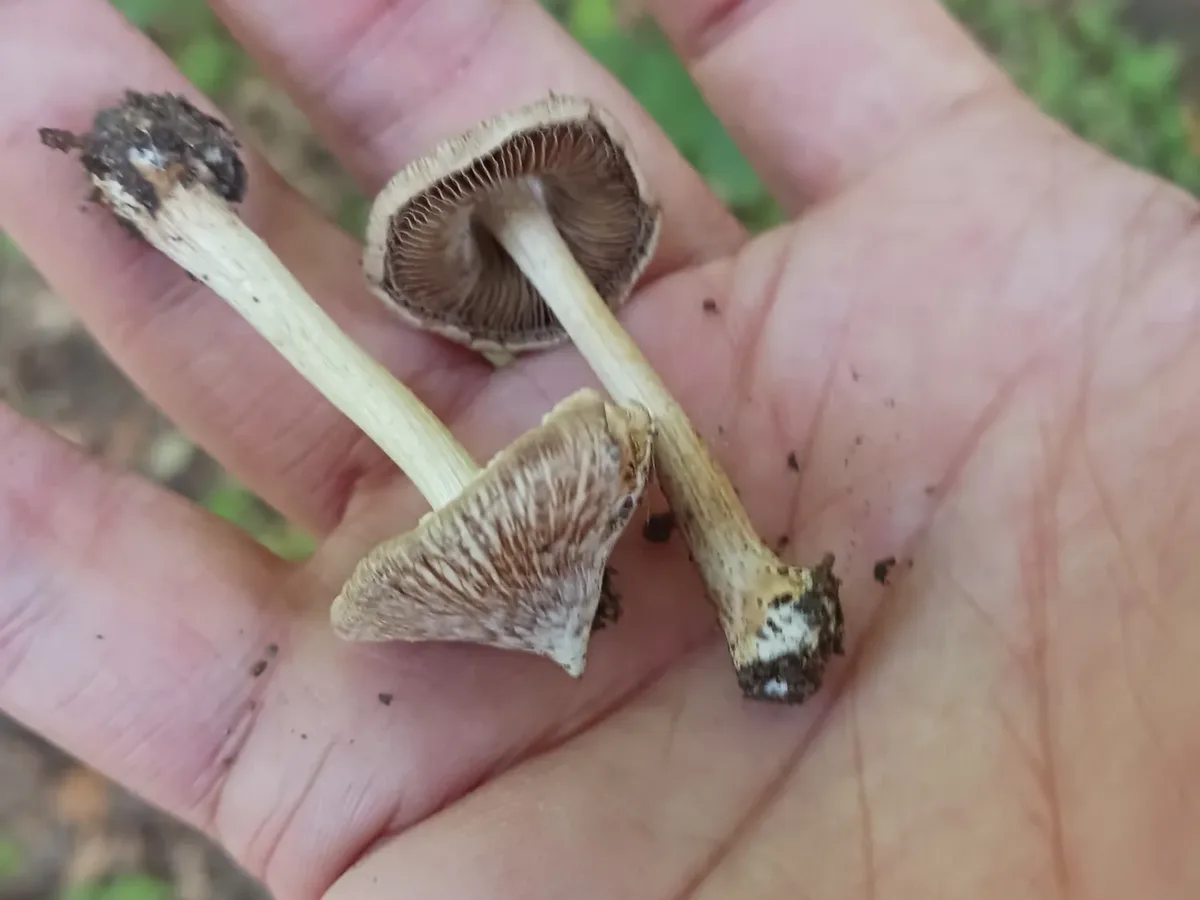 T. Pedro Hafermann (CC0)T. Pedro Hafermann (CC0)© Rob van Kruining (CC BY)
Edible only with the right preparation - or safe for some people but not others. Learn the caveats first.
How to recognise it
Inocybe maculata is one of the more distinctive members of an otherwise confusingly uniform genus, thanks to the white cottony veil fragments that speckle the brown cap surface. These patches are the defining field character and the basis for both the Latin name (maculata = spotted) and the English common name 'frosty'.
Cap
The cap is medium-sized for an Inocybe (3-7 cm), brown with a darker chestnut centre, broadly bell-shaped at first and later expanding to broadly convex with a persistent low central boss (umbo).
The background cap surface is silky-fibrous (as in all fibrecaps), and the scattered white flocci sit on top of these fibres. In old or wet specimens the patches can partly detach or merge with surrounding fibres, diminishing this character.
Gills
The gills begin pale and age snuff-brown, tracking spore maturity.
Stem
The stem is robust for the genus - 4-8 cm tall and noticeably fleshy - pale, silky and often bearing a faint ring zone where the cortina (cobweb veil) once attached.
Smell
The odour is sweet and faintly fruity or honey-like with an earthy undertone, less sharply spermatic than Inocybe geophylla but still recognisably 'Inocybe' once the smell is known.
Why it's dangerous
Muscarine poisoning from Inocybe species requires prompt medical attention.
Atropine (a specific muscarinic antagonist) rapidly reverses symptoms when administered intravenously, but must be given at the right dose.
The symptoms, while rarely directly fatal in healthy adults receiving treatment, are severe and distressing. In children, the elderly, or people with cardiac or respiratory disease the bradycardia and bronchospasm can be life-threatening.
Do not attempt to manage symptoms at home. Instead:
- call emergency services
- bring a specimen or photograph of the mushroom
- inform the treating clinician that Inocybe poisoning (muscarinic) is suspected, so that atropine treatment can be initiated promptly
Toxin
Muscarine is a quaternary ammonium alkaloid that acts as a selective agonist at muscarinic acetylcholine receptors in the parasympathetic nervous system and at peripheral cholinergic synapses.
It is not degraded by digestive enzymes, stomach acid, or heat.
Inocybe species (along with Clitocybe dealbata and related species) are the primary clinical cause of muscarine poisoning in Europe - they contain muscarine at concentrations substantially higher than Amanita muscaria, despite that species lending its name to the toxin.
The toxin is absorbed rapidly from the gastrointestinal tract, explaining the fast onset of symptoms.
Symptoms
Classic muscarine poisoning follows the SLUDGE/DUMBELLS pattern:
- Salivation (excessive drooling)
- Lacrimation (tearing)
- Urination (incontinence)
- Defecation (urgency or involuntary)
- Gastrointestinal distress (cramping, nausea, vomiting)
- Emesis
Additionally:
- Diaphoresis (profuse sweating)
- Urination
- Miosis (pinpoint pupils - the cardinal sign)
- Bradycardia (dangerously slow heart rate)
- Bronchospasm (wheeze, respiratory difficulty)
- Excessive secretions
- Lacrimation
- Salivation
Onset is rapid: 15 minutes to 2 hours after ingestion.
The cardinal triad in clinical practice is sweating, salivation, and a slow pulse.
Symptoms resolve within 6-24 hours with appropriate treatment.
Staying safe
Inocybe maculata is a muscarinic poisonous fungus and must never be eaten.
The muscarine content of Inocybe species is substantially higher than in Amanita muscaria, the species for which muscarine was named.
Muscarine acts on the parasympathetic nervous system, producing the classic SLUDGE syndrome (see symptoms), which is extremely unpleasant and potentially dangerous - particularly in children, the elderly, and those with heart or respiratory conditions.
No cooking method destroys muscarine - it is a heat-stable, water-soluble compound.
The toxic dose from a moderate serving of Inocybe is reliably sufficient to cause clinical poisoning. Onset is rapid (15 minutes to 2 hours), which distinguishes muscarine poisoning clearly from the delayed liver toxicity of amatoxin-containing species.
Seek emergency medical care immediately if ingestion is suspected. Treatment with atropine is specific and effective but must be administered promptly.
Where & when it grows
Habitat
This species shows a strong association with beech woodland and mixed beech-oak forest on mildly base-rich soils, reflecting the preference of its primary mycorrhizal partners (Fagus, Quercus, Corylus) for such substrates.
Look for it:
- along shaded forest rides
- on soil banks at the edges of paths
- in the deeper humus-rich layers of mature deciduous woodland
It also appears in parks, old gardens, and urban plantings wherever suitable tree hosts are established.
The mycorrhizal dependency means it is always found in proximity to suitable tree roots, even if those roots run well beneath a path surface or lawn edge.
When
The main fruiting season in central and western Europe runs from late July through October. The greatest flush typically follows warm late-summer rainfall (15-30 mm or more), when soil temperatures remain between about 10 °C and 20 °C.
Flushes appear roughly 5-12 days after triggering rainfall.
The species coincides with the main edible-mushroom season (ceps, chanterelles, hedgehogs), which increases the risk of accidental collection.
Fruitings are sporadic after October and effectively cease once hard frosts arrive, though mild spells in November can occasionally extend the season.
How it grows
Inocybe maculata lives the hidden life shared by all mycorrhizal fungi: the visible fruitbody is just a brief above-ground moment for a mycelium that may have been threading the soil beneath a beech or oak for decades. It is locked into a mutual exchange with its host tree - carbon flowing down from the leaves, minerals and water flowing back up through the fungal web.
Without a living root partner the species cannot grow, and it cannot be cultivated.
In good seasons the same mycelial patch returns year after year, pushing up fruitbodies singly or in small scattered groups rather than tight clusters.
The delicate cortina - a cobweb-fine veil that bridges the cap edge to the stem in very young buttons - is one of the most fleeting structures in the fungal world. It collapses within hours of the cap expanding, leaving only a faint fibrous ring zone on the stem and the characteristic white flocci pressed onto the cap surface.
Spores are ellipsoid to bean-shaped, smooth, tobacco-brown in mass, and wind-dispersed once the cap opens fully.
Fruiting conditions
Flushes 5-12 days after significant rainfall (15 mm or more over two weeks) once summer heat subsides and daytime air temperatures fall below about 22 °C; peak activity from late August to early October in central Europe when soil temperature is roughly 9-17 °C. The mycorrhizal habit ensures annual return to established mycelial patches under host trees in favourable conditions.
Look-alikes
Several edible and inedible species share some features with Inocybe maculata. The white cap patches are a critical distinguishing feature that separates it from most confusion species, but they can diminish in old or rain-washed specimens.
- 1Young field mushrooms and horse mushrooms (Agaricus campestris, Agaricus arvensis) have a similar brown-capped fleshy appearance in some conditions, but always have free gills (not adnate), a persistent ring on the stem, initially pink gills that turn chocolate-brown, and white flesh that may yellow or redden slightly when cut. Agaricus also has a more regular, even cap surface without a pronounced umbo.
- 2Small Macrolepiota and Lepiota species have a double ring (or prominent moveable ring), a distinctly scaly cap, and white or greenish (Chlorophyllum) gills; the fibrous-only cap texture of Inocybe is different from the discrete flat scales of these species.
- 3Amanita spissa (Grey-brown amanita) bears a grey-brown cap with pale greyish veil remnants that could superficially recall the frosty patches of I. maculata in very young specimens, but has a volva/stem base enclosed in a bag, a well-developed ring, white free gills, and a white spore print - and the cap remnants are softer, wart-like rather than fibrous.
- 4Other Inocybe species - the genus is large and many species are visually similar to I. maculata. Without white cap patches, they are even harder to distinguish field characters from I. maculata; all are to be treated as poisonous regardless.
- 5Cortinarius species, particularly brown-capped species with a cortina remnant on the stem, overlap in habitat and cap colour; Cortinarius have rusty-brown (not tobacco-brown) spore prints, often broader, more viscid caps, and distinctive gill colours (initially lilac, violet or pale in many species).
None of the realistic confusion species are amatoxin-containing; all poisoning risk from I. maculata confusion is muscarinic.
Brown Cortinarius species share the webby cortina veil and woodland habitat. Cortinarius have a rusty orange-brown (not tobacco-brown) spore print, often show lilac, violet or blue-grey tones in gills or flesh, typically lack the distinctive Inocybe odour, and have broadly adnate to sinuate gills. Note: some Cortinarius species (e.g. C. orellanus, C. rubellus) are deadly due to orellanin - if uncertain about the genus, do not eat.
Agaricus campestris has free gills that begin pink and turn chocolate-brown (not adnate clay-brown from the start), a persistent ring on the stem, a non-umbonate cap without silky fibres, and flesh that may blush faintly pink when cut. No cortina remnants or veil patches on the cap.
Amanita spissa has a grey-brown cap with soft greyish wart-like veil remnants (not fibrous patches), free white gills, a well-developed skirt-like ring, and a swollen stem base enclosed in a sheath. Spore print white. Amanita spissa itself is considered edible by some, though eating it is inadvisable due to the risk of confusion with deadly Amanita species.
Agaricus arvensis is larger and fleshier with free gills, a prominent double-edged ring, white flesh that yellows slightly when bruised, and an anise-like smell. It lacks the umbonate silky-fibrous cap, veil patches, and earthy-fruity Inocybe odour.
Dozens of other Inocybe species share brown fibrous caps and woodland habitat. Most lack the distinctive white veil patches of I. maculata. All share the muscarinic toxin and all must be avoided - confusing one Inocybe species for another does not change the poisoning risk, but does mean the white patches (when visible and fresh) are the most reliable distinguishing feature of I. maculata within the genus.
A reference guide - never an edibility guarantee. When in doubt, leave it out.