Star-spored fibrecap
Inocybe asterosporasyn. Agaricus asterosporus, Inocybe asterospora var. asterospora
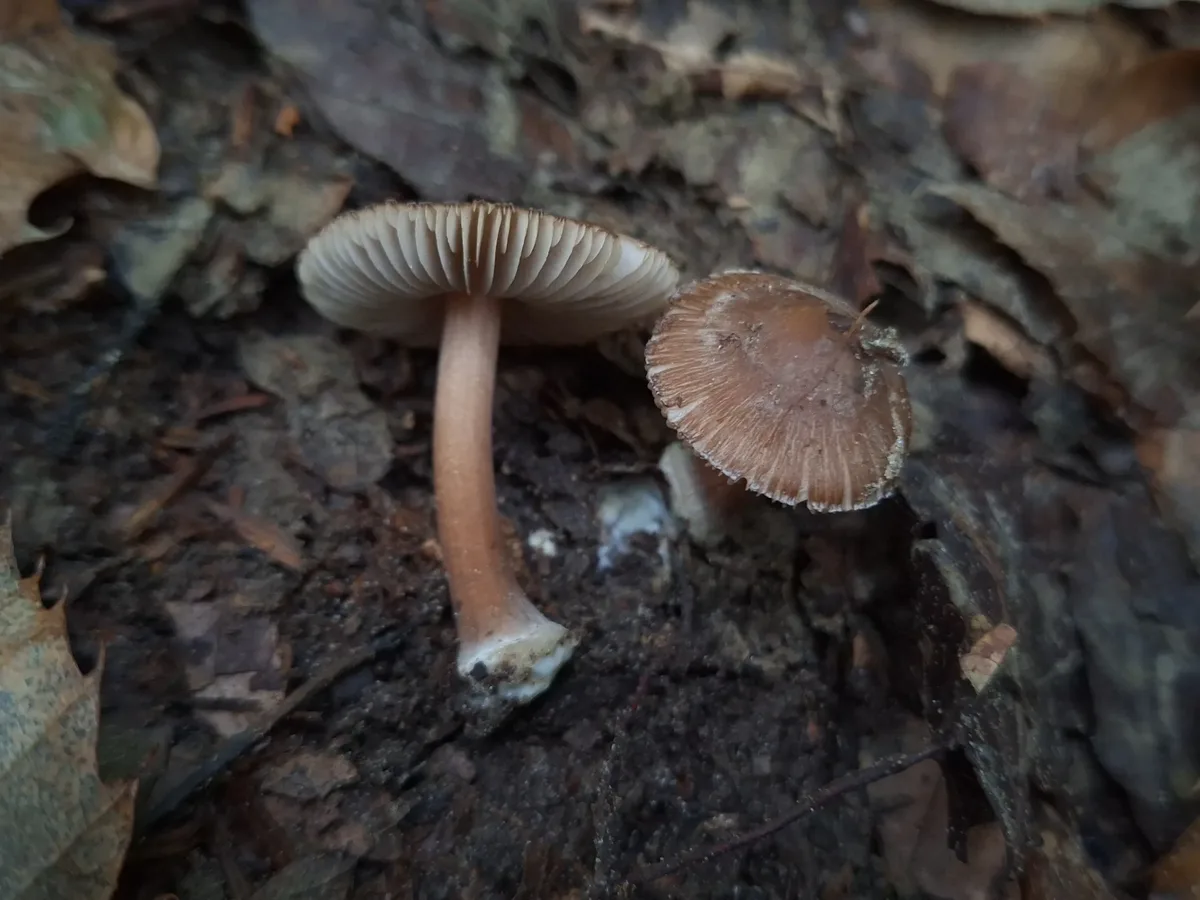 © yellowplant (CC BY)
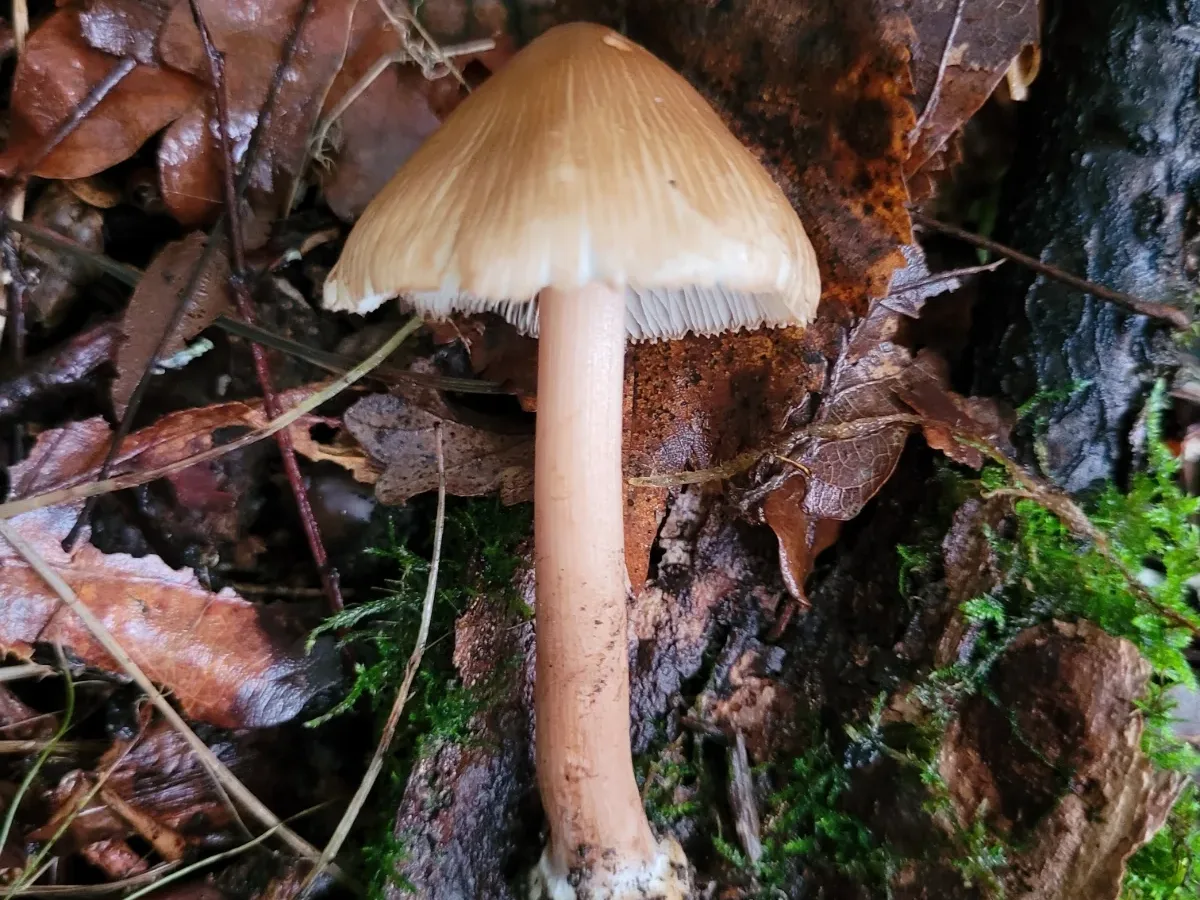 © Ellen Christensen (CC BY)
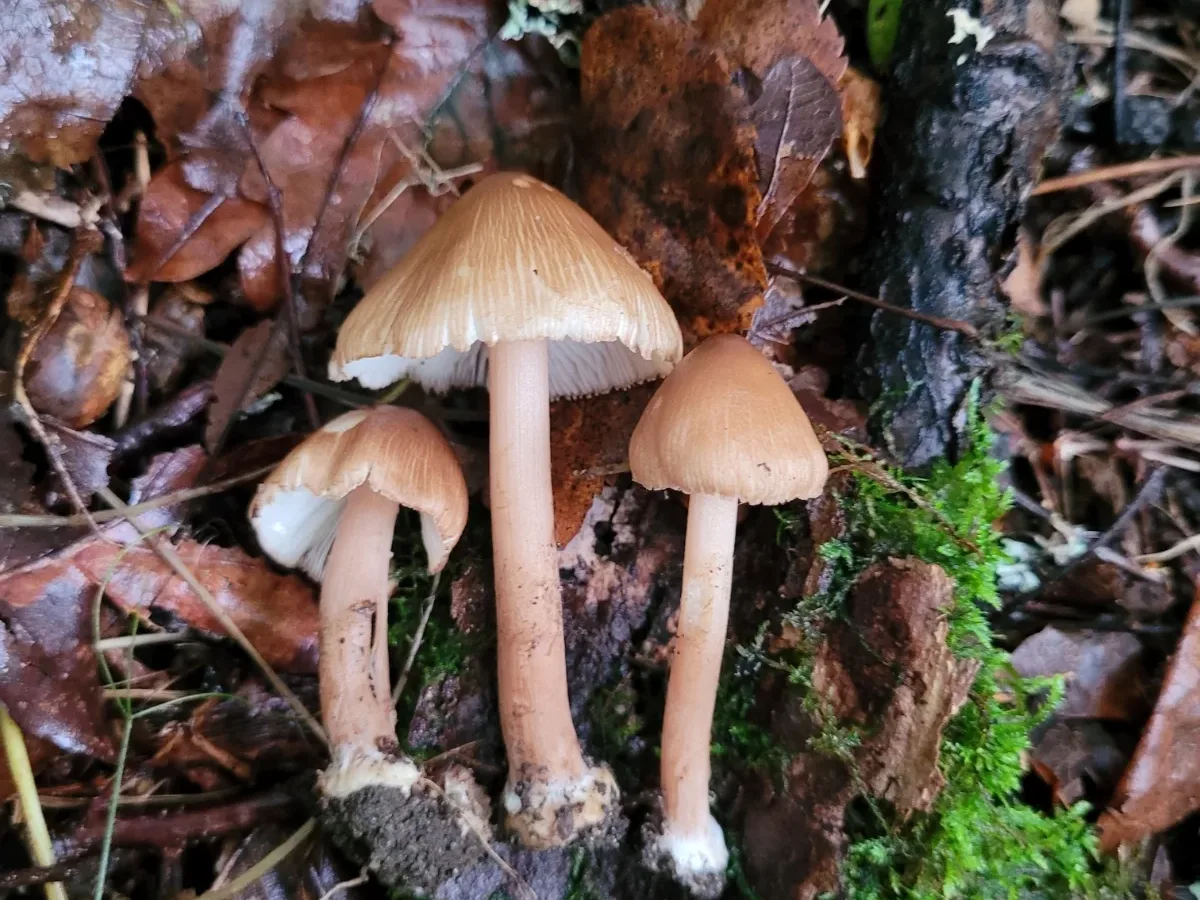 © Ellen Christensen (CC BY)
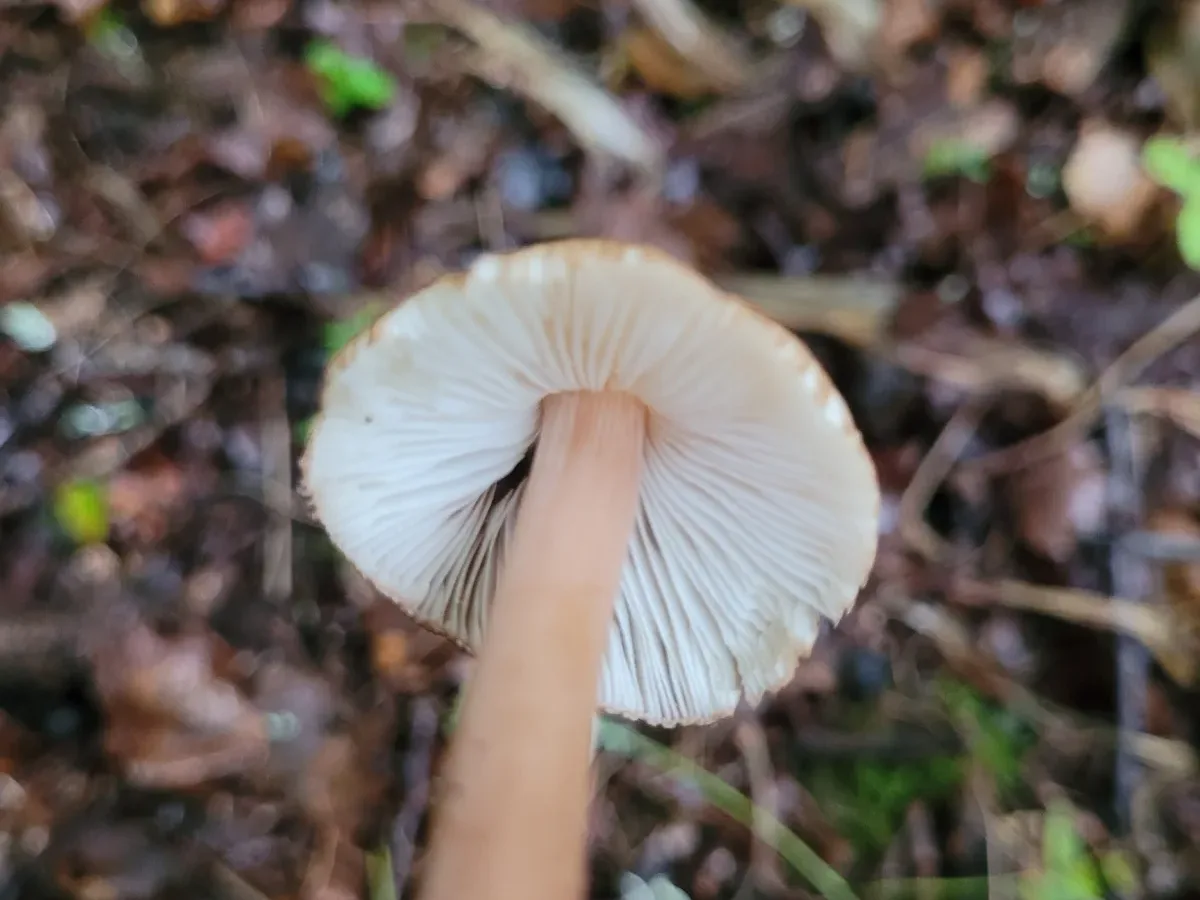 © Ellen Christensen (CC BY)
 © Per Marstad (CC BY)© yellowplant (CC BY)© Ellen Christensen (CC BY)
Edible only with the right preparation - or safe for some people but not others. Learn the caveats first.
Never eat a mushroom you are not 100% sure of - check the look-alikes below, and always cook wild mushrooms.
How to recognise it
A medium-brown, fibrous-capped woodland mushroom in the classic Inocybe pattern.
Cap
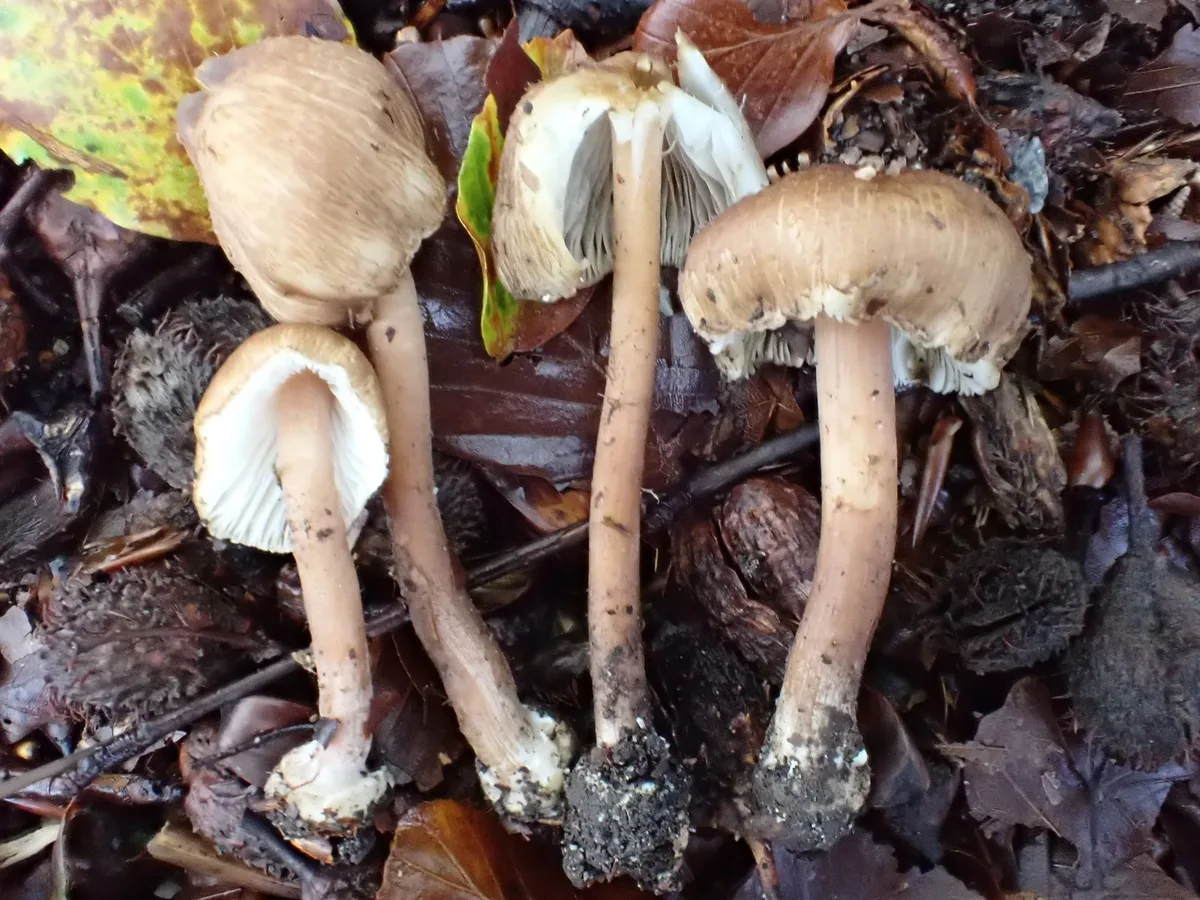
2-6 cm, broadly conical to bell-shaped with a firm central boss (umbo) that stays prominent even as the cap opens up, covered in silky radial fibres that may crack slightly at the margin in dry weather.
Colour is hazel to date-brown, typically a touch darker and more tawny at the centre.
Stem
3-8 cm, whitish to pale ochre; the apex has a distinctive mealy-powdery (pruinose) texture - best seen with a hand lens - and the base often carries a small but fairly abrupt bulge that may be slightly rimmed.
Always ease the stem carefully out of the soil to inspect the base; that detail matters.
Gills
Gills age to dull snuff-brown, matching the spore print.
Smell & taste
The smell is strongly earthy and spermatic - the hallmark Inocybe odour, unlike anything edible, and a reliable cue to walk away.
Definitive identification to species requires a microscope: the spores are stellate (star-shaped with blunt angular tubercles), unlike the smooth spores of I. geophylla or the differently-shaped nodulose spores of other Inocybe species.
Thick-walled, crystal-encrusted cystidia (metuloids) are another microscopic marker.
Why it's dangerous
Muscarine poisoning is a medical emergency, particularly in children, elderly persons, and those with cardiac or respiratory disease.
The specific antidote is atropine (a muscarinic antagonist), which is effective and rapidly reverses symptoms when given intravenously at adequate dose.
Do not self-treat and do not wait for symptoms to progress - call emergency services promptly.
The potential for confusion with the deadly fibrecap Inosperma erubescens (which causes muscarine poisoning severe enough to be fatal, with documented deaths) means that any suspected ingestion of a fibrous-capped brown woodland mushroom must be treated as a potential emergency.
Report clearly that the mushroom was a small brown fibrous-capped species from broadleaf woodland with an earthy smell.
Toxin
Muscarine, a quaternary ammonium alkaloid, is the principal toxin. It acts as a direct agonist at muscarinic acetylcholine receptors throughout the parasympathetic nervous system, causing uncontrolled cholinergic stimulation.
The toxin is not broken down by:
- cooking heat
- drying
- gastric acid
Inocybe species contain muscarine at concentrations far exceeding those found in Amanita muscaria, despite the historical association of the toxin name with the latter.
The mechanism is purely neuronal/autonomic and does not directly damage the liver or kidneys.
Symptoms
Rapid-onset (15 minutes to 2 hours) cholinomimetic syndrome following the SLUDGE/DUMBELLS pattern:
- Salivation
- Lacrimation
- Urination
- Defecation
- Gastrointestinal distress (cramping, nausea, vomiting)
- Emesis
Plus:
- Diarrhoea
- Urinary incontinence
- Miosis (pinpoint pupils)
- Bradycardia (slowed pulse)
- Bronchospasm with excessive secretions
- Excessive sweating (diaphoresis)
- Low blood pressure
The cardinal field signs are profuse sweating, salivation, and a slow pulse.
Symptoms typically resolve within 6-24 hours with treatment. In severe cases, bronchospasm and cardiovascular depression can be dangerous.
Staying safe
Inocybe asterospora is a muscarinic poisonous species and must never be eaten.
It contains muscarine - a quaternary ammonium alkaloid that activates parasympathetic muscarinic acetylcholine receptors - at concentrations typical of the Inocybe genus, which are significantly higher than in Amanita muscaria.
The onset of muscarine poisoning is rapid (15 minutes to 2 hours), in contrast to the delayed-onset amatoxin poisoning of deadly Amanita.
While muscarine poisoning is rarely fatal in healthy adults with prompt medical treatment, it is medically serious and can be dangerous in children, the elderly, and those with cardiac or respiratory conditions.
The critical safety concern with I. asterospora is that it shares its general appearance with Inosperma erubescens (deadly fibrecap), which is classified as deadly and has caused fatalities. Any uncertainty about a fibrous-capped brown woodland mushroom must be resolved by not eating it.
Cooking does not destroy muscarine, which is heat-stable and water-soluble.
If ingestion is suspected, seek emergency medical attention immediately - do not wait for symptoms to develop.
Where & when it grows
Habitat
Mature broadleaf woodland is its home - primarily under beech, oak, and hornbeam, on moist, moderately base-rich soils with a decent leaf-litter layer.
Look along shaded forest tracks and in the understory of old beech stands. Unlike I. rimosa, it prefers the shaded interior of established woodland over open, sunny, disturbed edges, though there is some overlap in mixed stands.
Old urban parks with large broadleaf trees can also hold it.
Be aware that it shares woodland, season, and broadly similar scale with chanterelles, hedgehog mushrooms, and autumn boletes - species it could be casually mistaken for by a distracted eye.
When
July through October, with the bulk of fruiting from August into October - a little later in the year than I. rimosa, and squarely in the heart of the prime autumn mushroom season.
Flushes come 5-12 days after meaningful rainfall (at least 20 mm over a couple of days) once summer soil temperatures have started to ease, typically somewhere between 8 °C and 18 °C.
That timing puts it alongside chanterelles, hedgehog mushrooms, and autumn boletes - an overlap worth keeping firmly in mind.
How it grows
Like all Inocybe species, I. asterospora is obligately mycorrhizal - it lives only in partnership with living tree roots and cannot be grown in cultivation.
Invisible mycelial networks thread the soil beneath host trees for years, surfacing each autumn as fruitbodies when conditions align.
Those fruitbodies emerge singly or in small scattered groups from mineral soil or thin humus - never in tight clusters.
With a wide range of deciduous partners (beech, oak, hornbeam, birch, lime, alder), it can turn up wherever mature broadleaf trees have had time to establish: old woodland, urban parks, estate grounds, and roadside avenues alike.
Fruiting conditions
Flushes 5-12 days after significant rainfall (≥20 mm over 2-3 days) when soil temperature is between 8 °C and 18 °C, with the peak window in late August through October in central and western Europe. The mycorrhizal nature ensures annual return to established patches. More autumn-biased than I. rimosa, with the main flush coinciding with the first substantial September-October rains.
Look-alikes
Inocybe asterospora can be confused with several other Inocybe and related species, and critically with a deadly species.
The most dangerous confusion is with Inosperma erubescens (deadly fibrecap), which shares the fibrous, umbonate, medium-brown cap, grows in similar woodland habitats, and is deadly - fatalities have occurred.
Inosperma erubescens tends to be more reddish-brick or tawny-tinged and often shows reddish staining on bruised flesh, but field separation between brown Inocybe-type mushrooms is unreliable without microscopy.
Any fibrous-capped, umbonate, brown-capped mushroom with an earthy-spermatic smell found in broadleaf woodland must be treated as potentially deadly.
Other confusions include:
- 1Inocybe rimosa (split fibrecap) - the cap fibres split more dramatically in I. rimosa, which is straw-yellow to pale ochre rather than hazel-brown; I. rimosa fruits earlier and more in open habitats; both are muscarinic and toxic.
- 2Inocybe geophylla (white fibrecap) - much paler, white to ivory, but the lilac variety could cause confusion with brownish Inocybe.
- 3Cortinarius species in brown-ochre forms - these retain cobweb-like cortina fibre remnants between cap edge and stem in young specimens, and have rusty-cinnamon (not snuff-brown) spore prints; Cortinarius rubellus (deadly webcap) is a deadly orellanin-containing species that can occur in similar woodland.
- 4Hebeloma crustuliniforme (poison pie) and other Hebeloma species - these are brown-capped and poisonous but have a more radish-like or unpleasant smell (not spermatic), a smoother cap without pronounced umbo or radial fibres, and often a slight ring zone.
- 5Young specimens of edible Cortinarius caperatus (gypsy mushroom) - this has a frosted-pruinose bloom on the cap surface and a conspicuous white ring on the stem.
Inosperma erubescens shares the fibrous, umbonate, medium-brown cap, earthy-spermatic smell, and woodland habitat. The deadly fibrecap often shows reddish or brick-tinged tones and may redden on bruising, but these features are variable and unreliable. Field separation based on macroscopic characters alone is not safe. Critically, Inosperma erubescens is classified as deadly - fatalities are documented - because it contains muscarine at concentrations that overwhelm the cardiac and respiratory system. Any uncertainty about a brown fibrous-capped, umbonate woodland mushroom with an earthy-spermatic smell must be resolved by not eating it.
Cortinarius rubellus has a broadly conical to umbonate cap in tawny to orange-brown tones and grows in similar mixed woodland. Key distinctions: young specimens show cobweb-like cortina fibres stretched between the cap margin and the stem; the spore print is rusty-cinnamon (not dull snuff-brown); the overall colour is more orange-tawny than hazel-brown. Cortinarius rubellus causes delayed kidney failure from orellanin - symptoms appear days to weeks after ingestion, making it even more treacherous. Confirm exclusion by checking for the cortina in young specimens and the rusty spore print.
Cortinarius caperatus is a choice edible that appears broadly similar at first glance - medium-brown, broadly umbonate - but has a cap surface with a distinctive white-frosted or granular bloom when young (like sugar-dusting on the cap), a conspicuous white ring (annulus) on the stem that is unique within the Cortinarius genus, and a rusty ochre spore print. The smell is pleasant and earthy (not spermatic). I. asterospora has no ring, no frosted cap bloom, and a strongly earthy-spermatic odour. The ring on C. caperatus is the single most reliable exclusion field mark.
Hebeloma crustuliniforme has a smooth, pale ochraceous to clay-buff cap without pronounced radial fibres or a sharp pointed umbo; its smell is typically of radish or horseradish rather than the spermatic-earthy smell of Inocybe; the stem may show faint ring-zone remnants or a slightly pruinose surface, and the gills have characteristic beaded water-droplets in fresh specimens. Hebeloma species are gastrointestinally irritating rather than muscarinic - unpleasant but a different toxidrome. Neither is safe to eat.
Inocybe rimosa has a more prominently splitting cap margin with bold radial fissures, a more straw-yellow to pale ochre (less hazel/date-brown) colour, and favours more open, sunny, disturbed habitats - path edges, parkland rides, roadsides. Both species are muscarinic and toxic. Definitive separation requires microscopy: I. rimosa has smooth ellipsoid spores, whereas I. asterospora has distinctive stellate (star-shaped, heavily tuberculate) spores. Confusing one for the other is not dangerous in terms of toxicity - both are poisonous - but neither should be eaten.
Inocybe geophylla and its lilac variety are pale white to ivory (or pale mauve-lilac) - quite different from the hazel-brown of I. asterospora. Both share the earthy-spermatic smell and the pruinose stem apex. I. geophylla has smooth spores (not stellate). Both are muscarinic and toxic.
A reference guide - never an edibility guarantee. When in doubt, leave it out.