Trooping Funnel
Infundibulicybe geotropasyn. Clitocybe geotropa, Agaricus geotropus, Agaricus maximus, Clitocybe maxima, Aspropaxillus giganteus (misapplied)
 T. Pedro Hafermann (CC0)
 © Yves Bas (CC BY)
 © davidhanks (CC BY)
 © Yves Bas (CC BY)
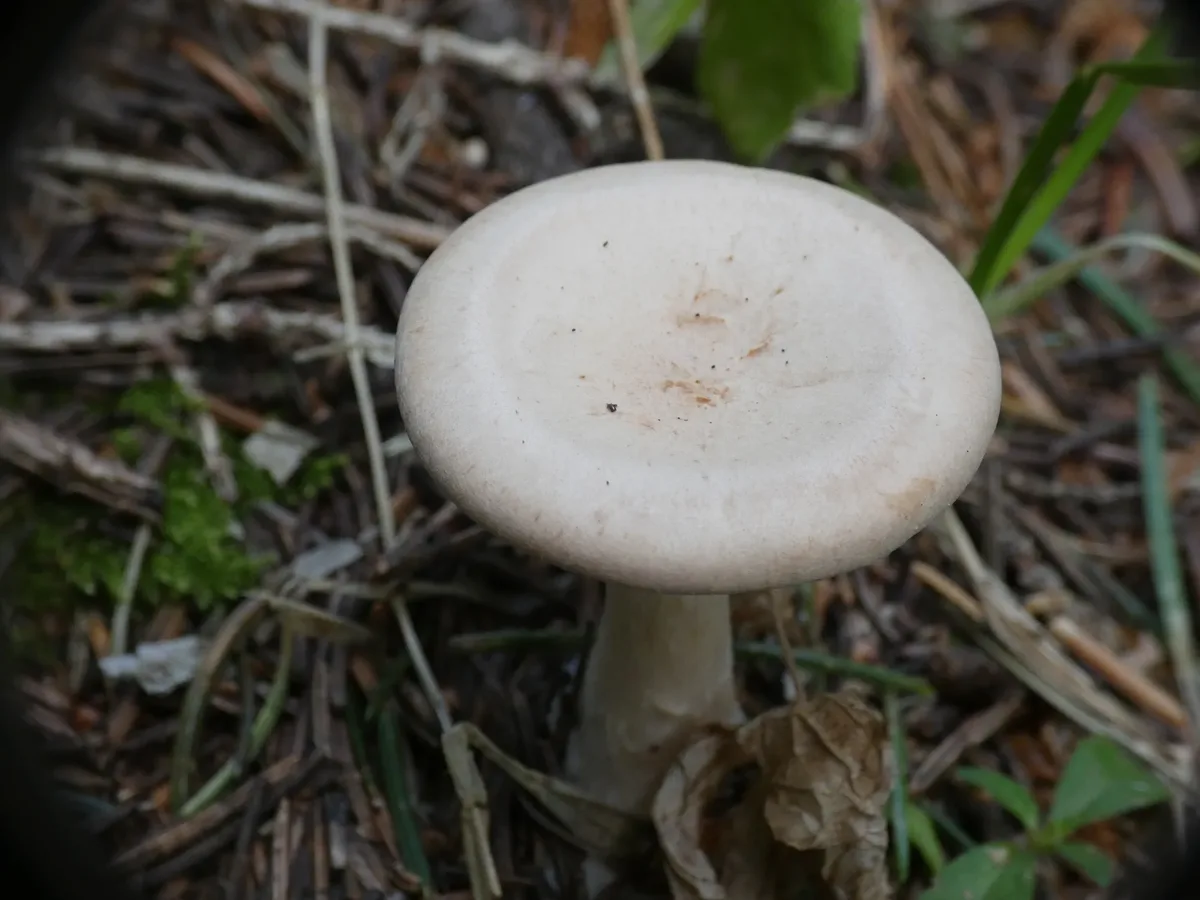 © Yves Bas (CC BY)
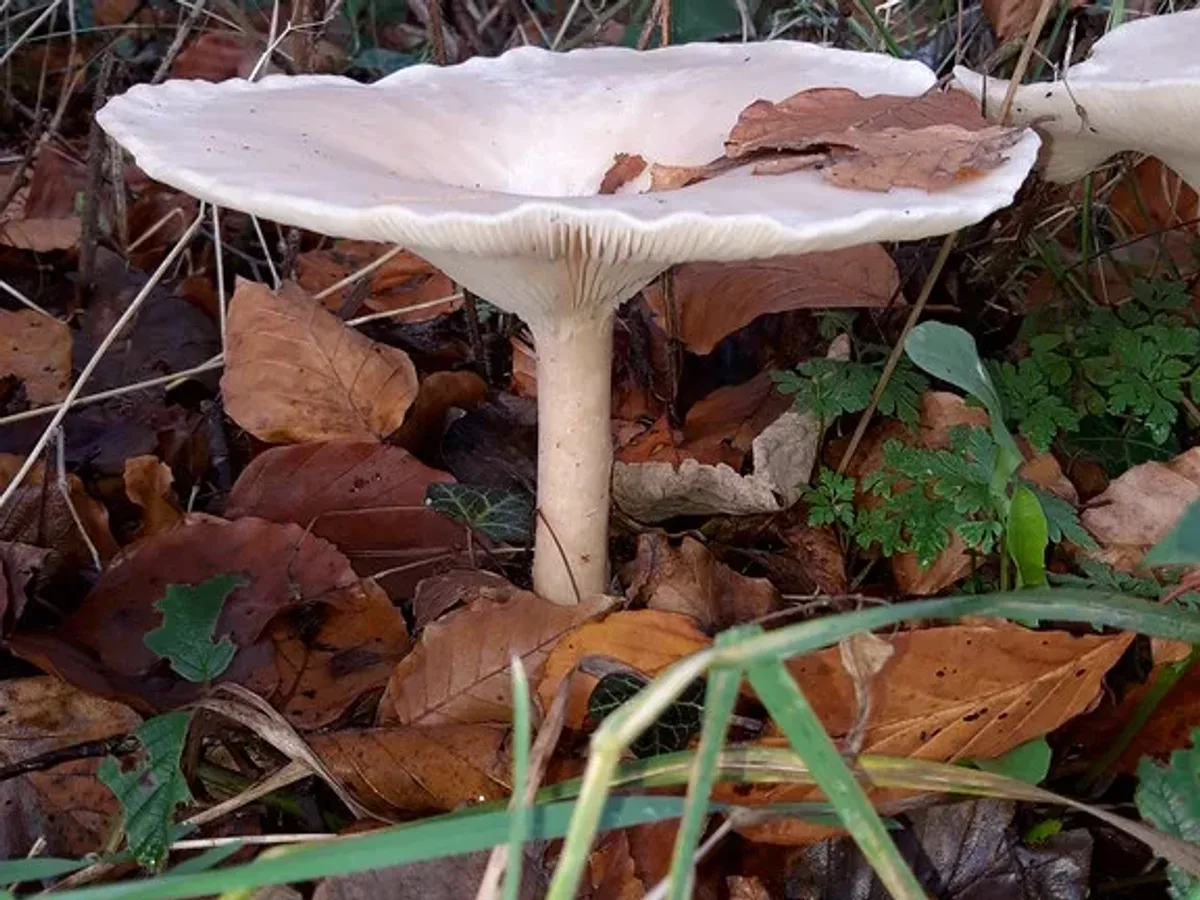 © alx_chief (CC BY-SA 2.0)T. Pedro Hafermann (CC0)© Yves Bas (CC BY)
One of the best mushrooms you can bring home - once you are certain of the identification.
Never eat a mushroom you are not 100% sure of - check the look-alikes below, and always cook wild mushrooms.
How to recognise it
Cap
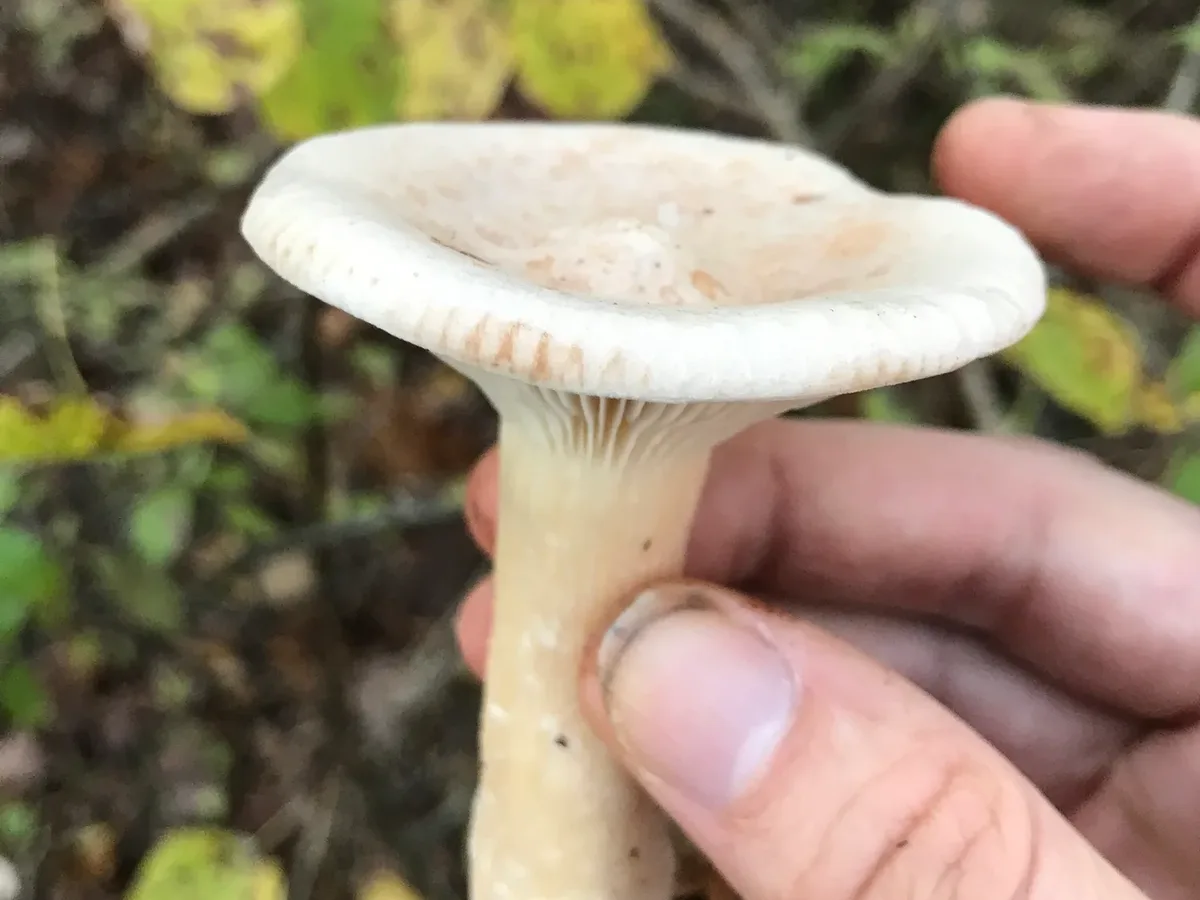
The Trooping Funnel is one of the largest and most imposing funnel caps, frequently 10-20 cm or more across.
The cap begins convex with a tightly inrolled rim and matures into a broad funnel, but the single most reliable feature is the small persistent boss or umbo that sits at the centre of the depression, like a navel in the bottom of a shallow bowl.
Colour is an even pale buff, leather-cream or ochre-tan, drying paler.
Gills
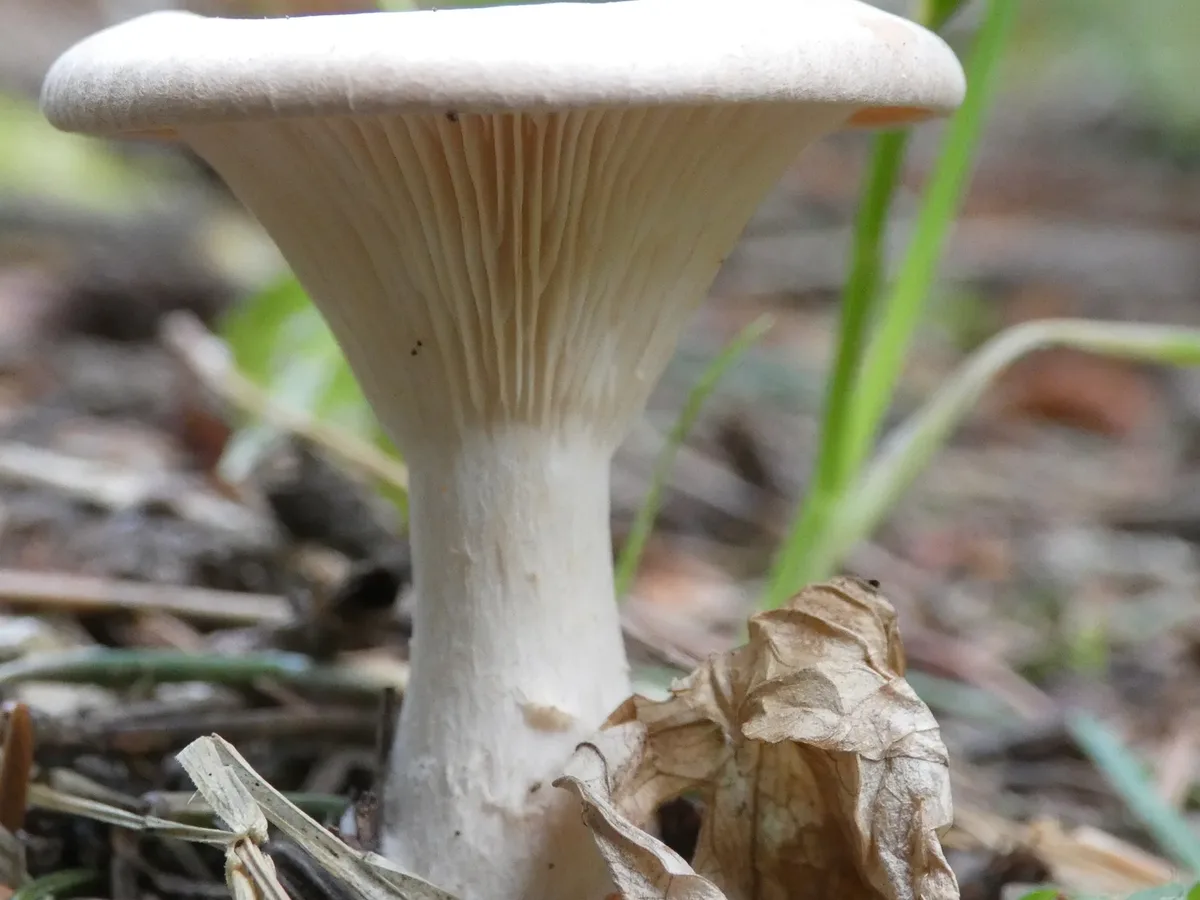
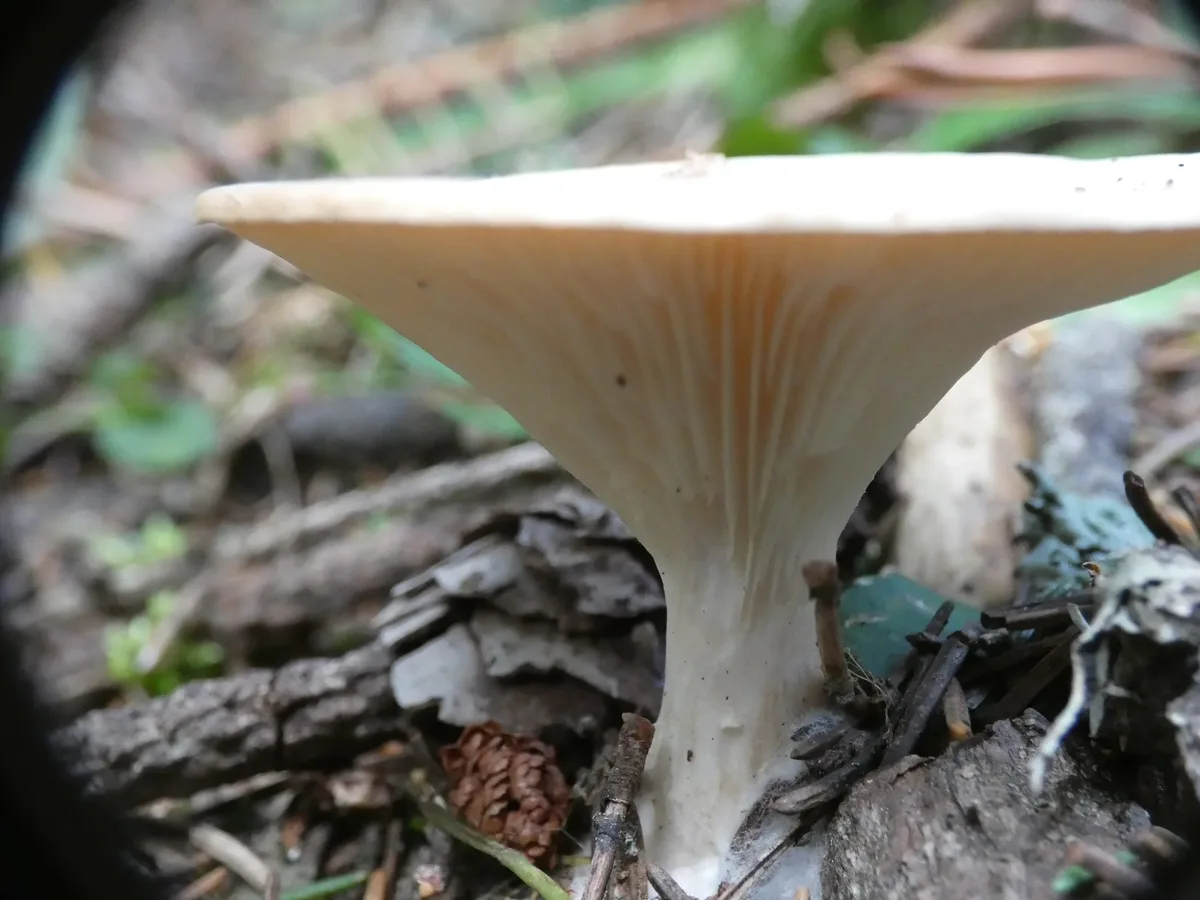
The gills are crowded, narrow, whitish-cream and conspicuously decurrent, sweeping a long way down the stem.
Stem
The stem is correspondingly massive: tall, firm and noticeably swollen or club-shaped towards a felted base bound with white mycelium.
The whole fungus is firm and dry to handle, and a spore print is white to cream.
Where & when it grows
Habitat
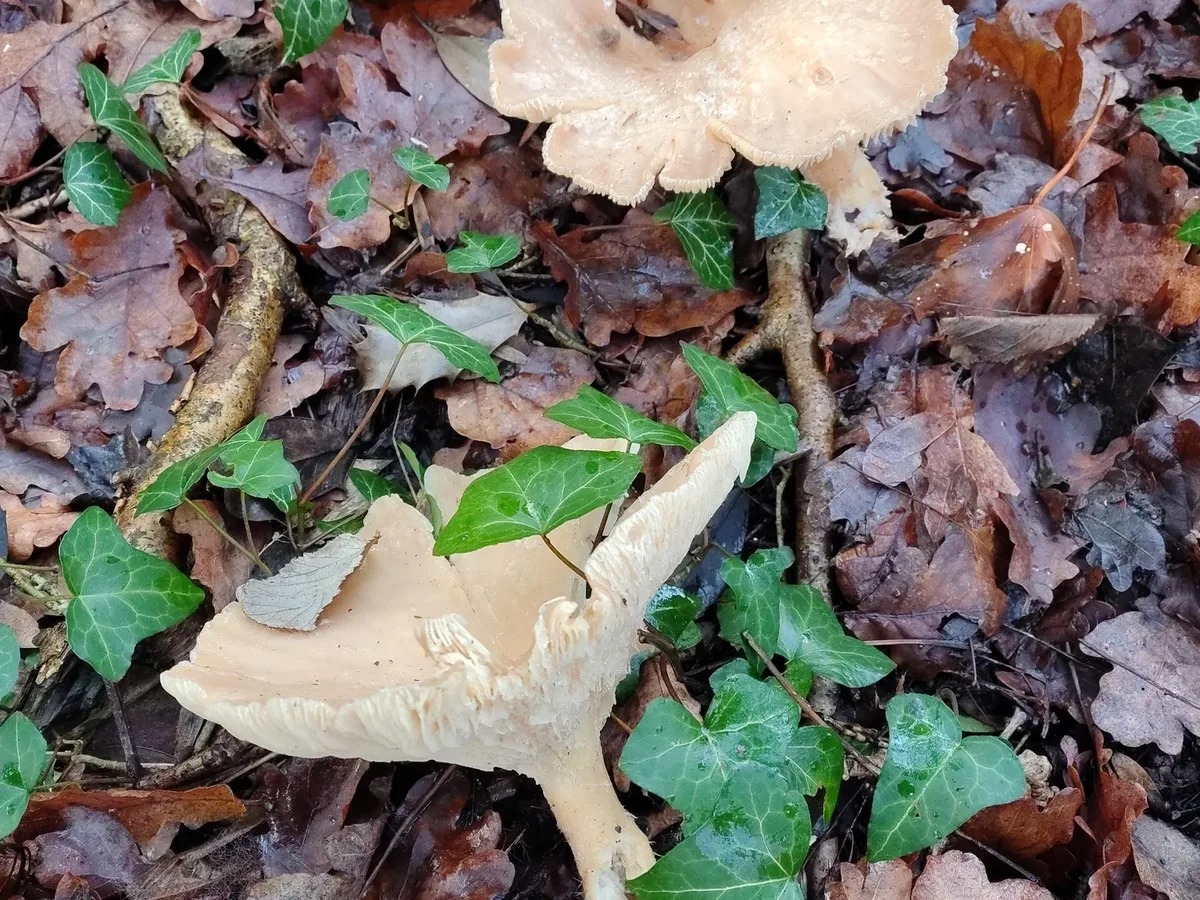
Look in deciduous and mixed woodland with deep, rich leaf litter, and especially along the more open margins:
- grassy clearings
- woodland rides
- scrubby hedgerows
- copses and tree-lined verges
It is a litter saprotroph rather than a tree partner, so it is tied to decomposing organic matter rather than to a specific host root.
It is strongly gregarious, characteristically appearing in long arcing troops or in expanding fairy rings several metres across that return to the same ground for many seasons.
When
The Trooping Funnel is one of the season's final acts. Fruiting begins in late summer or early autumn but really hits its stride in mid-to-late autumn, when most other mushrooms have already faded.
It carries on well into November and December, pushing through the cold and damp long after the woodland floor has quieted, until a hard freeze finally brings it to a halt.
If you find a productive fairy ring, mark the spot: the mycelium is perennial, and the ring will return to the same ground year after year.
How it grows
Saprotrophic, decomposing fallen leaves and woody litter.
The mycelium is perennial and forms expanding rings; the same ring can fruit for decades, enlarging slightly each year.
Fruit bodies emerge in dense troops, the rings often partly hidden among bracken or tall grass, so scan for the curved line of pale caps rather than single mushrooms.
Fruiting conditions
A cool-season litter saprotroph: flushes follow autumn rains as soil temperatures fall, and fruiting continues into near-freezing conditions until a hard frost. Fairy rings recur on the same ground annually, so site memory predicts flushes better than weather alone.
Look-alikes
Several pale, decurrent-gilled mushrooms grow in the same habitat.
- The Clouded Funnel (Clitocybe nebularis) is greyer, with a less deeply funnelled cap and adnate-to-shortly-decurrent gills, and is itself only edible with caution.
- The Miller (Clitopilus prunulus) is smaller, has a strong mealy smell and a PINK spore print.
- Most importantly, the poisonous Livid Pinkgill (Entoloma sinuatum) is similar in size and colour but has sinuate (notched), NON-decurrent gills that turn salmon-pink as the PINK spores mature, a shorter stem, and a mealy smell.
- The small, all-white meadow funnels Clitocybe rivulosa and C. dealbata are DEADLY (muscarine) but are a fraction of the size and never reach the bulk of a true Trooping Funnel.
- Melanoleuca grammopodia is browner with a musky smell and adnexed gills.
DEADLY (muscarine; can cause fatal SLUDGE-syndrome poisoning). Small, pure white to ivory funnel caps only 2-5 cm across, growing in grass and lawns; they never approach the large size, buff colour, central boss or massive bulbous stem of a true Trooping Funnel. Avoid ALL small white funnels and never substitute size judgement for certainty.
Edible only with caution (causes gastric upset in some people, and not all tolerate it). Greyer cap, less deeply funnelled with no central boss, gills adnate to only shortly decurrent and pale grey-cream, strong sweetish-musty smell. Trooping Funnel is paler buff with a true funnel, a central umbo and deeply decurrent gills.
Edible but poor/unpleasant. Browner-grey cap, flatter with a low umbo, gills adnexed to slightly decurrent and whitish, distinct musky/unpleasant smell, fibrous striate stem. Lacks the deep funnel and clean sweet smell.
Poisonous (severe, prolonged vomiting and diarrhoea that can be dangerous in the elderly and children). Similar pale colour and large size but gills are SINUATE (notched) and NOT decurrent, turning salmon-pink with age; spore print is PINK, not white; stem shorter and not club-bulbous; strong mealy smell. A white spore print plus deeply decurrent gills rule it out.
Edible. Much smaller, irregular whitish cap, strong mealy (cucumber/flour) smell, decurrent gills, but spore print is PINK. Size and pink spores separate it.
In the kitchen
Picking & cleaning
Choose young to middle-aged caps for the table; the flesh of the stem becomes fibrous and tough with age, so many foragers take only the caps of larger specimens.
Cut at the base and check that you are dealing with a genuinely large fungus with a central boss and decurrent gills, not a small white funnel.
Because it grows in long-lived rings, harvest a portion and leave others to mature; the colony is not harmed by removing fruit bodies.
Carry caps gills-down to drop a spore print and confirm white spores before eating.
Cooking
A choice, meaty edible with a firm texture and pleasant, faintly sweet flavour that holds up well to cooking. Use only the caps of larger specimens and discard tough fibrous stems.
Always cook thoroughly; it should never be eaten raw.
It takes well to slow cooking, frying, stews, soups and sauces, and dries excellently to make a flavourful powder.
The robust flesh stays firm where softer mushrooms would collapse, so it is valued for casseroles and as a substantial vegetable component.
A few people experience mild digestive upset, so start with a modest portion.
Good to know
The decisive safety check is a combination of four features:
- large size
- deeply decurrent pale gills
- a central boss
- a WHITE spore print
Any pale funnel-shaped mushroom with sinuate gills that bruise or age PINK must be discarded as the poisonous Entoloma sinuatum, which causes severe and prolonged vomiting and diarrhoea.
Never rely on size alone in the field: always take a spore print of an unfamiliar collection and confirm gills run down the stem.
Absolutely avoid all small white funnels (the DEADLY muscarine-containing Clitocybe rivulosa/dealbata group), which share the funnel shape but are tiny and grow in grass.
As with all wild fungi, eat only a small thoroughly cooked portion the first time and never eat raw.
A reference guide - never an edibility guarantee. When in doubt, leave it out.