Lobster mushroom
Hypomyces lactifluorum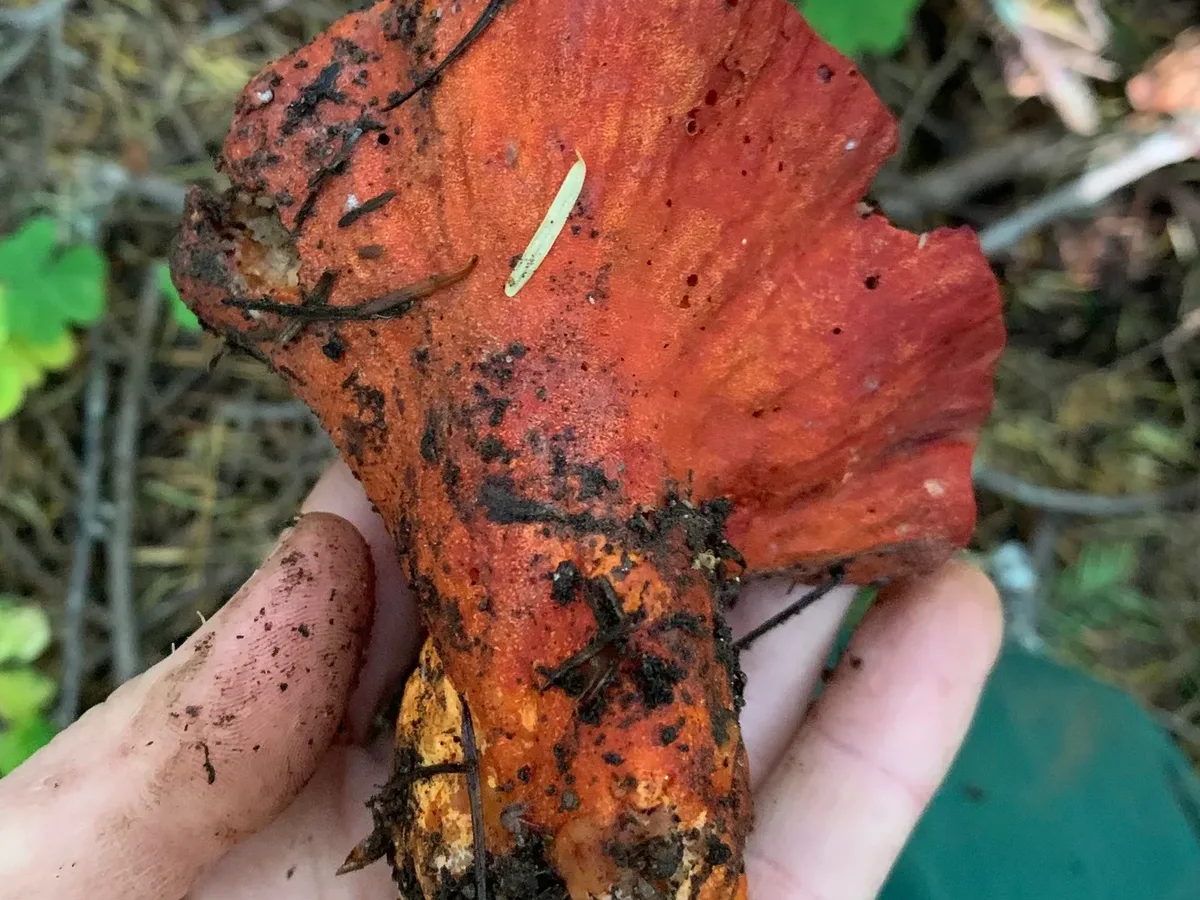 Kate Manning (CC0)
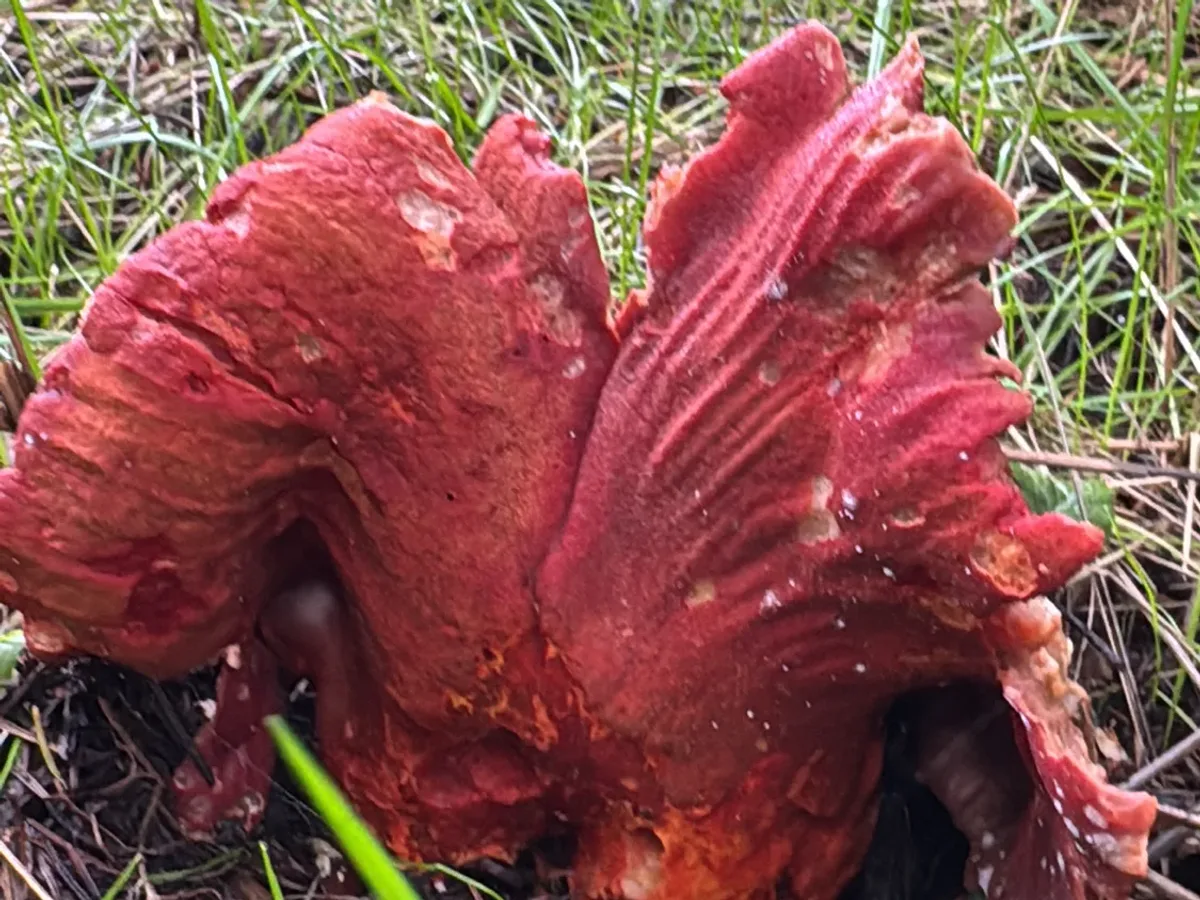 © Megan “Moe” Morelock (CC BY)
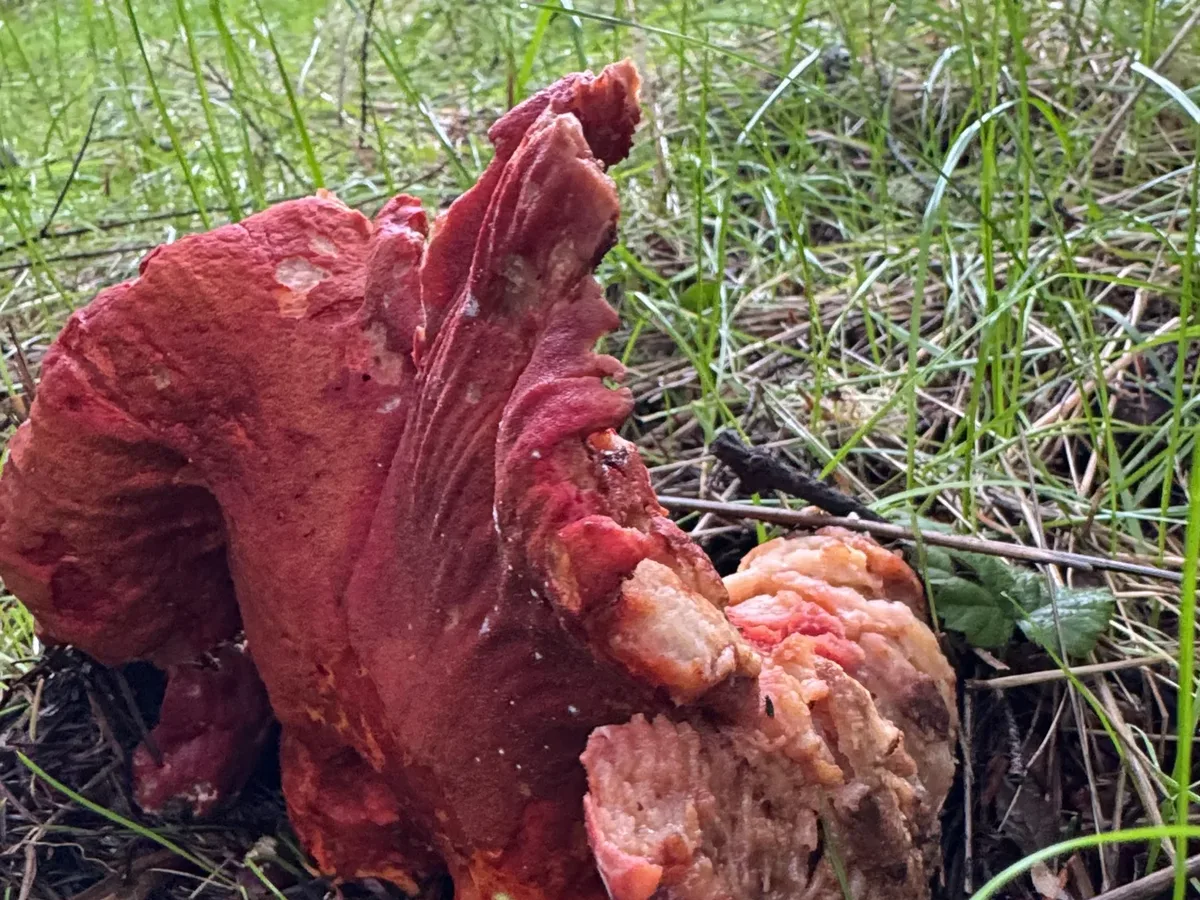 © Megan “Moe” Morelock (CC BY)
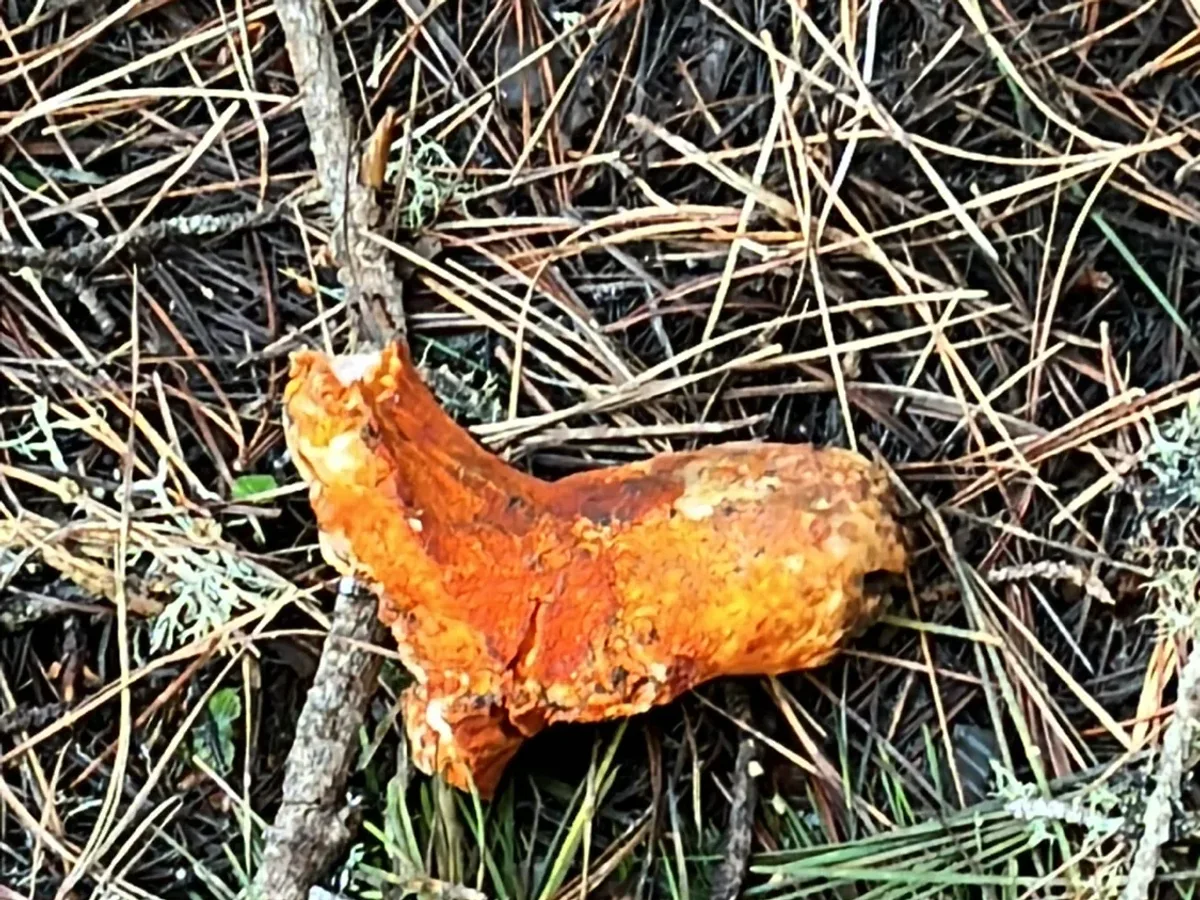 © htasoff (CC BY)
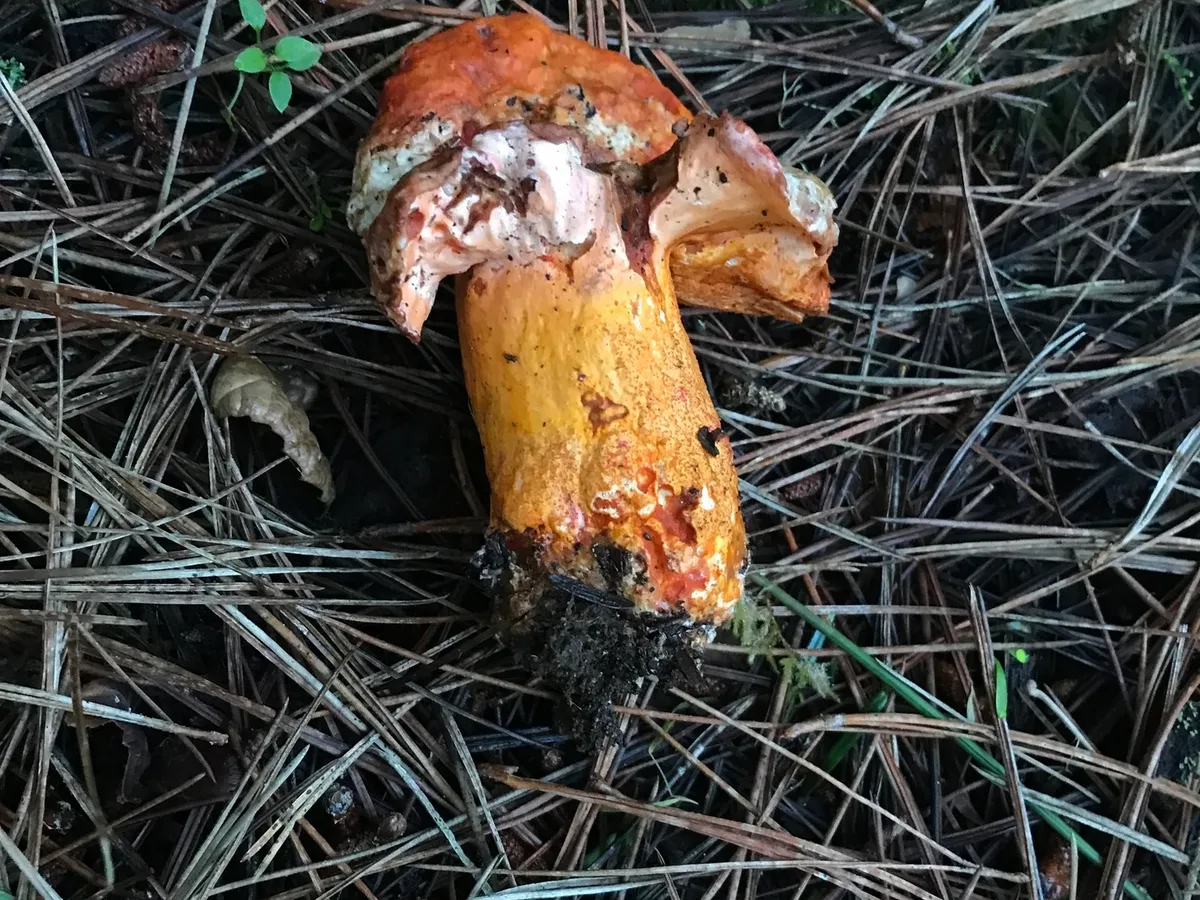 © Matthew Rozanoff (CC BY)
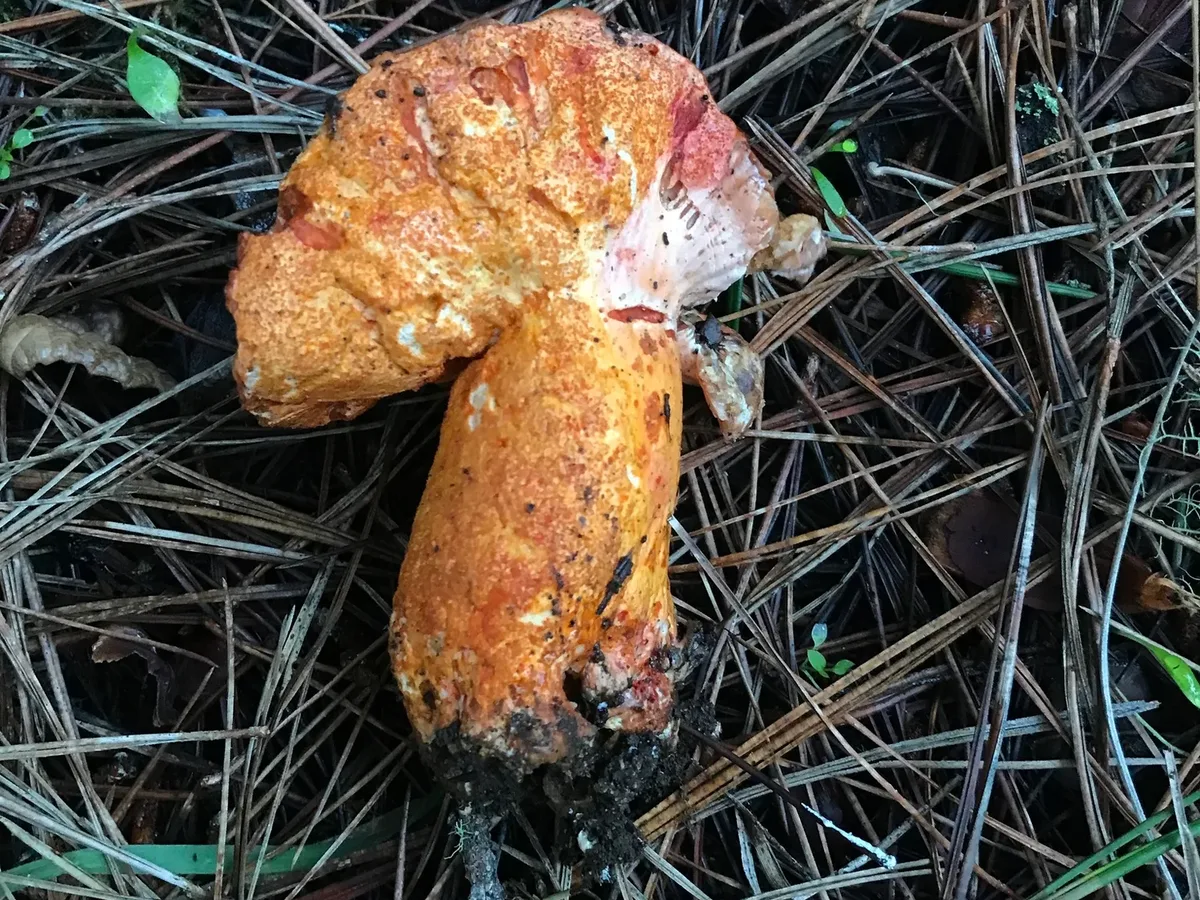 © Matthew Rozanoff (CC BY)
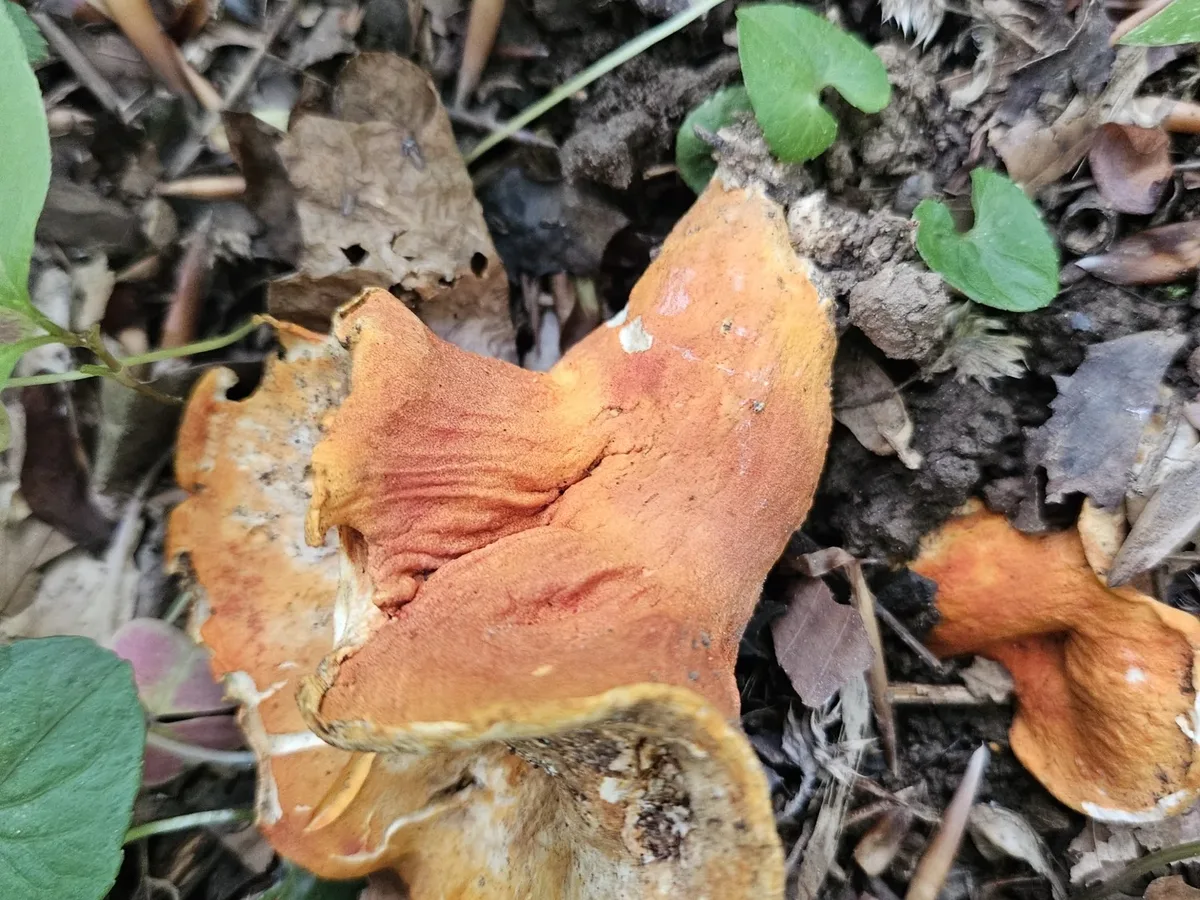 © lisebsb (CC BY)
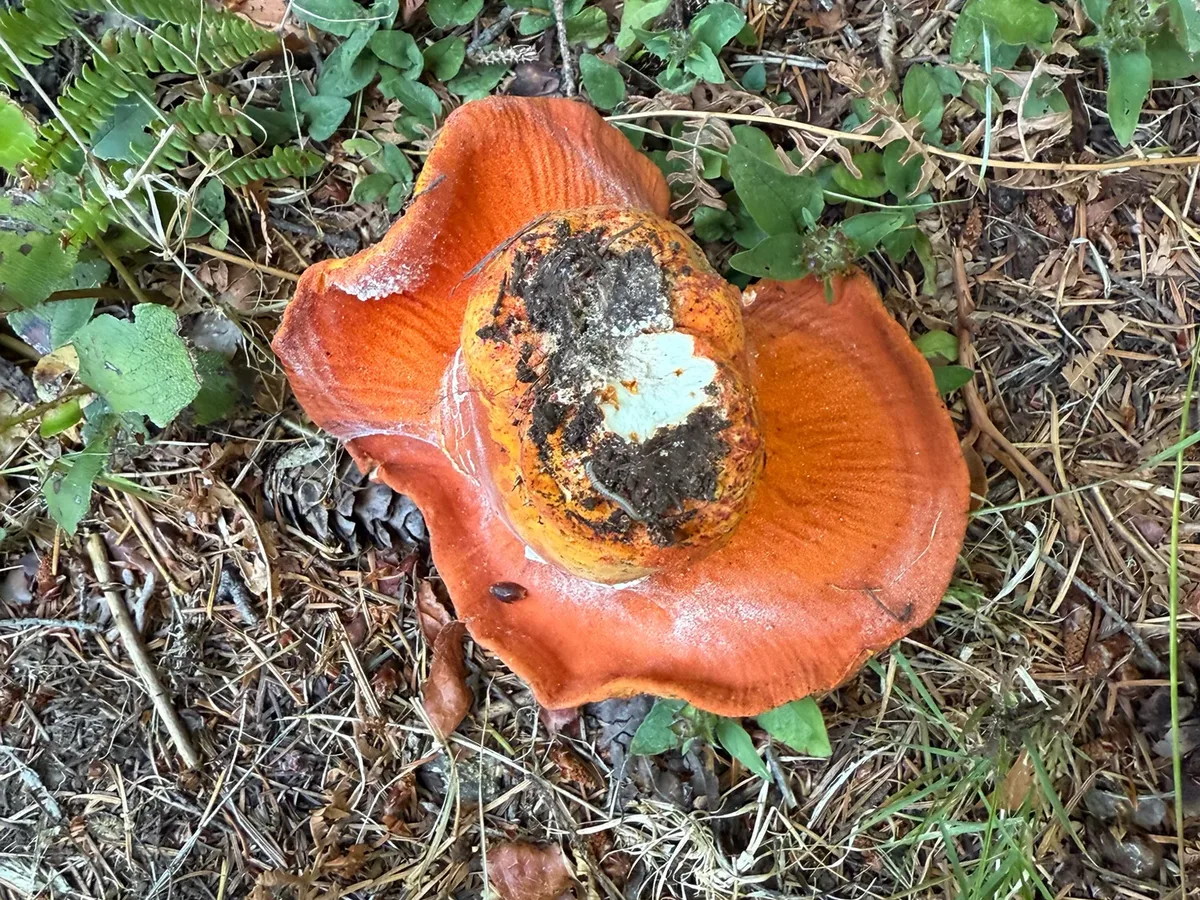 © Jared Lincenberg (CC BY)
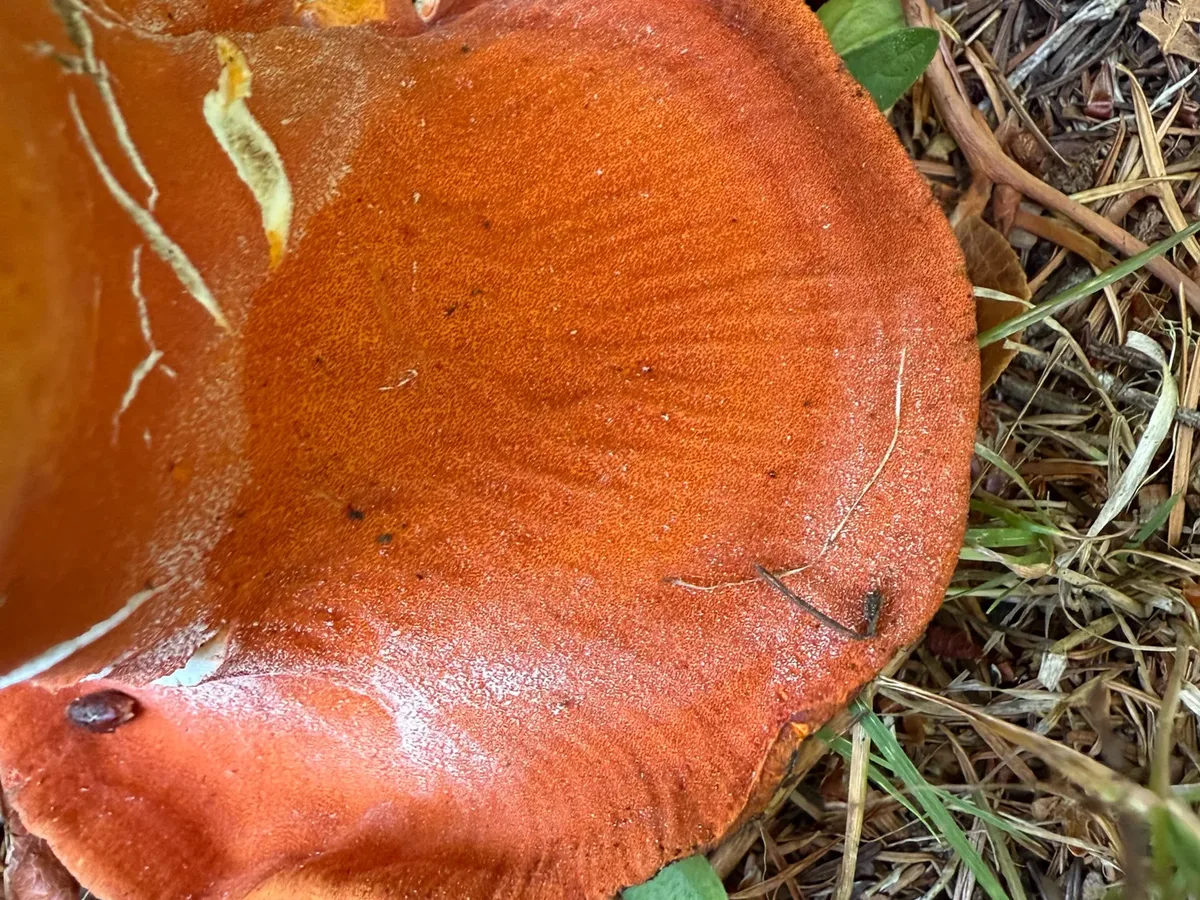 © Jared Lincenberg (CC BY)
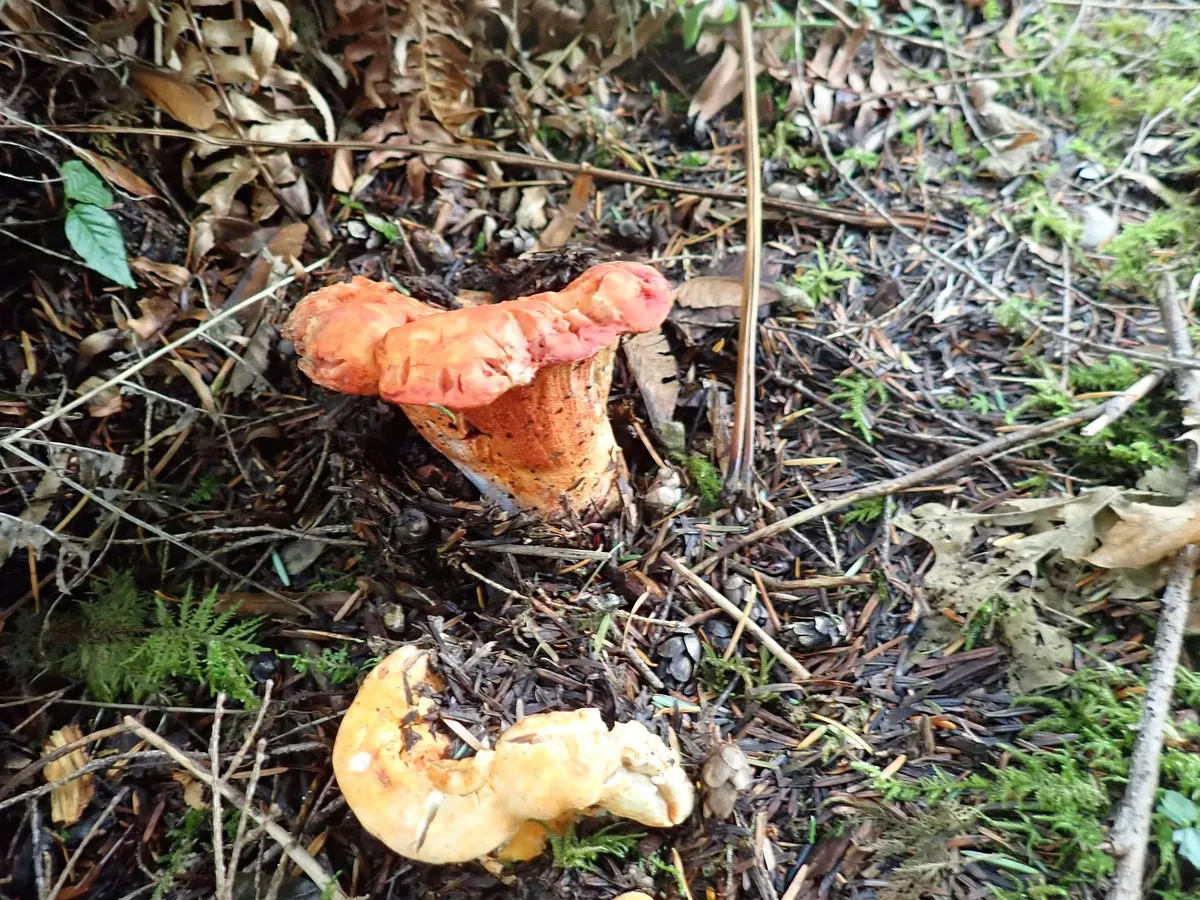 © John Brew (CC BY 4.0)
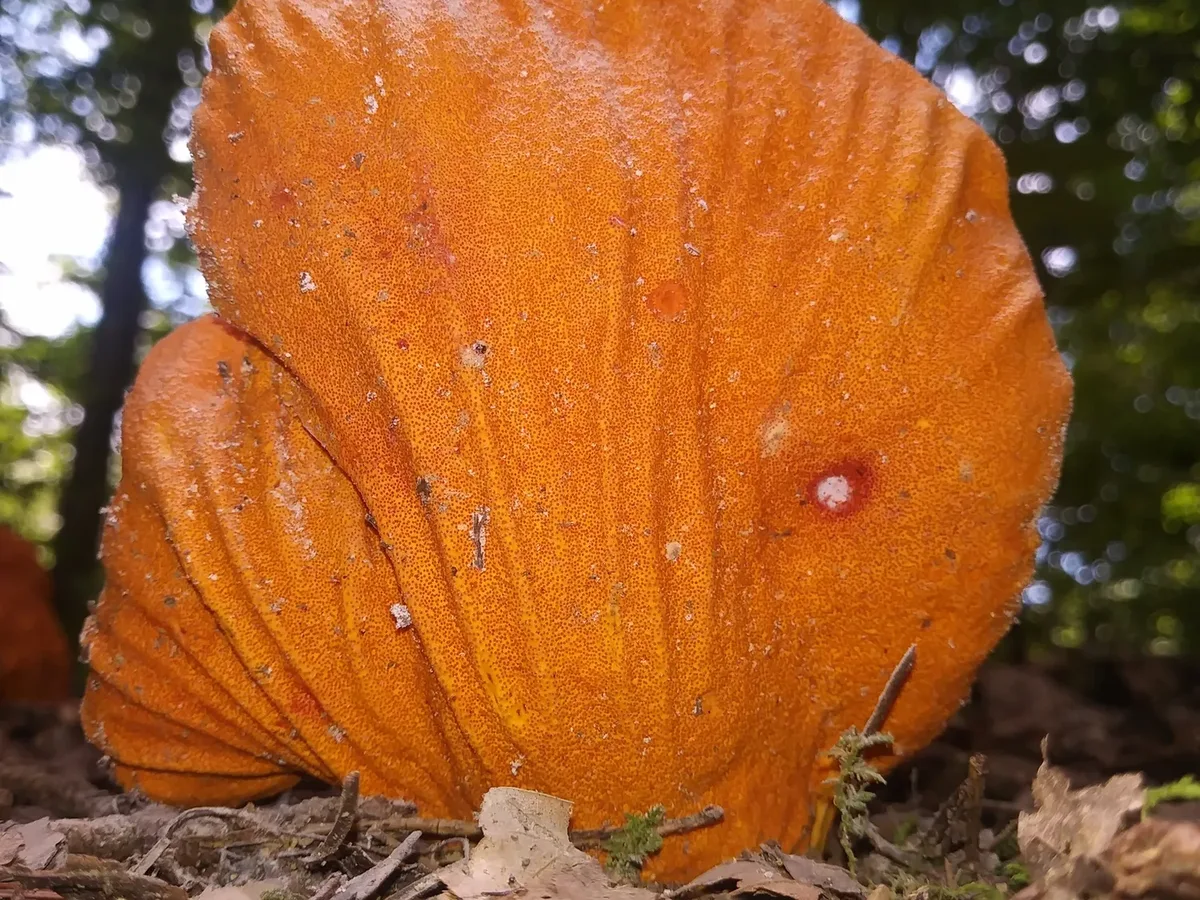 Daniel Estabrooks (CC0)
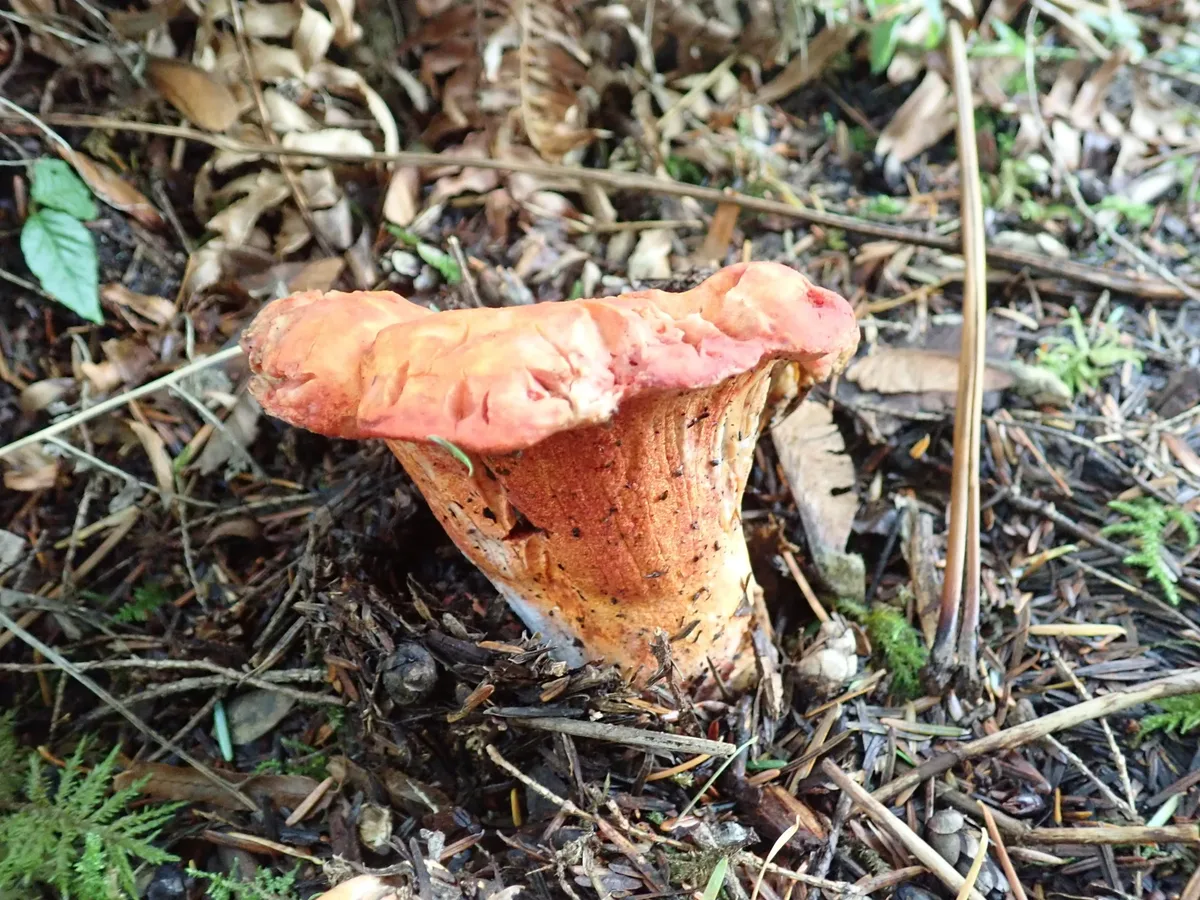 © John Brew (CC BY 4.0)
 © pinonbistro (CC BY-SA 4.0)Kate Manning (CC0)© Megan “Moe” Morelock (CC BY)
Good to eat, once you have identified it with certainty and cooked it through.
How to recognise it
What you are looking at when you find a lobster mushroom is not one organism but two fused into something neither could be alone. Hypomyces lactifluorum is a mycoparasite - an ascomycete fungus that colonizes and overtakes a host mushroom, eventually consuming and restructuring it from the outside in.
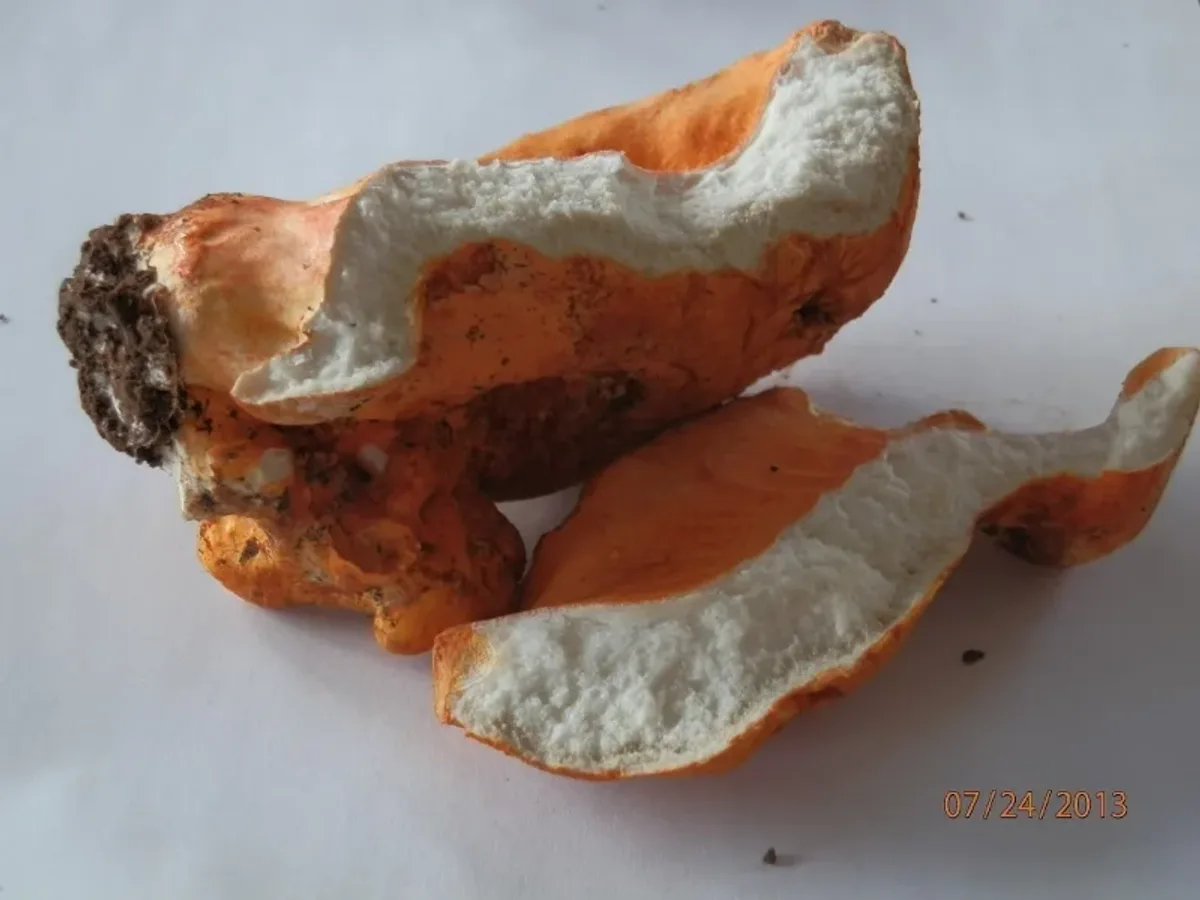
The result is a solid, heavy fruitbody that has completely lost its original surface character. Gills, if the host had them, are buried under a continuous, hard orange shell: the stroma of the parasite, peppered with tiny flask-shaped perithecia visible to the naked eye as fine pimples or bumps.
The color ranges from vivid orange to a deeper orange-red, sometimes with patches approaching vermilion, and it is remarkably uniform - the parasite lays down its pigment across the entire exposed surface with an evenness that makes the comparison to a boiled crustacean inescapable. The cap and stem margins of the host are often distorted, swollen, and irregular; the whole structure becomes blocky and sculptural.
Flesh
Slice through it and the interior is white and dense, with a texture closer to firm tofu than typical mushroom flesh.
Smell & taste
The aroma, faint but distinctive at first, strengthens when the flesh is cut: a mild seafood note that most describe as reminiscent of shellfish or cooked crab.
Where & when it grows
Habitat
Hypomyces lactifluorum follows its hosts wherever they grow, which means its habitat is less a matter of soil type or microclimate and more a map of where Russula brevipes and Lactarius piperatus choose to fruit.
Both hosts are mycorrhizal - they form intimate nutrient-exchange partnerships with the roots of forest trees, most often conifers such as fir, spruce, hemlock, and pine, but also with hardwoods in mixed stands. This means the lobster mushroom is reliably a forest species, rarely straying onto open ground or disturbed edges.
It is found across a vast north-south range: from the boreal mixed forests of southern Canada through the Pacific Northwest, the Rockies, and the Appalachians, south through Mexico to at least Michoacan.
Successful spots often have deep duff and good moisture retention - the parasite needs its host to have established a fruitbody before it can work, and hosts fruit most readily in cool, moist understory conditions.
Stands of hemlock and white fir are particularly productive in the eastern and western ranges respectively, and experienced foragers often map host-rich spots and return annually, since the underlying mycorrhizal network persists for years even when surface fruiting is intermittent.
When
The season for lobster mushrooms runs from July through October across most of North America. The earliest finds typically appear in the Pacific Northwest and higher-elevation eastern sites in July, and the main flush peaks in August and September after the first significant summer rains.
Because Hypomyces lactifluorum can only develop once its host has already formed a fruitbody, the timing is parasitically dependent: Russula brevipes and Lactarius piperatus must fruit first, then the ascomycete moves in. This can create a slight lag - observers sometimes find the chalky white hosts in early summer, followed weeks later by the fully orange parasitized specimens as the colonization advances.
By October, fruitbodies that have not been harvested typically begin to darken toward purple-brown as they age past prime, and by the first hard frosts they collapse.
In the warmest part of the range (southern Mexico), the fruiting season may extend longer, tied to monsoon moisture rather than temperate summer patterns. Peak market availability in the American West typically falls in late August through mid-September.
How it grows
The biology underlying what foragers see is one of the more striking examples of fungal parasitism in temperate North America. Hypomyces lactifluorum belongs to the Hypocreales, an order packed with species that parasitize other fungi.
It begins its attack on a young host fruitbody - or possibly colonizes the mycelium in soil before the host has fully emerged. Its mycelium threads through the host tissue, suppressing the host's own development while laying down the characteristic orange stroma on the outer surface.
The host's ability to form normal spores is entirely shut down: the orange layer buries the gill surface, and the host never achieves reproductive maturity. Instead, the perithecia of the parasite produce the ascomycete's own ascospores, released from the surface pimples.
One of the most functionally remarkable outcomes of this takeover is what happens to flavor. Lactarius piperatus, the peppery milkcap, produces extremely acrid, burning compounds - sesquiterpene lactones - that make it effectively inedible as a raw or unmodified host.
The parasite appears to chemically neutralize or mask these compounds during its colonization, leaving the resulting combined fruitbody mild and palatable. How this occurs at the biochemical level is not fully resolved, but the outcome is consistent and well documented: fully parasitized lobster mushrooms derived from otherwise acrid hosts are reliably mild.
Fruiting conditions
Appearance is tied to its hosts (Russula brevipes, Lactarius piperatus); fruits in summer through autumn once those hosts are established and conditions are moist.
Look-alikes
Hypomyces lactifluorum has no true field lookalikes among other mushroom species - the fully orange, finely pimpled, entirely gill-free exterior is structurally unique and not mimicked by any other common fungus.
The identification question that does carry real weight is not about confusing it with another species, but about the identity of the host beneath the orange crust. Once fully parasitized, the host is completely unrecognizable - you cannot:
- see its gill structure
- confirm its spore color
- check its latex
- observe its stem attachment
In the vast majority of documented collections, the hosts are Russula brevipes (short-stemmed russula) and Lactarius piperatus (peppery milkcap), both edible or at least benign when cooked. However, it is biologically possible - if uncommon in practice - for the parasite to colonize other Russula or Lactarius species, and some of these hosts would be inedible or mildly toxic.
The safety rule is structural rather than visual: collect only specimens that are fully and uniformly orange with white, firm flesh throughout.
A half-parasitized specimen retains enough host identity to be ambiguous; an old, discolored, or soft specimen may no longer deliver the same chemical modification the parasite achieves in fresh material. Both conditions are reasons to pass.
Avoid partly parasitized specimens and overripe ones, which have a soft, brownish interior rather than a firm white one.
Chanterelles lack the wart-like perithecia of the lobster mushroom's surface.
Another host; the parasite neutralizes its pungency. Eat only firm, clearly parasitized white-fleshed specimens; avoid half-parasitized, purple, soft, fishy-smelling ones since the host identity is uncertain.
Common host; once fully parasitized it becomes the bright orange, white-fleshed lobster mushroom.
In the kitchen
Picking & cleaning
The quality window for lobster mushrooms is real and worth understanding before you harvest.
A fully parasitized, market-ready specimen is uniformly orange on all surfaces, heavy and dense in the hand, and cuts to reveal pure white flesh with no gray, purple, or olive discoloration anywhere in the cross-section. The texture should be firm and almost waxy, and the smell should be mild - the seafood note is pleasant and faint, not strong or fishy.
Specimens that are past prime show several warning signs:
- the outer crust begins to darken toward brownish-purple or develops soft patches
- the flesh shows darkening or sliminess internally
- the odor turns from mild to an unpleasant, heavy fishiness
These old specimens are best left in the field.
Half-parasitized specimens - where the orange crust covers only part of the host and white or gray-white host surface is still visible - present a different consideration. Because you cannot confirm the host species identity when it is fully buried, and because half-parasitized hosts may still carry their original defensive compounds (acrid milkcap latex, for instance), it is safest to collect only fully converted specimens.
Use a brush to clear debris from the crevices at the base; a brief rinse under cool water is fine. The dense flesh does not absorb water like thin-capped species.
Cooking
Lobster mushrooms are among the most kitchen-friendly wild mushrooms:
- they hold their shape through long cooking
- retain their orange color even after sustained heat
- contribute both flavor and visual drama to dishes
The texture is firm and slightly chewy, similar to squid or firm white fish, which makes them a natural fit in seafood-adjacent preparations.
- Chowder and bisque are classic matches - the mushroom provides body and a subtle oceanic note that deepens the broth without overpowering it.
- In risotto, the chunks stay intact through stirring where most mushrooms would disintegrate.
- Sauteing in butter over high heat produces a slightly golden, lightly crisped exterior with a concentrated flavor; a short deglaze with white wine or sherry lifts the pan fond and rounds the profile.
In Michoacan, where the species is called trompa de puerco (pig's snout), the traditional preparation is to boil the mushroom until tender, then fry it with tomato, onion, and chili as a taco or tortilla filling - a treatment that has been repeated across generations and treats the mushroom as a meat substitute with real culinary standing.
Because the flesh is dense, cut pieces slightly thinner than you would with typical cap mushrooms; 5-7 mm slices cook through evenly. Drying concentrates the flavor effectively and the dried mushroom rehydrates with less texture loss than most species.
Good to know
Lobster mushrooms are sold commercially in grocery stores and at farmers' markets across North America, and at traditional markets in Mexico, where the species has a long culinary history.
This market presence reflects its established safety profile: Hypomyces lactifluorum is considered reliably edible when fully parasitized, dense, and cooked thoroughly. It must be cooked - as with most edible wild mushrooms, eating it raw is not recommended.
The primary safety consideration is not a toxin in the species itself but the host-identification problem: a fully buried, unrecognizable host cannot be confirmed visually. The practical answer is to harvest only fully converted, uniformly orange specimens with white flesh, and to pass on anything half-parasitized, discolored, or soft.
There are no documented mass poisonings attributed to correctly identified lobster mushrooms. The species is not associated with any allergen distinct from general mushroom sensitivities.
As with any wild edible, people trying it for the first time should eat a small amount and wait to assess individual tolerance before eating a full portion.
A reference guide - never an edibility guarantee. When in doubt, leave it out.