March woodwax
Hygrophorus marzuolussyn. Agaricus marzuolus Fr., Limacium marzuolum (Fr.) P. Kumm., Camarophyllus marzuolus (Fr.) Ricken
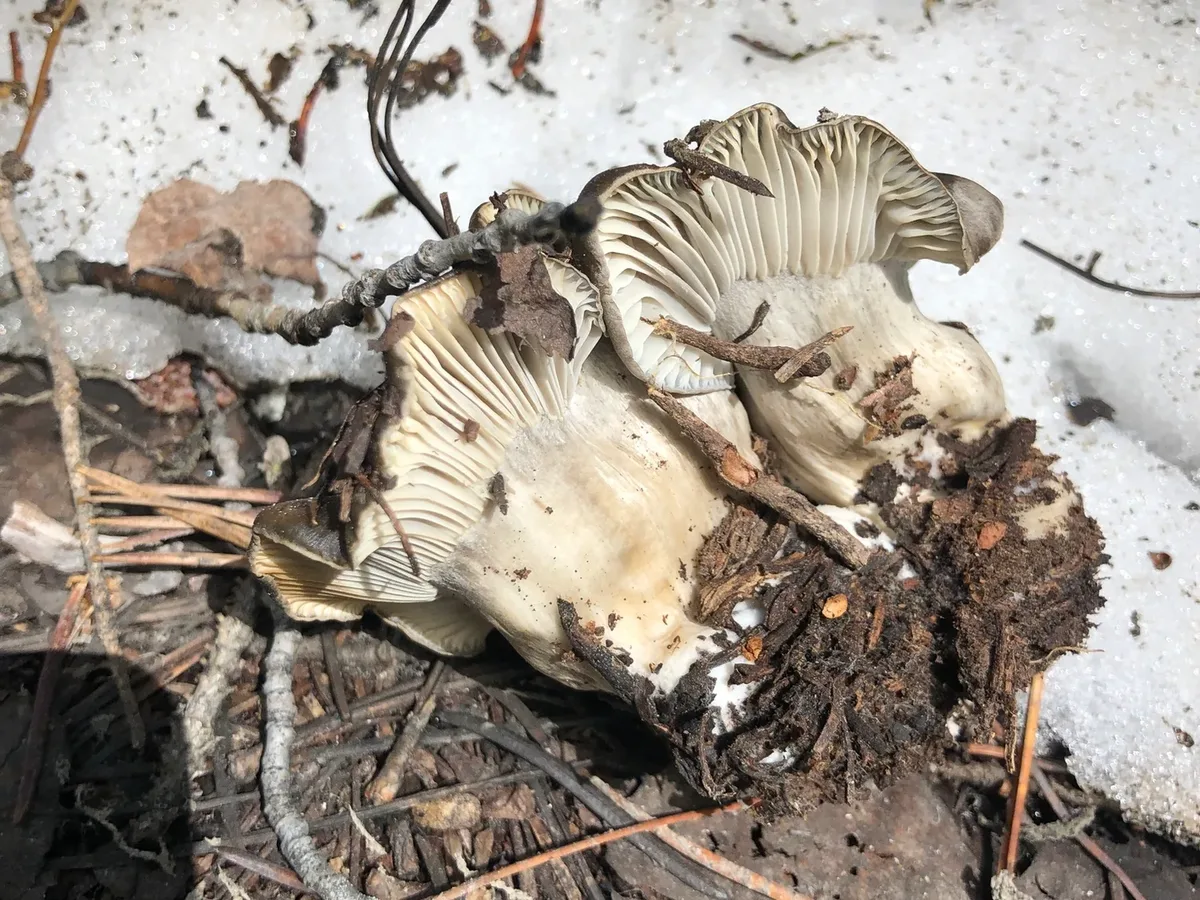 © Mike Dechter (CC BY 4.0)
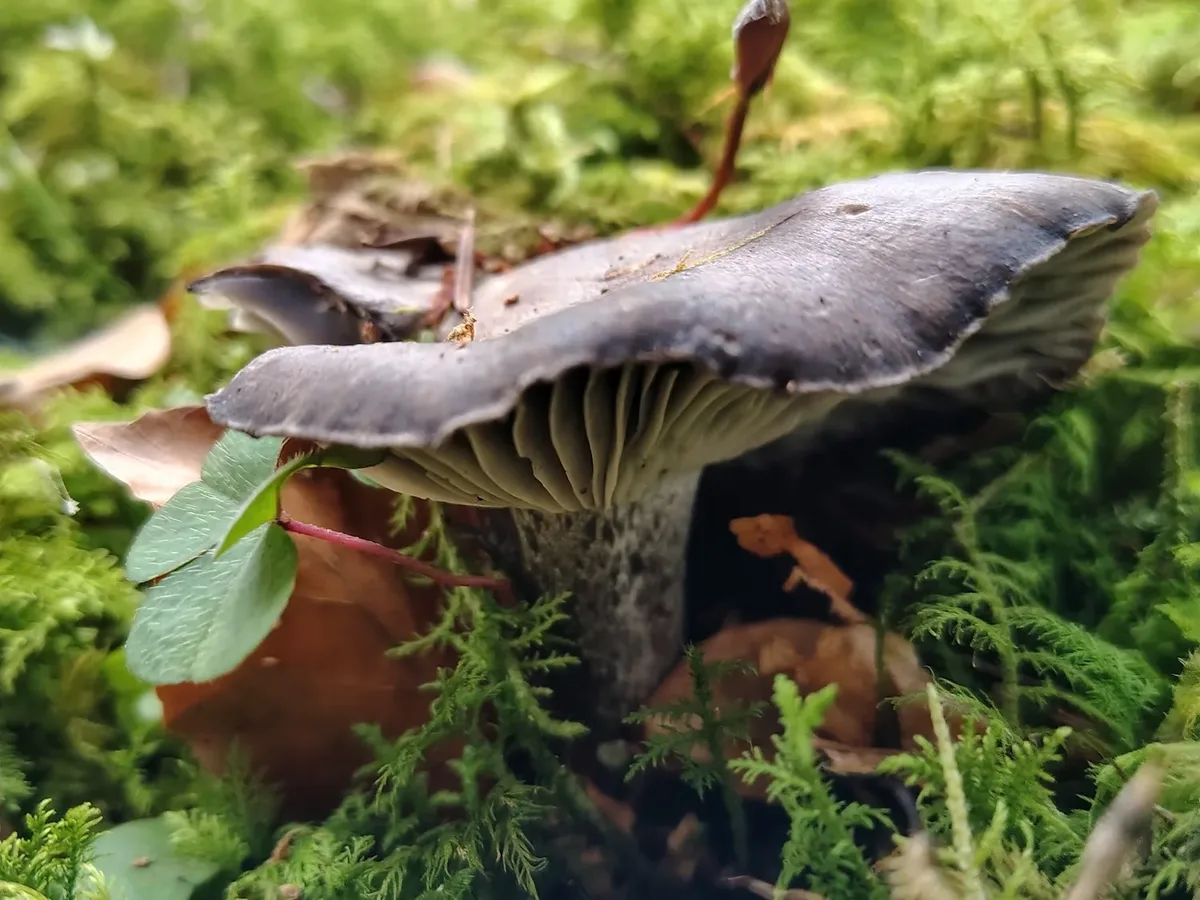 © vuikaan (CC BY)
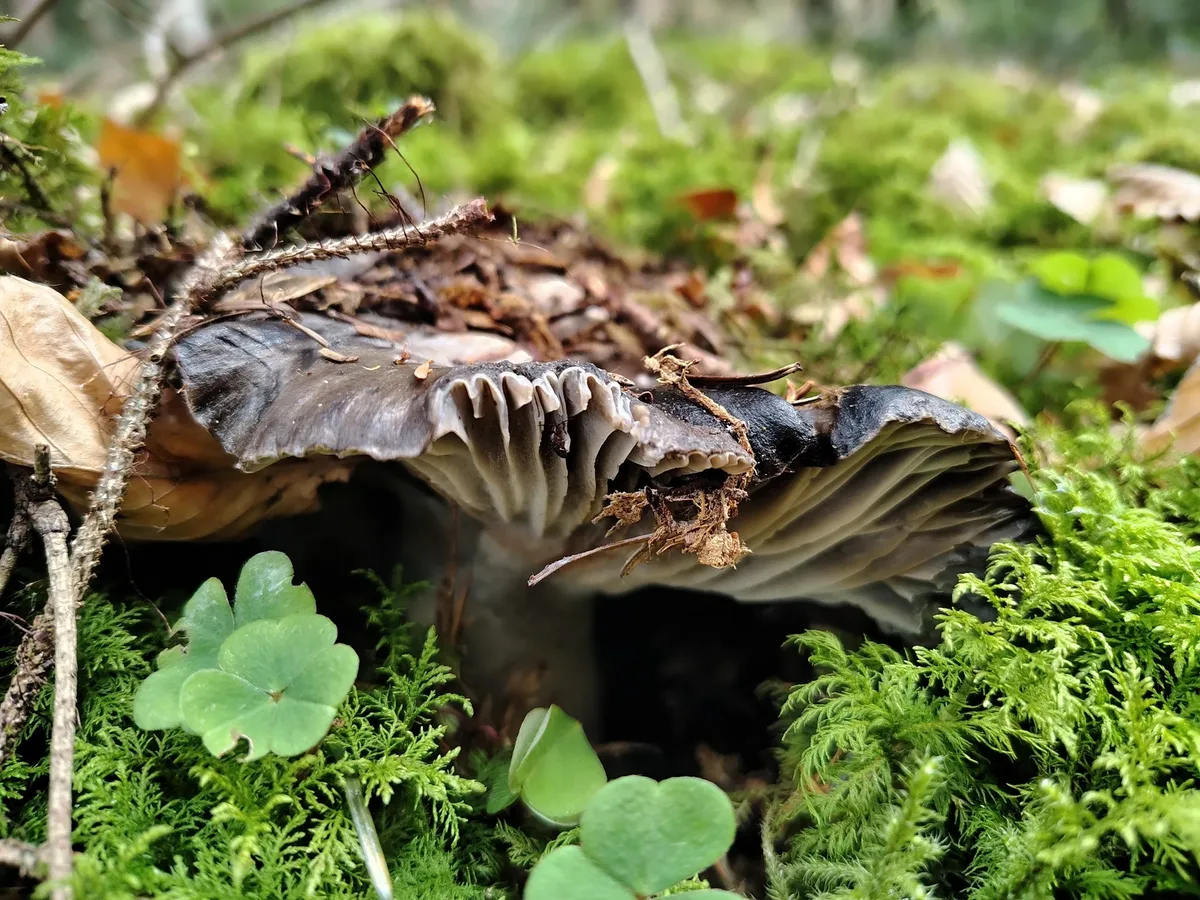 © vuikaan (CC BY)
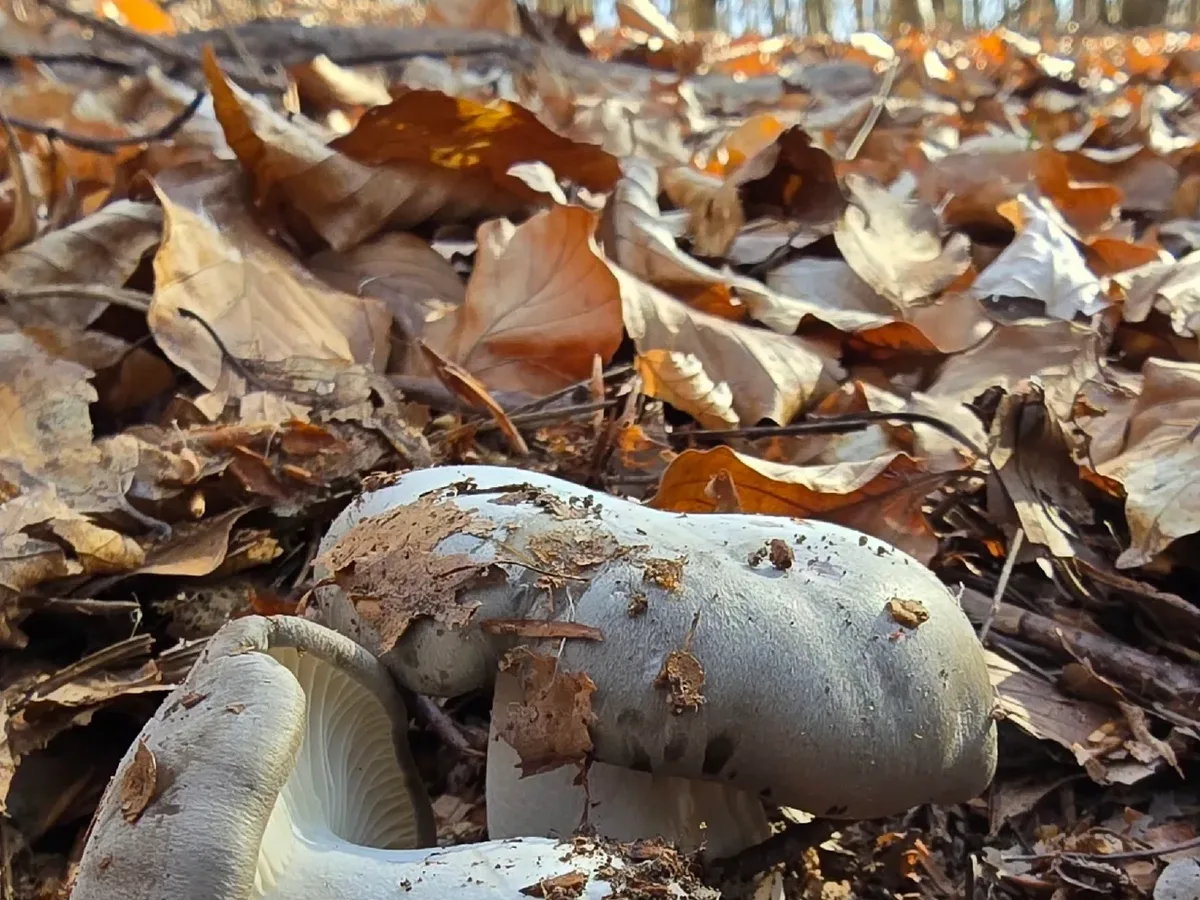 © Paula Nimigean (CC BY)
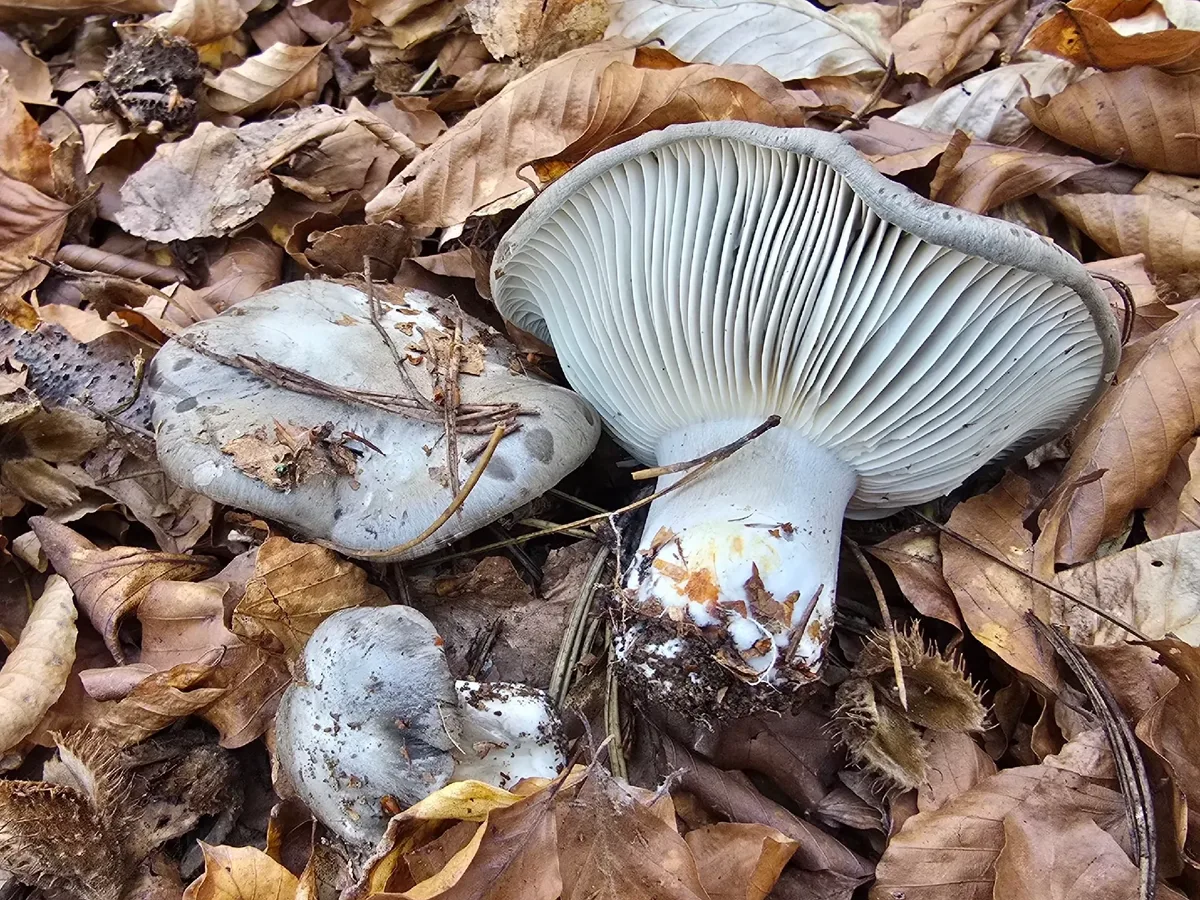 © Paula Nimigean (CC BY)
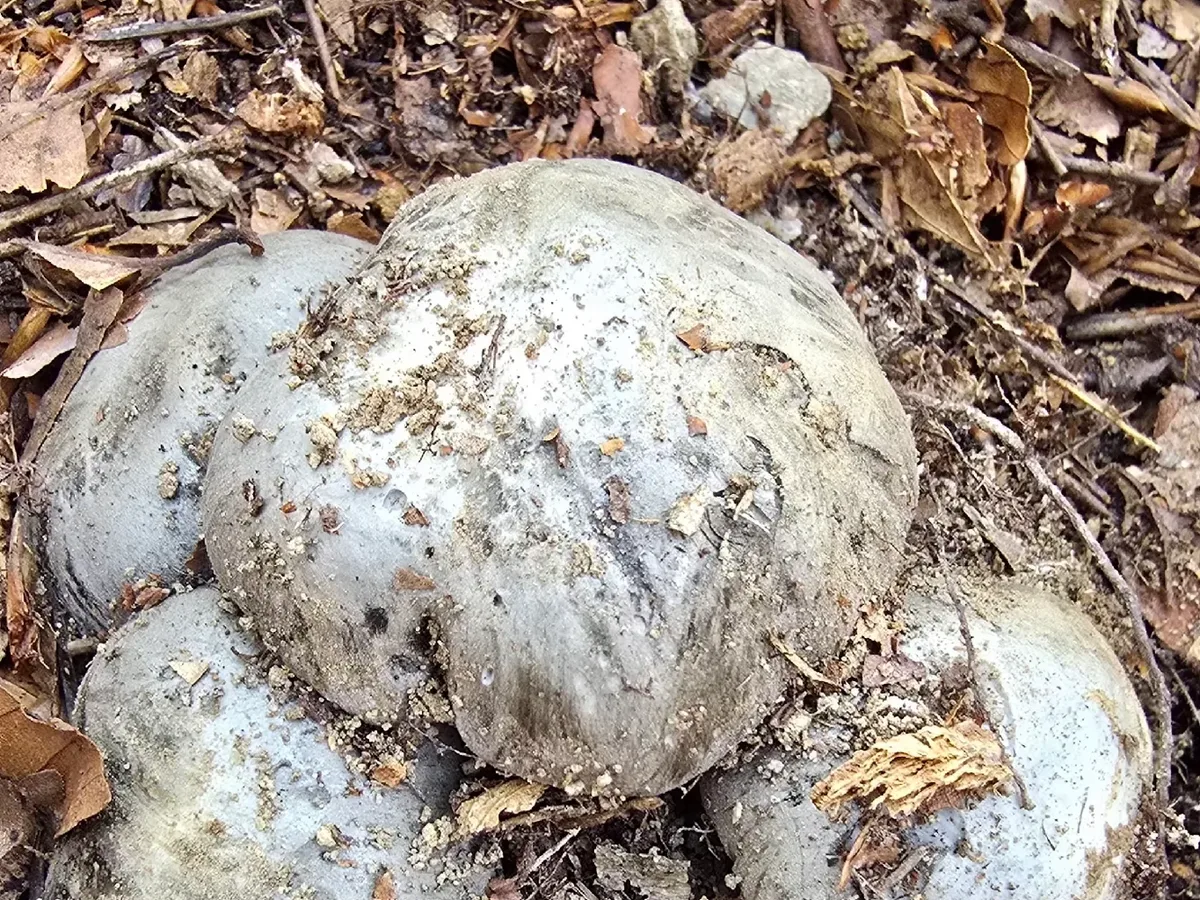 © Paula Nimigean (CC BY)
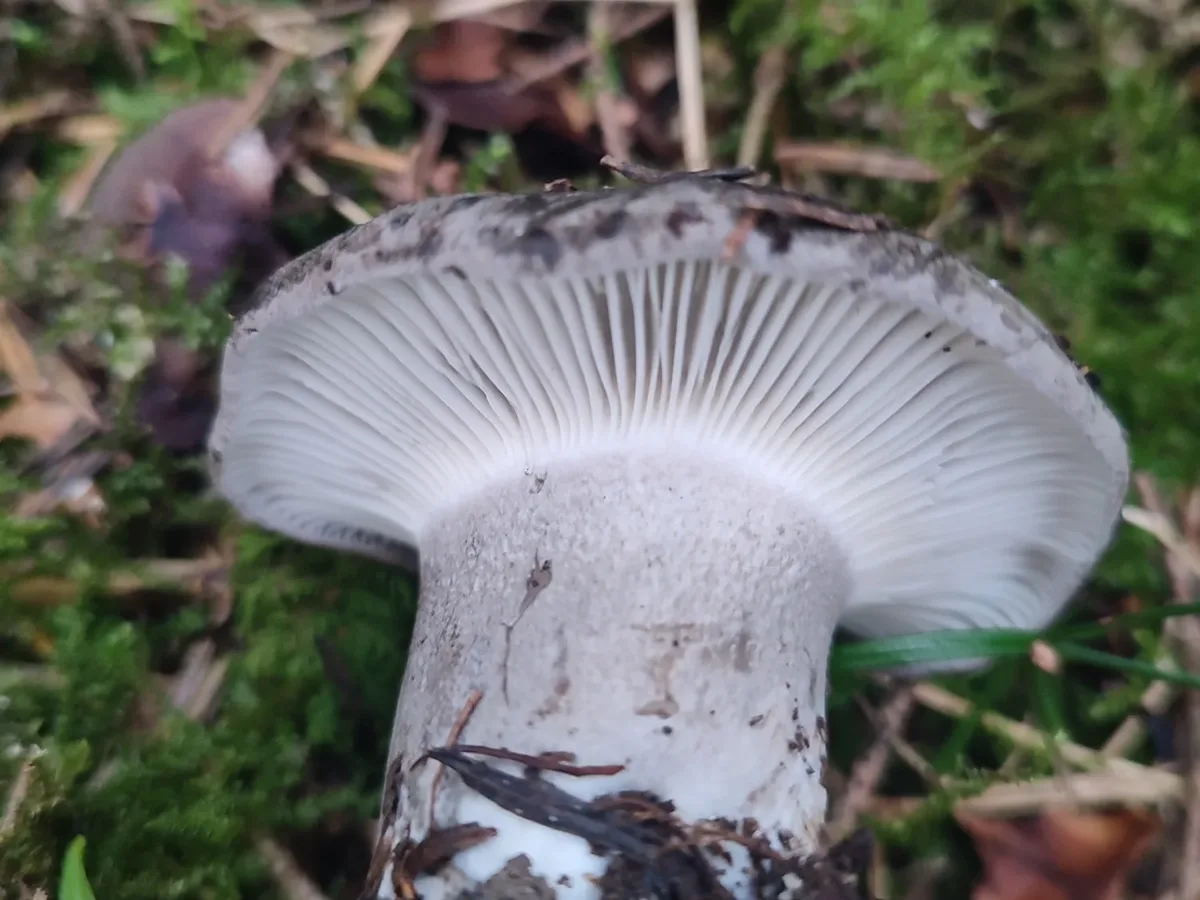 © victor laborde (CC BY)© Mike Dechter (CC BY 4.0)© vuikaan (CC BY)
Good to eat, once you have identified it with certainty and cooked it through.
How to recognise it
Hygrophorus marzuolus is a robustly built, leaden-grey waxcap of immediately distinctive appearance.
Cap
The cap opens hemispherical with an involute margin, then expands broadly without fully flattening in most specimens; the disc often remains slightly elevated or only gently depressed even in old fruit bodies.
The cap surface is the first diagnostic feature: when moist (which it almost always is, given its snowmelt habitat), it is distinctly slimy or viscid - picking up fine debris that sticks to it - but dries to an attractive silky, slightly lustrous finish.
The colour is characteristic: a dark, leaden or slate-grey at the centre, lightening through silver-grey to a paler margin. This uniform, metallic grey colouration, darker toward the disc and paler outward, is quite unlike the browner or more olivaceous tones of most other grey waxcaps.
Gills
The gills are the genus hallmark: wide, moderately spaced, and distinctly waxy in feel - when you pinch and slowly pull apart a gill between thumb and forefinger it stretches slightly and feels like slowly softening candle-wax or modelling clay.
This waxy consistency is impossible to mistake once learned; no funnel-cap or knight-mushroom has it. The gills are white at first, then become faintly grey-tinged with age, remaining pale throughout.
Stem
The stem is notably stout relative to cap size, solid throughout (never hollow), fibrillose-silky, and white to greyish-white with a grey base.
There is no ring and no volva - the absence of a ring immediately separates it from superficially similar Lepista or Tricholoma species that may occur in the same forests in other seasons.
Flesh
Flesh is firm and white, not reddening, blackening, or changing colour in any way on cutting - an important distinction from several grey Tricholoma species.
Smell
The smell is mild, barely distinctive: faintly farinaceous (a faint mealy or floury note) or essentially odourless. This mildness is itself a useful clue, since the most dangerous confusable species (Tricholoma pardinum, the tiger knight) has a strong farinaceous-unpleasant smell.
Spore print white; this rules out several gilled fungi of similar habitats that have brownish or pinkish prints.
Where & when it grows
Habitat
H. marzuolus is tightly bound to mature mountain conifer forests, especially those dominated by silver fir (Abies alba), Norway spruce (Picea abies), or mixtures of both.
It is a characteristic species of the Abietum (montane fir forest) and Piceetum (subalpine spruce forest) vegetation zones of the Alps, northern Apennines, Pyrenees, Jura, Vosges, Black Forest, Carpathians, and Cantabrian mountains. The primary range is Mediterranean montane to sub-Alpine, with the core commercial harvest occurring in northern Italy (Trentino-Alto Adige, Piedmont, Lombardy, Friuli) and southern Switzerland.
The ecological niche is unusual: it occupies the period between the end of the snow cover and the emergence of spring warmth. The mycelium is active under the insulating snowpack throughout winter, and fruiting bodies begin to form at soil temperatures just above 0 °C.
This cold-adapted strategy means the species appears at a time when competition for resources and predation by invertebrates is minimal - fruiting bodies develop slowly and are often found in near-perfect condition.
Soil preference is for moist, calcareous to slightly acidic, humus-rich brown soils beneath deep needle litter, usually at elevations of 800-2000 m. Aspect matters: north-facing slopes where snow lingers longer tend to produce mushrooms later and over a longer period than south-facing slopes. The habitat is often described as 'where the fir trees drip snowmelt in March.'
When
Hygrophorus marzuolus is exceptional among European edible mushrooms in fruiting in late winter and early spring - typically February to April - at a time when the ground is barely free of snow or still partially snow-covered.
This unusual phenology is the species' most distinctive field characteristic, and its common name, 'marzuolo' (Italian for 'of March'), commemorates this.
The fruiting season at any given site is short, typically 4-6 weeks, coinciding almost exactly with the snowmelt window: the mushrooms appear as soon as the snow recedes sufficiently to allow air exchange but before the soil warms above about 8 °C, then cease fruiting once spring warmth arrives.
The precise timing varies strongly with elevation and aspect.
- At 800-1000 m on south-facing Alpine slopes, fruiting may begin in late January or February in mild years.
- At 1600-2000 m on north-facing slopes, the season may not start until April or even early May.
In the Italian Alps, the traditional harvest peak falls broadly in late February to March at mid-altitude sites.
Fruits singly or in scattered groups; not in flushes triggered by rainfall in the conventional sense, since soil moisture is already high from snowmelt. Soil temperature approaching 2-5 °C appears to be the primary trigger.
How it grows
Solitary to scattered, occasionally in loose groups of 3-8, rarely forming dense clusters.
Growth is ectomycorrhizal, the mycelium living perennially in the roots of fir and spruce - a partnership that may run for decades in the same patch of old-growth forest.
Fruiting bodies push up very slowly in the cold, taking 10-14 days to expand from primordium to a fully open cap. That unhurried pace works in the forager's favour: insect larvae are inactive at near-freezing temperatures, so fruit bodies are almost always found in near-perfect condition, unbored and clean.
The cold-adapted metabolism that makes this possible also makes the species impossible to cultivate. Individual fruiting bodies can persist for 2-3 weeks under cold, snowy conditions before they begin to deteriorate.
Fruiting conditions
Fruiting is triggered not by rainfall but by snowmelt: soil moisture is already abundant from the melting snowpack. The primary driver is soil temperature rising above 0 °C under the thawing snow. Optimal soil temperature for fruiting is 1-6 °C; fruiting ceases once soil warms above approximately 8 °C with the advance of spring. The flush lag is long (10-21 days) reflecting extremely slow mycelial and primordial development at near-freezing temperatures. No conventional rain trigger applies - this species occupies the unique phenological window of late-winter snowmelt in mountain conifer forests.
Look-alikes
The seasonal context alone (February-April, under snow-covered fir and spruce) eliminates most mushroom confusions, since very few species fruit at this time and in this habitat. Nevertheless, several species warrant attention:
- Tricholoma pardinum (tiger knight): The most important safety comparison. This species causes severe, violent gastrointestinal poisoning (nausea, vomiting, diarrhoea beginning 30 minutes to 2 hours after ingestion) and is NOT deadly but can require hospitalisation. It is grey, grows in conifer and mixed forest, and is superficially similar in colour. However, T. pardinum is a late-summer to autumn species (August-October), not a late-winter species - the seasons do not overlap in practice. Moreover, T. pardinum has a distinctly scaly or streaked cap surface (not smooth and viscid), a strong unpleasant farinaceous or radish-like smell (not mild), and a more robust, heavily built stature. Gill texture is non-waxy. If you find a grey mushroom in these forests in summer or autumn, consider T. pardinum; if it is February-April, the risk is essentially absent.
- Hygrophorus eburneus (ivory woodwax): Pure white to ivory, smooth, slimy cap and stem; occurs in broadleaf forest (mainly beech) in autumn. No realistic confusion given the very different season, colour, and habitat.
- Hygrophorus olivaceoalbus (olive-grey woodwax): Autumn-fruiting, olive-grey with a sooty-streaked slimy stem, no grey leaden cap colouration; grows with spruce in autumn, not spring.
- Clitocybe nebularis (clouded funnel): Grey, fleshy, can grow in conifers - but this is an autumn species, with non-waxy (thin, crowded) gills, a mealy-unpleasant smell, decurrent gills, and a cream (not white) spore print. Causes gastrointestinal upset in a notable proportion of people. The waxy gill texture and season rule this out.
- Leucopaxillus species: Some large, grey-white, fleshy gilled fungi can superficially resemble H. marzuolus but have non-waxy gills, often bitter taste, autumnal season, and different microscopy. Not a credible field confusion for an attentive picker.
- Pleurotus ostreatus (oyster mushroom): Grey-capped, but fan-shaped, growing on wood, no stipe centred under the cap - instantly distinguished.
The single most reliable identification confirmation for H. marzuolus:
- 1late winter/early spring season
- 2under fir or spruce
- 3smooth, slimy, leaden-grey cap
- 4waxy gills
- 5no ring, no volva
- 6solid white stem
- 7white spore print
All six criteria together make identification secure.
Autumn species. Cap grey but with a distinctive streaked, sharply umbonate appearance. Gills non-waxy. Taste markedly bitter to acrid. Causes gastrointestinal upset.
Autumn species, not late winter. Gills are not waxy - thin, crowded, non-waxy in texture. Smell mealy-unpleasant, not mild. Gills strongly decurrent. Spore print cream rather than white. Causes gastrointestinal upset in many people even when cooked.
Pure white to ivory throughout including cap and stem - not grey. Autumn species. Grows in beech forest, not fir-spruce. Slimy in same manner but easily told by colour and season.
Autumn-fruiting, not spring. Cap olive-grey to dark brownish-grey. Stem distinctly clothed in sooty fibrillose-zonate streaks, not plain and white. No leaden uniform grey colouration. Edible.
Fruits in summer to autumn (August-October), not late winter - seasons do not overlap in practice. Cap surface has distinct fibrillose scales or streaks rather than the smooth, viscid grey of H. marzuolus. Smell is strongly unpleasant, mealy-radish. Gills non-waxy. Causes severe gastrointestinal poisoning requiring hospitalisation but is not reliably fatal.
In the kitchen
Picking & cleaning
Cut cleanly at the stem base with a knife - the stem is stout, solid, and has a clean base, so digging it out serves little purpose unless you are ruling out a volva (Amanita is absent at this season and habitat, but confirming takes two seconds).
The fruit bodies are robust and travel well, less fragile than many spring mushrooms.
Brush needle litter and soil off the slimy cap in the field; the viscid surface picks up debris readily.
Before dropping anything into the basket, do the waxy-gill check: pinch a gill between thumb and forefinger and pull slowly apart - a characteristic waxy resistance and slight give is the genus signature.
Keep collections moderate; H. marzuolus is considered vulnerable to over-harvesting in parts of its range and is regulated in several Swiss cantons and Italian provinces.
Cooking
Hygrophorus marzuolus has a mild, pleasant flavour - not intensely aromatic like porcini or chanterelles, but clean and subtly woodsy with a slightly nutty undertone that develops on cooking.
Its great culinary virtue is timing: it appears in late winter when no other wild mushrooms are available, making it a highly prized seasonal ingredient in northern Italian cuisine.
The waxy, firm flesh holds its texture well during cooking and does not release excessive water. Sauté in butter or olive oil over medium-high heat until golden at the edges, 4-5 minutes; the flesh firms and develops a pleasant slight chewiness.
The flavour is mild enough to suit delicate preparations: risotto ai marzuoli is a classic Trentino dish. Also excellent in frittata, pasta, creamy sauces, and alongside white meats.
The viscid cuticle can be peeled before cooking if the texture is undesirable, though it largely disappears with heat.
Do not overcook - prolonged heat makes the flesh slightly rubbery. Pairs well with butter, cream, white wine, garlic, and mild herbs (thyme, flat-leaf parsley). Less suited to bold, strongly spiced preparations that would overwhelm the delicate flavour.
Good to know
Hygrophorus marzuolus is well-documented as edible and has been collected and eaten in the Alps and Apennines for centuries. The traditional Italian marzuolo harvest in Trentino, Lombardy, and Friuli is commercially significant, and the mushroom is sold in markets.
No reliable toxicological reports of poisoning from correctly identified H. marzuolus exist in the modern literature.
The primary safety consideration is correct identification. The seasonal window (late winter, February-April) is itself the strongest safety filter: the most dangerous grey-capped lookalike, Tricholoma pardinum, fruits in summer to autumn and does not overlap in season.
Confirming the waxy gill texture is the most important single check: it cannot be faked or confused once you know what it feels like.
Do not eat raw; as with all Hygrophorus species, thorough cooking is standard and recommended. Some Hygrophorus species consumed raw can cause mild gastrointestinal disturbance.
Foragers should also be aware that H. marzuolus is regarded as a vulnerable species in parts of its range due to habitat loss (mountain forest management) and overharvesting. Several Italian regions and Swiss cantons regulate collection quantities. Harvest responsibly and do not uproot entire clusters.
Pick only from clean, unpolluted mountain forest. Ectomycorrhizal fungi can accumulate heavy metals, particularly on contaminated substrates - though mountain fir forests are generally among the least polluted environments in Europe.
A reference guide - never an edibility guarantee. When in doubt, leave it out.