Vesterholt's hedgehog
Hydnum vesterholtii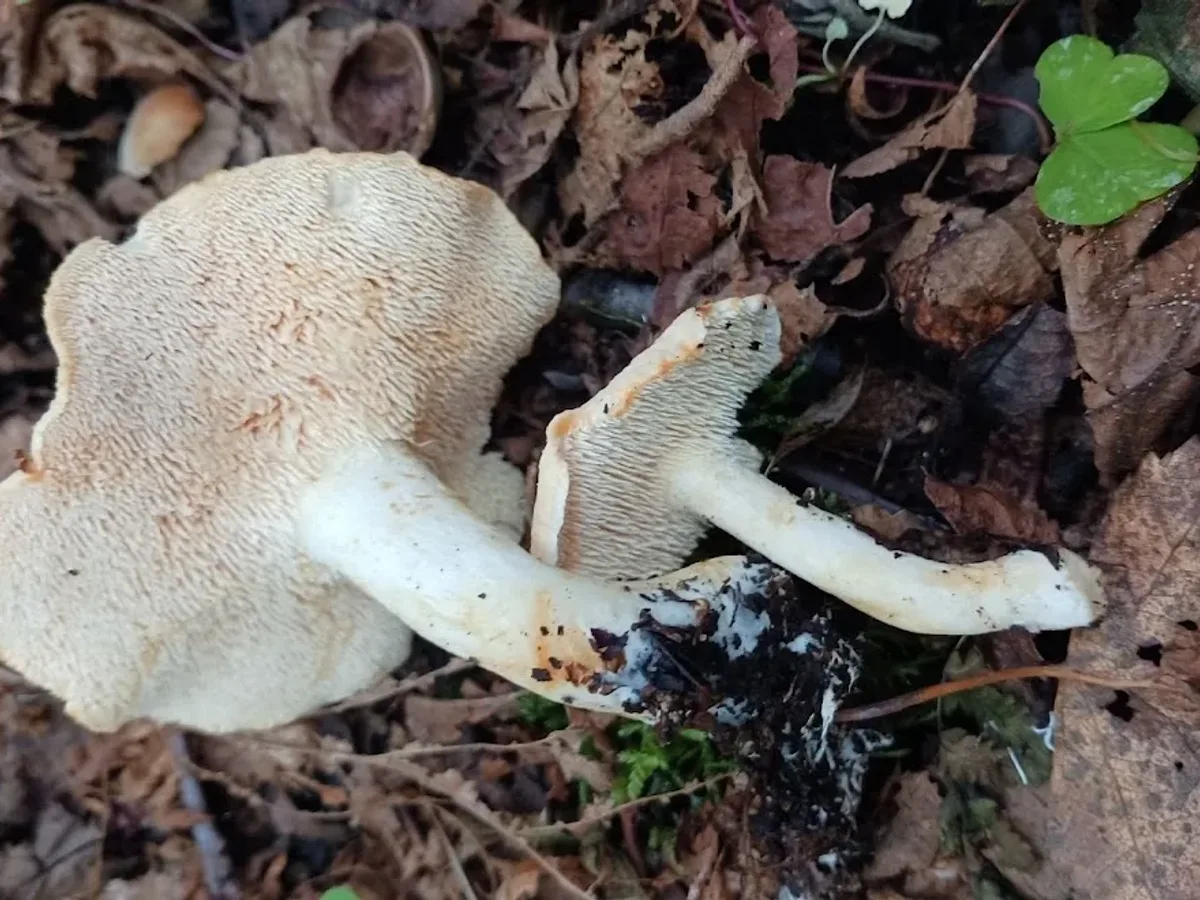 © Nina Fiskerstrand (CC BY)
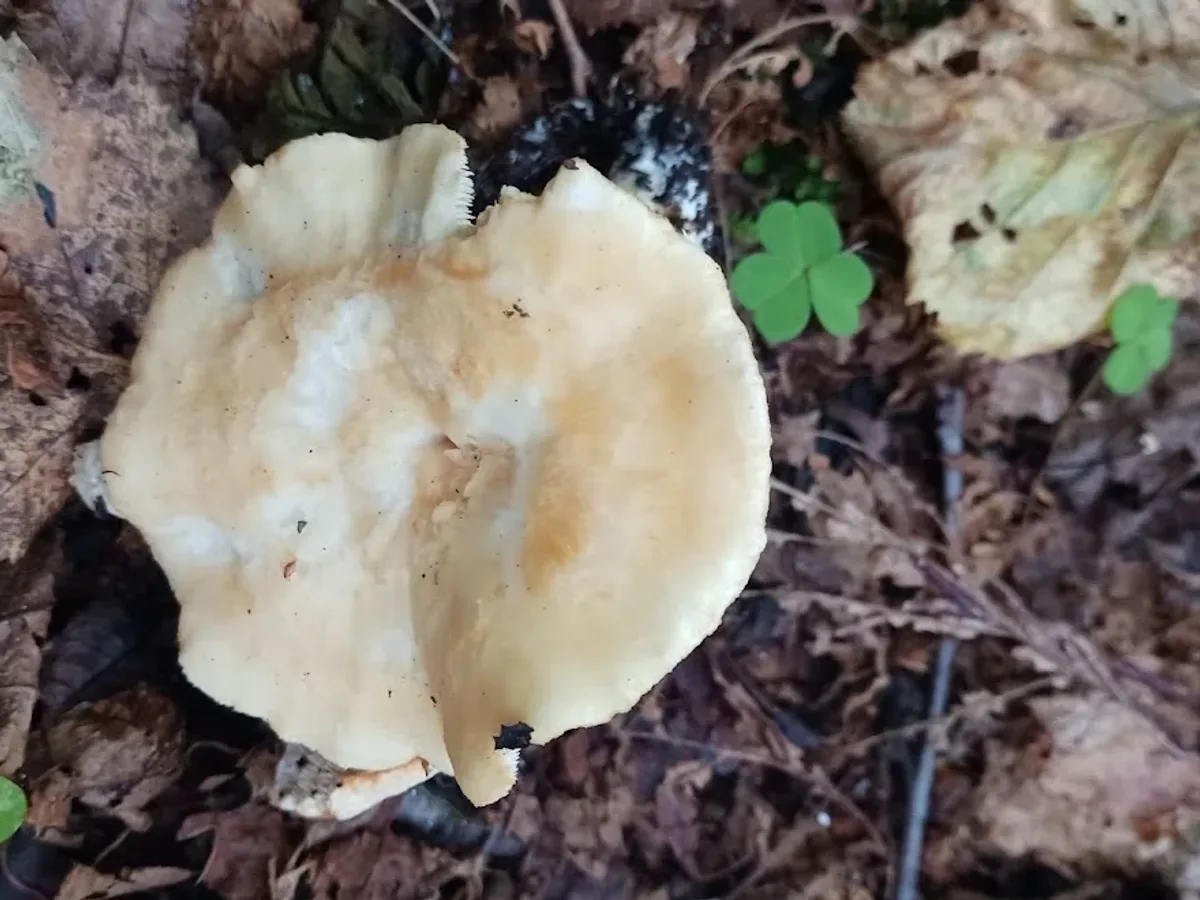 © Nina Fiskerstrand (CC BY)© Nina Fiskerstrand (CC BY)© Nina Fiskerstrand (CC BY)
Good to eat, once you have identified it with certainty and cooked it through.
Never eat a mushroom you are not 100% sure of - check the look-alikes below, and always cook wild mushrooms.
How to recognise it
Hydnum vesterholtii is a robust, pale hedgehog mushroom that belongs to the H. repandum species complex - a group of closely related toothed fungi that were long lumped together under the name H. repandum until molecular and morphological studies (particularly Lantieri et al. 2020) distinguished several cryptic species.
H. vesterholtii is generally paler than most segregates.
Cap
The cap is 4-12 cm across, broadly convex when young, and expands to become nearly flat or shallowly depressed with an irregular, wavy or lobed margin.
The surface is dry and suede-like, white to very pale ochre-buff or cream - not the deeper salmon-buff typical of H. repandum sensu stricto, and not the deep terracotta-orange of H. rufescens.
Gills / Pores
The diagnostic feature of the genus is the spore-bearing surface: instead of gills or pores, the underside carries dense, pendant, fragile spines (teeth) 3-7 mm long.
These spines are white to cream and run slightly down onto the stem (decurrent). They are readily dislodged by rubbing and make the genus instantly recognisable once encountered.
Stem
The stem is stout, solid, white to pale cream, and 3-7 cm tall.
Flesh
Flesh is white throughout, firm, and unchanging when cut.
Smell & taste
The mild, slightly mealy smell and almost tasteless flavour (raw) are characteristic; the faint bitterness present in some specimens disappears entirely on cooking.
Spore print white; spores broadly ellipsoid, about 7-9 µm long, smooth and hyaline under the microscope.
Where & when it grows
Habitat
The single most useful habitat clue for H. vesterholtii is the substrate: it has a clear affinity for calcareous soils on chalk and limestone, especially under beech.
While H. repandum can appear on a wide range of soil types, H. vesterholtii is most characteristic of classic chalk beechwood - the dense, high-canopy, low-ground-flora woodland that develops on thin alkaline soils over chalk in southern England, the Paris Basin, Belgium, and the Jura.
In these settings it forms reliable perennial fruiting sites among beech root zones, often returning to exactly the same spot year after year.
Outside chalk-beech association it also occurs under calcareous-soil oaks and occasionally hornbeam, but always with a preference for alkaline ground.
The leaf-litter layer is usually well-developed, and fruiting bodies emerge from beneath fallen beech mast and decaying leaves. It is far less common in acid-soil coniferous plantation, distinguishing it from H. rufescens.
When
Across central-western Europe the main fruiting period runs from late August through November, with the most consistent peak in October and early November, when soil temperatures settle in the 6-14 °C range.
In warm autumns, chalk-downland beechwoods can produce successive flushes into December.
H. vesterholtii is moderately frost-tolerant, and fruitbodies often persist in good condition after light overnight frosts, because the firm, dense flesh does not collapse quickly.
One of this species' more forgiving qualities is its slow, patient development: buttons take 7-14 days to reach full size, so once a flush begins you have an unusually long window to return to a site before the best specimens pass their prime.
Long-lived fruiting sites in well-known chalk beechwoods tend to be visited by the same foragers season after season - and for good reason.
How it grows
H. vesterholtii is an ectomycorrhizal fungus, meaning its mycelium wraps the fine root tips of host trees in a dense sheath - the Hartig net - exchanging hard-won soil minerals and water for sugars that only the tree can fix from sunlight.
This is an obligate partnership: the fungus cannot survive without a living host, and it plays no role in decaying dead wood.
What we see above ground is just the fleeting reproductive tip of something much older. The subterranean mycelial mat threads through chalk soil and beech roots, quietly expanding year after year; some established patches are thought to have been fruiting from the same underground network for decades, tied to the same generation of trees.
Fruitbodies emerge singly or in loose groups from this hidden mat, developing slowly over 7-14 days.
The spines on the underside bear basidia that release white spores downward into the air currents of the woodland floor - the whole visible mushroom existing, in the end, just to scatter those spores before it fades.
Fruiting conditions
Fruiting is triggered by autumn rainfall after summer drought, once soil temperatures drop below 14 °C. On chalk soils the drainage is rapid, so a higher cumulative rainfall over the preceding two weeks (>20 mm) is necessary to maintain sufficient soil moisture. Fruitbodies develop slowly over 7-14 days and persist well; expect the best harvests 10-14 days after a significant rain event in late September or October when nighttime temperatures fall below 8 °C.
Look-alikes
H. vesterholtii belongs to the Hydnum repandum complex, and the most realistic confusion is with other members of this group - all of which are edible, so misidentification within the complex carries no health risk:
- H. repandum sensu stricto tends to have a deeper salmon-buff or pale apricot cap, is common on acidic soils as well as calcareous ones, and has a more noticeably bitter taste raw.
- H. rufescens has a distinctly deeper terracotta-orange to brick-red cap and is usually smaller (2-7 cm).
- H. albidum (white hedgehog) is paler and smaller, found more in calcareous grassland and scrub edges.
None of these distinctions have safety implications.
The more dangerous confusion risk comes from other woodland species encountered in similar calcareous beech habitat.
Clitopilus prunulus (the sweetbread mushroom, an edible prized in France) has a broadly convex pale cap and runs down the stem - but it bears gills, not spines, has a distinctly mealy smell, a white spore print that is clearly pink when massed, and grows in grass-edge habitats as well as woodland.
The truly dangerous species to be aware of is Clitocybe phyllophila (frosted funnel), which is DEADLY - a muscarine-containing whitish funnel with strongly decurrent gills that can appear in similar chalk-woodland leaf litter.
Any person carrying pale spined mushrooms should confirm the spine-bearing underside before tasting; C. phyllophila has obvious white gills, not spines, so the distinction is unambiguous.
Paxillus involutus (roll-rim) causes DEADLY immune-mediated haemolysis with repeated consumption and grows in similar deciduous woodland; it is brown with strongly inrolled margins, crowded forking gills (not spines), and is readily distinguished.
Sarcodon imbricatus (scaly hedgehog) shares the spine-bearing surface but is much larger, has a brown scaly cap, and is inedible-bitter.
DEADLY - contains muscarine and has caused fatalities. A white to cream funnel-shaped mushroom with a frosted or silky cap surface and strongly decurrent white GILLS (not spines) on the underside. The underside is the critical check: gills in Clitocybe phyllophila versus pendant spines in H. vesterholtii make confusion impossible for anyone who turns the fruitbody over. Grows in similar chalk-woodland leaf litter in autumn.
DEADLY with repeated consumption - causes cumulative immune-mediated haemolytic anaemia that has killed people. Brown to olive-brown cap, strongly inrolled margin even in mature specimens, crowded forking GILLS that are decurrent and bruise brown when pressed - never spines. Any pale autumn woodland mushroom with downward-pointing spines (not gills) is safely distinguished from Paxillus.
H. repandum has a deeper salmon-buff to pale apricot colour, typically grows on a broader range of soil types including acid substrates, and usually has a more noticeably bitter raw taste. The two species are effectively identical in culinary use; any confusion is harmless. Macroscopic separation in the field is difficult and often requires familiarity with the H. repandum species complex.
Shares the spine hymenophore but is a much larger species (cap 5-30 cm), with a distinctly brown cap covered in large, coarse, dark uplifted scales, grey-brown spines, and firm bitter-peppery tasting flesh. Considered inedible to mildly toxic in quantity. The scaly brown surface and large size prevent confusion.
An edible species with a white to pale grey broadly convex cap and decurrent GILLS (not spines), very strong mealy-floury smell, and a spore print that becomes distinctly pink when massed. Sometimes encountered in similar woodland and occasionally grows large. Distinguished immediately by gills versus spines on the underside.
H. rufescens has a distinctly deep terracotta-orange to brick-red cap and is consistently smaller (2-7 cm vs 4-12 cm). It prefers acidic soils. Equally edible; no safety consequence.
H. albidum is smaller and uniformly white to pale cream throughout, with spines and cap nearly the same colour. More often associated with calcareous grassland and scrub edges rather than closed beechwood. Edible.
In the kitchen
Picking & cleaning
Select young to medium-aged specimens:
- the spines should still be pale and fully intact
- the cap surface firm and dry
- the flesh white without worm galleries
Cut cleanly at the base with a knife rather than pulling - this minimises disturbance to the shallow mycelium.
Trim away any base soiled with soil and debris before placing in your basket; the spines trap leaf matter readily.
Carry in an open wicker basket: the spines are fragile and compress in sealed plastic bags, making the mushrooms harder to clean later and releasing mild bitter compounds.
Because fruiting sites are long-lived perennial spots, repeated disturbance of the soil and mycelium should be avoided - do not rake through the leaf litter looking for buttons.
Cooking
H. vesterholtii is a versatile, pleasantly flavoured edible with firm flesh that holds its texture well on cooking.
The standard preparation is to sauté thickly sliced caps in butter or good olive oil over medium-high heat for 5-8 minutes, until the spines soften and the flesh colours to pale gold. Season with salt, black pepper, garlic, and fresh parsley.
The spines are fully edible - they collapse into the sauce and add no off-flavour.
It suits risotto and creamy pasta dishes well (the mild flavour complements but does not overpower), and the firm texture survives in soups and pot-roast accompaniments without disintegrating.
Pair with herbs that are similarly restrained - thyme, chervil, chives - and avoid strongly flavoured aromatics that would mask the delicate earthiness.
To dry:
- 1Slice 5 mm thick and dry at 40 °C until brittle.
- 2Store in an airtight jar.
- 3Reconstitute in warm water for 20 minutes.
The dried version develops a more concentrated, slightly sweet umami note excellent in stocks and sauces.
Freezing after a brief blanch (2 minutes) is acceptable but results in some softening of the spine layer on reheating.
Good to know
H. vesterholtii is considered a safe edible with no known toxins.
The spine-bearing hymenophore is unmistakable among dangerous species - no deadly mushroom in central-western Europe shares this feature - making it a suitable species for foragers developing confidence in field identification.
Mild raw bitterness disappears completely on cooking. As with all wild mushrooms, cook before eating, and eat a modest portion the first time to rule out personal sensitivity.
The primary safety obligation is to confirm the underside spines are present, ruling out any white-gilled funnel (Clitocybe / Clitopilus) that might be picked alongside in the same leaf litter. Keep the underside intact until back in the kitchen if uncertain.
A reference guide - never an edibility guarantee. When in doubt, leave it out.