Ovoid-spored hedgehog
Hydnum ovoideisporum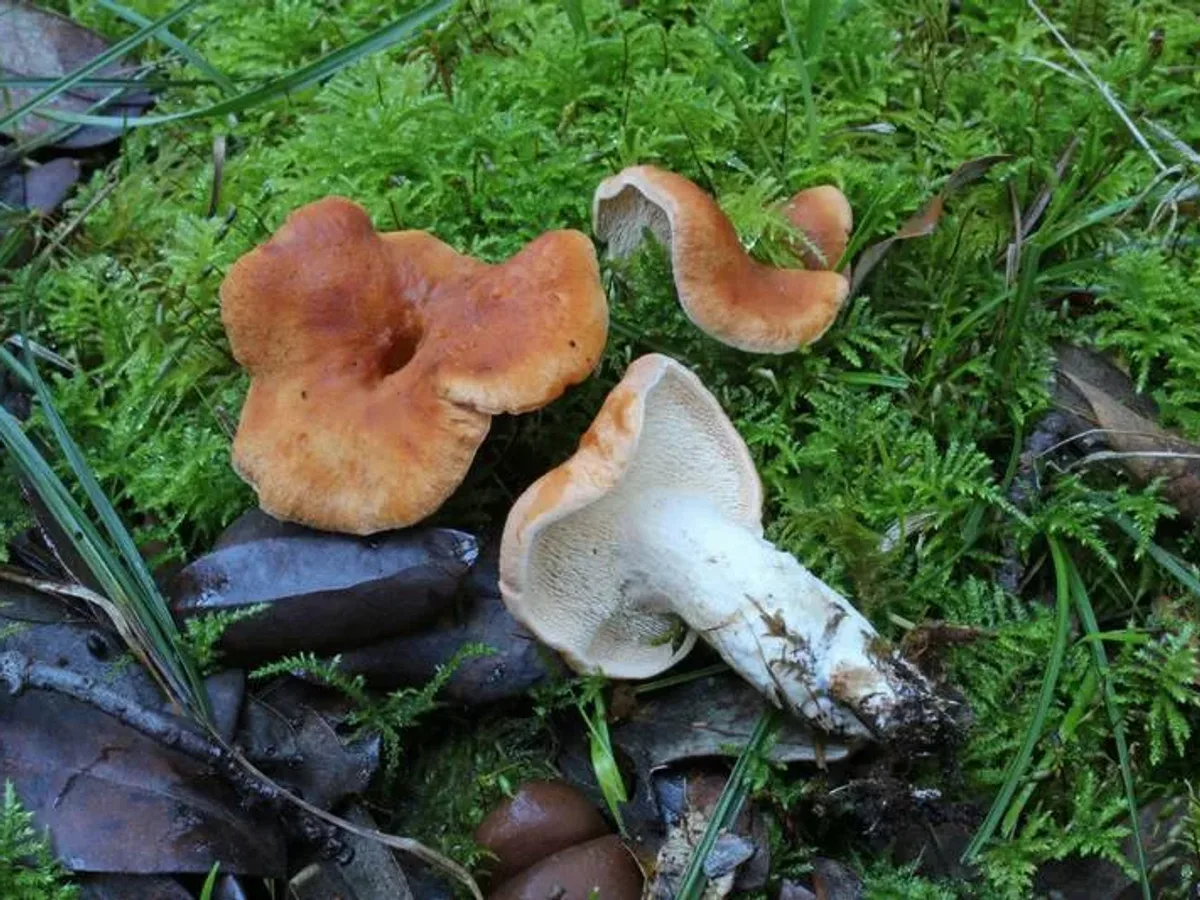 © Davide Puddu (CC BY)
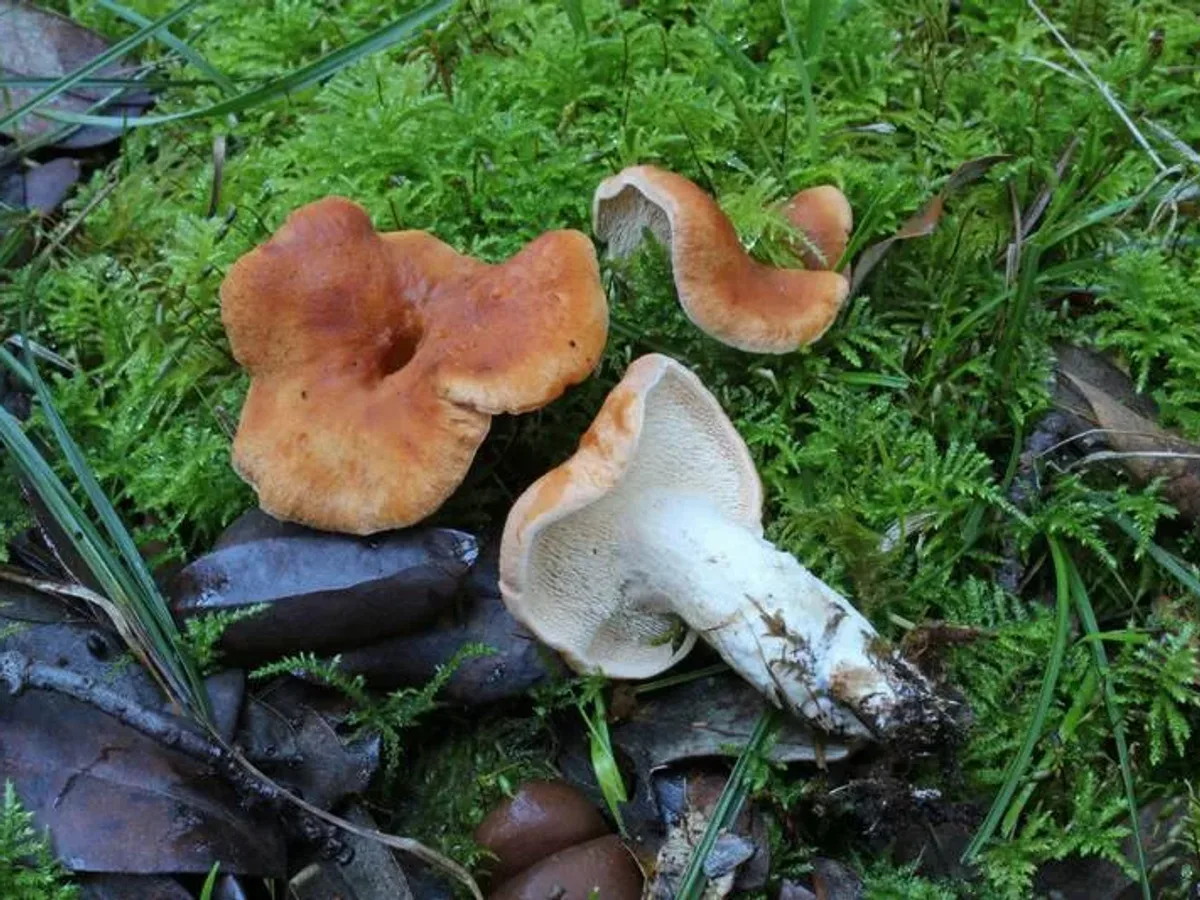 © Davide Puddu (CC BY 4.0)
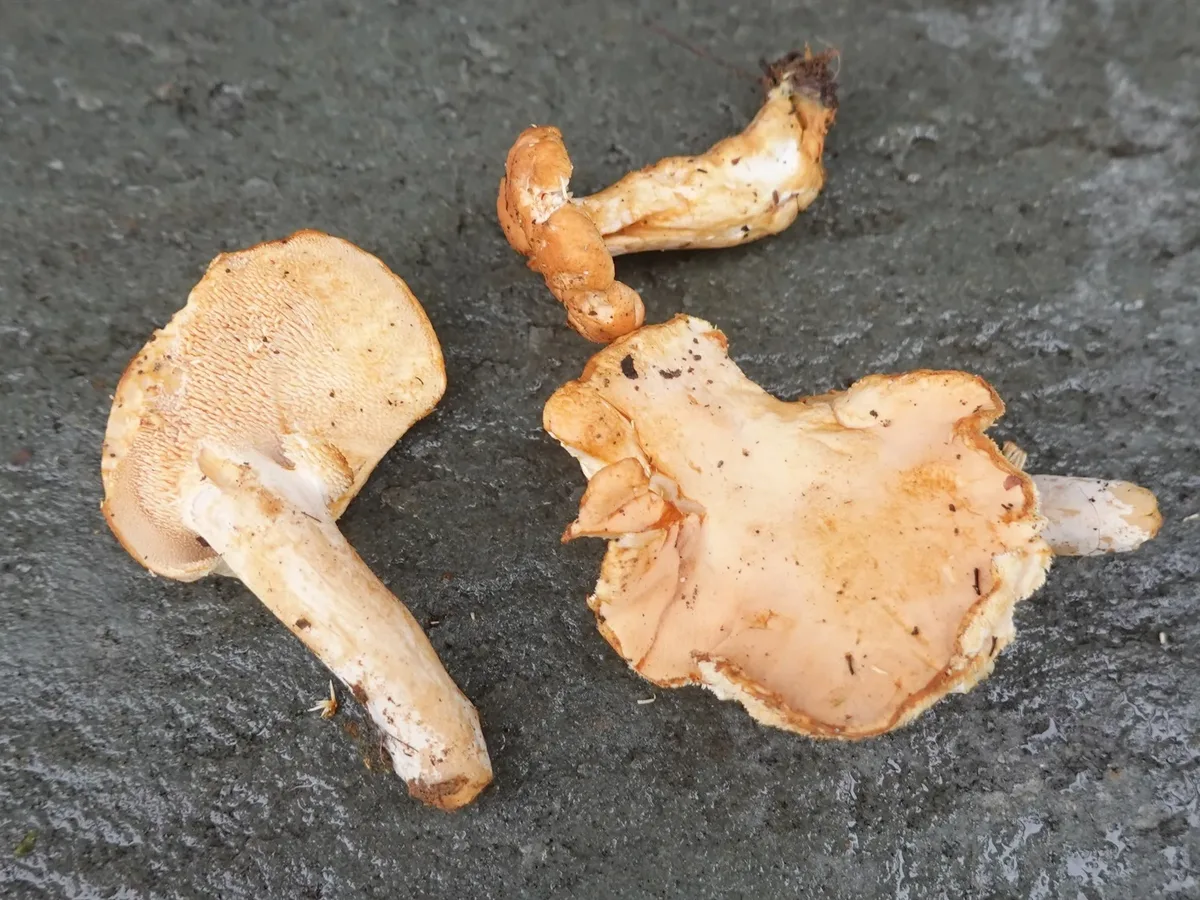 © Perry Gunnar Larsen (CC BY)© Davide Puddu (CC BY)© Davide Puddu (CC BY 4.0)
One of the best mushrooms you can bring home - once you are certain of the identification.
How to recognise it
The ovoid-spored hedgehog belongs to the H. repandum species complex - a cluster of closely related European Hydnum species disentangled by combined morphological and molecular work in the early 21st century. In the field it looks almost identical to H. repandum.
Cap
A 3-10 cm cap that is dry, smooth to slightly felty, and pale cream to honey-buff with an occasional faint apricot wash. The margin is typically wavy or irregularly lobed, and older caps may settle into a shallow central depression.
Gills / Pores
The diagnostic character - and the most reliable mark for any hedgehog mushroom - is the underside: instead of gills or pores, it carries densely packed, fragile, white to cream downward-pointing teeth (spines) 2-6 mm long that brush off easily when rubbed. These spines run a short distance down the stem (decurrent).
Stem
2-6 cm tall and 0.7-2.5 cm wide, solid and firm, pale cream to buff, sometimes slightly off-centre.
Flesh
White throughout, does not discolour when cut.
Smell & taste
Mild, pleasant, and faintly mealy. Spore print white.
The species is most reliably told from H. repandum under a microscope: the spores of H. ovoideisporum are clearly ovoid to ellipsoid (7-10 × 5.5-7.5 µm), while those of H. repandum are near-spherical.
Without a microscope, the best combination of clues is a slightly smaller, slightly paler fruitbody found under mature oak or beech - but since both are equally fine edibles, the distinction matters more to science than to the forager's basket.
Where & when it grows
Habitat
A mycorrhizal ectomycorrhizal species tightly linked to mature broadleaf woodland in temperate Europe.
It forms symbiotic associations with the fine root tips of oak (Quercus robur, Q. petraea, Q. pubescens), beech (Fagus sylvatica), and occasionally other deciduous trees including hornbeam, chestnut, and hazel.
Look for it on the floor of established, well-canopied deciduous woods on moderately acidic to calcareous loamy soils, often where a layer of leaf litter or sparse moss covers the mineral soil.
It grows singly or in scattered troops, sometimes loosely grouped; ring-like growth patterns reflecting the radially expanding mycelium are occasionally evident.
Established fruiting sites tend to be reliable year after year - experienced foragers often revisit the same oak or beech groves with consistent results in good years.
Unlikely to be found in open grassland, dense conifer plantations, or highly disturbed soils.
When
Fruiting begins in late summer (August-September) as temperatures start to moderate and the first significant autumn rains arrive, continuing through November and occasionally into December in mild Atlantic-influenced climates.
The peak flush across most of central-western Europe falls in mid-October to mid-November, corresponding to weeks 40-45 of the year.
Emergence is triggered by a combination of falling soil temperature (below approximately 15 °C) and sustained moisture from rain events; a lag of roughly 7-14 days between meaningful rainfall and fruiting is typical for ectomycorrhizal Hydnum species.
In warm years with dry autumns, fruiting may be sparse or delayed. Cold but snowless winters can produce late flushes in sheltered woodland.
How it grows
Hydnum ovoideisporum is an obligate ectomycorrhizal fungus - it cannot complete its life cycle without a living broadleaf host, and does not decompose dead wood or soil.
Beneath the surface, its mycelium wraps the fine feeder roots of oak and beech in a sheath called a Hartig net, exchanging mineral nutrients and water for the tree's photosynthetically produced sugars.
This partnership can persist in the same patch of woodland for decades, the two organisms quietly trading resources through an unseen network threaded through the soil.
When autumn rain and falling temperatures finally align, fruitbodies push up from that long-established mycelium and develop slowly - typically 7-14 days from pin to mature cap - which means they hold their quality in the field longer than many fast-growing gill mushrooms.
Spores release downward from the spine surfaces and disperse on air currents.
Because the same mycelial network sustains fruiting year after year, disturbing the soil at a productive site - through digging or heavy repeated foot traffic - can suppress or eliminate a colony.
Fruiting conditions
Fruiting is triggered by consistent autumn rainfall combined with cooling soil temperatures. A minimum of approximately 20 mm of rain over the preceding 14 days and soil temperatures falling below 16 °C appear necessary for reliable fruiting. Fruitbodies typically appear 7-14 days after a significant rain event. The species is moderately frost-tolerant and can persist through light ground frosts, extending the effective harvest window into late November or December in mild years.
Look-alikes
The most frequent confusion is with Hydnum repandum (hedgehog mushroom / sweet tooth), which is practically indistinguishable in the field without a microscope. It is usually somewhat larger, tends to have a more salmon-pink or apricot hue in European forms, and associates more freely with conifers as well as broadleafs. Since both species are choice edibles, confusion between them has no safety consequence.
- Hydnum rufescens (terracotta hedgehog) is smaller and distinctly deeper terracotta-orange in colour - easy to separate visually.
- Hydnum albidum is uniformly white to pale cream throughout, entirely lacking any ochre or buff tones.
- Sarcodon imbricatus (scaly hedgehog) shares the spine-bearing hymenophore but is much larger (cap up to 30 cm), has a grey-brown cap covered in coarse uplifted scales, dark grey-brown spines, and tough bitter flesh that renders it inedible; the scale pattern and size make confusion implausible for anyone who looks carefully.
- Hydnellum and Phellodon species also bear spines but have corky, tough, inedible flesh and strong, distinctive smells; they cannot be mistaken for Hydnum once the flesh is tested.
No deadly species produces the combination of a pale, smooth, spiny-undersurface fruitbody with white spore print and edible white flesh - the spine hymenophore is the single most reliable safety character in the European hedgehog group.
Practically indistinguishable in the field without a microscope; H. repandum is usually slightly larger and can have a more salmon-pink or apricot tint, and associates more freely with conifers. Spores of H. repandum are near-spherical (subglobose), while H. ovoideisporum has clearly ovoid-ellipsoid spores - microscopic distinction only. Both are equally choice edibles; confusion has no safety consequence.
Much larger (cap 5-30 cm), with a conspicuously coarse-scaled grey-brown to dark brown cap, grey-brown spines (not white), and tough bitter flesh that is considered inedible. The overlapping scale pattern and size make confusion very unlikely for any attentive observer.
Smaller (cap 2-7 cm) with a distinctively deep terracotta-orange to brick-red cap colour - far more saturated than the pale cream of H. ovoideisporum. Also an excellent edible.
Tough, corky-woody flesh that cannot be sliced cleanly; cap surface is velvety with concentric zones and the fruitbody often smells strongly sweet or peppery. Spines are typically brown to purplish-brown at maturity. Unpalatable and inedible, but not deadly.
Uniformly white to pale cream cap, spines, and stem; lacks any ochre or buff toning. Also edible.
In the kitchen
Picking & cleaning
- Cut cleanly at the stem base with a knife, or twist-and-pull gently; the firm flesh handles well without crumbling.
- Check the stem base for insect larvae.
- Carry in a breathable basket - the spines interlock and can become crushed in sealed plastic bags, releasing some bitterness.
- Brush or shake off leaf litter and soil immediately in the field; the spines trap debris readily.
- Select firm, dry specimens with pale cream spines; avoid specimens with darkened, soft, or sticky spines and caps showing orange-brown discolouration, which indicate age and possible off-flavours.
- Do not over-harvest from a single site: leave at least half the fruitbodies to complete spore dispersal and leave the soil undisturbed around the base.
Cooking
Hydnum ovoideisporum has the same flavour profile and culinary qualities as H. repandum: mild, nutty, and faintly mealy, with firm flesh that holds its shape during cooking.
Sauté sliced caps and spines in butter over medium-high heat for 5-8 minutes until golden, seasoning with salt and pepper; finish with garlic and fresh parsley or thyme. The spines soften entirely on cooking and contribute no off-flavour.
Excellent in risotto, pasta, omelettes, and cream sauces; the firm texture prevents waterlogging. Any residual bitterness in raw specimens (uncommon in young material) disappears completely with heat.
Dries well: slice thin and dehydrate at 40 °C, then store in an airtight jar; reconstituted dried material adds mild umami depth to stocks.
Pairs naturally with butter, white wine, garlic, cream, and hard aged cheeses.
Good to know
Hydnum ovoideisporum has no known toxins and has been consumed safely as an edible mushroom across its European range wherever it has been recognised as distinct from H. repandum.
It has no meaningful dangerous lookalikes: the spine-bearing underside is unique among European edible fungi and eliminates confusion with any toxic gill mushroom.
Some individuals may experience mild digestive discomfort after consuming large quantities raw; always cook thoroughly before eating. As with any wild mushroom, try a small amount first to rule out individual intolerance.
The microscopic distinction between H. ovoideisporum and H. repandum is academically important for taxonomy but has no foraging safety implication, since both are equally good edibles.
A reference guide - never an edibility guarantee. When in doubt, leave it out.