Ellipsoid hedgehog
Hydnum ellipsosporum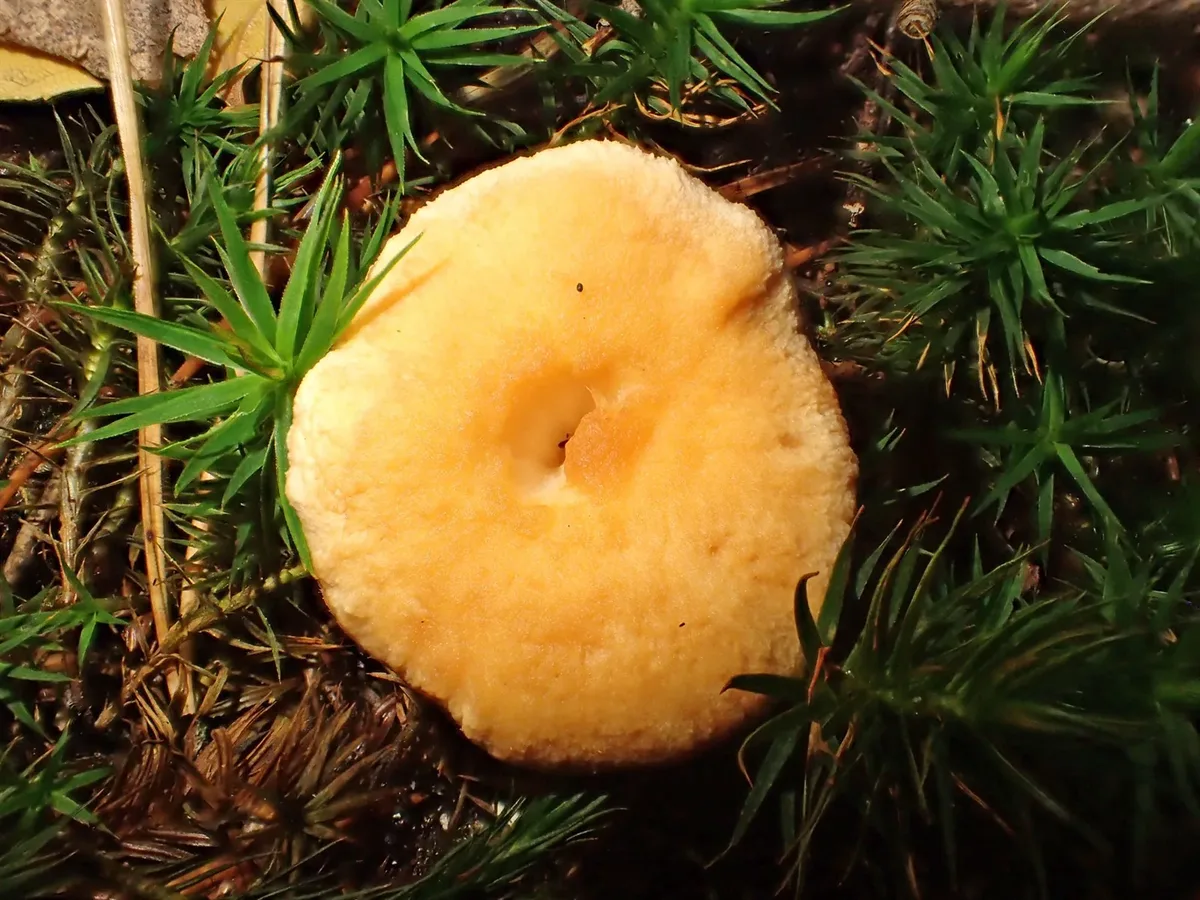 © Inger-Lise Fonneland (CC BY)
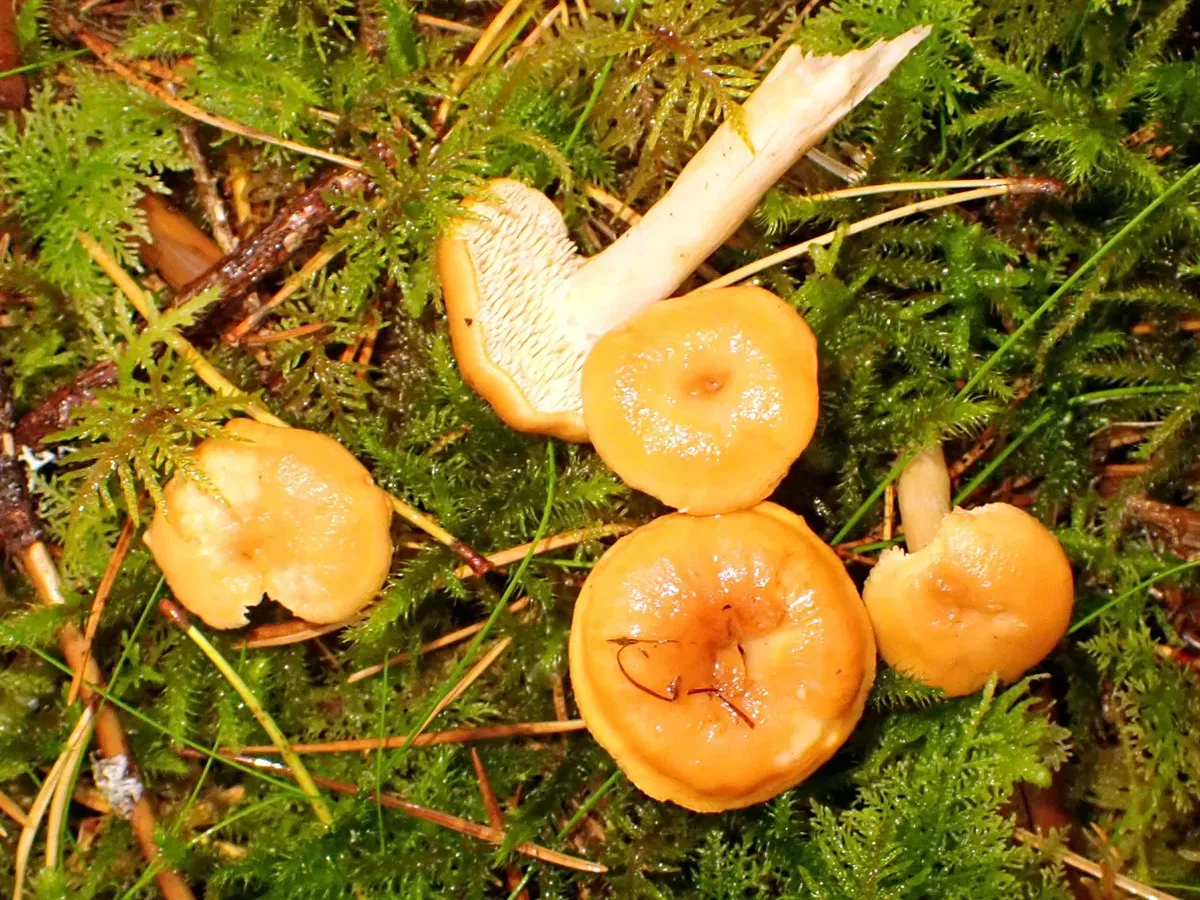 © Perry Gunnar Larsen (CC BY)
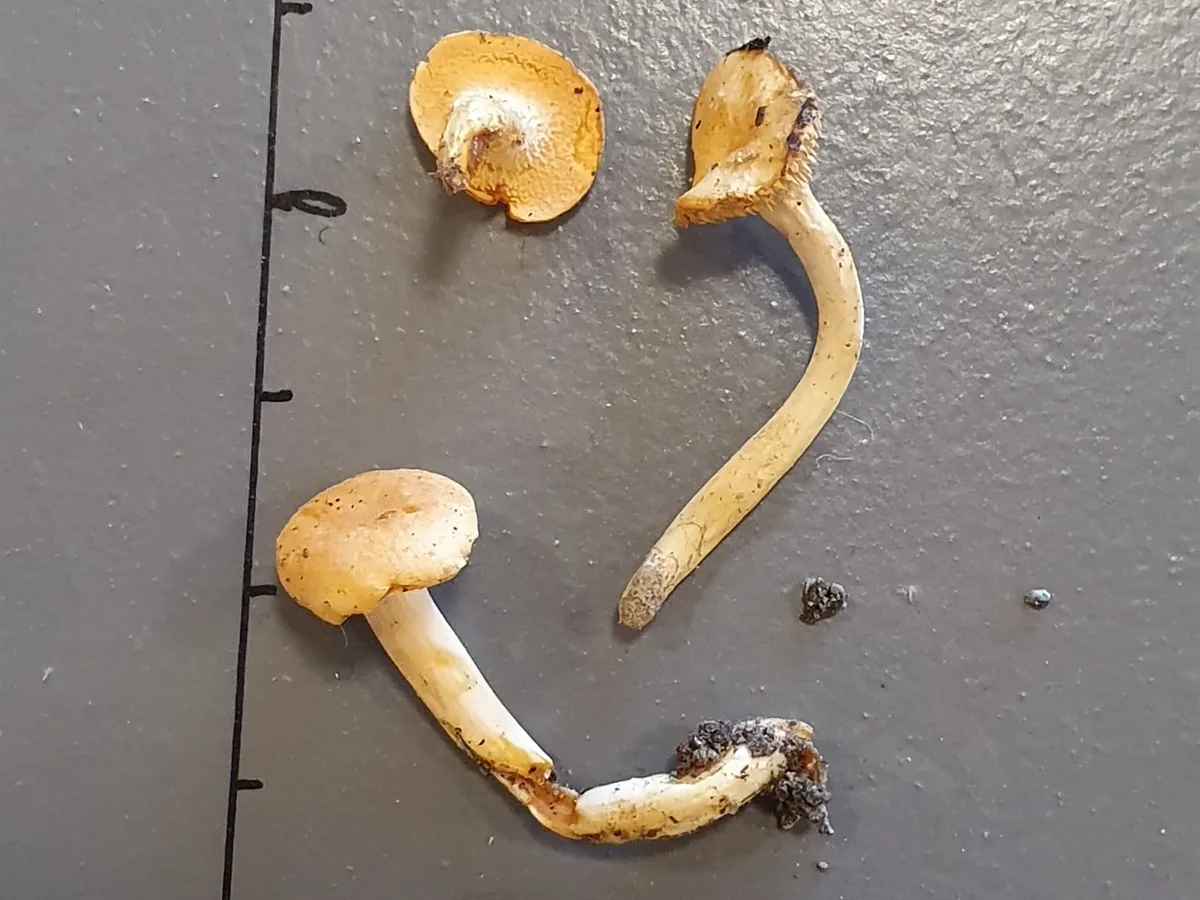 © Reidun Braathen (CC BY)
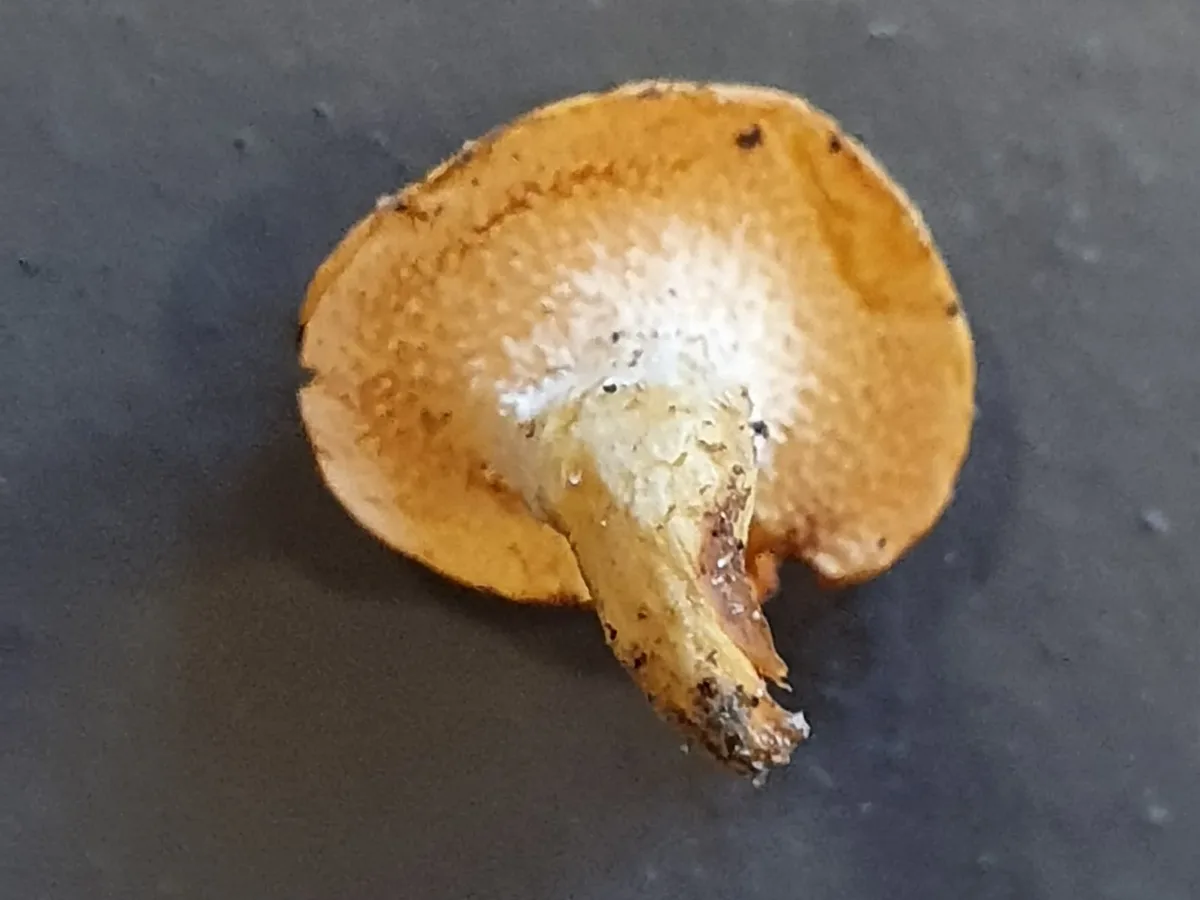 © Reidun Braathen (CC BY)
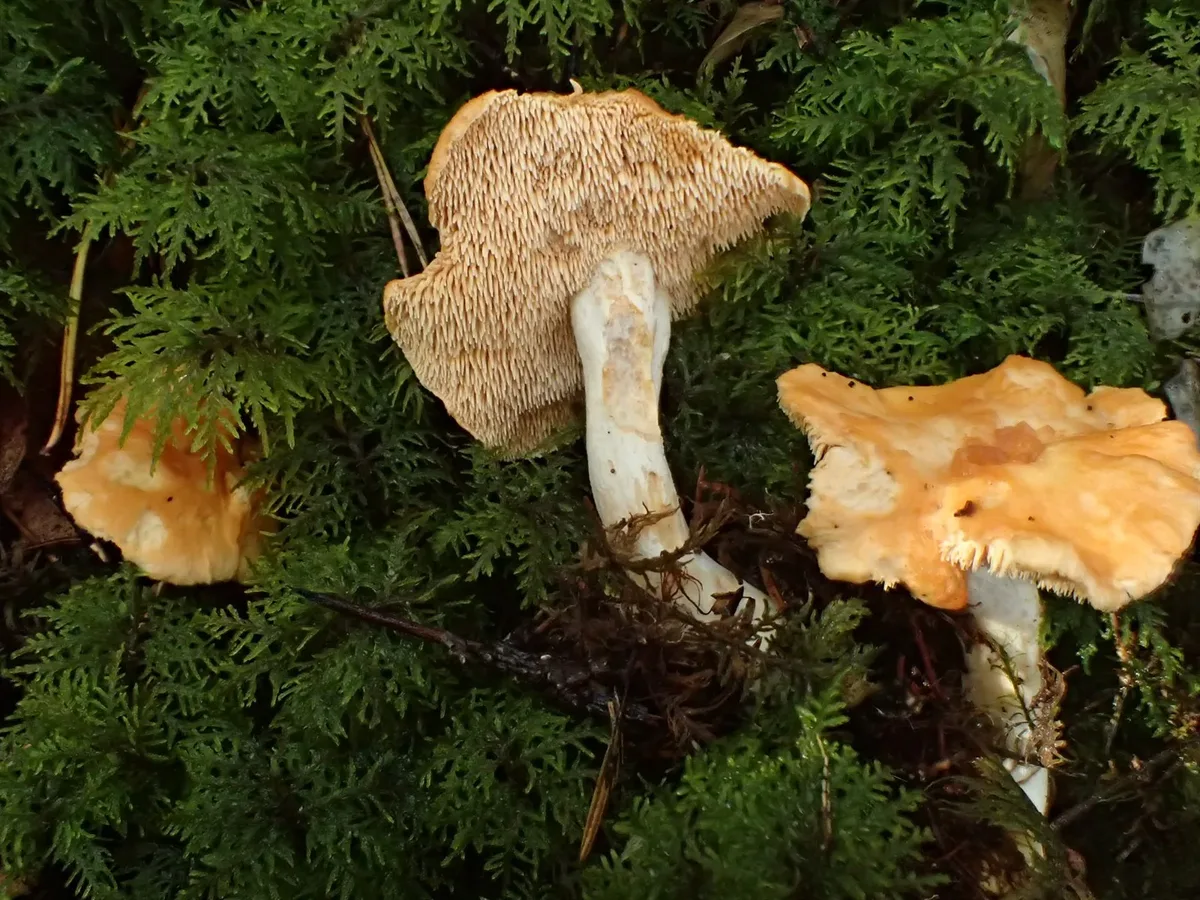 © Edvin W. Johannesen (CC BY)
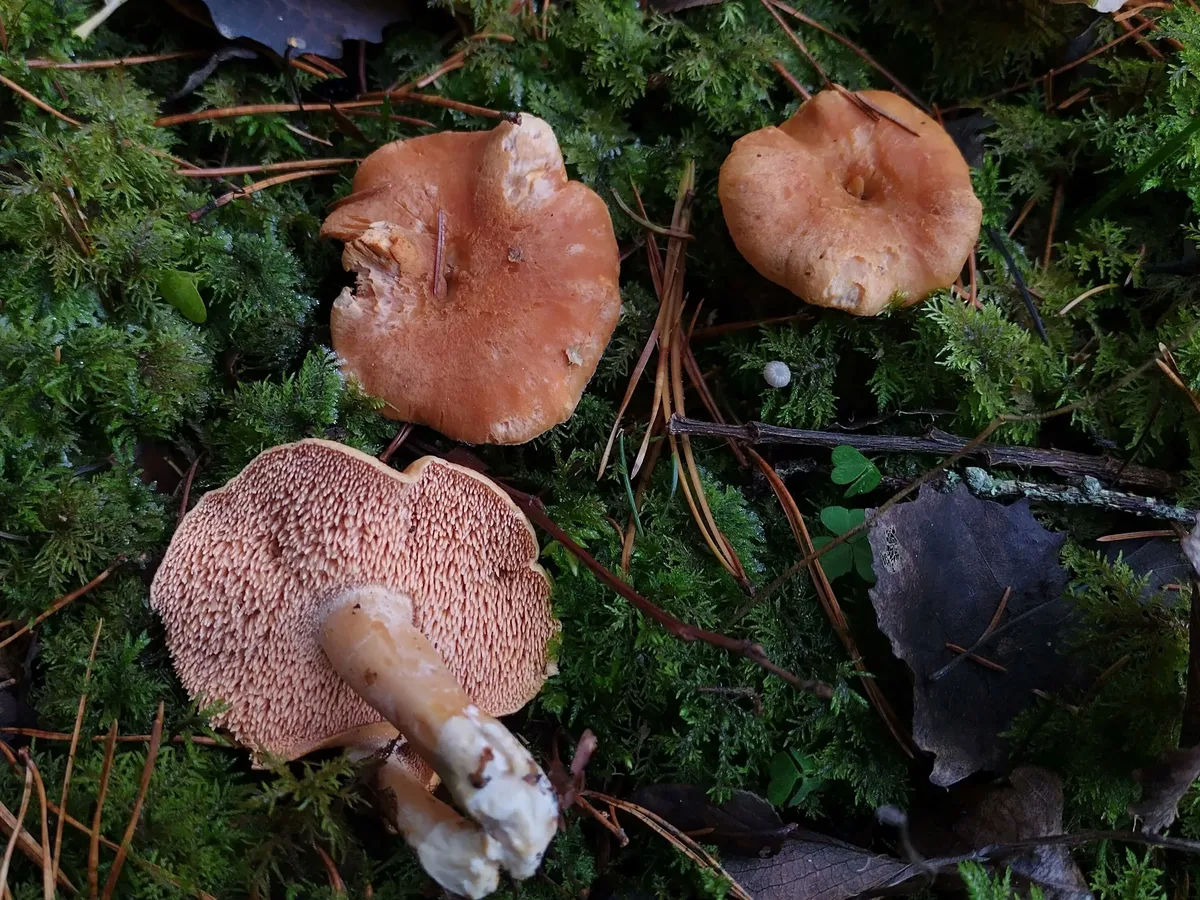 © Sebastian Källman (CC BY-SA)© Inger-Lise Fonneland (CC BY)© Perry Gunnar Larsen (CC BY)
Good to eat, once you have identified it with certainty and cooked it through.
How to recognise it
The ellipsoid hedgehog belongs to the hedgehog mushroom group - named for the dense, downward-pointing spines that carpet the underside of the cap in place of gills.
It was only formally separated from the look-alike Hydnum repandum in 2004, when Ostrow and Beenken showed that its spores are distinctly ellipsoid rather than near-spherical - a small microscopic difference with real taxonomic weight.
Cap
In the field you'll find a cap 3-10 cm across, usually somewhat smaller than a large H. repandum. The surface is dry and suede-soft, pale cream to ochre-buff or faintly pinkish-buff, often more even in hue than the variable common hedgehog.
It starts convex with an inrolled edge, then flattens and develops the characteristically wavy, lobed margins, sometimes dipping slightly at the centre with age.
Spines
The spines beneath are 3-6 mm long, densely packed, fragile, and cream to whitish. They run slightly down the stem (decurrent) and detach easily when rubbed - handle the cap gently in the basket.
Stem
The stem is 3-7 cm tall, solid, and about the same colour as the cap or a shade paler.
Flesh
The flesh is white, firm, and stays white when cut.
Smell & taste
The smell is mild and faintly mealy; the taste is mild with a very slight bitterness that disappears completely with cooking.
Spore print white. Under a microscope, the spores are clearly ellipsoid at 8-11 x 5-7 micrometres, noticeably longer relative to width than the near-spherical spores of H. repandum - the one character that conclusively identifies the species.
Where & when it grows
Habitat
A mycorrhizal species of temperate deciduous and mixed forests in western and central Europe, the ellipsoid hedgehog grows in habitats nearly identical to those of H. repandum: beech-dominated forests, oak woodland, and mixed stands with beech, oak, and occasional conifers.
It prefers well-drained forest floors with an intact litter or moss layer on moderately acidic to circumneutral soils.
Like all ectomycorrhizal fungi, it is rooted in a relationship with living trees - the mycelium threads invisibly through the soil and root tips for years before a fruitbody ever appears.
Permanent fruiting spots tend to be highly consistent, appearing at the same locations year after year, which is useful for foragers who have found a hedgehog patch and want to return.
It often grows alongside H. repandum and H. rufescens in mixed colonies, making macroscopic separation difficult without microscopic verification. It avoids compacted or heavily disturbed soils and prefers shaded woodland interior over open habitats.
When
In central and western Europe the main fruiting period runs from late August through November, with a distinct peak in October.
Autumn rain events followed by mild temperatures trigger fruitbody formation. The species is moderately frost-tolerant and may continue to fruit during mild spells into November or early December.
In Atlantic-climate regions (western France, the British Isles) the season can extend well into late autumn.
Because the fruiting window largely overlaps with H. repandum and H. rufescens, hedgehog mushroom patches during October almost always contain a mixture of all three species - though distinguishing them reliably requires spore measurement.
How it grows
Like all Hydnum species, H. ellipsosporum is ectomycorrhizal. It forms Hartig-net associations with the fine root tips of its tree hosts, exchanging soil minerals and water for photosynthate.
Fruitbodies emerge singly or in small scattered groups, developing slowly over 7-14 days - considerably more slowly than most gilled mushrooms. As a result they remain in good field condition for a comparatively long time.
The mycelium is perennial, and permanent fruiting sites may persist for decades if the host trees and soil structure are undisturbed.
Fruitbodies expand from small buttons, and during wet autumns a single site can produce multiple successive flushes.
Fruiting conditions
Responds to sustained autumn rainfall once soil temperatures cool below approximately 15 degrees C. Like other Hydnum species, fruitbody development is slow, unfolding over 7-14 days, which means fruiting bodies remain in good condition for an extended period after emergence. Peak flushes in October occur 1-2 weeks after the main autumn rain events when soil temperatures are in the 6-12 degrees C range.
Look-alikes
The realistic lookalikes for H. ellipsosporum are exclusively other Hydnum species, all of which are edible, so confusion within this group carries no health risk.
- Hydnum repandum (common hedgehog or sweet tooth) is the primary confusion species: typically larger (cap up to 15 cm), cream to pale pinkish-buff or salmon-buff, with subglobose spores (6-9 micrometres) rather than clearly ellipsoid (8-11 x 5-7 micrometres) - a distinction requiring a microscope.
- Hydnum rufescens (terracotta hedgehog) differs by its distinctly deeper terracotta-orange to brick-red cap colour, which is generally more saturated and warmer-toned than the pale buff of H. ellipsosporum.
- Hydnum albidum is essentially white throughout, paler than H. ellipsosporum.
In practice, the three common central-European Hydnum species (repandum, rufescens, and ellipsosporum) form a complex that can only be reliably separated by spore measurement. However, all are edible, so the forager is never at risk from misidentifying among them.
More broadly, the spine-bearing hymenium of any Hydnum species is unique among common poisonous or deadly fungi: no deadly species produces this combination of a pale, fleshy, centrally-stemmed cap with dense, pale, fragile, downward-pointing spines and a white spore print.
- Sarcodon imbricatus has spines but is far larger, has dark scaly cap surfaces, and has grey-brown (not white) spines.
- Hydnellum species have tough, corky flesh and are not fleshy.
The only scenario where confusion could theoretically involve a dangerous species is a very young, still-unexpanded fruitbody of a pale Amanita species growing in the same area before spines are visible. Always ensure the characteristic spines are fully developed and visible on the underside before consuming any pale, stemmed woodland mushroom.
Typically larger cap (up to 15 cm vs 3-10 cm), more cream to pale pinkish-buff or salmon-buff colour, and subglobose spores (6-9 micrometres) versus the clearly ellipsoid spores (8-11 x 5-7 micrometres) of H. ellipsosporum. Reliable separation requires microscopy; both species are equally edible and confusion carries no health risk.
Hydnellum species have distinctly tough, corky or leathery flesh -- not the brittle, fleshy texture of Hydnum -- and are much tougher to break. The flesh often has concentric zones and the cap and spines may be brown, grey, or blue-toned. Not edible but not deadly.
Much larger (cap 5-30 cm), with a distinctly scaly dark brown to grey-brown cap surface, grey-brown (not white) spines, a bitter and peppery taste, and tough, corky flesh. The scaling pattern and dark colouration make confusion with the pale, smooth-capped H. ellipsosporum very unlikely. Inedible to mildly toxic in large quantities, but not deadly.
Distinctly deeper terracotta-orange to brick-red cap, usually more saturated in colour than the pale buff of H. ellipsosporum; also smaller on average. Spores of H. rufescens are broadly ellipsoid to subglobose, 6-8 x 5-7 micrometres. Also equally edible; no safety risk from confusion.
Essentially uniformly white to pale cream throughout cap, stem, and spines, lacking the buff or ochre tones of H. ellipsosporum. Also edible; no danger.
In the kitchen
Picking & cleaning
Select firm, young to medium-aged specimens where the spines are still pale, the cap is not water-soaked, and the flesh shows no worm damage. Older caps with browning spines and soft flesh should be left.
Cut cleanly at the base with a knife or twist-and-pull, and avoid excavating the base unnecessarily to protect the mycelium.
The spines trap leaf litter readily, so brush off debris in the field and carry in a breathable basket. Avoid dense plastic bags, which crush the delicate spines and can accelerate deterioration.
Because H. ellipsosporum grows in the same patches as its relatives, all being equally edible, it is not necessary to separate species in the basket - pick the best specimens regardless of which Hydnum they represent.
Cooking
The culinary qualities of H. ellipsosporum are essentially identical to those of H. repandum and H. rufescens. The flesh is firm enough to saute without becoming watery, the flavour is mild, nutty, and pleasant, and it holds its texture well in risottos, pasta sauces, soups, and egg dishes.
Any raw bitterness is fully eliminated by cooking.
The standard preparation is to saute sliced or torn specimens in butter over medium-high heat for 5-7 minutes until golden, seasoned with salt, pepper, garlic, and fresh herbs such as parsley or thyme. The spines soften during cooking and add no off-flavour; there is no need to remove them.
It dries well on strings or in a dehydrator at 40 degrees C until brittle, and reconstitutes in warm water to give a concentrated earthy-umami flavour suitable for stocks and sauces.
Mixed preparations with H. repandum and H. rufescens (gathered from the same patch) are entirely acceptable and result in a pleasant hedgehog mushroom dish regardless of species proportions.
Good to know
Hydnum ellipsosporum is a safe, wholesome edible with no known toxins and an excellent safety record consistent with all species in the Hydnum genus.
It has no dangerous lookalikes. The tooth-bearing hymenophore is the single most reliable safety feature in all of European mycology, as it is shared only with other edible Hydnum species and with the tough, inedible (but harmless) Sarcodon and Hydnellum species.
Any mild bitterness present in raw specimens disappears completely on cooking.
- As a precaution applicable to all wild mushrooms, eat a modest amount on first encounter to rule out personal intolerance.
- Always cook before eating.
Because this species is macroscopically very similar to H. repandum and H. rufescens, definitive identification to species level requires microscopic spore measurement. This is not a safety concern - all three species in the complex are equally edible.
A reference guide - never an edibility guarantee. When in doubt, leave it out.