White hedgehog
Hydnum albomagnum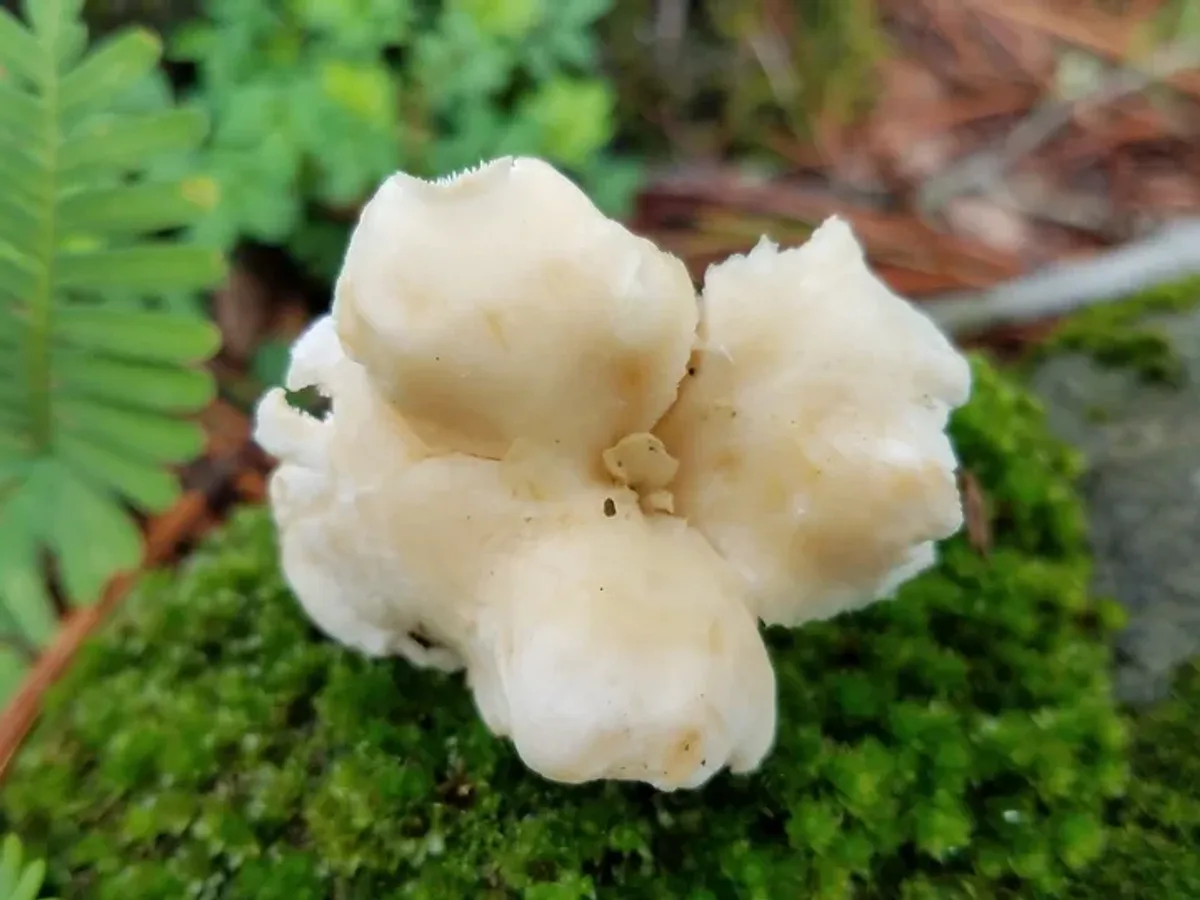 © Alan Rockefeller (CC BY-SA)
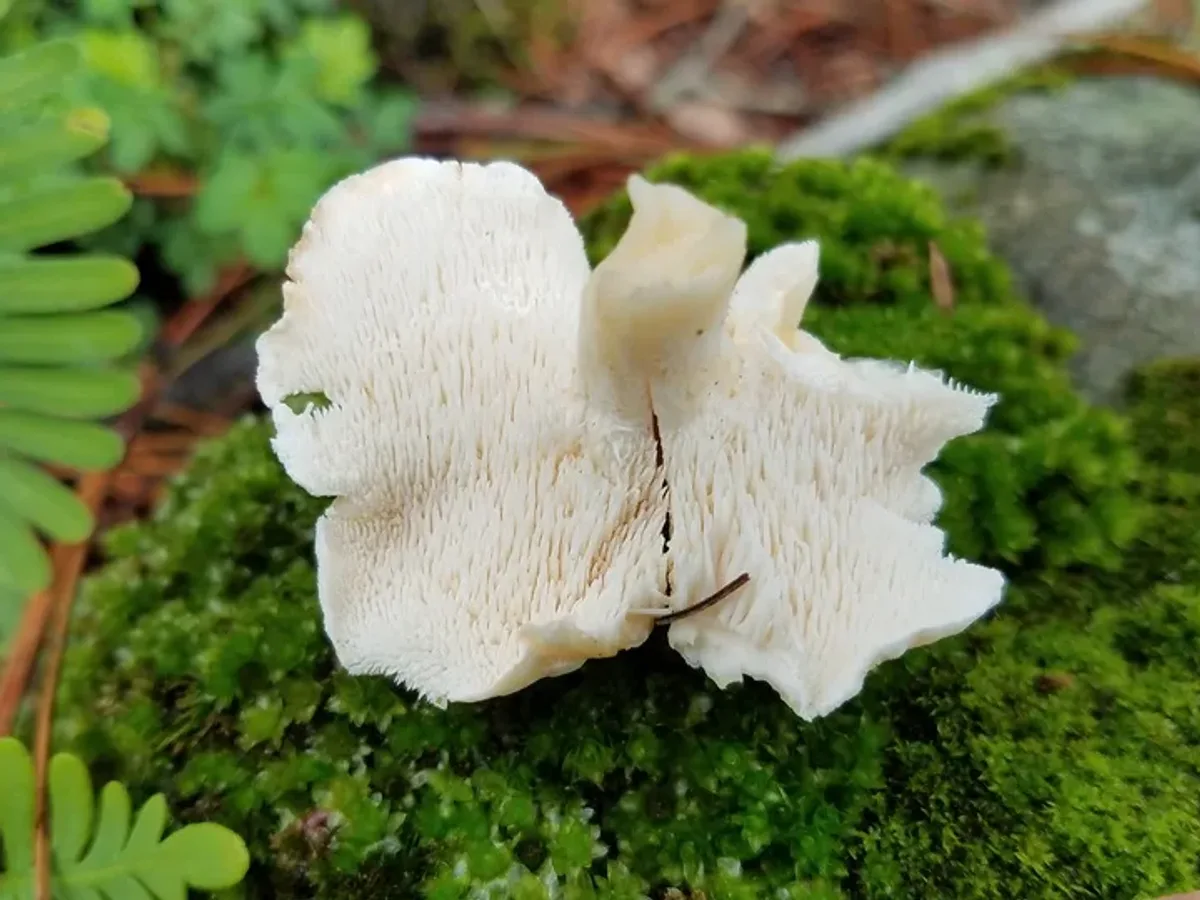 © Alan Rockefeller (CC BY-SA)
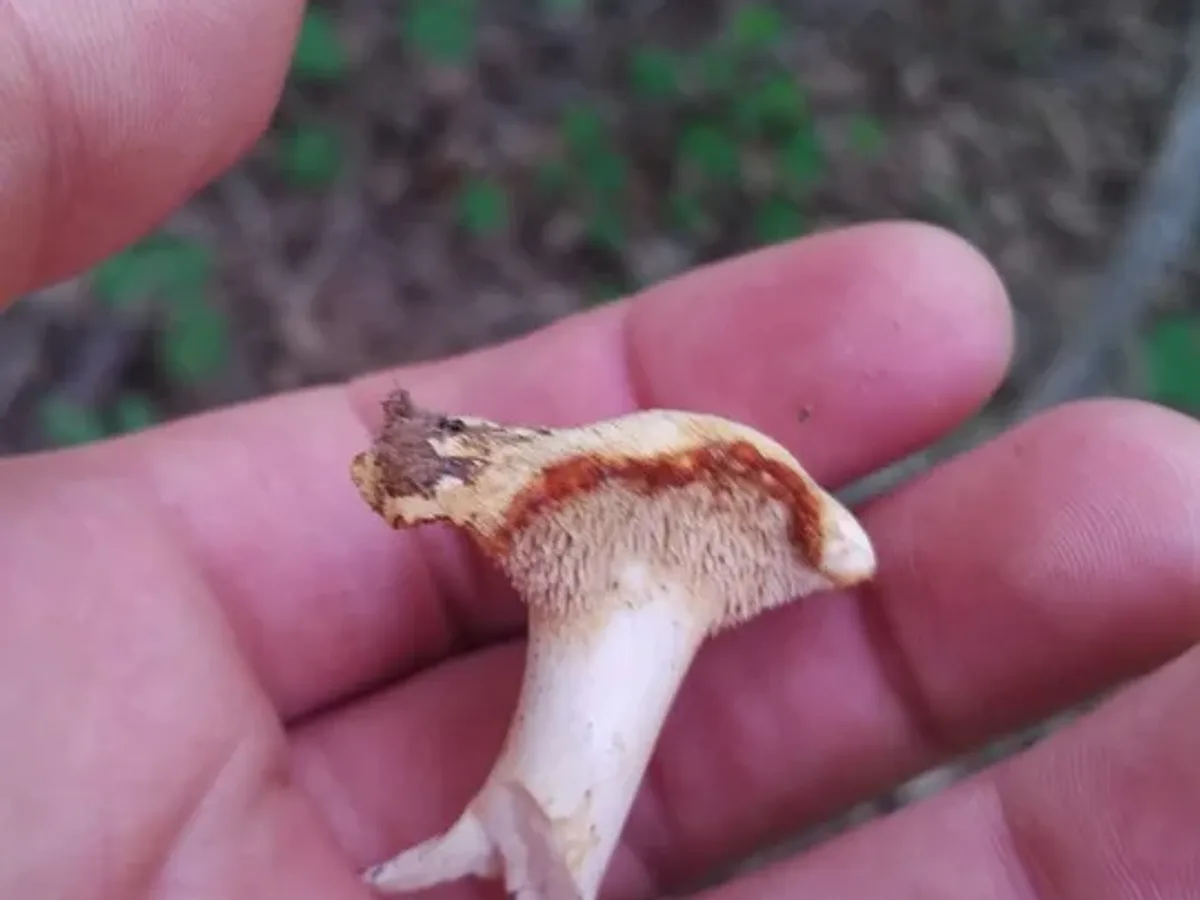 © Ian Blaylock (CC BY-SA)© Alan Rockefeller (CC BY-SA)© Alan Rockefeller (CC BY-SA)
One of the best mushrooms you can bring home - once you are certain of the identification.
Never eat a mushroom you are not 100% sure of - check the look-alikes below, and always cook wild mushrooms.
How to recognise it
Hydnum albomagnum is a large, robust hedgehog mushroom immediately identifiable by its all-white to pale ivory colouration and the pendant tooth-like spines on the underside of the cap.
Cap
The cap spans 5-15 cm across (rarely larger), starting convex and firm in youth then flattening and becoming broadly wavy and irregularly lobed at maturity; the surface is dry and smooth to finely tomentose.
The colour holds persistently white to pale cream, occasionally drifting to very light buff in old specimens.
Spines
The spine-bearing hymenophore - the spore surface made of pendant teeth rather than gills or pores - is the first thing to confirm: the spines are 3-8 mm long, closely packed, white to pale cream, brittle, and run slightly down the upper stem.
Stem
The stem is stout, 1.5-4 cm wide, solid, white throughout, and may be club-shaped.
Flesh
Flesh is firm and white when cut, without significant colour change or strong odour; the taste is mild and pleasant with none of the bitterness occasionally found in H. repandum.
Spore print is white.
Where & when it grows
Habitat
This is a mycorrhizal species tightly associated with cool coniferous and mixed forests, where it forms ectomycorrhizal relationships with spruce, fir, hemlock, pine, and (secondarily) with northern hardwoods such as beech, maple, and birch growing in the same stands.
It grows on the forest floor in thick needle duff, moss mats, or humus-rich soil, often partly obscured by the substrate - look for the white caps breaking through the leaf litter on north-facing slopes, in ravines, and along shaded stream banks where soil moisture persists into autumn.
The species is widespread in eastern North America from the Appalachians north through New England and across the Canadian boreal zone; it has also been collected in the Pacific Northwest.
Similar-looking European material is now assigned to Hydnum albidum, which was separated from North American material on the basis of molecular phylogenetics.
When
In eastern North America, the main fruiting season runs from late August through November, with the peak flush concentrated from early September through mid-October.
One of Hydnum albomagnum's most useful traits for the autumn forager is its frost tolerance - fruitbodies push through after the early cold snaps that end many other species' seasons, persisting in good condition through light frosts and making this one of the more reliable finds in boreal and northern temperate forests as the year winds down.
The season tends to be triggered by the combination of cooling temperatures and rainfall after summer; in years with a warm, dry August followed by September rains, several successive flushes are common.
- In the southern Appalachians at elevation, fruiting may begin as early as late July.
- In the far north of the boreal zone (Quebec, Ontario, Maritime provinces), the effective window compresses to August-September before killing frosts arrive.
How it grows
Fruitbodies emerge singly or in small scattered groups from the mycelial mat below the needle duff, slowly pushing upward over several days. Young buttons are compact, all-white, and hemispherical; they expand gradually to the characteristic broad, wavy cap of maturity.
The firm, dense flesh resists rapid decay, and fruitbodies are long-lived relative to most agarics - a healthy, frost-undamaged specimen may remain collectible for a week or more.
The mycelium is perennial, and the same patch often produces fruitbodies in the same location for many consecutive years, making careful notes about productive spots particularly rewarding.
Unlike the sympatric and similar H. umbilicatum, individual fruitbodies of H. albomagnum are consistently large.
Fruiting conditions
Responds to autumn rain events following late-summer drying; optimal soil temperatures 4-15 °C. Frost-tolerant; fruitbodies persist through light freezes. Second flushes common after successive September-October rain events. Season compresses in high boreal latitudes.
Look-alikes
The most important safety comparison for any large white mushroom in eastern North America is with the destroying angel, Amanita bisporigera. This deadly species has:
- true free white gills (not pendant teeth)
- a skirt-like ring on the upper stem
- a cup-like volva buried at the base
A. bisporigera is lethal - a single cap can kill a human via amatoxin-driven liver failure - and it shares the forest habitat of H. albomagnum.
Confirming that the hymenophore consists of pendant downward-pointing teeth (not plate-like gills), and verifying the absence of a ring and basal volva, absolutely eliminates Amanita. Never collect any large white mushroom without checking the underside and digging up the base.
Other lookalikes:
- Hydnum albidum is the morphologically nearest non-deadly lookalike - the European counterpart separated on molecular grounds, essentially indistinguishable in the field and equally edible.
- Hydnum repandum (hedgehog mushroom) is buff-orange to apricot-tan rather than white and often noticeably bitter when raw; also an excellent edible.
- Hydnum umbilicatum is much smaller (2-7 cm), orange-toned, and has a prominent central depression (umbilicus) in the cap.
- Tricholoma album, a mildly toxic white agaric of mixed forests, has true sinuate gills, a mealy or unpleasant smell, and lacks any pendant teeth.
The critical safety comparison. A. bisporigera is all-white with true free gills (plate-like, not pendant teeth), a skirt-like ring on the upper stem, and a cup-like volva at the base (often buried in soil). It is lethally toxic - amatoxins cause delayed liver and kidney failure. H. albomagnum has pendant downward-pointing teeth on the underside (not gills), no ring, and no volva. Always confirm the teeth and the absence of a volva before collecting any large white mushroom in eastern North America. These two species are distinguished beyond doubt by underside and base inspection.
Much smaller (2-7 cm), distinctly orange to apricot-toned, and has a prominent central depression (umbilicus) in the cap. Lacks the large, all-white appearance of H. albomagnum. Also edible.
Morphologically nearly identical; separated primarily by molecular phylogenetics and geography. H. albidum is the European counterpart; H. albomagnum is the primary North American species. Both are choice edibles - confusion carries no risk. H. albidum may average slightly smaller fruitbodies and occurs predominantly in European forests.
H. repandum is distinctly buff-orange to apricot-tan rather than white, and raw flesh can be noticeably bitter. Cap colouration (buff/tan vs white) is the key visual distinction. Also an excellent edible - no safety risk from confusion.
A mildly toxic white agaric of mixed forests. Distinguished by having true sinuate gills (not pendant teeth) on the underside, an unpleasant mealy or fruity odour, and the absence of any tooth-bearing surface. Confirming teeth vs gills immediately eliminates this species.
In the kitchen
Picking & cleaning
- Twist and pull cleanly at the base, or cut with a knife.
- Slice through the stem base to check for insect larvae (uncommon in this species).
- Carry in a wide, breathable basket - the fragile spines detach and interlock if fruitbodies are crowded in a sealed container.
- Shake off debris in the field and brush the spines gently with a soft brush; the spines trap grit and soil particles.
Partly-buried specimens are common: when you see a white cap peeking through needle duff, probe the surrounding area gently with a finger to locate the full extent of the fruitbody before pulling.
Avoid waterlogged, discoloured, or soft specimens - freshness is indicated by a dry, firm cap and intact spines.
Clean in the kitchen with a dry brush or brief cold rinse; the cap peel does not need to be removed. The species stores well refrigerated for several days.
Cooking
The flesh of H. albomagnum is mild, faintly nutty, and pleasantly firm, holding its texture through extended cooking better than many delicate edibles.
Sauté in butter over medium-high heat with salt until the moisture evaporates and the spines and cap take on a light golden colour; finish with garlic, thyme, or fresh herbs.
The spines may trap butter or oil and become slightly gelatinous if underdone, so cook until the edges are lightly golden rather than merely softened.
- Excellent in risotto, cream sauces, pasta, omelettes, and soups.
- Can be dried (sliced thin, low heat) and reconstitutes with a mild earthy note.
- Suitable for pickling.
The consistent large size means it can be sliced into substantial pieces that work well as a standalone mushroom dish rather than just a flavouring.
Good to know
Hydnum albomagnum has no known toxins and an excellent safety record. The critical safety step is confirming the pendant-teeth hymenophore: no deadly mushroom shares this character.
The all-white colouration means this species does get visually confused with large white Amanita species at first glance, so always flip the cap to inspect the underside before collecting:
- Gills mean do not collect.
- Teeth mean you are looking at a hedgehog mushroom.
Also check the stem base for a volva. Once the teeth are confirmed and the base verified as lacking a volva, there is no dangerous confusion possible.
Cook before eating as standard practice. The species is suitable for beginners once they have mastered the teeth identification feature.
A reference guide - never an edibility guarantee. When in doubt, leave it out.