White Saddle
Helvella crispasyn. Helvella crispa (Scop.) Fr., Elvela crispa Scop., Phallus crispus Scop., Costapeda crispa (Scop.) Falck
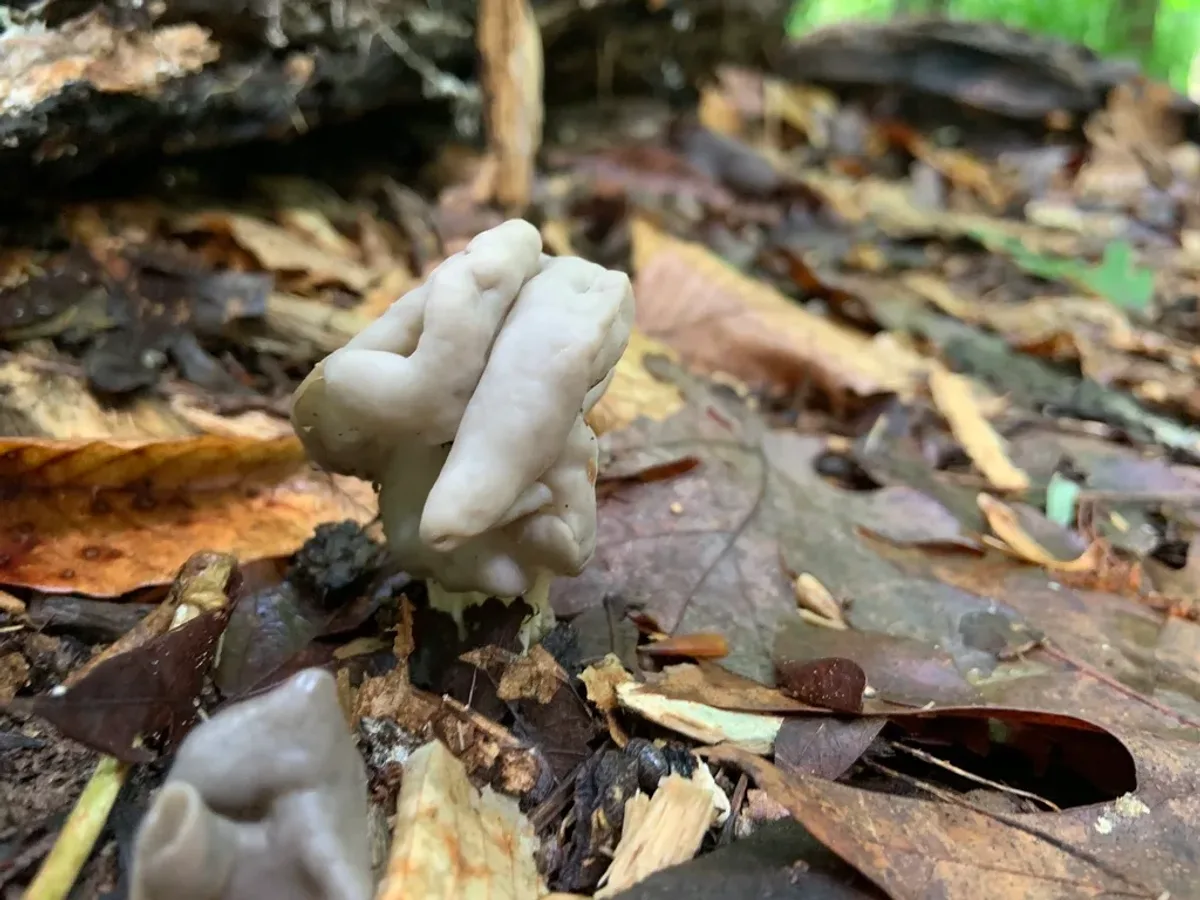 (c) evlyshroom, some rights reserved (CC BY)
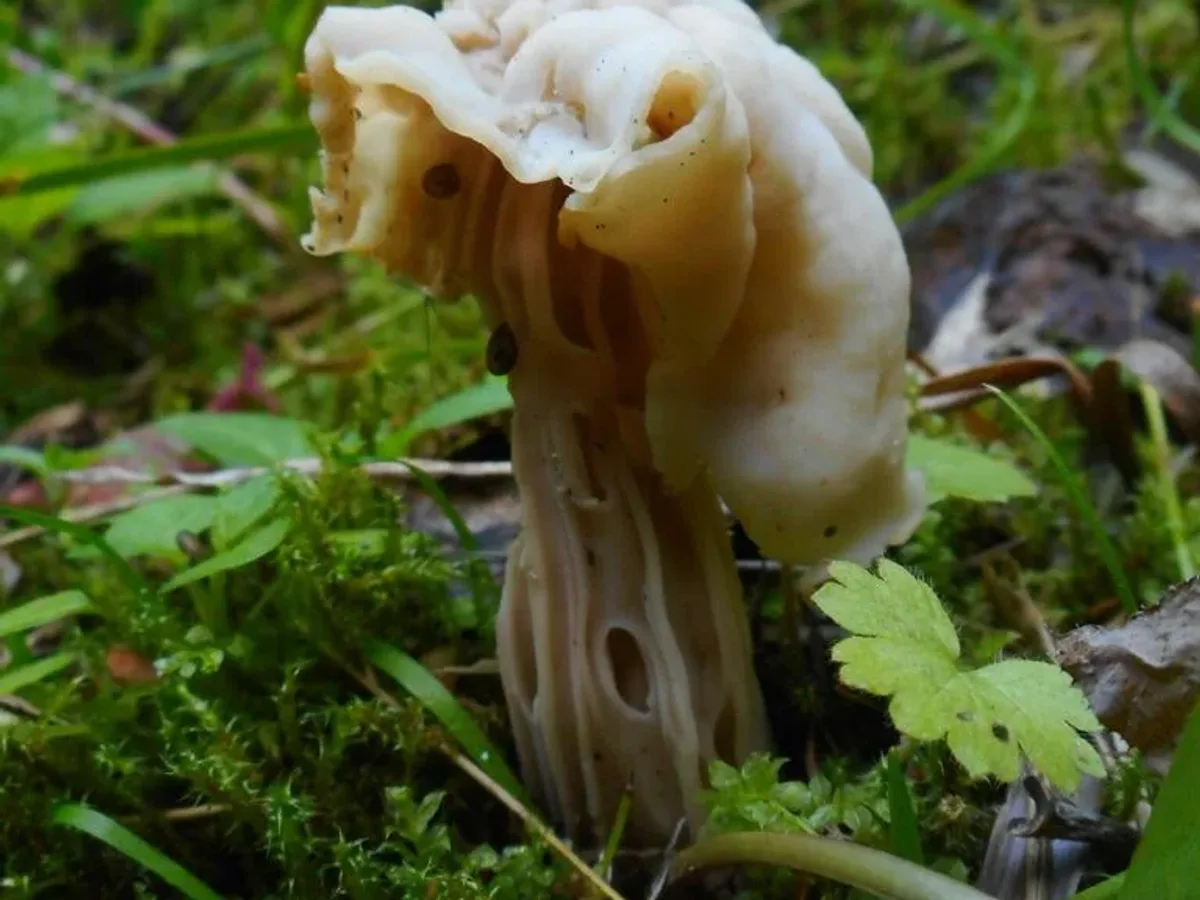 (c) Eugene Popov, some rights reserved (CC BY)
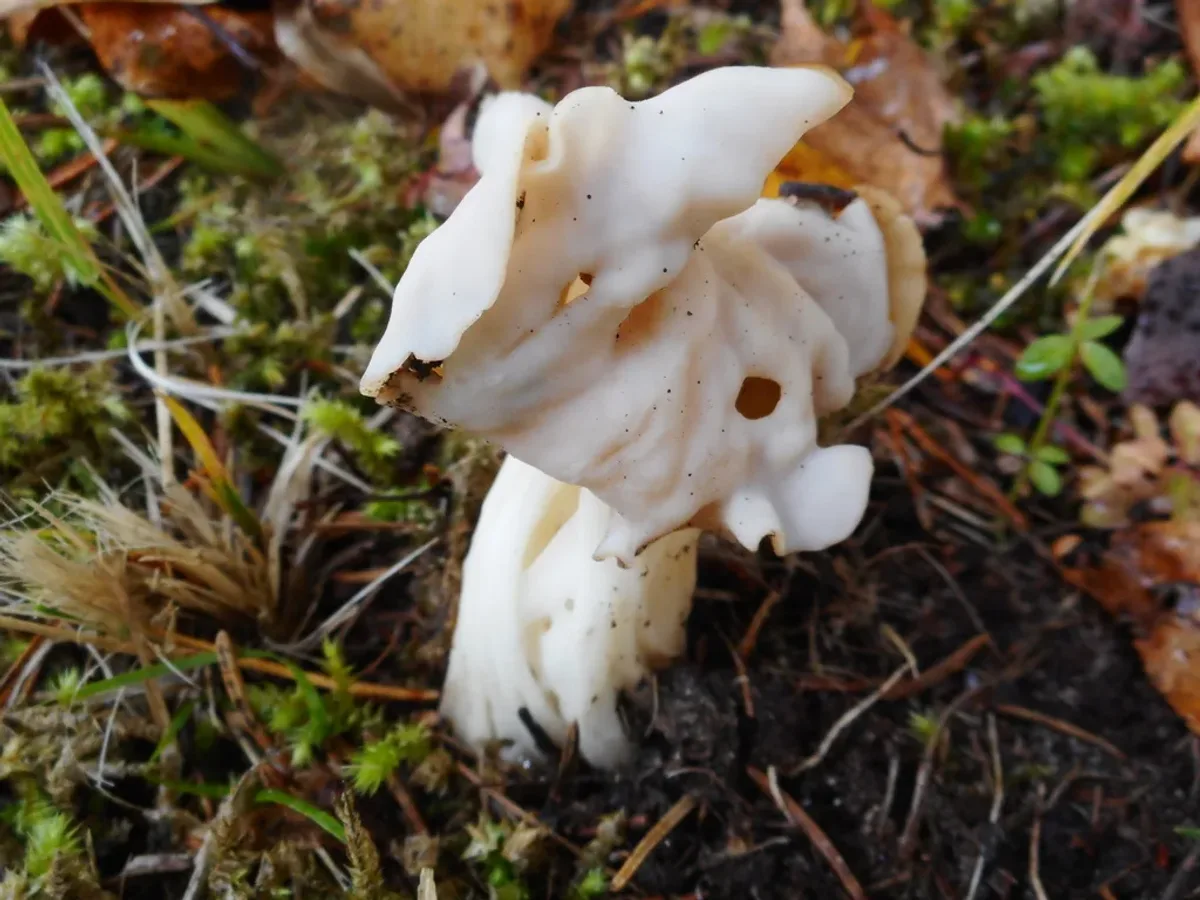 (c) Eugene Popov, some rights reserved (CC BY)
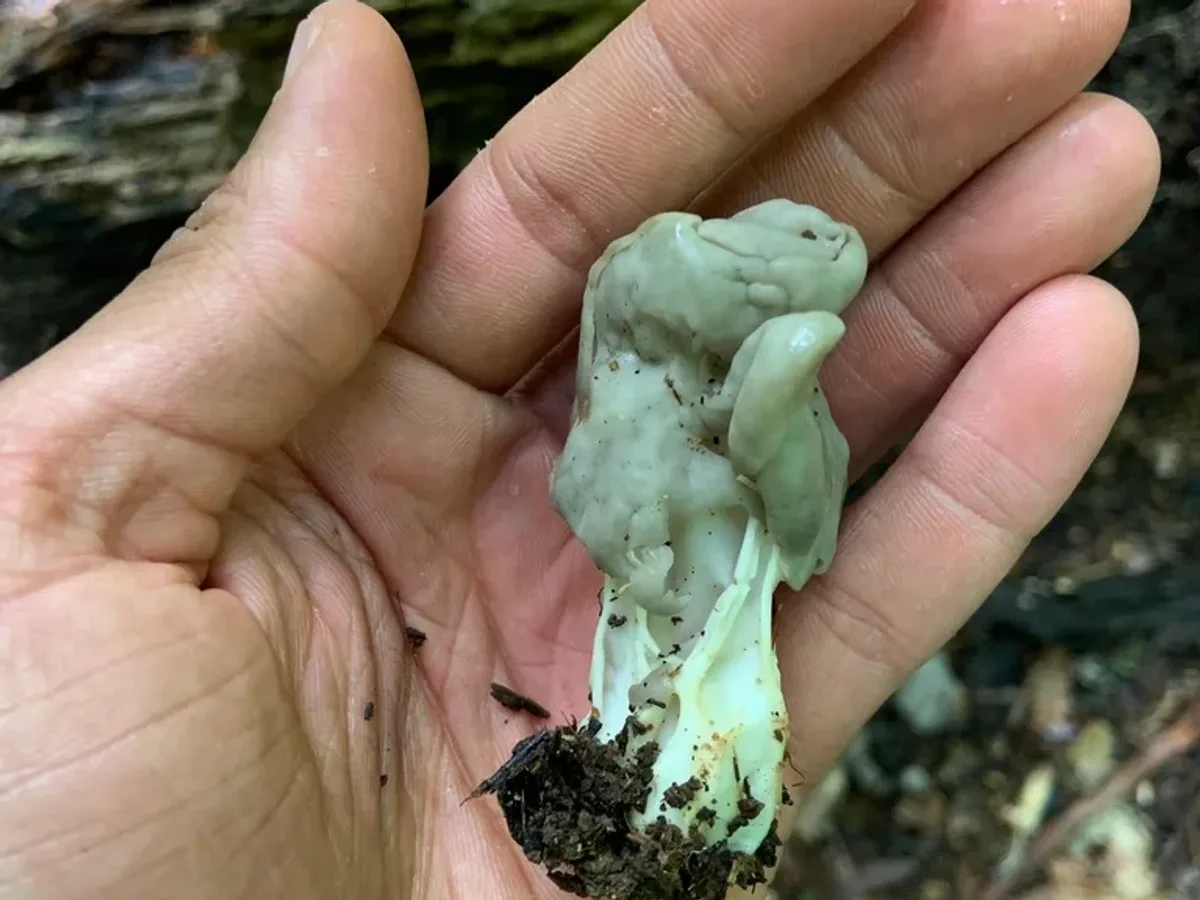 (c) evlyshroom, some rights reserved (CC BY)(c) evlyshroom, some rights reserved (CC BY)(c) Eugene Popov, some rights reserved (CC BY)
Edible only with the right preparation - or safe for some people but not others. Learn the caveats first.
Never eat a mushroom you are not 100% sure of - check the look-alikes below, and always cook wild mushrooms.
How to recognise it
Helvella crispa is immediately recognisable to those who know it: a pale, ghostly-white or cream-coloured mushroom with a deeply convoluted, saddle-like cap and a strikingly ribbed, hollow-chambered stipe that resembles a miniature architectural column more than a conventional mushroom stem.
Cap
The cap consists of two to three broad, irregular lobes that fold and drape downward in a crisped, undulating fashion. The Latin name 'crispa' means 'curled' or 'crisped', and the English name 'White Saddle' captures both the colour and the riding-saddle shape of the cap outline.
Both sides of the cap lobes are functional fertile surface on the outer (upper-facing) side and sterile on the underside, though the whole cap curls and inverts so much that distinguishing 'top' from 'bottom' can be difficult on mature specimens.
The pale cream-white colouration is the single most useful field character: no part of a fresh H. crispa specimen should be reddish-brown, grey-brown, or tan - if it is, reconsider the identification.
As specimens age, the cream colour may fade to pale buff or very faint greyish; the cap lobes may collapse or become waterlogged and translucent in heavy rain.
Stem
The stipe is the other defining feature. Unlike any true morel and unlike Gyromitra species, the stipe of H. crispa is not simply smooth or slightly ribbed but is a deeply sculpted, chambered structure of anastomosing ridges enclosing open channels - visible in cross-section as a series of irregular hollow cavities running the stipe's full length, akin to a scaffold or a coral skeleton.
This ribbed stipe is diagnostic for Helvella within the confusable genera.
There is no ring, no volva, no gills - only the distinctive cap surface and chambered stipe.
Why it's dangerous
The danger from Helvella crispa is primarily from raw or undercooked consumption, and from confusion with the deadly Gyromitra infula, which occupies the same habitat at the same season.
The autumn fruiting season of H. crispa directly overlaps with G. infula, making seasonal separation - which works for distinguishing G. ambigua or G. esculenta - unreliable here. Colour (pale cream vs. reddish-brown) is the key field separator, but specimens at odd lighting or partial decomposition can be harder to assess.
Cooking vapours during preparation are a secondary hazard.
The variability of gyromitrin content between individual specimens means that no amount of culinary tradition guarantees safe consumption of any given batch.
In East and Southeast Asian markets, H. crispa is occasionally sold dried or fresh as a food mushroom, but incidents of poisoning from inadequately prepared specimens are reported.
Always assume a pale, ribbed-stipe elfin saddle is H. crispa and handle the caution tier accordingly.
Toxin
The primary toxin in Helvella crispa is gyromitrin (N-methyl-N-formylhydrazone), the same pro-toxin found in Gyromitra esculenta and related false morels.
Gyromitrin is hydrolysed by stomach acid to monomethylhydrazine (MMH), which:
- inhibits pyridoxal phosphate (vitamin B6)-dependent enzymes
- disrupts GABA synthesis in the nervous system
- causes direct hepatotoxicity
- induces haemolysis of red blood cells
MMH is also classified as a probable human carcinogen (IARC Group 2B).
In addition to gyromitrin, H. crispa has been reported to contain helvelic acid, a water-soluble haemolytic compound that may contribute to gastrointestinal and haematological symptoms.
The total toxin content per specimen is highly variable and cannot be predicted from appearance alone.
Symptoms
Symptoms of Helvella poisoning typically appear after a delay of 6 to 12 hours, which is characteristic of gyromitrin poisoning and important for diagnosis - the meal is often not immediately suspected as the cause.
Early symptoms (6-12 h) include nausea, severe vomiting, watery diarrhoea, abdominal cramping, headache, dizziness, weakness, and sweating.
In more severe cases or with larger doses, haemolysis may produce dark or reddish urine, jaundice, and anaemia.
Hepatotoxic effects may elevate liver enzymes; in severe poisoning, acute liver or kidney failure can develop. Neurological symptoms including confusion and seizures can occur with high MMH exposure.
Deaths from Helvella poisoning have been reported historically, though modern cases with timely supportive care are rarely fatal.
The delayed onset means patients may not seek care until the critical early window has passed.
Staying safe
Helvella crispa is not safe to eat raw.
The species contains gyromitrin, a thermolabile pro-toxin metabolised to monomethylhydrazine (MMH), along with helvelic acid (a haemolytic compound) and possibly other uncharacterised toxins.
While traditionally listed in some European and Asian field guides as edible after thorough cooking, current scientific and regulatory consensus places it firmly in the caution category. The toxin content varies between individual specimens, seasons, and locations - individual batches have caused poisoning even after parboiling.
The primary danger is twofold:
- 1eating it raw or undercooked (gyromitrin and helvelic acid poisoning)
- 2misidentifying deadly look-alikes - particularly Gyromitra infula - as H. crispa
The European Food Safety Authority (EFSA) and several national food safety authorities advise against consuming Helvella species at all, given the unpredictability of toxin content and the difficulty of complete detoxification.
Persons with liver disease, children, pregnant women, and those with G6PD deficiency face elevated risk.
Never eat raw specimens; never use in salads or uncooked preparations.
Where & when it grows
Habitat
Helvella crispa is a saprotrophic or weakly facultatively mycorrhizal ascomycete of deciduous and mixed woodland, growing from the soil in habitats where organic matter from tree leaf litter accumulates at the surface of mineral soil.
It has a clear preference for richer, neutral to calcareous soils compared with many other Helvella species, which favour more acidic substrates.
Regional settings:
- In Europe it is characteristic of mature beech and ash woodland on chalk and limestone, the woodland path margins and grassy clearings within such woods, and along sheltered banks and ditches.
- In Japan and temperate East Asia it occurs in mixed broadleaf forests at low to mid elevations, often in secondary or disturbed woodland, forest paths, and roadsides with mature tree cover.
- In Korea it is recorded in similar late-summer-to-autumn mixed-forest settings.
The species is not strictly dependent on any particular tree partner and can appear near various broadleaf hosts, which makes pinpointing it as truly mycorrhizal difficult; most current sources treat it as saprotrophic (decomposing buried organic matter and plant debris).
It can tolerate urban settings, appearing in city parks with large mature trees, and is occasionally found in gardens adjacent to mature hedgerows or woodland margins.
When
The main fruiting season is late summer through autumn - broadly August to November in Europe and temperate East Asia - with a clear peak in September and October, when soil temperatures moderate after summer heat and autumn rains restore soil moisture.
This autumn timing distinguishes H. crispa ecologically from the spring-fruiting Gyromitra species (G. esculenta, G. gigas, G. ambigua) with which it might otherwise be confused morphologically.
In warm years a minor early flush is possible in July, particularly in moist, shaded sites.
The species is more frost-sensitive than many autumn fungi, and the season typically ends with the first hard frosts of November.
In montane areas of Japan and Korea the season shifts upward: higher-altitude sites see peak fruiting from August into September, while valley-floor populations persist through October.
How it grows
Fruit bodies appear singly or in small scattered groups of two to six, never in dense compact clusters.
They push up from the humus layer over several days, with the ribbed stipe fully formed early and the cap lobes unfurling and crisping as the ascospores mature. Full development from primordium to mature fruiting body takes approximately seven to twelve days under typical autumn conditions.
Specimens deteriorate relatively quickly - within one to two weeks of reaching maturity they begin to collapse, becoming waterlogged and papery, and the pale cap lobes lose their crisp three-dimensional form.
Sites that produce the species in one autumn tend to do so in subsequent years provided habitat conditions remain stable, suggesting a persistent mycelial network in the soil.
Fruiting conditions
Autumn fruiting triggered by a combination of cooling soil temperatures and adequate moisture from autumn rainfall. Fruiting bodies typically appear one to two weeks after soaking autumn rains once soil temperatures have dropped from summer peaks to the 8-14 °C range. Unlike spring Gyromitra species, H. crispa does not rely on snowmelt; it requires true autumn rain events. The species is sensitive to early frost and the season terminates with the first hard freezes.
Look-alikes
Several dangerous species can be confused with Helvella crispa. The most important are the saddle-shaped and lobed Gyromitra species.
- Gyromitra infula (the Hooded False Morel): it has a similar two-lobed, saddle-shaped cap but is distinctly reddish-brown to chestnut-brown in colour, with a cap surface that is ochre to liver-brown rather than cream-white, and it fruits in late summer and autumn - overlapping precisely with H. crispa's season. It is a deadly-toxic species containing gyromitrin, and it is the single most dangerous confusion species for H. crispa in the field; the colour difference (pale cream vs. reddish-brown) is the key separator.
- Gyromitra ambigua: another saddle-shaped spring-fruiting species with a purplish-brown cap - it is less likely to be confused with H. crispa because it typically fruits in spring rather than autumn, but late-season G. ambigua or early H. crispa at altitude could overlap.
Other Helvella species, particularly Helvella lacunosa (the Slate-Grey Elfin Saddle) and Helvella elastica (the Elastic Elfin Saddle), are confusable:
- H. lacunosa has a similar deeply ribbed stipe but a dark grey to grey-black cap.
- H. elastica has a slender smooth (not ribbed) stipe and a small saddle-shaped pale brown cap.
Neither H. lacunosa nor H. elastica is considered safe to eat raw, and both share the genus's cautionary status.
Other species to distinguish:
- True morels (Morchella spp.) are distinguished by their clearly honeycombed, pitted cap surface and completely hollow interior; they do not share the lobed/saddle form.
- A pale Verpa bohemica could cause momentary confusion but has a thimble-shaped cap attached only at the stipe apex.
G. infula has a saddle-shaped, two-lobed cap like H. crispa but is distinctly reddish-brown to chestnut-brown - never cream-white. Its stipe is also paler and more cylindrical, lacking the deep ribbing and chambering of H. crispa's stipe. Seasons overlap (late summer to autumn), making colour the critical separator in the field. G. infula is deadly and contains gyromitrin; it is the single most important confusion species for H. crispa.
Also saddle-shaped but with a distinctly violaceous-brown or purplish-chestnut cap - never pale cream. Fruits primarily in spring rather than autumn, which is usually sufficient to separate it from H. crispa, but altitude and microclimate can create seasonal overlaps. Also deadly.
True morels have a clearly honeycombed, pitted and ridged cap surface - never lobed, saddle-shaped or crisped. The interior is completely hollow from cap to stipe base with no chambers. Morchella is edible when thoroughly cooked, but the cap surface architecture is immediately distinct from any Helvella.
Smaller and more slender than H. crispa; cap is pale greyish-brown to tan (not cream-white) and saddle-shaped, but the stipe is smooth and slender - NOT deeply ribbed or chambered. The unribbed stipe is the decisive distinguishing character. Also in the caution category.
Very similar structure including the deeply ribbed and chambered stipe, but the cap is dark grey to blackish-grey - a completely different colour from H. crispa's pale cream. H. lacunosa shares the caution tier; it is not considered deadly but contains similar toxins and must not be eaten raw.
A reference guide - never an edibility guarantee. When in doubt, leave it out.