Chrome-footed bolete
Harrya chromapessyn. Boletus chromapes, Tylopilus chromapes, Leccinum chromapes, Krombholzia chromapes
 (c) Annie Weissman, some rights reserved (CC BY)
 (c) Annie Weissman, some rights reserved (CC BY)
 (c) Annie Weissman, some rights reserved (CC BY)
 (c) Annie Weissman, some rights reserved (CC BY)
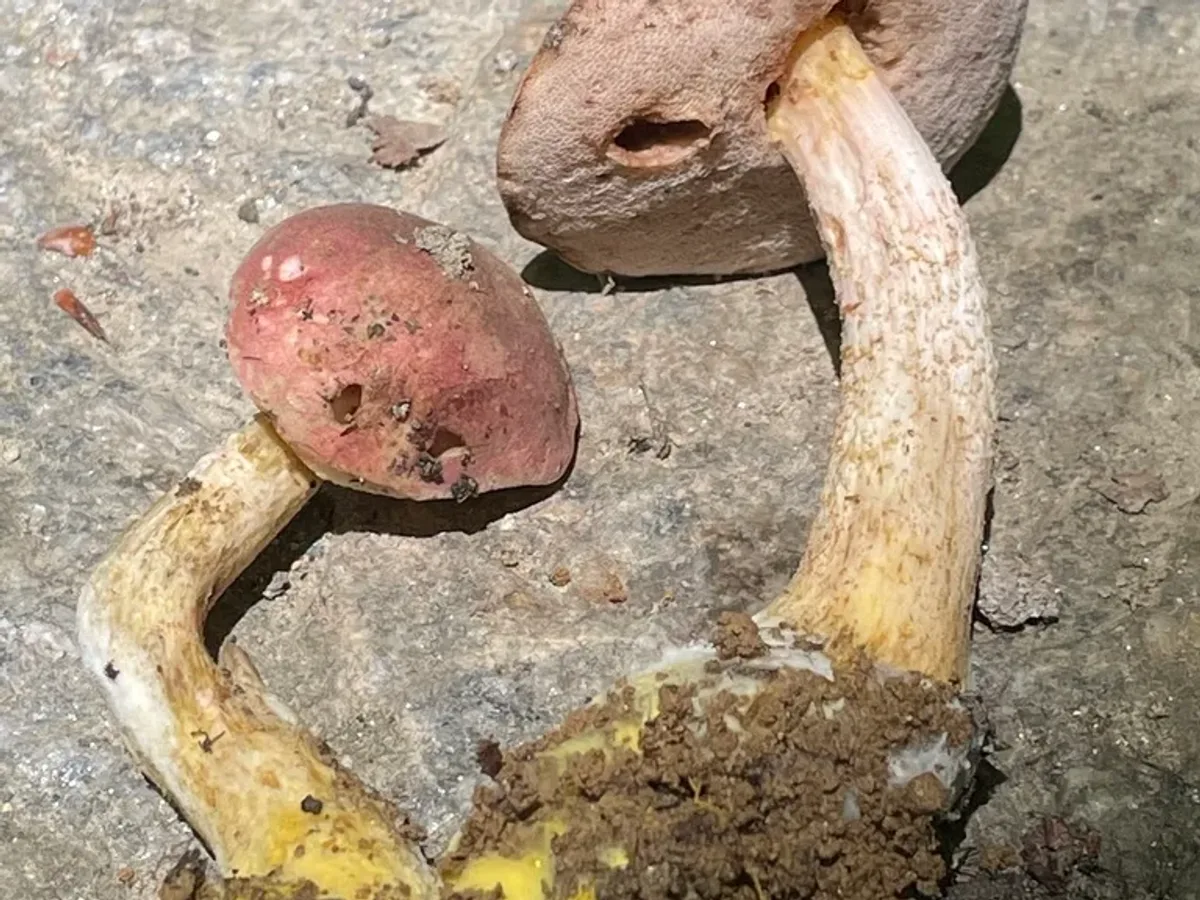 (c) Annie Weissman, some rights reserved (CC BY)
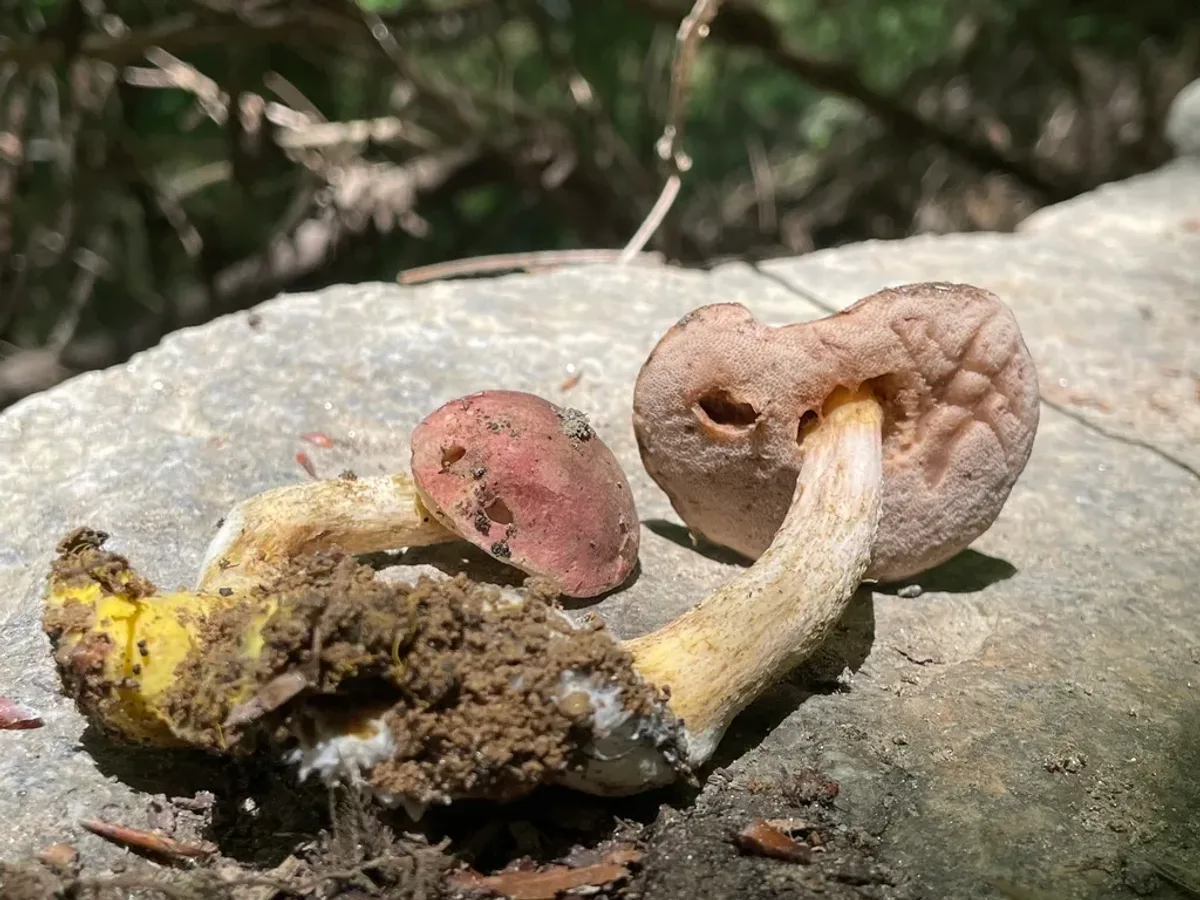 (c) Annie Weissman, some rights reserved (CC BY)(c) Annie Weissman, some rights reserved (CC BY)(c) Annie Weissman, some rights reserved (CC BY)
Good to eat, once you have identified it with certainty and cooked it through.
How to recognise it
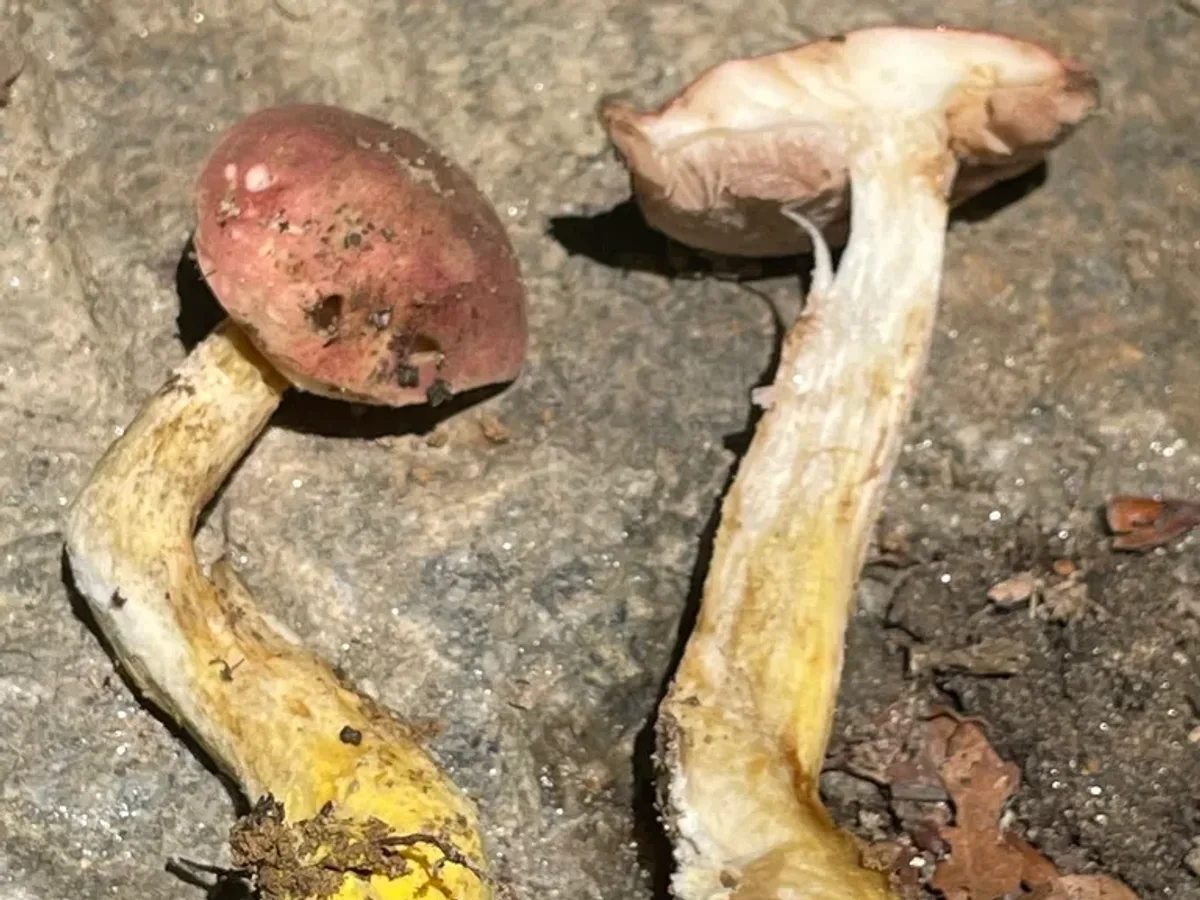
Harrya chromapes is a bolete you recognize immediately once you have seen it: the chrome-yellow stipe base is a colour that does not appear on any other bolete sharing its habitat and is as close to a field-safe identifier as mushroom foraging offers.
Cap
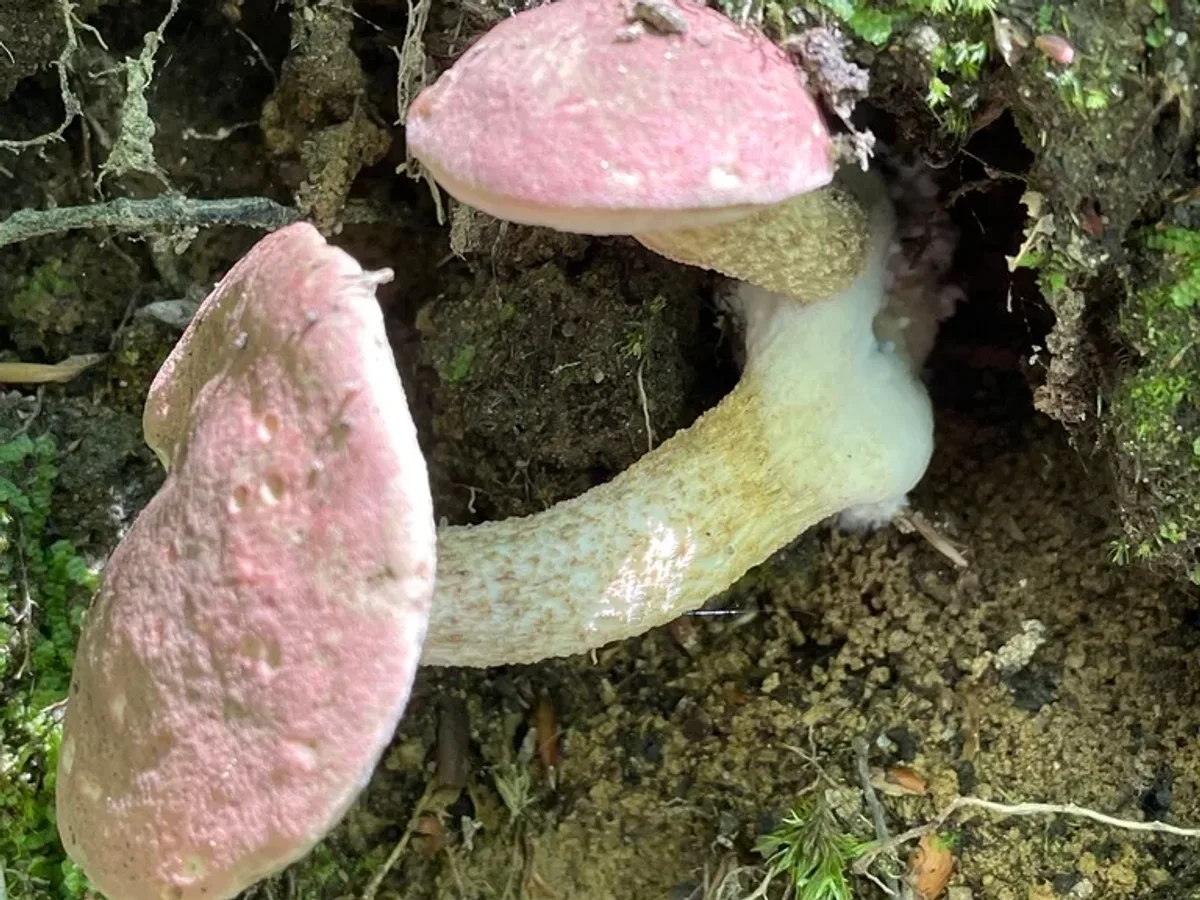
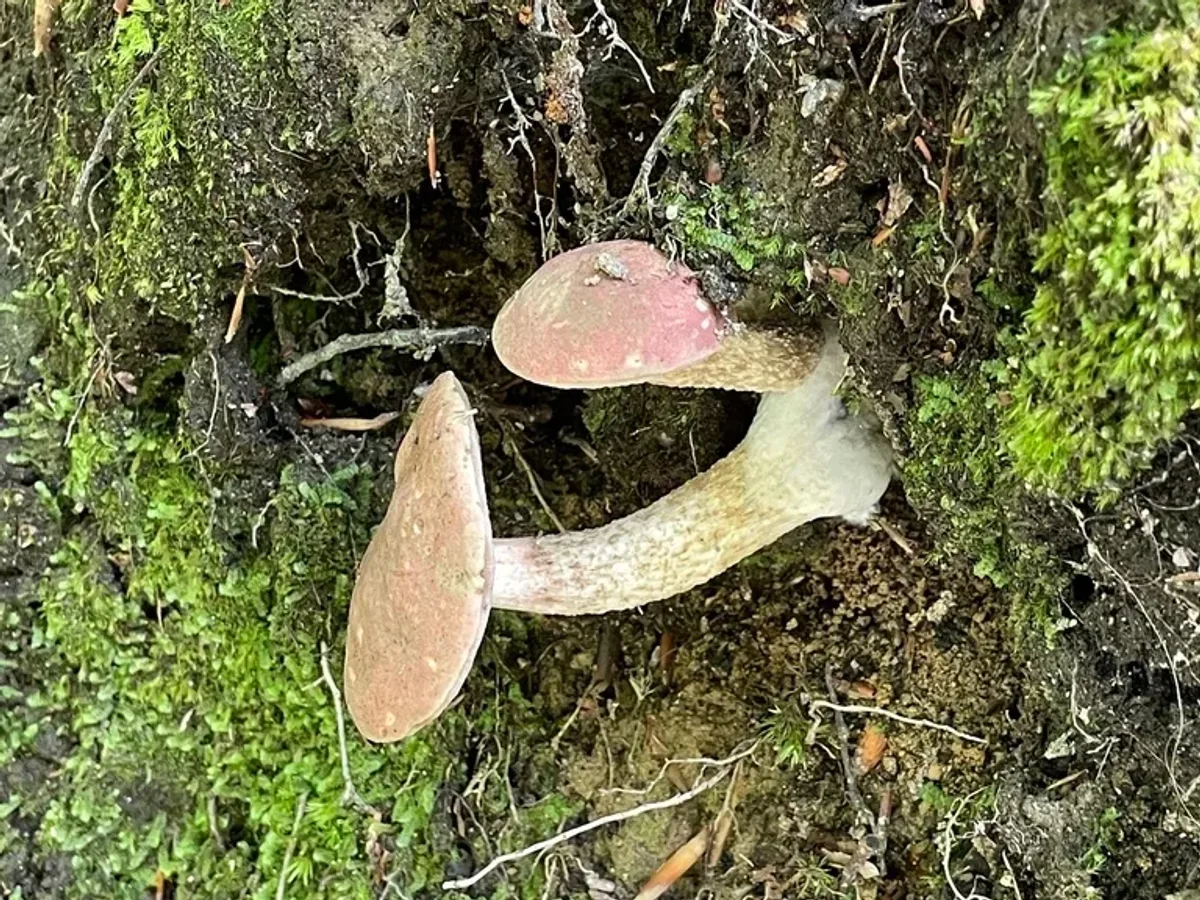
The cap is modest in size and subdued in colour - a soft pinkish-tan to rose-buff or pale flesh-pink, gently domed when young and broadening to a flat cushion shape, with a dry, slightly velvety surface that is never slimy.
Gills / Pores
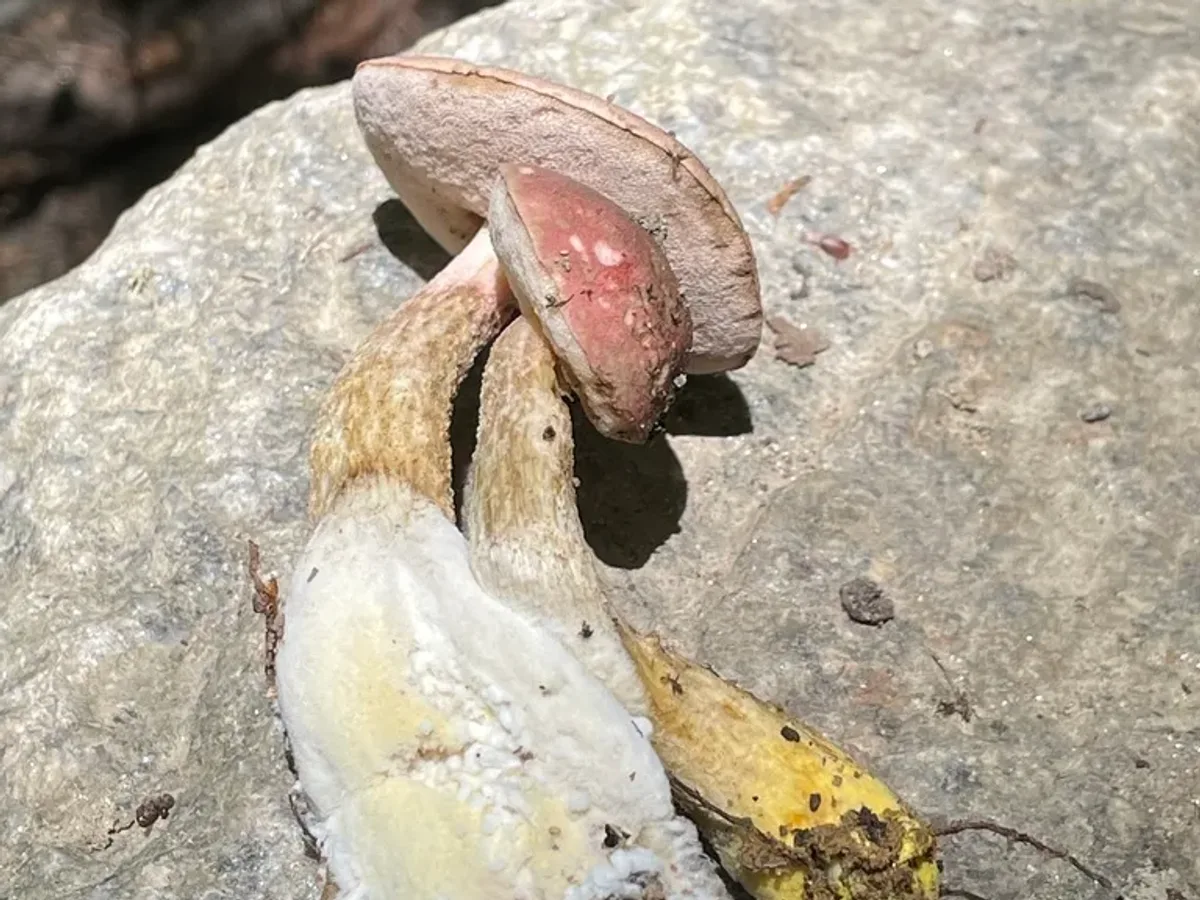
The underside of the cap carries not gills but a dense sponge of tubes that open as small round pores; unlike most choice boletes those pores are distinctly pink to rose-flesh in colour, not white and not yellow, and they do not change colour when pressed.
Stem
The stipe is the showpiece: look at the base and you find a vivid patch of lemon-yellow or chrome-yellow that intensifies in bright specimens and is present even in buttons.
The stipe surface is dotted with small scabers - tiny tufts of darker tissue that are a hallmark of the broader Leccinum/Harrya group - pale pinkish above and darkening to rufous-brown or almost black on the yellow base.
Flesh
The flesh is firm and white, turning slightly pinkish-tan when sliced, but never blue, never green.
That chrome-yellow stipe base and those pink pores together form a combination shared by no dangerous species in the same range.
Where & when it grows
Habitat
This is a deciduous and mixed-forest bolete with a wide distribution spanning eastern North America and the forests of East and Southeast Asia, reflecting an ancient biogeographic connection between these temperate and subtropical regions.
In North America, it is most at home in the oak and oak-mixed forest of the eastern United States and southeastern Canada - from the Appalachians northward into New England and the Great Lakes states, and southward along the Piedmont. It favours well-drained, moderately acidic mineral soils under mature red, white, or black oaks, but also turns up in mixed woods with eastern white pine and hemlock.
In East and Southeast Asia, it inhabits the warm-temperate and subtropical montane forests of Japan, Korea, and China, growing under Quercus, Castanopsis, and related Fagaceous hosts.
In both regions the habitat fingerprint is the same: shaded forest floor with deep leaf litter, acidic humus-rich soil, and the presence of a suitable ectomycorrhizal partner. It rarely appears in disturbed or heavily managed forest but persists well in secondary growth with mature trees.
When
The fruiting season follows warmth and moisture.
In eastern North America, look from late June onward once midsummer heat has set in and soils are well moistened; the peak is July and August, often coinciding with the hottest and most humid period of the year. A secondary flush after Labor Day rains in September is common in good years, and fruit bodies occasionally persist into October.
In East and Southeast Asia, the season runs with the summer monsoon - from June through October, peaking July through early September when monsoon rains keep soils warm and wet.
The pattern in both regions is consistent: warm soils above roughly 16 °C, combined with sustained rainfall, trigger a flush that pushes up fruit bodies 7-14 days after the rain. Dry mid-summer periods suppress fruiting; a thunderstorm followed by continued warm, humid weather is the classic forecast to watch for.
How it grows
Fruit bodies arise singly or in scattered loose groups of 2-5, not in dense clusters.
Buttons emerge as tight pale spheres, already showing the first blush of yellow at the base, and expand over 3-6 days under warm, humid conditions. The stipe base yellows more intensely as the fruit body matures.
Established mycelial networks under large oaks and other hosts fruit reliably from the same spots over many years; experienced foragers return to productive trees season after season.
The fruit bodies are moderately durable and may persist for 5-8 days before deteriorating, though warm-season insects invade quickly - inspect the cut stipe for larvae.
Fruiting conditions
Requires warm soils (roughly 15-26 °C) and sustained summer rainfall. In eastern North America, flushes follow midsummer thunderstorms and warm humid conditions; in East and Southeast Asia, fruiting tracks the summer monsoon. Fruit bodies typically appear 7-14 days after soaking rain when soils are already warm.
Look-alikes
Harrya chromapes is distinctive enough that serious confusion with dangerous species is unlikely once the chrome-yellow base is noted, but several species warrant attention.
Tylopilus felleus (bitter bolete) shares broadly similar coloration - brownish-pink cap, pinkish pores, stout stipe - but its pore surface turns dingy pink and its flesh is intensely bitter even in a tiny raw taste; it also lacks any yellow coloration on the stipe. Not toxic but can ruin a meal.
Various Leccinum species (scaber stalks) share the scabrous stipe pattern and can have somewhat similar cap colours; however, Leccinum species typically have white pores that bruise slowly grey or blue-grey (not pink), and lack the chrome-yellow stipe base. Some Leccinum species can cause mild GI upset in certain individuals when undercooked or consumed in large quantities.
Neoboletus erythropus and Rubroboletus species in the region have red or orange pores and blue intensely when cut - fundamentally different from Harrya chromapes and should never be eaten.
Any bolete in the same habitat showing red or orange pores, or flesh that stains blue on cutting, should be left alone regardless of other features.
Cap brownish to brown (lacking the pinkish-rose tone of H. chromapes), pores white becoming dirty pink with age (similar but with a darker, more netted stipe), stipe with dark brown reticulation on a pale ground rather than scabers, and no yellow at the base. Most reliably identified by tasting a tiny raw fragment: the flesh of T. felleus is intensely, unforgettably bitter. Not toxic, but even one piece can ruin an entire dish.
Closely related alpine species with similar pink pores and scabrous stipe but lacking the vivid chrome-yellow stipe base. Distinguished by habitat (higher elevations, subarctic zones) and absence of the defining yellow base colour. Edibility similar. Confusion is harmless from a safety standpoint.
Cap brownish-olivaceous to dark brown; pores orange-red to blood-red; flesh turns intensely blue within seconds of cutting. These species cause severe gastrointestinal poisoning requiring hospital treatment. H. chromapes has pink (never red) pores and white non-blueing flesh. Any bolete with red or orange pores, or flesh that blues on cutting, must not be eaten regardless of other apparent similarities.
Share the scabrous stipe pattern but have white-to-cream pores that bruise slowly grey, grey-green, or blue-grey when cut (not pink), and lack any yellow on the stipe base. Cap colours are typically brown, orange-brown, or grey-brown rather than pinkish. Some Leccinum species can cause GI upset especially when undercooked; all should be thoroughly cooked.
In the kitchen
Picking & cleaning
Cut the stipe near the base with a knife; the chrome-yellow base is part of the specimen and helps with in-basket identification.
Confirm the diagnostic features before pocketing:
- pink pores (not white, not yellow, not red)
- a vivid yellow lower stipe
- no blueing anywhere when flesh is cut
Young to mid-aged specimens are best: flesh still white and firm, pores tight.
In warm summer conditions, larvae move through the stipe rapidly - probe the stipe lengthwise and discard any specimen where more than a quarter of the flesh is tunneled.
Carry in an open basket; the firm flesh is robust but bruises if crushed. Trim the base clean and inspect before cooking.
Cooking
Harrya chromapes is edible and palatable, though it is generally rated as a moderate rather than exceptional edible - its flavour is mild and pleasant, and the texture is firm and meaty in young specimens.
The pink pore layer can become soft and spongy in older specimens and may be removed for a cleaner texture. The vivid yellow base flesh is softer and sometimes bitter in older fruit bodies and is best trimmed away.
Sauté slices in butter with garlic and herbs for a straightforward preparation. It holds up reasonably well in soups, stews, and rice dishes.
Drying concentrates the flavour considerably and is a good use for larger harvests: slice 5-8 mm thick and dry at 40-50 °C; the dried mushroom has a more pronounced umami character than the fresh one. The dried product rehydrates well and can substitute for other dried boletes in stocks and sauces.
Always cook thoroughly.
Good to know
Harrya chromapes is a legitimate edible with a long record of consumption in both North America and East Asia and no documented serious toxicity. Its most important safety asset is its recognizability: the chrome-yellow stipe base is unmistakable and appears on no dangerous lookalike.
That said, as with all wild boletes, always cook thoroughly - never eat raw. Raw or undercooked boletes as a group frequently cause gastrointestinal upset even for choice species, and Harrya chromapes is no exception.
Some individuals report mild GI discomfort from wild boletes generally; start with a small portion on first acquaintance.
The most important safety habit when collecting any bolete is to apply the two-check rule - confirm that:
- 1pores are pink (not red or orange); AND
- 2no part of the flesh turns blue when cut or pressed.
Any bolete failing either check must not be eaten.
As with all wild mushrooms, collect only in areas free from pesticide or industrial contamination.
A reference guide - never an edibility guarantee. When in doubt, leave it out.