Bluing bolete
Gyroporus cyanescenssyn. Boletus cyanescens Bull., Suillus cyanescens (Bull.) Kuntze, Leccinum cyanescens (Bull.) Gray, Gyroporus cyanescens var. lacteus (Fr.) Quél.
 Uilleam Uir (CC0)
 Uilleam Uir (CC0)
 © Victoria M. (CC BY)
 © Victoria M. (CC BY)
 © Victoria M. (CC BY)
 © Victoria M. (CC BY)
 © Victoria M. (CC BY)
 © Victoria M. (CC BY)Uilleam Uir (CC0)Uilleam Uir (CC0)
Edible only with the right preparation - or safe for some people but not others. Learn the caveats first.
Never eat a mushroom you are not 100% sure of - check the look-alikes below, and always cook wild mushrooms.
How to recognise it
No other bolete in southeastern Australian forest quite matches Gyroporus cyanescens for sheer visual drama.
Cap
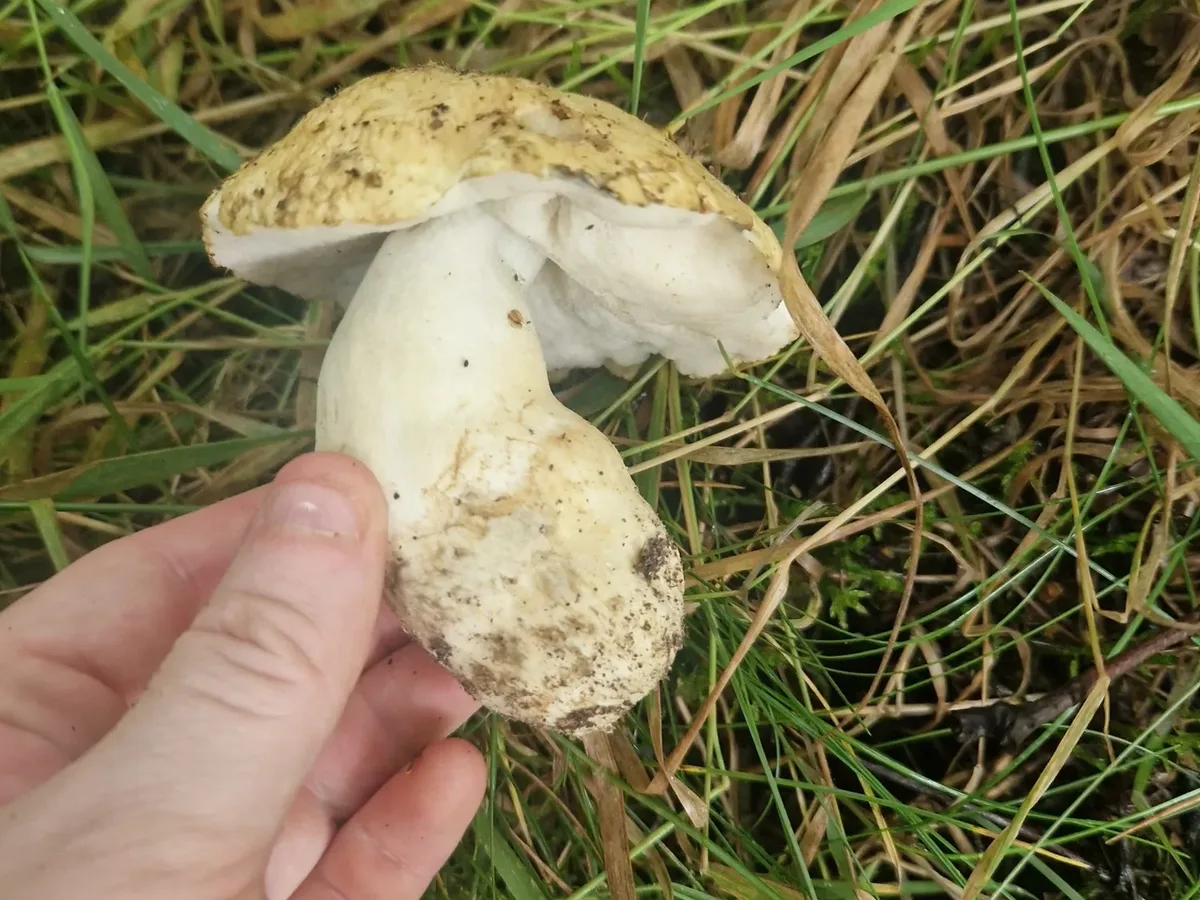
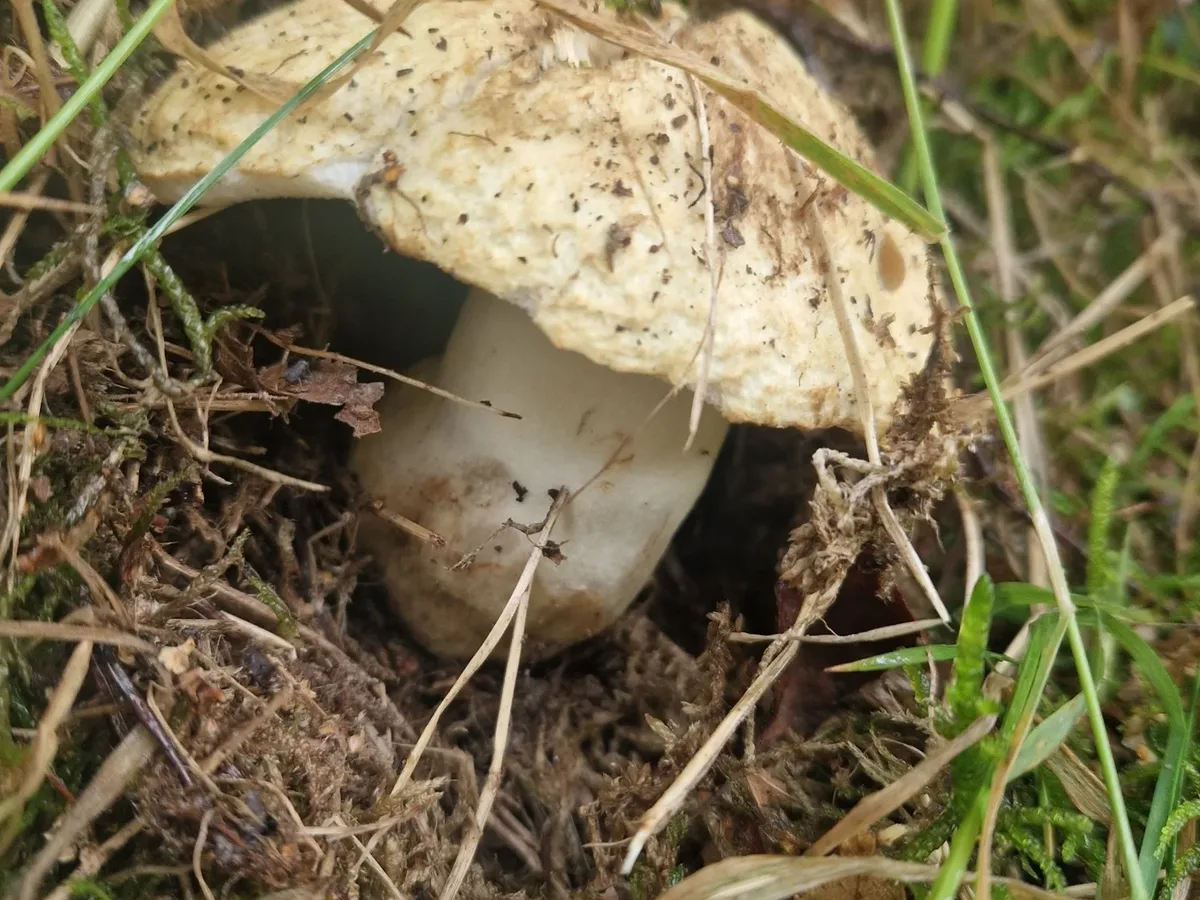
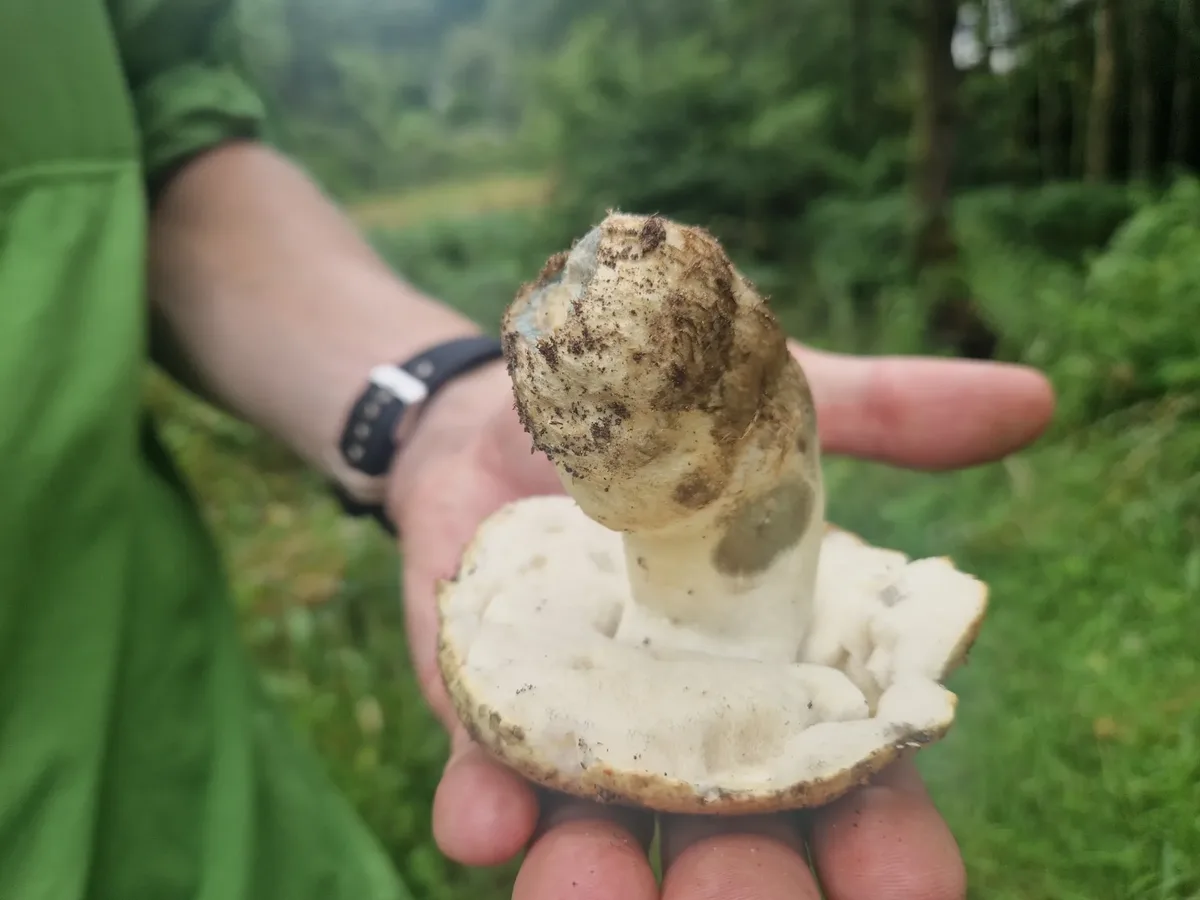
The cap begins as a neat convex dome and flattens gradually with maturity; its surface is dry, finely felty or granular-scurfy, and coloured in strikingly pale tones - straw-yellow, chalky buff, or pale ochre - which make the fruitbody look almost bleached against the forest floor. The margin stays slightly incurved in youth.
Gills / Pores
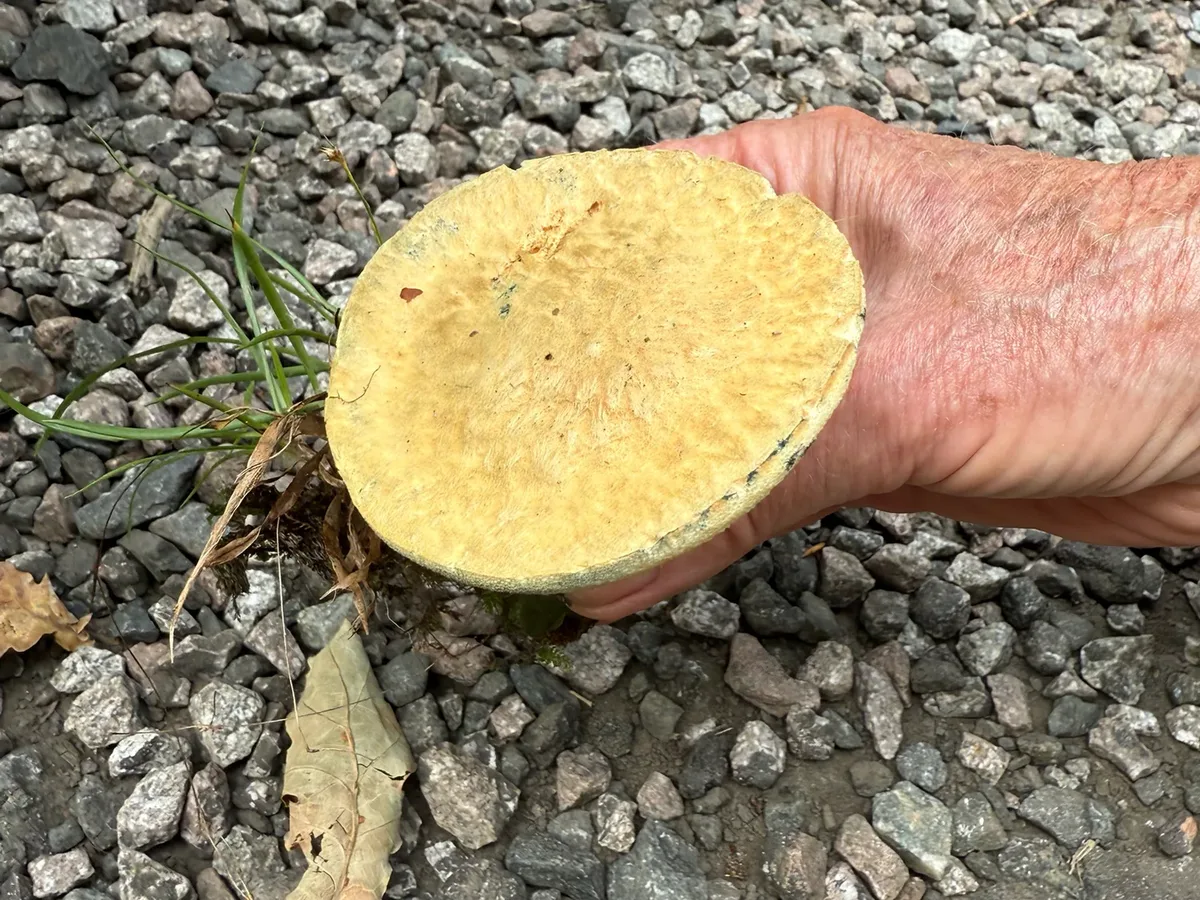
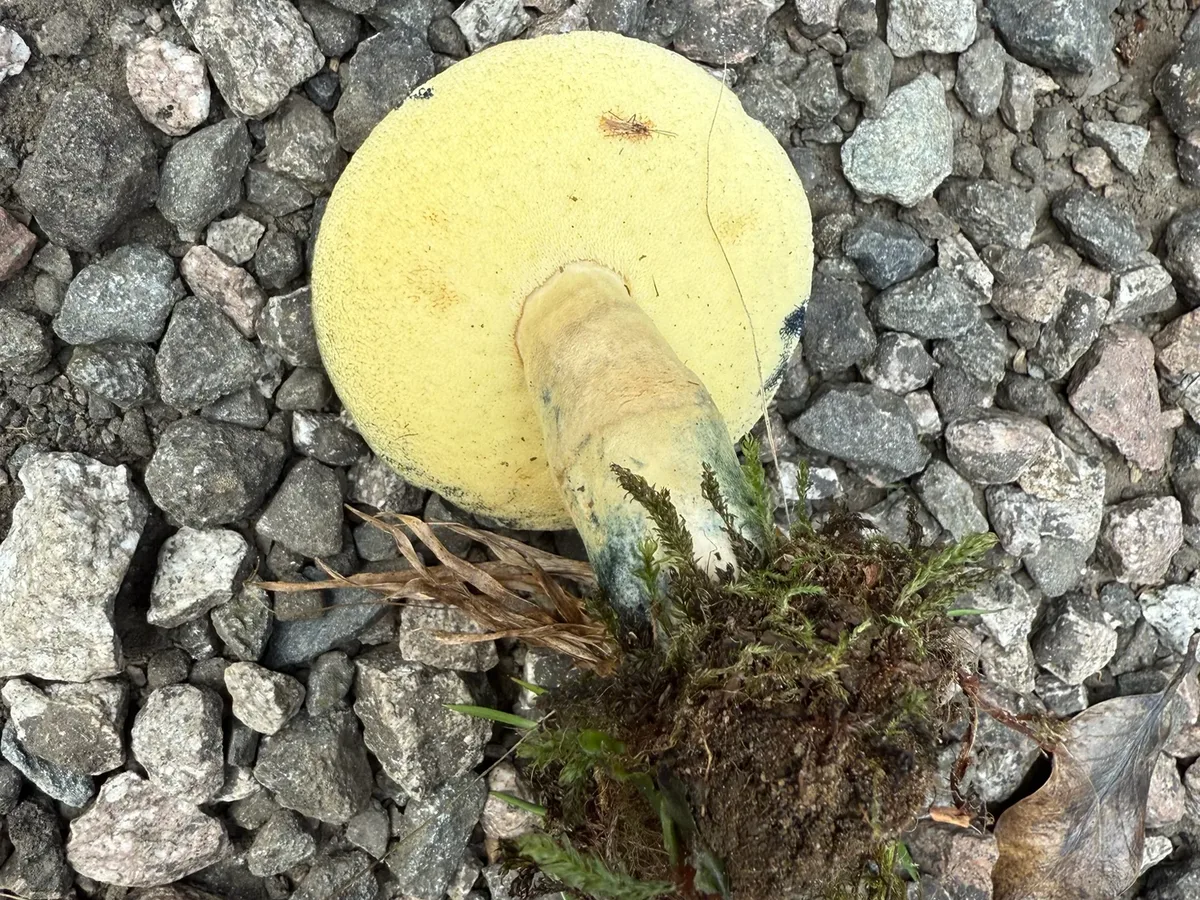
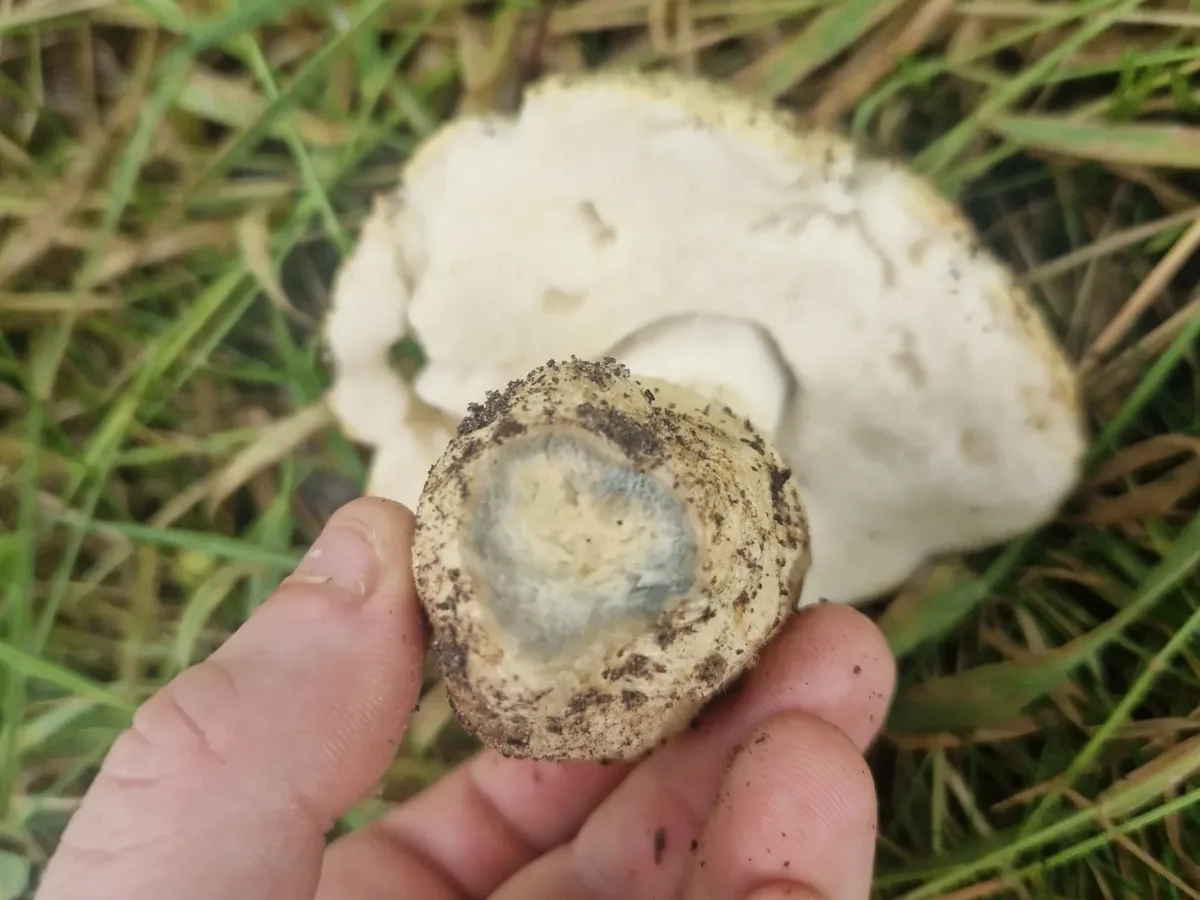
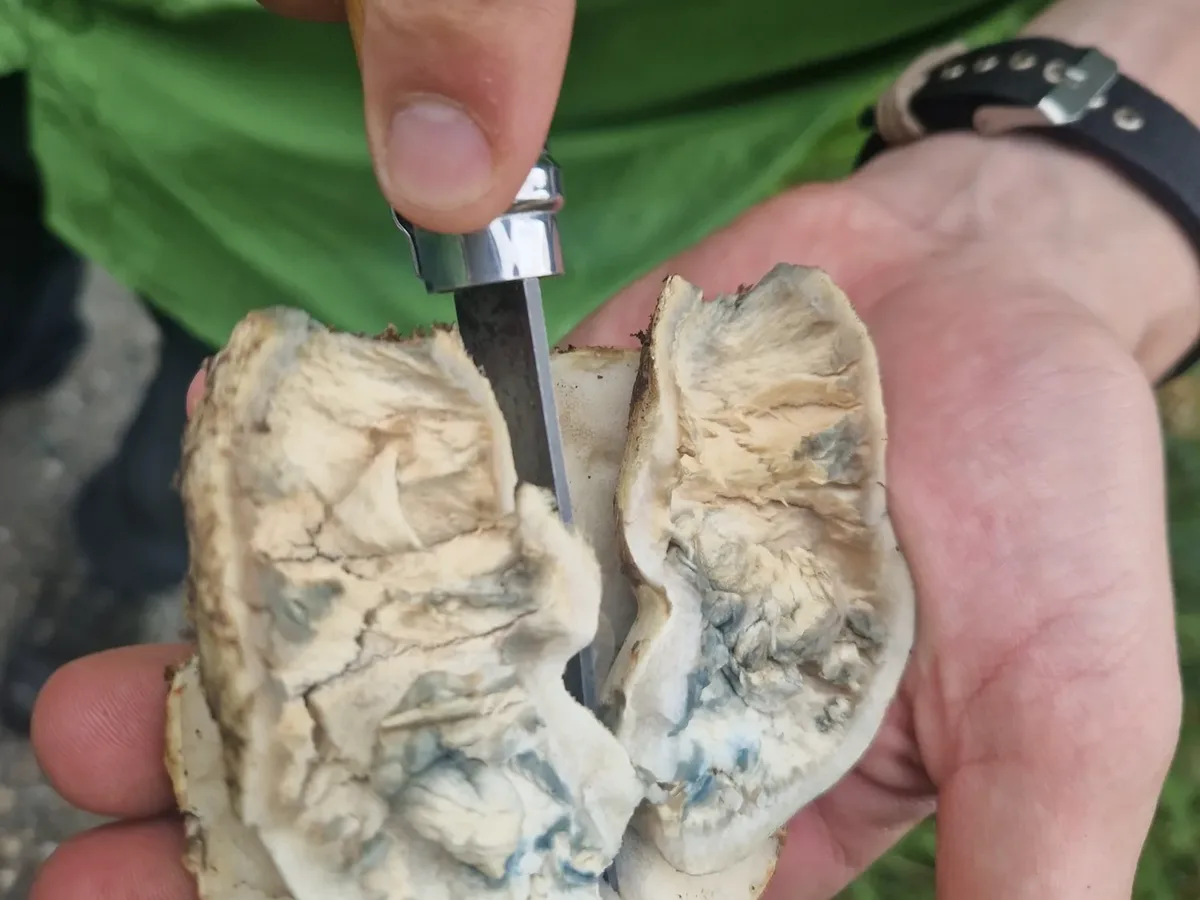
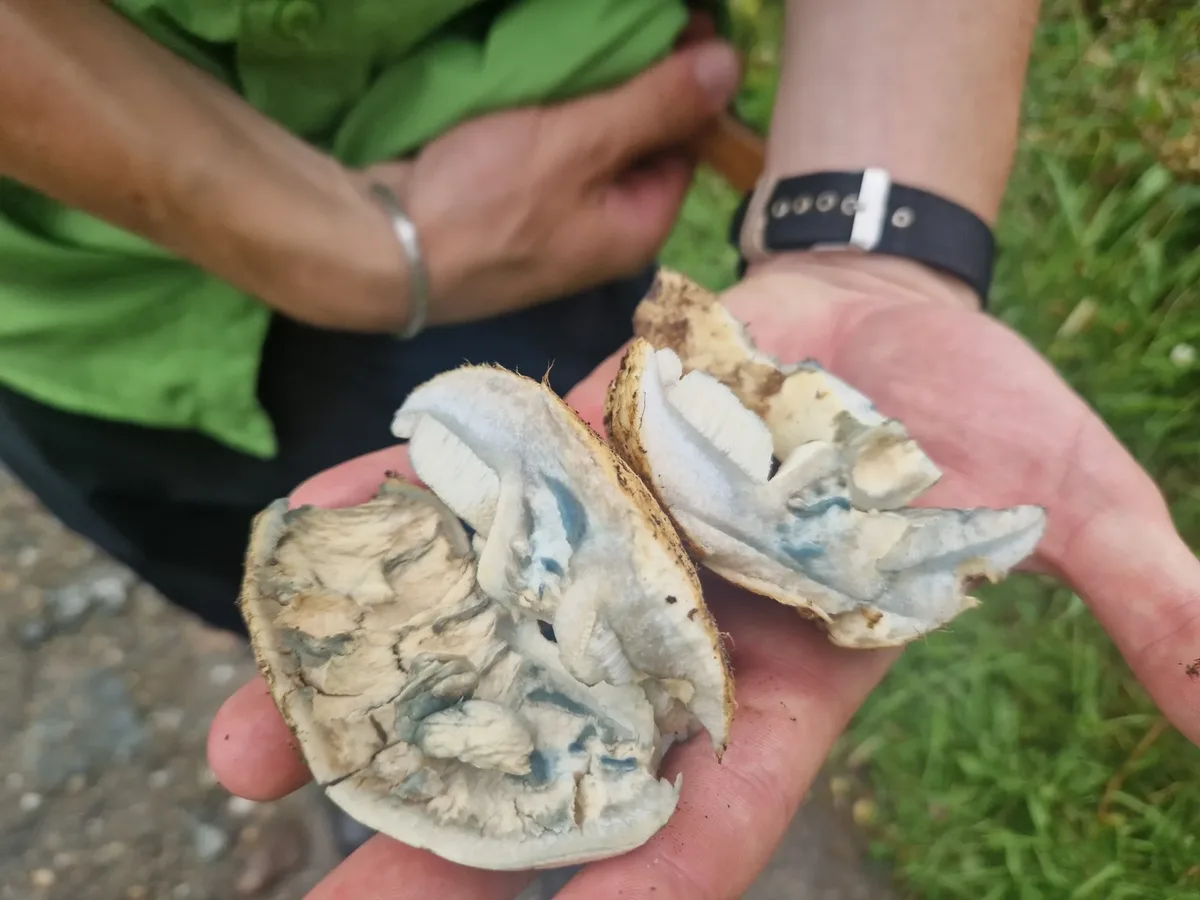
The pore surface beneath starts pure white to cream, neat and clean-looking. Then you touch it or cut through it, and within two to five seconds the white flesh and white pores transform to a vivid, deep indigo-blue that darkens further toward near-black.
This is among the most rapid and intense blueing reactions in the entire bolete family, driven by the enzymatic oxidation of variegatic acid and related phenolic compounds in the flesh. No photograph fully captures how complete and immediate this colour change is; in the field it can genuinely stop a first-time observer in their tracks.
Stem
The stipe matches the cap in colour - whitish to pale straw-yellow - and is the second key feature of the genus: snap or break it cleanly across and the interior reveals a network of white-walled chambers and air pockets. This chambered, hollow stipe is the structural hallmark of Gyroporus, shared with only a handful of close relatives. The stipe surface also stains blue when broken.
Flesh
The flesh throughout is firm and white when young, becoming somewhat brittle and powdery in age - a texture characteristic of the genus.
Spore print pale yellow. Spores ellipsoidal, 8-11 × 4-6 µm, smooth.
Where & when it grows
Habitat
Gyroporus cyanescens is an ectomycorrhizal species, weaving its mycelium into the root tips of living trees in a mutual exchange that trades fungal minerals for tree photosynthates - an ancient partnership visible only through the annual appearance of fruiting bodies.
In its native Northern Hemisphere range it associates primarily with deciduous trees:
- oaks and beeches on warm sandy slopes
- birches on heathland
- chestnuts in Mediterranean-influenced lowland forest
It is consistent in its preference for light, acidic, freely draining soils - the kind of sandy or gravelly substrate that warms quickly in summer and holds moisture only briefly after rain.
In Australia and New Zealand, this species occurs in two broad habitat contexts:
- 1Introduced-pine plantation and plantation-margin forest, where Pinus radiata (radiata pine) has brought Northern Hemisphere ectomycorrhizal fungi with it over decades of forestry; Gyroporus cyanescens has been recorded under such pines in southeastern mainland Australia and Tasmania.
- 2Native eucalypt and Nothofagus forest in the cooler, wetter southeastern ranges, where sufficient microclimatic conditions and presumably earlier introductions or independent presence allow it to persist.
Look for it on well-drained, slightly acidic forest soils, at the edges of tracks and rides where light reaches the ground - the open microhabitat that characterises this bolete across all its ranges.
When
In Australia and New Zealand, the season falls in austral autumn - the fungal autumn of the Southern Hemisphere - broadly from March through June. April and May represent the productive heart of the season as temperatures drop from summer highs and autumn rain begins to rehydrate dry soils.
The precise timing at any site is driven by two factors acting together:
- soil temperature cooling below approximately 16 °C
- adequate rainfall (at least 20-25 mm) in the preceding 10-14 days
In Tasmania and the Victorian highlands, where summer is shorter and soils cool earlier, the season may begin in late February or March; in warmer areas of New South Wales, peak fruiting drifts toward May and June. By July, winter temperatures have generally pushed soil temperatures below the species' minimum threshold and fruiting ceases.
In the Northern Hemisphere, where this species is native and most thoroughly documented, the season runs from late spring through autumn - roughly June through October - peaking in the warm, humid weeks of late summer and early autumn (August-September in temperate Europe and northeastern North America).
The key trigger there is warm summer rain after a dry period, producing a flush of boletes about one to two weeks after sufficient precipitation. The Southern Hemisphere season is directly analogous but offset by six months.
How it grows
Solitary or in scattered small groups; not known to form dense tufts or fairy rings. As an ectomycorrhizal species tied to particular host trees, it returns to the same sites year after year provided the host tree and soil conditions remain stable.
It is not a particularly abundant species even in good habitat; finding three to five quality specimens in an outing is a rewarding find.
Fruiting bodies push up from the soil with the cap tightly closed and expand over three to six days to full size.
Prime specimens deteriorate relatively quickly, especially in warm or dry conditions, and insect larvae find them reliably, so young-to-mid stage specimens are the most valuable to collect.
Fruiting conditions
In the Southern Hemisphere (Australia/NZ), fruiting is triggered by the combination of cooling autumn soils and seasonal rain (March-June). A minimum of 20 mm rainfall over the preceding two weeks, combined with soil temperatures between 8-18 °C, produces the best conditions. The flush typically follows a meaningful rain event by 7-14 days. In the Northern Hemisphere the same soil temperature range but in summer-autumn (June-October), with the flush lag identical. Does not fruit in winter cold or high summer heat; warm soil and adequate moisture must coincide.
Look-alikes
The extraordinary blueing reaction of Gyroporus cyanescens is both its most memorable field character and the source of its greatest confusion risk. While the pale-coloured cap and white pores are distinctive within the species, the rapid blue staining means that a forager focused only on 'this bolete turns blue' must still check pore colour, stipe structure, and habitat carefully to distinguish it from other bluing species, some of which are dangerous.
The single most critical safety distinction is pore colour before bruising: in Gyroporus cyanescens the pores are white to pale cream before being disturbed. Any bolete with orange or red pores - before or after bruising - must be treated as potentially dangerous regardless of how dramatically it blues.
Rubroboletus satanas (Satan's bolete, European) and Rubroboletus pulcherrimus (red-pored bolete, Pacific Northwest North America) both blue intensely and are seriously toxic, but their pores are orange-red to blood-red even in young specimens, and the cap is whitish-grey (R. satanas) or brownish-red (R. pulcherrimus). Neither species is established in Australia, but any red-pored bolete encountered anywhere must be treated as potentially deadly.
The second check is the stipe: Gyroporus cyanescens has a hollow, chambered stipe unique to the genus. Any blue-staining bolete with a solid stipe is a different species entirely.
Within Australia, the primary realistic confusion species are native and introduced boletes:
- Gyroporus castaneus (chestnut bolete) - occurs in some of the same eucalyptus-associated habitats and has the same hollow chambered stipe, but does NOT blue when cut - the white pores remain white, and the flesh stays white - so it is immediately separable at the pore-press test.
- Boletellus obscurecoccineus (Reddish bolete) and other Australian Boletellus species - distinctly more colourful caps (red, reddish-brown, or darker), different pore colours, and a different spore surface architecture; most do not blue to the extreme degree of G. cyanescens.
- Imleria badia (bay bolete), if present under introduced pines - a smooth chestnut to bay-brown cap, pores that blue faintly and slowly rather than instantly and intensely, and a solid (not chambered) stipe.
- Suillus species in Australia - grow under introduced Pinus, are often slimy-capped, and have a partial veil that leaves a ring or ring-zone on the stipe; none blue to any significant degree.
The combination of pale straw cap + white pores that instantly turn deep indigo + hollow chambered stipe is sufficient to identify Gyroporus cyanescens wherever it occurs.
The Pacific Northwest equivalent of Satan's bolete; has caused at least one confirmed fatality. Blues intensely and instantly when cut, but has reddish-brown cap and bright blood-red pores from the start - never white. Stipe solid and reddish-blushed. Not established in Australia, but the same red-pore rule applies wherever a forager travels: red or orange pores + bluing = dangerous species, always.
A European species causing severe gastrointestinal poisoning (one of the most toxic European boletes). Both it and G. cyanescens blue dramatically when cut, but the distinguishing features are immediate and absolute: R. satanas has a whitish-grey to pale clay cap and blood-red to orange-red pores from youth - never white or cream. The stipe is stocky and solid (not hollow and chambered), with a red-blotched net. Any bolete with red or orange pores must not be consumed regardless of bluing. Not established in Australia but encountered by travellers in Europe.
Has a smooth chestnut to bay-brown cap (darker and warmer than the pale straw-yellow of G. cyanescens), a solid (not hollow) stipe, and pores that blue faintly and slowly when cut rather than instantly and intensely. The stipe is fibrous and solid throughout. Edible and common under introduced pines in Australia.
Shares the hollow chambered stipe of the genus Gyroporus and occurs in similar eucalyptus and oak woodland. Easily separated: G. castaneus does NOT blue when cut or bruised - the white to cream pores remain white, and the chestnut-brown flesh stays white. Also distinguished by its warmer chestnut-brown cap (never pale straw-yellow). Edible.
An Australian native with a dark reddish to purplish-brown cap, distinctly coloured and striated spores visible under microscopy, and a red-toned stipe. Does not produce the rapid intense blue staining of G. cyanescens; cap and stipe are far more deeply coloured. Inedibility status uncertain; not recommended for eating.
Common under introduced Pinus in Australia and New Zealand. Distinguished from G. cyanescens by a slimy-glutinous cap surface in wet weather, a partial veil leaving a slimy ring on the stipe, glandular dots on the stipe above the ring, and pores that do not blue appreciably. Stipe is solid. No dramatic colour change when cut.
In the kitchen
Picking & cleaning
Select young, firm specimens with white or barely cream pores; these represent the peak of eating quality. Once the pores have begun to yellow noticeably and the stipe feels light and hollow throughout, the flesh has lost much of its firmness and flavour.
- Cut cleanly at the stipe base with a knife to avoid disturbing the surrounding mycelium.
- The dramatic blue staining that develops as you handle and cut specimens is entirely normal and expected - do not discard a specimen because of the colour change; it is the species' signature.
- Carry in a basket or open paper bag; avoid sealed plastic, which traps moisture and accelerates spoilage.
- Clean by brushing rather than washing.
- Refrigerate promptly and use within two days; the flesh can become spongy more rapidly than some other boletes.
Important: cook thoroughly before eating. Raw or inadequately cooked specimens have caused gastrointestinal upset. The bluing compounds (including variegatic acid and its oxidation products) are heat-labile and largely neutralised by thorough cooking, but the safest practice is to ensure the flesh is fully cooked through before consuming.
Cooking
The flavour of Gyroporus cyanescens is pleasant - nutty, mild, and clean - though it does not match the deep umami intensity of Boletus edulis. The flesh is firm and holds its texture reasonably well through cooking.
When cooked, the dramatic blue-black colour fades and the flesh returns to a pale greyish-white or cream, which can be disconcerting but is entirely normal.
Sauté thick slices in butter or olive oil over medium-high heat until golden and cooked through - about 6-8 minutes, ensuring the interior is cooked fully, not just browned on the outside.
It works well in pasta sauces, risotto, omelets, and as a side dish with poultry or game. Its mild flavour benefits from aromatics: garlic, thyme, and a small amount of white wine or cream complement it well without overwhelming the mushroom itself.
The cap and the upper stipe are both edible; the chambered stipe cooks to a somewhat different texture from the cap and can be sliced separately or used in stocks where texture is less important. Avoid frying with insufficient fat or heat, which may leave the interior underdone.
Dried Gyroporus cyanescens has a moderate flavour, acceptable in soups and sauces but inferior to dried porcini. Freeze after blanching (3 minutes boiling water, then ice-water bath, then well-drained) rather than fresh-freezing for best texture results. Always cook from frozen without thawing if adding to hot dishes.
Good to know
Gyroporus cyanescens is considered edible when properly cooked and has a history of consumption in Europe and North America. It is not a toxic species and is not known to accumulate heavy metals or other harmful compounds at dangerous levels.
However, two safety considerations are non-negotiable:
- 1Cook thoroughly before eating. Raw or lightly cooked specimens have caused gastrointestinal irritation - nausea, vomiting, and abdominal cramping - in some individuals. The bluing compounds in the flesh are heat-labile and largely broken down by adequate heat; full cooking (internal temperature above 70 °C for several minutes) is required. Never eat it raw; never add it to salads; never taste a thin slice from a raw specimen.
- 2The intense and rapid bluing reaction means that any forager collecting a 'bluing bolete' must verify pore colour before bruising: white to cream pores identify Gyroporus cyanescens; red or orange pores, regardless of how dramatically the flesh blues, indicate a potentially dangerous species (Rubroboletus group) that must not be consumed. This check takes three seconds and can prevent a serious or fatal poisoning. Always apply it, every time, even if you think you recognise the species.
The species is uncommon enough in Australia that systematic quality-of-life or allergic-reaction data is limited; as with any edible species eaten for the first time, trying a small amount first and waiting 24 hours before larger quantities is a prudent precaution.
A reference guide - never an edibility guarantee. When in doubt, leave it out.