Chestnut bolete
Gyroporus castaneussyn. Boletus castaneus Bull., Leucobolites castaneus (Bull.) Beck, Suillus castaneus (Bull.) Kuntze
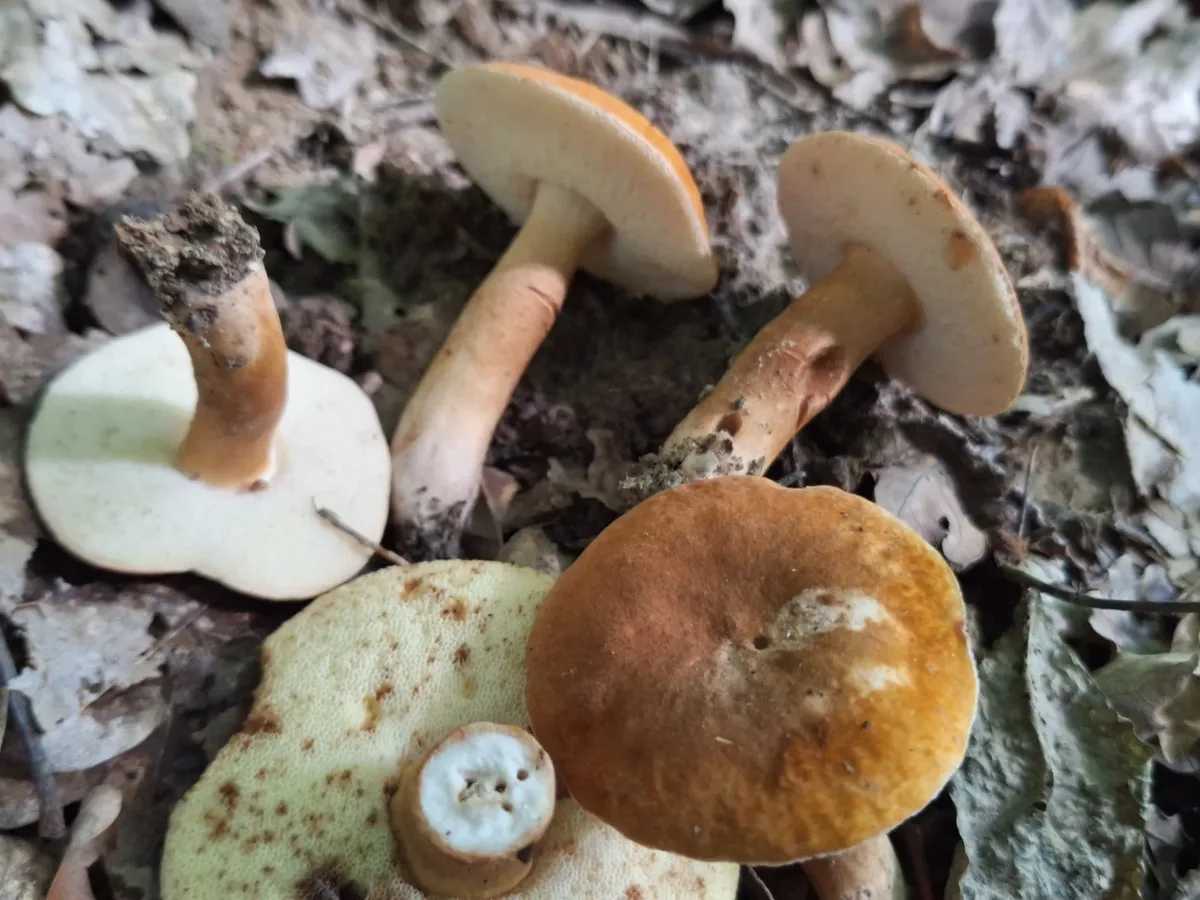 © yellowplant (CC BY)
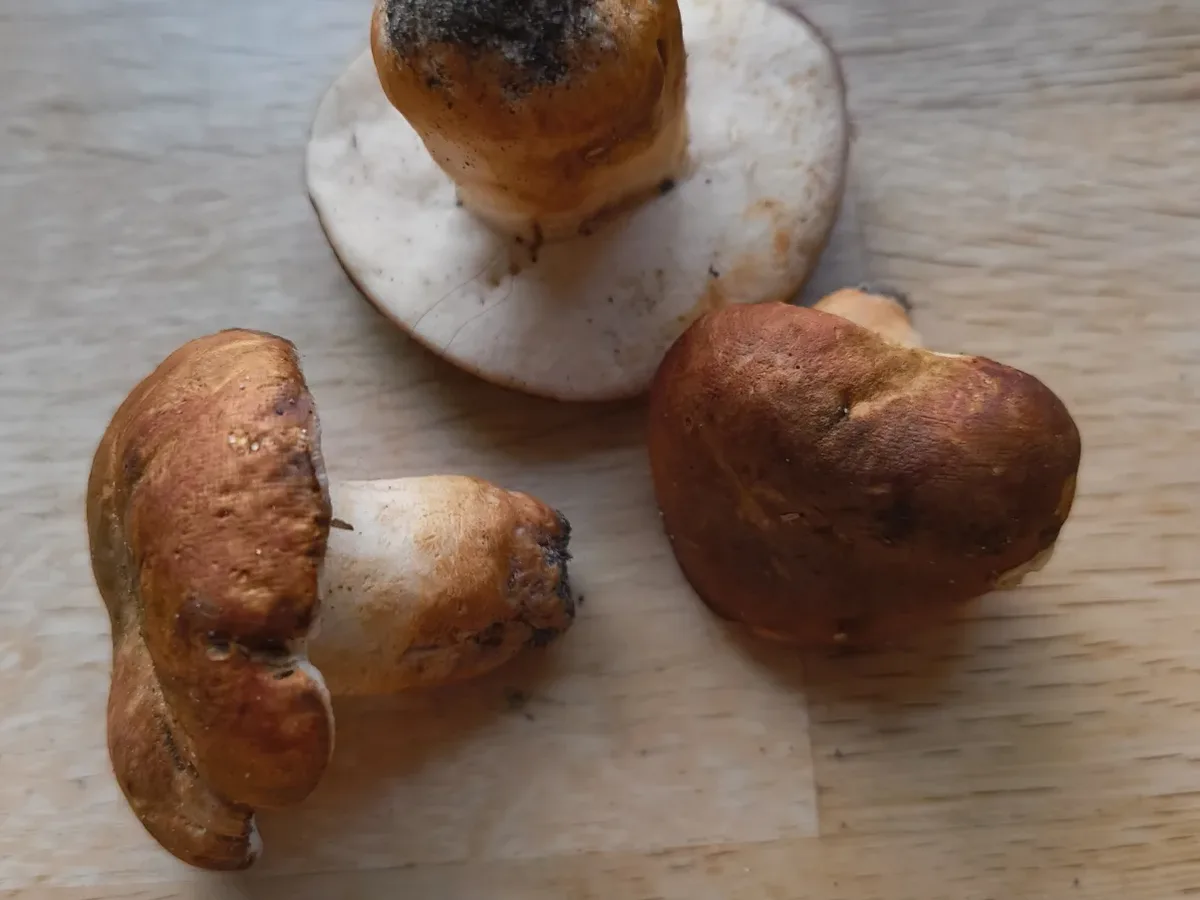 © Karoline Johnsen (CC BY)
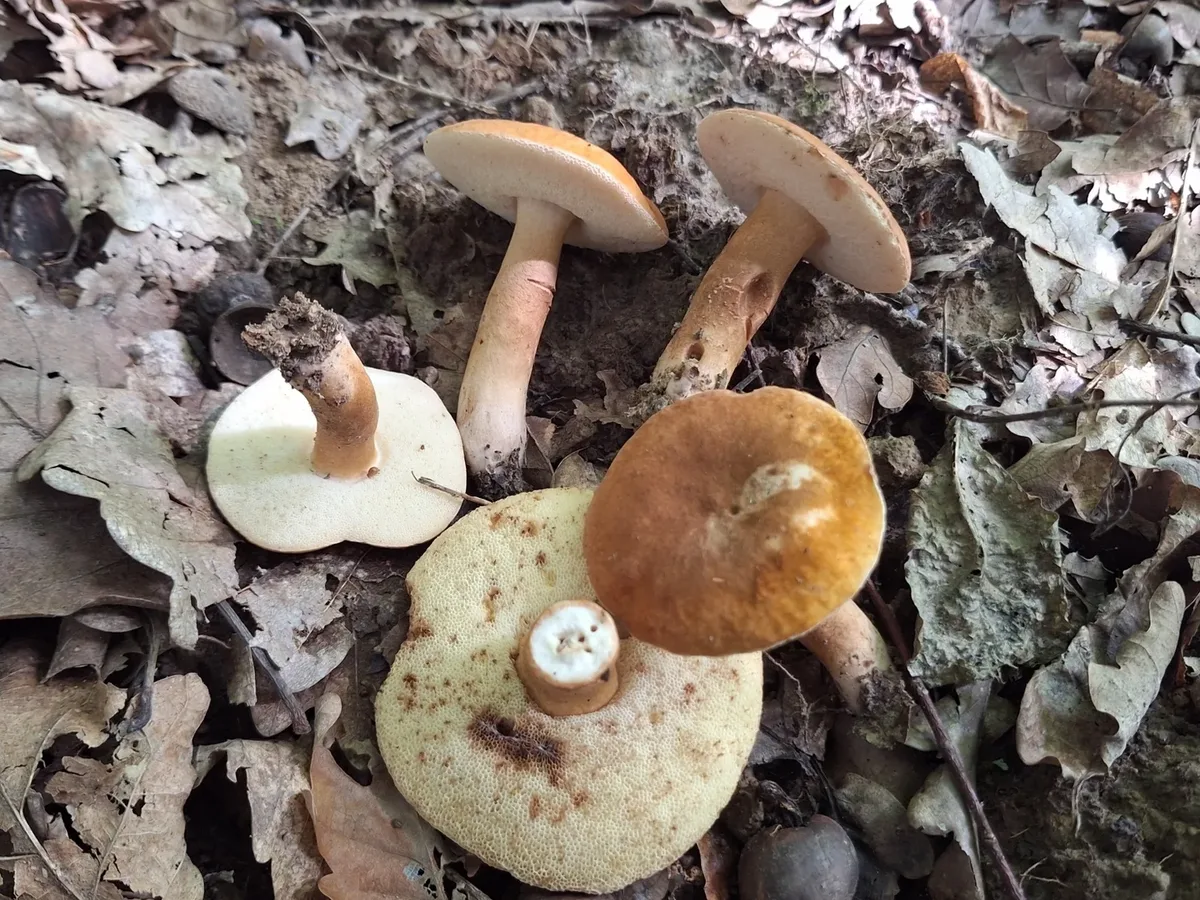 © yellowplant (CC BY)
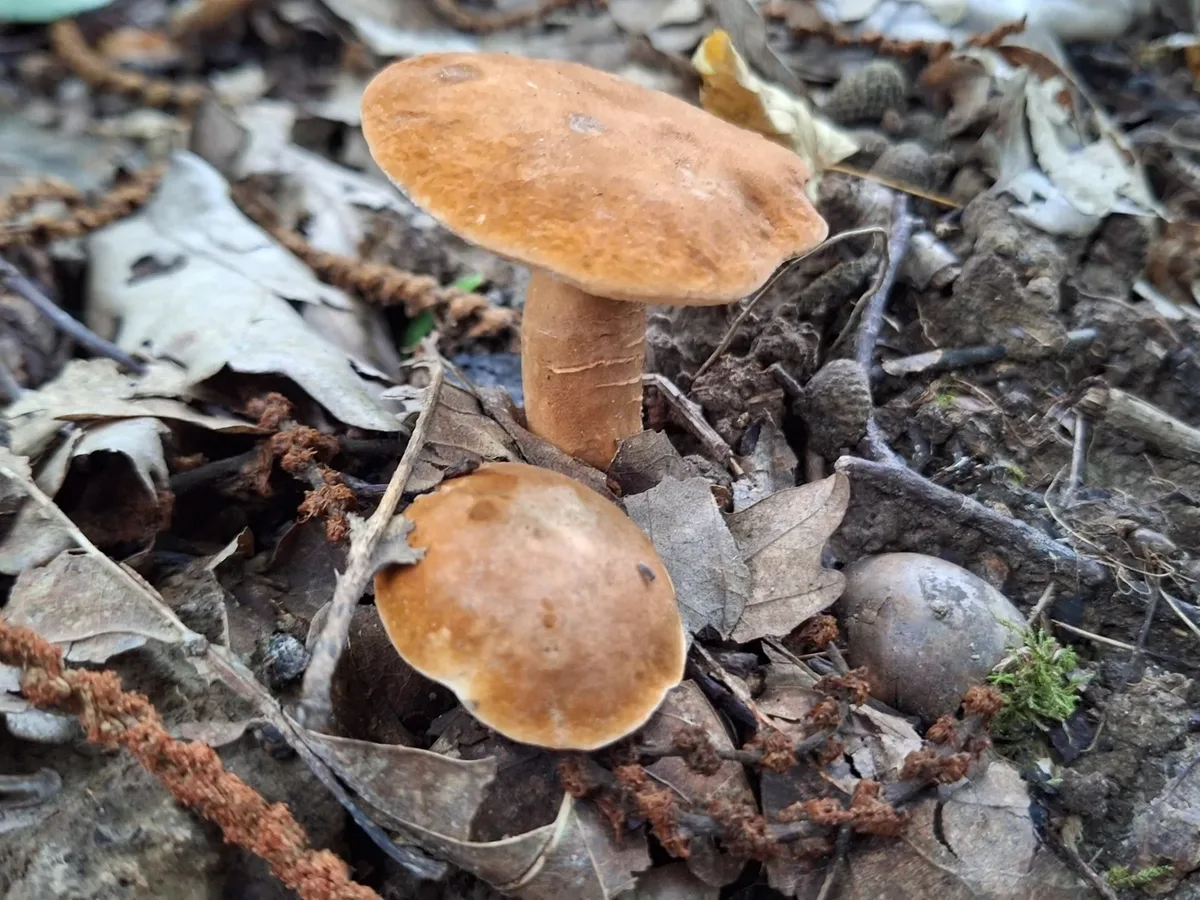 © yellowplant (CC BY)
 © yellowplant (CC BY)
 © yellowplant (CC BY)
 © yellowplant (CC BY)© yellowplant (CC BY)© Karoline Johnsen (CC BY)
Good to eat, once you have identified it with certainty and cooked it through.
Never eat a mushroom you are not 100% sure of - check the look-alikes below, and always cook wild mushrooms.
How to recognise it
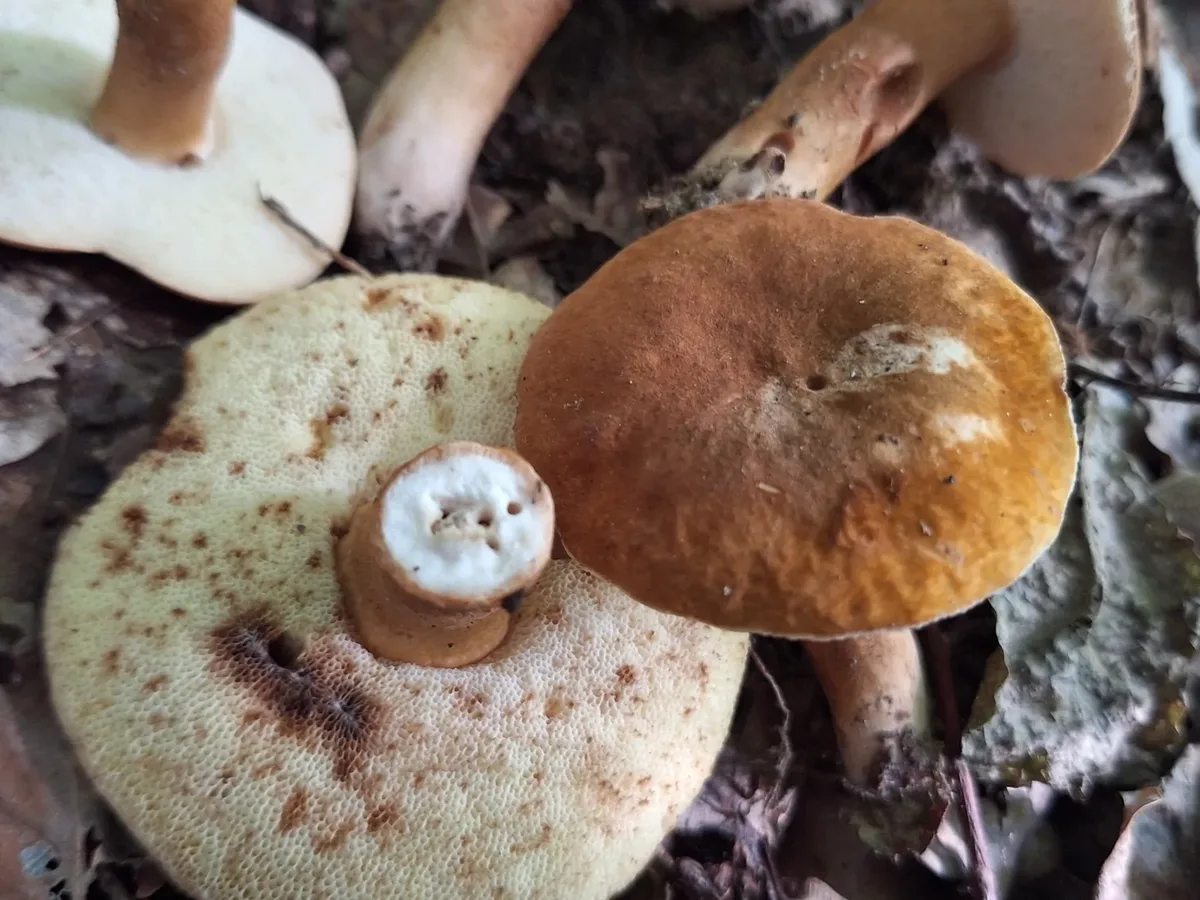
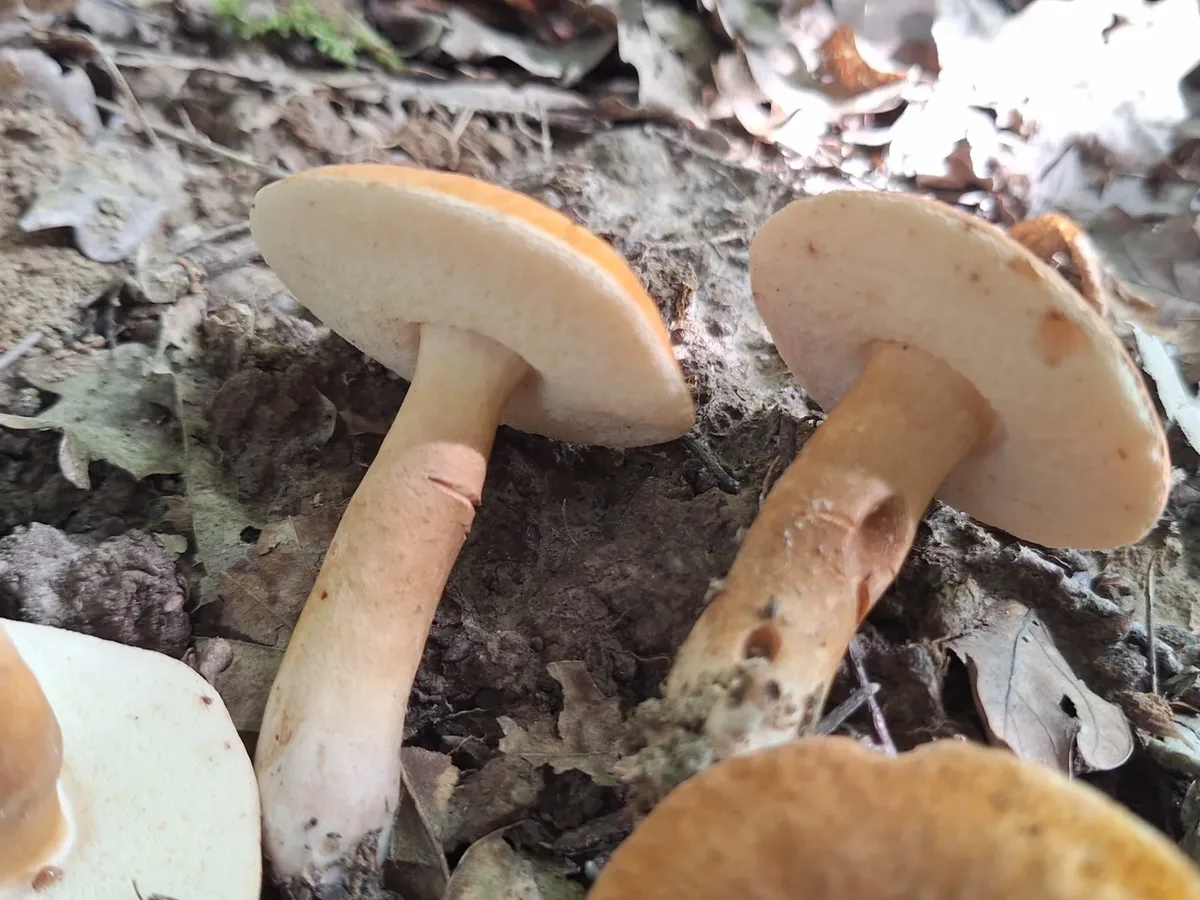
Two things give the chestnut bolete away at once, and together they are unique among European boletes: the cap and stem are a warm, uniform chestnut-brown, and when you snap the stem you find it hollow - not solid wood like most of its relatives, but a maze of white-walled chambers, like a stalk of elder pith. If those two details match, you are almost certainly holding Gyroporus castaneus.
Cap
The cap starts convex and almost hemispherical as a button, then opens to a broadly humped or nearly flat disc with age, usually 3-6 cm across and occasionally reaching 10 cm.
The surface is dry - never sticky, even in wet weather - and has a soft suede-like texture in youth that smooths to near-polished in older specimens.
The colour is its most immediately pleasing feature: a rich, warm chestnut or hazel brown, sometimes paling to rust-buff at the margin. Old or sun-bleached caps can fade to tawny-ochre.
The margin stays slightly incurved for longer than you might expect, only flattening fully when the cap is well expanded.
Pores
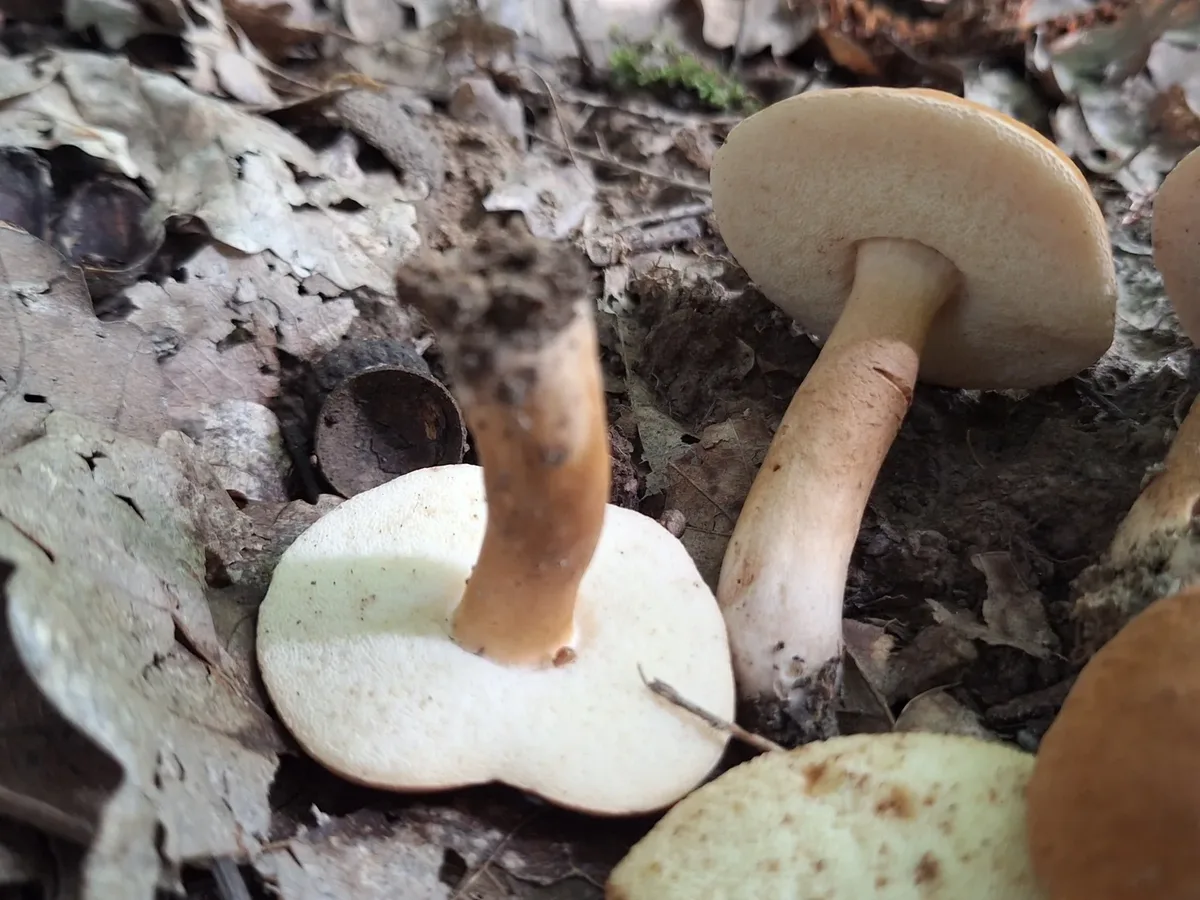
Flip it over and the pore surface is the second thing to check. In young specimens the pores are an immaculate white - noticeably clean compared to many boletes - slowly warming to cream, pale yellow, and finally pale straw-yellow as the fruitbody ages.
Press the pores, slice through the flesh, wait thirty seconds: there should be no blue. Not faint blue, not a hint of blue. The non-bluing reaction is a reassuring field test and a true diagnostic character.
The pores are small and neat (1-3 per mm, circular), and the tube layer peels cleanly from the cap flesh.
Flesh
The flesh throughout is white, firm when young, turning brittle and somewhat powdery with age, and it stays white on cutting - no colour shift at all.
Smell & taste
The smell is faintly pleasant, a mild fruity-nutty note.
Stem
The stem is stocky (3-8 cm tall, 8-20 mm wide), roughly equal or slightly swollen at the base, and coloured to match the cap or a shade paler.
When young it feels solid and stuffed; as the fruitbody matures the interior hollows progressively into irregular chambers. A clean snap anywhere along the stem reveals this at once - white walls enclosing one or several air pockets.
The stem surface is dry and fibrous, finely mealy near the apex. There is no ring, no volva, no partial veil of any kind.
Spores
Spore print pale straw-yellow to pale yellow. Spores 8-11 × 4-6 µm, ellipsoidal, smooth.
Where & when it grows
Habitat
A mycorrhizal partner of deciduous trees on acidic, free-draining mineral soils - principally sandy loam or sandy soils derived from sandstone, granite, or quartzite.
- Oak (Quercus spp.): the overwhelming preference in Western and Central Europe, both sessile and pedunculate oak.
- Sweet chestnut (Castanea sativa): a reliable second habitat; the chestnut-brown cap colour of the mushroom is often thought to mimic the husk of the tree's nut.
- Beech and mixed beech-oak woodland with oak understorey also support populations.
- In northern parts of the range it may occur with birch on heathland.
The species does not tolerate waterlogged, compacted, or calcareous soils.
Fruitbodies appear singly or in scattered groups of two to four, at forest edges, in open glades, on banks beside forestry tracks, and in bracken-encroached margins where light reaches the ground. It is rarely found deep in closed-canopy forest.
The habitat requirements explain why populations are patchily distributed: they track the combination of appropriate host tree, soil type, and warm microclimate that prevails in continental central Europe and the warmer parts of western Europe.
In the British Isles the species is scarce, largely confined to the southern counties of England; it is more frequent across France, Germany, the Iberian Peninsula, and into Russia. In North America it occurs in eastern deciduous forest with oaks, hickories, and beeches on sandy upland soils.
When
This is a summer bolete, not an autumn one. While many of its relatives wait for cooling September nights, the chestnut bolete is at its best in the heat of August - one of those fungi that flourishes when the forest floor is warm and the air still carries a summer weight.
In temperate Central and Western Europe the main window runs July to October, peaking in August and September during warm, continental years.
The key is warm soil, not just wet soil. A spell of summer rain after a dry period, when the ground has had time to heat up, tends to bring on a flush about a week or two later.
The species disappears well before winter: once the first ground frosts arrive it is gone, and it is rarely worth searching after October in the north.
In Mediterranean Europe and the southern Balkans, season can start as early as late June following summer rains. At higher elevations in the Alps or Carpathians it shifts toward September and October.
In eastern North America the timing mirrors Europe's: mid-July through October, peaking in August and September across the mid-Atlantic and New England states.
How it grows
Fruitbodies appear singly or in small scattered groups, never in dense tufts or rings.
Beneath the surface, however, the organism is far from solitary: the mycelium is perennial, threading through the sandy soil around the roots of the same oak or sweet chestnut for years - possibly decades - unseen.
Experienced foragers know to return to the same trees each summer; a patch that produced one good flush in August often will again, in the right conditions, for as long as the tree and the soil stay undisturbed.
Fruiting spikes follow warm summer rain when soil temperatures are above roughly 15 °C, with the flush typically emerging a week to two weeks after sufficient rainfall.
The fruitbodies themselves are short-lived: a well-developed specimen may stand for only four to six days before being claimed by insects or dried out by sun and wind.
Older caps often show yellow powdery patches of the bolete-mould Sepedonium chrysospermum, and the tubes are frequently bored by beetle and fly larvae - yet another reason to pick young and firm.
Fruiting conditions
Warm summer boletes require sustained soil warmth above 14 °C; fruiting flush typically follows 7-14 days after sufficient rainfall during warm periods in July-September.
Look-alikes
The chestnut bolete does not have dangerous lookalikes within most of its European range once the hollow stem and non-bluing white pores are confirmed.
IMPORTANT REGIONAL EXCEPTION: in Portugal, Spain, and parts of coastal France, foragers must be aware of Gyroporus ammophilus (Sandy gyroporus), a formally described species originally treated as a variety of G. castaneus and almost identical in appearance.
G. ammophilus causes severe gastroenteritis and grows in coastal pine woods and fixed dunes on sandy soils - habitat that overlaps with G. castaneus in Iberia. Foragers in these countries must exercise extra caution; if in doubt do not eat.
Several other species can cause initial confusion:
- 1Imleria badia (Bay bolete) - cap similarly bay-brown, but pores turn distinctly sky-blue when cut or bruised; stem solid (not hollow), paler, streaked; flesh may blue faintly. Very common and edible, but the bluing is an instant separator.
- 2Xerocomus subtomentosus and allies (Suede boletes) - cap olive-brown, pores yellow (not white), cracking to show yellow flesh; stem solid with yellowish network; flesh may blue faintly at stem base. Distinguished by pore colour, solid stem, and tendency to crack.
- 3Xerocomus ferrugineus / chrysenteron group - pores yellow, cap often cracking to reveal pink-red subhymenium; stem fibrous, solid.
- 4Tylopilus felleus (Bitter bolete) - cap similarly brown, pores pink in age, stem with a coarse dark net; flesh intensely bitter; stem solid. Harmless but inedible - one specimen ruins a whole dish.
- 5Neoboletus luridiformis (Scarletina bolete) - larger; red pores instantly separate it; flesh stains dark blue immediately; no risk of confusion at the pore level.
- 6Rubroboletus satanas (Satan's bolete) and R. rhodoxanthus - much larger; pores red-orange from the start; flesh blues instantly; grow on calcareous soils. No realistic confusion if pores are checked.
- 7Paxillus involutus (Roll-rim) - gills (not pores), inrolled cap margin, no hollow stem; deadly toxic. Any beginner who confuses a bolete with a gilled mushroom should not forage.
The hollow, chambered stem + white non-bluing pores + chestnut-brown dry cap is effectively unique in the European bolete flora - but always check for G. ammophilus in Iberia and coastal France.
Confusion with G. castaneus is not credible in practice: Paxillus involutus bears gills on the underside of the cap, not the porous tube layer of a bolete - a structural difference visible to the naked eye without magnification. Any observer who has turned the cap over has already eliminated this species. Included here as a genus-level reminder: always verify the underside is a pore surface (tubes), not gills, before consuming any brown-capped mushroom. Paxillus involutus is genuinely deadly via cumulative immune-haemolytic sensitisation (Paxillus syndrome).
Bay bolete has pores that stain distinctly blue when cut or bruised; the stem is solid (not hollow); it is common and edible but easily confused visually at a distance. Confirm by pressing the pore surface - any blue tinge rules out G. castaneus.
Cap similarly brown, pores white to pink (not yellow-ageing-straw), stem with a coarse dark raised net, flesh intensely bitter. Stem solid. Harmless but inedible - even a small fragment ruins a dish. Distinguished from G. castaneus by solid stem and bitter taste.
Cap surface cracks to reveal pinkish-red subhymenium below; pores yellow; stem solid with red at base; not hollow.
CRITICAL WARNING for foragers in Portugal, Spain, and coastal France: G. ammophilus is nearly identical to G. castaneus in appearance and was originally described as a variety of it. It causes severe gastroenteritis lasting up to a week. It grows strictly on sandy, coastal dune soils in Pinus woodland (not inland oak/chestnut woods). In Iberia and Atlantic coastal France, any chestnut-brown Gyroporus found in dune or coastal pine habitat should be treated as potentially G. ammophilus and not consumed.
Very large bolete with whitish to pale grey cap; pores bright red to orange-red; flesh stains blue immediately; occurs only on calcareous soils. Causes severe gastrointestinal poisoning requiring medical attention, but is not a confirmed lethal species. The red pores and large size are instant distinguishing features - there is no realistic risk of confusion once pores are examined.
Much larger; pores orange-red immediately; flesh stains intensely blue within seconds; highly contrasting colouration. Edible only when well cooked but very easily separated from G. castaneus by pore colour alone.
Cap olive-brown and frequently cracking; pores are yellow (not white) even in youth; stem solid and with a yellowish network; flesh yellows on exposure rather than staying white.
In the kitchen
Picking & cleaning
Select young, firm specimens only: once the pores have turned distinctly yellow and the stem feels light and hollow throughout, the flesh is already becoming brittle and mealy and the eating quality is much reduced.
The best specimens are buttons and early-expanded caps where the pores are still white or pale cream, the flesh firm, and the stem not yet fully chambered.
Cut cleanly at the base rather than pulling, to leave the mycelium intact.
The brittle flesh of mature specimens damages easily in the basket; collect them at the top of the basket or wrap loosely in paper.
The absence of any bluing reaction makes field identification straightforward and means there is no risk of confusing it with the non-bluing but toxic Rubroboletus species once you have confirmed the white-to-cream pore colour.
Best eaten fresh on the day of collection; the brittle, rather dry flesh does not hold well and dries poorly compared to Boletus edulis.
Clean with a soft brush rather than washing.
Cooking
The flavour is pleasant but delicate - mild, slightly nutty, with none of the robust depth of Boletus edulis. The flesh is notably drier and more brittle than porcini, which makes it less versatile but still agreeable in simple preparations.
Sautéed in butter with garlic and thyme it makes a fine accompaniment to eggs or light pasta; the dry texture means it benefits from a generous amount of fat and a hot pan rather than a gentle steam.
It can be dried (sliced thin and air-dried or dehydrated at low temperature) but the resulting flavour is more neutral than dried porcini; rehydrated specimens work acceptably in soups and risottos.
Always cook thoroughly - raw consumption is not recommended, as with most boletes. Pairs well with mild cheeses, eggs, and white-fleshed poultry.
Good to know
Gyroporus castaneus is considered a safe edible with no known toxins when correctly identified. The non-bluing white pores are a reassuring negative test for the most dangerous European boletes.
Key safety reminders:
- 1Always verify the stem is indeed hollow by snapping it - a solid stem should prompt re-examination.
- 2Confirm pores do not blue at all, even faintly, over 30 seconds after cutting.
- 3Confirm pores are white to pale straw-yellow, never red or orange.
CRITICAL REGIONAL WARNING: In Portugal, Spain, and coastal France, the nearly identical Gyroporus ammophilus grows on sandy, coastal pine soils and causes severe gastroenteritis. If foraging in these countries, exercise extreme caution.
The species can only be reliably distinguished by its strictly coastal sandy/dune habitat association with Pinus (rather than oak and chestnut on inland soils), but habitat is not a safe sole criterion in the field. In these regions, consider avoiding the species entirely unless you have expert confirmation.
Additionally, mycologist Marcel Bon listed G. castaneus as suspect in 1987, and occasional gastric upsets have been reported by some consumers. Always cook thoroughly - never eat raw - and try only a small portion on first consumption.
If any of the identification checks fail, do not eat the specimen.
A reference guide - never an edibility guarantee. When in doubt, leave it out.