Gyroporus austrobrasiliensis
Gyroporus austrobrasiliensis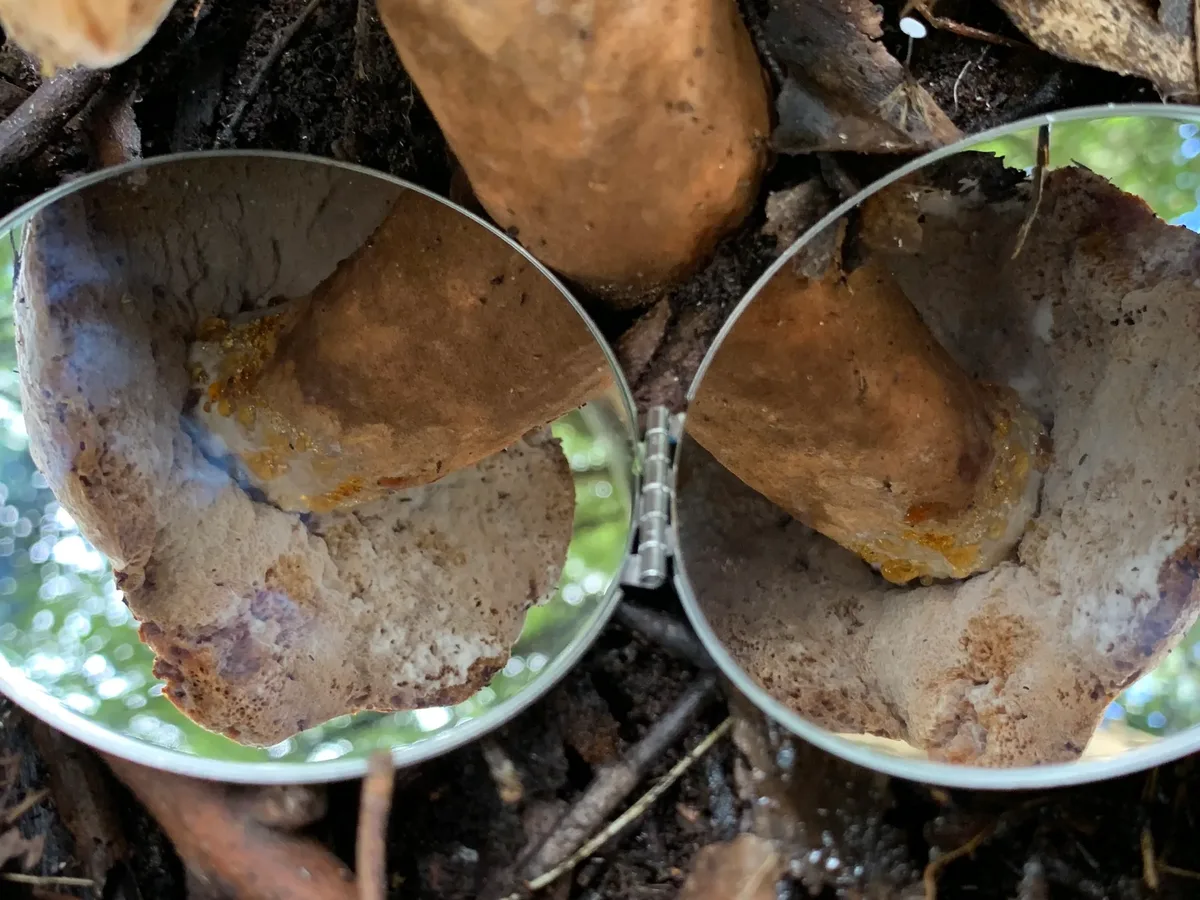 © Atlas of Living Australia (CC BY)
 © Atlas of Living Australia (CC BY)
 © Atlas of Living Australia (CC BY)© Atlas of Living Australia (CC BY)© Atlas of Living Australia (CC BY)
Edible only with the right preparation - or safe for some people but not others. Learn the caveats first.
Never eat a mushroom you are not 100% sure of - check the look-alikes below, and always cook wild mushrooms.
How to recognise it
Gyroporus austrobrasiliensis is the South American member of a globally distributed bolete genus defined by two unusual features that set it apart from nearly all other boletes: a stipe that is hollow and chambered inside, and pores that do not change colour when cut or bruised.
Finding a specimen means looking for something that closely resembles the familiar chestnut bolete of the Northern Hemisphere - a warm brown, dry-capped, clean-poled bolete - but fruiting in the montane forests and temperate araucaria woodlands of southern Brazil.
Cap
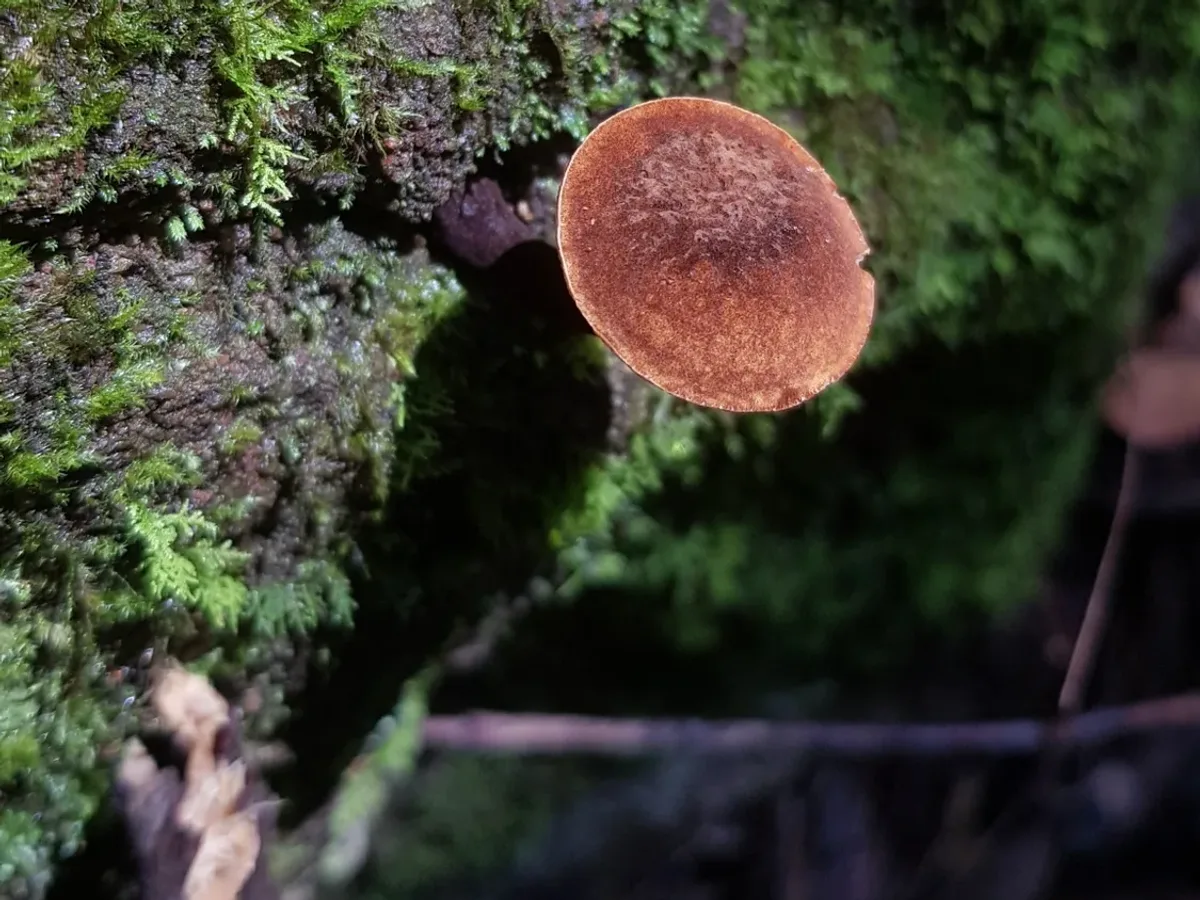
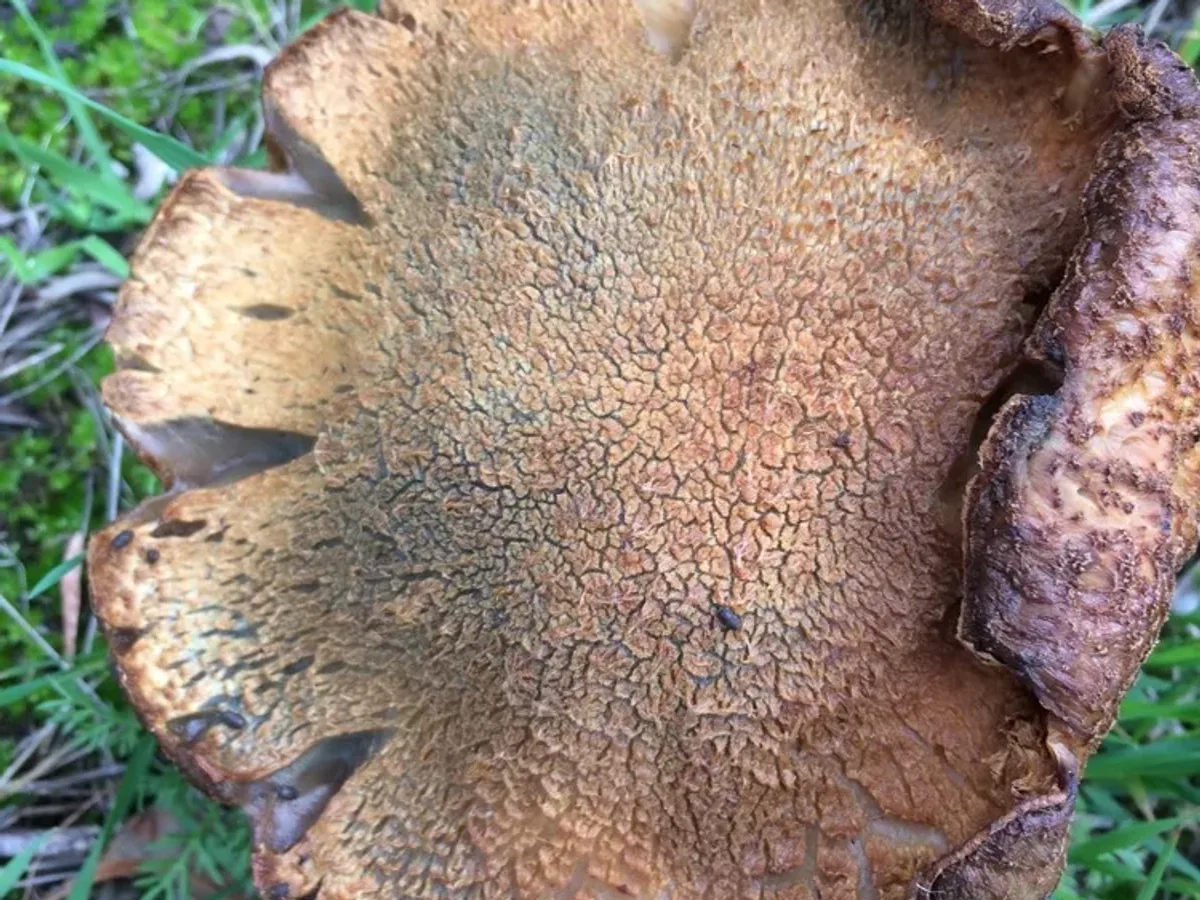
The cap is a warm, uniform chestnut-brown to tawny-hazel, smooth and dry to the touch with a faint suede-like texture in youth, never sticky. It begins as a compact convex dome and opens gradually to a broad, gently arched disc, usually 3-6 cm across and occasionally reaching 8 cm.
Gills / Pores
Turn it over: the pores beneath are immaculate white to cream, neat and fine (1-2 per mm), and remarkably clean-looking even in damp conditions.
Press the pores firmly with a finger and wait thirty seconds - there should be no colour change at all, not even a faint hint of blue. This non-bluing reaction is both a diagnostic character and a practical safety test: it definitively separates this species from a range of blue-staining boletes, some of which are toxic or dangerous.
Stem
The stipe is the most structurally distinctive feature of the genus. Snap it cleanly across the middle and the interior reveals a network of white-walled hollow chambers - like the pith of an elder stem - rather than the solid, fibrous flesh of most other boletes. This hollow, lacunose interior is unique within the local bolete flora and, once seen, is unmistakable.
The stipe exterior matches the cap or runs a shade paler. There is no ring, no veil remnants, and no cup at the base.
Flesh
Flesh throughout is white, firm in young specimens and progressively more brittle and slightly mealy with age; it remains white on cutting, with no colour shift over any time period.
Smell & taste
The smell is mild and pleasantly fungoid. Spore print pale straw-yellow.
Where & when it grows
Habitat
A mycorrhizal species, Gyroporus austrobrasiliensis builds invisible partnerships with the fine root tips of living trees, exchanging mineral nutrients - particularly phosphorus scavenged by its far-reaching mycelium - for the carbohydrates the tree manufactures through photosynthesis.
This partnership ties each fruiting body intimately to its host tree, and explains why the species can reappear at the same sites year after year while being entirely absent from nearby structurally similar forest lacking the right tree species.
In southern Brazil the primary hosts appear to be native trees of the Atlantic Forest and Araucaria Forest biomes:
- Araucaria angustifolia (Paraná pine, Brazil's iconic southern conifer).
- Various Nothofagus (southern beeches in highland areas).
- Possibly native Myrtaceae in warmer lowland forest.
In areas where Pinus elliottii and Pinus taeda have been planted at scale - common across Rio Grande do Sul and Santa Catarina as plantation timber species - the species has been recorded in association with introduced pines, consistent with the ability of Gyroporus species globally to adapt to introduced conifer partners.
The preferred microhabitat is open forest interior or forest-edge ground with freely draining, acidic, humus-rich soil - the kind of soil that is neither waterlogged in winter nor baked bone-dry in summer.
Look along the margins of araucaria stands, at the edges of native forest fragments, along creek-side forest strips, and beside forestry tracks where light penetrates to the ground.
When
In the seasonally variable subtropical climate of Rio Grande do Sul and Santa Catarina, Gyroporus austrobrasiliensis is an autumn bolete, fruiting as summer transitions to cooler, wetter conditions from March onward.
The productive season centres on April and May, when soil temperatures drop from their summer highs into the 12-18 °C range that boletes of this type favour, and when autumn rainfall events begin to rehydrate the forest floor after the drier summer months.
The timing of individual flushes tracks two factors acting together:
- Adequate rainfall in the preceding one to two weeks (at least 20-25 mm over 14 days provides a reasonable threshold).
- Soil temperatures within the productive range.
A spell of warm dry weather in March and early April can delay the first flushes; a sequence of wet, mild autumn weeks in April and May tends to produce the most reliable fruiting.
By June and July at higher-elevation sites, cooling soil temperatures push fruiting toward its lower threshold and productivity declines; at lower elevations and coastal sites in a mild year, occasional late specimens may appear into August.
Because this is a relatively poorly documented species, the full seasonal envelope has not been systematically characterised in the scientific literature, and local variation likely exists across the altitudinal gradient from sea-level Atlantic Forest to the Serra Gaúcha highlands.
How it grows
Fruitbodies appear singly or in small scattered groups, consistent with the ectomycorrhizal habit and the patchy distribution of suitable host trees.
The underground mycelium is perennial, and productive patches tend to recur at the same sites in favourable years, tied to the root zones of the same individual trees.
Under moist conditions the fruitbodies develop relatively rapidly, emerging as compact buttons and reaching full size over three to six days. But mature specimens deteriorate quickly in warm or humid weather, particularly after rainfall, and insect larvae (fly and beetle larvae) find them reliably. Prime quality specimens are young to mid-stage, with white pores and firm flesh.
As with other Gyroporus species, this bolete is never particularly abundant at any single site; finding a few good specimens on any outing represents a rewarding encounter with a genuinely uncommon species.
It is not a bolete that rewards large-scale harvest, both because of its scarcity and because the relatively dry, brittle flesh does not hold as well in the basket as the more robust porcini relatives.
Fruiting conditions
Austral autumn bolete; fruiting is triggered by the combination of cooling soil temperatures (10-20 °C) and adequate autumn rainfall (at least 20 mm in the preceding 14 days). Flush typically emerges 7-14 days after significant rain. Season runs March through July in southern Brazil, peaking April-May. Fruiting declines as winter soil temperatures drop below approximately 10 °C at higher-elevation sites.
Look-alikes
In the bolete flora of southern Brazil, Gyroporus austrobrasiliensis does not have a known deadly lookalike, but several species require careful distinction.
Tylopilus species (bitter boletes) are the most commonly encountered confusions. Multiple Tylopilus occur in Araucaria and Atlantic Forest in southern Brazil, sharing the brown cap, white-to-cream pore colour, and superficially similar stature.
They are separated by several features:
- Solid (not hollow) stipes.
- Pores that may age to pale pink.
- Intensely bitter flesh (a taste test is definitive, even if unpleasant).
- A spore print that tends toward pink-lilac or purplish-pink rather than pale straw-yellow.
Bitter boletes are not known to be lethally toxic but cause severe gastrointestinal distress and ruin a dish if a single specimen is mixed in; always perform the bitterness taste test and check the stipe interior.
Neoboletus and related blue-staining boletes found in association with Araucaria and native trees in southern Brazil produce the immediate blue staining that G. austrobrasiliensis entirely lacks; any brown-capped bolete from this forest that blues when cut is emphatically not this species and should be treated with caution until identity is established.
Imleria or Imleria-like species (bay boletes, regional relatives) have bay-brown caps and solid stipes; their pores may produce a faint to moderate blue stain when pressed - enough to distinguish them from the non-bluing G. austrobrasiliensis. The solid stipe is also an immediate separator.
Paxillus species (roll-rims) bear gills rather than pores on the underside - a structural difference that is visible to the naked eye at a glance. No bolete and no roll-rim should ever be confused by any forager who checks the underside of the cap.
Paxillus involutus sensu lato causes cumulative immune-mediated haemolytic disease that can be fatal; similar caution applies to native Austropaxillus species reported from southern South American forests.
Deadly via cumulative immune-mediated haemolytic disease (Paxillus syndrome). Separated from any bolete by having GILLS on the underside of the cap rather than the porous tube surface of a bolete - a structural difference visible at a glance without any instrument. Always check the underside of any brown-capped mushroom before collecting it. Austropaxillus infundibuliformis and related southern South American Paxillus-group species have been recorded from Nothofagus and Araucaria forests and should be treated as potentially dangerous.
Multiple Tylopilus species occur in Araucaria and Atlantic Forest in southern Brazil and share a brown cap and pale pores. They are separated from G. austrobrasiliensis by their SOLID (not hollow) stipe - snap the stipe to confirm the interior - and by intensely bitter flesh; pores may age to pinkish tones and the spore print tends toward pink-lilac rather than pale straw-yellow. Not typically lethal, but cause significant gastrointestinal distress; a taste test (tiny amount on the tip of the tongue, then spit out) is definitive.
Several brown-capped boletes in the Araucaria forests of southern Brazil blue when cut or bruised. G. austrobrasiliensis does NOT blue at all - press the pores firmly and wait 30 seconds; the absence of any blue is one of the two key identity checks. Any brown bolete from this habitat that blues immediately or within seconds is a different species entirely; approach with caution until identity is established.
Edible. The closest morphological relative and Northern Hemisphere counterpart of G. austrobrasiliensis; not naturally present in South America. Included for comparative context only: both species share the hollow chambered stipe, non-bluing white pores, and chestnut-brown dry cap that define the species group. Any introduced Gyroporus castaneus under introduced European oak or other Northern Hemisphere ectomycorrhizal hosts would be separable from G. austrobrasiliensis primarily by geographic and host context.
In the kitchen
Picking & cleaning
Select young, firm specimens with pores that are still white or pale cream. Once the pores have turned distinctly yellow, the flesh is already becoming brittle and the eating quality diminished.
Cut cleanly at the stipe base with a knife rather than pulling, to avoid disturbing the soil and the mycelium network around the host tree roots. The hollow stipe may crumble slightly if handled roughly, so carry specimens carefully at the top of the basket.
Clean by brushing with a soft brush rather than washing. Use fresh, on the day of collection or within one day of refrigeration; the dry, somewhat brittle flesh does not store well and dries to a comparatively bland product.
Always confirm two identity checks before eating:
- 1Press the pores and confirm no blue staining after thirty seconds.
- 2Snap the stipe and confirm the hollow chambered interior.
Both checks together with the chestnut-brown dry cap are sufficient to confirm the genus and species in the South American context. If either check fails, do not eat the specimen.
Cooking
The flavour is mild and pleasant - nutty, with a gentle earthiness typical of the genus - though it lacks the deep umami intensity of porcini (Boletus edulis group).
The flesh is firm and moderately dry when young, becoming more brittle and somewhat powdery at maturity. Best enjoyed fresh, as the quality declines quickly after collection.
Simple preparations suit it best. Slice and sauté in butter or a neutral oil over medium-high heat with garlic and fresh herbs (thyme, parsley, or local equivalents) until golden and cooked through - about 6-8 minutes, ensuring the interior is fully cooked.
Pairs well with eggs, rice, and mild fresh cheeses; works in pasta sauces and soups. The dry texture means it benefits from generous fat in the pan and sufficient heat to brown rather than steam.
Always cook thoroughly - never eat raw, and never assume a light sauté is sufficient; the interior should be cooked through, not just browned on the outside.
Drying is possible but produces a relatively mild flavour compared to dried porcini. Rehydrated dried specimens are acceptable in soups and grain dishes. Fresh is strongly preferred.
Good to know
Gyroporus austrobrasiliensis has no reported toxicity in the scientific literature available up to the knowledge cutoff (2025). It belongs to the genus Gyroporus, which includes the well-established edible species G. castaneus and G. cyanescens of the Northern Hemisphere, and shares the same structural and morphological features associated with edibility in that genus. On this basis it is considered edible.
However, two important qualifications apply:
- 1This is a regionally endemic species with limited research documentation; the absence of reported toxicity partly reflects the small number of people who have consumed and documented it, not a comprehensive toxicological study. As with any poorly studied endemic species, the cautious approach is to cook thoroughly, try a small portion first, and wait 24 hours before consuming larger amounts.
- 2A handful of regional Gyroporus species - most notably Gyroporus ammophilus in Iberia - have proven to cause gastroenteritis despite their morphological similarity to edible relatives. The principle that morphological similarity within the genus does not guarantee edibility should be held in mind.
The two field identity checks are non-negotiable:
- 1Press or cut the pores and confirm there is absolutely no blue staining after 30 seconds - any blue reaction means this is a different species.
- 2Snap the stipe and confirm the hollow, chambered interior - a solid stipe means this is not a Gyroporus at all.
Both checks must pass before consumption. Never eat raw or lightly cooked; always cook thoroughly to an internal temperature of at least 70 °C.
A reference guide - never an edibility guarantee. When in doubt, leave it out.