Spectacular Rustgill
Gymnopilus junoniussyn. Gymnopilus spectabilis, Pholiota spectabilis, Flammula spectabilis, Agaricus spectabilis
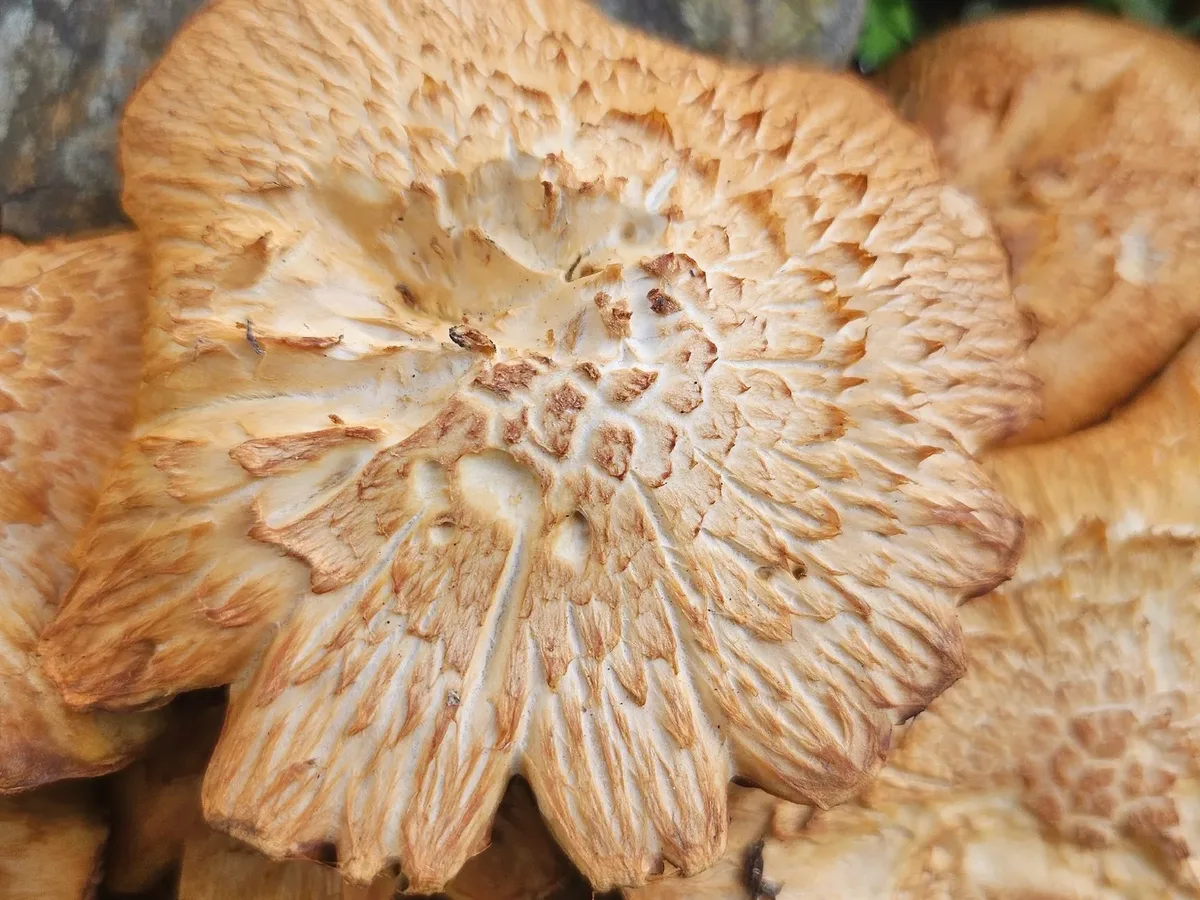 © Ayla Bigea (CC BY)
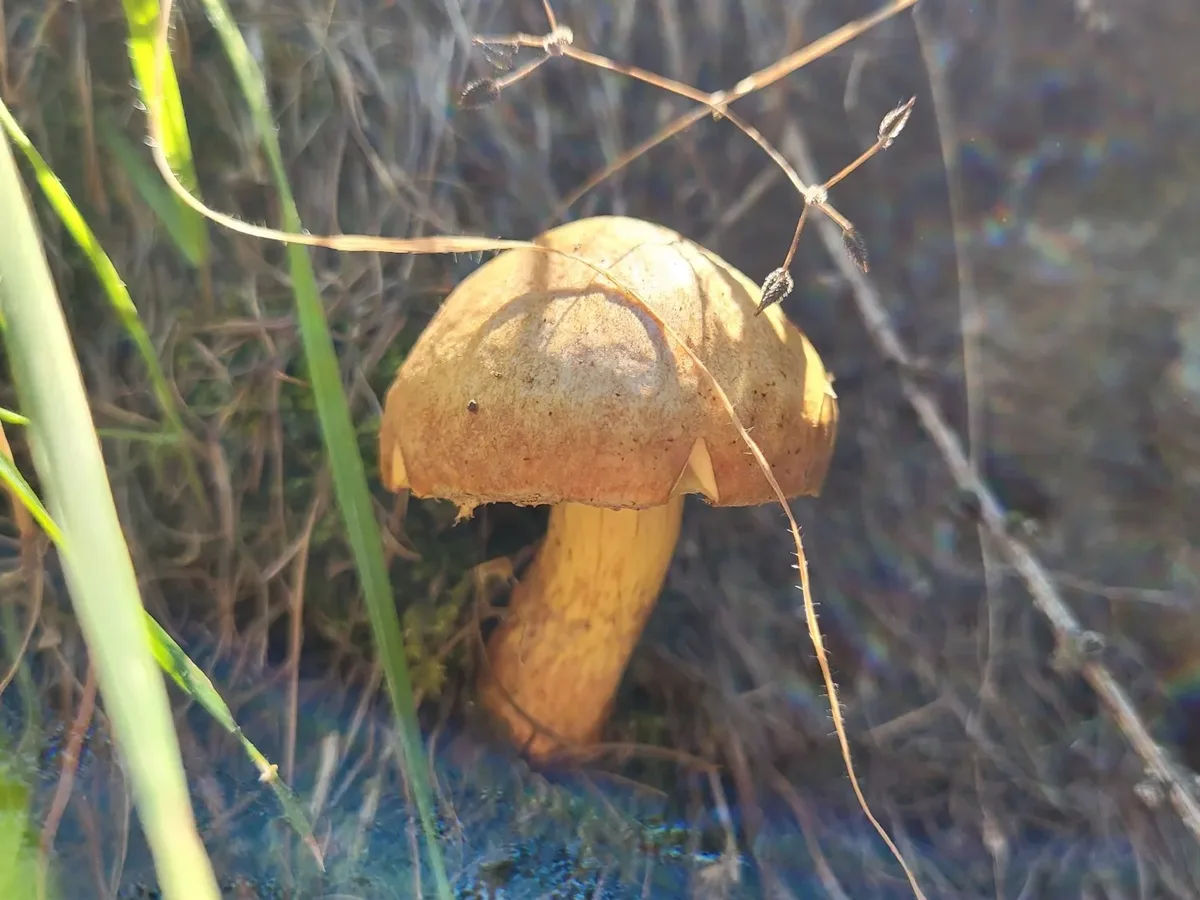 Sonia Parsons (CC0)
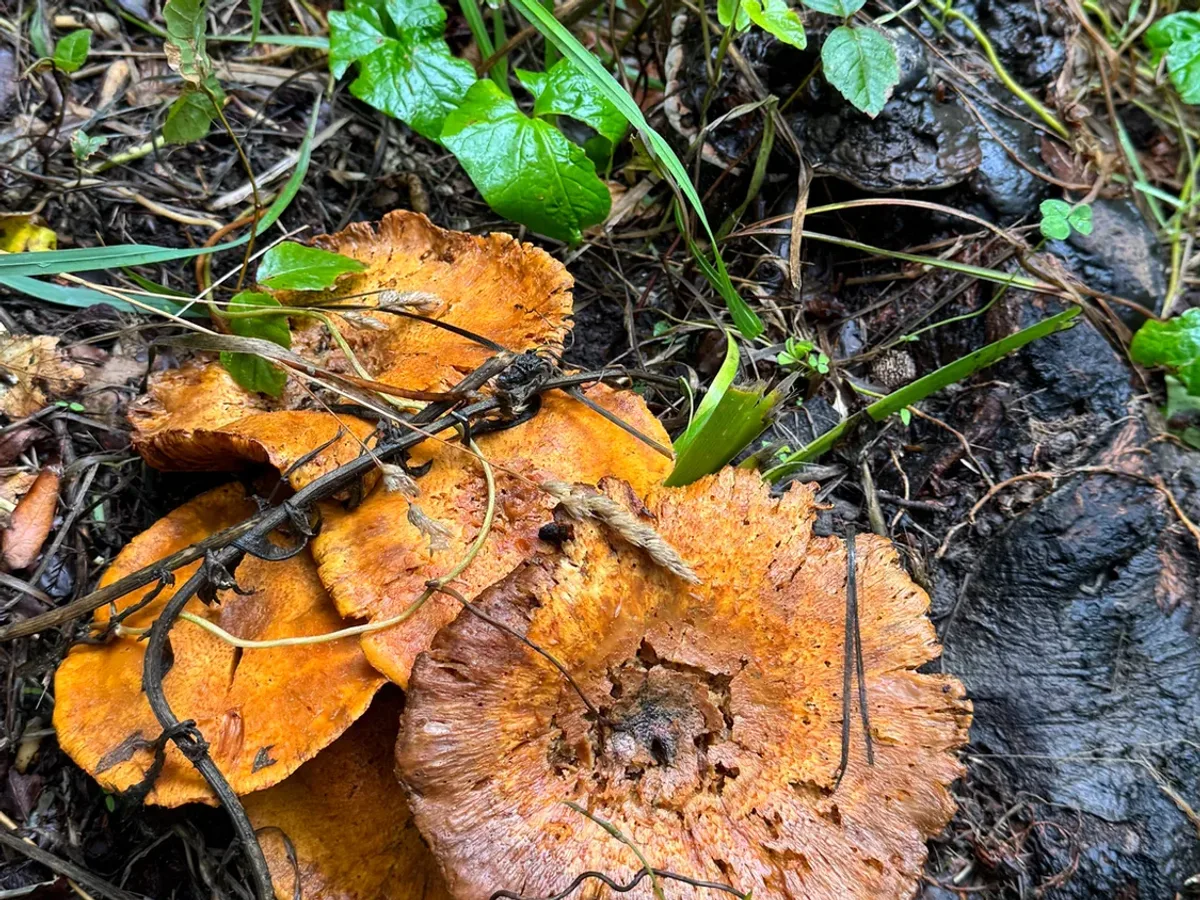 © Frank Ashwood (CC BY)
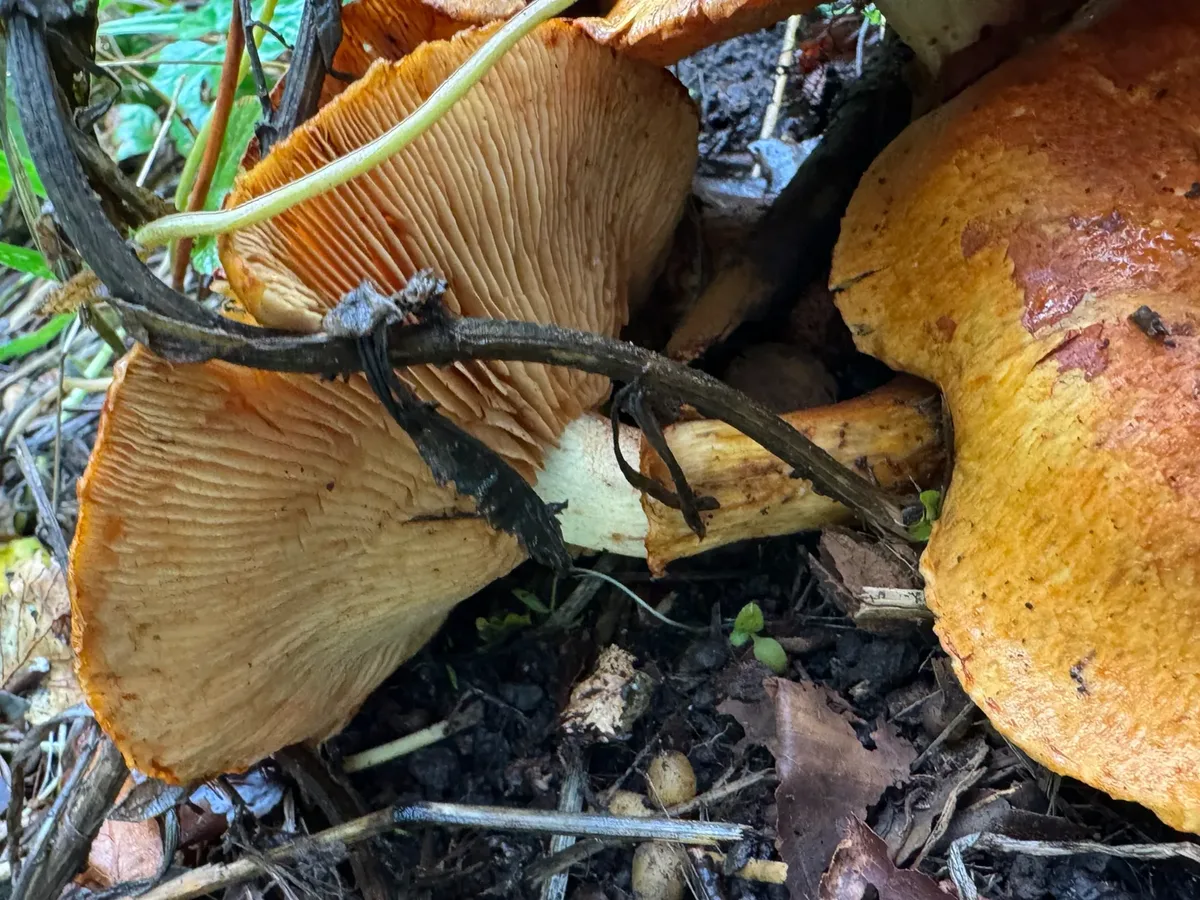 © Frank Ashwood (CC BY)
 © Frank Ashwood (CC BY)
 © Maureen Howard (CC BY)
 © Grey Smith (CC BY)
 © Ayla Bigea (CC BY)© Ayla Bigea (CC BY)Sonia Parsons (CC0)
Edible only with the right preparation - or safe for some people but not others. Learn the caveats first.
Never eat a mushroom you are not 100% sure of - check the look-alikes below, and always cook wild mushrooms.
How to recognise it
The Spectacular Rustgill is one of the most visually arresting wood-inhabiting mushrooms in the world - the common name 'junonius' refers to Juno, the majestic Roman goddess, and the epithet is apt.
Cap
The cap ranges from 5 to 20 cm across, convex when young and broadening to a wide, gently umbonate plate with age.
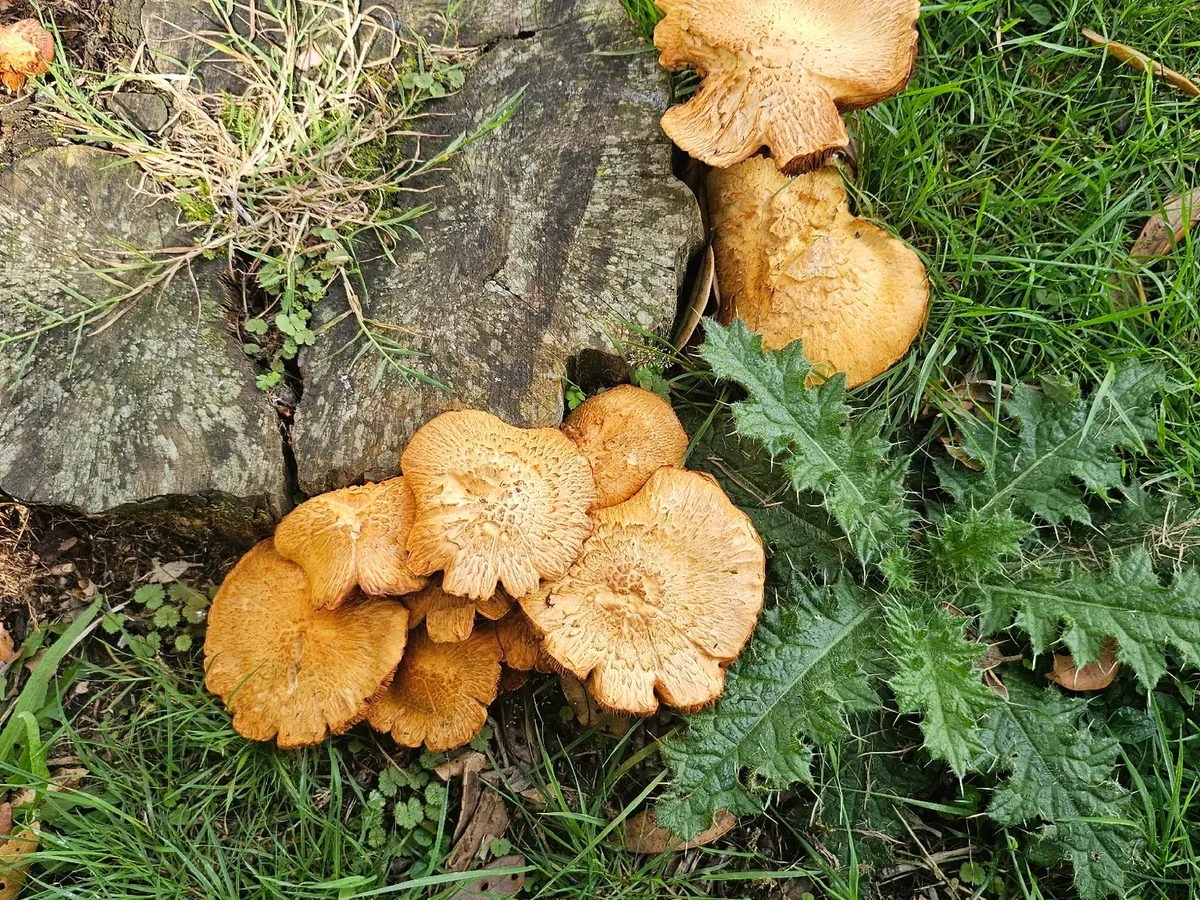
The surface is dry, bearing fine radiating fibres and subtle scales especially toward the centre, coloured an intense tawny-orange to golden-yellow or rusty-amber. The hue shifts as the cap matures, with the disc deepening to rusty-brown while the margin retains yellow-orange tones.
Gills
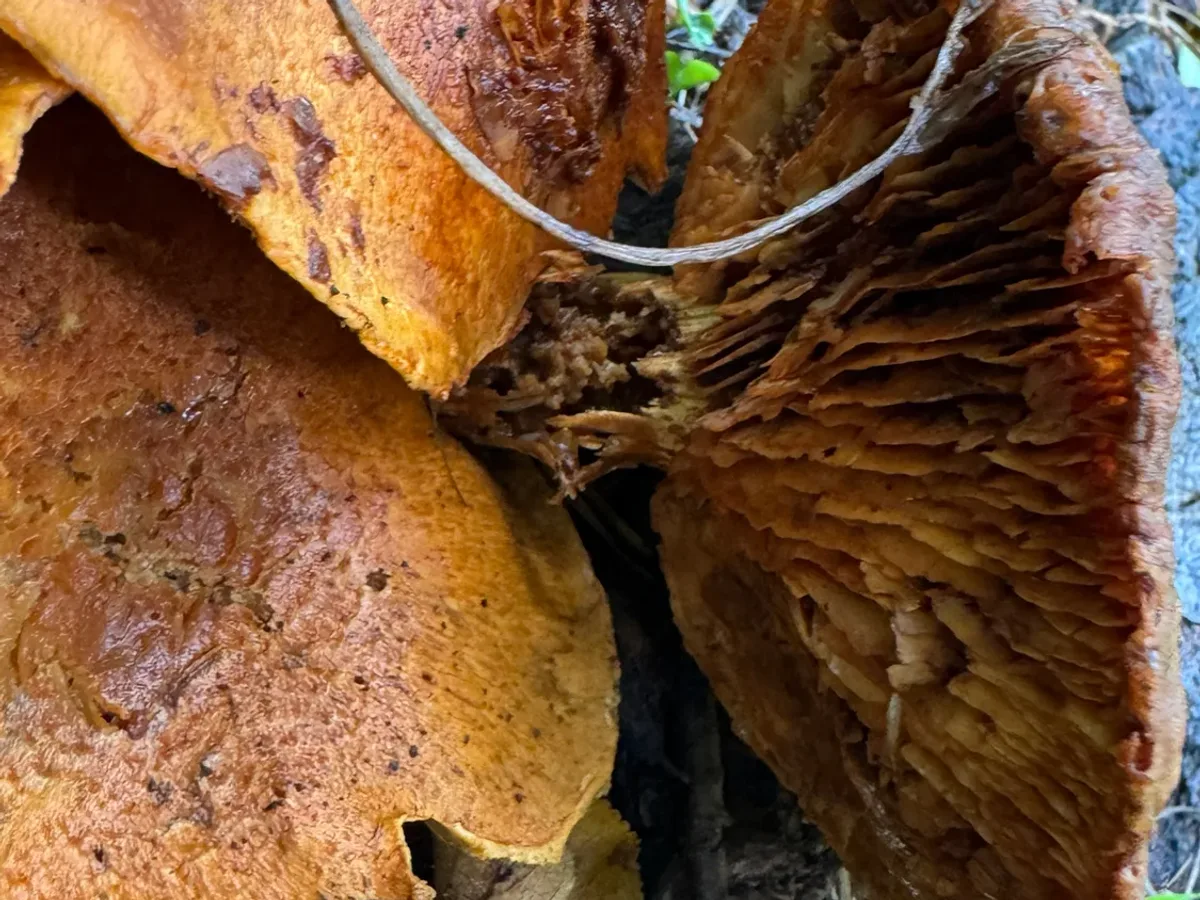
Adnate to slightly decurrent, crowded, starting bright yellow then progressing through orange-yellow to deep ferruginous rust-brown as the spores develop. This colour arc is characteristic and can be seen across a single cluster where caps of different ages grow side by side.
Stem
The stem is 5-15 cm tall and 1-3 cm thick, fibrous, solid, orange-buff to tawny, and carries a robust, membranous ring in its upper zone - yellow on its upper face, dusted with rust-brown spores beneath.
Multiple stems typically share a common base, producing the cluster habit the species is known for.
The spore print is the single most powerful diagnostic tool: a vivid rust-orange to ferruginous brown, totally unlike the white spore print of edible Armillaria (the most common confusion) or the purplish-brown print of Hypholoma species.
Flesh
Flesh is pale yellow, firm, and unchanged on cutting, but tastes markedly bitter and acrid - most foragers who bite a small piece immediately spit it out, a reflex that has saved many from the neurological effects.
Why it's dangerous
The primary danger from Gymnopilus junonius is twofold:
- 1Inadvertent ingestion through misidentification as edible honey fungus (Armillaria mellea). The neurological effects can be alarming and disabling, particularly for someone who did not intend to ingest a psychoactive substance - this scenario has caused genuine medical emergencies.
- 2The risk that Galerina marginata - which contains lethal amatoxins and can fruit on the same woody substrate - is collected alongside or instead of Gymnopilus specimens.
In its own right, Gymnopilus junonius is not considered a reliably lethal species at normal ingestion quantities. But any foraged mushroom that looks similar must have its identity confirmed by spore print colour before any contact with food is considered.
Toxin
The principal psychoactive compounds are psilocybin and its dephosphorylated form psilocin, which act as serotonin 5-HT2A receptor agonists.
Their content varies considerably by geographic population:
- Some North American populations have tested negative or near-negative.
- Japanese, Korean, and European populations more consistently test positive.
Bis-noryangonin, a styrylpyrone compound, is also present and may potentiate or modify the psychedelic effects.
Gymnopilins - bitter sesquiterpene esters - are responsible for the acrid taste and contribute to gastrointestinal irritation independent of the psychoactive compounds.
Symptoms
Neurological and perceptual symptoms of psilocybin intoxication begin 30 minutes to 3 hours after ingestion:
- Visual and auditory distortions
- Altered time perception
- Uncontrollable laughter (the source of the Japanese folk name 'laughing mushroom')
- Euphoria or dysphoria
- Anxiety or panic
- Confusion and disorientation
Physical signs include dilated pupils, elevated heart rate, nausea, and vomiting.
Symptoms generally resolve over 4-8 hours without permanent sequelae in otherwise healthy adults, but can be severely distressing, particularly for individuals unaware they have ingested a psychoactive substance. There is documented risk of psychological decompensation in vulnerable individuals.
Gastrointestinal irritation - cramping, nausea, diarrhoea - may occur independently of or alongside the neurological effects, attributable to gymnopilins and other irritants.
Staying safe
Gymnopilus junonius is a toxic and psychoactive species and must not be eaten. It is classified here as caution - not deadly - because it does not reliably cause fatal poisoning at normal ingestion quantities. However, the neurological and psychological effects of accidental ingestion can be severe, distressing, and medically significant.
The bitter taste is usually protective (most people reject it immediately), but cooking does not neutralise the toxins. Attempts to remove bitterness by prolonged boiling merely risk masking the warning signal while concentrating residual compounds.
The greatest danger is misidentification as edible Armillaria: any large, clustered, ring-bearing, wood-growing mushroom must have its spore print confirmed as white (Armillaria) before consumption. A rust-orange or ferruginous spore print from a suspected Armillaria harvest means the batch contains Gymnopilus and must be discarded entirely.
If accidental ingestion occurs, symptoms typically begin within 30 minutes to 3 hours. Then:
- Seek medical advice promptly.
- Report the species consumed.
- Preserve a specimen for identification.
Where & when it grows
Habitat
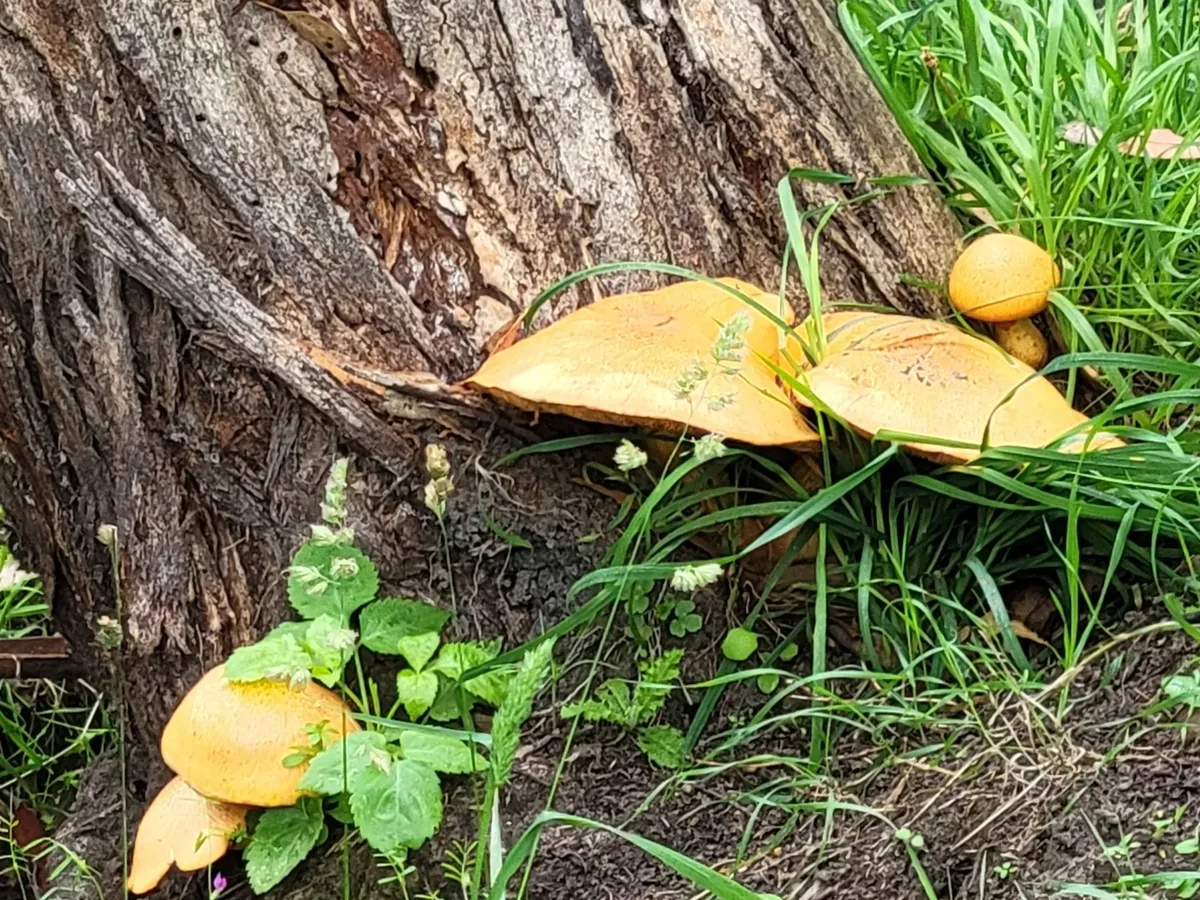
A saprotrophic wood-rotter causing white rot, fruiting in dense, often enormous clusters on dead or dying hardwood stumps, fallen logs, and at ground level from buried roots.
Favoured substrates vary by region:
- East and Southeast Asia: oak, beech, Japanese cedar, mulberry, and broad-leaved tropical hardwoods.
- North America and Europe: oak, maple, beech, and elm stumps most commonly colonised.
The mycelium breaks down lignin and cellulose efficiently, and the same stump reliably produces year-after-year crops until the wood is consumed.
Large flushes - multiple overlapping clusters, hundreds of caps - can appear from a single substrate. They are the source of its Japanese common name, which translates roughly as 'big laughing mushroom', the 'laughing' a wry reference to the psychoactive properties.
When
Primarily an autumn species in temperate climates. Fruiting timing varies by region:
- Japan and Korea: the main flush runs from late September through November, peaking in October.
- Warmer, more humid parts of East and Southeast Asia: a broader season that can extend well into winter.
- Temperate Europe and eastern North America: August through November, with peak September-October.
- Australia and New Zealand: triggered by autumn conditions in March-June.
Cool nights combined with warm moist days and adequate rainfall are the key triggers. The species will not produce fruitbodies in the heat of summer or the deep freeze of winter.
How it grows
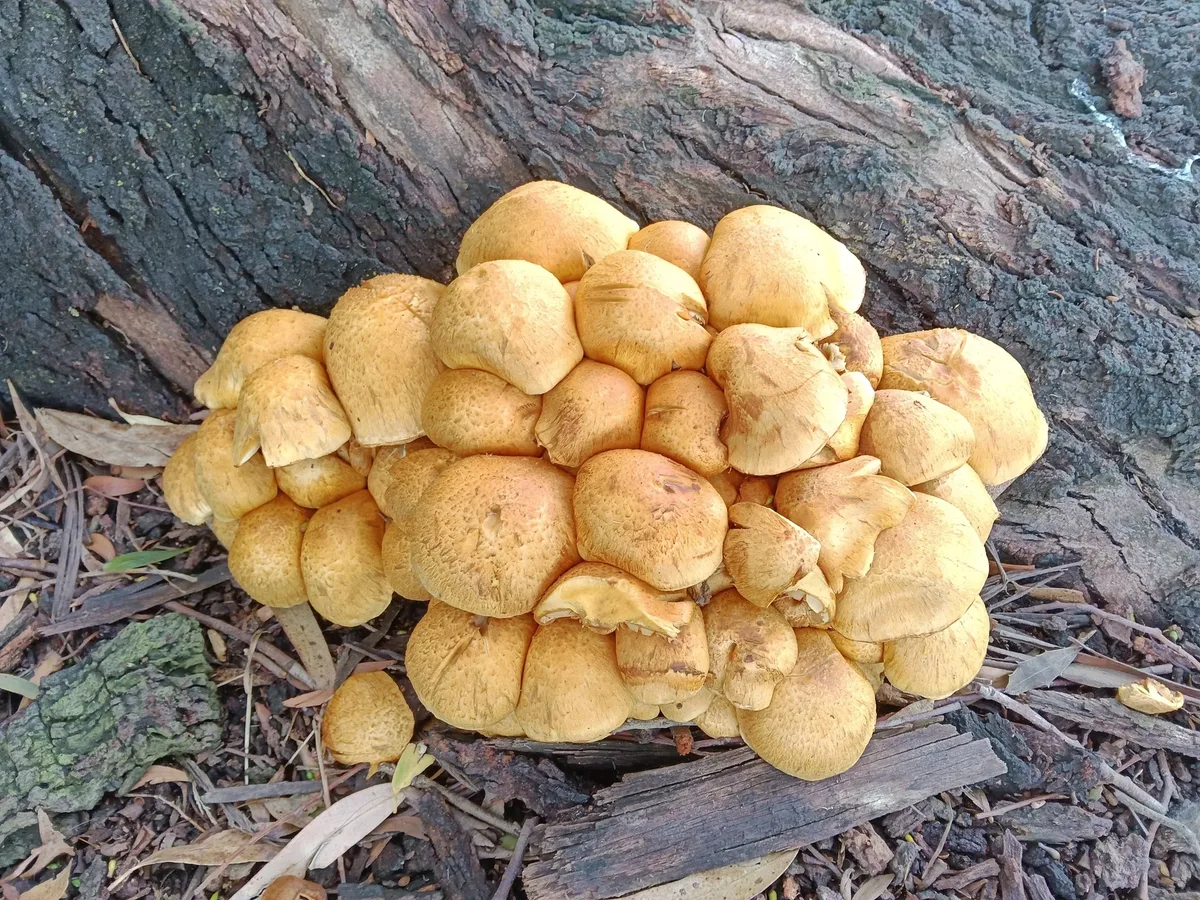
Grows in dense, multi-stemmed clusters from a shared mycelial base - sometimes a single substrate erupts with dozens or even hundreds of individual caps arising in tight, overlapping groups.
Individual caps within a cluster may be at very different stages of development simultaneously, producing a stacked spectacle of sizes from egg-shaped buttons to fully expanded plates.
Because the mycelium is embedded in the wood substrate rather than soil, fruiting is relatively independent of soil conditions. What matters most is air temperature, humidity, and the internal moisture content of the wood.
The same stump commonly produces multiple flush events across a single autumn and returns in subsequent years.
Fruiting conditions
Wood-decay saprotroph; fruiting is driven by autumn cooling and sustained moisture. Because the mycelium inhabits wood rather than soil, internal wood moisture matters more than soil moisture per se, but 14-day rainfall above 25 mm is a reliable proxy for conditions adequate to trigger fruitbody initiation. The flush lag tends to be longer than for soil-dwellers (7-18 days) because moisture must penetrate the wood substrate. The same stump reliably re-flushes across multiple seasons.
Look-alikes
The most significant lookalike risks are as follows.
Armillaria mellea (honey fungus, edible) is the most common confusion in the field, particularly for less experienced foragers. It is also a large, clustered, wood-inhabiting species with a ring, but differs in:
- A white spore print (never rust).
- White to cream gills that do not turn rust-brown with age.
- A cap bearing dark-tipped fibrous scales on a paler ground colour.
- Flesh that is not intensely bitter.
This is a critical distinction: many cases of Gymnopilus ingestion have occurred when foragers believed they were harvesting Armillaria. Always take a spore print - white versus rust-orange will immediately resolve the question.
Pholiota squarrosa (shaggy scalycap, inedible/caution) is another clustered wood-inhabiting species with a yellow to tawny cap and ring, but differs in:
- A distinctly shaggy-scaly cap and stem below the ring.
- A glutinous surface when moist.
- An unpleasant garlic-like smell.
- A browner (rather than vivid orange) spore print.
Hypholoma fasciculare (sulphur tuft, poisonous) grows on similar substrates in dense clusters, but differs in:
- Smaller size, bright sulphur-yellow without the tawny-orange centre.
- Greenish-yellow gills.
- A purplish-brown spore print.
Galerina marginata (funeral bell, DEADLY) is the crucial safety concern. It also grows on decaying wood and produces a rust-brown spore print, but differs in:
- Far smaller size (cap 2-5 cm vs. 5-20 cm) and a thin stem.
- Typically solitary to gregarious rather than densely clustered.
- A fragile ring that often disappears.
- A hygrophanous cap that dries dramatically from the centre outward.
However, Galerina can occasionally grow intermixed with large Gymnopilus clusters on the same stump, and the risk of accidental inclusion is real - especially when collecting in bulk without individual cap examination.
Far smaller (cap 2-5 cm vs. 5-20 cm), thin-stemmed, typically solitary to scattered rather than massively clustered, with a hygrophanous cap that dries dramatically from the centre outward. Ring is delicate and often disappears with age. Contains lethal amatoxins. Can occasionally fruit on the same woody substrate as Gymnopilus. Any time a cluster of large golden mushrooms is harvested on wood, check that no smaller Galerina-like individuals have been included; spore print of Galerina is a darker, browner rust versus the vivid orange of Gymnopilus.
Clustered on hardwood stumps, particularly poplar and elder, with a ring. Cap is brown with a paler margin, gills white to cream, spore print brown but not vivid rust-orange. Edible and cultivated; the mild smell and white to pale gill colour distinguish it from the yellow-gilled Gymnopilus. No bitter taste.
The most common confusion. Armillaria is also a large, clustered, ring-bearing wood-grower but has a white spore print (completely different from Gymnopilus's rust-orange), white to cream gills that never turn rust-brown, a cap bearing dark fibrous scales on a paler honey-coloured ground, and flesh that is mild, not intensely bitter. Always confirm a white spore print before treating any clustered, wood-growing, ring-bearing mushroom as Armillaria. A rust-orange print means it is Gymnopilus; discard the batch.
Also clustered on wood with a ring, but has a distinctly shaggy cap and stem covered with recurved, dark-tipped scales, a glutinous surface when moist, and an unpleasant garlic or radish odour. Spore print is brown but darker and less vivid than Gymnopilus. Considered inedible to mildly toxic. Distinguishable by the strong scaling and smell.
Dense clusters on wood, but cap is bright sulphur-yellow without the tawny-orange centre and warm amber tones of Gymnopilus. Gills are initially greenish-yellow, and the spore print is a purplish-brown - never rust-orange. Intensely bitter taste is shared, which actually makes confusion less likely once a piece is tasted. Poisonous causing gastrointestinal illness.
A reference guide - never an edibility guarantee. When in doubt, leave it out.