Grifola sordulenta
Grifola sordulentasyn. Polyporus sordulentus Mont., Polyporus frondosus var. sordulentus (Mont.) Cooke, Meripilus sordulentus (Mont.) Ryvarden
 © FelipeND (CC BY-SA)
 © FelipeND (CC BY-SA)© FelipeND (CC BY-SA)© FelipeND (CC BY-SA)
Good to eat, once you have identified it with certainty and cooked it through.
How to recognise it
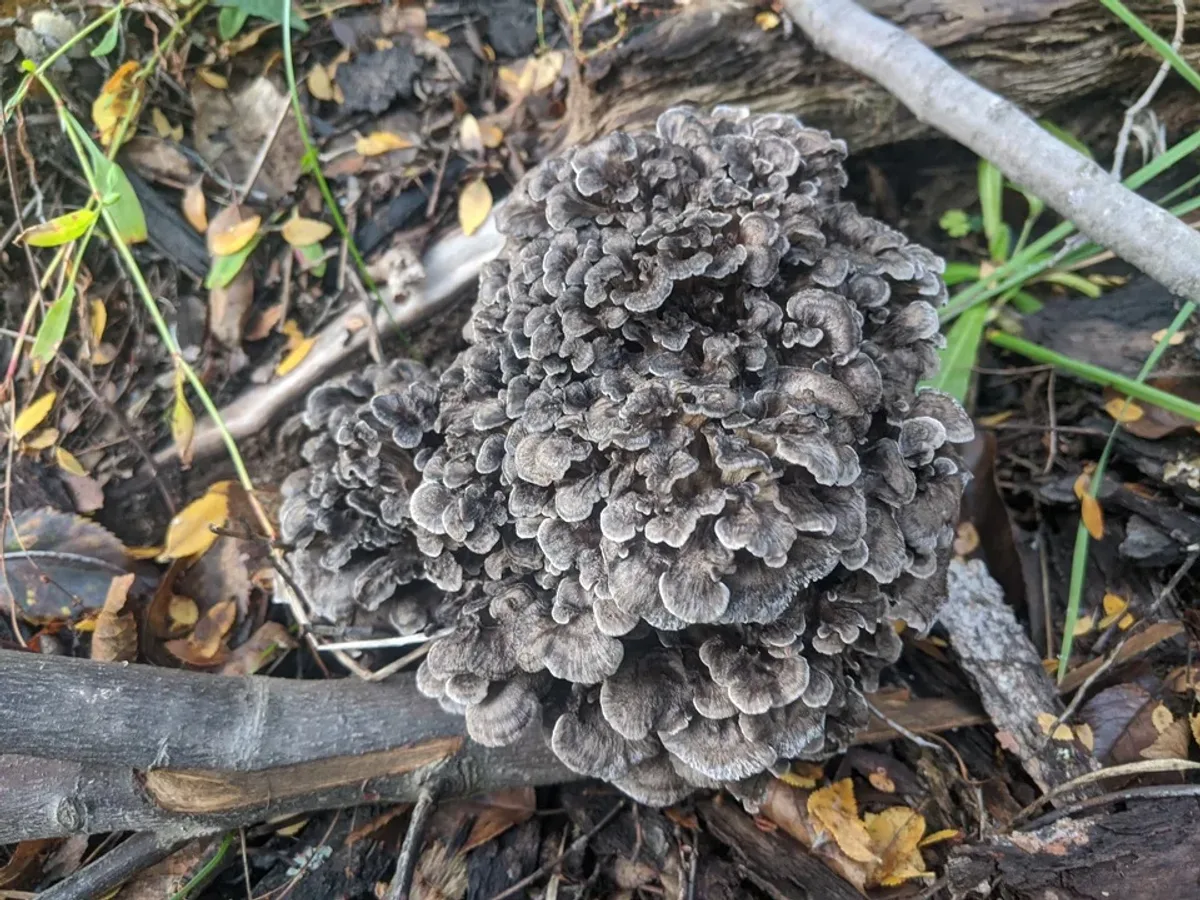
Grifola sordulenta announces itself as a broad, layered mass at the foot of a southern beech - overlapping fan-shaped caps arranged in a loose rosette, each one 3-12 cm wide, all sharing a common branching base that rises from the soil or emerges directly from the trunk. The whole fruitbody can reach 20-40 cm across.
Cap
The upper surfaces are muted and understated: a dull grayish-brown to dingy ochre, earthy rather than eye-catching (the species name 'sordulenta' means just that - somewhat dirty, somewhat dim).
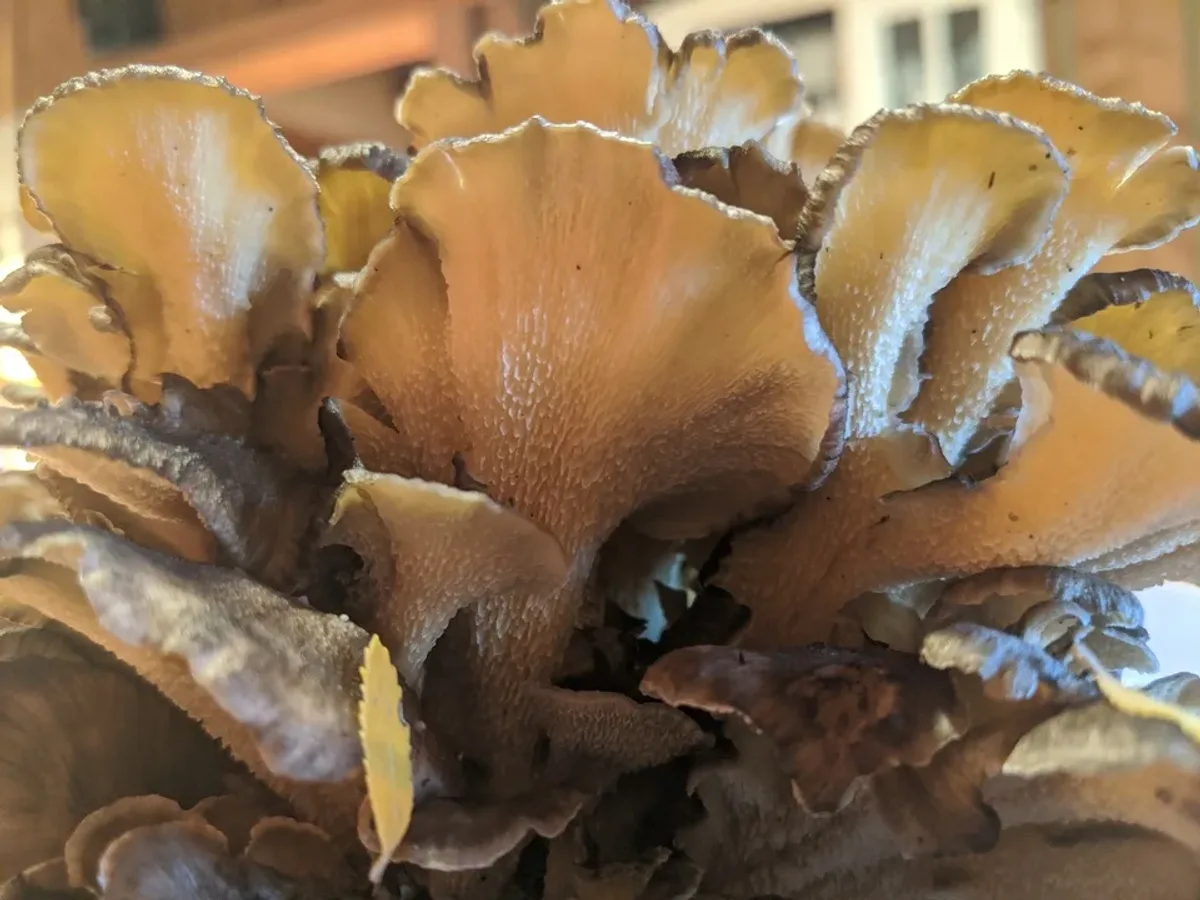
The cap margins are thin and wavy, often lobed and irregular.
Pores
Flip a cap over and you find a clean, white to cream pore surface with small, even pores (3-5 per mm) - unblemished in young specimens.
Flesh
The flesh is white, firm, and fibrous in a radial pattern toward the stem. Cut flesh does not change color.
Smell
One key character: it does not carry the strong sweet almond or marzipan scent of its famous relative Grifola gargal; instead the smell is mild and plainly fungal.
Where & when it grows
Habitat
Grifola sordulenta belongs entirely to the world of Nothofagus - the ancient southern beeches that dominate Patagonian and Andean temperate rainforest. Its mycelium threads through the root system of mature or aging trees, quietly breaking down root wood and lower heartwood with a white rot while the tree still stands.
In that sense it fills almost exactly the same ecological role that its northern relative maitake (Grifola frondosa) fills under oaks in the forests of Japan and eastern North America - the same genus, the same strategy, a hemisphere apart.
Look for it at the base of large, old Nothofagus in humid valley forests, sheltered ravines, and mountain slopes between roughly 400 and 1500 m.
It has been recorded on both deciduous species (Nothofagus obliqua, N. antarctica) and evergreens (N. dombeyi), and on the Nothofagus species of Tasmania and New Zealand as well.
Once the mycelium settles in, it tends to return to the same spot year after year - a productive site can keep giving.
When
Southern Hemisphere autumn is when this fungus shows itself: roughly March through June in Chilean and Argentine Patagonia, peaking in April and May as temperatures cool, soils stay moist from autumn rains, and the deciduous Nothofagus canopy begins to thin.
Fruiting is triggered by soil temperatures dropping below around 15 °C combined with adequate rainfall. In sheltered spots, late fruitbodies can persist into July.
How it grows
The mycelium of Grifola sordulenta lives in the root system of its host for years, breaking down cellulose and lignin - a white rot that can outlast many fruiting seasons.
What appears to be a new mushroom emerging from bare soil is often the visible tip of that long-running underground partnership.
When autumn conditions align, the compound fruitbody develops quickly, expanding over 7-14 days into its full layered form. A good season may bring two successive flushes from the same base if moisture holds.
Fruiting conditions
Fruiting is initiated by cooling autumn temperatures and adequate soil moisture from autumn rains in Patagonian and Andean forests. Soil temperatures dropping into the 6-14 °C range combined with at least 25 mm of rainfall over the preceding two weeks are the typical trigger conditions. Values are standard-mycology estimates derived from observed season and climate; not empirically measured for this species.
Look-alikes
The most likely confusion in Patagonia is with Grifola gargal, the celebrated 'gargal' mushroom. Both are large compound polypores growing at the base of Nothofagus trees in the same region.
The key distinction is scent: G. gargal has a pronounced, unmistakable sweet almond or marzipan aroma both fresh and cooked, whereas G. sordulenta has only a mild, ordinary fungal smell.
Cap color also differs - gargal tends toward whitish-cream or pale buff, while sordulenta is a dirtier, greyer-brown. Both are edible.
Meripilus giganteus, the giant polypore, is a related European species that can superficially resemble Grifola in general growth form, but it is not present in Patagonia. Local Meripilus-like species (if any) would be distinguished by flesh that blackens when bruised or cut, which does not occur in Grifola sordulenta.
No deadly fungus is realistically confused with this species in its Nothofagus forest habitat.
Both grow at the base of Nothofagus trees in Patagonia and are edible. Gargal is distinguished by its strong, unmistakable sweet almond or marzipan aroma - often detectable from meters away - and tends to have paler, more cream-colored caps. Grifola sordulenta lacks this almond scent and has dirtier grey-brown caps. Both are edible, so confusion is not a safety concern, though gargal is more prized culinarily and is an IUCN Endangered species deserving conservation.
Meripilus giganteus is a European species and would not be present in the natural range of G. sordulenta. Any large, compound polypore at the base of trees in Patagonia or southern Australasia that bruises or stains blackish-brown when cut or handled should be treated with caution - Grifola sordulenta does not blacken. Meripilus species are sometimes considered edible when young but can cause gastrointestinal upset; the blackening reaction is the key differentiator from Grifola.
The northern-hemisphere maitake is a close relative and would not normally be encountered in Patagonia or Australasia, where G. sordulenta lives. Morphologically very similar; maitake is associated with oaks in the Northern Hemisphere rather than Nothofagus. Both edible.
In the kitchen
Picking & cleaning
Harvest young fruitbodies when the caps are still firm, the pore surface is pristine white to cream, and before the margins have begun to blacken or the texture has become tough and leathery. Larger, older specimens are often waterlogged, gritty, or insect-ridden.
Cut at the base with a knife, leaving the root system undisturbed to encourage future fruiting.
The overlapping cap clusters trap leaf litter, debris, and occasionally insects; clean thoroughly by separating clusters and brushing or rinsing.
The mushroom keeps for 3-5 days refrigerated and dries reasonably well.
Cooking
As an edible relative of maitake, Grifola sordulenta can be treated similarly in the kitchen:
- Sauté in butter or olive oil.
- Add to soups and stews.
- Incorporate into rice dishes.
The flavor is mild and pleasantly fungal - less complex and aromatic than gargal.
The fibrous, firm texture holds up well to cooking and does not dissolve into mushiness. Pan-frying at medium-high heat produces a satisfying result.
It can be dried and reconstituted, though the flavor is more modest dried than fresh. It pairs well with garlic, onions, herbs, and cream-based sauces.
Good to know
Grifola sordulenta is considered edible and has been collected and eaten in Patagonia and in Australasian Nothofagus forests without reports of toxicity.
It is in the same genus as maitake (G. frondosa) and the celebrated gargal (G. gargal), both of which are well-regarded edibles. No toxins have been identified.
Standard mushroom-foraging precautions apply:
- Cook before consuming; do not eat raw in large amounts.
- Confirm identification before eating, paying particular attention to the scent test to distinguish from gargal.
- Try a small portion first if eating for the first time.
Be aware that conservation context matters: where old-growth Nothofagus forests are under pressure, harvest sparingly.
A reference guide - never an edibility guarantee. When in doubt, leave it out.