Hen of the woods
Grifola frondosa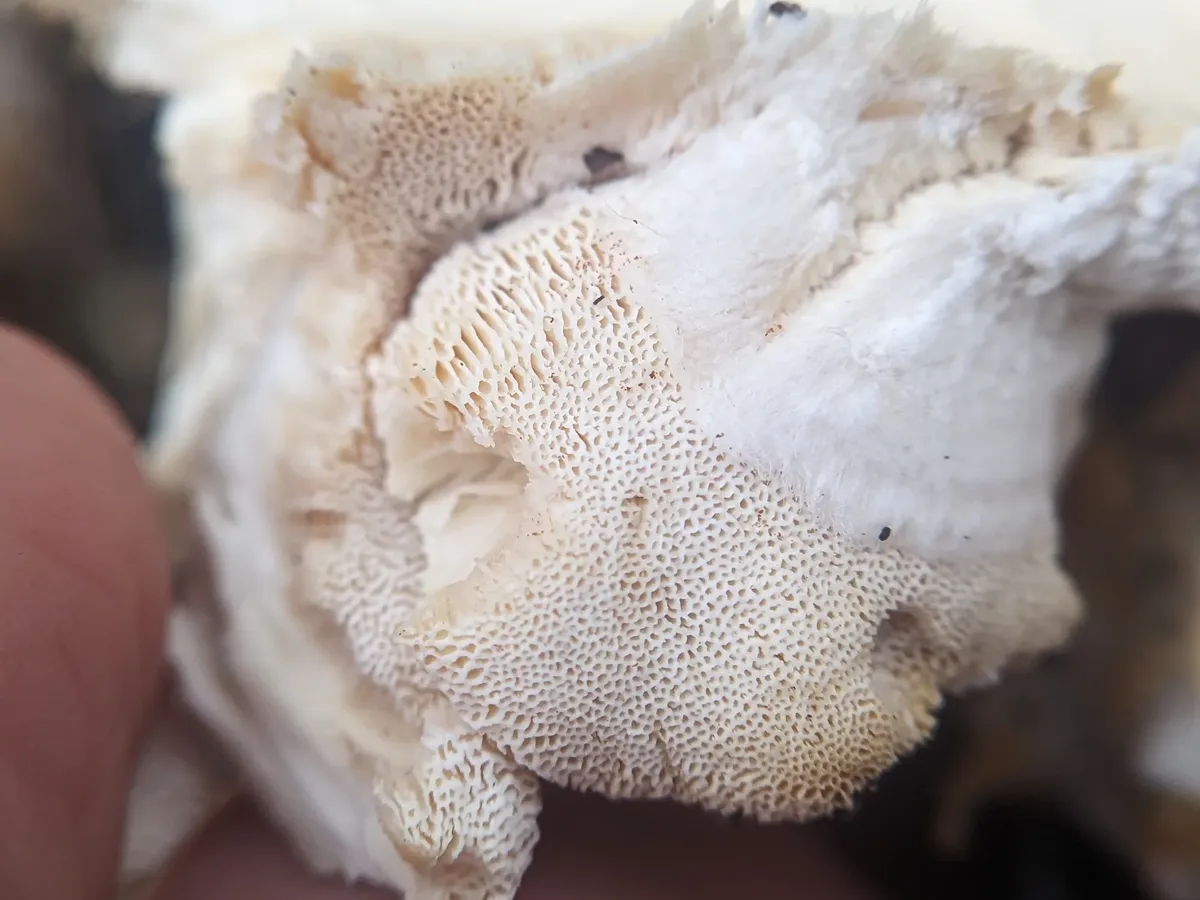 © Tom Sisan (CC BY-SA 4.0)
 © cynthia nocton (CC BY 4.0)
 © Seppo Kallio (CC BY-SA)
 © Seppo Kallio (CC BY-SA)
 © Turo Tuomikoski (CC BY-SA)
 kristen_276 (CC0)
 kristen_276 (CC0)
 Teagan Weiss (CC0)
 janetgraham84new (CC0)
 © Erin Lalime (CC BY 4.0)
 © Dominic McLean (CC BY 4.0)© Tom Sisan (CC BY-SA 4.0)© cynthia nocton (CC BY 4.0)
One of the best mushrooms you can bring home - once you are certain of the identification.
How to recognise it
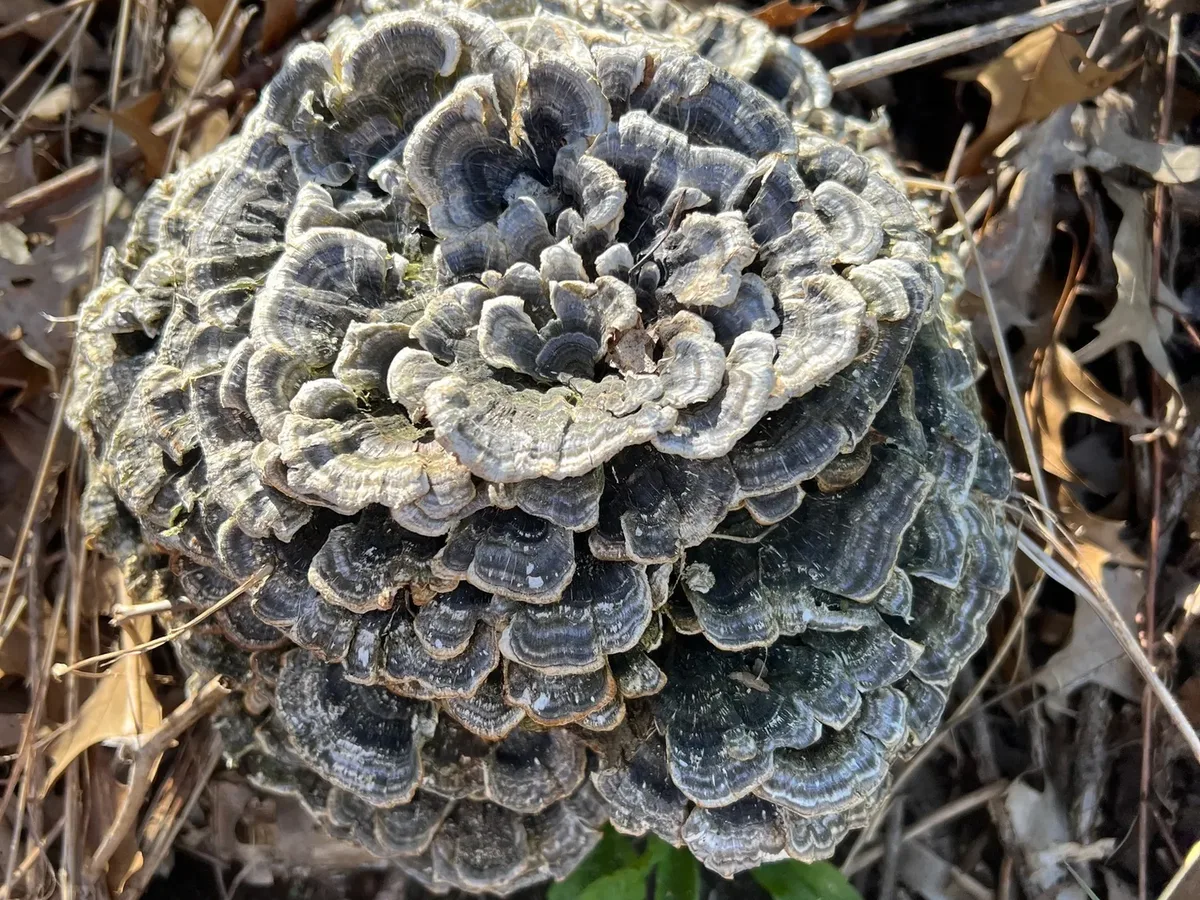
Grifola frondosa is one of the more visually striking fungi of the eastern forest floor, forming large, compound polypore clusters that can be spotted from a considerable distance.
A complete cluster can reach 20-60 cm across and weigh 1.5-15 kg; there are documented Japanese specimens exceeding 45 kg from ancient oaks.
Cap
Each individual cap is spoon- or fan-shaped, 2-10 cm wide, with a surface that ranges from pale grey to dark greyish-brown, often with faint concentric zoning.
The margins are distinctly wavy and lobed, giving the whole cluster a ruffled, layered look that earned the mushroom its English name.
Stem
All the caps share a common, branching stem system that converges at a single basal attachment point - pull one frond back and you can trace its stalk down through the cluster to the central mass.
Pores
Turn any cap over and the underside is white to pale cream, covered in tiny round pores running 1-3 per millimetre; these pores extend partway down the stalk.
The spore print is white.
Flesh
The flesh is white, firm when young, and does not change colour when cut or handled.
Smell & taste
Fresh specimens carry a distinctive smell: rich, nutty, and faintly earthy with a mild spicy undertone that concentrates in the oven.
Aged specimens lose this aroma and develop a sour, unpleasant odour - a reliable cue for passing them by.
Where & when it grows
Habitat
In eastern North America, Grifola frondosa grows almost exclusively at the base of mature oaks, especially red oak (Quercus rubra). It will occasionally colonise other hardwoods such as maple, elm, and beech, and it readily fruits on stumps and buried root systems of felled trees.
It is a wood-decay fungus, not a mycorrhizal partner: it causes white rot, selectively decomposing the lignin in the heartwood of its host while leaving the cellulose largely intact.
This decay process can weaken a tree structurally over many years, making the mushroom a low-grade parasite that eventually shifts to saprotrophic breakdown once the host dies.
The fruiting body always emerges from the root collar or from roots at or just below soil level, never from the main trunk or from branches.
In urban and suburban parks, old oaks that have fruited reliably for years become well-known spots among local foragers.
West of the Rocky Mountains the species is uncommon; east of the Mississippi it is considerably more abundant, with the Appalachian foothills, the Great Lakes region, and the Mid-Atlantic states offering the most consistent populations.
When
The main fruiting season runs from late August through November, with the peak varying by latitude and elevation.
- Midwest and Great Lakes: the flush typically centres on September and early October.
- Further south, including Texas and the Gulf Coast: the season shifts slightly earlier, with some finds in late August.
- Mid-Atlantic coast and southern Appalachians: October is the heart of the season.
Like many polypores, maitake requires a combination of cooling air temperatures and sufficient soil moisture: conditions that commonly coincide with the first sustained autumn rains after summer heat breaks.
Because the sclerotium beneath the host persists year after year, a single tree can produce clusters at very similar calendar dates across multiple decades, making phenological records from a known spot genuinely predictive.
Fruitbodies can appear within seven to fourteen days of a triggering rain event once soil temperatures have dropped into the 10-20 °C range.
How it grows
Grifola frondosa is classified as a white-rot saprotroph and weak parasite: it secretes enzymes that dismantle the lignin and hemicellulose in living or recently dead hardwood while leaving cellulose fibres more intact.
The visible fruitbody is only the reproductive tip of a much larger and longer-lived organism.
Beneath the soil, embedded in the decaying root system of the host tree, sits the sclerotium - a compact, potato-shaped or irregular mass of hardened mycelial tissue, sometimes the size of a human fist or larger, that stores nutrients and water through unfavourable seasons.
This structure can persist for decades, allowing the same genetic individual to fruit from the same tree for a human lifetime or beyond.
The sclerotium is the reason experienced foragers mark their trees: the mycelium is not starting from scratch each year but resuming from a pre-positioned reserve.
When conditions align - adequate soil moisture and the right temperature window - the mycelium in the sclerotium rapidly differentiates and pushes up the compound fruitbody. The entire cluster can expand from a small nub to full size in as little as five to ten days.
A single host oak may support several clusters simultaneously at different points around its base.
Fruiting conditions
Fruits in cooling autumn conditions following autumn rains; a perennial sclerotium returns at the same host tree year after year.
Look-alikes
Grifola frondosa has no dangerous lookalikes. All species that could plausibly be confused with it are either edible or simply inedible, and the combination of white pores, branching grey-brown caps, oak substrate, and white non-staining flesh is diagnostic.
The three species most likely to be encountered alongside it are all worth knowing.
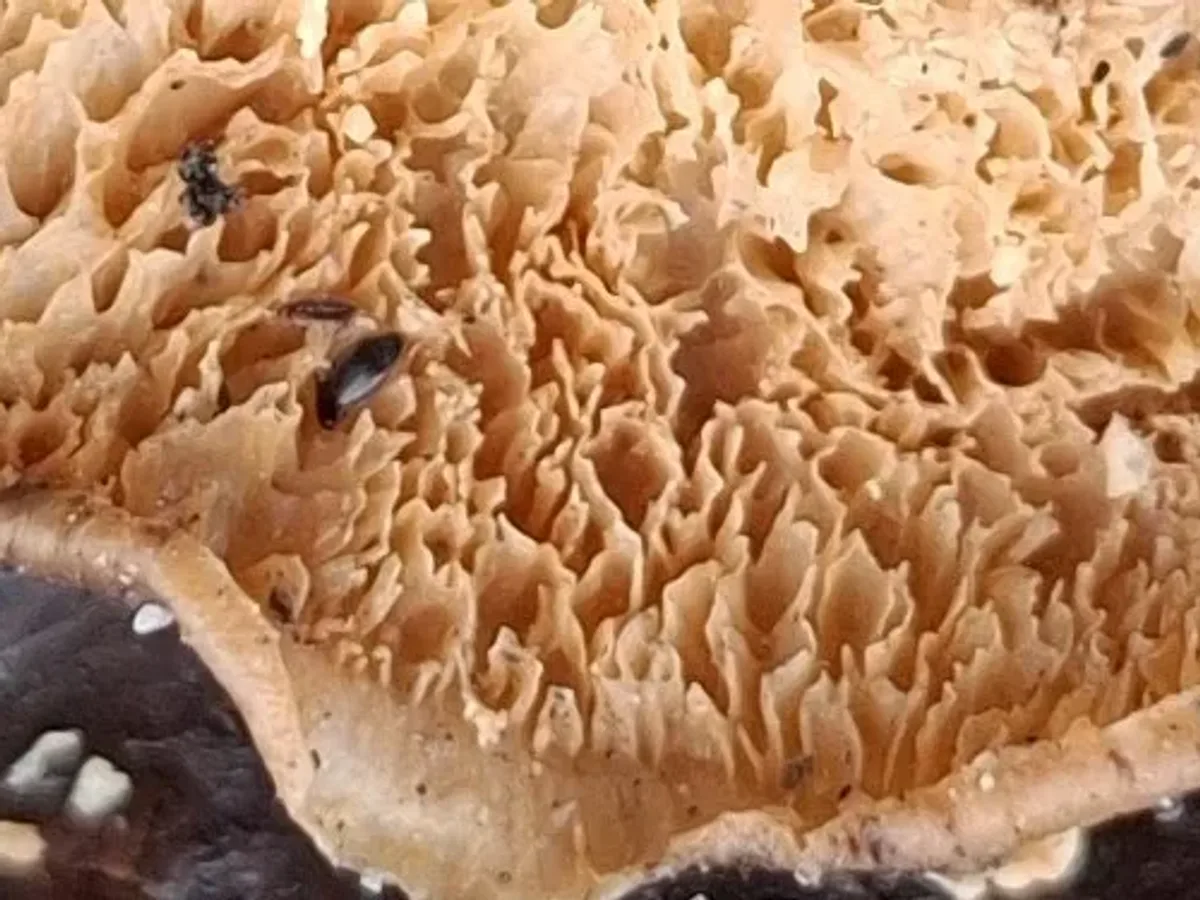
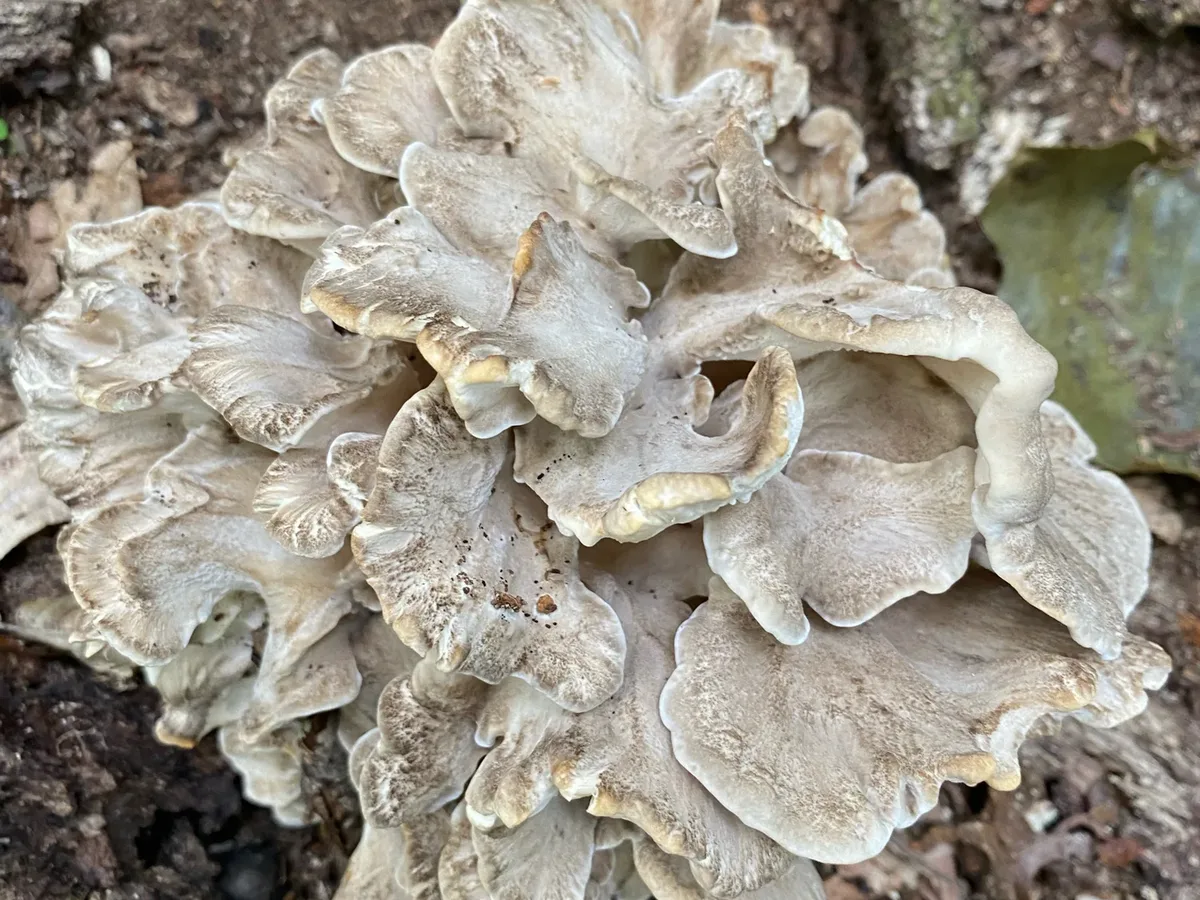
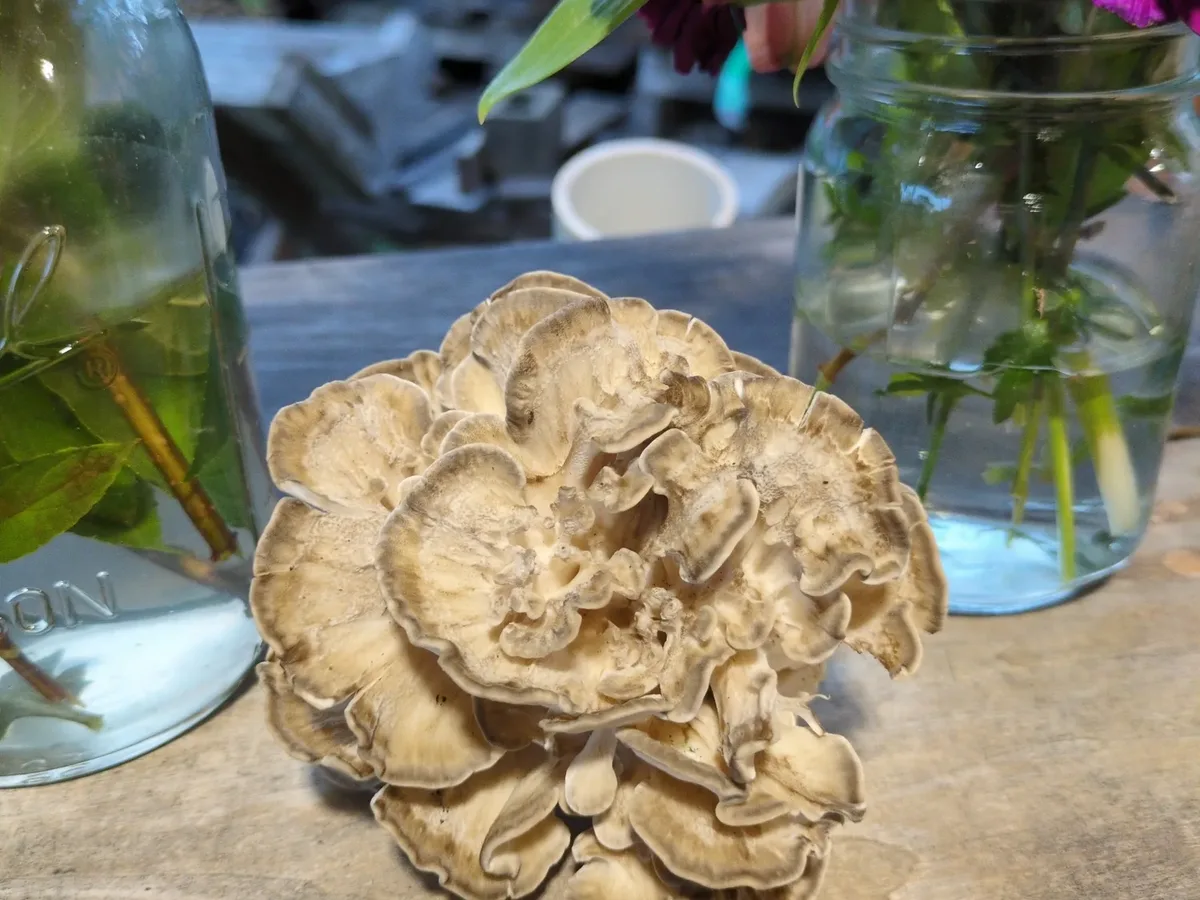
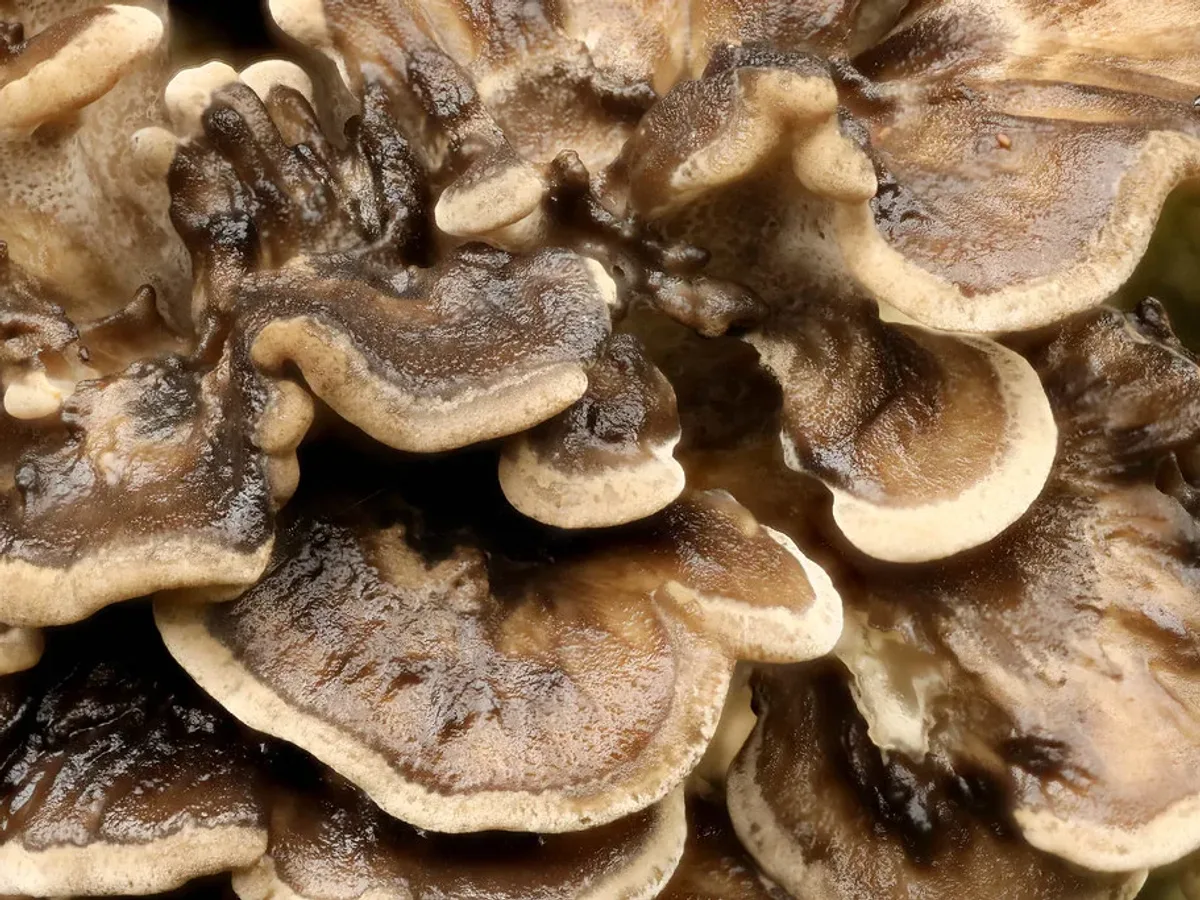
- Blackening polypore (Meripilus sumstinei) is very similar in its compound, overlapping cap structure and habitat preference, but the caps and flesh bruise and stain dark brown to black within minutes of handling - a reaction absent in Grifola frondosa; it is edible when young though notably inferior.
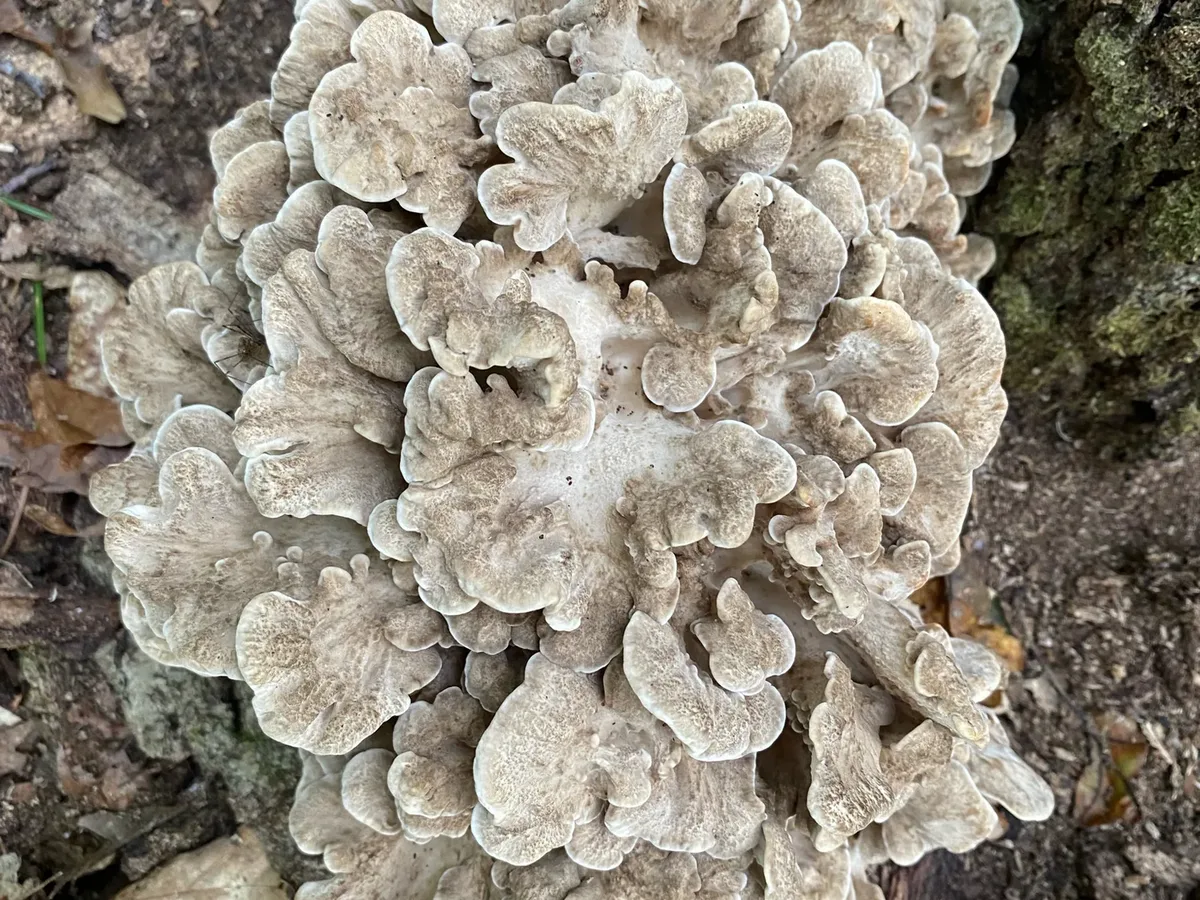
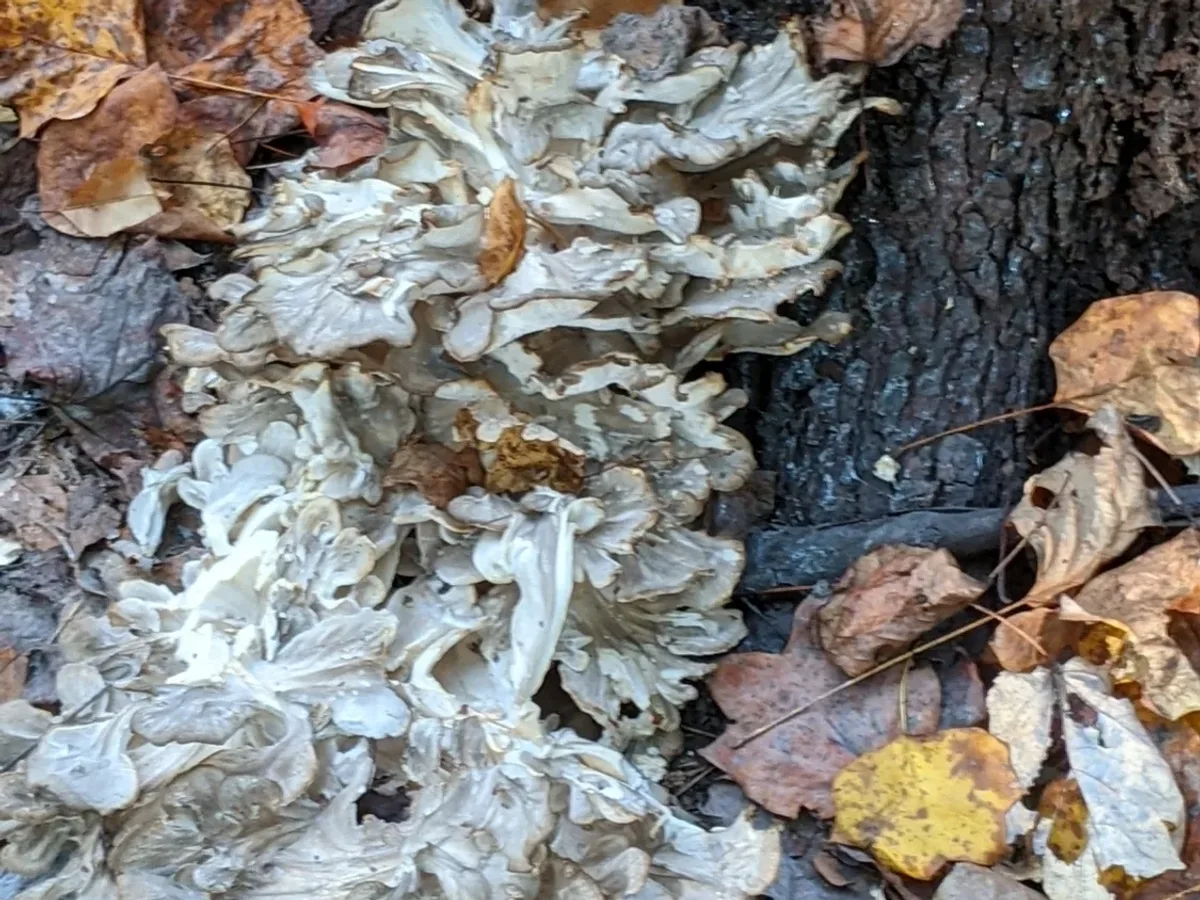
- Berkeley's polypore (Bondarzewia berkeleyi) produces similarly large clusters at the base of oaks, but the individual caps are much larger (often 10-25 cm each), cream to pale tan rather than grey-brown, and distinctly thick-fleshed; it is edible when young but quickly becomes tough and bitter.
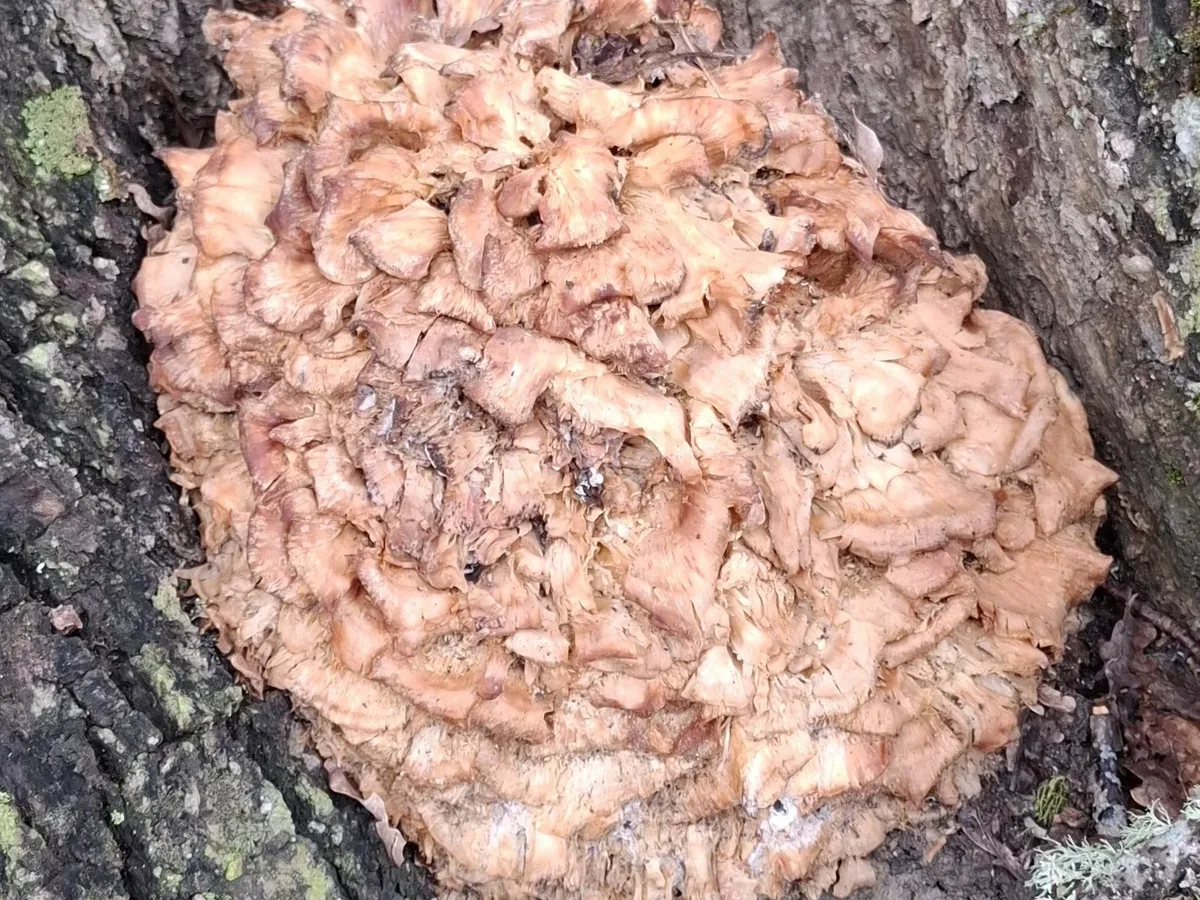
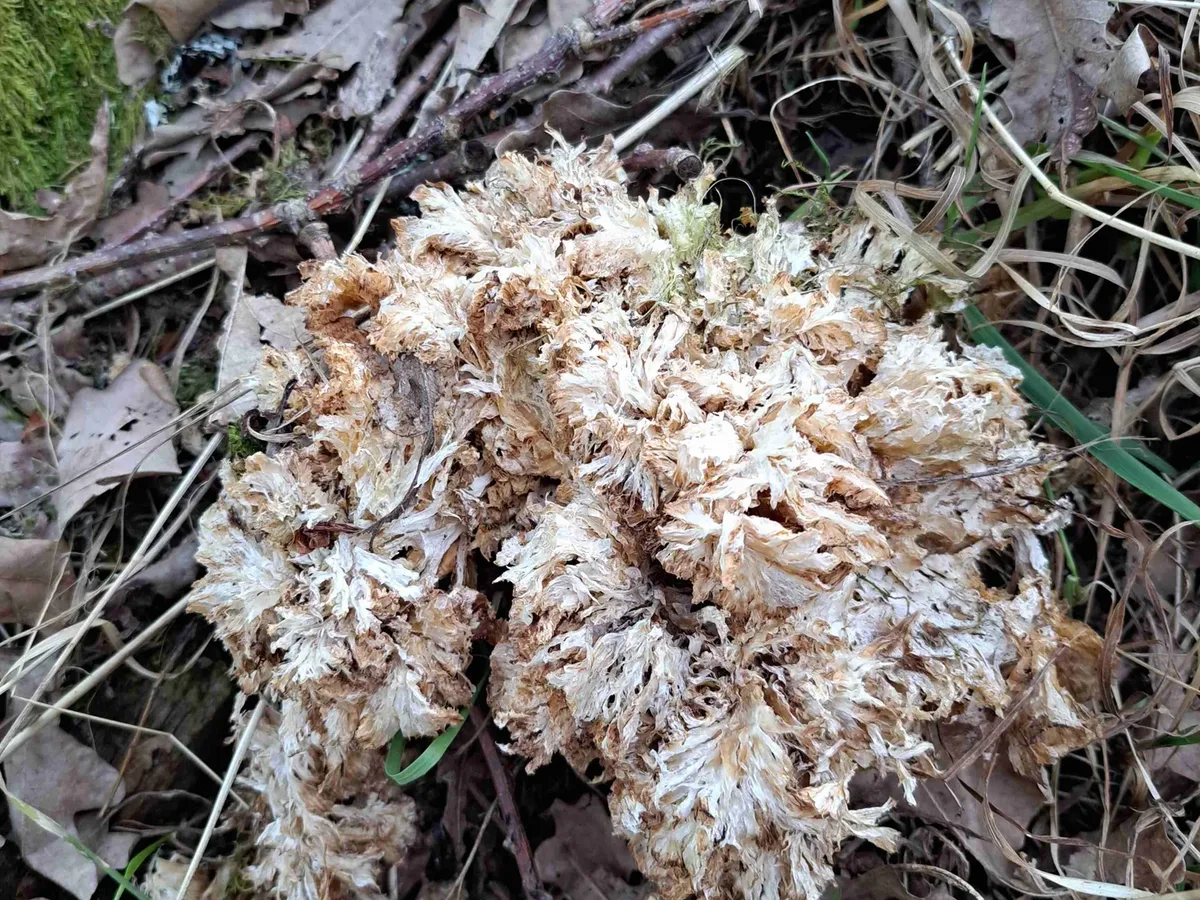
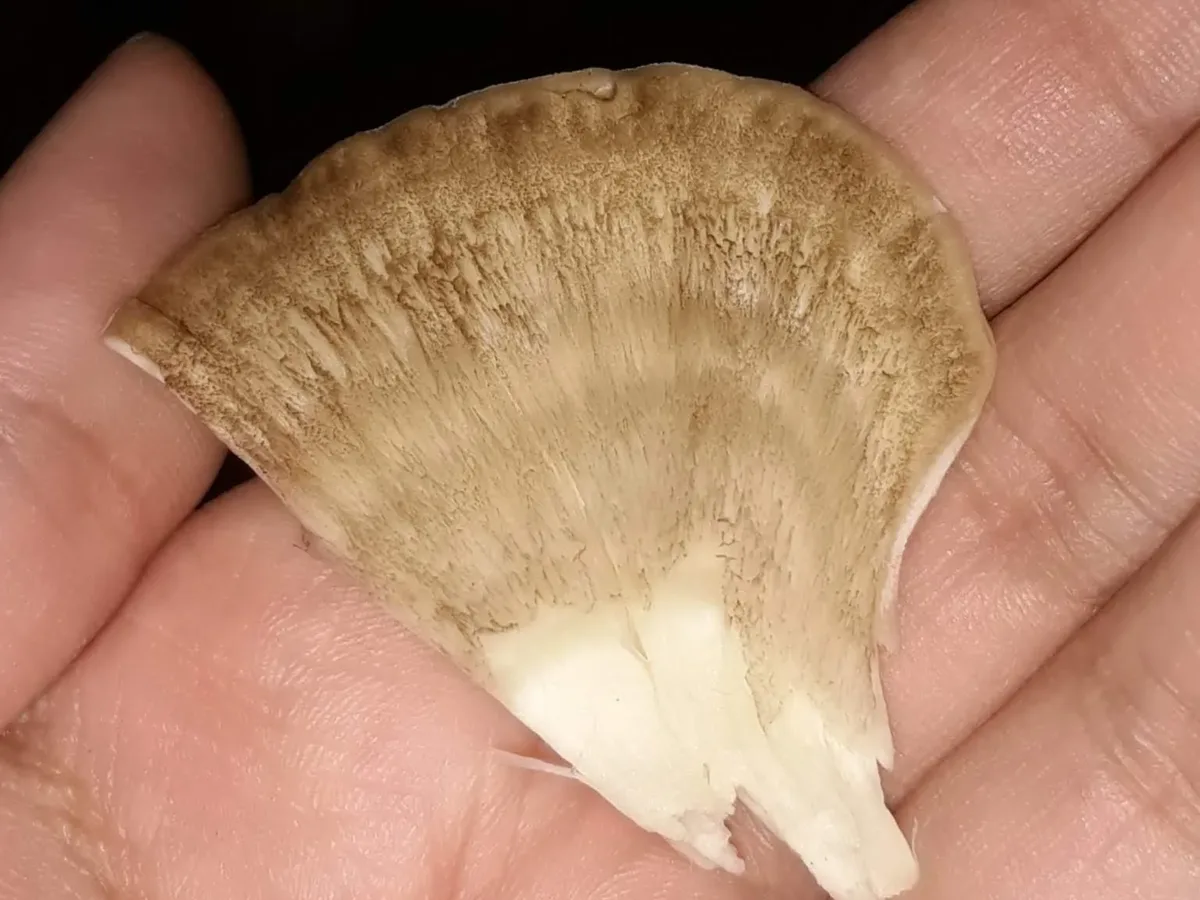
- Eastern cauliflower mushroom (Sparassis spathulata) grows from oak roots but its fronds are flat, ribbon-like, and cream-coloured rather than spoon-shaped and grey, giving it a crinkled noodle-like appearance; it too is edible.
None of these share the specific grey-brown colouration and small-capped rosette form of true maitake. Because maitake is a pore fungus, any strongly gilled mushroom at the base of a tree is something else entirely.
An edible lookalike; thick-fleshed and cream-coloured.
An edible lookalike that blackens when touched.
An edible lookalike with ribbon-like folds rather than spoon-shaped capped fingers.
In the kitchen
Picking & cleaning
Harvest the entire cluster by cutting through the central stalk at its base, as close to the ground as practical, without disturbing the sclerotium underneath.
A single clean cut with a stiff knife is preferable to twisting or pulling, which can damage the mycelium and the sclerotium.
Prioritise specimens that are pale, firm, and pleasantly aromatic - the lighter the colour of the individual caps, the more recently they have expanded, and the more tender and flavourful the flesh will be.
Darker, wetter-looking clusters that have been out for more than a week often harbour insect larvae in the deeper fronds; separate the cluster into individual "fingers" back at camp and inspect for tunnelling before cooking.
Debris - leaf litter, bark fragments, soil - clings readily to the dense pore surfaces, so a systematic check is worthwhile.
Rinsing under cool running water works well for muddy specimens; dry with a clean cloth or spin-dry.
The mushroom stores well for three to five days in a paper bag in a refrigerator. It also freezes cleanly both raw and after a brief sauté, making it one of the more practical wild species for bulk harvests.
Cooking
Maitake has a firmer, more substantial texture than most gilled wild mushrooms, and it holds together well through a wide variety of cooking methods, making it one of the more kitchen-friendly wild species.
Separating the cluster into individual fronds before cooking dramatically increases the surface area exposed to heat, which drives off moisture quickly and allows the edges to crisp.
The most straightforward preparation is oven-roasting:
- 1Lay the separated fronds on a baking sheet.
- 2Coat lightly with olive oil.
- 3Season with salt.
- 4Roast at 200-220 °C until the margins are deep golden brown and crunchy, roughly 20-25 minutes.
The texture at this point is something between a roasted vegetable and a potato chip at the edges, with a meaty, chewy centre.
Maitake is also excellent in a ripping-hot cast-iron pan with butter, garlic, and fresh thyme; the high heat produces the same crisping at the edges.
Japanese culinary tradition uses it in miso soup, hot-pot (nabe), tempura, and as a rice-cooker addition (maitake gohan), where the fungi infuse the rice with an earthy, umami depth.
The mushroom freezes well both raw and after partial cooking, and dehydrates cleanly, rehydrating to a texture close to fresh.
Avoid prolonged braising in acidic liquids, which tends to make the texture rubbery rather than meaty.
Good to know
Grifola frondosa is considered an excellent edible with a long culinary history in Japan and increasingly in North America. But a small proportion of individuals experience gastrointestinal sensitivity - nausea, mild stomach cramps, or loose stools - particularly when consuming large quantities or eating the species for the first time.
This is not an allergic reaction in the clinical sense but a sensitivity that diminishes with repeated exposure for most people.
The standard precaution applies: eat a modest portion the first time you encounter this species and wait 24 hours before consuming more.
All wild polypores, including maitake, should be cooked thoroughly before eating; raw or undercooked specimens are more likely to cause digestive upset.
There are no dangerous lookalikes in eastern North America, and the species cannot be mistaken for any deadly fungus.
Individuals taking blood-thinning medications or immunosuppressants should be aware that maitake contains beta-glucans with documented immunomodulatory activity. The culinary doses involved are small, but this is worth noting for people on complex medication regimens.
A reference guide - never an edibility guarantee. When in doubt, leave it out.