Southern Bracket
Ganoderma australesyn. Ganoderma europaeum Steyaert, Ganoderma adspersum (Schulzer) Donk, Polyporus adspersus Schulzer, Fomes australis (Fr.) Cooke, Boletus australis Fr.
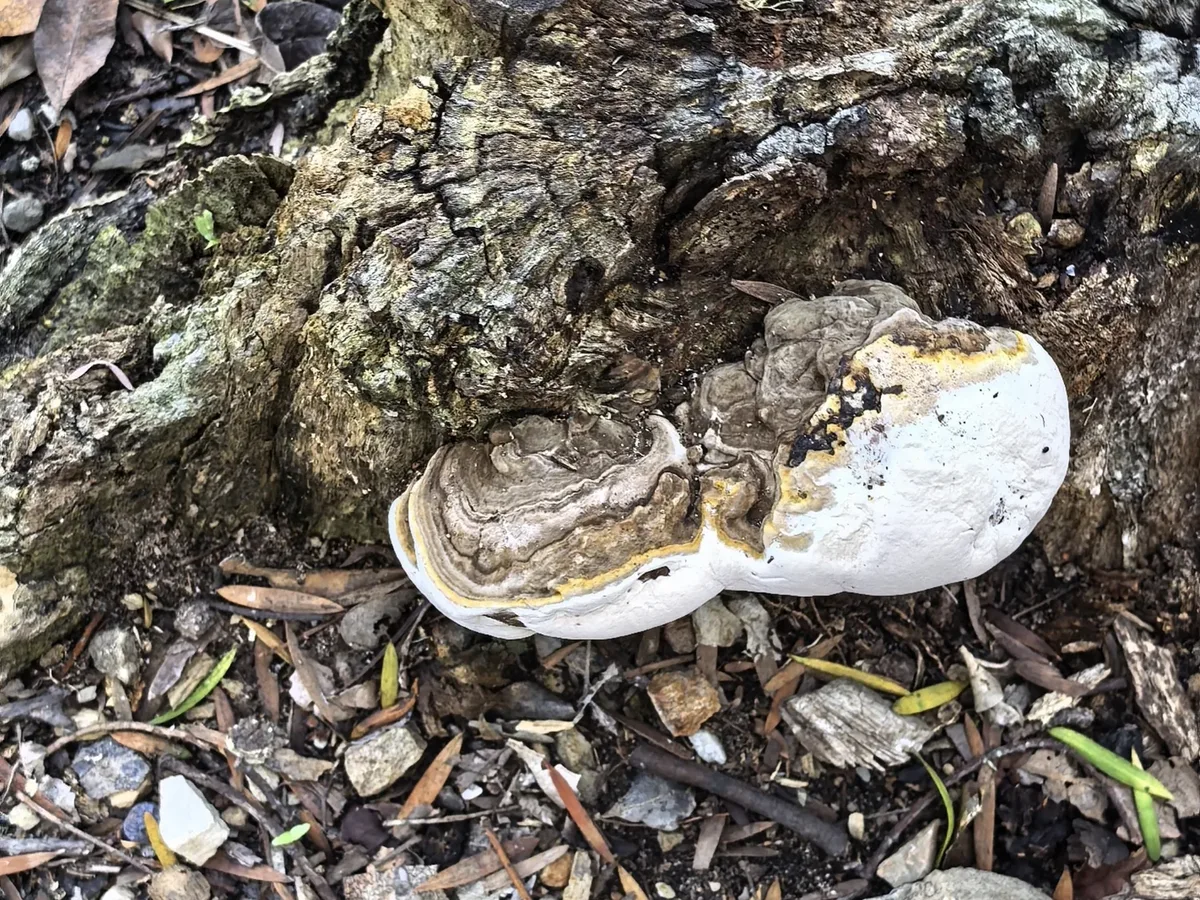 Di Turner (CC0)
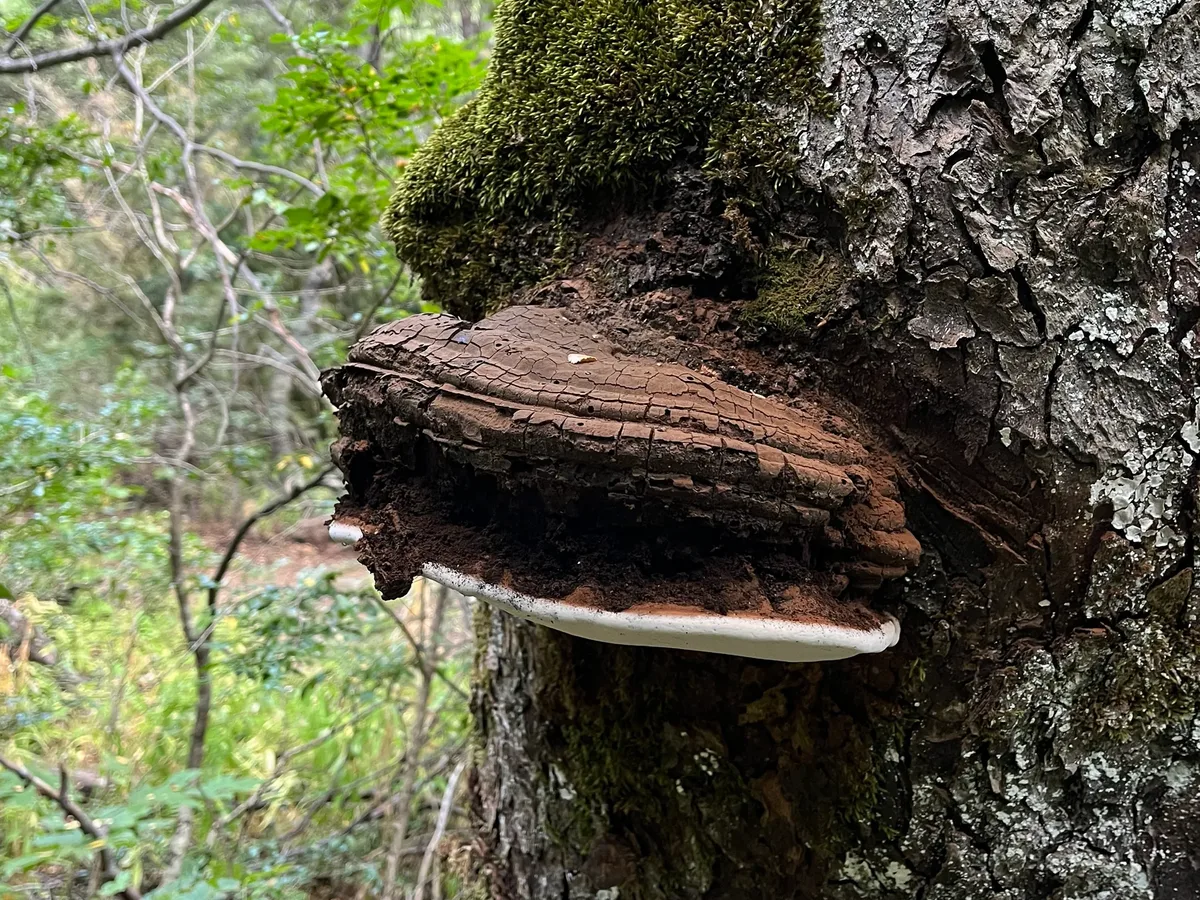 © Cristian Riquelme (CC BY)
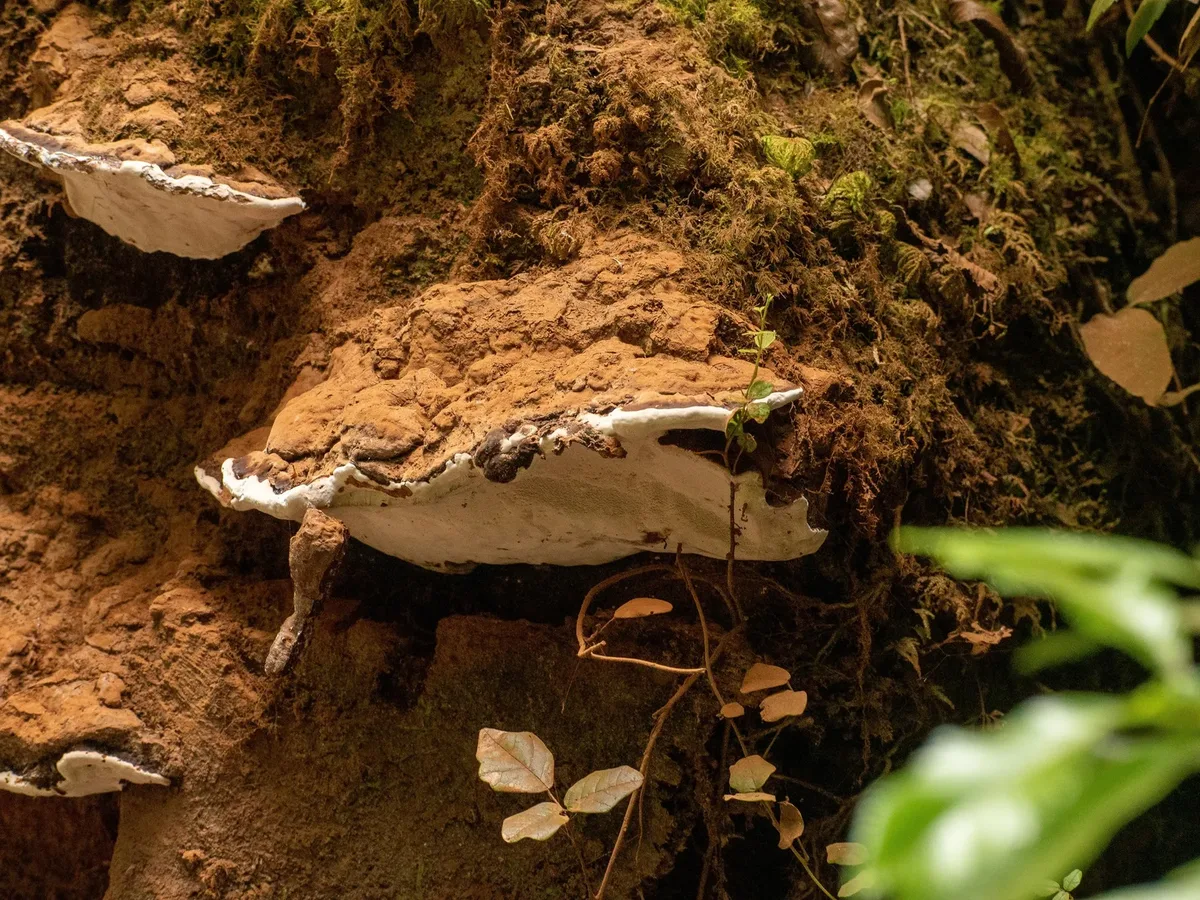 © Ezequiel Racker (CC BY)
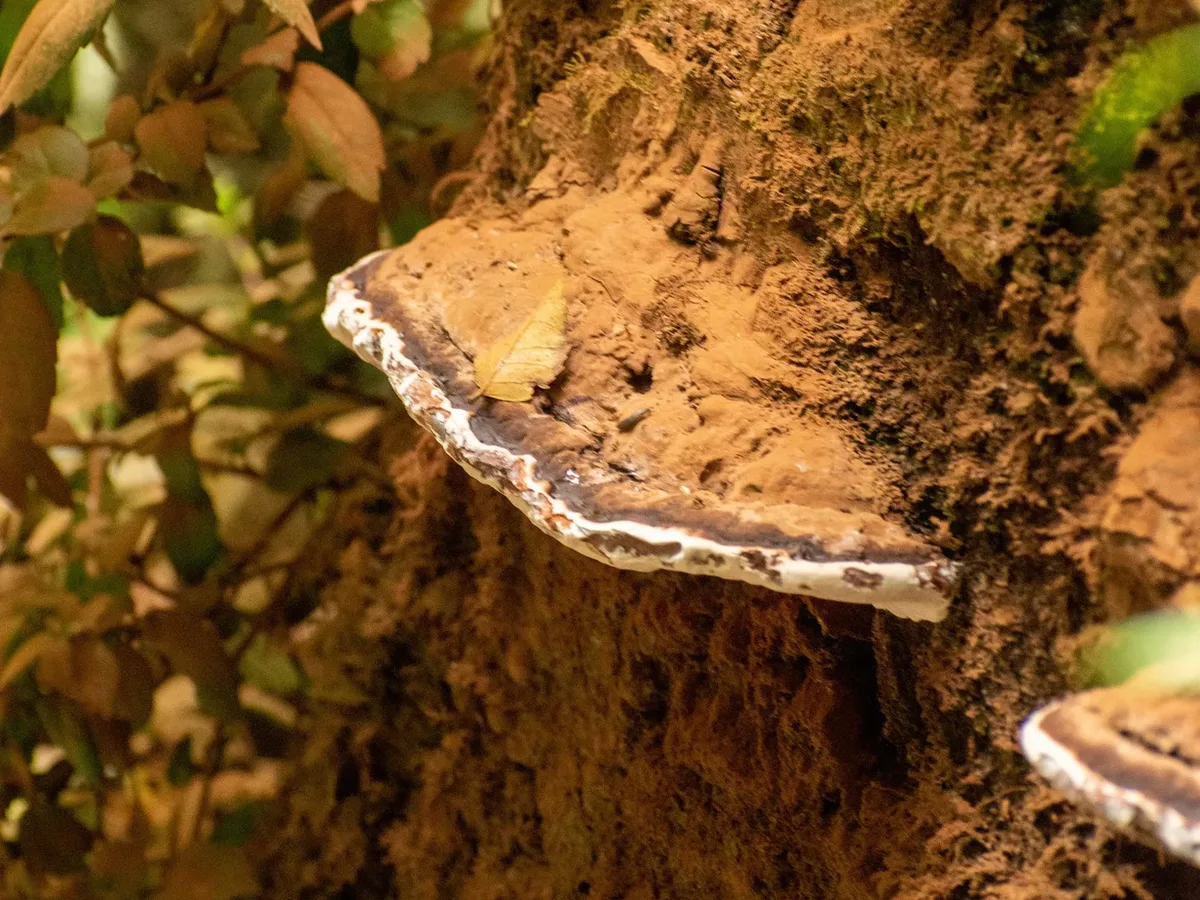 © Ezequiel Racker (CC BY)
 © Ezequiel Racker (CC BY)
 © Matthew Rozanoff (CC BY)
 Nutri Gabi Barrera (CC0)
 Nutri Gabi Barrera (CC0)Di Turner (CC0)© Cristian Riquelme (CC BY)
Not poisonous, but not worth eating - too tough, bitter, or bland for the pot.
How to recognise it
Ganoderma australe is a fruitbody built on a geological timescale. Each year the same bracket adds a new centimetre or two to its depth and a new ring to its grey-brown upper surface, so a large specimen on an old Nothofagus or Fagus may be 50-80 cm across and weigh several kilograms, representing decades of steady growth.
Cap
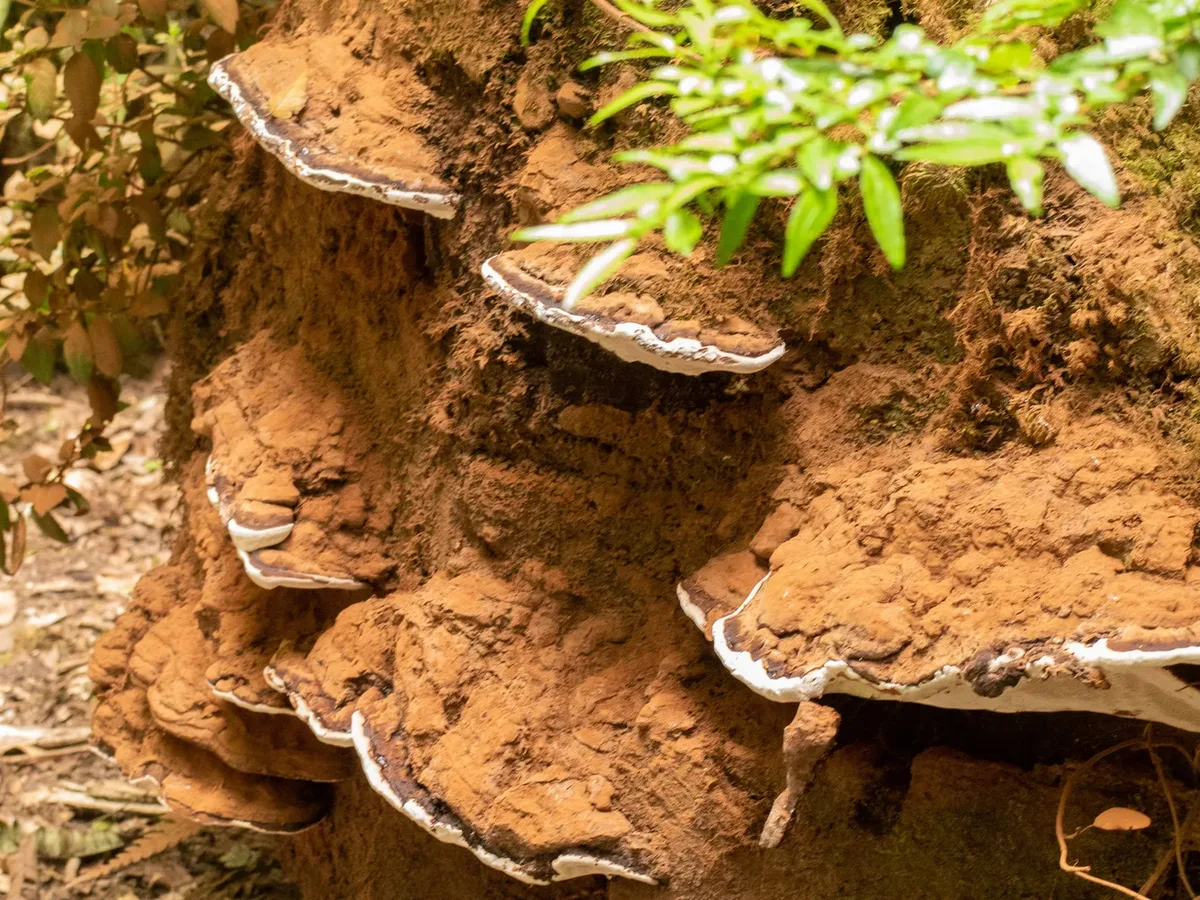
The shape is a hoof- to shelf-like semicircle, broadly attached and entirely without a stem.
The upper face is concentrically ridged and grooved in concentric zones of grey to umber-brown, often coated in summer with a heavy deposit of the species' own chocolate-brown spore powder, which is produced in such quantities that it visibly dusts the ground and nearby vegetation beneath the bracket.
Pore surface
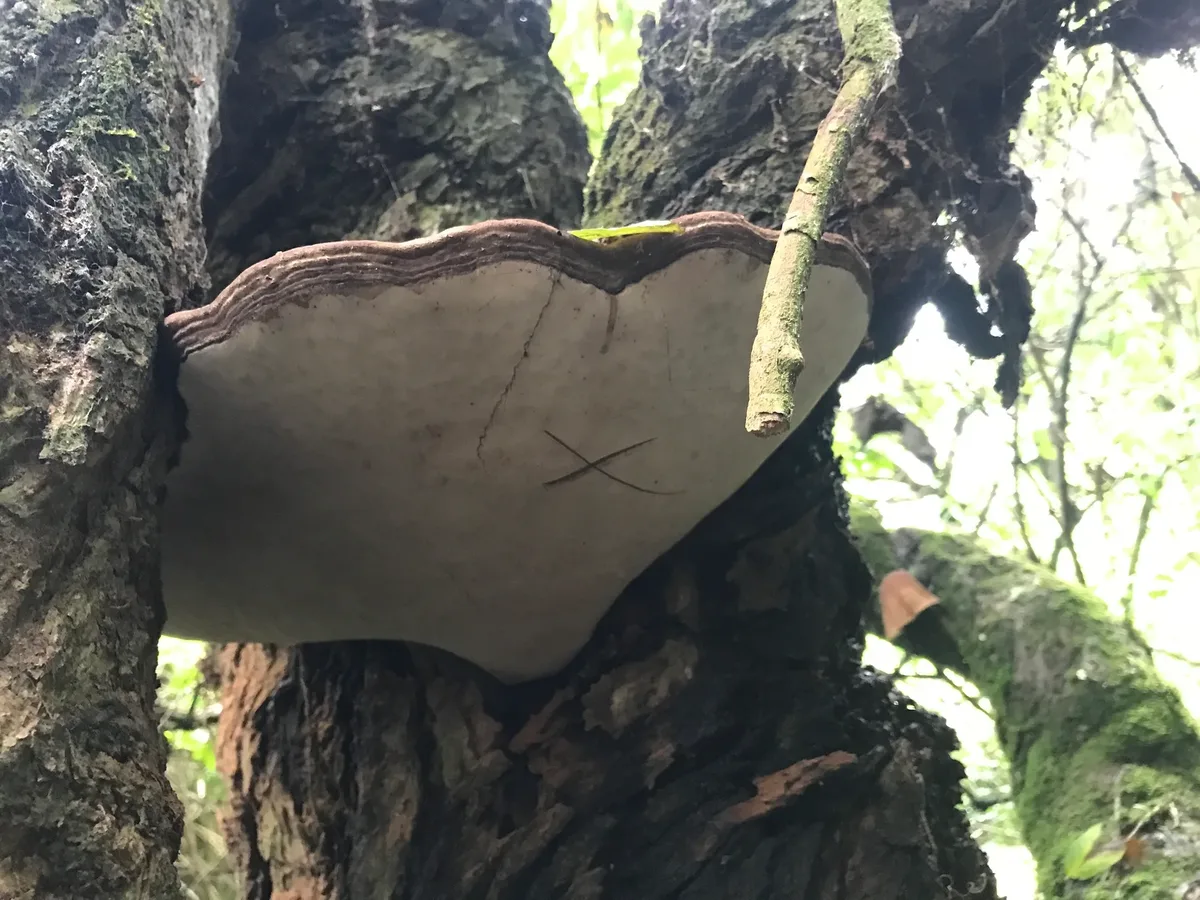
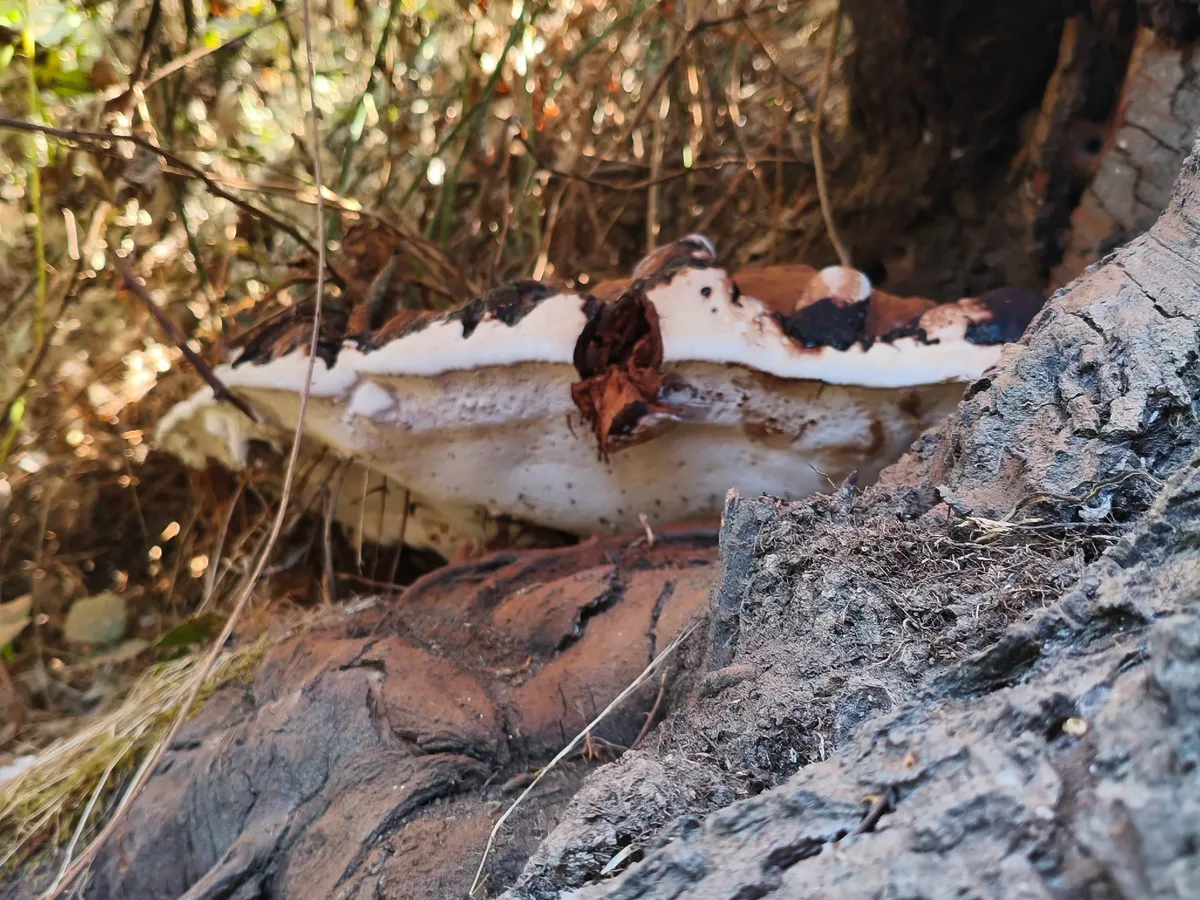
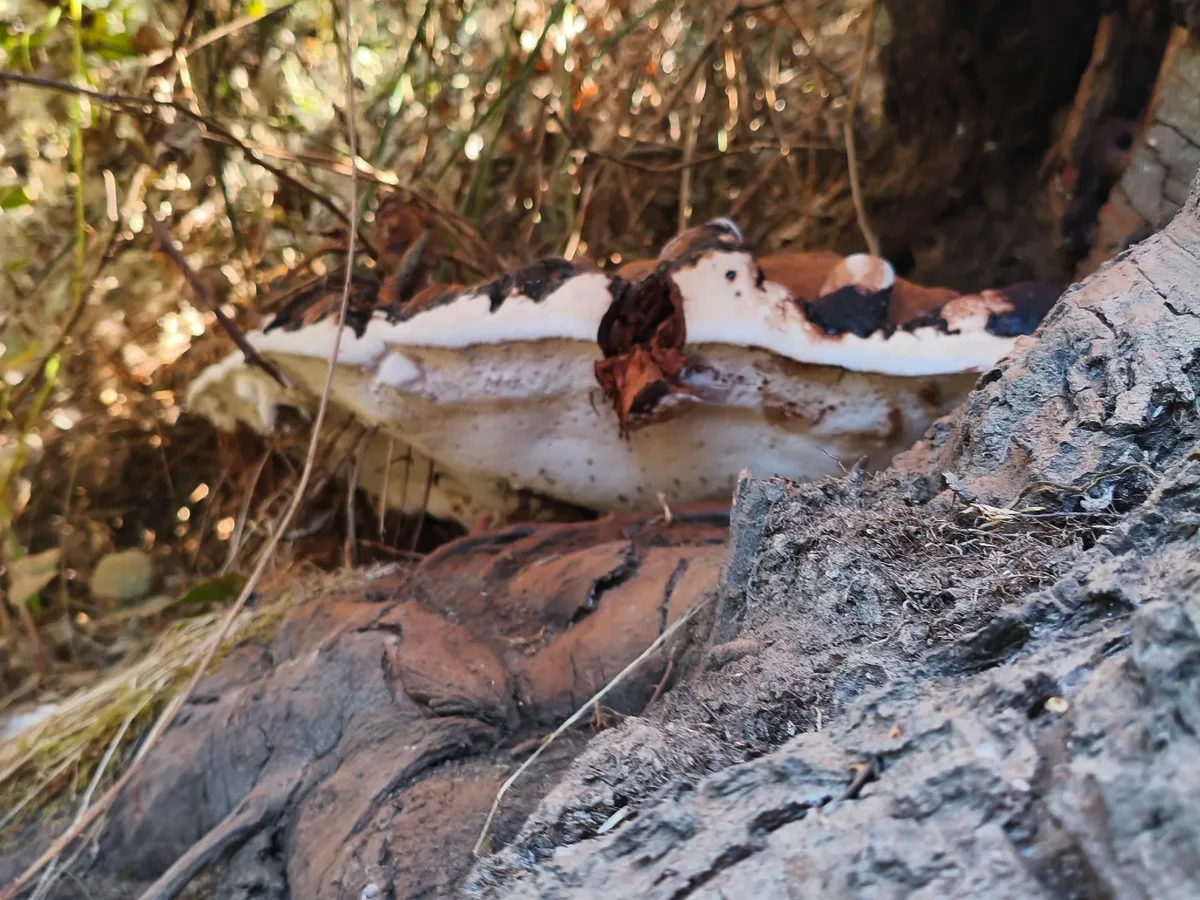
Press the back of a fingernail against the fresh cream-white pore surface underneath and a dark brown mark appears instantly. This bruising response is faster and more dramatic than in any closely related species and makes identification in the field almost certain for anyone who knows to look for it.
Flesh
Cut through the bracket and you see the layered history of its life: pale tubes stacked annually in a series of cream-to-tan bands through the corky brown flesh, like growth rings in timber. The flesh itself is fibrous and hard; there is no culinary value here, only structural biology.
Where & when it grows
Habitat
In Australia and New Zealand this species is a familiar companion of old-growth Nothofagus (southern beech) rainforest and eucalypt woodland alike, occupying the ecological niche that G. applanatum holds in the Northern Hemisphere.
It colonises living trees through wounds, root damage, and natural cracks in the bark, then slowly decomposes the wood from the inside outward via a white rot that breaks down both cellulose and lignin. Because it can persist in the same tree for decades without killing it outright, it is as much a part of the forest structure as the trees themselves.
In parks and gardens across Auckland, Sydney, and Melbourne, it appears on the bases and lower trunks of ornamental plane trees, eucalypts, and acacias, sometimes startling urban walkers who have never encountered such a large bracket.
In temperate South America it follows the Nothofagus forest southward into Patagonia. In Europe it replaces - or overlaps with - G. applanatum on beech and oak in warm, humid deciduous woodland.
Look for it:
- low on trunks
- at the root collar
- on stumps
- on fallen logs of large-diameter hardwoods
When
Because each fruitbody is perennial, there is no single season in the conventional sense - a bracket present in midwinter was also present in summer and will be present next year.
What does follow a seasonal pattern is the bracket's activity. In the Southern Hemisphere, new tube growth on the underside is most vigorous in late summer and autumn (roughly February-May), accompanied by peak spore release.
At this time the cream margin is soft, the pore surface is brightest white, and the brown spore haze beneath may be dense enough to colour water runoff. By winter the new tube layer has hardened.
The most visually obvious encounter is when the chocolate-brown spore deposit on the upper surface reaches its maximum in mid-to-late summer. A bracket that looked dull and grey-brown in the cooler months suddenly appears dusted with cocoa powder, and this is often how people first notice the species.
How it grows
Growth is slow, steady, and relentless. Each growing season adds a new tube layer to the pore surface and widens and thickens the pileus. The pale cream-buff growing margin at the outer edge represents the current year's expansion.
Brackets can live for 20-40 years or more, reaching truly remarkable dimensions on long-lived host trees.
The mycelium within the wood is equally long-lived and far more destructive than the visible bracket suggests: white rot progressively hollows the heartwood and sapwood, reducing structural integrity.
A large mature bracket on a living urban tree is therefore not merely an interesting fungus - it is a reliable indicator of significant internal decay. Tree surgeons and arborists treat its presence as a flag for structural risk assessment.
Fruiting conditions
A perennial wood-decay species; new tube growth is driven not by soil moisture in the conventional sense but by sustained warmth and ambient humidity following wetting events. In Australian temperate eucalypt and Nothofagus forest, new tube growth begins in late summer after warm, humid periods (typically February-April in the Southern Hemisphere). Peak sporulation coincides with the warmest months. Because the bracket persists year-round, the 'flush lag' refers to new annual tube layer initiation rather than bracket emergence from ground mycelium. In cooler or drier periods, sporulation slows but the fruitbody does not die.
Look-alikes
The most important confusion risk is with Ganoderma applanatum (artist's conk), which is the closest relative and occupies the same ecological niche in the Northern Hemisphere.
The two species are mycologically distinct - G. australe has significantly larger spores (11-14 × 7-10 µm versus 6-8.5 × 3.5-5.5 µm), a more rapidly and intensely bruising pore surface, and tends to be the dominant species on large hardwoods in the Southern Hemisphere and in parts of southern Europe - but they are essentially identical to the naked eye. In Europe both species can occur, and their distributions overlap. For foragers, this distinction is irrelevant since neither is edible.
Other brackets to know:
- Ganoderma lucidum and its relatives (reishi group) differ clearly in having a brilliant lacquered or varnished upper surface in shades of reddish-maroon to orange-red, a lateral stem, and an annual rather than perennial fruitbody.
- Ganoderma resinaceum (resinous polypore) has a more reddish-brown, sometimes lacquered cap and is also stemless but is more southern European.
- Inonotus hispidus (shaggy bracket) is rusty-brown, soft-fleshy when young, hairy-bristly, and annual; it does not bruise brown and lacks the hard, layered flesh of Ganoderma.
- Phellinus spp. (fire sponges, Fulvifomes group) are also hard, perennial, and shelf-like on hardwoods, but have a brown to grey-brown upper surface with a typically cinnamon-brown or rusty-brown pore surface and distinct finely dissepiment-walled tubes; the pore surface does not bruise brown when scratched.
None of the realistic lookalikes in the Ganoderma australe complex are acutely toxic or deadly.
The closest relative and effectively identical to the naked eye; distinguished reliably only by spore size under microscope (G. applanatum: 6-8.5 × 3.5-5.5 µm; G. australe: 11-14 × 7-10 µm) and by geographic emphasis (G. applanatum predominates in Northern Hemisphere temperate woodland; G. australe is dominant in the Southern Hemisphere). Both are inedible, non-toxic, perennial, sessile brackets with grey-brown upper surface and white pore surface that bruises instantly brown. The distinction does not affect any safety or edibility decision.
Distinguished clearly by the brilliant lacquered or varnished reddish-maroon to orange-red upper surface, a distinct lateral or eccentric stem, annual (not perennial) fruitbody, and smaller overall size. G. lucidum is a stemmed species; G. australe is always sessile (stalkless). If a bracket has a varnished gloss and a stem, it is not G. australe.
A southern European species on large oaks and chestnuts; perennial and sessile like G. australe but may show a more reddish-brown to orange-brown tinge on the upper surface, sometimes with a slight resinous gloss; pore surface also bruises brown; flesh and tubes similar. Separation in the field is difficult without microscopy. Neither species is edible or toxic.
Annual (not perennial), softer and fleshy when young, with a rusty-orange to rust-brown upper surface covered in coarse, shaggy, bristle-like hairs; flesh brown and soft, exuding amber droplets when young; pore surface does not turn brown when scratched. Becomes black and crusty with age. No layered history in the flesh. Also inedible but less likely to be confused closely.
Hard, hoof-shaped, perennial bracket on oak and other hardwoods; upper surface grey to grey-brown and concentrically ridged, similar in outline; pore surface cinnamon-brown to rust-brown (NOT white bruising dark), lacking the instantaneous dark-brown bruise of Ganoderma. Flesh cinnamon-brown, fibrous. Spore deposit, if present, is white to pale, not cocoa-brown. The brown pore surface is the quick separator from G. australe.
In the kitchen
Picking & cleaning
There is no reason to collect Ganoderma australe for food; it is not edible. The flesh is corky-woody and completely indigestible whether raw, boiled, or roasted.
Unlike the medicinally prized G. lingzhi and G. lucidum, G. australe has no established medicinal tradition, and its biochemical profile - while containing some of the same polysaccharide classes - has not been validated for human therapeutic use.
It is, however, collected by natural artists who use the white pore surface as a drawing medium. Gentle pressure from a fingernail, pencil point, or stylus leaves a permanent dark-brown mark, and detailed pictures can be 'etched' into the surface, which then hardens as the bracket dries. Collected brackets also serve well as display specimens and for spore prints.
If you do collect for artistic purposes, cut cleanly from the wood with a knife rather than wrenching, as the bracket is firmly anchored and tearing can damage both the specimen and the bark.
Good to know
Ganoderma australe is not poisonous. It contains no known acute toxins, and there is no record of illness resulting from touching or being near this fungus.
It is, however, entirely inedible. The flesh is too tough and woody to be eaten in any conventional culinary sense, and it has no established edible or medicinal tradition analogous to the reishi group.
Do not confuse it with medicinally valued Ganoderma species such as G. lingzhi or G. lucidum, and do not self-administer it as a medicinal supplement on the basis of a family resemblance to them.
The vast quantities of brown basidiospores released by mature brackets can be an irritant to the respiratory tract if inhaled in quantity, particularly for individuals with asthma or fungal spore allergies. Avoid disturbing large sporulating brackets or standing directly downwind.
From a tree-health perspective, a bracket on a garden or street tree warrants consultation with a qualified arborist: the white rot it produces can cause significant structural weakness even in trees that still appear healthy externally.
A reference guide - never an edibility guarantee. When in doubt, leave it out.