Dwarf bell
Galerina pumilasyn. Agaricus pumilus (Pers.) Fr., Galerina hypnorum var. pumila (Pers.) Singer, Galera pumila (Pers.) Quél.
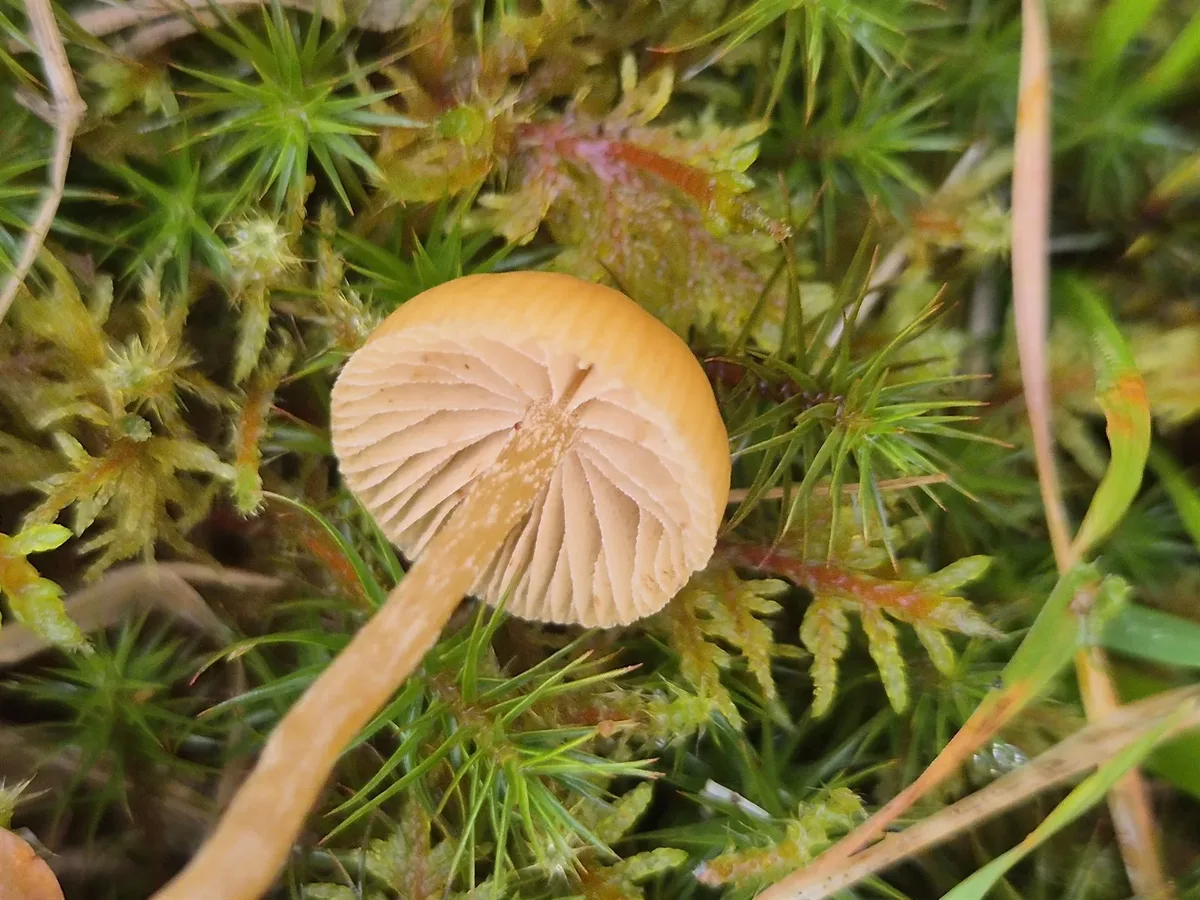 © Per Gerhard Ihlen (CC BY)
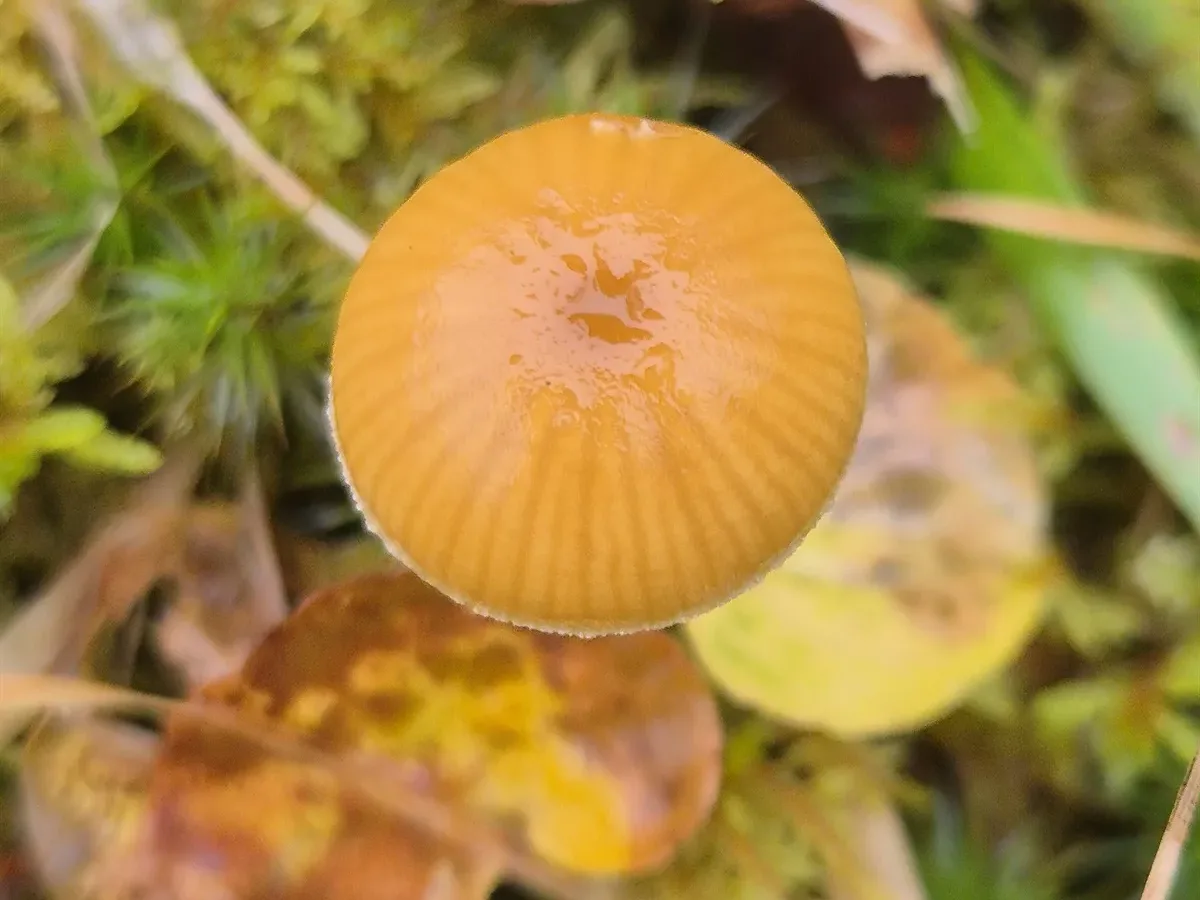 © Per Gerhard Ihlen (CC BY)© Per Gerhard Ihlen (CC BY)© Per Gerhard Ihlen (CC BY)
Toxic - and the most serious cases can be fatal. Never eat it, and wash your hands after handling.
Never eat a mushroom you are not 100% sure of - check the look-alikes below, and always cook wild mushrooms.
How to recognise it
Galerina pumila is tiny even by Galerina standards. The cap rarely exceeds 2 cm across and often stays under 1.5 cm.
Its silhouette - a narrow bell that opens to convex with a persistent central bump (umbo) - is the shape to recognise.
The most important visual feature is hygrophanous colour change: when the cap is wet it is a warm, saturated ochre-brown to honey-tawny, but as it dries it bleaches concentrically from the margin inward to a dull straw-buff.
A single cap can simultaneously show two colours - dark disc and pale margin - when partially dry, and this two-toned effect in a tiny bell-shaped cap amid moss is as close to a field character as this species offers.
The gills are pale at first and age to rusty cinnamon-brown.
The stem is extremely thin (often pencil-thin or narrower), fragile, and usually lacks any ring. The absence of a ring is a normal feature of this species; it does NOT indicate it is a safe species to eat.
Taking a spore print - rusty brown, like cinnamon powder - is the single most reliable field step beyond recognition of the habitat.
Why it's dangerous
Amatoxin poisoning is a medical emergency. Do not wait for symptoms to develop. If ingestion is suspected - even a single fruitbody - go immediately to the nearest emergency department.
- Bring a specimen, photograph, or any remaining material.
- State the estimated time of ingestion.
Treatment is intensive supportive care:
- intravenous rehydration
- early administration of activated charcoal (if within 1-2 hours of ingestion)
- continuous monitoring of liver and kidney function
- silibinin infusion (where available as a specific treatment)
- N-acetylcysteine
- in cases of fulminant hepatic failure, urgent assessment for liver transplantation
Early intervention dramatically improves prognosis; delay past the 'apparent recovery' phase is associated with significantly worse outcomes.
In Nordic countries, contact the national Poisons Information Centre immediately:
- Sweden - 08-33 12 31
- Finland - 09-471 977
- Norway - 22 59 13 00
- Denmark - 82 12 12 12
Toxin
Alpha-amanitin and beta-amanitin - amatoxins. These are bicyclic octapeptide cyclopeptides that act as highly potent inhibitors of RNA polymerase II, the enzyme that transcribes DNA into messenger RNA in eukaryotic cells.
By blocking mRNA synthesis they halt protein production in actively metabolising cells. The liver and kidneys - the organs that concentrate and excrete the toxin - suffer the greatest damage:
- hepatocellular necrosis (death of liver cells)
- in severe cases, acute tubular necrosis in the kidney
The toxins are water-soluble and heat-stable.
After absorption through the gut wall they undergo enterohepatic recirculation (repeated cycles of absorption, liver uptake, bile excretion, intestinal reabsorption), which prolongs tissue exposure, delays elimination, and extends the toxic episode well beyond the initial dose.
This recirculation is one reason why the delayed, multi-phase clinical presentation of amatoxin poisoning is so treacherous.
Symptoms
Amatoxin poisoning from Galerina pumila follows the same three-phase clinical course as Death Cap (Amanita phalloides) poisoning.
- 1PHASE 1 - latent period (6-24 hours after ingestion): no symptoms at all. This long silence is deceptive and is the most dangerous feature of amatoxin poisoning: the absence of immediate symptoms leads victims to believe no harm was done, delaying help-seeking.
- 2PHASE 2 - gastroenteritis phase (begins 6-24 hours): sudden onset of explosive cholera-like gastroenteritis, including severe abdominal cramps, profuse watery or bloody diarrhoea, vomiting and rapid dehydration. Without rehydration, cardiovascular collapse is possible. Symptoms last 12-24 hours.
- 3PHASE 3 - apparent recovery (24-72 hours): gastrointestinal symptoms subside and the patient feels better. Liver enzyme levels (AST, ALT) are rising, however, indicating ongoing hepatocellular damage. This apparent recovery is particularly dangerous as it may lead to premature discharge from medical care.
- 4PHASE 4 - organ failure (days 3-7 and beyond): progressive jaundice, coagulopathy (failure of blood clotting as liver synthetic function collapses), hypoglycaemia, hepatic encephalopathy, and fulminant liver failure. Renal failure may co-occur. Death or urgent liver transplantation follows in the most severe cases.
The 6+ hour delay before any symptom appears is the toxicological hallmark, and the reason the causal link between mushroom ingestion and illness is so often missed - especially for a tiny mushroom few people recognise.
Staying safe
TREAT AS LETHAL. Chemical analysis of Galerina pumila specimens has confirmed the presence of amatoxins (alpha-amanitin and beta-amanitin) - the same deadly cyclopeptide toxins that make the Death Cap (Amanita phalloides) and Funeral Bell (Galerina marginata) the leading causes of fatal mushroom poisoning worldwide.
The toxin is present throughout the fruitbody, is completely heat-stable, and is not destroyed by cooking, boiling, drying, pickling or freezing. There is no known antidote.
Even a few grams of fresh material may contain a clinically dangerous dose.
The genus Galerina should be treated as uniformly deadly by default - there are no safe edible species. The tiny size of G. pumila does not reduce danger: amatoxin dose-per-gram of tissue is high.
If this or any unidentified small brown mushroom has been ingested, treat it as an emergency:
- go immediately to hospital with a specimen or photograph
- note the time of ingestion
- do not wait for symptoms
Where & when it grows
Habitat
Galerina pumila occupies humid, mossy ground rather than the decaying wood that typifies its close relatives. Look for it in thick moss cushions on old lawns, heathland, bog edges, and forest floor clearings.
It is especially characteristic of nutrient-poor, semi-natural habitats: the species thrives where moss has had decades to build up a spongy layer. Sphagnum bogs and wet heathland are strongholds in the Nordic region.
Unlike G. marginata, the substrate is not visibly woody - fruitbodies seem to emerge from moss or humus - but the mycelium may be feeding on fine organic debris trapped in the moss.
The habitat is often shared with other small LBMs: Mycena species, small Coprinus-allies, Galerina hypnorum, and others.
The combination of tiny size, mossy habitat, and rusty-brown spore print is the defining fingerprint.
When
Late summer to late autumn. In Scandinavia and the Nordic region the main flush begins in August-September as temperatures drop from summer highs and autumn rain arrives, with peak fruiting in September and October.
Fruitbodies emerge in flushes following rain events and are short-lived: they may be fully gone within a week. Multiple brief flushes occur through the season.
The species can be difficult to observe because its fruitbodies are so small and transient - a careful observer visiting the same moss patch over several weeks may catch two or three flushes that a casual visitor would miss entirely.
How it grows
Saprotrophic, growing from moss substrate, buried fine debris, and accumulated organic material in dense turf and peat. Not mycorrhizal.
The white mycelium threads its way through the moss mat, quietly recycling leaf fragments, dead moss stems, and bark dust that accumulate in damp ground cover - a slow, hidden work that can persist for years in an undisturbed moss patch before a flush of fruitbodies suddenly surfaces.
Fruitbodies emerge singly or in scattered groups (sometimes gregariously in larger numbers), never in the tight dense clusters typical of Hypholoma or Kuehneromyces.
The ecology of the moss mat means populations can be widespread and diffuse, with fruitbodies spread across a large area rather than concentrated on a single stump.
Fruiting conditions
Requires cooling autumn temperatures and adequate moisture to trigger fruiting. The soil temperature dropping below about 15 °C in combination with at least 15 mm of rain in the preceding two weeks is the primary trigger in Nordic regions. Slightly lower minimum rain requirement than woodland wood-rotters because the moss substrate retains moisture well. Flush lag of 4-9 days reflects the slow pace of mycelial activation at cool temperatures. Repeated brief flushes follow successive rain events through the autumn.
Look-alikes
Galerina pumila's closest and most dangerous lookalike is Galerina marginata (Funeral Bell), which also contains lethal amatoxins and can grow in mossy forest habitats where it appears similar to G. pumila.
G. marginata is typically somewhat larger, usually has a persistent membranous ring on the stem, and is more strictly associated with decaying wood - but the ring can be absent in young specimens or worn away in wet conditions, and both species occur in forest-edge settings.
Never use presence or absence of a ring as a safety argument: treat all small rusty-spored bell-caps in moss as potentially deadly.
Galerina hypnorum (Moss Bell / Mossslöjskivling) is a very closely related and frequently confused species - essentially the same ecological guild, also growing in moss, and also suspected or confirmed to contain amatoxins in at least some specimens. Both must be treated as deadly.
Other species that share the habitat can be separated:
- Mycena species (bonnets) frequently share mossy habitats but have a white spore print, not rusty-brown, and their gills remain pale or grey rather than turning rusty cinnamon.
- Marasmius and Marasmiellus species growing in turf are tougher, dry-shrinking caps that revive when wetted and have white spore prints.
- Agrocybe pediades (Common Fieldcap / Ängsskivling) grows in similar grassy habitats but is stouter, has a cap without striations, browner-duller spore print (not bright rust), and lacks the bell shape.
The definitive safeguard is a spore print: rusty-brown means Galerina must be in the differential, and no Galerina should be eaten.
Galerina marginata is closely related and equally deadly, containing the same lethal amatoxins. It is typically somewhat larger (cap 1-4 cm), more strictly associated with decaying wood (stumps, logs, buried wood), and usually bears a persistent membranous ring on the stem. However, the ring can be absent in young specimens or eroded by rain, and both species can occur in forest-edge habitats with mossy ground cover. The distinction between G. pumila and G. marginata is not reliable in the field, and both must be treated as lethally poisonous. Never use the presence or absence of a ring to rule out Galerina danger.
Galerina hypnorum is an extremely closely related species, also growing in moss, essentially the same habitat and superficially identical appearance. Modern chemical screening has detected amatoxins in G. hypnorum, and the two species are sometimes treated as varieties of the same taxon in older literature. Treat G. hypnorum as equally deadly. The practical message is identical: no Galerina in mossy habitat is safe to eat.
Mycena species share similar bell-shaped caps but have white to pale pinkish-cream spore prints (never rusty-brown), pale whitish or grey gills that do not turn rusty with age, and a tough, wiry, cartilaginous stem. Galerina pumila's rusty-brown spore print is the decisive diagnostic separator from all Mycena species.
Agrocybe pediades grows in grassy places and lawns and has a dull brown (not strongly rust-cinnamon) spore print and a smooth, hemispherical to convex cap that lacks striations and is not strongly hygrophanous. It is stouter than G. pumila. Not deadly, but belongs to the same difficult LBM category; do not eat it unless expertly identified.
Various Hygrocybe species (waxy caps) grow in the same old, mossy, nutrient-poor grassland and heathland habitats that G. pumila favours, and a forager targeting waxy caps could inadvertently pocket G. pumila. Hygrocybe species have a characteristically waxy feel and texture to the gills (they look as if coated in wax), white spore prints, and gills that are thick, broadly spaced and do not turn rusty-brown. The white spore print of all Hygrocybe species immediately rules out Galerina.
A reference guide - never an edibility guarantee. When in doubt, leave it out.