Digüeñe del norte
Cyttaria berteroisyn. Sphaeromyces berteroi, Exoascus berteroi
 © Nicolás Villaseca Merino (CC BY-SA)
 © Francisco E. Fonturbel (CC BY)© Nicolás Villaseca Merino (CC BY-SA)© Francisco E. Fonturbel (CC BY)
Good to eat, once you have identified it with certainty and cooked it through.
How to recognise it
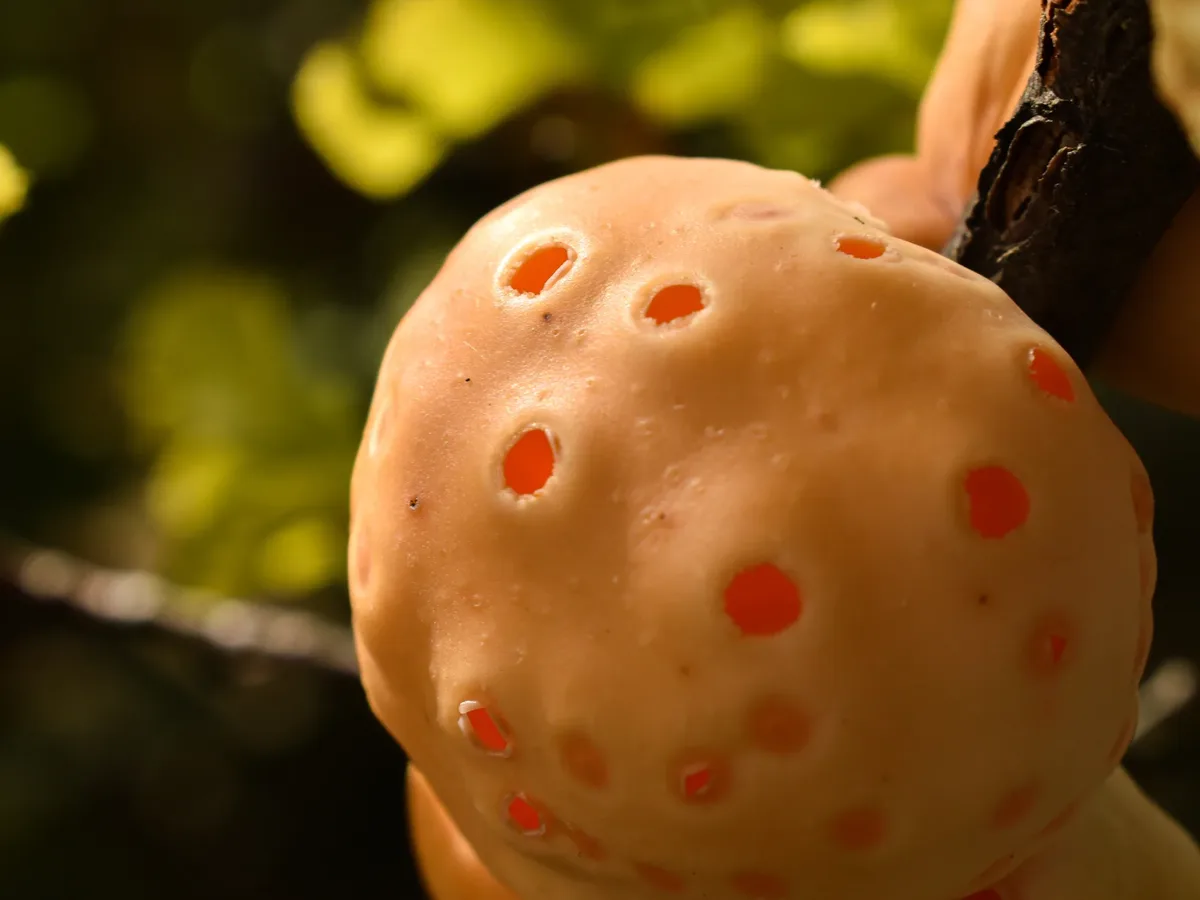
Cyttaria berteroi is one of those fungi that looks nothing like the stereotypical mushroom, and that distinctiveness is part of its safety profile. The entire fruit body is a firm, gelatinous globe or slightly flattened sphere, 1-4 cm across, with no cap, no gills, no stem, and no ring.
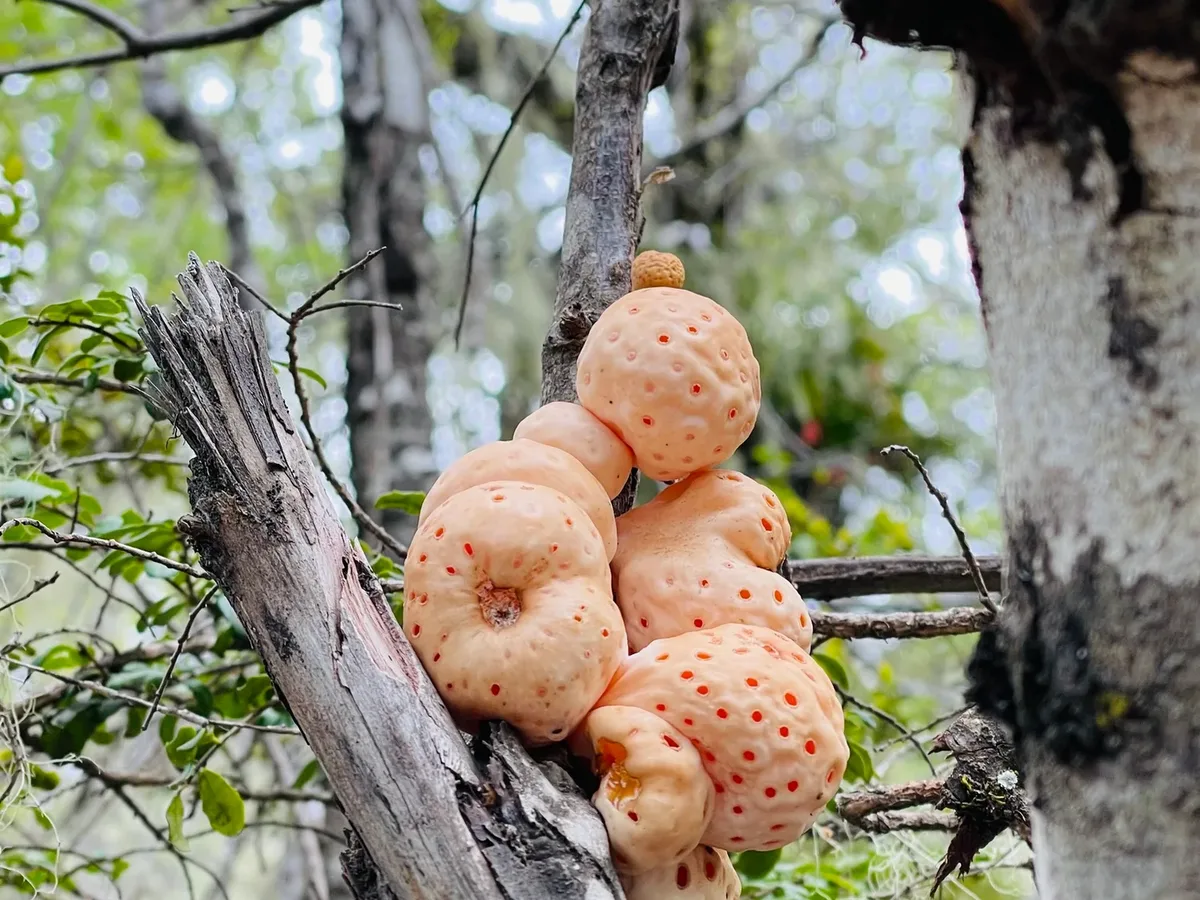
When young the surface is smooth and pale cream-white, sometimes called 'beech strawberry' by locals for its size and nodular, clustered growth, though the texture is gelatinous-rubbery rather than firm like a strawberry. As spores ripen the surface turns yellowish to pale ochre-orange. The inside is whitish and jelly-like.
Most strikingly, the globes grow in tight clusters of dozens of individuals erupting from distinctive woody tumours (galls) on the bark of Nothofagus branches - this gall-plus-cluster arrangement is unmistakable. Old specimens may shrivel and turn dull brown.
The combination of orange-to-cream gelatinous globes sprouting from a beech-branch gall in the spring forest is unique in the region.
Where & when it grows
Habitat
This species is a strict biotroph - it lives only inside living Nothofagus tissue and cannot survive elsewhere.
Look for it in temperate Southern Beech forests of central and south-central Chile (Maule, Bío-Bío, Araucanía) and in the adjacent Andean foothills of Argentina, at elevations from roughly 200 m up to about 1 400 m, in cool, damp forest where Nothofagus obliqua (roble) and Nothofagus glauca (hualo) dominate. The fungus also occasionally infects Nothofagus alpina in mixed stands.
Because the fungus induces conspicuous perennial galls on the host branches, the collecting site is essentially a permanent one: once you find a galled tree you can return each spring. Forest near rivers and in ravines, where humidity is consistently high, tends to produce the most prolific fruiting.
When
Cyttaria berteroi fruits in the Southern Hemisphere spring - October through December - synchronised with the breaking of winter dormancy and the leaf-flush of its host tree. The peak is typically November at mid-elevations.
The season at any single site is short, often just two to four weeks before the globes ripen fully, shrivel, and collapse. Collecting windows vary by altitude: lower-elevation roble forest fruits first, and sites higher on the Andean slopes follow as the season warms.
A single wet, mild spring can produce spectacular quantities; a late-frost spring or an unusually dry September can dramatically reduce yields. The rhythm is strongly tied to Nothofagus phenology rather than to rainfall in the way that saprotrophic fungi depend on rain.
How it grows
Unlike any gilled mushroom, Cyttaria berteroi does not emerge from soil. Its mycelium lives perennially inside the wood and bark of Nothofagus, inducing the host to form rough, dark, woody galls - persistent knobs that can be as large as a fist and may remain on the tree for years or decades.
Each spring the fungal tissue produces the visible white globes, which erupt through the gall surface and expand over several weeks. Dozens of globes can appear from a single gall in a season, turning the branch into a strange coral-like bouquet.
This is an ascomycete (cup fungus family Cyttariaceae), not a basidiomycete, so it produces spores in microscopic tube-like asci inside the gelatinous flesh rather than on gills.
Cyttaria belongs to a fascinating ancient lineage with a distinctly Gondwanan distribution. Different species of the genus are found only in South America (Chile, Argentina, and the Falklands) and in Australia-New Zealand, a biogeographic pattern that mirrors the distribution of Southern Beech itself.
Fruiting conditions
Fruiting is phenologically tied to Nothofagus leaf-flush and spring warming rather than to rainfall events. The obligate endophytic lifestyle means the mycelium is already in place inside the host gall year-round; fruiting is triggered by rising air and soil temperatures in spring (October onward in the Southern Hemisphere). Rain independence distinguishes Cyttaria from most saprotrophic fungi - the bottleneck is host phenology and temperature, not soil moisture. Expect fruit bodies once daytime temperatures consistently exceed ~10-12°C.
Look-alikes
Cyttaria berteroi is highly distinctive in its ecological context - pale gelatinous globes on Nothofagus galls - and has no genuinely dangerous lookalikes.
Within the Cyttaria genus, closely related species occur on Southern Beech in the same forests. Cyttaria espinosae and Cyttaria hookeri are southern relatives that may grow sympatrically or nearby; all are edible and similar in appearance. The practical distinction by species within Cyttaria matters little from an edibility or safety standpoint.
Confusion with anything harmful is essentially impossible for anyone who understands the host tree identification: no toxic species in South America grows as white-to-orange gelatinous globes emerging from galls on Southern Beech branches.
General caution: if you find white to orange gelatinous globes on any tree other than Nothofagus, do not assume they are Cyttaria - other genera of gall-forming fungi exist but are uncommon. The overall risk level of misidentification for this species, for a collector who can identify Nothofagus, is very low.
Another edible Cyttaria found on Nothofagus in southern South America and the Falkland Islands. Very similar pale-orange gelatinous globes on Nothofagus galls. Host specificity and range overlap with C. berteroi in some areas; also edible and no safety concern.
A closely related edible Cyttaria species occurring in the southern part of the Nothofagus zone in Chile and Argentina, primarily on Nothofagus pumilio and N. antarctica. Very similar in appearance - pale gelatinous globes on Nothofagus galls - and also edible. The host tree species and geographic range (further south, higher elevation) help distinguish them, but both are safe edibles and the practical distinction matters little for foragers.
Various gall-inducing fungi and other organisms can produce irregular growths on trees. None in the Chilean-Argentine Nothofagus forests produce pale, smooth, gelatinous spheres resembling Cyttaria. If globose growths are found on a tree that is not Nothofagus, do not assume Cyttaria - confirm the host identity before collecting.
In the kitchen
Picking & cleaning
Collect the young, firm, pale-cream to pale-yellow globes before they turn deeply orange or begin to dry and shrivel.
- Twist or cut the globes from the gall surface cleanly; avoid pulling entire gall tissue from the branch, as the perennial gall and the resident mycelium are needed for future seasons.
- Place globes gently in an open basket rather than a plastic bag, as the gelatinous flesh bruises and deteriorates quickly.
- Confirm the host tree: white-to-orange gelatinous globes emerging from galls on any species of Nothofagus are the correct context.
If fruit bodies appear on any other tree species, do not collect - there is no other fungus in Chilean-Argentine forests that closely mimics Cyttaria on Nothofagus, but the host check is an important confirming step.
Consume or refrigerate promptly; the shelf life of fresh Cyttaria is only one to three days.
Cooking
Traditionally eaten raw in the field by indigenous communities during the spring harvest season - the fresh, young globes have a mildly sweet, slightly gelatinous, neutral flavour reminiscent of a mild jelly.
- Also eaten in salads, mixed with sugar as a dessert, or cooked in soups and stews where the gelatinous flesh adds body.
- In Chilean culinary tradition digüeñe is paired with toasted flour (sopaipilla), eaten with sugar and lemon juice, or incorporated into sweet preparations.
- For pickling or preserving, the globes can be lightly blanched and stored in brine or vinegar.
The texture softens further when heated and the gelatinous flesh becomes almost transparent and silky. The flavour is mild enough to absorb surrounding seasonings well.
A brief gentle sauté in butter or olive oil and a pinch of salt lets the subtle, earthy sweetness of the flesh come forward.
Good to know
Cyttaria berteroi has a long, well-documented history of consumption by Mapuche and other indigenous communities in Chile and Argentina, and there are no credible reports of toxicity from correctly identified, fresh fruit bodies.
The main practical safety points are:
- 1Confirm the host tree is Nothofagus - the ecological specificity of this species is itself a safety feature.
- 2Consume fresh young specimens only, as older, over-ripe, or deteriorated globes may cause gastrointestinal discomfort.
- 3As with any wild food, individuals with unusual food sensitivities should try a small quantity first.
There are no known deadly lookalikes in the same ecological niche.
The species contains significant amounts of mannitol (a sugar alcohol) and simple sugars; excessive consumption of mannitol can cause a laxative effect in sensitive individuals, so moderate portions are sensible.
A reference guide - never an edibility guarantee. When in doubt, leave it out.