Konrad's black trumpet
Craterellus konradiisyn. Cantharellus konradii Bourdot & Maire
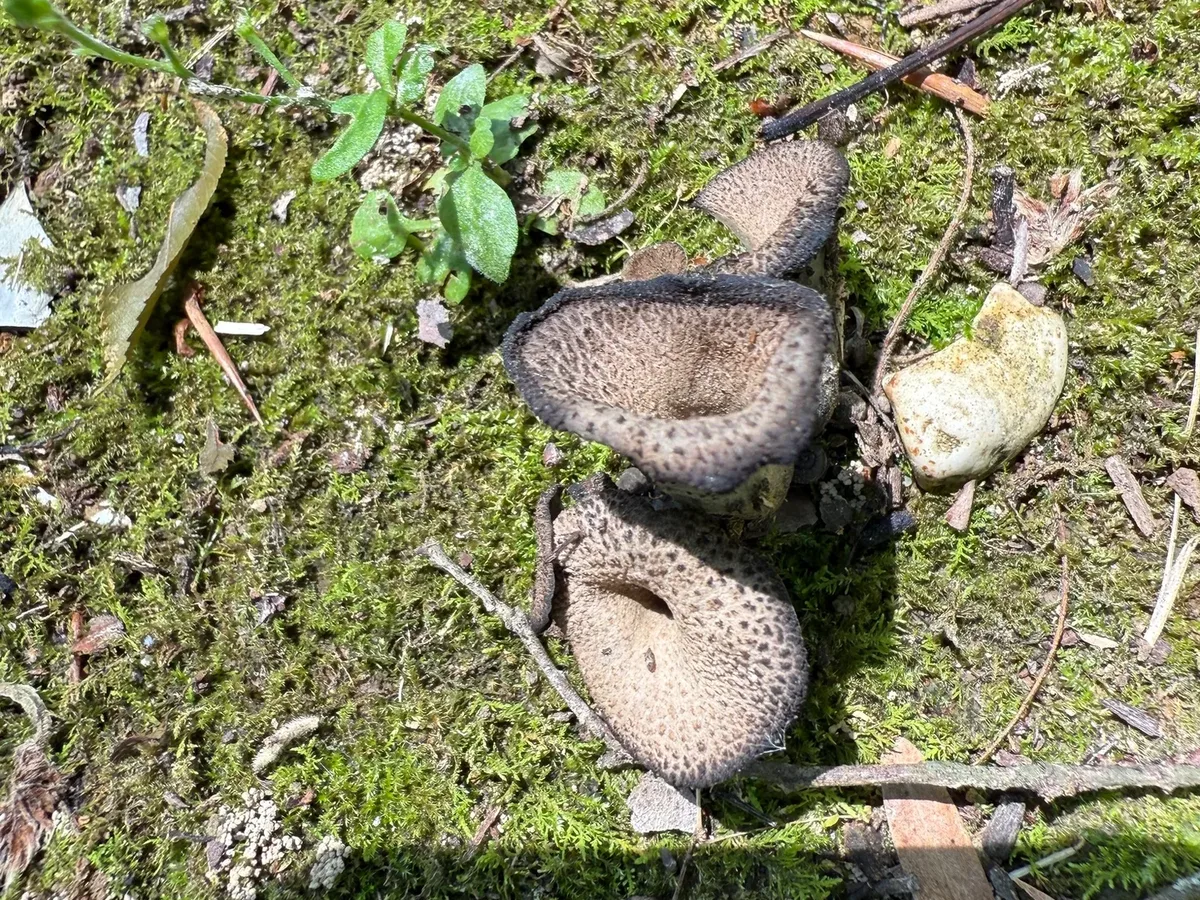 © Brandon Johnson (CC BY)
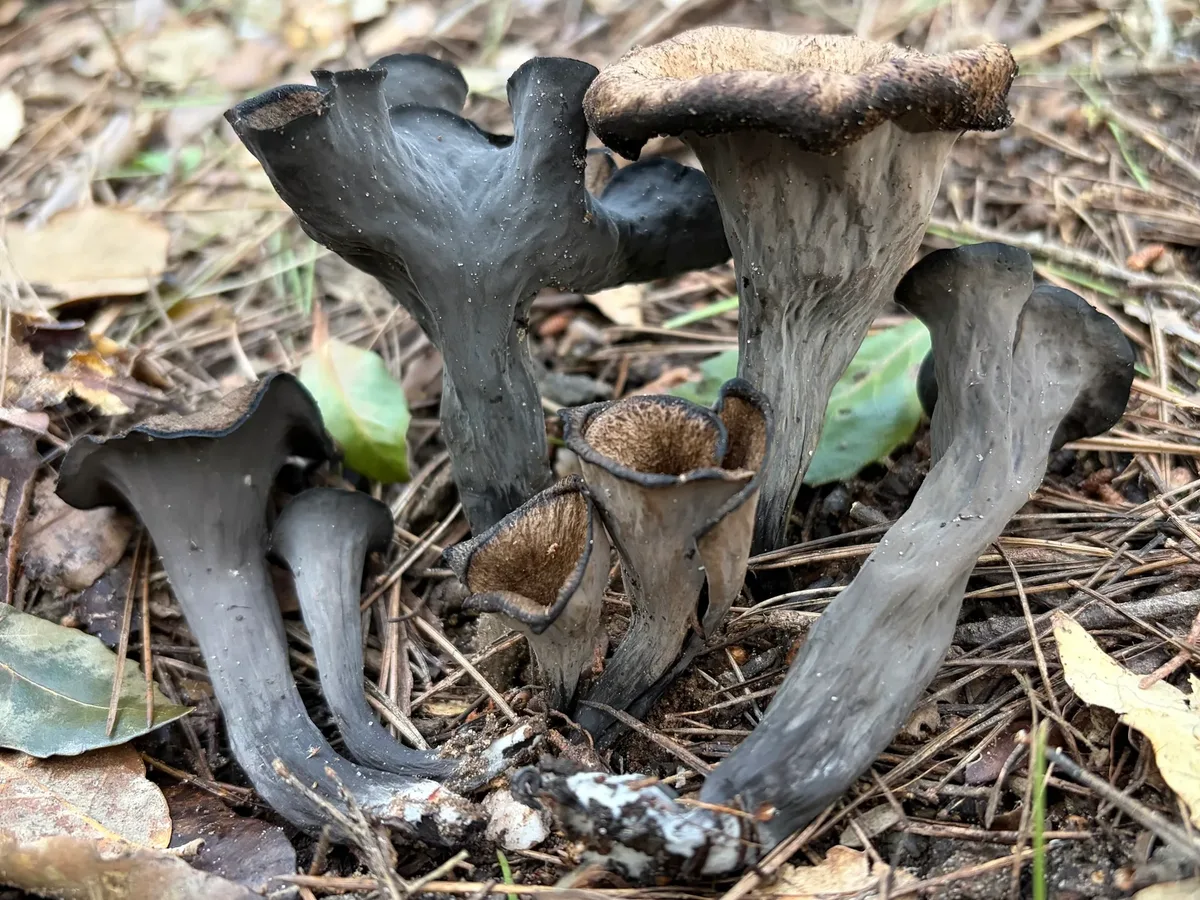 © Lucian Clanet (CC BY)
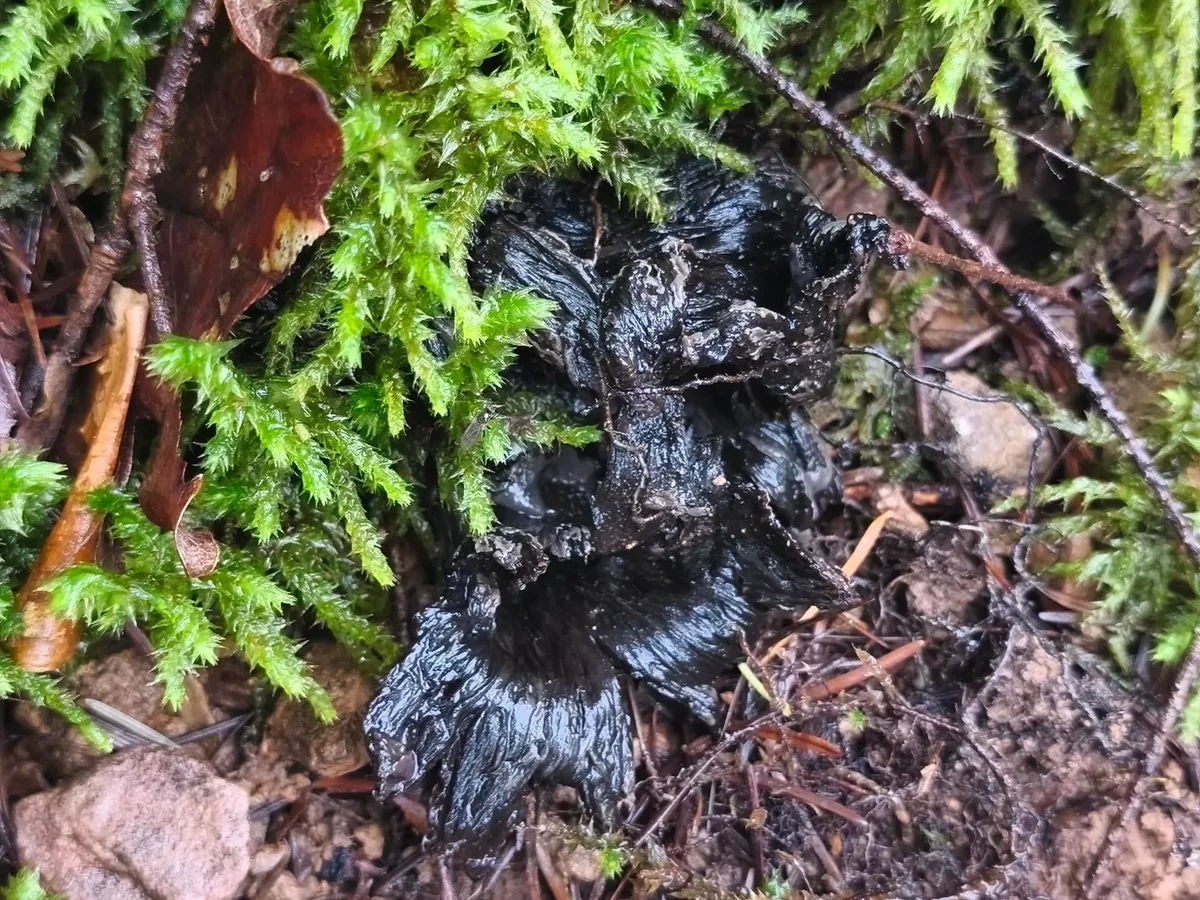 © victor laborde (CC BY)
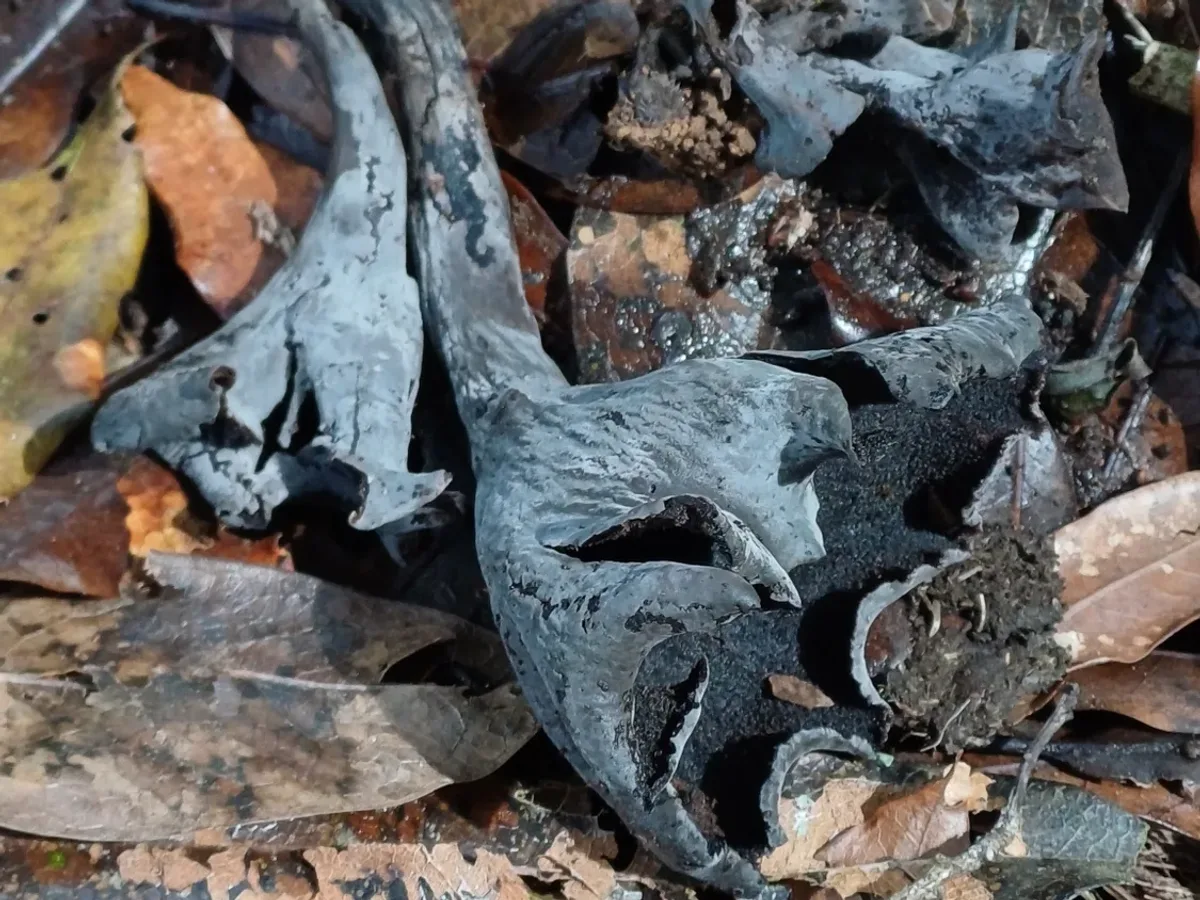 © Andrey Loria (CC BY)
 © Andrey Loria (CC BY)
 © Andrey Loria (CC BY)© Brandon Johnson (CC BY)© Lucian Clanet (CC BY)
One of the best mushrooms you can bring home - once you are certain of the identification.
How to recognise it
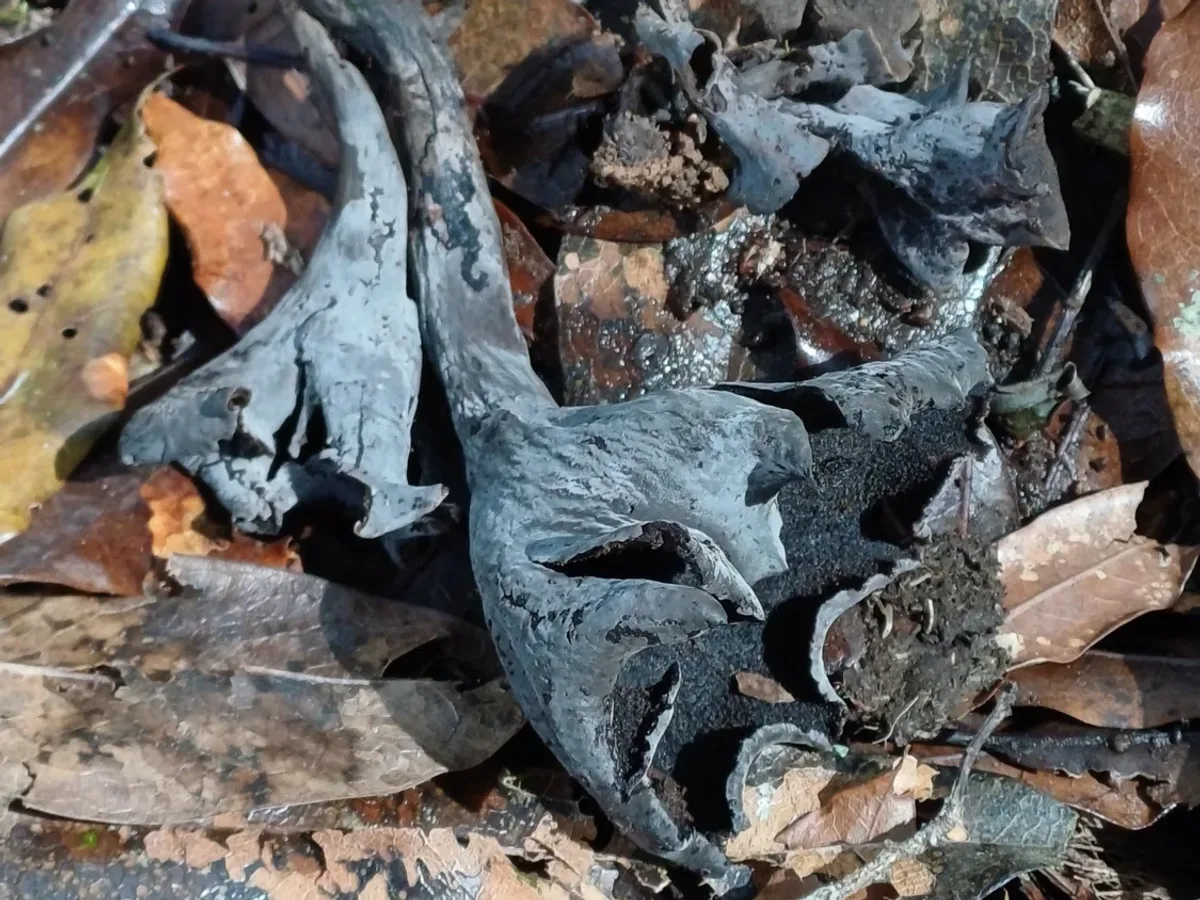
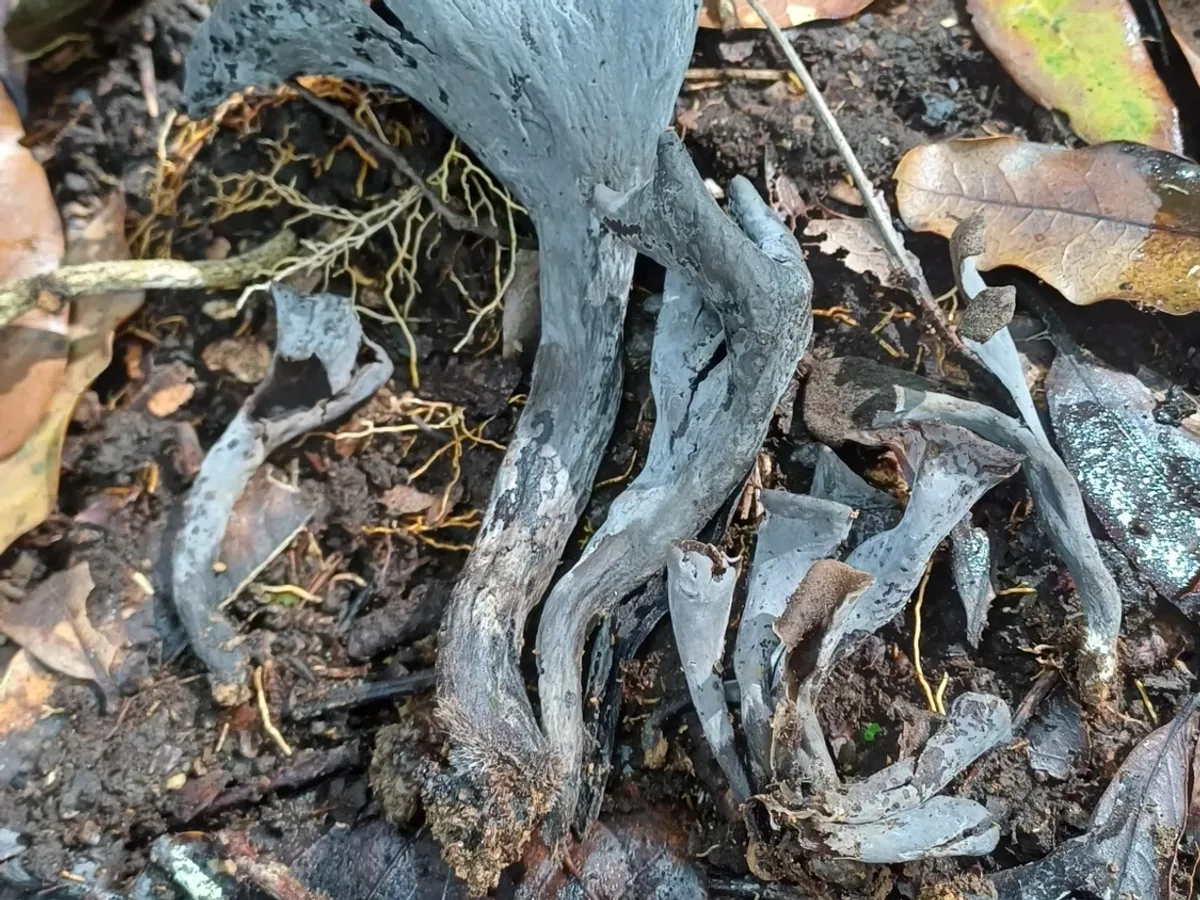
Craterellus konradii is the Mediterranean counterpart of the familiar horn of plenty - a dark, graceful hollow trumpet that pushes up through the leaf litter of warm oak woodland. Fruiting bodies are 3-10 cm tall, deeply funnel-shaped, and thin-fleshed but elastic and pliable.
Cap
The upper surface of the cap is dry, dark grey-brown to blackish-grey or sooty; in dry conditions it deepens to almost charcoal-black. The margin is wavy, irregularly lobed, sometimes split or torn in older specimens.
Gills / Pores
Flip it over and you'll find the hallmark of the genus: not true gills but shallow, blunt, forking vein-like ridges, pale grey to greyish-lilac or greyish-buff, running down the stem.
Stem
The stem itself is simply the continuation of the cap cavity - slice it lengthwise and it opens like a pipe, grey to greyish-brown, smooth or faintly fibrous, with no ring, no volva, and no basal bulb.
Flesh
The flesh is thin, grey, and slightly elastic. Spore print white to very pale cream.
Smell & taste
A mild smoky-fruity or earthy aroma, with a pleasant taste.
Compared to C. cornucopioides, this species tends to be slightly more robust and a shade paler or browner overall, but the two are very similar and are best told apart by habitat and range.
Where & when it grows
Habitat
Craterellus konradii is a mycorrhizal species inseparable from the Mediterranean oak woodland that shaped it.
Its core habitat is the warm, aromatic forest dominated by evergreen holm oak (Quercus ilex), with its tough, crackling litter. It also occurs under downy oak (Quercus pubescens), Turkey oak (Quercus cerris), and, toward the northern edge of its range, in mixed deciduous woodland.
The species spans the full Mediterranean basin:
- southern France (especially Provence and Languedoc)
- Catalonia and the broader Iberian Peninsula
- Italy (peninsula and Sardinia)
- North Africa
- the Balkans
- Turkey
It tolerates soils from calcareous limestone to mildly acidic volcanic ground, as long as the woodland is intact and the leaf-litter layer undisturbed.
Beneath each fruiting body, the mycelium has threaded the soil and the roots of nearby oaks for years in a quiet partnership, exchanging minerals for sugars.
Degrade the forest, break up the root network, and the trumpets stop appearing - C. konradii is never found in heavily disturbed or replanted stands. Fruiting bodies emerge scattered to gregarious, often half-buried under leaves and easy to miss.
When
Craterellus konradii is a creature of the Mediterranean autumn, and its rhythm is written by rain.
After the long, bone-dry Mediterranean summer, the first significant autumn downpour - typically in October - breaks the soil's slumber and triggers the mycelium to fruit. Within a week or two the first dark trumpets appear.
Peak fruiting runs through mid-October and November. In mild years with early autumn rain, a first flush may arrive in late September; in drought years, the trumpets may hold off until November or December.
At higher montane elevations the season compresses to a tighter October window. Coastal sites with mild, wet winters can see fruiting stretch into December.
Unlike the northern C. cornucopioides, which sometimes fruits in late summer, C. konradii is purely an autumn species - find it after that first real autumn storm.
How it grows
Grows scattered to gregarious in loose troops beneath Mediterranean oaks, arising from the leaf-litter layer.
The fruiting bodies are partly or largely concealed by fallen evergreen oak leaves, which are tough, dry, and crackling - making this species especially easy to overlook despite its dark coloration.
Experienced foragers in the Mediterranean listen for the crunch of litter and look for the characteristic blackish tips of the trumpet emerging from the leaf layer. Because the entire body is dark grey-brown, it blends almost perfectly with the dry litter of Q. ilex woodland.
The mycorrhizal mycelium is perennial, and productive patches recur in the same location year after year when rainfall is adequate. Individual fruiting bodies are relatively short-lived but may persist for up to a week or two in cool, damp conditions.
Fruiting conditions
Fruiting is triggered by autumn rain breaking the dry Mediterranean summer. At least 25 mm over the preceding 14 days is typically needed to initiate fruiting; soil temperatures must have dropped from summer highs into the 7-18 °C range. Flush lag of 7-18 days after sustained rainfall. In years with abrupt summer-to-autumn transitions and heavy early autumn rain, fruiting can be prolific and rapid.
Look-alikes
The most important and only dangerous confusion in Mediterranean habitats is Omphalotus olearius (jack-o'-lantern mushroom), which grows in the same region, at the same season, and can superficially resemble a dark, funnel-shaped mushroom when viewed from above.
However, O. olearius is distinguished by:
- true blade-like gills (not blunt vein-like ridges)
- growth in dense clusters at or near the base of olive trees, oak stumps, or other hardwood
- brilliant orange to orange-yellow internal coloration (it may appear dark only on the outside)
- an unpleasant or strongly mushroomy/rancid smell
- the ability to bioluminesce faintly in complete darkness
O. olearius causes severe gastrointestinal poisoning. A forager who inverts a suspected C. konradii and finds a hollow stem with blunt vein-like ridges and a mild, pleasant smoky smell has confirmation the specimen is not O. olearius.
Craterellus cornucopioides is practically identical to C. konradii and is also edible and choice; it is more typical of northern beech and hornbeam woodland but may overlap in range. Separation is primarily by habitat (beech-hornbeam vs. Mediterranean oak) and often impossible in mixed woodlands - fortunately both are choice edibles.
Pseudocraterellus undulatus (the sinuous chanterelle) is smaller, paler, and has a more wavy, undulate hymenophore surface rather than the true hollow trumpet shape; it is also edible.
Small dark Clitocybe species (e.g., Clitocybe metachroa, Clitocybe vibecina) are superficially similar but have true gills, solid stems, and typically lack the characteristic smoky aroma.
Virtually identical morphologically; also edible and choice. C. cornucopioides is more typical of northern beech and hornbeam woodland while C. konradii is the Mediterranean oak associate. Where ranges overlap, separation may be impossible - fortunately both are excellent edibles.
Has true thin blade-like gills (not blunt vein-like ridges), grows in dense clusters at the base of olive trees, oaks, or other hardwoods, is orange-yellow internally, has an unpleasant rank odour, and bioluminesces faintly in darkness. Causes severe gastrointestinal poisoning. C. konradii has a hollow stem, blunt ridges (not gills), and a mild smoky-pleasant odour.
Smaller, paler brownish-grey, with a more wavy and undulate hymenophore surface and a less deeply hollow, narrower stem; typically much smaller fruiting bodies. Also edible, though of lesser culinary quality.
Has true thin gills (not blunt ridges), a solid stem, and lacks the hollow trumpet form. Smaller and thinner-fleshed with a hygrophanous cap. Considered suspect or mildly toxic; do not eat.
In the kitchen
Picking & cleaning
Cut cleanly at the base or pinch free from the litter; avoid pulling the mycelium.
The hollow funnel acts as a natural collector for litter, insects, and small invertebrates - invert and shake the trumpet in the field to dislodge debris, and inspect the inside. A gentle blow into the hollow trumpet will often dislodge remaining leaf fragments.
Collect into a basket; the thin-fleshed fruiting bodies are somewhat fragile and should not be compressed.
Because Mediterranean oak litter is dry and dusty, the mushrooms may need a brief rinse before cooking, but avoid soaking - the thin flesh absorbs water readily.
Collect only specimens in good condition; overripe or insect-damaged individuals should be left in place.
Cooking
Craterellus konradii is an excellent edible, used in the same way as horn of plenty (C. cornucopioides) and valued by foragers across the Mediterranean region. Its mild, smoky-earthy flavour intensifies significantly on cooking and especially on drying.
Sauté in butter or olive oil with garlic and fresh herbs (thyme, rosemary) - the thin flesh cooks rapidly. It is excellent in pasta sauces, risotto, omelettes, and as a garnish for grilled meat or fish. In Mediterranean cuisine, it is also used to flavour stocks and braising liquids.
It dries exceptionally well: spread on a rack in a warm, airy location or dry in a low oven. When dried, the flavour intensifies dramatically and the mushrooms can be ground into a powder used as a seasoning in the same way as dried porcini.
Rehydrate in warm water for 20-30 minutes before using in cooked dishes. The soaking liquid retains the smoky aroma and can be strained and added to the dish.
Avoid prolonged high-heat cooking, which drives off the volatile aromatic compounds.
Good to know
Craterellus konradii has no documented toxicity and is considered a safe, choice edible fungus, edible at the same level as the well-known Craterellus cornucopioides.
The key safety rule is to confirm two features:
- A hollow stem - slice lengthwise; it is pipe-like from tip to base.
- Blunt, vein-like ridges on the underside (not true gills).
This combination, together with the pleasant smoky-fruity smell and the Mediterranean oak woodland habitat, excludes all dangerous species.
The only serious risk in its habitat is confusion with Omphalotus olearius, which is immediately distinguishable by true gills and cluster growth at the base of trees.
Novice foragers should carry a cross-section of the stem to confirm hollowness and should carefully examine the underside for gill structure.
Cook before eating as a matter of good practice, although C. konradii is not known to cause any problems even if tasted raw.
A reference guide - never an edibility guarantee. When in doubt, leave it out.