Horn of plenty
Craterellus cornucopioides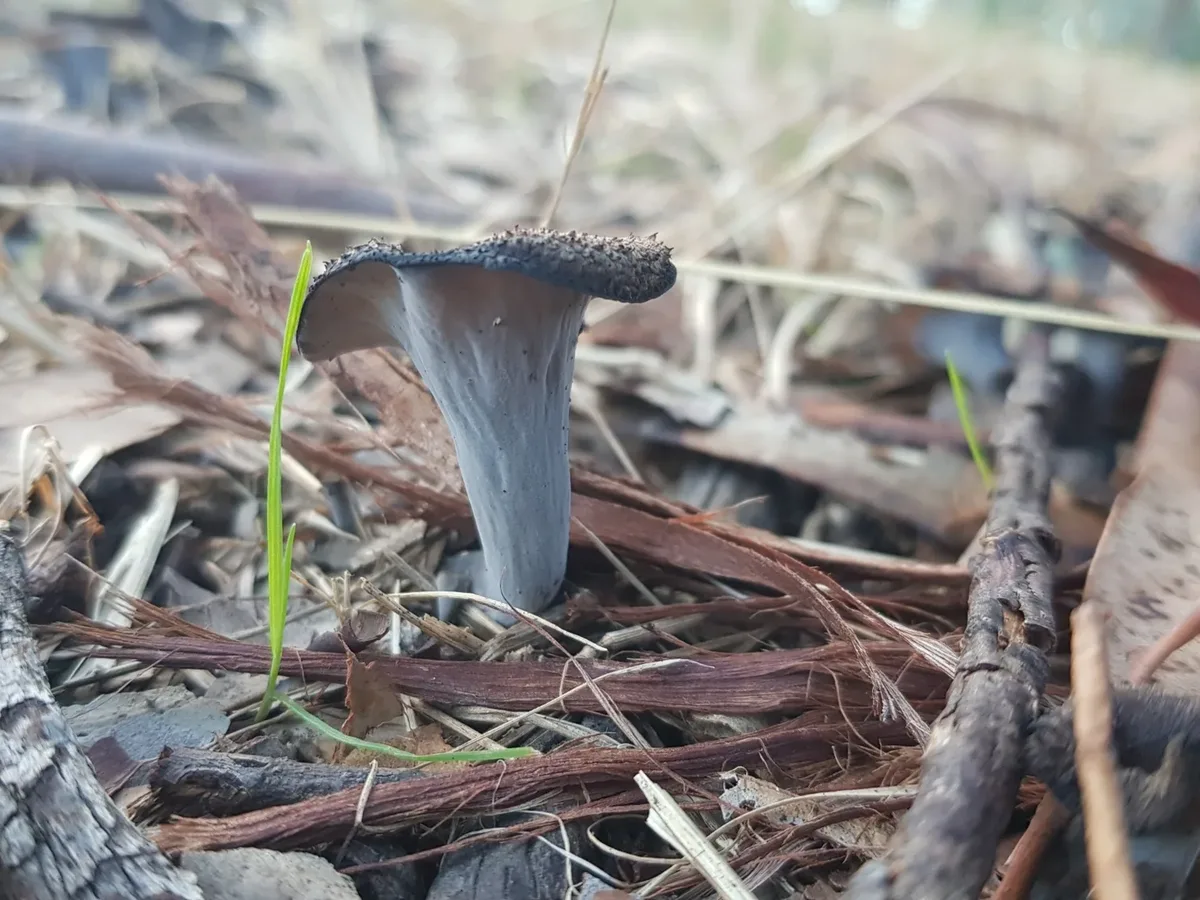 © Sofia Zvolanek (CC BY 4.0)
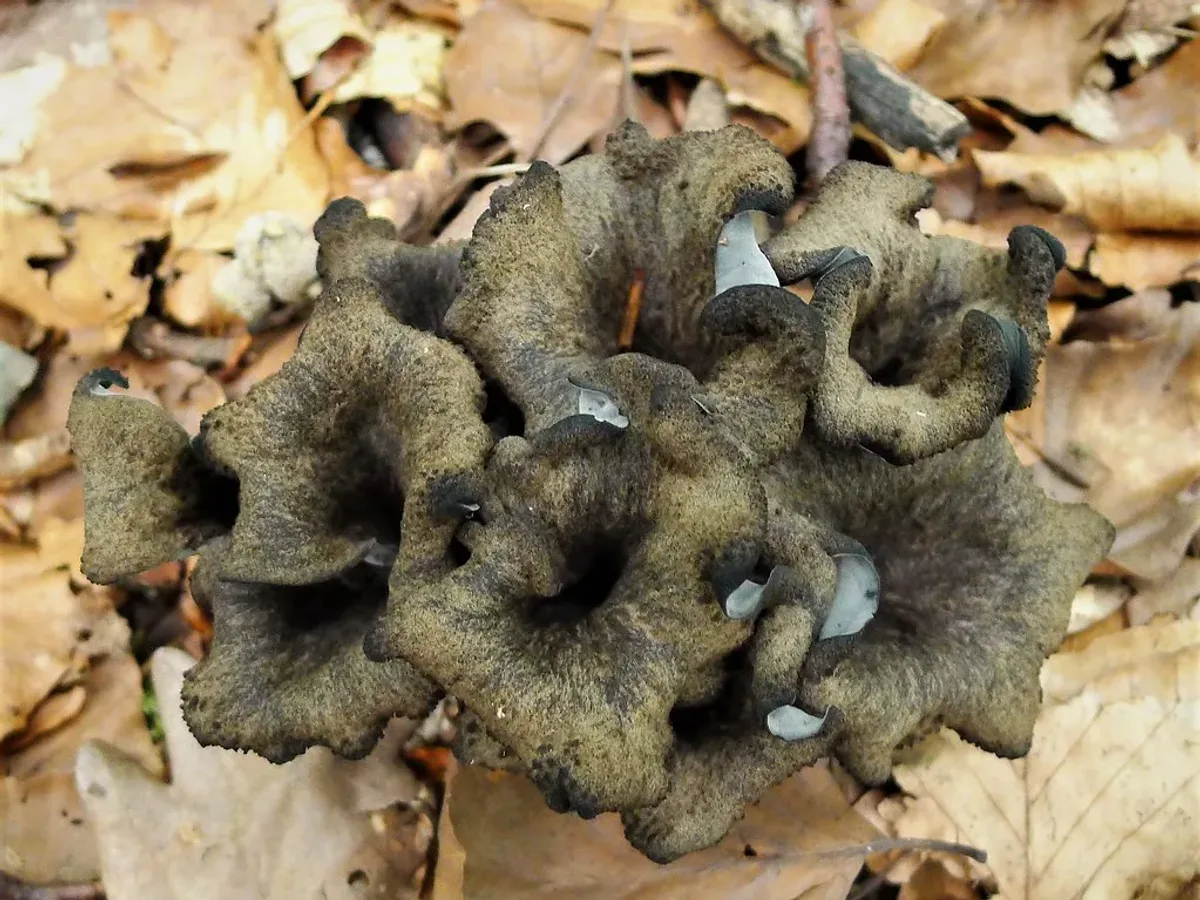 © gailhampshire (CC BY 2.0)
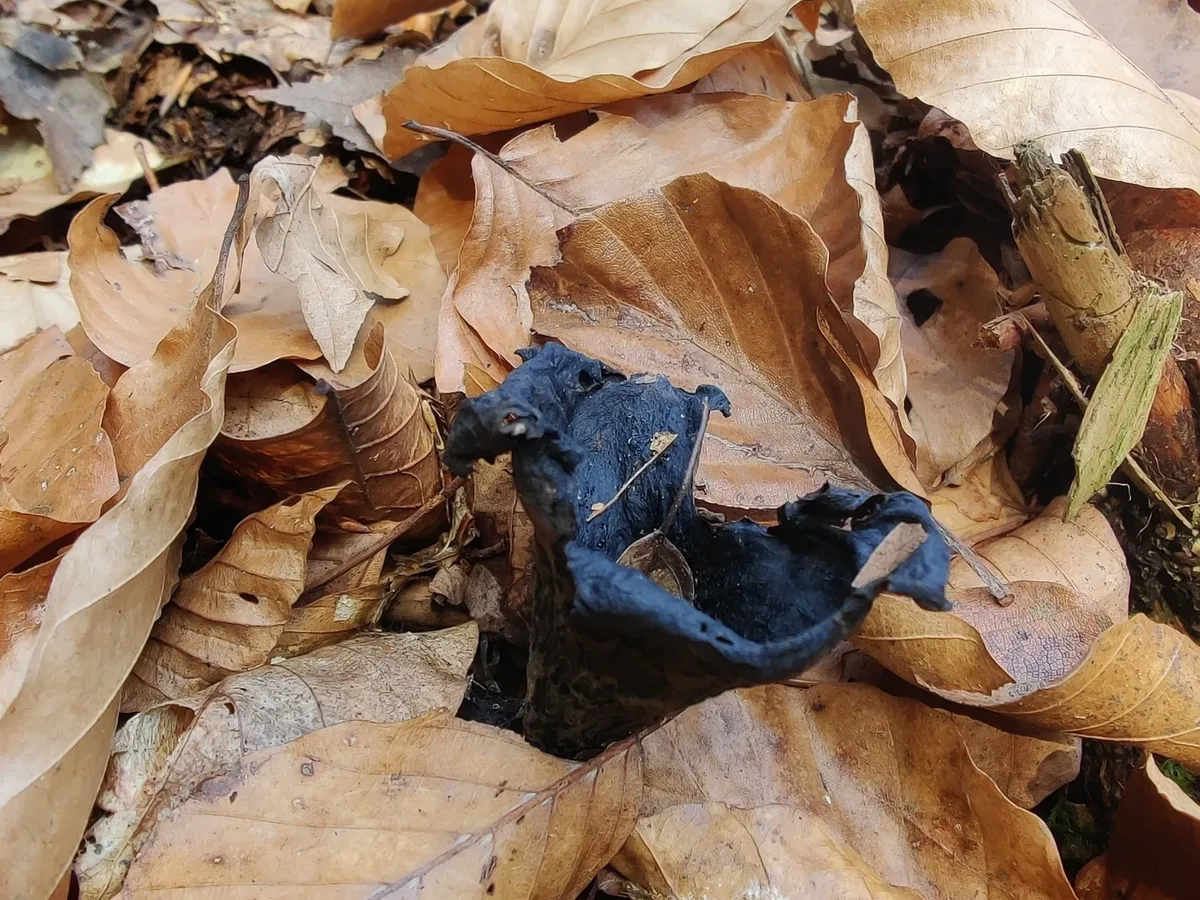 © carnifex (CC BY)
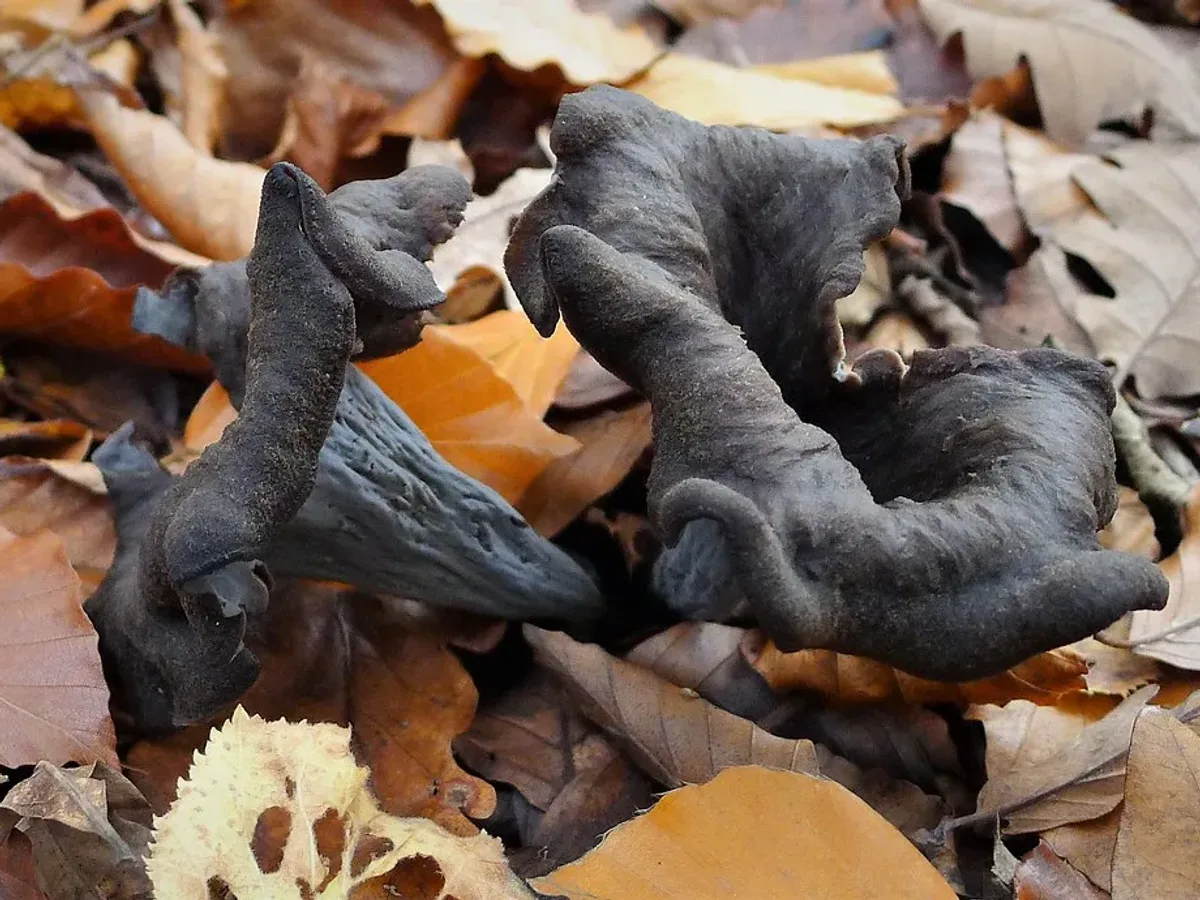 © gailhampshire (CC BY 2.0)
 © gailhampshire (CC BY 2.0)
 © Elena_Sherehora (CC BY 4.0)© Sofia Zvolanek (CC BY 4.0)© gailhampshire (CC BY 2.0)
One of the best mushrooms you can bring home - once you are certain of the identification.
How to recognise it
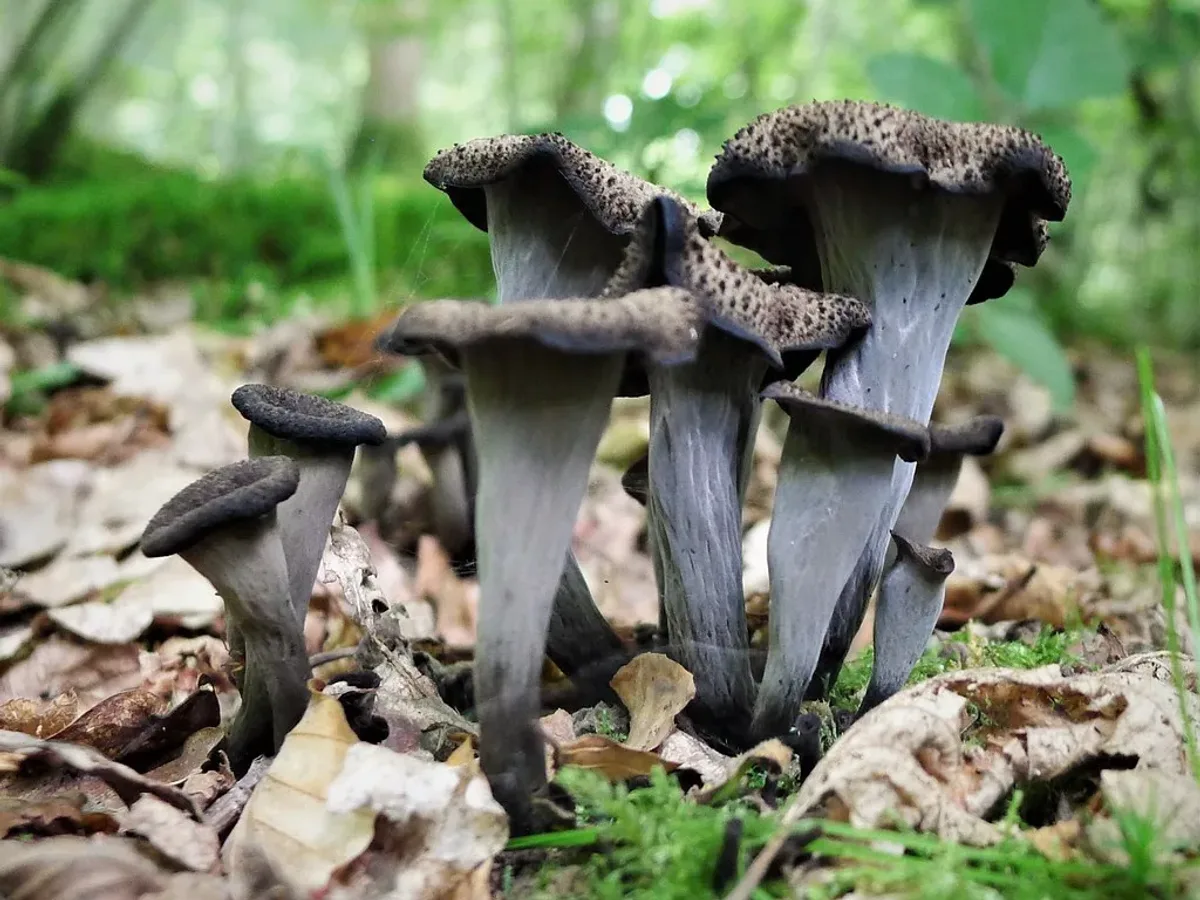
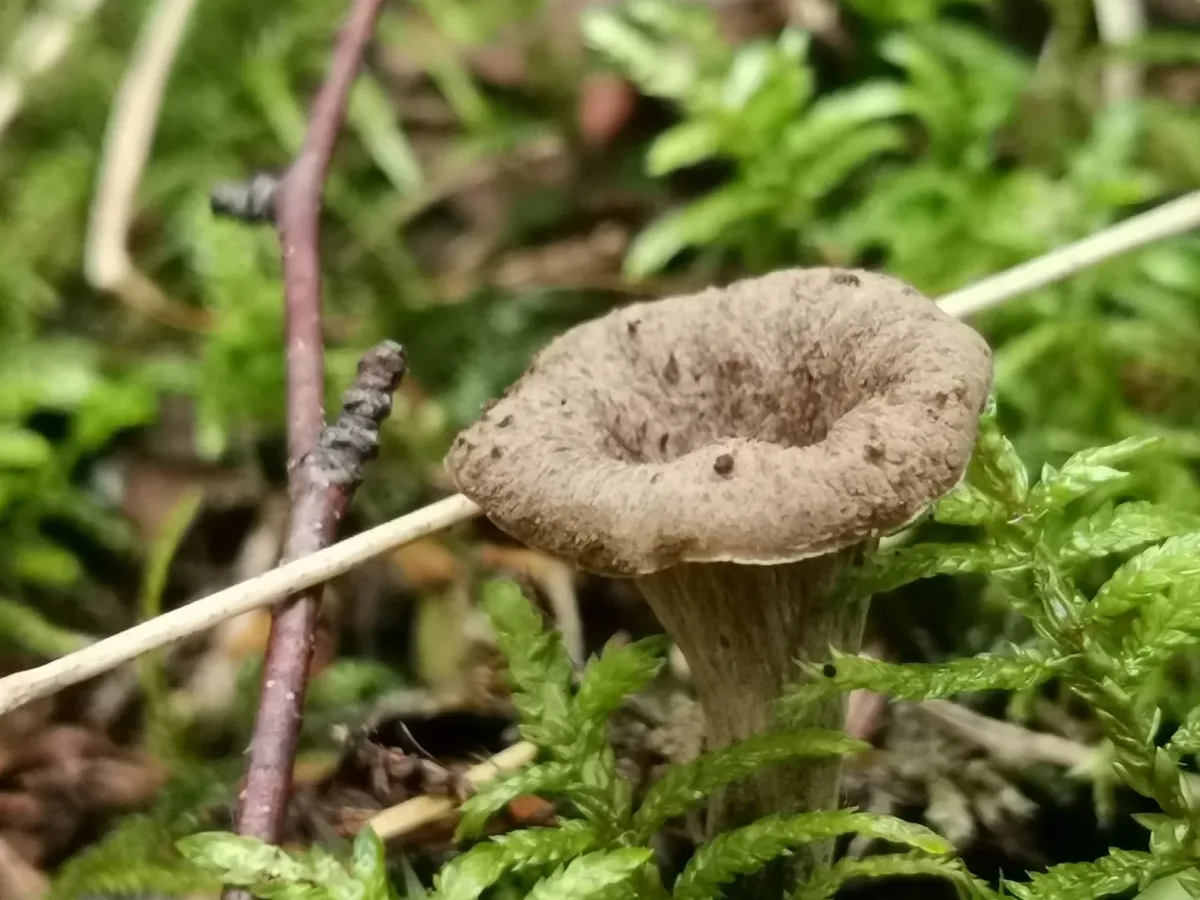
Craterellus cornucopioides is one of the most architecturally distinctive fungi in European woodland, and the architecture serves a purpose. The fruitbody is a continuous hollow tube - no separate cap, stem or junction - tapering from a flared, ragged-edged opening at the top down to a narrow base that emerges from the soil.
Mature specimens reach 5-12 cm tall and 2-6 cm wide at the mouth, the walls no thicker than a few millimetres, thin enough to be slightly translucent when held to light.
The inner surface (the actual spore-bearing hymenium) faces inward and downward: spores fall through the hollow interior and drift out through the base, a reversal of the typical mushroom arrangement. The colour of the inner surface runs from sooty black or charcoal in young, fresh specimens to dark grey-brown or occasionally yellowish-grey as they age and dry.
The outer surface is the paler side - ash-grey to blue-grey - and carries low, blunt, repeatedly forking ridges running lengthwise from rim to base. These are not true gills but pseudogills, solid folds that lack the blade-like structure of genuine lamellae.
Spore print white to pale cream-yellow.
Flesh
The flesh is thin, firm when fresh but brittle and crisp, and dries to a papery texture almost without shrinkage.
Smell & taste
The aroma is distinctive even in the field: earthy, truffle-adjacent, faintly smoky, intensifying dramatically on drying.
The common names across Europe - "trumpet of death", "trompette des morts", "Totentrompete" - reflect the dark colouring and late-season funerary associations, and have nothing to do with toxicity.
Where & when it grows
Habitat
Craterellus cornucopioides forms ectomycorrhizal partnerships with a narrow suite of deciduous trees:
- Beech (Fagus sylvatica).
- Pedunculate and sessile oak (Quercus robur, Q. petraea).
- Hornbeam (Carpinus betulus), which appears to be the most productive host across much of central-western Europe.
The partnership is obligate - the fungus cannot complete its lifecycle without a living root partner - and the mycelium threads through the mineral soil and leaf-litter layer in a network that may persist for decades, invisible except when it fruits.
The preferred microhabitat is consistent: moist, shaded forest floor with an intact leaf litter layer, often where moss or liverworts hold moisture against the substrate.
Calcareous or mildly acidic soils both support it. Low-light conditions beneath a closed canopy seem to matter more than soil chemistry.
Once a colony is established it tends to return to the same spot year after year, sometimes shifting a few metres as the mycelium expands.
The species rarely fruits in young, even-aged plantations; it is most reliably found in older mixed deciduous woodland with structural complexity - uneven canopy, varying stem ages, accumulated organic matter.
Where it occurs it is sociable: colonies of dozens or hundreds of fruitbodies are the rule rather than the exception, which is why the initial find - almost always accidental - often yields a large harvest.
When
The fruiting window runs from late summer through autumn, typically August to November in central-western Europe, with the core of the season in September and October.
First fruitbodies tend to appear when summer heat breaks and sustained rainfall accumulates. The fungus responds to the combination of soil cooling (below roughly 15-18 °C) and adequate moisture rather than to either trigger alone.
In warmer, wetter years the season can extend into December; in drought years the whole window may compress or fail entirely.
The underground mycelium survives drought and frost without damage; an apparently dead patch often fruits vigorously the following autumn after an adequate summer.
In a typical Central European year the first flush follows the equinox rains, with a second flush possible in October if conditions repeat.
The timing is latitude-dependent:
- At the southern edge of the range (Mediterranean margins): October to December.
- In Britain, the Netherlands and northern Germany: peak September to early November.
Peak fruiting at any given site tends to occur within one to two weeks of optimal trigger conditions, and a colony can push up, spore, and collapse within ten to fourteen days if weather turns dry again.
How it grows
Like all ectomycorrhizal fungi, Craterellus cornucopioides spends most of its existence as mycelium woven between and into the root tips of its host trees - a relationship that predates the trees themselves in evolutionary time and that benefits both partners.
The fungus supplies the tree with mineral nutrients, particularly phosphorus extracted from the soil matrix by the hyphal network; the tree returns fixed carbon as sugars.
This exchange is ancient - ectomycorrhizal lineages appear in the fossil record over 50 million years ago - and the partnership at any given site may reflect a mycelial network that has been continuously active for decades or longer.
The fruitbodies that appear in autumn are reproductive structures, equivalent to the fruit of a plant: the main organism remains underground.
The signal for fruiting is a combination of soil moisture crossing a threshold and temperature dropping into the optimal band. Once triggered, fruitbodies develop rapidly, typically emerging from soil and leaf litter within days of the trigger event.
They grow in dense clusters or loose troops, sometimes following root lines between two trees, occasionally appearing in broad arcs or rings that faintly trace the perimeter of the mycelial mat.
Spore dispersal is passive: white spores fall through the hollow tube and are carried by ground-level air currents.
Individual fruitbodies are short-lived (days to two weeks), but a colony in good conditions may produce successive flushes across several weeks.
Fruiting conditions
Conservative standard-mycology estimate; the guide does not specify fruiting triggers. Fruits after sustained autumn moisture once soils have cooled.
Look-alikes
Craterellus cornucopioides has an unusually clean lookalike profile for a wild edible: there are no dangerous or deadly species that could plausibly be confused with it.
The main comparison is with the yellowfoot or trumpet chanterelle (Craterellus tubaeformis / Cantharellus tubaeformis), a close relative that shares the trumpet shape and deciduous woodland habitat.
The yellowfoot is reliably distinguished by its ochre-yellow to mustard-coloured stem - the outer surface below the funnel is strikingly warm-toned - while C. cornucopioides is uniformly dark grey to blackish throughout.
The yellowfoot's outer surface also bears more pronounced forking ridges with a yellowish or orange tinge; the whole fruitbody is paler overall. Both are good edibles.
The false chanterelle (Hygrophoropsis aurantiaca) is a more distantly related species occasionally mentioned as a lookalike. It differs conspicuously in:
- Colour (orange).
- True gills, not ridges.
- A more conventional cap-and-stem structure.
- Habitat.
Visual confusion between a uniform blackish-grey hollow funnel and an orange-capped false chanterelle requires unusual conditions (very worn or bleached specimens) and would resolve immediately on checking colour, structure, and the presence or absence of a hollow interior.
No toxic species in the European mycota closely resembles the characteristic dark, hollow, ridge-bearing trumpet of C. cornucopioides.
Can resemble it superficially; differs in form and colour.
Resembles the funnel chanterelle more than the black trumpet.
Edible; the only similar species.
A darker trumpet chanterelle but with a yellow stem; edible.
In the kitchen
Picking & cleaning
Craterellus cornucopioides is one of the most forager-friendly edible species in practical terms. The challenge is visual detection, not identification or handling.
The dark colouring blends into wet leaf litter and shadows almost perfectly. Experienced foragers describe learning a particular ground-level scanning technique - looking for slight irregularities in the leaf surface, or for the silhouette of the funnel opening against a slightly lighter background.
Once the search image is locked in, a colony that was invisible becomes obvious.
Picking is straightforward: grasp near the base and twist gently, or cut with a knife.
The hollow funnel invariably collects leaf fragments, grit and small invertebrates; hold each fruitbody upside down and shake, or rinse briefly under water and drain.
The thin flesh dries naturally very quickly, and fruitbodies collected on a dry day can be carried without any special container.
If the colony is large, harvest selectively - taking the mature, open-mouthed specimens and leaving smaller, tighter ones to spore.
There is good evidence that mycorrhizal fruitbodies return more reliably to sites that are harvested without soil disturbance; avoid tearing up the litter layer or compacting the soil around the colony.
A breathable bag or basket allows residual moisture to escape and keeps the delicate fruitbodies from bruising.
Cooking
The culinary reputation of Craterellus cornucopioides is disproportionate to its modest appearance. It ranks among the finest edible fungi of the European autumn, prized by professional kitchens for an aroma that is simultaneously earthy, smoky, and faintly truffle-like - a quality that survives and deepens through drying, making it one of the few wild mushrooms that is arguably better dried than fresh.
Fresh fruitbodies have delicate thin flesh that wilts quickly in a hot pan. They are best sautéed in butter or good oil over moderate-high heat, just long enough to drive off the moisture (two to three minutes), before being incorporated into sauces, risottos, omelettes or pasta.
The species pairs particularly well with cream, white wine, game and poultry, and with aged hard cheeses. Its dark colour bleeds slightly into pale sauces, which is considered desirable.
Dried specimens (achieved easily at 40-50 °C in a dehydrator or a low oven with the door ajar) shrink to a fraction of fresh volume but retain full flavour. Rehydrated in warm water or white wine for twenty minutes, the soaking liquid itself becomes a flavoured stock worth using.
Ground dried horn of plenty is used as a seasoning powder - a small quantity added to stocks, braises or egg dishes delivers a distinctive depth.
It is among the best wild mushrooms to blend with cultivated species when fresh wild supply is limited.
Good to know
Craterellus cornucopioides is one of the safest wild edibles in the European flora. It is not poisonous, has no known dangerous compounds, and no confirmed serious adverse reactions attributable to the species have been documented in the toxicological literature.
The dramatic common names ("trumpet of death", "trompette des morts") are purely folkloric - references to the dark colouring and its fruiting season around All Saints' Day - and have no basis in toxicity.
As with all wild edible fungi, consumption of raw specimens is not recommended; brief cooking is sufficient and is standard practice.
There are no known drug interactions or special population contraindications, beyond the general advice to avoid giving novel wild fungi to very young children or immunocompromised individuals in large quantities.
The species is not known to bioaccumulate heavy metals at problematic levels, though foragers harvesting near roadsides or industrial sites should apply the usual caution regardless of species.
Confident identification is straightforward. No hazardous European species replicates this combination:
- Uniform dark grey-black colouring.
- A completely hollow, thin-walled funnel.
- A smooth or faintly ridged outer surface (no true gills).
- Late-season deciduous woodland habitat.
A reference guide - never an edibility guarantee. When in doubt, leave it out.