Golden trumpet
Craterellus aureussyn. Cantharellus aureus
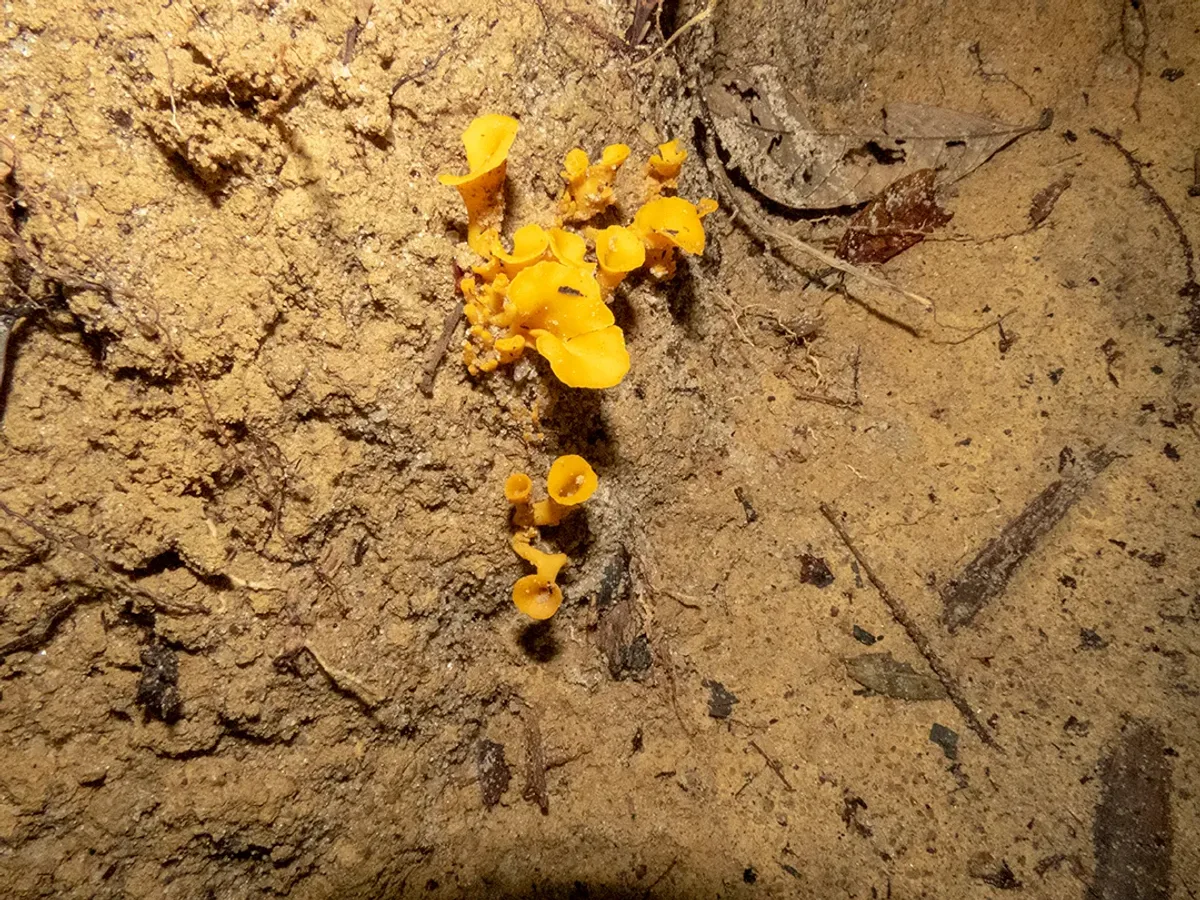 © Sebastian Doak (CC BY)
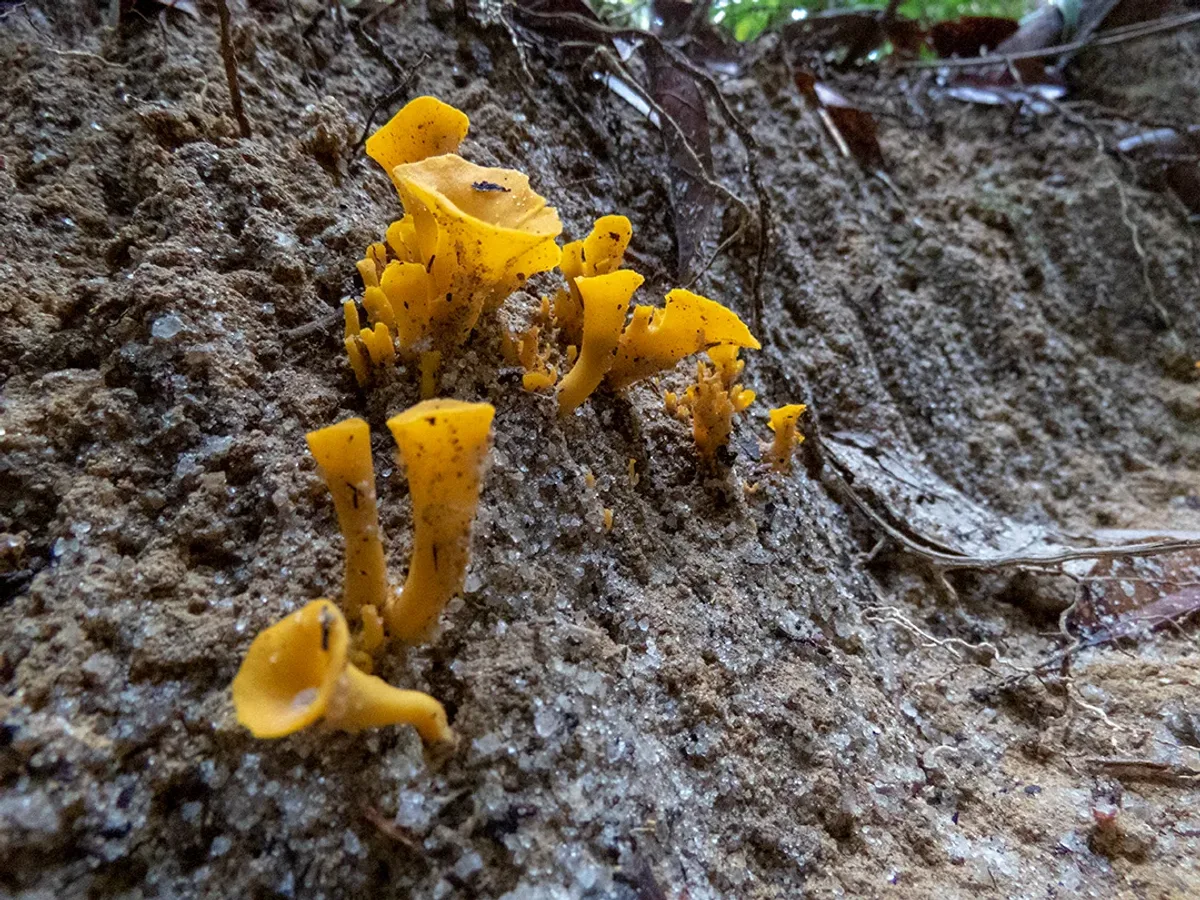 © Sebastian Doak (CC BY 4.0)
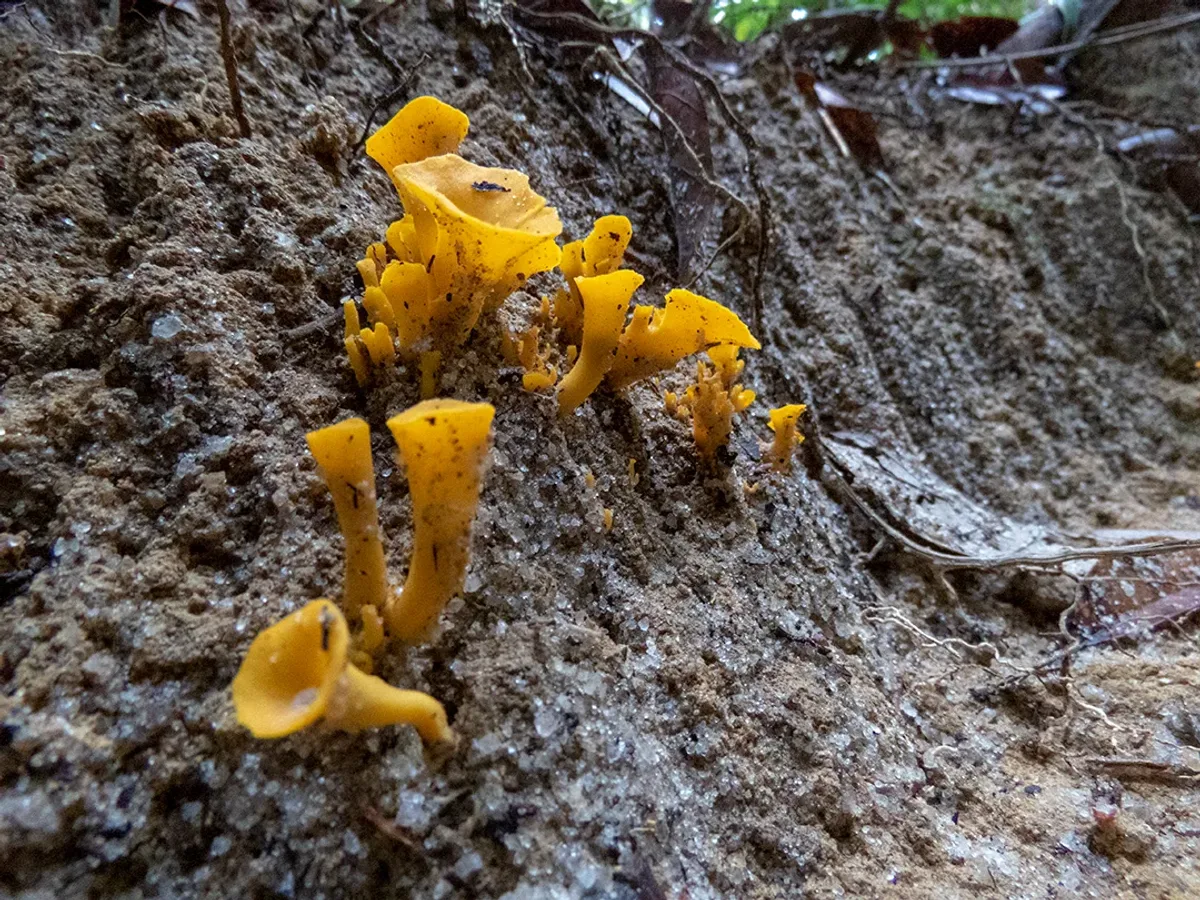 © Sebastian Doak (CC BY)© Sebastian Doak (CC BY)© Sebastian Doak (CC BY 4.0)
One of the best mushrooms you can bring home - once you are certain of the identification.
How to recognise it
Craterellus aureus is a medium-sized, deeply funnel- or trumpet-shaped mushroom of unmistakably bright golden-yellow coloring.
Unlike the better-known black trumpet (C. cornucopioides), which is charcoal-grey to black and blends into the litter almost invisibly, C. aureus stands out vividly against the forest floor with its saturated golden to egg-yellow tones.
Cap
The cap begins somewhat convex and centrally depressed in young specimens, quickly developing into a deep, open funnel or trumpet shape as the fruiting body matures.
The cap margin characteristically becomes wavy, irregularly lobed, and often split or torn in older specimens.
Gills / Pores
The underside of the cap is the key feature distinguishing Craterellus species from true gilled mushrooms: instead of thin, blade-like gills, it carries only shallow, blunt, forking vein-like ridges or wrinkles (false gills) of pale yellow to ochre-yellow.
These ridges run down the stem (decurrent) and are not sharp-edged like true gills - you cannot separate them cleanly from the flesh.
Stem
The stem is hollow throughout its entire length, forming a continuous channel with the funnel of the cap; this can be confirmed instantly by cutting the specimen lengthwise.
The hollow stem is a reliable distinguishing feature from Omphalotus species, which have solid, dense stems.
Flesh
Flesh is thin, pale yellowish, mild-flavored, and pleasantly aromatic with a subtle apricot or fruity note.
There is no ring, skirt, or volva. Spore print white to pale cream.
Where & when it grows
Habitat
Craterellus aureus is an obligate mycorrhizal fungus, forming underground partnerships with the roots of living forest trees.
In eastern North America it is primarily associated with mature oak and beech-dominated hardwood forests, where it benefits from long-established mycorrhizal networks.
It shows a preference for moist, humus-rich, moderately acidic forest soils - especially on north-facing slopes, ravines, or stream-adjacent terraces where moisture is retained through dry spells. The thick leaf-litter of mature eastern deciduous forests provides the soil structure and moisture regime the species favors.
Fruiting bodies emerge singly or in loose groups or arcs that may indicate the underground spread of the mycelial network.
Once a productive site is located, it tends to produce fruitings across multiple seasons, as the mycorrhizal relationship is long-lived.
When
The primary fruiting season for Craterellus aureus in eastern North America runs from summer through early autumn - typically July through September at peak, with fruiting possible into October in warmer years or at southerly latitudes.
This is a warm-season fruiter, which sets it apart from the late-autumn chanterelles like C. lutescens and C. tubaeformis that emerge as temperatures fall.
What brings on a flush is a stretch of significant rain - at least 20-30 mm over 7-14 days - combined with warm soil above roughly 15 °C. After a good soaking in mid-July, a productive patch can fruit repeatedly through August as rain events repeat.
In the Mid-Atlantic and Appalachian states, mid-July to late August is the most productive window. Cool, dry summers delay or suppress fruiting.
How it grows
Fruits scattered to gregariously in the leaf litter of hardwood or mixed hardwood-conifer forest, sometimes in loose arcs or clusters suggesting an underlying mycorrhizal network.
Fruiting bodies develop relatively slowly and can persist in good condition for several days to a week in cool, moist conditions.
The golden coloring makes them easier to spot than their close relative C. cornucopioides (black trumpet), though they can still be partially hidden under leaf litter.
Individual patches visited in a productive year can yield harvests across multiple flushes as summer moisture events repeat.
Fruiting conditions
Summer-fruiting species requiring warm soil temperatures (above approximately 15 °C) and sustained moisture from significant rainfall events. Flushes typically appear 7-14 days after a period of at least 20-25 mm rainfall combined with warm conditions. Unlike autumn chanterelles that fruit in cooling soils, C. aureus is a warm-season fruiter and ceases production once soils cool in autumn.
Look-alikes
Craterellus aureus has no deadly lookalikes in typical eastern North American foraging contexts, but several species warrant attention.
Craterellus cornucopioides (black trumpet, horn of plenty) is the most closely related common species and occurs in the same forests. It is easily distinguished by its dark grey to black or dark brown coloring - there is no plausible confusion between a jet-black trumpet and a golden-yellow one. Both are choice edibles.
Craterellus fallax (black trumpet, dark form) is similarly dark-colored and equally safe.
Omphalotus illudens (jack-o'-lantern mushroom) is the most important caution: it is orange to orange-yellow, funnel-shaped to convex with a central depression, and could superficially resemble C. aureus to an inattentive observer. It differs in several ways:
- True, thin, blade-like, crowded gills on the underside (not blunt ridges or wrinkles).
- Grows in dense clusters at the base of hardwood trees or from buried wood (not scattered in leaf litter).
- Solid, non-hollow stem.
- Typically a stronger, somewhat rank odor.
- Bioluminesces faintly in total darkness.
The gills versus false ridges distinction is definitive and should be checked on every specimen. O. illudens causes severe gastrointestinal poisoning.
Hygrophoropsis aurantiaca (false chanterelle) is another orange funnel-shaped species: it has true crowded blade-like gills, a solid stem, a more saturated orange-yellow coloring throughout, and typically grows near conifers in sandy soil. It causes gastrointestinal upset.
Cantharellus cibarius sensu lato (golden chanterelle) is sometimes confused with C. aureus; it is typically more stout-fleshed and solid-stemmed with a less deeply funnel-shaped cap, but is equally edible and choice.
Easily distinguished by its dark grey to black or dark brown coloring - no confusion possible with C. aureus's bright golden-yellow. Both are choice edibles. Black trumpet grows in the same hardwood forests but is far darker and nearly invisible against the litter.
Has true crowded, thin, blade-like gills (not vein-like ridges); stem is solid (not hollow); cap is typically more saturated orange throughout, including the flesh; grows in sandy soil near conifers rather than hardwood leaf litter. Causes gastrointestinal upset; do not eat.
Also golden-yellow with false ridges, but cap is typically more convex and less deeply funnel-shaped, flesh is more robust and solid-stemmed, false ridges are more pronounced and branching. Both are equally safe choice edibles - any confusion is gastronomically harmless.
Has true thin, crowded, blade-like gills on the underside (not blunt vein-like ridges); grows in dense clusters at the base of hardwood trees or buried wood (not scattered in leaf litter); stem is solid and not hollow; typically has a rank or unpleasant smell; bioluminesces faintly in total darkness. Causes severe gastrointestinal poisoning. Check the underside first: blade gills = do not eat.
In the kitchen
Picking & cleaning
Cut or twist cleanly at the base, leaving the mycelium and surrounding litter undisturbed to protect the site for future harvests.
Craterellus aureus has thin flesh and is fairly delicate; collect in a shallow basket or trug rather than a plastic bag to avoid crushing. The hollow stem means these are lightweight for their apparent bulk.
Clean in the field by brushing away litter and debris; the hollow interior can harbor small insects and should be checked.
Because the habitat is typically moist forest floor, waterproof footwear is advisable. The species requires thorough cooking before consumption, consistent with all Craterellus family members.
Cooking
Craterellus aureus is a prized edible with a delicate, mildly fruity aroma similar to other chanterelles.
The thin flesh and hollow structure mean it cooks quickly and should not be subjected to prolonged high heat, which will destroy the aroma and reduce the texture to mush.
Classical preparations include:
- Sautéing in butter or olive oil with shallots or garlic and fresh herbs (thyme, tarragon) to accompany eggs, pasta, poultry, or fish.
- Incorporating into cream sauces for pasta or risotto.
- Adding to omelets or frittatas.
- Using as a garnish for grilled meats.
Because the flesh is thin, C. aureus loses volume quickly in the pan - start with more than you think you need.
The species dries well: its hollow structure facilitates rapid moisture loss, and dried golden trumpets can be crumbled directly into soups, stews, or sauces. Dried specimens retain a concentrated version of their fruity aroma.
They can also be lightly blanched and frozen for winter use.
Avoid eating raw; thorough cooking is standard practice for all wild mushrooms.
Good to know
Craterellus aureus is safe to eat when correctly identified and thoroughly cooked. No toxins are documented.
Confirm this combination of features before eating:
- 1Deep funnel- or trumpet-shaped cap with bright golden-yellow coloring.
- 2Blunt, forking, vein-like false ridges on the underside - NOT thin, sharp, crowded true gills.
- 3Hollow stem throughout (slice it lengthwise to confirm).
- 4Pleasant mild fruity aroma.
- 5Scattered growth in leaf litter of hardwood forest, not in tight clusters at tree bases or from wood.
The critical safety check is the gill vs. ridge distinction, which separates all safe chanterelle-family species from Omphalotus (jack-o'-lantern). If you see true blade-like gills, do not eat the specimen.
New foragers should confirm identification with an experienced mentor or regional mushroom society before eating for the first time.
A reference guide - never an edibility guarantee. When in doubt, leave it out.