Gassy webcap
Cortinarius traganussyn. Agaricus traganus Fr., Phlegmacium traganum (Fr.) Wünsche, Cortinarius traganus var. traganus
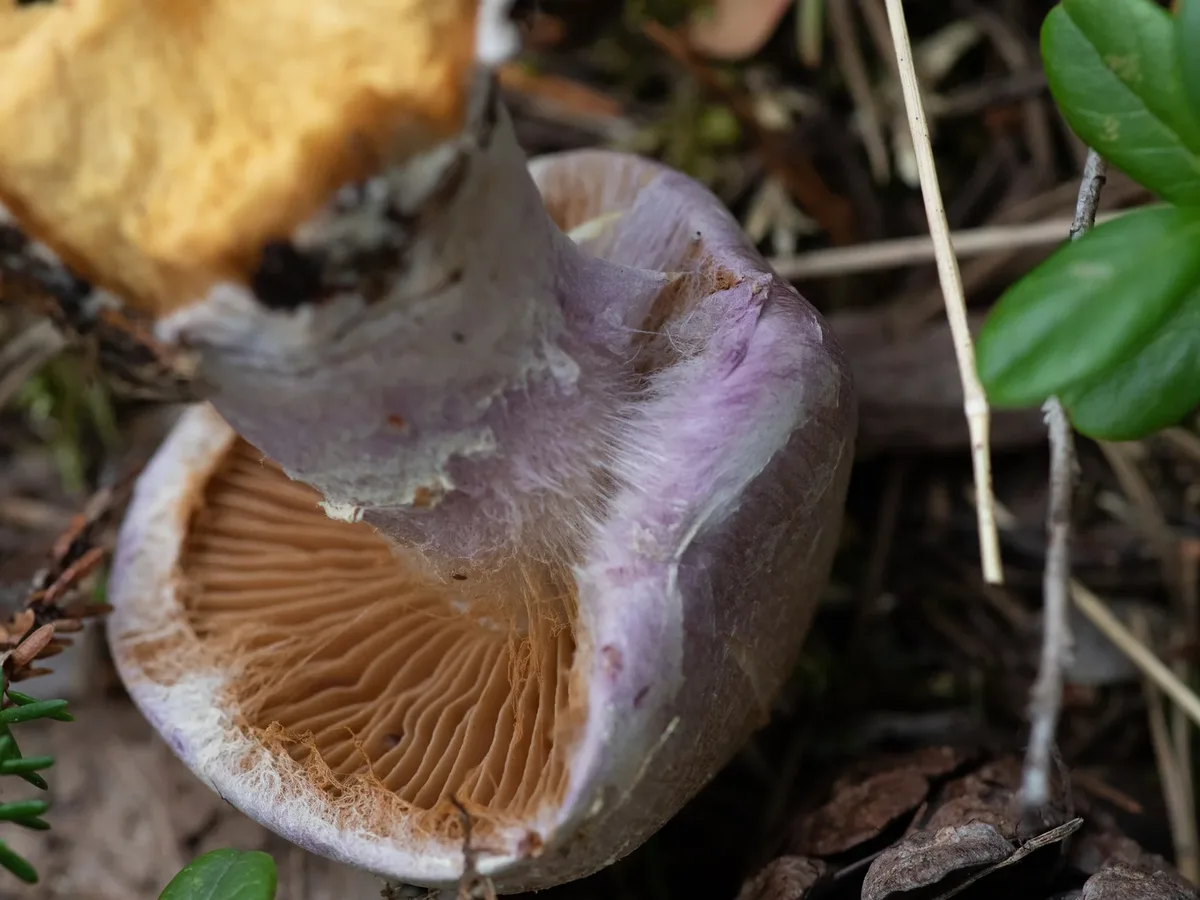 Jani Kettunen (CC0)
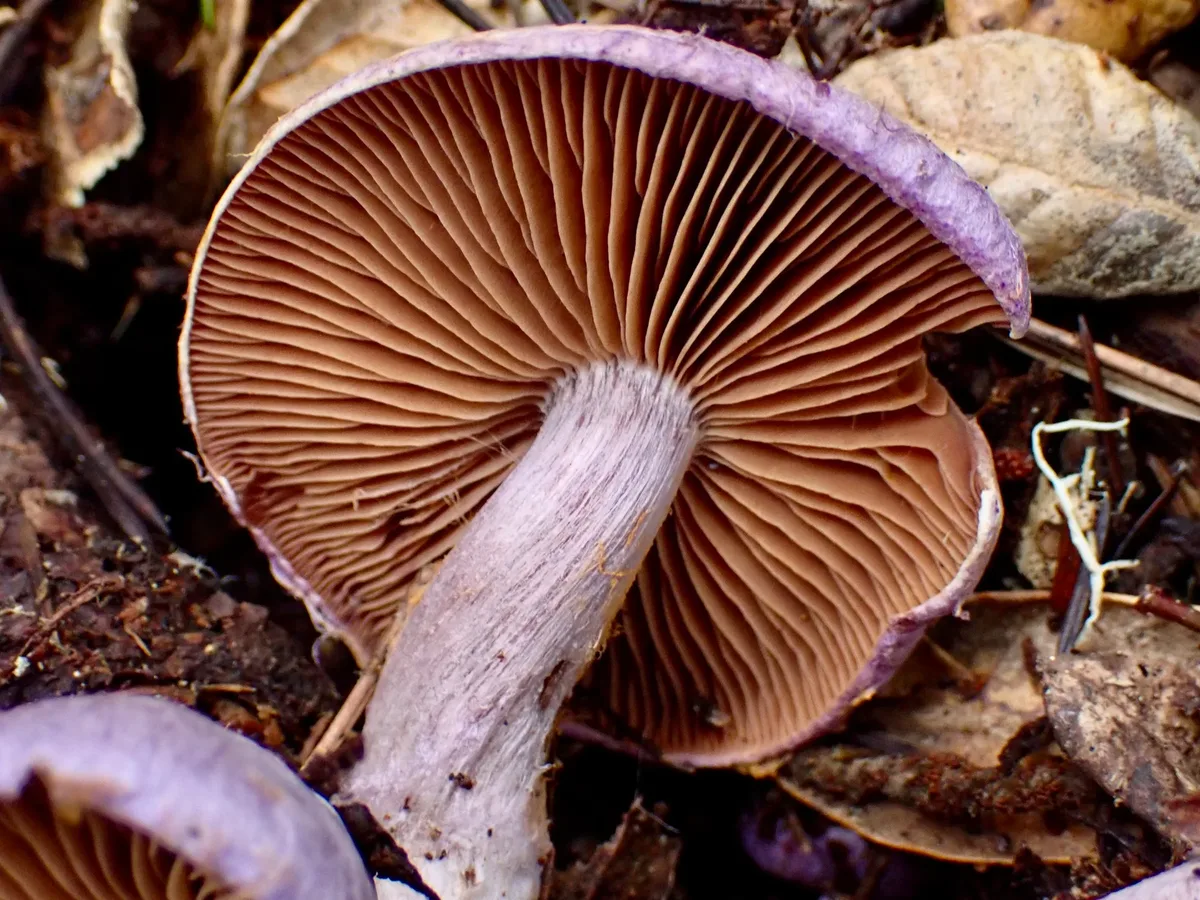 © Dutza K. (CC BY)
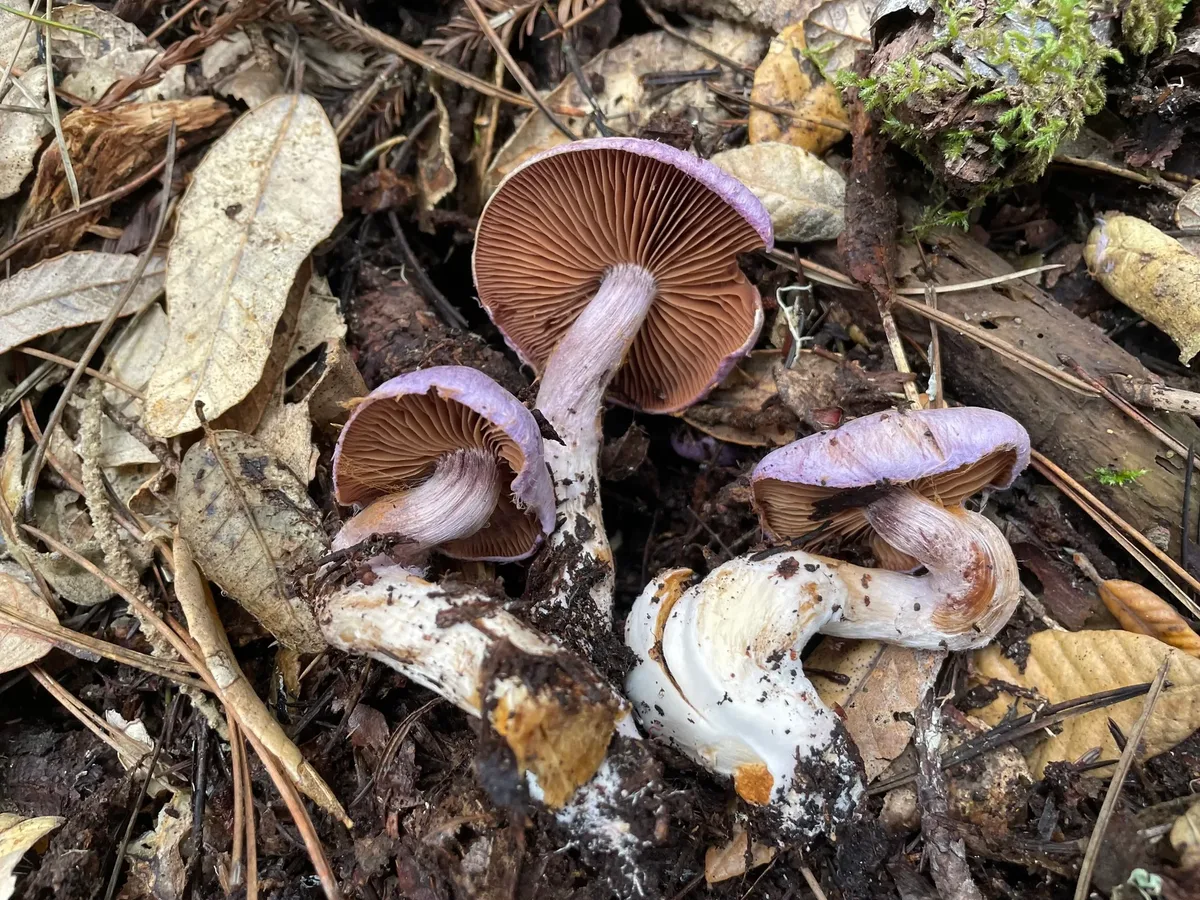 © Dutza K. (CC BY)
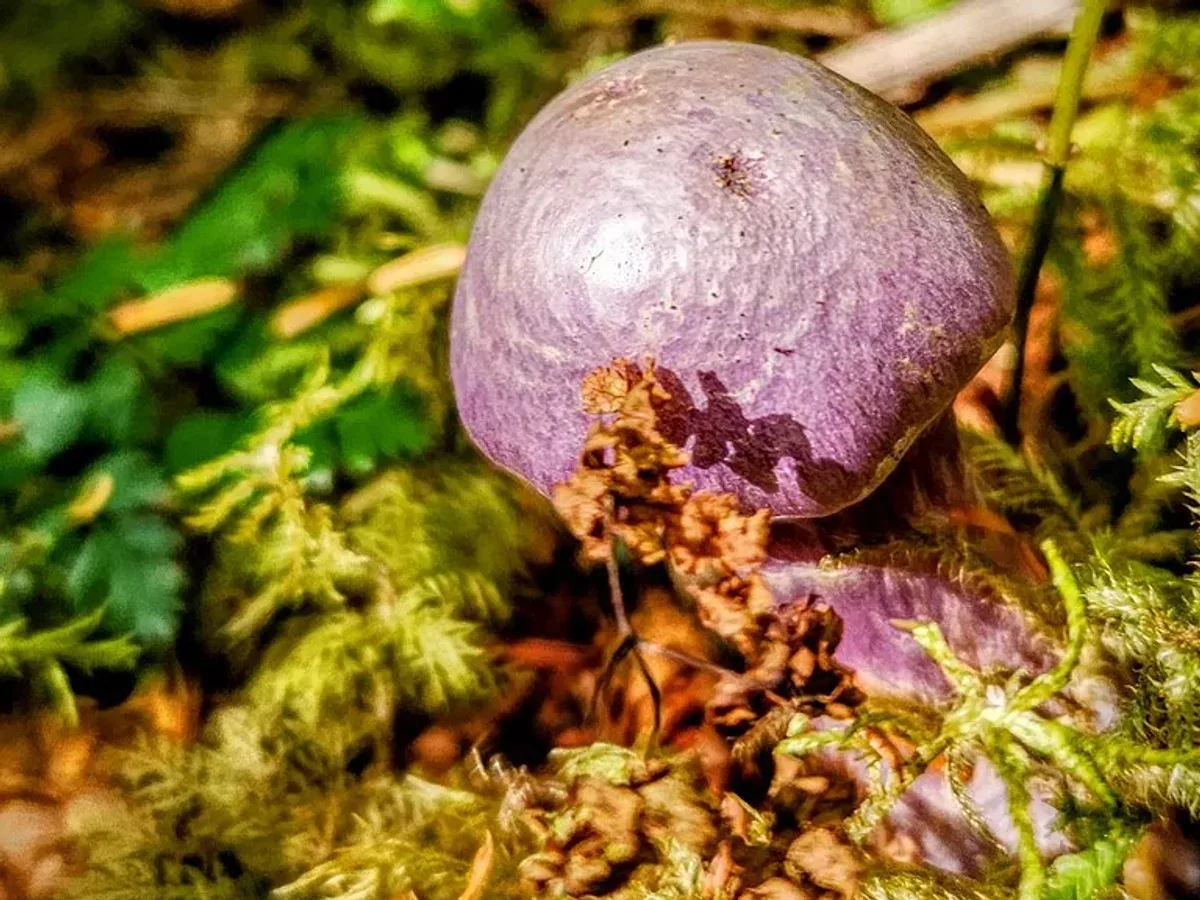 Forest Service Alaska Region, USDA (Public domain)
 muukalainen (CC0)Jani Kettunen (CC0)© Dutza K. (CC BY)
Edible only with the right preparation - or safe for some people but not others. Learn the caveats first.
Never eat a mushroom you are not 100% sure of - check the look-alikes below, and always cook wild mushrooms.
How to recognise it
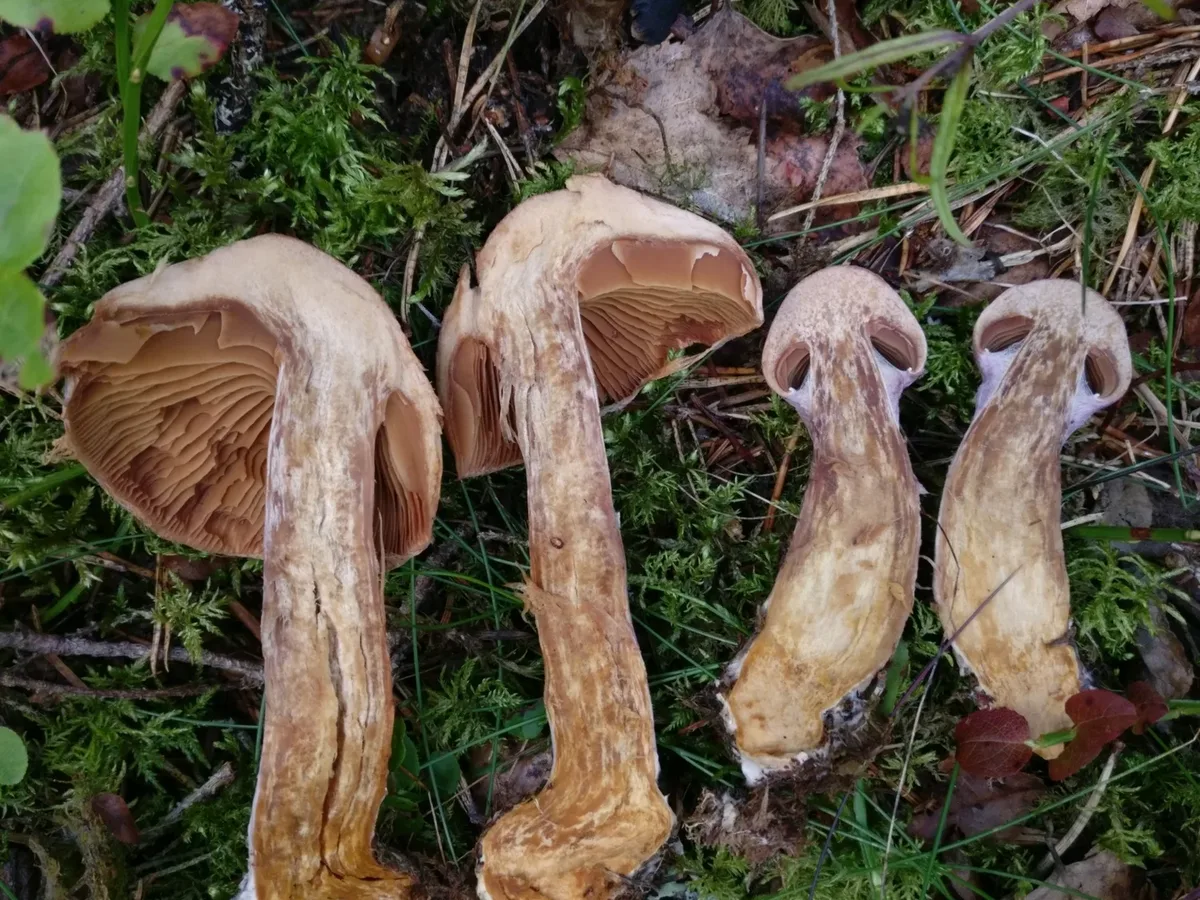
Cortinarius traganus is a medium-to-large Cortinarius in subgenus Phlegmacium, most easily identified by the combination of its colour change pattern and extraordinary smell.
Young fruitbodies are strikingly pale lilac to silvery violet-grey on the cap and stem - this early violet coloration, combined with the saffron to rusty-ochre gills, is the most important visual cue.
Cap
The cap colour fades progressively as the mushroom ages, shifting through violet-grey to yellowish or tawny buff, losing the lilac tone entirely in old specimens.
Gills
The gills are conspicuously saffron-yellow to ochre from a very early stage, never matching the pale violet of the cap - this contrast between the violet-tinted cap and the warm saffron gills is highly characteristic within the genus.
Stem
The stem is initially pale lilac-violet, usually with a markedly bulbous or club-shaped base, and becomes more ochre or buff with age.
The cobweb-like cortina is pale lilac when fresh, quickly collapsing and staining rust-brown from falling spores.
Flesh
The flesh is pale violet in fresh specimens, firm and solid throughout.
The rusty-brown spore print and coarsely warted spores are characteristic of the genus but not diagnostic at species level.
Why it's dangerous
Cortinarius traganus itself is inedible and treated as mildly (gastrointestinally) toxic rather than deadly. Its real significance for foragers is as a common, distinctively foul-smelling member of a genus that also contains lethal orellanine webcaps.
The cardinal rule is simple and absolute: do not eat ANY Cortinarius gathered from boreal or montane coniferous forest unless a trained expert has identified every specimen to species level.
Confusing a faded, less smelly C. traganus - or any brownish webcap - for an edible mushroom risks gathering the deadly C. rubellus or C. orellanus alongside it.
Fatal Cortinarius poisonings are documented in Scandinavian and central European case series, and all of them trace back to genus-level misidentification of exactly this kind.
Toxin
Cortinarius traganus is not a confirmed orellanine-containing species and is not regarded as deadly in its own right; it is treated as inedible and mildly toxic.
Reports attribute gastrointestinal upset to poorly characterised irritant compounds. The intense gas-like (acetylene / overripe pear) odour and bitterness make it thoroughly unpalatable.
The genuinely lethal hazard associated with this mushroom is indirect. It shares its conifer habitat and autumn season with the orellanine webcaps Cortinarius rubellus and C. orellanus, whose orellanine is a heat-stable nephrotoxin that destroys the kidneys with a notoriously delayed onset.
The key safety point is therefore that no Cortinarius from this habitat should be eaten - not because C. traganus itself is established as deadly, but because the genus contains species that are, and beginners cannot reliably tell them apart.
Symptoms
Eating Cortinarius traganus is expected to cause gastrointestinal upset - nausea, stomach cramps, and possibly vomiting or diarrhoea - though firm case data are scarce because its foul smell and bitterness deter ingestion. It is not associated with the delayed kidney failure caused by the orellanine webcaps.
The danger to be aware of is the symptom pattern of those deadly lookalikes (C. rubellus, C. orellanus):
- an alarming asymptomatic latent period of roughly 2 to 21 days after ingestion
- followed by intense thirst
- excessive then failing urine output
- flank pain
- progressive renal failure
Because that delay means the original mushroom meal is often forgotten, ANY suspected ingestion of an unidentified Cortinarius - even with no symptoms - warrants immediate medical assessment.
Staying safe
Do not eat Cortinarius traganus. It is inedible and considered mildly toxic, and its strong gas-like smell and bitterness are themselves a deterrent - but the smell can fade in old, dried, or frozen specimens and be masked in a mixed basket, so it should not be relied upon as the sole check.
The more important safety message is about the company it keeps: the deadly orellanine webcaps (C. rubellus, C. orellanus) share its forests and season. Treat every webcap from conifer woodland as off-limits unless expertly identified.
If any Cortinarius has been eaten and there is doubt about the species, seek emergency medical attention at once and bring the mushroom or a photograph - do not wait for symptoms, because the dangerous look-alikes act with a delay of up to three weeks.
Leave specimens undisturbed in the field and wash your hands after handling.
Where & when it grows
Habitat
Cortinarius traganus is a faithful companion of mature coniferous forest, most commonly Scots pine (Pinus sylvestris) and Norway spruce (Picea abies) in boreal and nemoral zones.
In Scandinavia it is most frequent in old pine heaths and mature spruce forests on acidic sandy or peaty soils with a feathermoss ground layer.
It is essentially absent from broadleaved forest and pure deciduous woodlands, and this habitat specificity is a useful negative identifier: if you are standing in beech or oak forest, you are not looking at C. traganus.
Growth is typically solitary or in loose scattered groups of two to five individuals; large flushes are not characteristic.
Look for it among needle litter and bilberry (Vaccinium myrtillus) understory, often near the trunk bases of mature conifers.
When
Fruitbodies emerge from late July to October, with the peak period in Scandinavia falling in late August through late September.
The fruiting season coincides exactly with the most active period for other dangerous orellanine-bearing Cortinarius species in the same habitat - C. rubellus and C. speciosissimus - reinforcing why foragers must be especially vigilant in late-summer coniferous forest.
Year-to-year fruiting intensity varies considerably depending on summer rainfall and autumn temperature.
How it grows
Strictly mycorrhizal, meaning the fungus lives in a close, two-way partnership with tree roots - swapping mineral nutrients drawn from the soil for sugars the tree produces through photosynthesis.
Like all Cortinarius species, it relies on a well-established network of hyphae woven through the soil around mature trees; it does not fruit in young plantations or recently disturbed ground.
Between fruiting seasons, that underground web persists unseen, sometimes for years, threading through needle litter and feathermoss in a forest that looks entirely mushroom-free - waiting for the right combination of late-summer rain and cooling soil temperature to push up fruitbodies.
Spores disperse passively by wind from the rusty-brown gilled caps.
Fruiting conditions
Requires sustained late-summer to early-autumn rainfall and cooling soil temperatures. Fruiting intensity correlates with the previous 2-3 weeks of precipitation following a warm summer. Warm, dry autumns suppress fruiting. The timing and weather conditions that trigger C. traganus also bring out other dangerous Cortinarius species in the same habitat.
Look-alikes
The most dangerous confusion scenario involves the violet coloration of young specimens prompting foragers to mistake C. traganus for an edible violet Cortinarius, particularly Cortinarius violaceus (the Violet webcap, which is edible).
- Cortinarius violaceus: has uniformly deep violet gills (never saffron), a much darker, more intensely violet cap covered in recurved scales, and an entirely different, faintly sweet smell - it never smells of gas or rotten fruit.
- Cortinarius camphoratus: another lilac-coloured conifer-forest Cortinarius with an unpleasant smell (goat-like, camphor), but it has lilac-brown gills rather than saffron gills and lacks the distinctly bulbous stem base.
- Cortinarius rubellus (the Deadly webcap): the most critical safety lookalike, which contains high concentrations of orellanine and causes fatal kidney failure. It has an orange-red to tawny cap and is brownish overall without lilac tones, but both species share the same coniferous forest habitat in the same season, increasing the risk of general Cortinarius confusion for inexperienced foragers.
- Cortinarius orellanus (also deadly, orellanine-containing): foxy-orange-brown and grows more typically in broadleaved forest, but can overlap in mixed forest.
None of the potential confusions are desirable edibles in this context - the risk is a forager mistaking aged (faded) C. traganus for a harmless brownish Cortinarius and sampling it.
Foxy-orange to rust-orange cap, dry and finely fibrillose-scaly, no lilac coloration. Gills orange-cinnamon. Grows more typically under deciduous trees (oak, birch, chestnut) in central and southern Europe. Also contains orellanine. Distinguished from C. traganus by warm orange tones, different habitat preference, and absence of the strong gassy smell.
Orange-red to tawny-brown overall, without any lilac or violet tones on cap or stem. Gills cinnamon-brown from the start, not saffron. No strong unpleasant smell. Also contains orellanine; causes fatal kidney failure. Shares the same boreal coniferous forest habitat and season. The risk of confusion is primarily through general Cortinarius unfamiliarity - both are dangerous and must be left alone.
Pale silvery lilac-white cap and stem with a silky fibrillose surface; gills pale grey-lilac becoming cinnamon-brown with spores. Lacks the saffron-yellow gills characteristic of C. traganus. Smell mild, slightly musty or farinaceous - never gassy. Inedible. Common in mixed forest under both conifers and broadleaves.
Similar pale lilac-violet coloration on cap and stem and also has an unpleasant smell, but the odour is described as goat-like or camphor-like (not gassy/acetylene). Gills are pale lilac-brown to ochre rather than saffron-yellow. Stem base is less markedly bulbous. Considered inedible to mildly toxic; not safe to eat. Shares coniferous forest habitat.
Deep, uniform royal-to-dark-violet cap and gills (gills are dark violet turning rusty brown with spores - never saffron-yellow). Cap covered in dark violet recurved scales. Faintly sweet or cedar-like smell, completely different from the strong gas-like odour of C. traganus. Edible. Both can appear similar to a quick glance when young, but close inspection of gill colour and smell immediately separates them.
A reference guide - never an edibility guarantee. When in doubt, leave it out.