Surprise webcap
Cortinarius semisanguineussyn. Dermocybe semisanguinea, Cortinarius semisanguineus var. semisanguineus, Agaricus semisanguineus
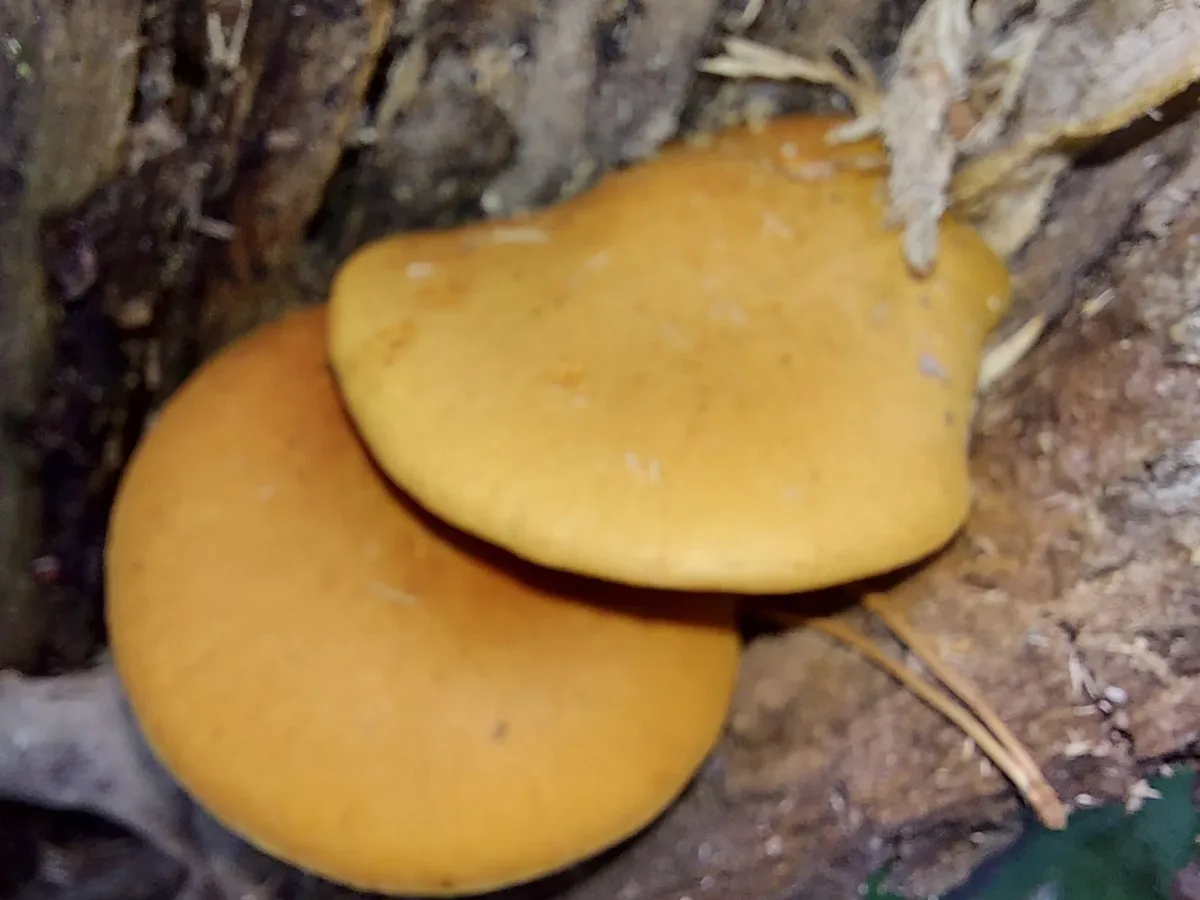 © Pavel Borodin (CC BY 4.0)
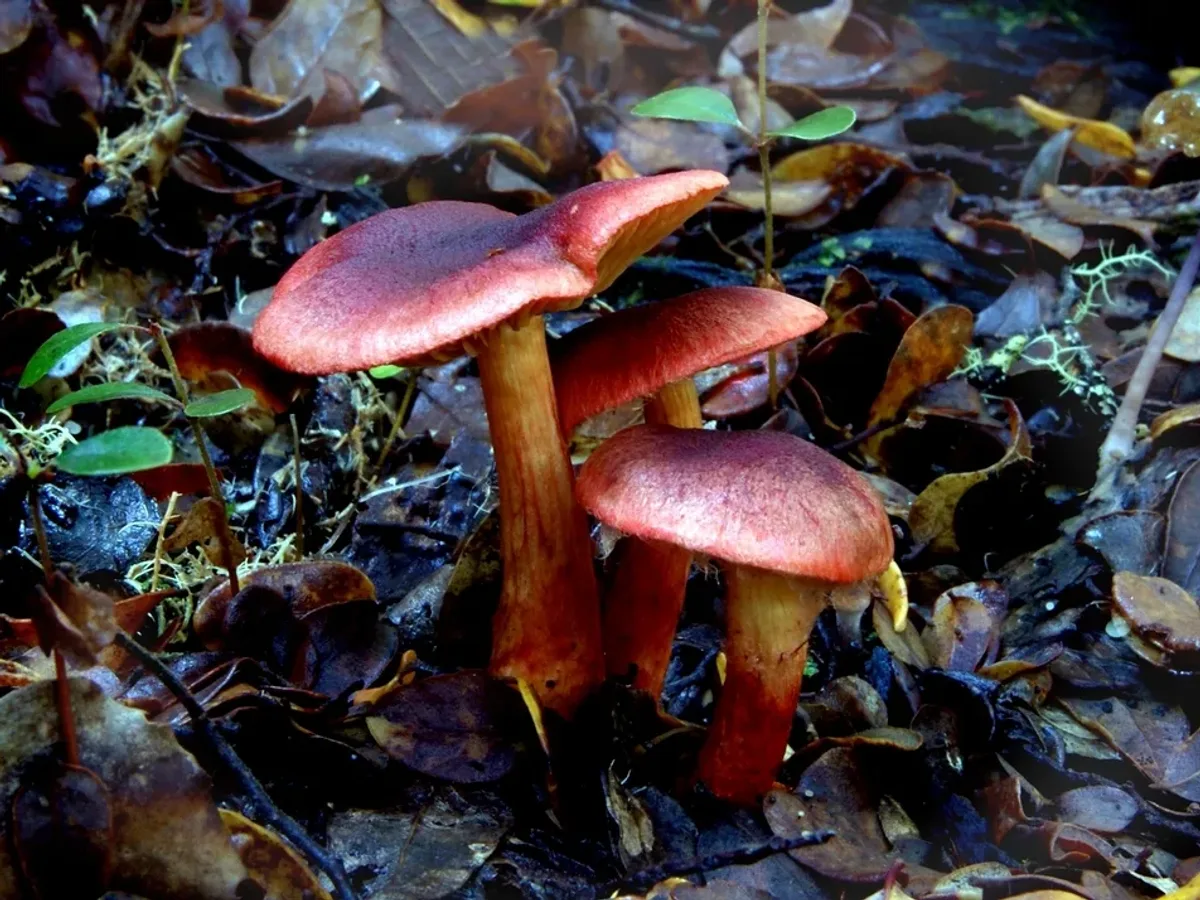 Openverse (CC0)
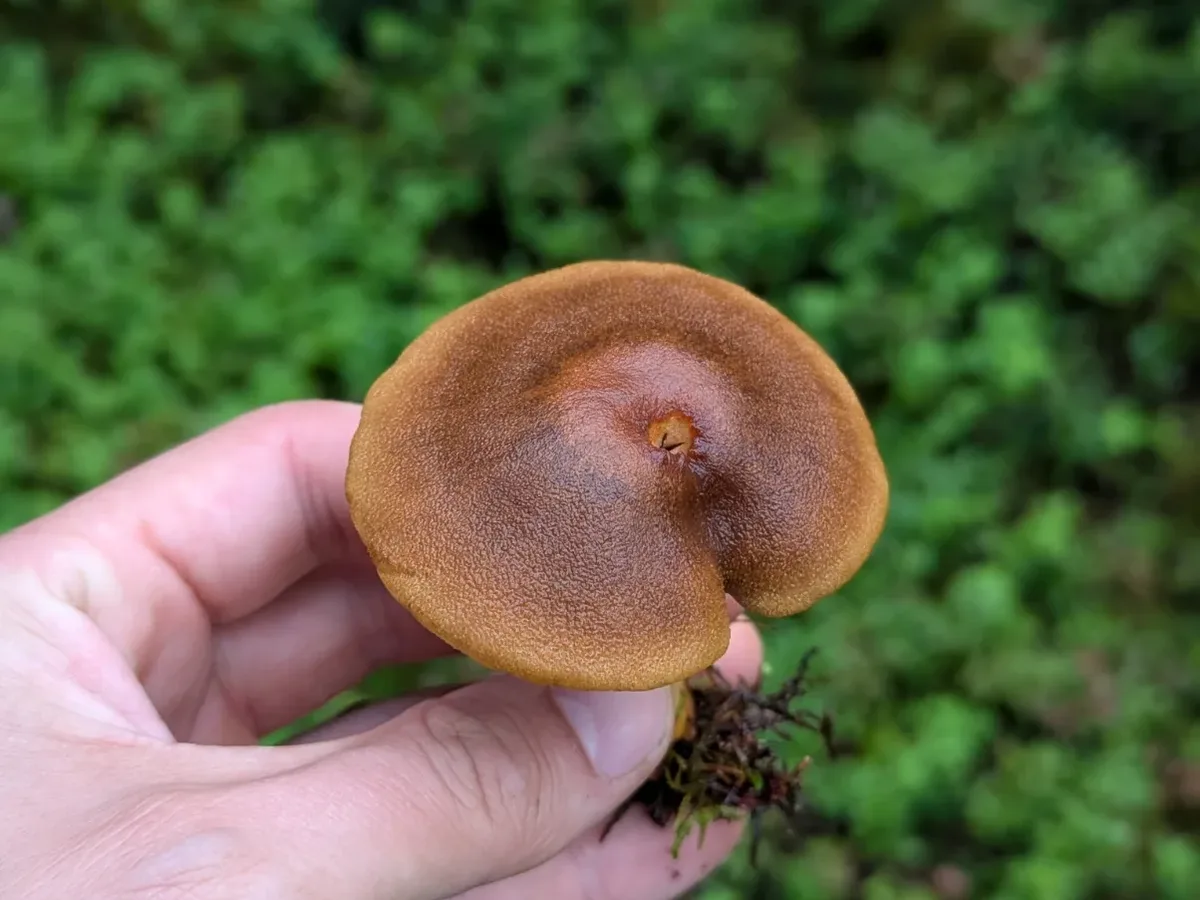 © Ole Christian Hagestad (CC BY)
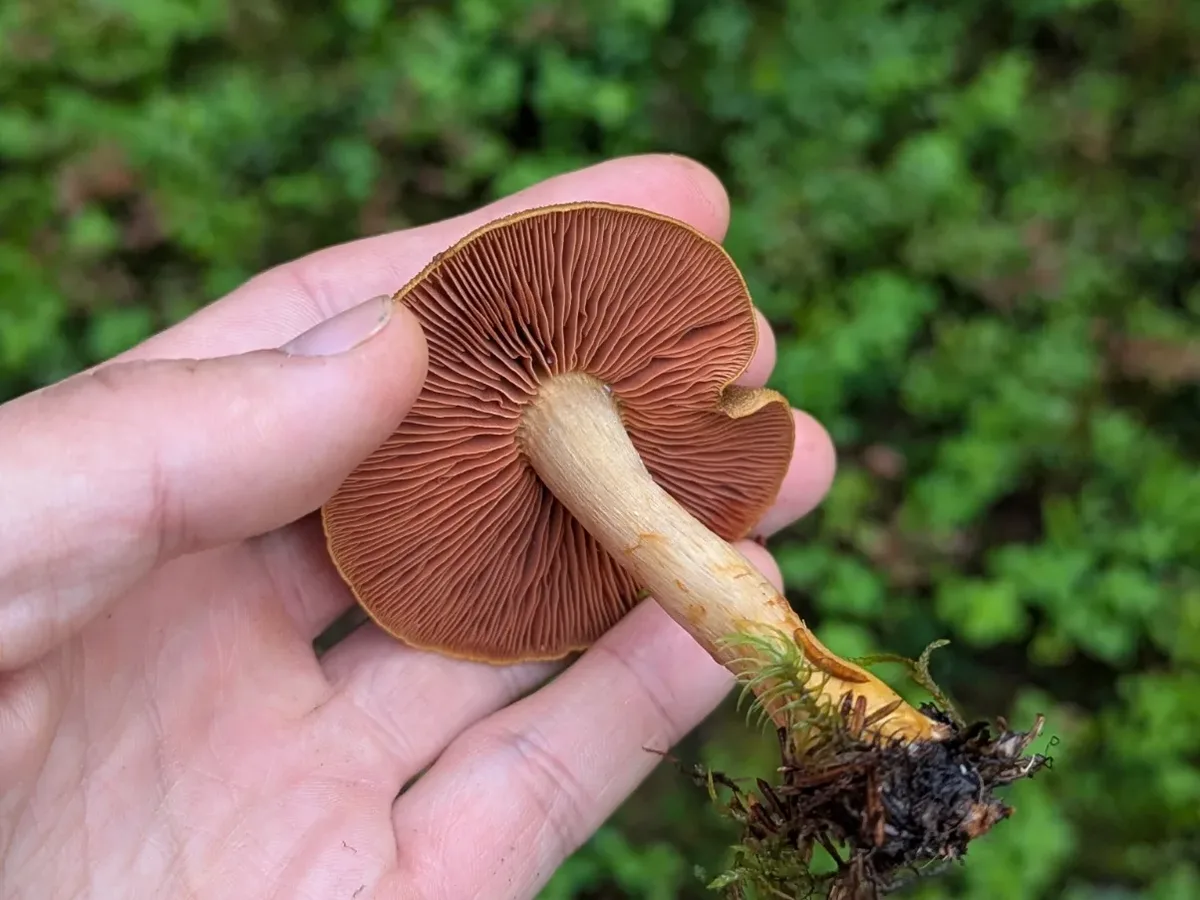 © Ole Christian Hagestad (CC BY)
 © Ole Christian Hagestad (CC BY)
 © Tessa Frenay (CC BY)
 © Tessa Frenay (CC BY)
 © Tessa Frenay (CC BY)
 © Tessa Frenay (CC BY)© Pavel Borodin (CC BY 4.0)Openverse (CC0)
Edible only with the right preparation - or safe for some people but not others. Learn the caveats first.
Never eat a mushroom you are not 100% sure of - check the look-alikes below, and always cook wild mushrooms.
How to recognise it
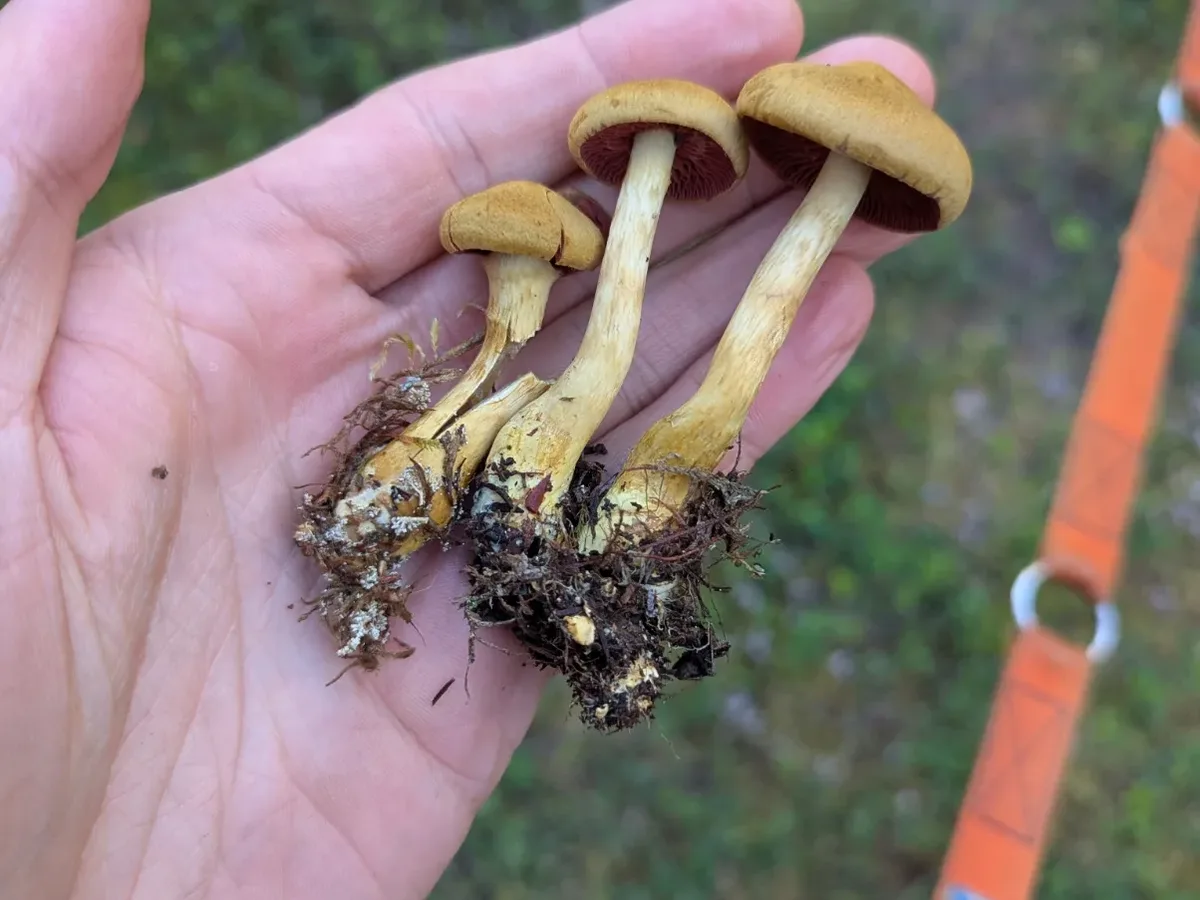
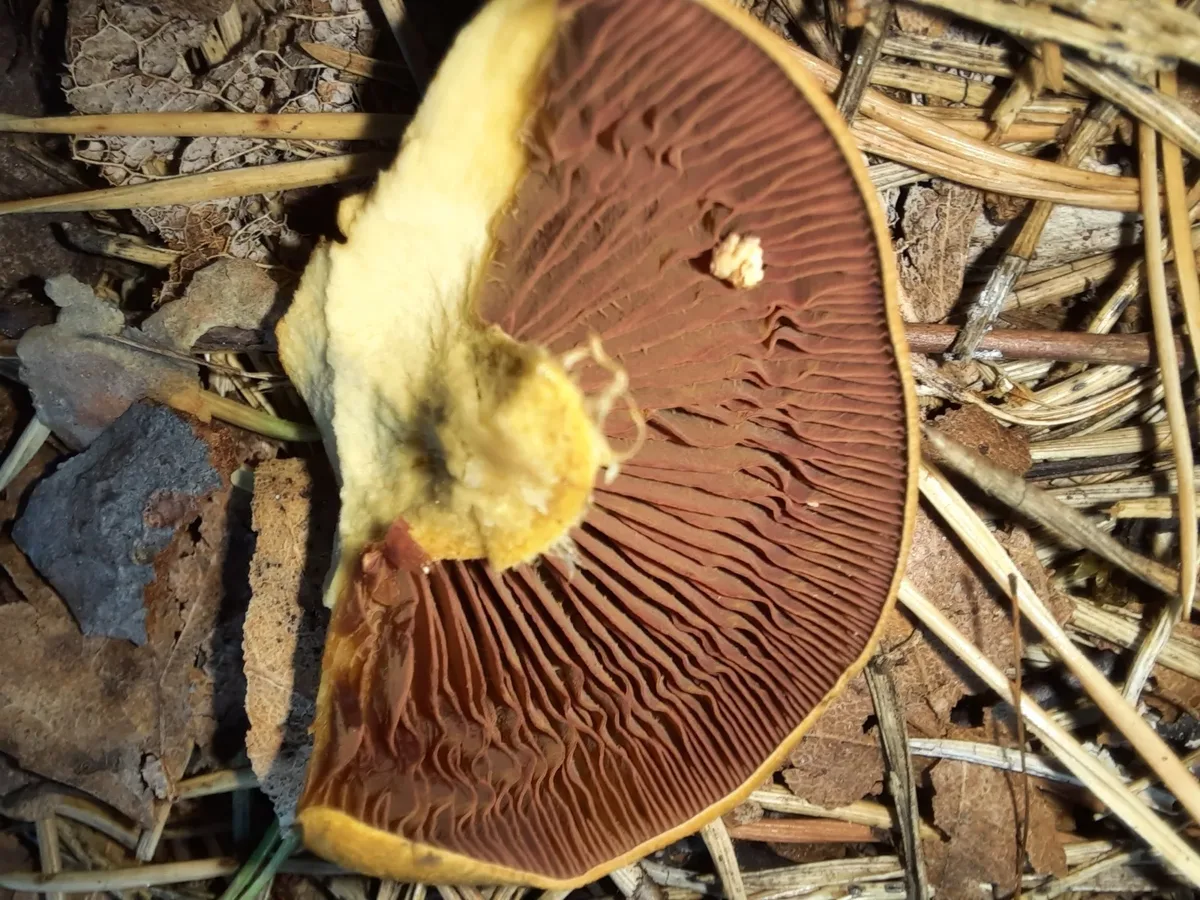
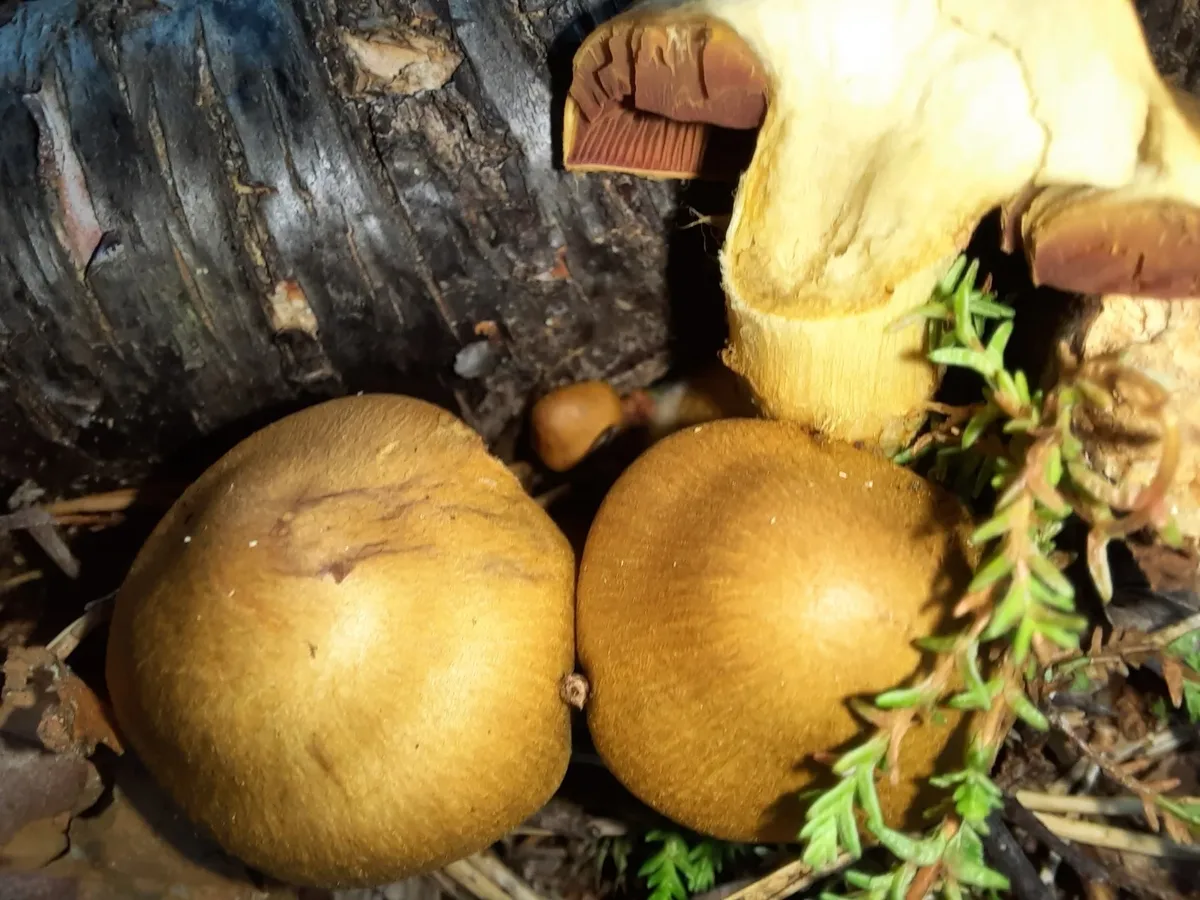
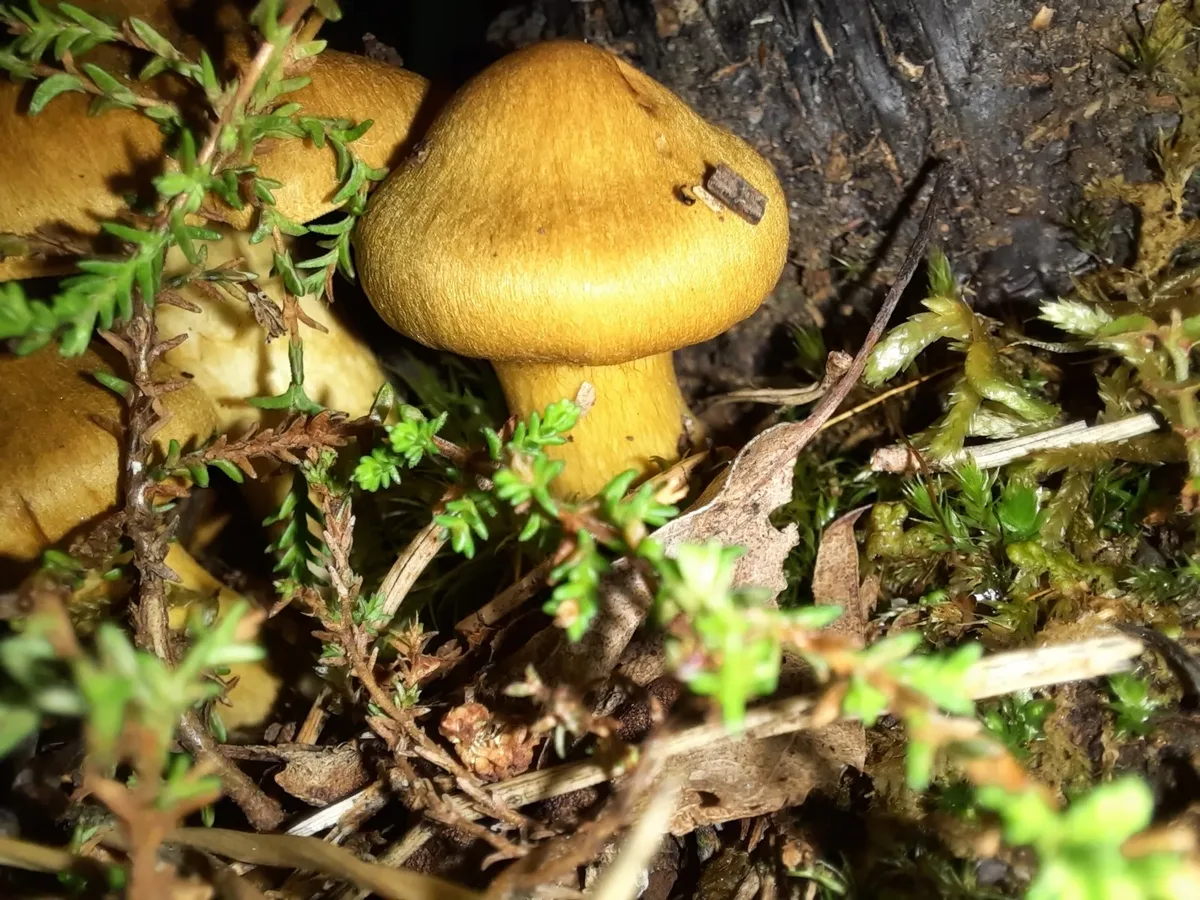
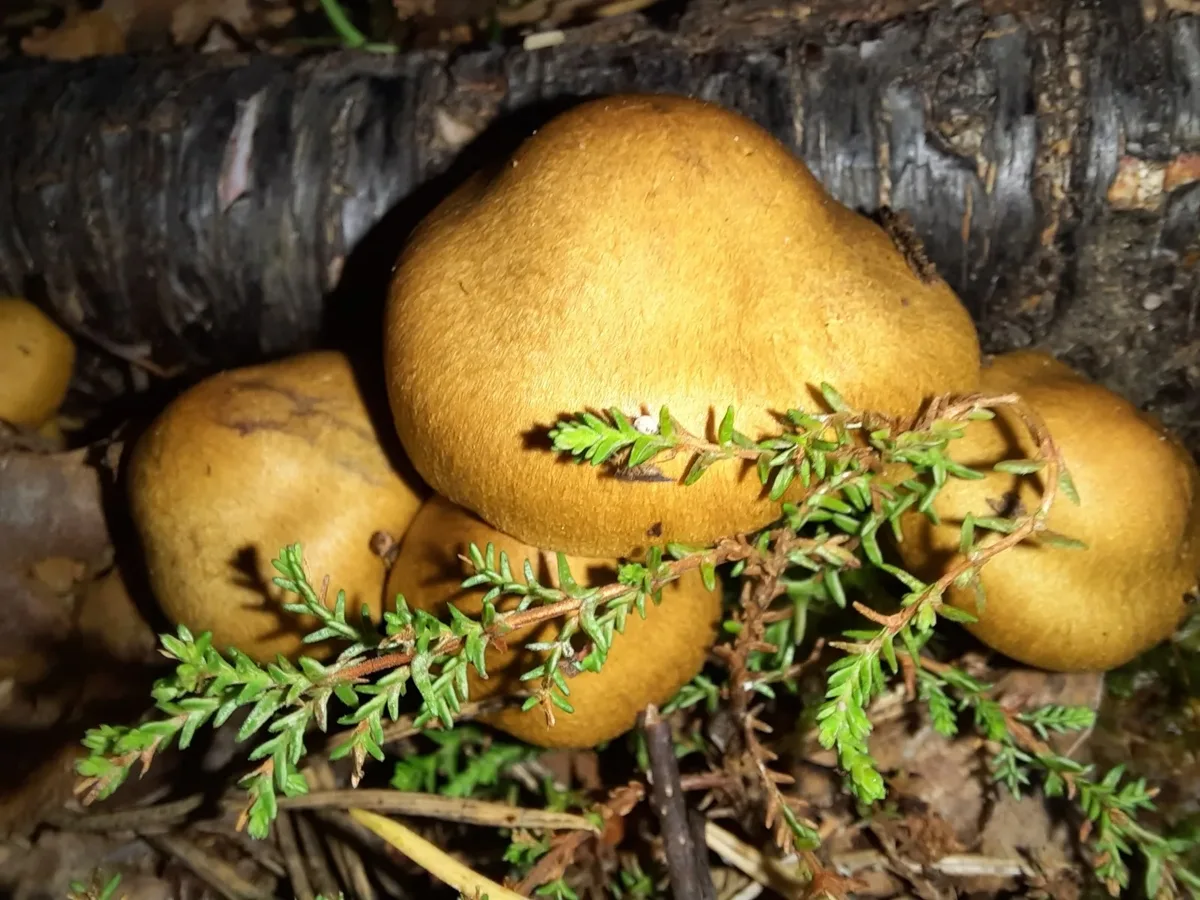
Cortinarius semisanguineus earns its English name 'Surprise webcap' from one of the most visually striking mismatches in the European flora. The cap is an entirely ordinary-looking ochre to tawny-brown, almost indistinguishable at a glance from dozens of harmless brown forest fungi, yet when the cap is turned over the gills are a deep, unmistakable blood-red to crimson.
This contrast - brown on top, blood-red underneath - is the single most diagnostic field feature and the origin of both the scientific name (semi = half, sanguineus = blood-red) and the common name.
Cap
The cap is 2-6 cm across, convex when young, broadening to a low dome or nearly flat disc with a slight central umbo. Its surface is dry and silky-fibrous, and does not become slimy even in wet weather.
Gills / Pores
Gills are crowded and adnate to sinuate, starting blood-red and maturing to a rich rust-red as the spores ripen. The spore print is rust-brown, again characteristic of the entire genus.
Stem
The slender stem is tawny-brown, showing the remnants of the reddish cortina - the cobweb-like partial veil that is unique to and diagnostic of the genus Cortinarius - as reddish fibrils on the upper stem.
Why it's dangerous
The danger of C. semisanguineus is twofold:
- 1Its own anthraquinone toxins damage kidney tissue, and the possible presence of trace orellanine means its safety profile cannot be cleanly separated from the confirmed-deadly C. sanguineus.
- 2Perhaps more practically dangerous, it grows in the same forests as C. sanguineus, and the two species share identical habitat, season, size and spore colour.
The only reliable field distinction - cap colour (brown in C. semisanguineus, uniformly blood-red in C. sanguineus) - can be obscured by lighting, age, or debris. A basket-picker who overlooks one specimen of C. sanguineus and confuses it with C. semisanguineus (or vice versa) faces a potentially lethal outcome.
The only safe rule in this habitat: do not eat any Cortinarius species in this colour range unless you are an experienced mycologist with certainty of identification.
Toxin
The primary toxins are anthraquinone pigments, including emodin and related hydroxyl-anthraquinones, which are responsible for the characteristic blood-red gill colour. These compounds are nephrotoxic in animal studies.
Some analytical investigations have reported trace levels of orellanine - the confirmed human-lethal bipyridine N-oxide nephrotoxin characteristic of C. orellanus and C. rubellus - though this is not universally agreed.
The anthraquinone content is not destroyed by heating.
Symptoms
The expected toxic syndrome from anthraquinone ingestion resembles that of other nephrotoxic mushrooms: gastric discomfort may occur, but the primary concern is delayed kidney damage.
If orellanine is present even in trace quantities, the syndrome could resemble orellanine poisoning: a latent period of days to weeks, followed by progressive renal failure presenting as thirst, reduced urine output, flank pain and rising blood creatinine.
The long latency - if orellanine contributes - means that a victim may not connect symptoms to the mushroom meal, and considerable renal damage can accumulate before a diagnosis is made.
Any suspicion of Cortinarius ingestion should prompt immediate hospital attendance and disclosure to physicians.
Staying safe
Cortinarius semisanguineus is toxic and must not be eaten.
Its primary toxins are anthraquinone compounds (emodin and related derivatives) responsible for the blood-red pigmentation of the gills; these cause kidney damage in animal toxicology studies.
Whether orellanine - the confirmed human-lethal nephrotoxin present in C. sanguineus, C. orellanus and C. rubellus - is also present in C. semisanguineus is disputed: some analytical studies report trace levels, others do not detect it. This uncertainty is not a reason for reassurance: it is a reason to apply the same absolute prohibition that applies to the confirmed orellanine species.
There is no treatment that removes the toxins; cooking, boiling, drying, pickling and freezing do not render the mushroom safe.
The critical safety rule for the entire genus Cortinarius: if you cannot identify your specimen with complete certainty as one of the few known edible species (Cortinarius caperatus / Rozites caperatus), do not eat it. In this species' habitat and at its growth stage, the cost of a mistake is kidney failure.
Where & when it grows
Habitat
A conifer-forest specialist that will always be found within the root zone of a living spruce or pine host, with which it forms an obligate ectomycorrhizal partnership.
Look for it in cool, shaded, acidic spruce and pine woods with a well-developed moss layer - it has a particular affinity for humid sites where sphagnum, feather-moss or similar cushion mosses carpet the ground.
It is never found on dead wood, in open meadows or in hardwood forests.
Because it shares its habitat intimately with the confirmed-deadly Cortinarius sanguineus, any warm-toned, rust-spored webcap found in mossy conifer forest must be treated with extreme caution.
When
An autumn fungus, fruiting from late August through October across northern and central Europe, with peak abundance in September and early October.
Like all ectomycorrhizal webcaps, it responds to the combination of late-summer rainfall and falling soil temperatures that characterises the boreal autumn - the mycelium has been threaded through the forest soil all year, waiting for these cues.
In a productive year, small scattered troops may appear throughout a suitable spruce or pine stand.
How it grows
Solitary or in small scattered groups on acidic forest soil, always close to the roots of a living conifer host. It never clusters on wood.
The fruit bodies are relatively small and easy to miss against the brown forest floor, particularly when the plain brown cap faces upward - the diagnostic red gills are hidden underneath and only visible once you pick the mushroom up and look.
Fruiting conditions
Autumn fruiter in humid, mossy coniferous forest; triggered by late-summer rainfall combined with falling soil temperatures. Standard mycorrhizal autumn-fruiter phenology, closely paralleling C. sanguineus in timing and environmental requirements.
Look-alikes
The most dangerous lookalike is Cortinarius sanguineus (Bloodred webcap), which is confirmed deadly and contains orellanine at concentrations sufficient to cause irreversible renal failure. C. sanguineus is uniformly blood-red throughout - cap, gills, stem and flesh are all deep crimson - whereas C. semisanguineus has a brown cap.
In poor light, in a basket, or when a specimen is partially obscured by debris, this distinction can be missed.
A second dangerous group includes the other orellanine-bearing Cortinarius species:
- C. orellanus - orange-brown cap, yellow-orange gills; deadly
- C. rubellus / C. speciosissimus - red-brown cap, rust-orange gills; deadly
- C. limonius - orange-yellow; deadly
None of these are commonly confused with C. semisanguineus directly, but they occur in the same forests and underline the broader rule: all warm-toned, rust-spored webcaps in conifer woods should be considered dangerous.
There are no edible species in this close alliance that can be reliably distinguished by a non-expert.
Confirmed deadly - contains orellanine. The key difference is that C. sanguineus is uniformly blood-red throughout: cap, gills, stem and flesh are all saturated crimson. C. semisanguineus has a brown to ochre-brown cap; only the gills are red. In good light and with a clear view, this distinction is reliable. In poor light, a basket, or a partially buried specimen, it can easily be missed. Never mix or confuse these two species - the penalty for error is irreversible kidney failure.
Confirmed deadly - contains orellanine. C. rubellus has a red-brown to foxy-red cap (not brown like C. semisanguineus) and rust-orange rather than blood-red gills. Both grow in coniferous forest. Although the two are not particularly similar when examined side-by-side, they co-occur in the same habitat, and confusion is possible for the uninformed picker. C. rubellus is lethal; treat any doubt as disqualifying.
Confirmed deadly - contains orellanine. C. limonius has an orange to saffron-yellow cap (not brown) and orange gills. The colour difference from C. semisanguineus is clear under good lighting, but both species are found in coniferous forest and both are dangerous. All warm-toned, small-to-medium Cortinarius in conifer woods must be treated as potentially lethal.
Confirmed deadly - contains orellanine. C. orellanus has an orange-brown to rust-brown cap with orange-rust gills and is more associated with deciduous trees (especially oak) than with conifers. The gill colour (orange-rust rather than blood-red) and habitat can help distinguish it, but it is equally lethal.
C. cinnabarinus is also toxic (anthraquinones) and also shows vivid red coloration, but unlike C. semisanguineus the cap is also bright cinnabar-red to orange-red, not brown. It is more associated with deciduous trees, especially beech and oak. Both species are inedible; neither should be consumed.
A reference guide - never an edibility guarantee. When in doubt, leave it out.