Bloodred webcap
Cortinarius sanguineussyn. Dermocybe sanguinea, Cortinarius puniceus
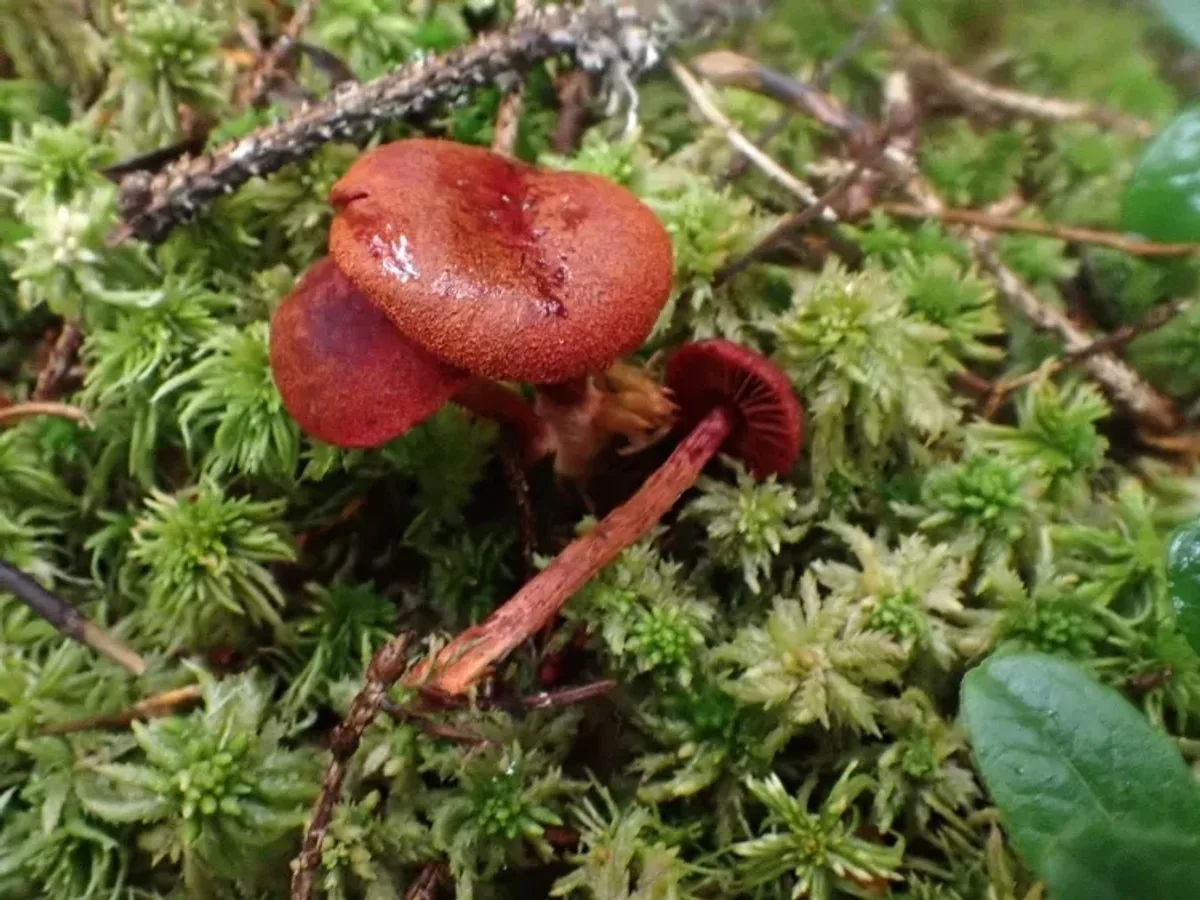 © Morten Pettersen (CC BY)
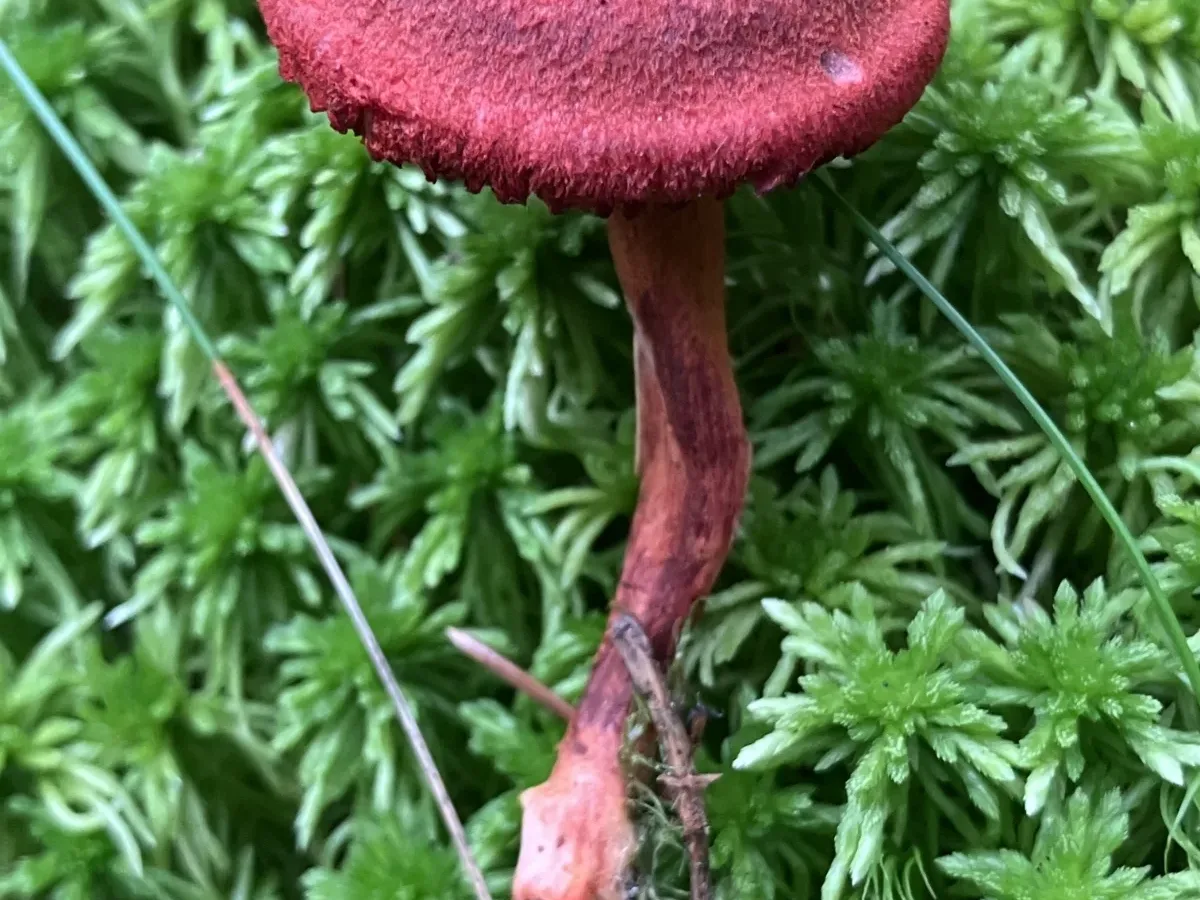 © Jonas Heggedal (CC BY)
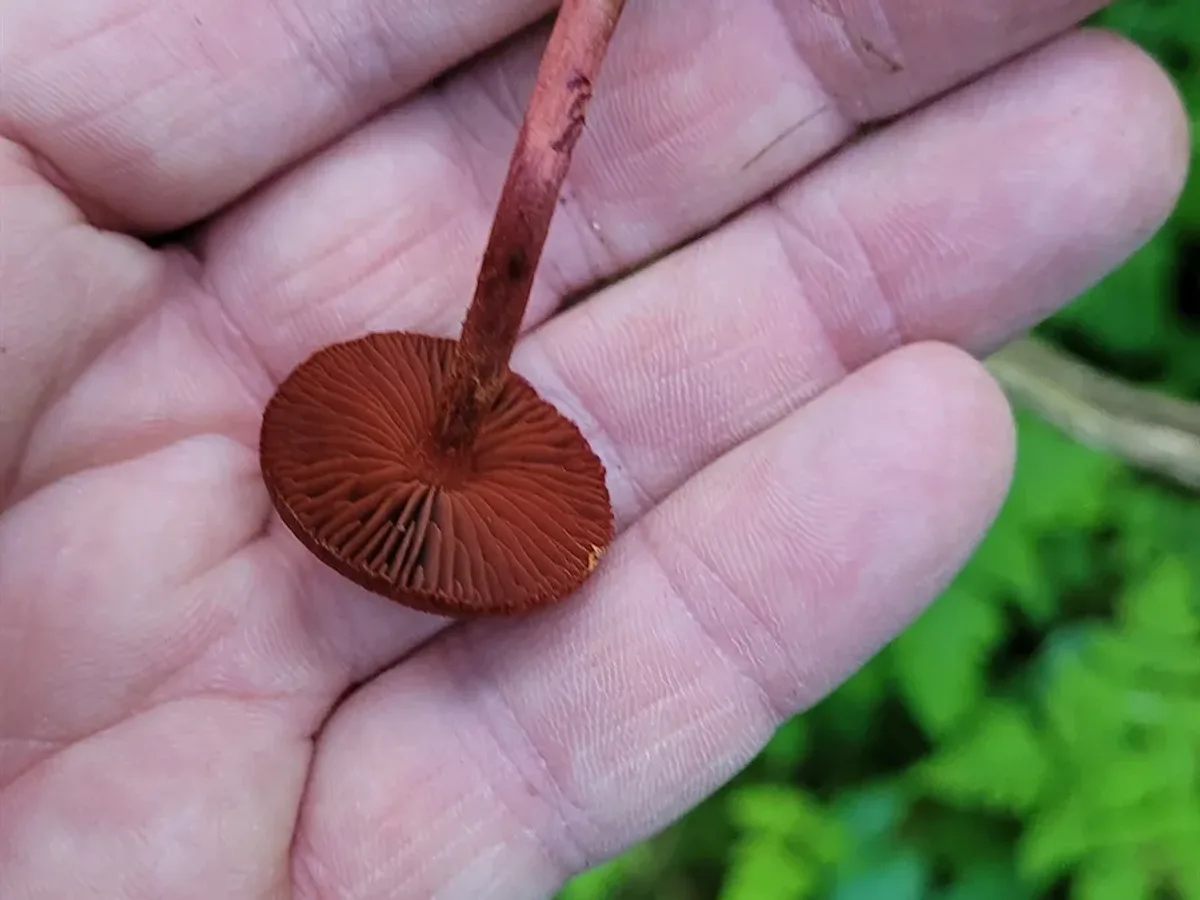 © Terje Bjerkan (CC BY)
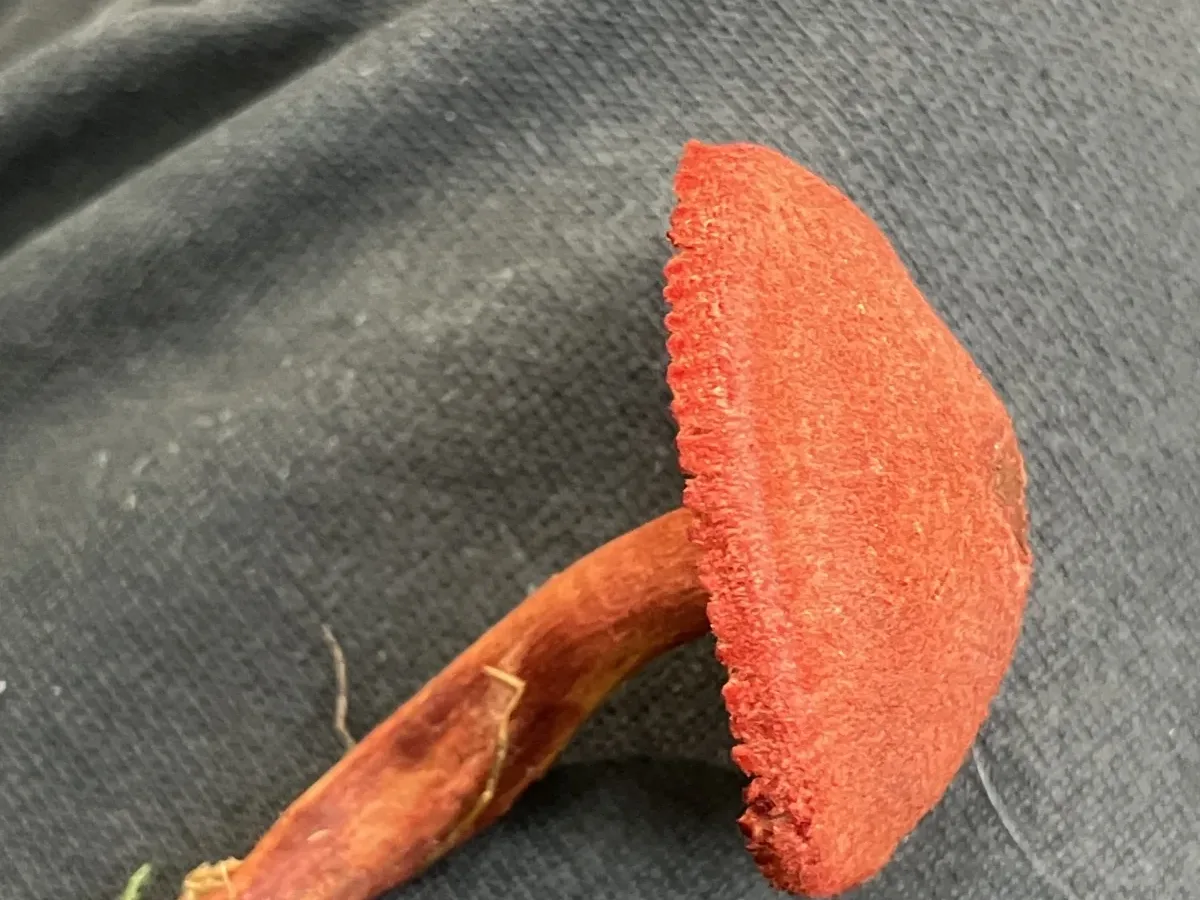 © Jonas Heggedal (CC BY)
 © Jonas Heggedal (CC BY)
 © Petri Roponen (CC BY-SA)
 © Marte Kristoffersen (CC BY)© Morten Pettersen (CC BY)© Jonas Heggedal (CC BY)
Toxic - and the most serious cases can be fatal. Never eat it, and wash your hands after handling.
Never eat a mushroom you are not 100% sure of - check the look-alikes below, and always cook wild mushrooms.
How to recognise it
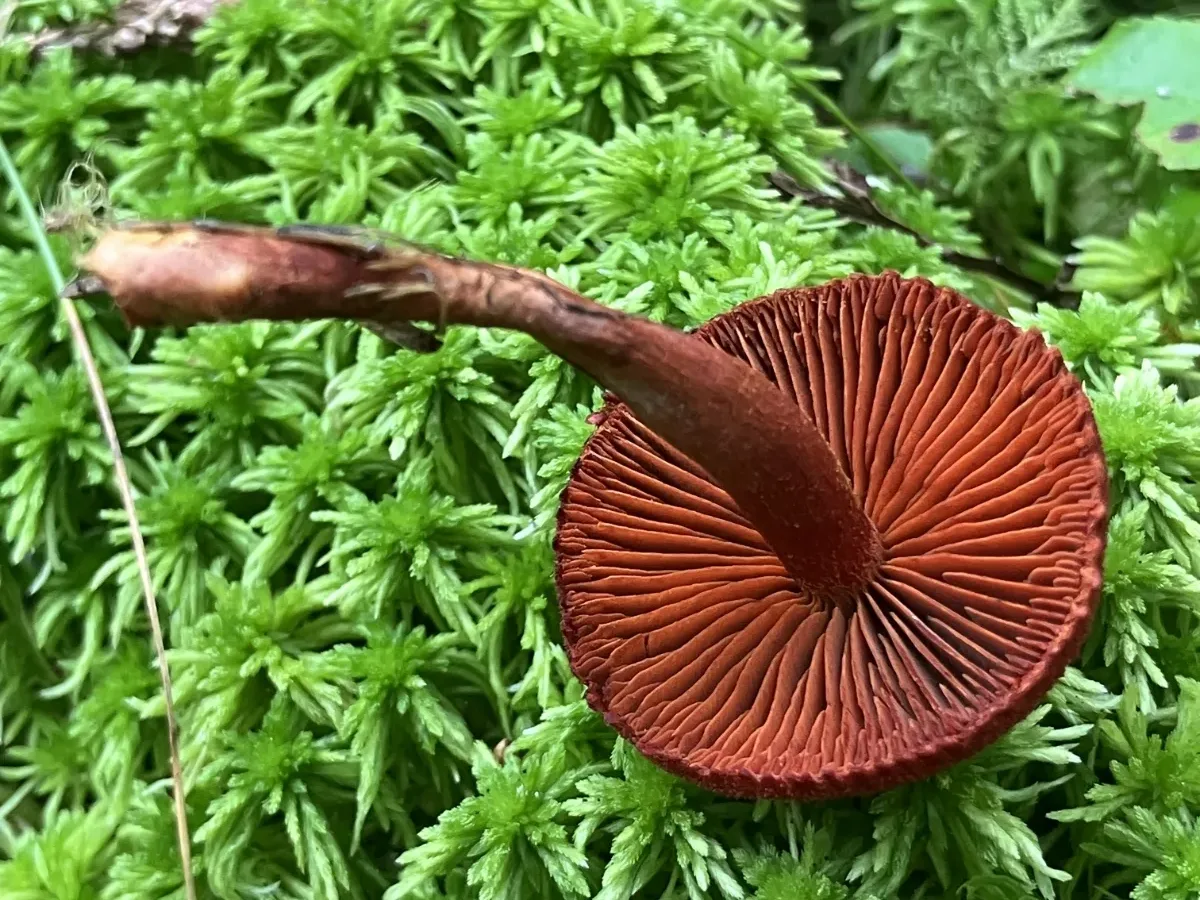
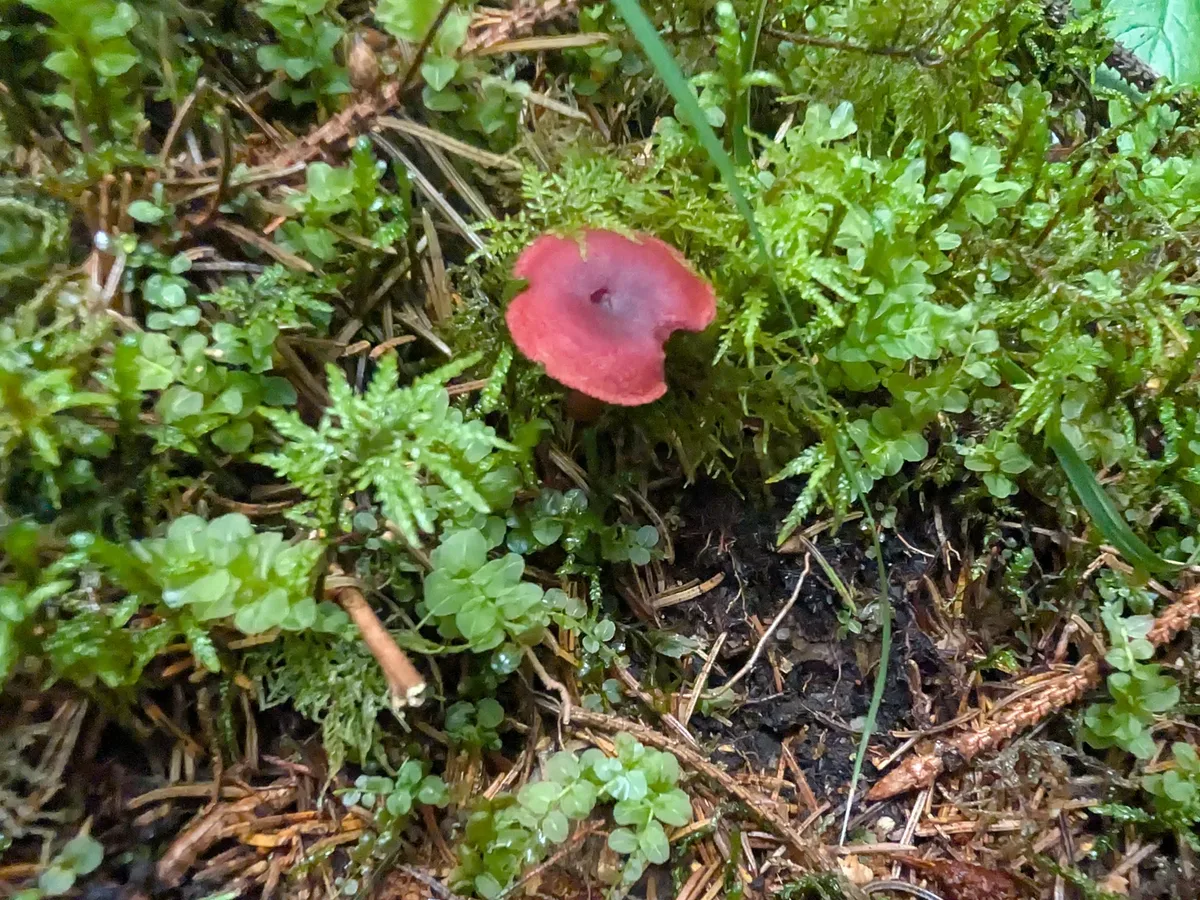
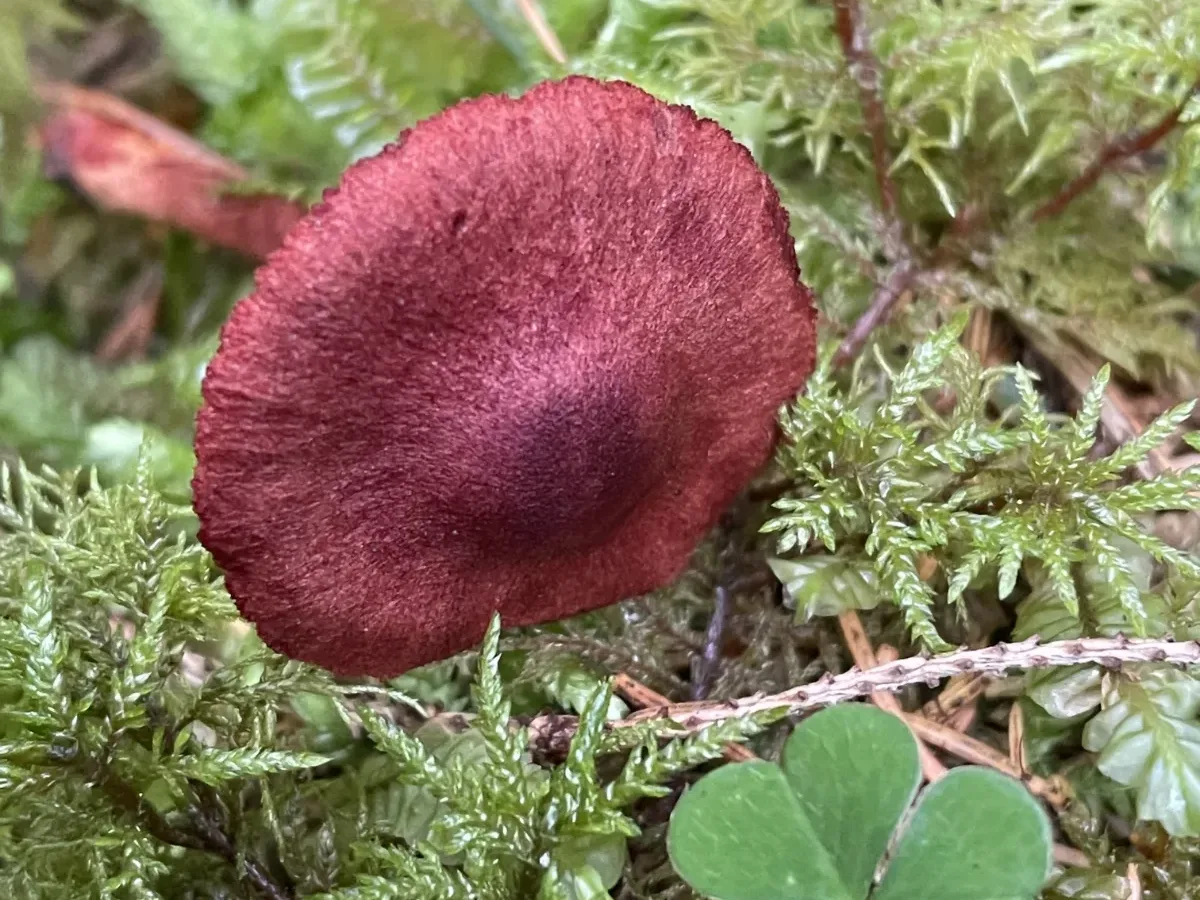
Cortinarius sanguineus is immediately arresting: every part - cap, gills, stem, and flesh - is a deep, uniform blood-red to crimson, as though dipped in the same pigment.
Cap
2-6 cm across, convex then broadly umbonate, with a dry, silky-fibrous surface that stays matte and non-sticky even in wet conditions.
Gills
Crowded, adnate to slightly sinuate, opening blood-red and gradually rusting as the spores ripen.
Stem
Slender (0.4-0.8 cm), cylindrical, equally red. It carries the hallmark of the whole Cortinarius genus: in young specimens a cobweb-like veil (cortina) spans from cap edge to stem; as it breaks, reddish fibrils cling to the upper stem - a detail that helps confirm genus.
Always take a spore print: it will be rust-brown, characteristic of every Cortinarius.
Flesh
Cut through the flesh and it is red all the way through.
Why it's dangerous
The combination of extreme toxin stability, absence of immediate warning symptoms, and very long latency makes C. sanguineus among the most dangerous mushrooms in Europe.
By the time a hospital presents the diagnosis, renal damage is typically well advanced. There is no antidote; treatment is dialysis and supportive care.
Outcome depends on the dose received and speed of diagnosis - many patients require dialysis for months and some require permanent renal replacement therapy.
A single cap consumed is sufficient to cause serious kidney injury in an adult.
The identical danger exists for C. rubellus and C. orellanus; all three species should be regarded as equally lethal.
Toxin
Orellanine (and related orelline and orellinine), bipyridine N-oxide nephrotoxins that generate free radicals in renal tubular cells.
The toxin load in C. sanguineus is comparable to that in C. rubellus.
Anthraquinone pigments responsible for the blood-red colour are also present, but are not themselves the primary nephrotoxins.
Symptoms
Orellanine poisoning has a notoriously long and deceptive latency period of 2 days to 3 weeks (most often 1-2 weeks), during which the victim feels entirely well or experiences only mild flu-like discomfort, nausea, headache, or thirst.
This latency is clinically dangerous because the patient has usually discarded the mushroom, cannot recall the meal, or does not connect the symptoms to the ingestion.
After the latent phase, progressive renal failure develops:
- flank pain
- oliguria
- rising creatinine and urea
- ultimately end-stage renal disease requiring dialysis
Staying safe
Cortinarius sanguineus contains orellanine, the same nephrotoxic bipyridine N-oxide responsible for the mass poisonings attributed to C. orellanus and C. rubellus.
Orellanine is extraordinarily stable: it is not destroyed by cooking, drying, boiling or freezing, and it is tasteless and odourless.
The toxin acts by generating reactive oxygen species in renal tubular cells, leading to progressive destruction of kidney tissue.
There is no antidote. The only treatment is supportive care and, in severe cases, renal dialysis or kidney transplantation.
Where & when it grows
Habitat
A conifer-forest specialist, most reliably found in humid, mossy Norway spruce woodland on cool acidic soils.
Like all mycorrhizal fungi, it lives in genuine partnership with its host: the mycelium threads through spruce roots, exchanging sugars for minerals in an arrangement that may persist for decades underground.
The fruiting body you see above ground is just the surface signal of that hidden relationship - which is why this species is always within root-range of a spruce or pine, never in open meadows or on dead wood.
Look for it among deep moss cushions, on north-facing slopes, and along the shaded banks of forest streams where moisture lingers longest through autumn.
When
Late summer through mid-autumn, typically August through October in central and northern Europe, peaking in September.
Fruiting follows late-summer rainfall combined with falling soil temperatures, the classic trigger for many ectomycorrhizal autumn species.
How it grows
Solitary or in small scattered groups; never in dense clusters.
Because each fruiting body is tied to the underground mycorrhizal network of an individual tree root, finds tend to be spread out across the forest floor rather than massed in one spot.
Fruiting conditions
Autumn fruiter in humid acidic conifer forest; requires cooling soil temperatures and adequate late-summer rainfall. Flush lag and thresholds are standard mycorrhizal autumn-fruiter estimates.
Look-alikes
Cortinarius semisanguineus (the semi-bloodred webcap) is the most dangerous confusion: it has a brown-orange cap but identically blood-red gills, making it visually similar when only the underside is examined. C. semisanguineus is also toxic (contains anthraquinone pigments and potentially orellanine).
Cortinarius cinnabarinus is another closely related red Dermocybe, with a bright cinnabar-red cap and red gills, also toxic.
None of the realistic lookalikes are edible, so any uniformly red, rust-spored, cobweb-veiled mushroom in conifer woods should be treated as dangerous.
C. limonius is orange to saffron-orange rather than blood-red, and contains orellanine - it is deadly. The orange-yellow colour distinguishes it from the blood-red C. sanguineus, but both species share conifer habitat and are equally lethal. All warm-toned, rust-spored webcaps in conifer woods must be treated as potentially deadly.
C. cinnabarinus is also uniformly red to cinnabar-red throughout, a very close lookalike. It tends to have a slightly more orange-toned cap and is associated with broadleaf trees (especially beech and oak) rather than conifers. It is also toxic and must not be eaten. In the field, distinguishing it from C. sanguineus requires attention to habitat (broadleaf vs. conifer host) and microscopy.
C. semisanguineus has a similar blood-red gill colour but its cap is ochre-brown to orange-brown rather than uniformly blood-red. When seen from above it looks like a brown mushroom; only the underside reveals the red gills. It is toxic (anthraquinones, possibly orellanine traces) and must not be eaten. The key distinction is the cap colour: uniformly red = C. sanguineus; brown cap with red gills = C. semisanguineus. Neither is edible.
A reference guide - never an edibility guarantee. When in doubt, leave it out.