Red-base webcap
Cortinarius rubrobasalissyn. Cortinarius rubrobasalis Cleland
 © Jason Hollinger (CC BY-SA)
 © Jason Hollinger (CC BY-SA)© Jason Hollinger (CC BY-SA)© Jason Hollinger (CC BY-SA)
Toxic - and the most serious cases can be fatal. Never eat it, and wash your hands after handling.
Never eat a mushroom you are not 100% sure of - check the look-alikes below, and always cook wild mushrooms.
How to recognise it
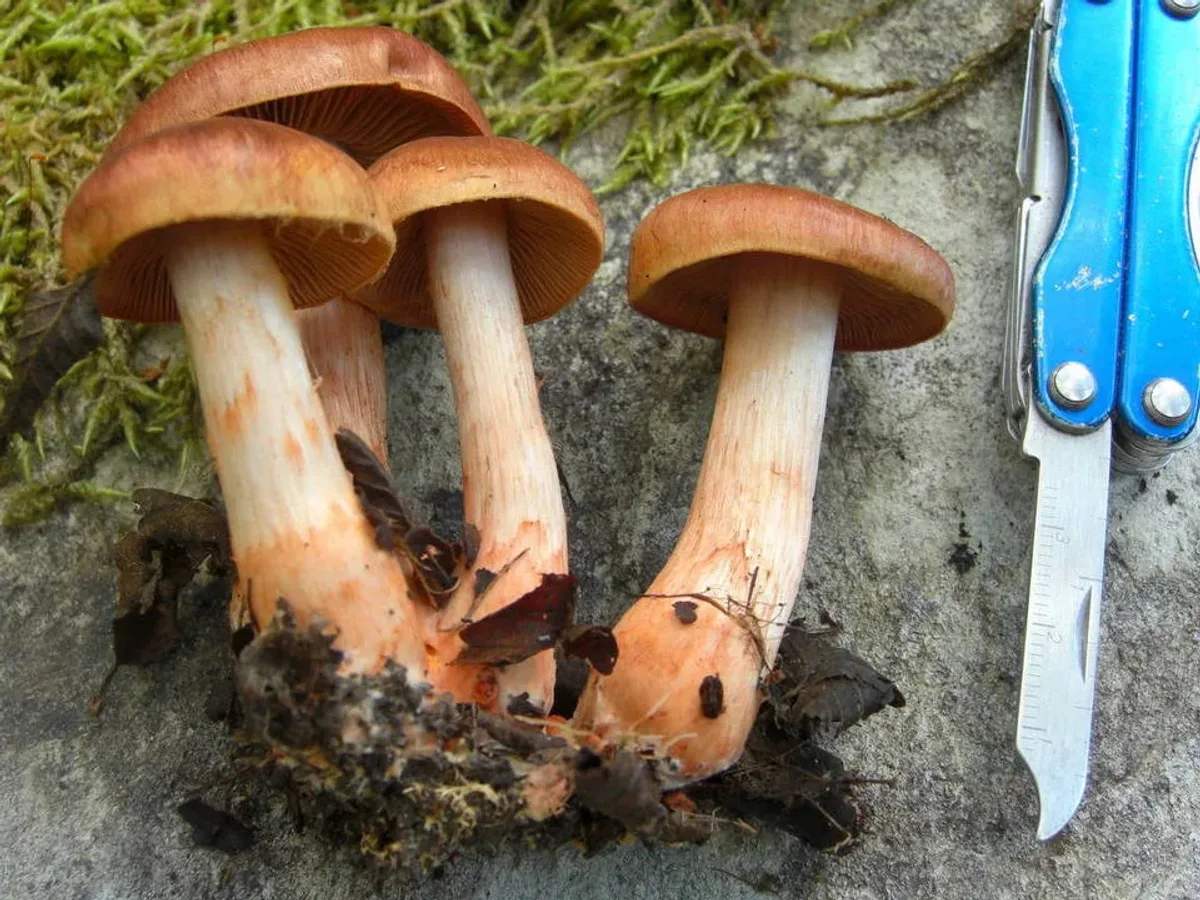
Cortinarius rubrobasalis is one of the more recognisable Australian webcaps thanks to the striking reddish to reddish-orange coloration at the stem base - the feature that names the species.
Cap
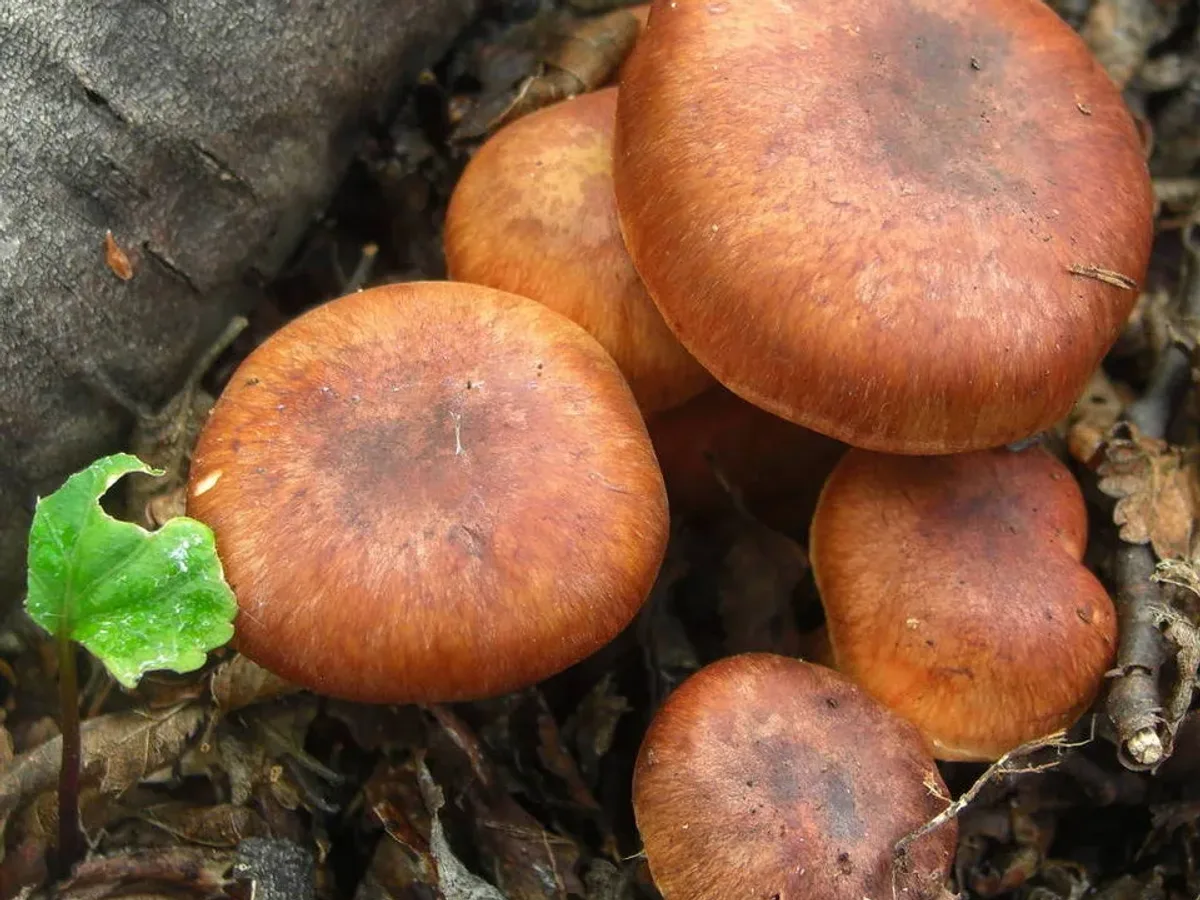
The cap is a warm tawny to ochre-brown, broadly convex and rather unremarkable in colour on its own, which is precisely the danger: the moderately dull cap might be mistaken at a glance for any number of brown woodland mushrooms.
Stem
What sets this species apart at a careful second look is the lower portion of the stem, which carries a vivid brick-red to carmine flush that stands out against the pale ochre of the upper stem.
As with all Cortinarius species, the cobwebby cortina is the key genus-level marker in youth - look for fine whitish-brown threads hanging between the cap margin and the stem in fresh young specimens - and the rust-brown spore print at maturity is a reliable and unambiguous confirmation.
Gills / Pores
The gills progress from pale ochre to full rusty cinnamon-brown as the spore load develops.
Flesh
Flesh is pallid and does not colour when cut.
Why it's dangerous
FATAL. Cortinarius rubrobasalis must be treated as a deadly poisonous mushroom.
The Australasian Cortinarius complex is well-established in the medical mycology literature as containing orellanine-class nephrotoxins in multiple species, and no safe member of this genus has been identified for Australasian foraging.
There is no specific antidote to orellanine. Treatment is supportive - haemodialysis and management of acute kidney injury - and in severe cases kidney transplantation has been required.
Three factors place this among the most dangerous categories of mushroom poisoning known worldwide:
- extreme latency (making early diagnosis nearly impossible)
- heat stability (cooking does not help)
- severity (permanent renal failure, death)
A forager who has consumed any Cortinarius in Australasian native bush must seek emergency medical care immediately, without waiting for any symptoms to appear. Contact the Poisons Information Centre (Australia: 13 11 26; New Zealand: 0800 764 766).
Toxin
Cortinarius rubrobasalis is classified as an orellanine-bearing species, consistent with the broader toxicological profile of the Australian Cortinarius complex.
Orellanine is a polypyridine N-oxide nephrotoxin - chemically related to orelline and nordihydroorellanine - that was first characterised from the European deadly webcap Cortinarius orellanus. It has since been analytically confirmed in multiple Australasian Cortinarius species.
Orellanine is unusually heat-stable. It is not degraded or inactivated by:
- boiling
- frying
- roasting
- drying
- pickling
- freezing
In the body, orellanine and its metabolites cause selective necrosis of the proximal tubule cells of the kidney, destroying the organ's ability to filter blood.
The specific analytical orellanine data for C. rubrobasalis are limited in the published literature. But mycological authorities universally apply the precautionary principle across the Australasian Cortinarius complex: all species must be treated as carrying full orellanine-class deadly risk.
Symptoms
The defining and most treacherous characteristic of orellanine poisoning is an extreme latency period between ingestion and the first symptoms. The typical delay is two to three weeks, with a documented range spanning from as few as four days to over three weeks.
During this entire period the victim may feel entirely well, have eaten numerous subsequent meals, discarded all remaining mushrooms, and have no reason to connect any symptom to the original meal.
When symptoms do emerge they are initially non-specific and may be attributed to a viral illness or dehydration:
- intense, persistent thirst
- increased urination (polyuria) that later transitions to decreased urination (oliguria) as renal function deteriorates
- nausea, vomiting, headache, severe fatigue, lower back or flank pain, and loss of appetite
These progress to overt signs of acute kidney injury - elevated creatinine and urea, reduced glomerular filtration rate - and without aggressive medical intervention, to end-stage renal failure.
Both the long latency and the non-specific initial symptom profile make diagnosis exceptionally difficult. Physicians not familiar with orellanine poisoning frequently fail to make the connection to a mushroom meal consumed weeks previously.
Staying safe
DO NOT EAT. Cortinarius rubrobasalis is a deadly poisonous mushroom. Its orellanine-class toxin is fully heat-stable and is not made safe by any cooking, preparation, or processing method.
The latency of up to three or more weeks between ingestion and the appearance of symptoms is what makes orellanine poisoning so uniquely dangerous. A forager who eats this species today may not fall ill for weeks, and by the time the connection is made between the meal and the kidney failure, extensive irreversible damage may already have occurred.
If any Cortinarius species has been consumed or even briefly tasted in Australasian native bush, seek emergency medical advice from a poisons centre at once - do not wait for symptoms to appear.
- In Australia: Poisons Information Centre, 13 11 26
- In New Zealand: National Poisons Centre, 0800 764 766
Never collect, taste, or experiment with any earth-toned, cobwebby-veiled, rusty-spored gilled mushroom from native Australian or New Zealand forest.
Where & when it grows
Habitat
This species is an obligate ectomycorrhizal partner of native Australian trees, primarily eucalypts (Eucalyptus) and related genera such as Corymbia, across southeastern and southern mainland Australia.
It inhabits dry and moist sclerophyll forest where a stable mycorrhizal community supports the long-lived subterranean mycelium that gives rise to the fruiting bodies.
You will find it among fallen eucalypt leaves and bark debris on acidic, well-drained to moderately moist soils in intact native forest. You will not find it:
- in gardens
- under introduced conifers or acacias
- in recently cleared or replanted land
The requirement for an established native ectomycorrhizal host means habitat itself is a useful sanity-check: any brownish webcap with a red-tinted stem base found beneath eucalypts in native bush belongs to a category that must be treated with extreme caution.
When
Fruiting occurs through the Southern Hemisphere autumn and into early winter, broadly March through July, with the reliable core of the season in April and May.
The mycological trigger is post-summer cooling. The established mycelium moves into reproductive mode as two conditions arrive:
- soil temperatures fall below roughly 16 °C after the dry Australian summer heat
- significant autumn rainfall - ideally 20 mm or more over one to two weeks - wets the soil profile
There is typically a lag of one to three weeks between the triggering rain event and the emergence of visible fruiting bodies. In wetter regions or years, fruiting may extend through June and into July.
How it grows
Cortinarius rubrobasalis develops as a classic webcap. The fruiting body begins as a button enclosed in a silky-fibrillose universal and partial veil, with the cortina most evident as a cobwebby skirt early in development.
As the cap expands and the gills develop, the cortina tears and hangs in rust-dusted remnants from the stem.
Growth is characteristically solitary or in small loose groups of two to five - dense clustering is not typical of this species or of the broader Cortinarius group in Australasian forest.
The visible mushroom is merely the reproductive organ of a perennial ectomycorrhizal mycelial network. The same location may fruit in successive years as long as the host tree remains healthy and autumn conditions are suitable.
That stability is a practical field point - a known site for red-base webcap is also a site to leave completely alone year after year.
Fruiting conditions
Southern Hemisphere autumn species. Fruiting triggered by post-summer cooling (soil temperatures falling below approximately 16 °C) combined with sustained autumn rainfall (20+ mm over 14 days). Typical flush lag 10-21 days after triggering rain. Peak April-May across most of range; may extend to June-July at wetter sites.
Look-alikes
The most dangerous confusions are within the genus itself. Many Australian and New Zealand Cortinarius species share overlapping brown, ochre-buff, and earth-toned caps with rust-brown spore prints and cobwebby cortinae.
Without specialist microscopy and chemical analysis, species-level identification within Australasian Cortinarius is unreliable, and all must be treated as equally deadly.
Beyond the genus, other look-alikes include:
- Edible field mushrooms (Agaricus campestris and relatives) - collectors have occasionally confused brownish Cortinarius species with these. Agaricus gills begin pink or whitish-pink and produce a dark chocolate-brown (not rust-orange-brown) spore print; they lack a cortina; and they are found in open grassland, not forest understory.
- Gymnopiloid webcaps (Gymnopilus species) - share rusty spore prints and can be superficially similar, but are characteristically yellow to orange-yellow or orange-brown throughout, not tan with a distinctly red stem base, and have a bitter taste.
- Hebeloma species (poisonous, non-lethal) - may have similar earth-toned caps and rusty-brown gills, but typically smell strongly of radish, have paler brown (not rust-orange) spore prints, and lack the cobwebby cortina.
The red stem base of C. rubrobasalis is unusual but should never be used as a casual 'safe check': colour alone is never a reliable identifier in this genus.
C. archeri is violet-purple rather than ochre-brown, but shares the same deadly orellanine-class risk, native Australasian forest habitat, rusty-brown spore print, and cobwebby cortina. Where C. archeri lacks the reddish stem base, the overall colour scheme of deep violet-purple contrasts with the warm ochre-brown cap of C. rubrobasalis - though neither distinction matters for safety purposes: both are equally deadly and must be avoided.
C. australiensis tends to ochre-brown to pale violet-brown coloration and overlaps significantly in macroscopic appearance and habitat with C. rubrobasalis. The vivid red stem base is more pronounced in C. rubrobasalis, but this character alone does not safely separate the species. Both carry orellanine-class risk. Any brownish webcap in southeastern Australian native forest should be treated as potentially deadly.
Dozens of native Australian and New Zealand Cortinarius species share similar brown to buff coloration, rusty spore prints, and cobwebby cortinae. Most have not been fully characterised toxicologically. Given confirmed orellanine content across the Australasian complex, all must be treated as deadly. Only specialist microscopy and chemical analysis can reliably separate species.
Field mushrooms have gills that begin bright pink and mature to dark chocolate-brown, not the pale-ochre-to-rust-brown of Cortinarius. The spore print is dark chocolate-brown to blackish-brown, not rusty cinnamon-orange. Agaricus species completely lack the cobwebby cortina. They grow in open grassland, not in native forest understory. A rust-brown spore print combined with a cortina remnant on the stem makes Cortinarius unmistakable and absolutely distinguishes it from any Agaricus.
Gymnopilus species share the rusty-orange spore print and partial veil with Cortinarius but are uniformly yellow to orange-brown or tawny throughout - including the stem base, which is not distinctively red. Many have an intensely bitter taste. Gymnopilus is not edible (contains psilocybin-like compounds and styrylpyrones) but is not known to contain orellanine; however, it should not be collected for food.
A reference guide - never an edibility guarantee. When in doubt, leave it out.