Bruising webcap
Cortinarius purpurascenssyn. Agaricus purpurascens Fr., Cortinarius purpurascens var. largus (Fr.) Nezdojm., Phlegmacium purpurascens (Fr.) M.M. Moser
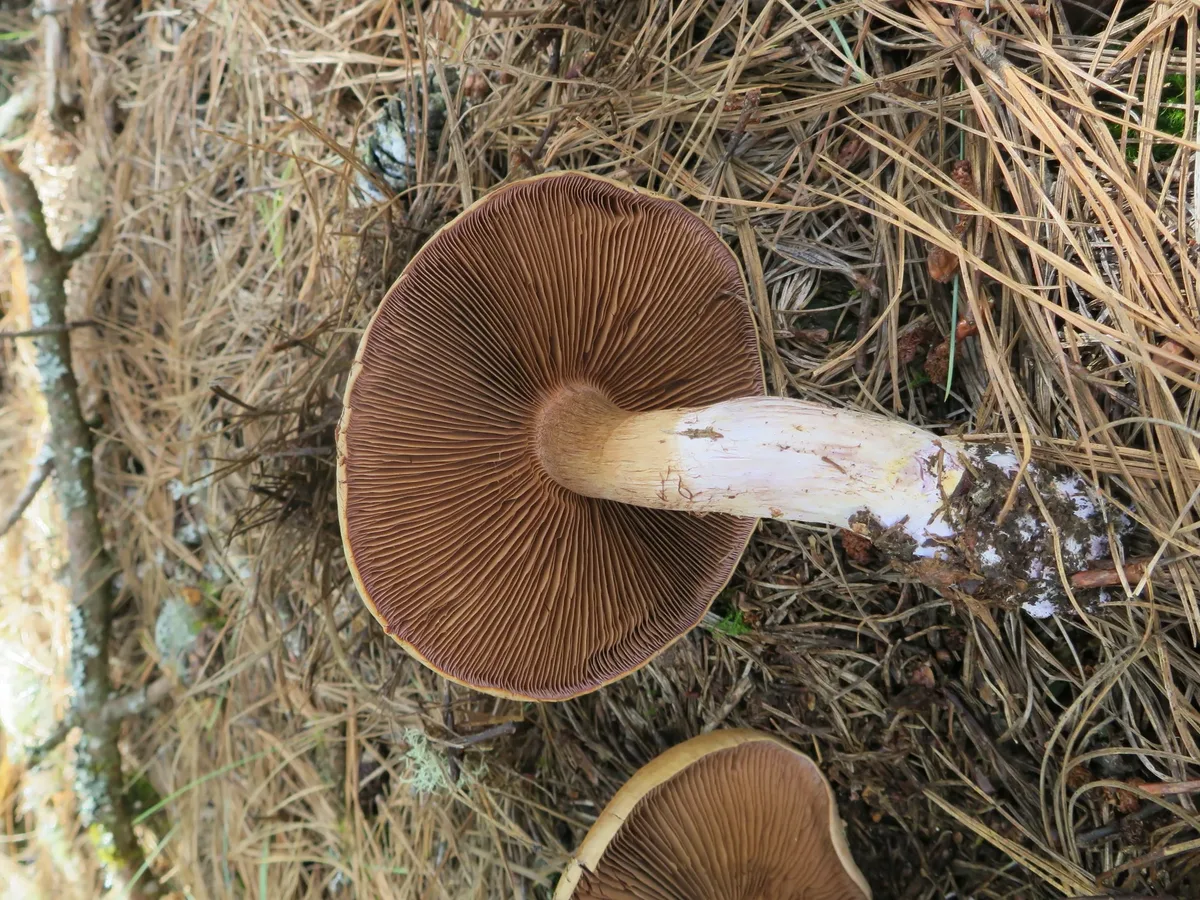 © Alan Rockefeller (CC BY 4.0)
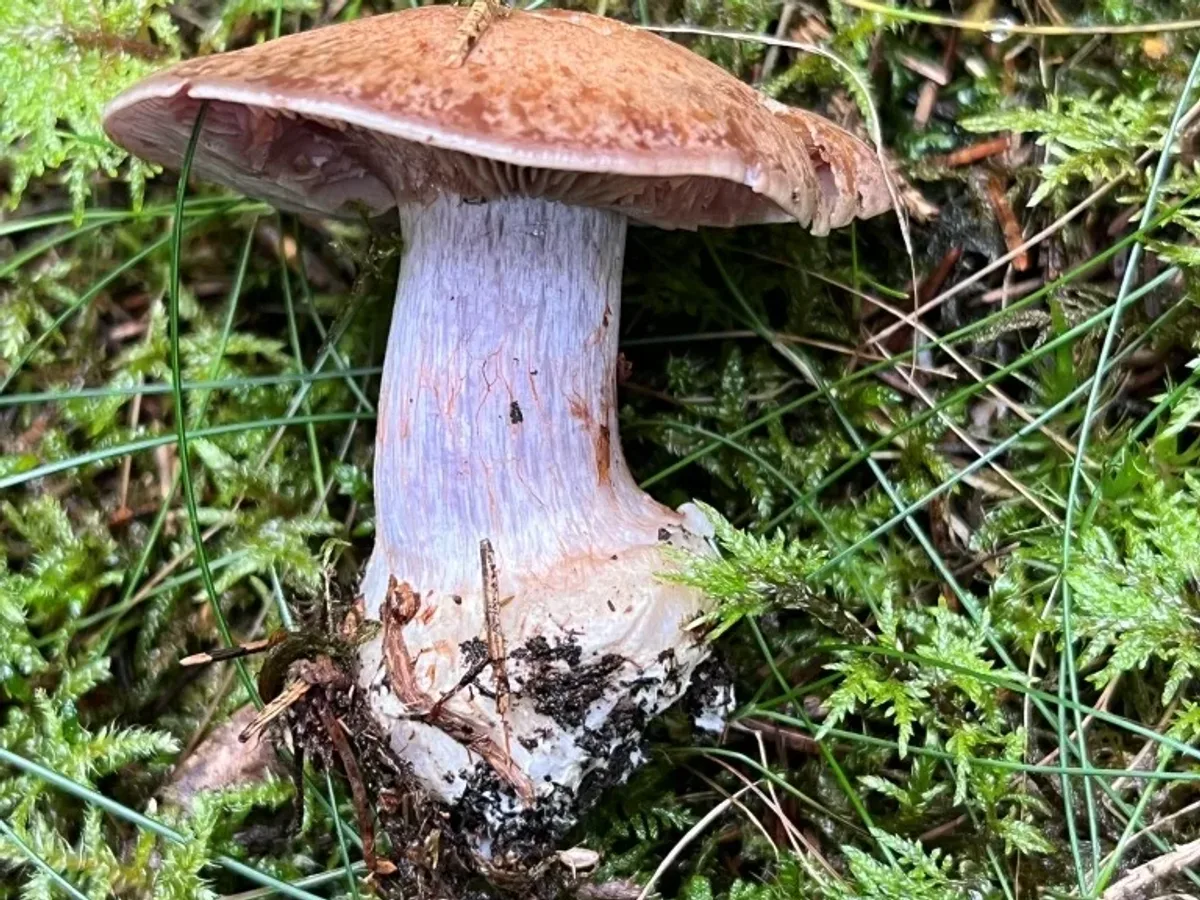 © Siv Moen (CC BY)
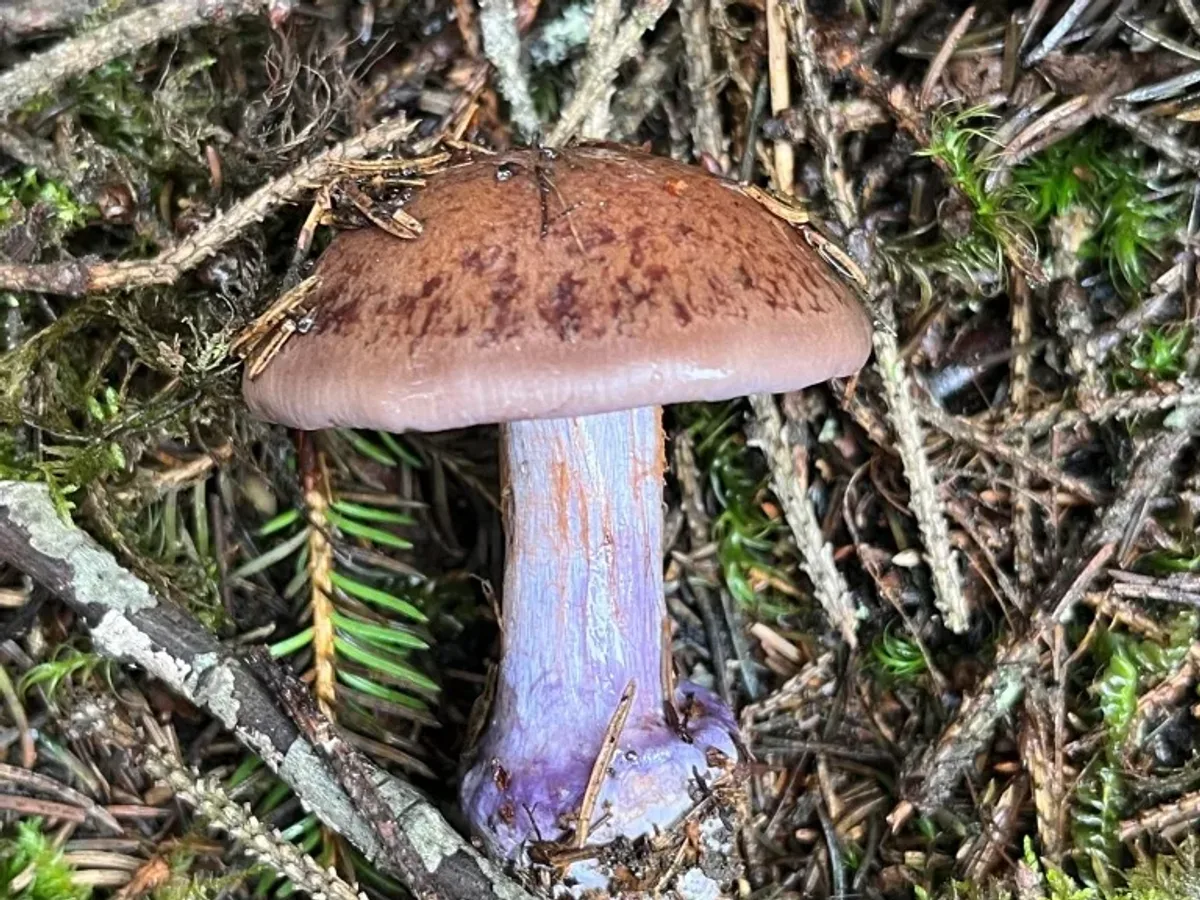 © Siv Moen (CC BY)
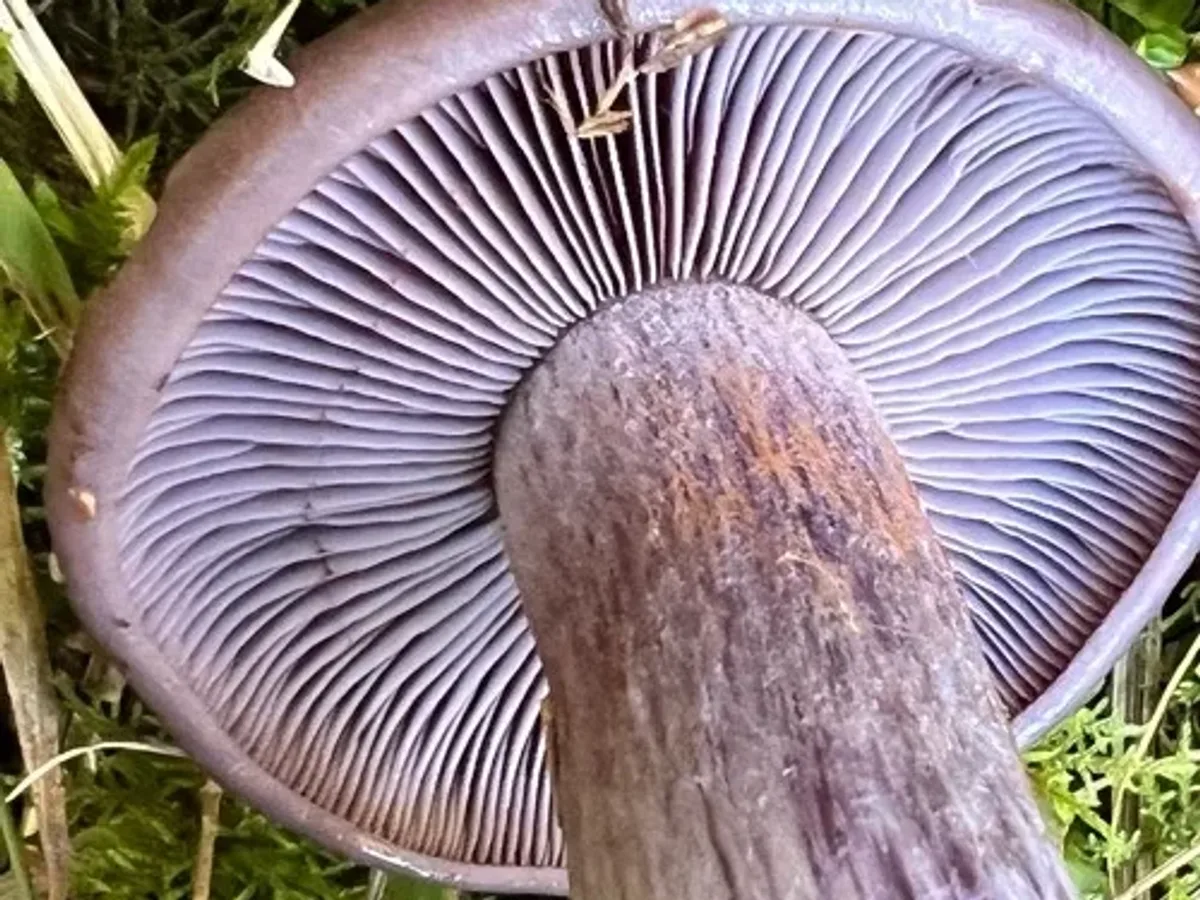 © Kirsti Anne Mandal (CC BY)
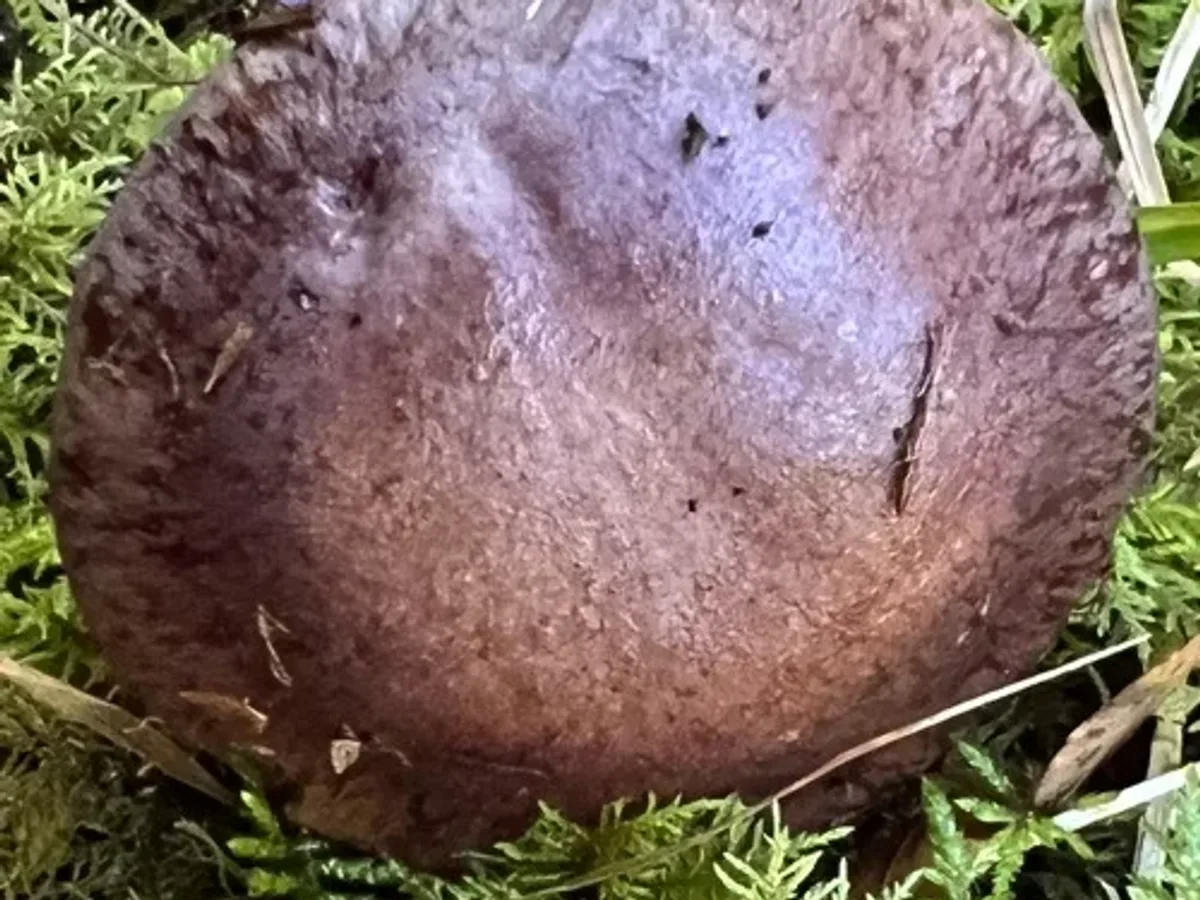 © Kirsti Anne Mandal (CC BY)
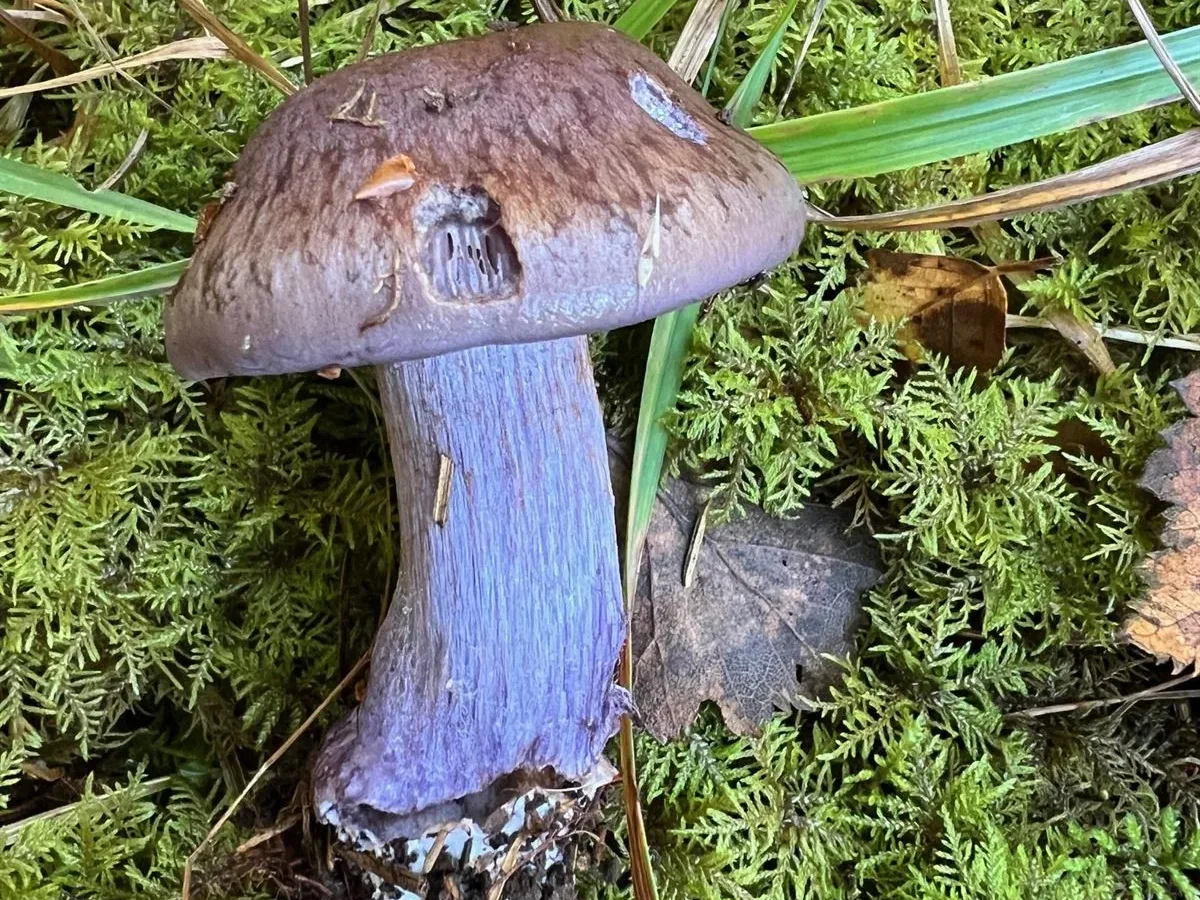 © Kirsti Anne Mandal (CC BY)
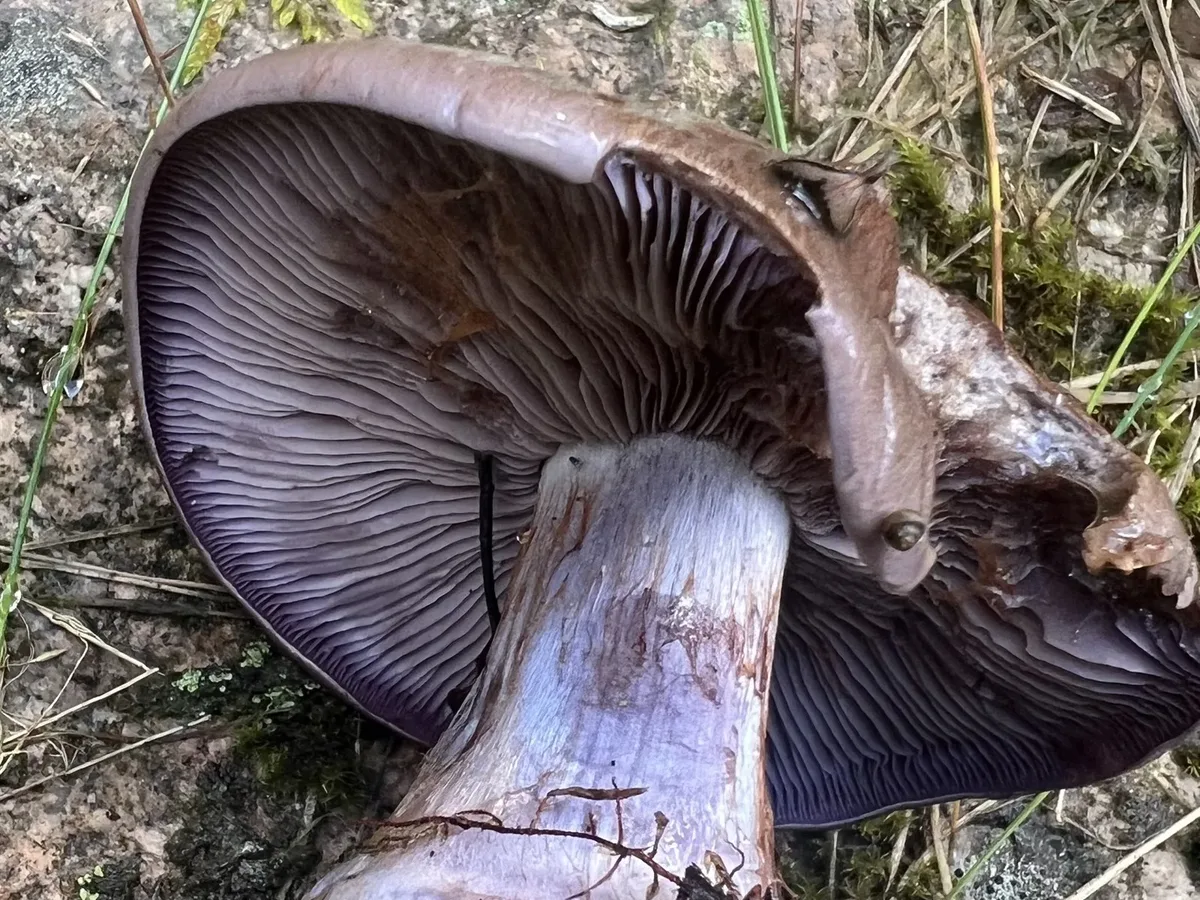 © Rune Zakariassen (CC BY)
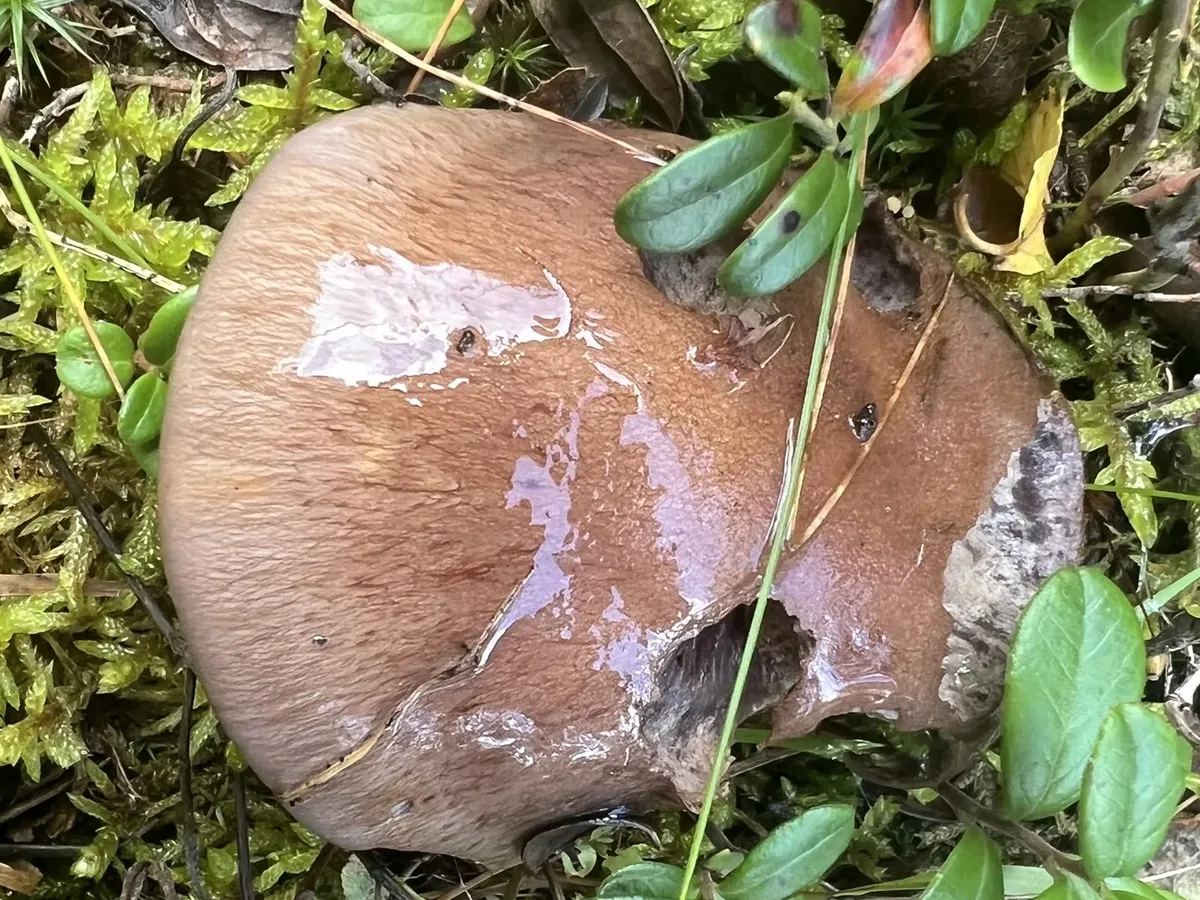 © Rune Zakariassen (CC BY)
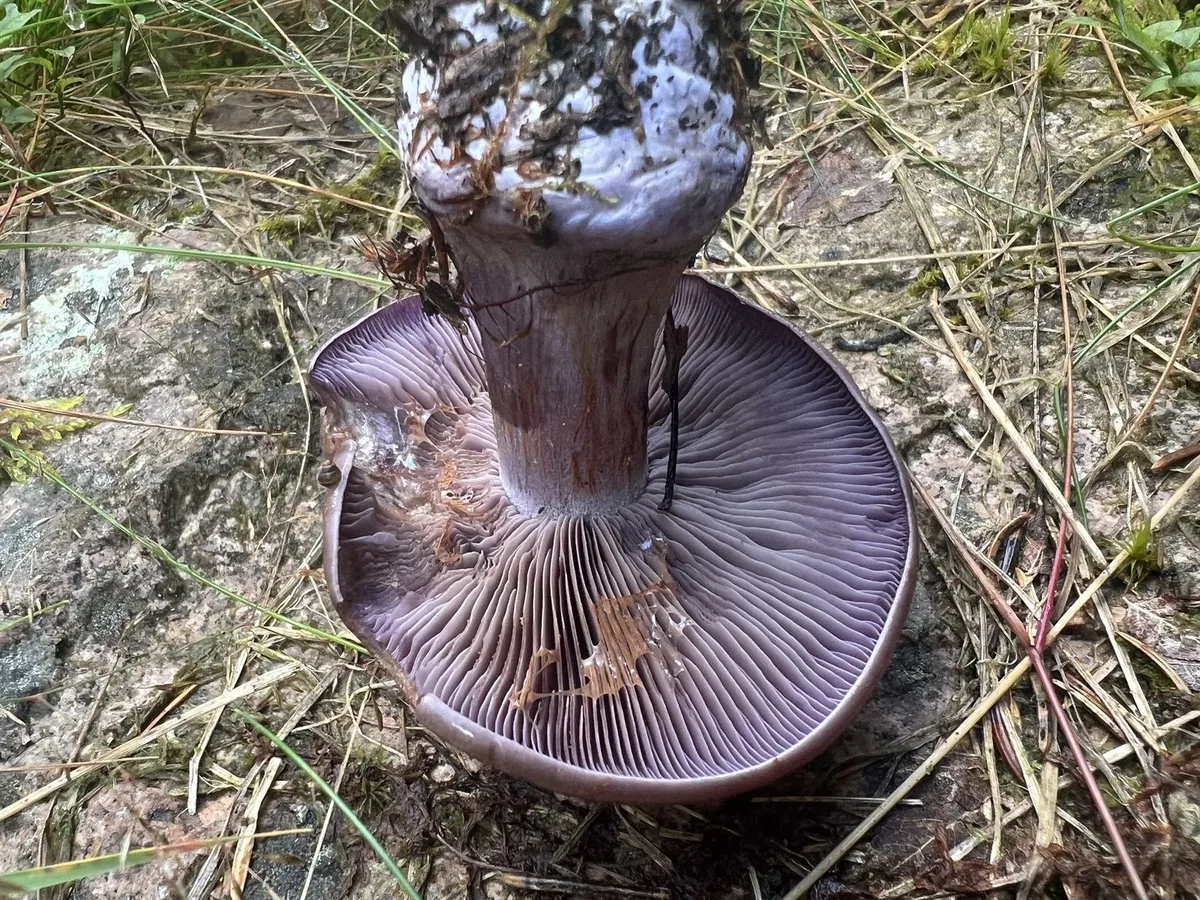 © Rune Zakariassen (CC BY)
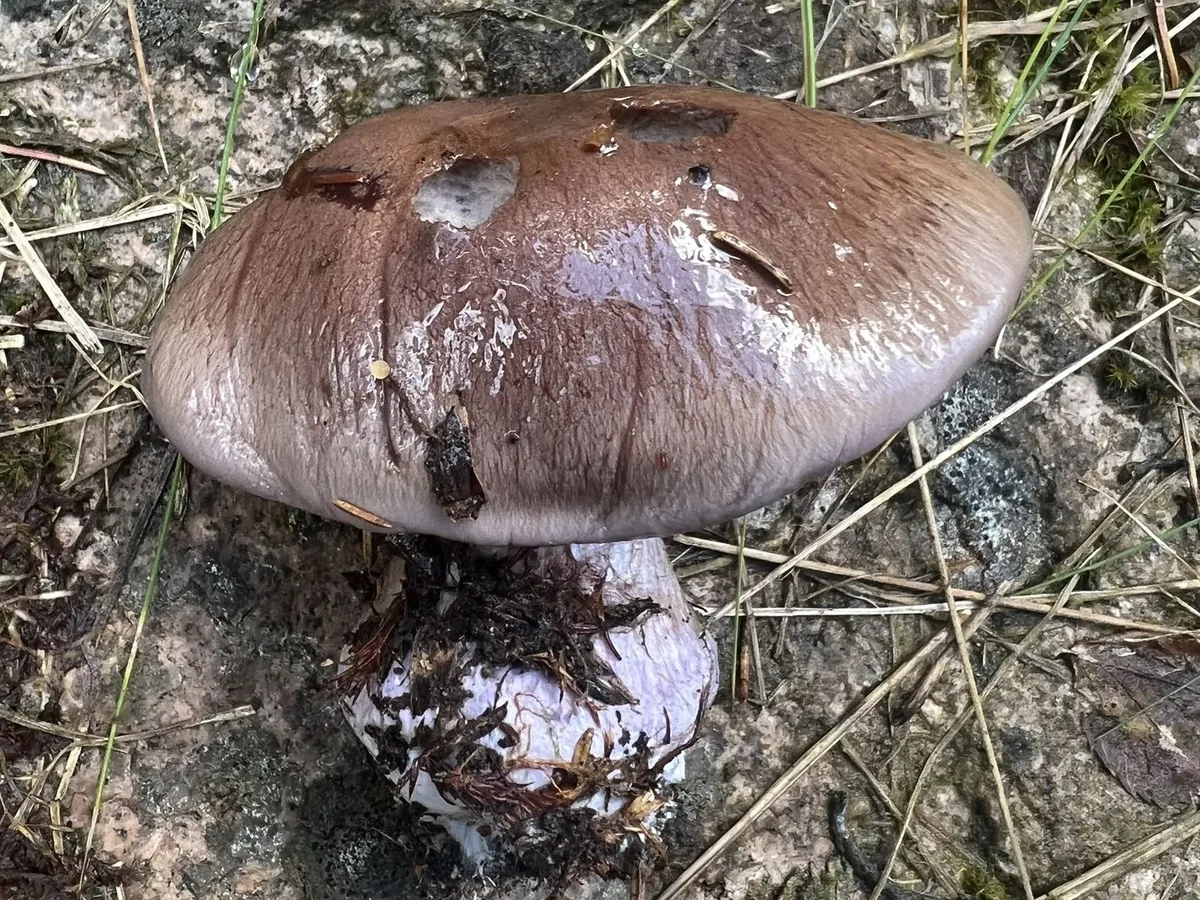 © Rune Zakariassen (CC BY)
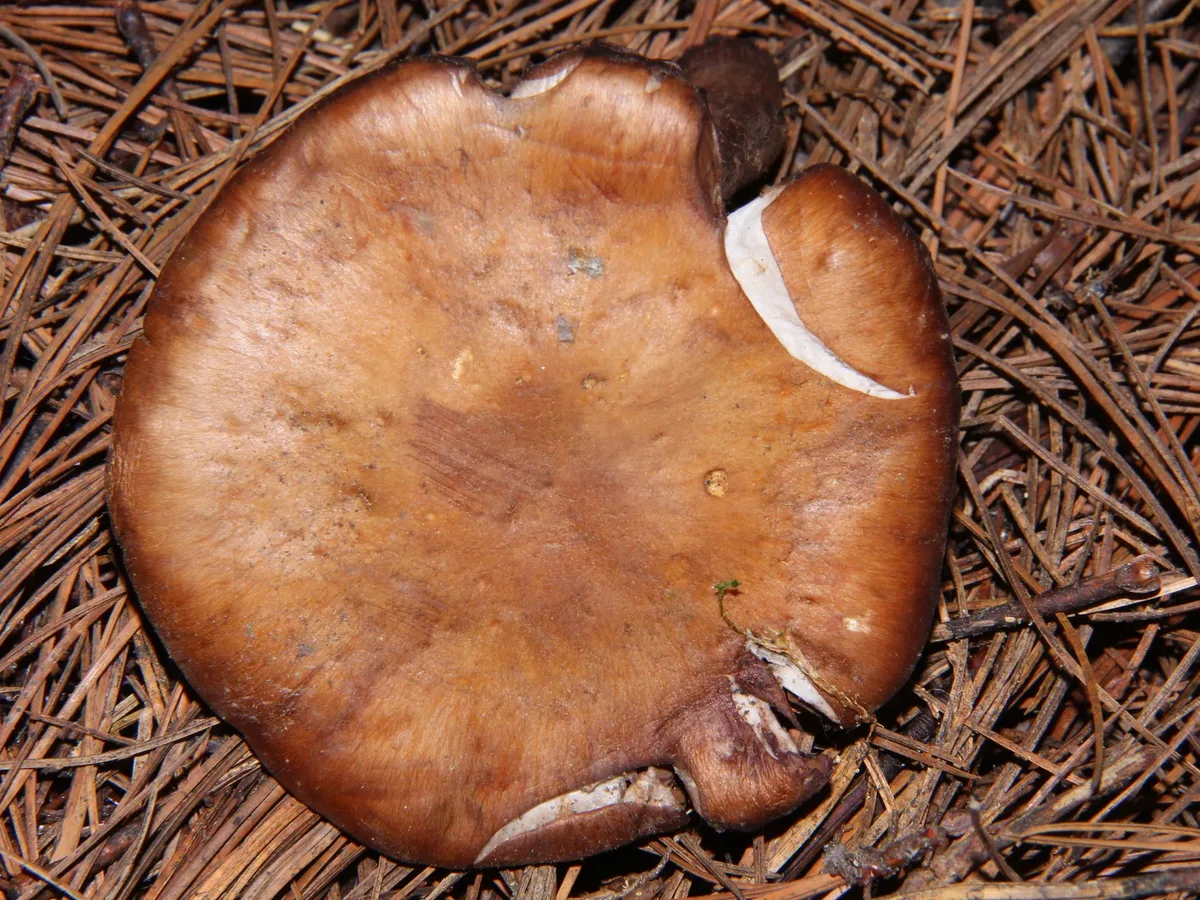 © Alan Rockefeller (CC BY 4.0)© Alan Rockefeller (CC BY 4.0)© Siv Moen (CC BY)
Edible only with the right preparation - or safe for some people but not others. Learn the caveats first.
Never eat a mushroom you are not 100% sure of - check the look-alikes below, and always cook wild mushrooms.
How to recognise it
Press a thumb into the cap, nick the flesh with a fingernail, handle the stem - and within seconds the contact points flush deep blue-violet to indigo. This bruising reaction is the species' defining field character, and it is so rapid and vivid that it feels almost like a response.
Cap
The cap is 5-12 cm, broadly convex to flat, with a smooth, slippery to glutinous surface when moist - a hallmark of the Phlegmacium group - and a polished look when dry. Background colour ranges from lilac-violet to violet-brown, typically stronger at the margin, where ochre-clay tones may intrude at the centre.
Gills
Gills start deep violet and age to rusty cinnamon as the brown spore print develops.
Stem
The stem carries a characteristic swollen, sometimes marginate bulb at the base and is flushed violet throughout, showing the blue bruising prominently on handling. Young specimens wear a fine violet cobweb cortina that later collapses and is stained rusty brown by falling spores.
The complete picture - slippery violet cap, bruising flesh, bulbous stem base, rust-brown spore print - is essentially unique within the genus.
Why it's dangerous
High contextual danger from lookalike confusion.
The species itself is not confirmed as acutely toxic, but its similarity in habitat and general appearance to deadly nephrotoxic Cortinarius species makes every collection a potential hazard unless positively verified by an expert.
The blue-bruising test is essential but must be treated as a screening tool, not a guarantee.
Never eat any Cortinarius without expert in-person verification of the specimen.
Toxin
Cortinarius purpurascens does not contain orellanine.
The blue-bruising pigments are believed to be quinone or polyene-type oxidative compounds analogous to the bruising pigments in some boletes, not orellanine.
The species is not known to be acutely toxic at normal consumption quantities, though comprehensive toxicological characterisation across all populations is not available.
Symptoms
No confirmed toxidrome is attributable to C. purpurascens itself.
If orellanine poisoning occurs from a misidentified lookalike (C. rubellus, C. orellanus), symptoms emerge 2-21 days post-ingestion:
- Initial flu-like malaise
- Intense thirst
- Frequent urination
- Nausea
- Then progressive renal failure over days to weeks
Orellanine poisoning has no antidote; outcome depends on severity of kidney damage and supportive care.
Any suspected Cortinarius ingestion with uncertain identification should be treated as a medical emergency.
Staying safe
Cortinarius purpurascens itself is not known to contain orellanine, amatoxins, or other well-characterised deadly toxins, and has a history of cautious use as an edible species in parts of Europe and Japan.
However, the genus Cortinarius contains some of the most dangerous mushrooms in the world, including C. rubellus and C. orellanus, which cause orellanine syndrome - a delayed nephrotoxic reaction that begins 2-3 weeks after ingestion and can progress to permanent kidney failure or death.
These deadly species can co-occur in the same forest as C. purpurascens and broadly resemble it in stature and habitat.
The blue-bruising reaction is a key safety separator but must be tested on every specimen. Any specimen that does not bruise blue-violet on handling should be discarded immediately.
Because the toxicological profile of Cortinarius species is complex and many species remain incompletely characterised, all Cortinarius collections for the table must be treated with extreme care. Beginners must not eat any Cortinarius.
Where & when it grows
Habitat
This species grows as an ectomycorrhizal partner with both conifers and hardwoods in mature temperate and boreal forest.
In northern Europe and Scandinavia it is most common in spruce-dominated or mixed spruce-pine-birch forest on acidic, moist, humus-rich soils, frequently in association with bilberry and mosses. In central Europe it also appears under beech and oak.
In Japan and East Asia, populations occur in cool-temperate and montane coniferous-broadleaved mixed forests (Abies, Picea, Quercus, Fagus) at elevations of 500-2000 m.
The soil is consistently moist, acidic to near-neutral, and the habitat is characterised by well-developed humus layers and significant organic debris.
It is not a species of disturbed or recently planted forest; finding it is a reliable indicator of ecosystem continuity. Fruit bodies emerge partially buried in deep litter, often camouflaged by matching leaf colours.
When
Fruiting runs from late August through November in the northern hemisphere, peaking in September-October as summer heat releases its grip and the first steady autumn rains soak down into the humus.
In the Nordic region and at higher elevations in Japan the peak arrives earlier - mid- to late September; at lower, milder central European sites, October is often the better month.
Two conditions drive fruiting reliably:
- At least 20 mm of rainfall over the preceding two weeks
- Soil temperatures that have dropped below 13-14 degrees C
A warm, dry autumn can suppress the species entirely. Patches are not consistent from year to year - a good spot one season may stay quiet for one or two years before fruiting again.
How it grows
Strictly mycorrhizal, dependent on a long-established partnership with host trees. Like most Phlegmacium species, it requires years to decades to colonise a new site and is never found in young plantations or disturbed ground.
Fruit bodies develop from the mycelium embedded in soil or humus 2-5 cm below the surface, emerging as stout, slimy-capped clubs that push through litter. Groups of 2-6 individuals are typical; solitary occurrence is less common.
Mycelial mats can persist for many decades if the host tree canopy is undisturbed.
Fruiting conditions
Requires sustained cool autumn moisture and soil temperatures dropping below 13-14 degrees C. Fruiting is correlated with the onset of autumn rains after the late-summer drought period in temperate zones. Warm dry autumns suppress fruiting. In East Asian montane sites, fruiting is linked to the post-monsoon cooling and stabilisation of moisture.
Look-alikes
The chief danger with Cortinarius purpurascens is confusion with other Cortinarius species, several of which contain the nephrotoxic compound orellanine and cause delayed, potentially fatal kidney failure.
The bruising reaction (turning blue-violet when pressed) is the most important distinguishing character - it is absent or faint in the deadly orellanine species.
- Cortinarius orellanus (fool's webcap) has a dry, foxy-orange to orange-brown cap with a more fibrous-scaly surface, ochre-brown gills and stem, no blue-bruising, and lacks the viscid surface of C. purpurascens; it grows primarily under deciduous trees (oak, birch) in central Europe.
- Cortinarius rubellus (deadly webcap) is orange-red to tawny-brown throughout, has a dry, silky-fibrous cap, grows under conifers (especially pine and spruce), and shows no bruising reaction.
Both are deadly.
Within the violet-coloured Cortinarius complex:
- Cortinarius violaceus is superficially similar in colour but is entirely dry and scaly (never viscid), lacks the rapid blue-bruising, and has a more uniformly deep violet-black colouration without ochre central tones.
- Cortinarius largus (sometimes considered conspecific or very closely related to C. purpurascens) has a paler violet-lilac cap that is also viscid and shows mild bruising; it requires careful comparison.
- Cortinarius caeruleus is smaller, less viscid, grows under beech, and has a weaker bruising response.
In all cases where the bruising reaction is absent or ambiguous, the collection must be discarded.
Foxy-orange to orange-brown, dry and finely scaly surface (not viscid or slimy), no bruising reaction, ochre-brown gills and stem, grows under deciduous trees (oak, birch) in central Europe. Contains orellanine. Completely lacks the viscid texture and blue-violet bruising of C. purpurascens.
Orange-red to tawny-brown throughout, dry fibrous-silky cap (not viscid), no blue-bruising reaction. Grows under conifers (especially pine and spruce). Contains orellanine - causes fatal delayed kidney failure with onset 2-3 weeks after ingestion. The absence of any blue-violet bruising and the warm red-brown colour distinguish it from C. purpurascens, but field conditions require care.
Smaller (cap 2-6 cm), paler blue-violet, less viscid, grows strictly under beech and oak; weak or absent bruising reaction. Not considered edible and may cause mild gastrointestinal upset.
Sometimes considered a close relative or synonym of C. purpurascens. Also viscid-capped and shows mild bruising, but colours tend toward paler lilac-ochre without strong violet tones. Separation requires careful comparison of cap colour, bruising intensity, and spore dimensions. Edibility comparable.
Uniformly deep violet-black, dry and velvety-scaly cap (never viscid or slimy), lacks the rapid blue-bruising reaction on pressing, more intensely dark violet throughout without ochre central tones. The dry, granular-scaly cap texture of C. violaceus is the clearest separator from the glutinous cap of C. purpurascens in moist conditions.
A reference guide - never an edibility guarantee. When in doubt, leave it out.