Purple Pouch Fungus
Cortinarius porphyroideussyn. Thaxterogaster porphyroideus (G.Stev.) T.J.Baroni & Matheny, Cortinarius porphyroideus G.Stev.
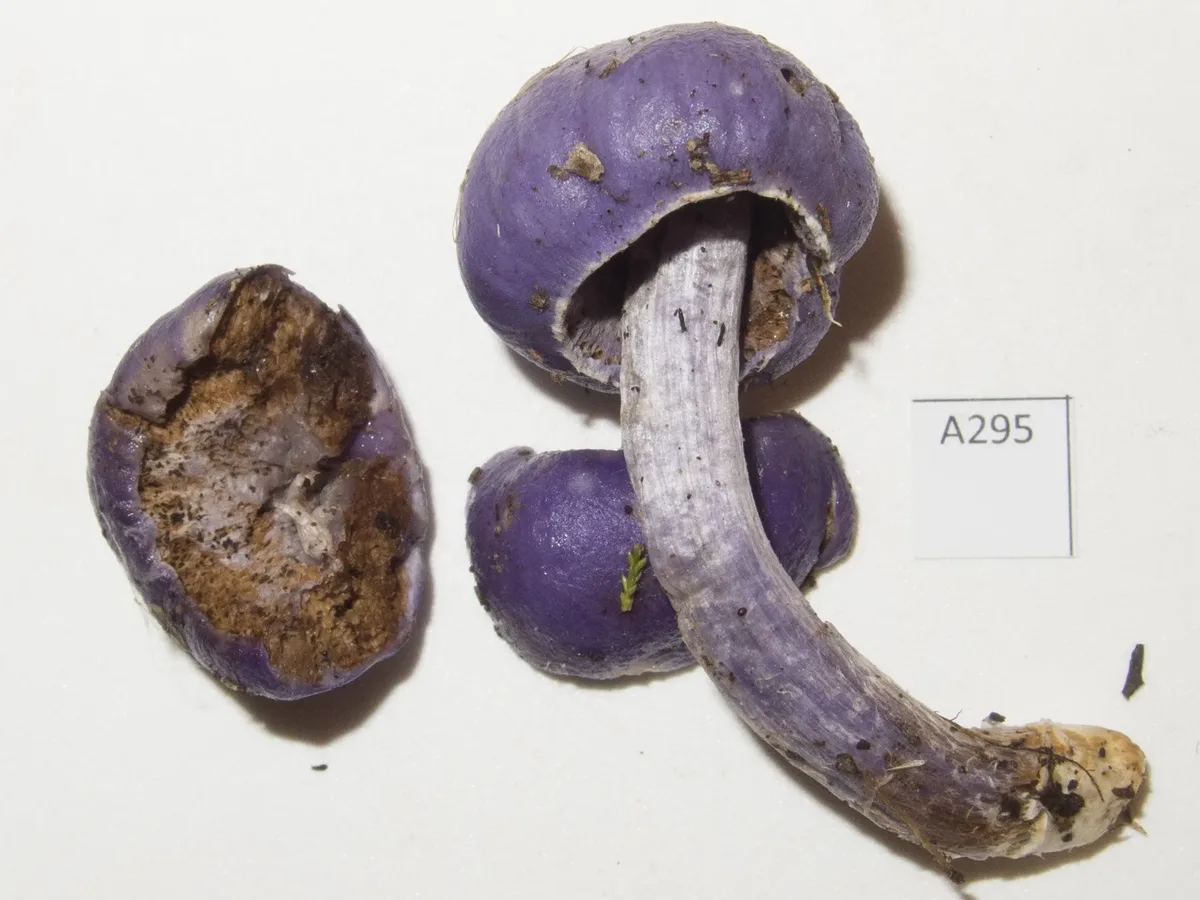 © Jerry Cooper (CC BY)
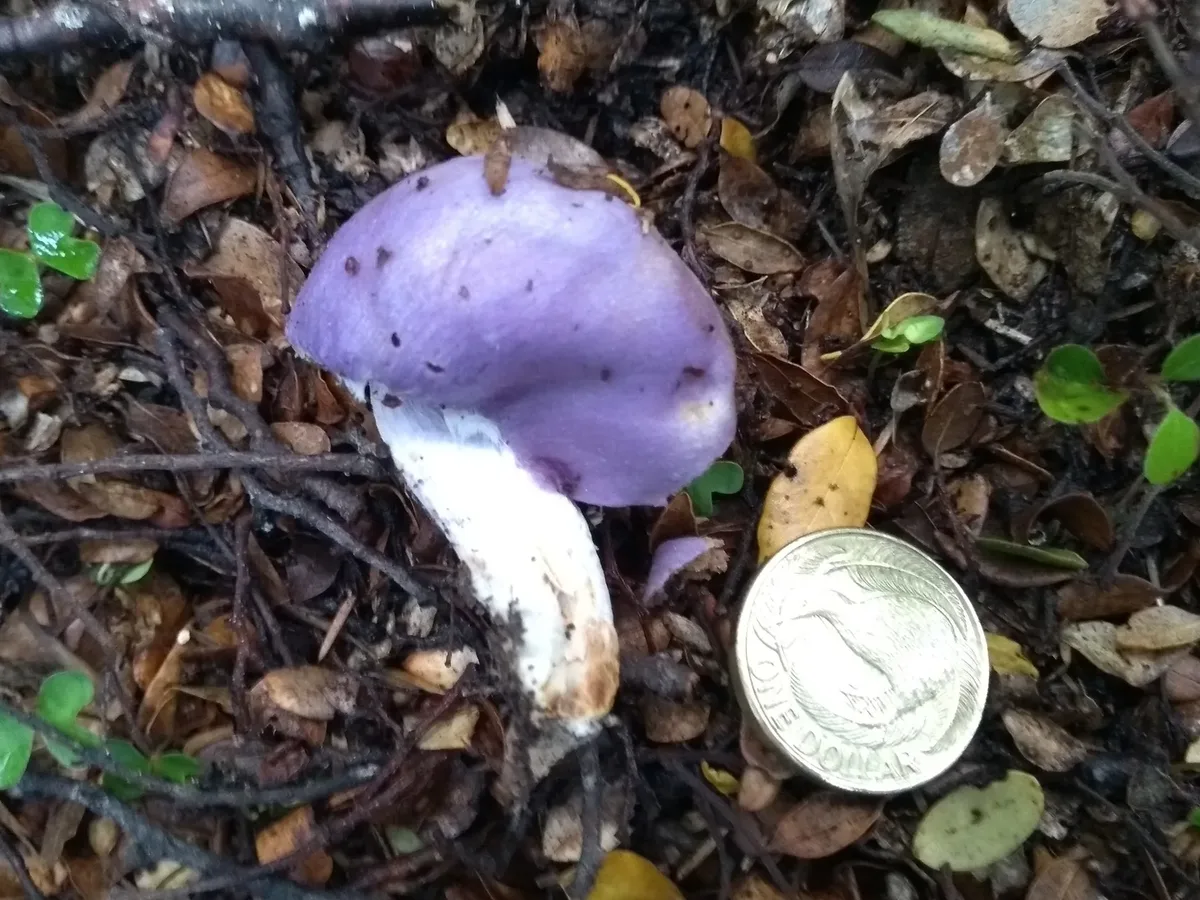 Geoff Ridley (CC0)© Jerry Cooper (CC BY)Geoff Ridley (CC0)
Not poisonous, but not worth eating - too tough, bitter, or bland for the pot.
Never eat a mushroom you are not 100% sure of - check the look-alikes below, and always cook wild mushrooms.
How to recognise it
Cortinarius porphyroideus defies the expectations of anyone looking for a typical mushroom. Instead of a cap on a stem with gills beneath, the fruiting body presents as an enclosed, roughly spherical to oval pouch - vivid purple to deep violet when fresh, producing an almost jewel-like quality on the forest floor.
This is a secotioid or gasteroid form: through an evolutionary compression of the normal webcap development, the cap has fused to the stipe to create a closed structure, retaining the gill tissue inside.
The intense purple colouration is immediately diagnostic: no other common native fungus of its size range in New Zealand or southeastern Australian beech and eucalyptus forest reproduces that particular saturated violet-purple.
Cap
The outer skin (essentially the cap tissue) is dry and lightly fibrillose, most vivid in young, fresh specimens and fading to dull lilac-grey or brownish-violet with age and drying.
Gills / Pores
When the pouch is cut open, the interior reveals tightly packed, vestigial gill plates (lamellae) in deep purple-brown, progressively darkening toward rust-brown as the enclosed spores ripen. Spores are rust-brown to ochre-cinnamon.
Stem
The stipe is short, stout, and coloured concolorous with the pouch, often partially embedded in the litter layer. The cortina - the cobwebby partial veil that is the Cortinarius signature - is absent or rudimentary, a consequence of the enclosed development.
Where & when it grows
Habitat
This species' home is mature, undisturbed native beech and eucalypt forest in New Zealand and southeastern Australia.
In New Zealand, Nothofagus beech forest is the primary habitat: it is recorded throughout the South Island wherever beech grows, in lowland river flat forest up through montane and subalpine zones, and in appropriate North Island beech stands. The association with multiple Nothofagus species - red, silver, and mountain beech - suggests a relatively broad mycorrhizal flexibility within the genus.
In Australia, it occurs in cool-temperate Nothofagus cunninghamii (myrtle beech) rainforest in Victoria and Tasmania and in tall eucalypt forest.
The forest must be mature and largely undisturbed for the established mycorrhizal networks to support fruiting. It fruits directly from the soil surface, often nestled against root buttresses or partially buried in deep accumulated humus and leaf litter where moisture is maintained longest into autumn.
When
Fruiting corresponds to austral autumn and early winter across its range: broadly March through July, with the main flush concentrated in April and May.
The biology follows the standard southern-beech forest autumn pattern: summer heat subsides, soil temperatures fall through the 8-14 °C range, and seasonal rains rehydrate soils that the summer has dried.
Under these conditions the established mycorrhizal mycelium initiates fruiting, with primordia emerging typically 10-20 days after a meaningful rainfall event of 20+ mm.
In the wetter, higher-rainfall South Island beech valleys of New Zealand - the Marlborough Sounds, the West Coast, Fiordland, and Arthur's Pass regions - the cool, moist climate extends the fruiting window: fruiting bodies can continue to appear through June and into July.
At warmer, drier sites the season is shorter and may centre on April alone.
How it grows
As an obligate ectomycorrhizal species, Cortinarius porphyroideus cannot reproduce without a living Nothofagus or eucalyptus host tree.
The underground mycelial network - the true body of the organism - threads through the soil and envelops the fine rootlets of the host tree. It facilitates the exchange of tree-fixed carbon sugars for mineral nutrients that the fungal mycelium extracts from the soil.
This mutualism can persist for years or decades at the same site; experienced observers return to productive beech forest patches annually.
Fruiting bodies emerge singly or in small scattered groups of two to five, rarely forming dense concentrations.
The closed, pouch-like structure means spore dispersal is passive: the pouch decays on the forest floor or is disturbed by invertebrates and small mammals, releasing the spore mass rather than air-dispersing from an open cap.
New Zealand's endemic invertebrate community - including weta, huhu beetles, and various soil invertebrates - likely plays a significant role in dispersal.
Fruiting conditions
Southern Hemisphere autumn species. Fruiting triggered by cooling soil temperatures (falling below approximately 14 °C from summer highs) combined with autumn rainfall rehydrating the soil profile after summer drought. A threshold of approximately 20 mm rainfall over 14 days combined with soil temperatures of 6-14 °C is estimated to trigger fruiting. Flush lag from rain event to emergent fruiting bodies is 10-20 days. Peak April-May; may extend into June-July in wetter, cooler South Island New Zealand beech valleys and Tasmanian montane sites.
Look-alikes
The most important lookalikes are other Cortinarius and Thaxterogaster species - particularly conventional webcap species in the same habitat that share violet or purple colouration.
Young C. rotundisporus, C. archeri, or other violet webcaps at the button stage, before the cap has fully separated from the stipe, can superficially resemble a small purple pouch. Any such partially closed violet-purple fungus in native Australasian forest must be treated as potentially carrying orellanine-class deadly toxicity until unambiguously identified.
Native puffballs (Lycoperdon, Calvatia, Morganella spp.) occupy the same forest floor but are uniformly white to pale grey-brown both externally and internally when young and fertile, and they lack any purple or violet colouration entirely.
Scleroderma (earthballs, toxic) is similarly brown-skinned without violet tones.
Entoloma species may be purple-violet but produce pink spore prints, are conventionally gilled (not pouched), and are typically smaller.
In New Zealand, no other native species regularly produces the specific combination of vivid purple pouch morphology in beech forest - the colour and form together are highly distinctive and unlikely to cause confusion for any careful observer with adequate light.
Another confirmed deadly Australasian Cortinarius with violet-purple coloration. In the button stage it is partially closed and can be mistaken for a pouch fungus. C. archeri opens fully to reveal conventional gills and a prominent cortina. It has confirmed orellanine content. Treat any violet-purple webcap-type button in native Australasian forest as potentially this species.
Young button-stage C. rotundisporus specimens, before the cap has separated from the stipe, can present as a partially closed violet-blue pouch that superficially resembles C. porphyroideus. C. rotundisporus has a deeper blue-violet (more blue than purple) colouration, and at even the earliest stage the cap margin can be seen beginning to separate; as it develops further it opens into a conventional cap-and-gills form. C. porphyroideus remains permanently enclosed or nearly so. C. rotundisporus is a confirmed deadly orellanine species. Any violet to blue fungus in the button stage in Australasian native forest must be treated as potentially this species until identified by a specialist.
Multiple Australian and New Zealand Cortinarius species share violet or purple colouration and habitat. All should be treated as potentially deadly in the absence of definitive expert identification. Any violet or purple fungus in Australasian native beech or eucalyptus forest - whether pouched or cap-and-gills - should be treated as potentially a deadly webcap, as the consequences of misidentification include irreversible kidney failure.
Scleroderma species are toxic, thick-skinned, and purple-black or slate-grey internally when cut. The outer skin is pale yellow-brown to ochre, typically with a warty surface, lacking any violet-purple external colouration. They occur in disturbed ground, tracksides, and under introduced trees as well as native forest. The absence of external purple colour and the distinctive warty yellow-brown skin separate it from C. porphyroideus.
Native puffball species share the enclosed pouch-like morphology but are uniformly white to pale cream or grey-brown externally, and internally show white, smooth to cottony gleba when young (rather than purple-brown gill plates). They have absolutely no violet or purple colouration at any stage. The purple outer skin of C. porphyroideus makes confusion with any native puffball unlikely if the colour is assessed in good light.
In the kitchen
Picking & cleaning
Do not collect Cortinarius porphyroideus for food. Its classification as inedible reflects its unpalatability and the structural unsuitability of the enclosed, gleba-filled pouch for culinary use, as well as the broader precautionary principle surrounding all Cortinarius relatives.
The vivid purple colouration and unusual form make it a rewarding photographic subject, and observation in situ is the appropriate interaction with this species.
If a specimen must be handled for identification purposes, do so briefly, wash hands thoroughly afterwards, and do not allow it to contact food or edible species.
Because the fruiting body does not produce an open gill surface, spore prints in the conventional sense are obtained by opening the pouch and allowing the rust-brown spore mass to settle - but this is a technique for scientific study rather than field identification.
Cooking
Cortinarius porphyroideus is inedible and should not be cooked or consumed.
The enclosed, gleba-filled pouch structure would not produce usable culinary material even if edibility were established: the spore mass and vestigial gills inside an aged specimen offer no meaningful food value or texture.
There is no preparation method that would make this species desirable to eat, and no culinary tradition that includes it. Do not cook, taste, or experiment with this species.
Good to know
Cortinarius porphyroideus is classified as inedible and is not known to be acutely toxic. However, three safety considerations are important.
- 1The broader Cortinarius and Thaxterogaster complex contains species with confirmed orellanine-class nephrotoxins (including confirmed deadly Australian and New Zealand webcaps), and the specific toxicological profile of C. porphyroideus has not been rigorously documented in peer-reviewed literature. Absence of proof is not proof of absence of toxicity for species in this family.
- 2The unusual gasteroid morphology means the species is more easily confused with other pouched or button-stage mushrooms in the field; any error toward a deadly webcap in this habitat carries extreme risk.
- 3Its inedibility means there is no culinary rationale whatsoever to consume it.
The only appropriate response to encountering this species is admiration and photography.
If any Cortinarius family member has been consumed accidentally, contact the Poisons Information Centre (Australia: 13 11 26; New Zealand: 0800 764 766) immediately without waiting for symptoms.
A reference guide - never an edibility guarantee. When in doubt, leave it out.