Brass Webcap
Cortinarius orichalceussyn. Cortinarius orichalceus (Berk.) Sacc., Phlegmacium orichalceum
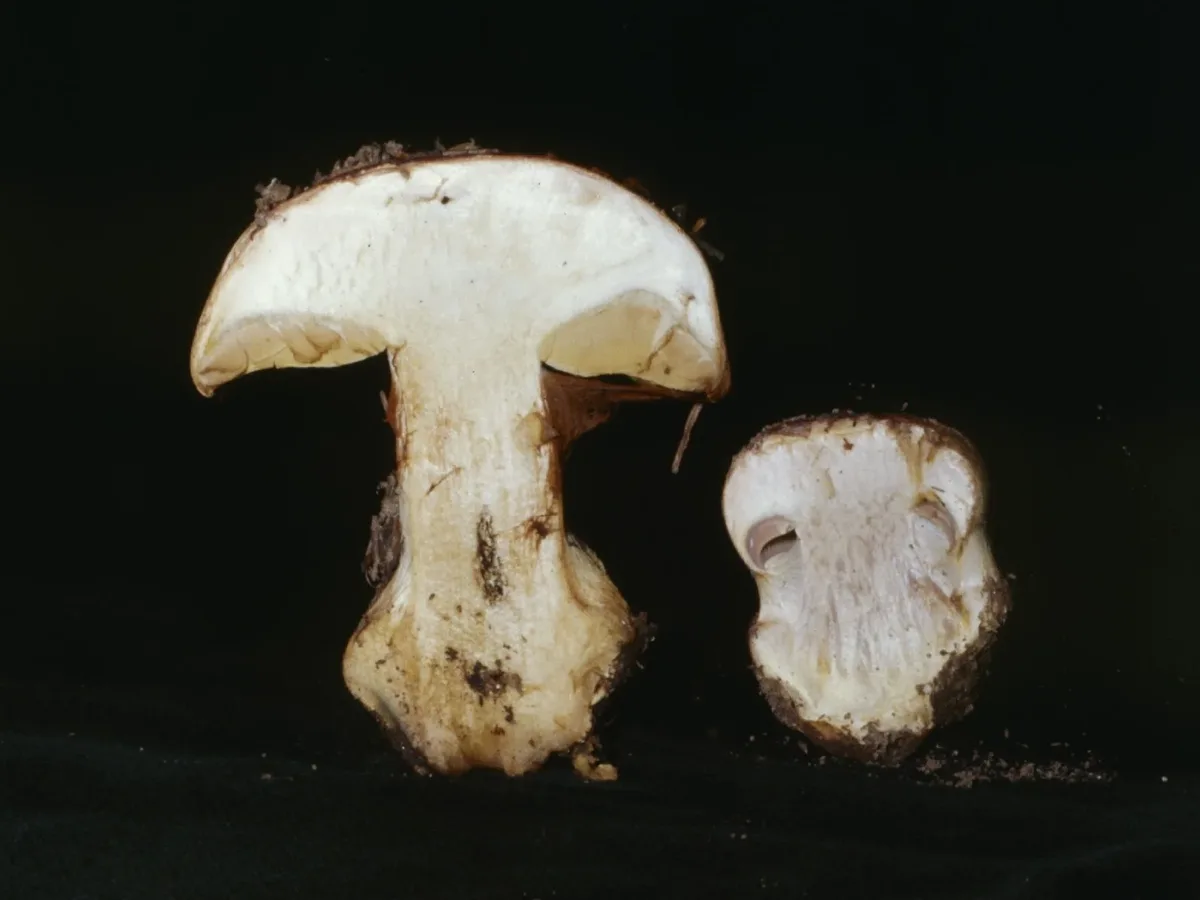 Denver Botanic Gardens, Sam Mitchel Herbarium of Fungi (DBG-DBG) (CC0)
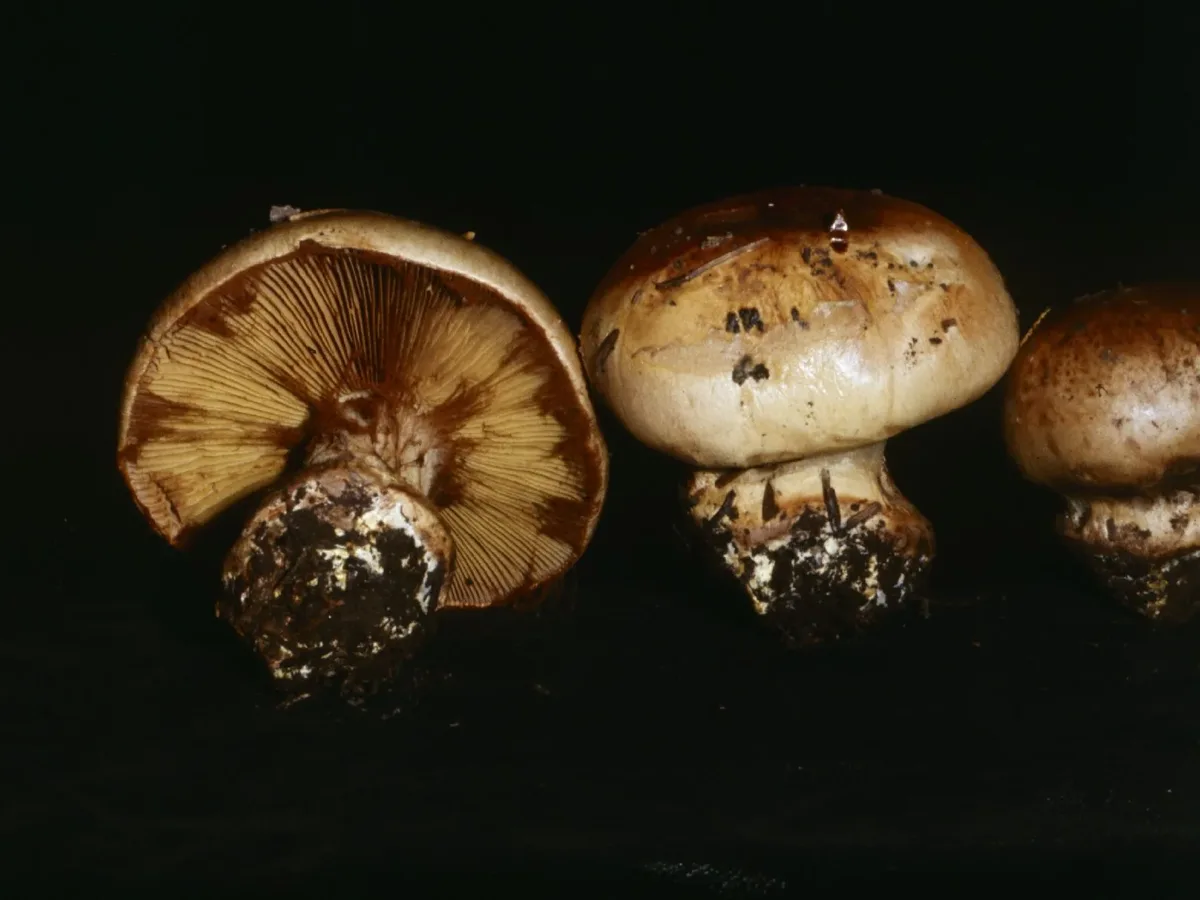 Denver Botanic Gardens, Sam Mitchel Herbarium of Fungi (DBG-DBG) (CC0)Denver Botanic Gardens, Sam Mitchel Herbarium of Fungi (DBG-DBG) (CC0)Denver Botanic Gardens, Sam Mitchel Herbarium of Fungi (DBG-DBG) (CC0)
Toxic - and the most serious cases can be fatal. Never eat it, and wash your hands after handling.
Never eat a mushroom you are not 100% sure of - check the look-alikes below, and always cook wild mushrooms.
How to recognise it
Cortinarius orichalceus is one of the more distinctive Australasian webcaps by virtue of its viscid, brass-yellow to golden-ochre cap. The specific epithet orichalceus derives from Latin for brass or oricalcum, the legendary yellow metal, and captures the cap colour precisely.
Cap
The viscidity (stickiness) when moist is a key characteristic of the Phlegmacium section of Cortinarius, in which this species sits. Picking up leaf litter, bark fragments, and soil on the cap surface is typical and actually helps confirm you are dealing with a viscid-capped webcap rather than a dry-capped relative.
In young specimens the cap is broadly convex and the brass-yellow colour is at its most vivid. With age the cap flattens and may take on faint olive or tawny-brown tones, especially at the centre.
Gills
The gills are initially pale ochre to cream and then progressively stain rust-brown as the spores ripen. This gill colour change from pale to rusty brown is a defining and irreversible characteristic of all mature Cortinarius fruit bodies, and one of the most reliable field markers for the genus.
Stem
The stem is whitish to pale yellowish, fibrillose, and bears the collapsed remnant of the cortina as a rust-stained ring-zone - the rust colour coming from spore deposition, not from the veil tissue itself.
Flesh
Flesh is whitish and firm, without distinctive smell.
The spore print is rust-brown to ochre-cinnamon, confirming genus membership.
Why it's dangerous
FATAL. Cortinarius orichalceus must be treated as a deadly poisonous mushroom without exception.
The Australasian Cortinarius complex is established to contain orellanine-class nephrotoxins, and no reliable field method exists to distinguish species within this genus that are toxic from any that might not be.
The combination of high toxin potency, absolute heat stability (cooking does not help), and the extreme latency period of orellanine poisoning places this species among the most dangerous classes of mushroom encountered anywhere in the world.
There is no specific antidote; treatment is supportive care, haemodialysis, and in the worst cases kidney transplantation.
If any Cortinarius has been consumed - even weeks earlier - seek emergency medical care immediately without waiting for symptoms.
- In Australia, call the Poisons Information Centre on 13 11 26.
- In New Zealand, call the National Poisons Centre on 0800 764 766.
Toxin
Australian and New Zealand mycological authorities treat Cortinarius orichalceus as carrying orellanine-class nephrotoxic risk, consistent with the established toxicology of the broader Australasian Cortinarius complex.
Orellanine, a polypyridine N-oxide, was first characterised from the European C. orellanus and subsequently confirmed analytically in multiple Australian and New Zealand Cortinarius species.
It is heat-stable: no cooking, drying, freezing, or other preparation inactivates it.
In the body, orellanine is metabolically converted to nordihydroorellanine and related compounds. These selectively destroy renal proximal tubule cells through free-radical mechanisms, causing progressive, potentially irreversible kidney failure.
Specific analytical toxin data for C. orichalceus itself are limited in the published literature. The precautionary principle - universally adopted across Australasian mycology - mandates treating all regional Cortinarius species as carrying full orellanine-class risk unless definitively proven otherwise.
No safe threshold of consumption has been established for any orellanine-bearing species.
Symptoms
Orellanine nephrotoxicity is defined by a dangerously long and deceptive latent period. The interval between ingestion and the appearance of symptoms is typically two to three weeks, with a documented range from a few days to over a month.
This extreme delay - far longer than almost any other mushroom toxin - is the most treacherous characteristic of orellanine poisoning: the victim feels entirely normal for weeks while progressive renal tubular necrosis develops silently.
By the time symptoms emerge, the causal meal has been forgotten and the mushroom discarded, making diagnosis very difficult.
Symptoms, when they eventually appear, include:
- Intense thirst.
- Increased urination, followed by decreased urination as renal function declines.
- Nausea and vomiting.
- Headache.
- Severe fatigue and muscle weakness.
- Burning or aching pain in the flanks or lower back.
These progress to overt signs of acute kidney injury - rising creatinine, oliguria, and in severe cases frank renal failure.
The delay in onset also profoundly complicates treatment, because effective intervention ideally occurs before extensive tubular necrosis.
Staying safe
DO NOT EAT. Cortinarius orichalceus is a deadly poisonous species.
Its orellanine-class toxin is heat-stable and is not inactivated by any cooking, drying, freezing, or other preparation technique.
The latency of two to three weeks before symptoms appear makes this uniquely dangerous: a forager can eat this mushroom, feel normal for weeks, and not recognise the causal link when kidney failure eventually begins.
If any Cortinarius has been consumed, or if there is any possibility that this species entered a food preparation context, seek emergency medical advice from a poisons centre without waiting for symptoms to develop.
- In Australia: Poisons Information Centre, 13 11 26 (24 hours).
- In New Zealand: National Poisons Centre, 0800 764 766.
Never collect, taste, or experiment with any ochre-yellow, golden, or viscid-capped webcap-type mushroom in Australasian native forest.
Where & when it grows
Habitat
This species is an obligate ectomycorrhizal partner of native trees - it cannot complete its life cycle without a living host root system and therefore never occurs in isolation from its forest habitat.
In mainland Australia it grows primarily beneath mature eucalypts in moist sclerophyll and wet sclerophyll forest, particularly the tall mountain ash and messmate communities of Victoria, the southern tablelands of New South Wales, and Tasmanian cool-temperate rainforest margins.
In montane areas and in New Zealand it may associate with Nothofagus cunninghamii (myrtle beech) and N. menziesii (silver beech).
The soil is typically acidic, well-drained to moist, and rich in organic matter. The species is consistently found in the shadier interior of mature forest rather than at forest edges or in open canopy.
Because a viscid yellow-gold Cortinarius in native Australasian forest carries the same orellanine risk as any other webcap in this region, habitat identification is safety-critical: this species does not move into gardens or exotic plantations, so finding it definitively establishes the dangerous context.
When
Cortinarius orichalceus fruits in the Southern Hemisphere autumn and early winter, broadly March to July, with the peak in April and May.
The trigger for fruiting is the classic Cortinarius combination: soil cooling after summer heat combined with sustained rainfall that moistens the soil to meaningful depth.
In practice this means a spell of 20 mm or more of rain over one to two weeks, occurring when soil temperatures are falling through the 10-15 °C range.
At wetter higher-altitude sites - in the Tasmanian highlands, the Snowy Mountains foothills of Victoria and New South Wales, and New Zealand - fruiting can extend to June or July.
The species does not fruit in summer regardless of rainfall, because soil temperatures remain too high to trigger reproductive development.
How it grows
As an ectomycorrhizal organism, C. orichalceus exists primarily as an invisible mycelial network interwoven through the soil and around the fine roots of its host trees. The mushroom itself is simply the reproductive fruiting body of this larger, longer-lived organism.
The network is perennial and, under suitable autumn conditions, the same site may produce fruit bodies in multiple successive years.
Fruiting bodies typically emerge singly or in scattered small groups of two to five; dense clustering is not characteristic of this species.
Young fruit bodies are buttons with the viscid cap still convex and the cortina intact and obvious. As the cap expands and the cortina tears, it leaves the characteristic rust-stained ring-zone.
The viscid cap makes young specimens particularly sticky and easy to recognise in the field, even before the full mature appearance is established.
Fruiting conditions
Southern Hemisphere autumn species. Fruiting triggered by post-summer cooling (soil temperatures falling below approximately 15 °C) combined with sustained autumn rainfall (20+ mm over 14 days). Typical flush lag 10-21 days after the triggering rain event. Peak April-May; extends to June-July at wetter or higher-altitude sites in Tasmania, the Victorian Alps, and New Zealand.
Look-alikes
The primary realistic confusion scenarios in Australasian native forest are with other native Cortinarius species.
Several Australian webcaps share the ochre-yellow to golden or tawny-brown cap coloration: C. sinapicolor and other pale-capped viscid Cortinarius species can look very similar at similar growth stages. All carry the same orellanine risk - species-level discrimination among these offers no practical safety benefit, since all are dangerous.
A more dangerous confusion occurs with the golden chanterelle (Cantharellus sp.) or with yellow-capped waxcaps (Hygrocybe spp.), both of which can be golden-yellow in native Australian forest. They are separated as follows:
- Chanterelles: distinguished absolutely by their forked, blunt-edged, gill-like ridges (not true sharp-edged gills), a white to pale yellow spore print (never rust-brown), and a firm fruity or apricot-like odour; they have no cortina.
- Waxcaps (Hygrocybe spp.): have brightly waxy gills, a white spore print, and no cortina.
- Suillus luteus (slippery jack): viscid-capped and ochre-yellow but has pores (not gills) on the cap underside and is associated exclusively with introduced pine plantations, not native eucalypt forest.
- Pholiota species: similarly tawny-ochre with rust-brown spore prints but typically grow in clusters on dead or dying wood (not soil), have a more membranous ring rather than a cobwebby cortina, and often display scaly cap surfaces.
In all confusion scenarios, confirming the rusty-brown spore print from a viscid-capped soil-based gilled mushroom under native Australasian trees points conclusively to Cortinarius, and must trigger immediate discard without tasting.
C. australiensis overlaps in habitat, season, and cap colouration - tending toward pale violet-brown to ochre-brown - and is equally deadly. Field separation between the two is unreliable; both species bear orellanine-class risk. Any viscid or fibrillose Cortinarius in native Australasian forest must be treated as potentially deadly regardless of exact cap colour.
Numerous Australasian Cortinarius species share the ochre to tawny-brown viscid cap and rusty spore print. All should be treated as deadly. The characteristic markers of the genus - viscid cap (in Phlegmacium section), rusty-brown spore print, and collapsed cobweb-cortina ring-zone on the stem - identify a Cortinarius; distinguishing the exact species is a specialist task requiring microscopy and chemical analysis and carries no safety benefit since all are equally dangerous.
C. sinapicolor is a similarly ochre-yellow to mustard-yellow viscid-capped Cortinarius in the same native Australian forest habitat and season. It is equally dangerous. The two species represent the same orellanine risk; species-level discrimination in the field has no practical safety value.
Chanterelles are golden-yellow and superficially similar in colour, but are immediately distinguished by their forked, blunt-edged, gill-like ridges (not true sharp-edged gills), a pale cream to white spore print (never rust-brown), firm fruity or apricot odour, and complete absence of any cortina at any growth stage. The cap surface is dry and not viscid. Chanterelles are edible and prized, but any confusion scenario with a Cortinarius could be fatal - always confirm white spore print, blunt forking ridges, and no cortina before harvesting any golden mushroom in native Australasian forest.
Pholiota species share a tawny-ochre to golden-brown cap with a rusty-brown spore print, but typically grow in dense clusters on dead or dying wood or at the base of trees (not from soil), have distinctly scaly caps in many species, a more membranous ring rather than a cobwebby cortina remnant, and do not form ectomycorrhizal associations. None are edible or desirable, but the clustered wood-growing habit is the clearest separator from the soil-based solitary C. orichalceus.
Suillus luteus is also viscid-capped and golden-yellow to ochre, but has spongy pores (not gills) on the cap underside, a membranous ring (not a cobwebby cortina remnant), and grows exclusively with introduced pines - not in native eucalypt or Nothofagus forest. The pore surface is the single most definitive marker: if the underside of the cap has gills, it cannot be Suillus.
A reference guide - never an edibility guarantee. When in doubt, leave it out.