Viscid violet cort
Cortinarius iodessyn. Cortinarius iodes Berk. & M.A.Curtis, Phlegmacium iodes (Berk. & M.A.Curtis) M.M.Moser
 © willingarden (CC BY)
 © willingarden (CC BY)
 Garrett Taylor (CC0)
 © willingarden (CC BY)
 © willingarden (CC BY)
 © willingarden (CC BY)
 © Alex Abair (CC BY)
 © willingarden (CC BY)© willingarden (CC BY)© willingarden (CC BY)
Not poisonous, but not worth eating - too tough, bitter, or bland for the pot.
Never eat a mushroom you are not 100% sure of - check the look-alikes below, and always cook wild mushrooms.
How to recognise it
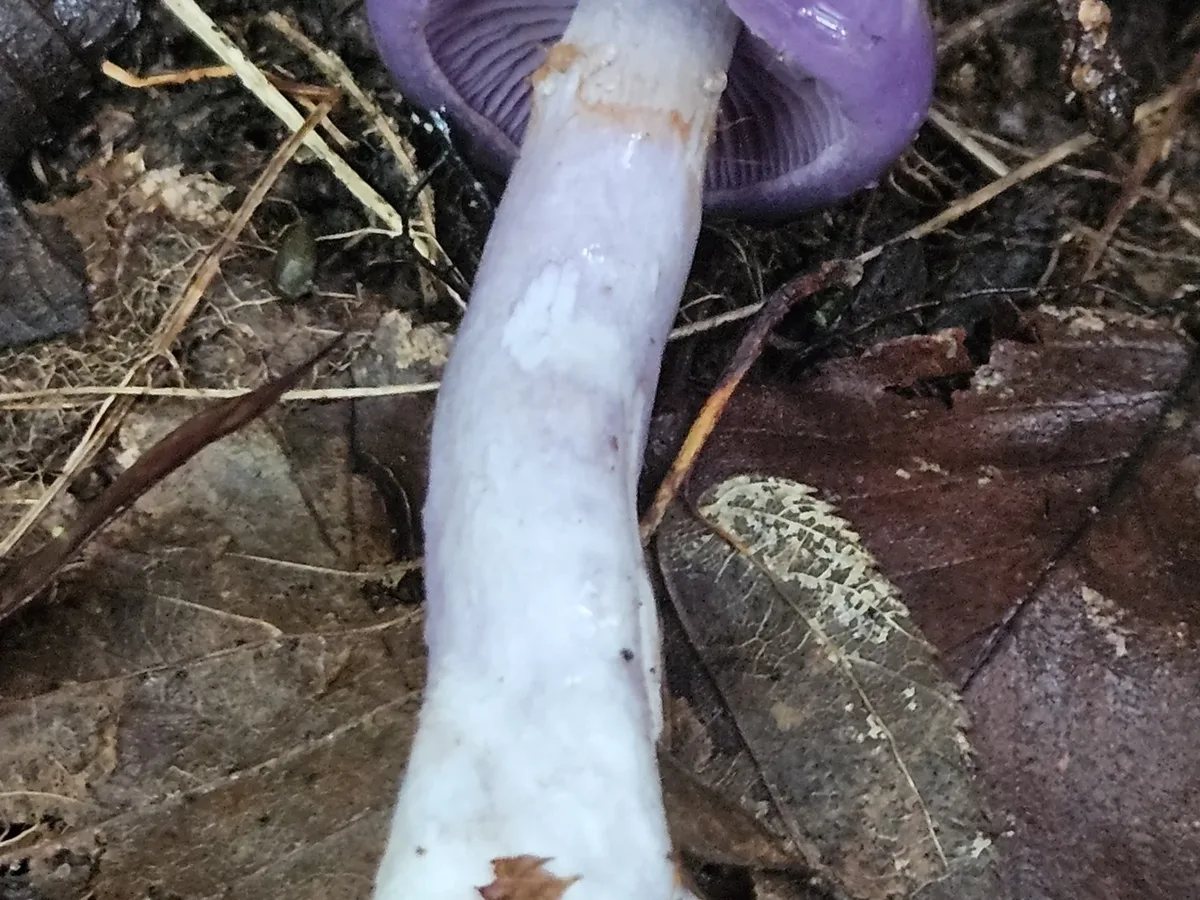
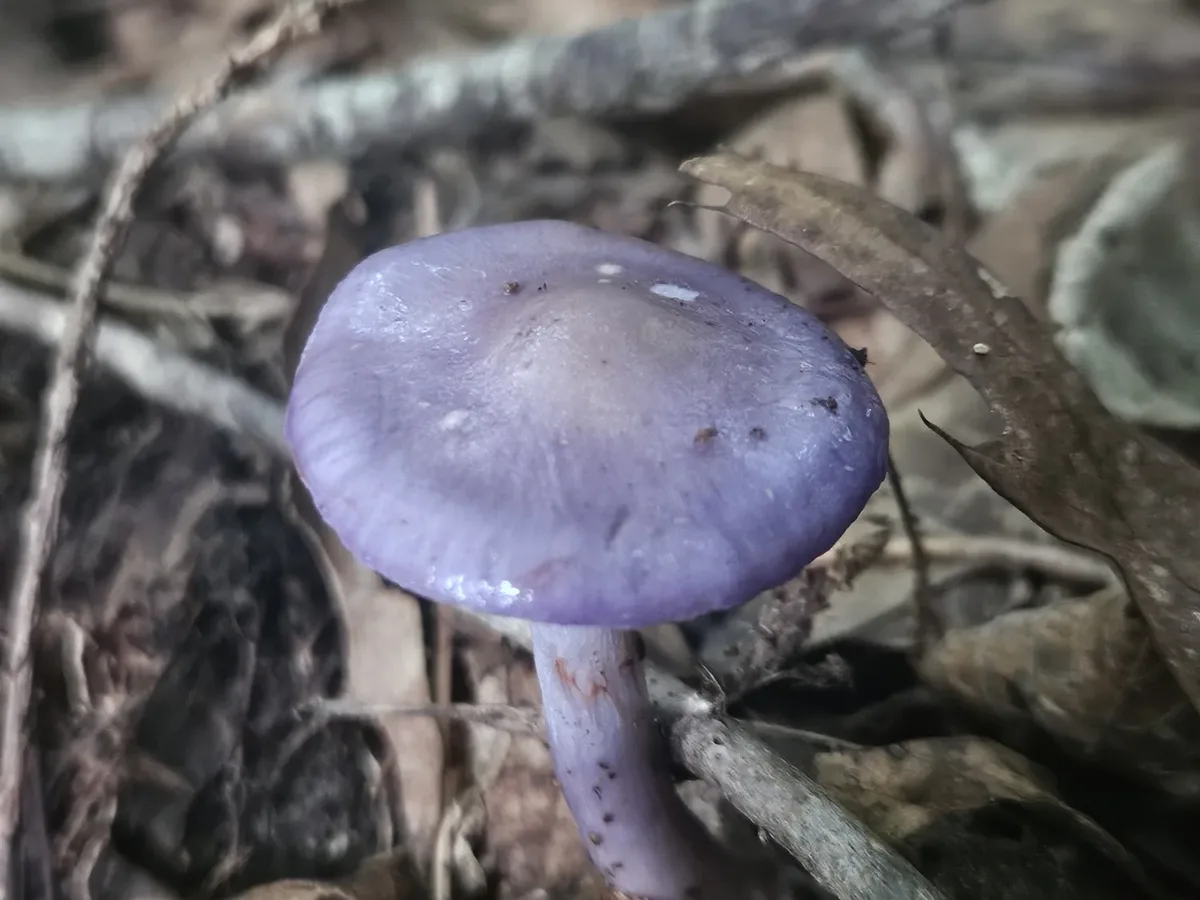
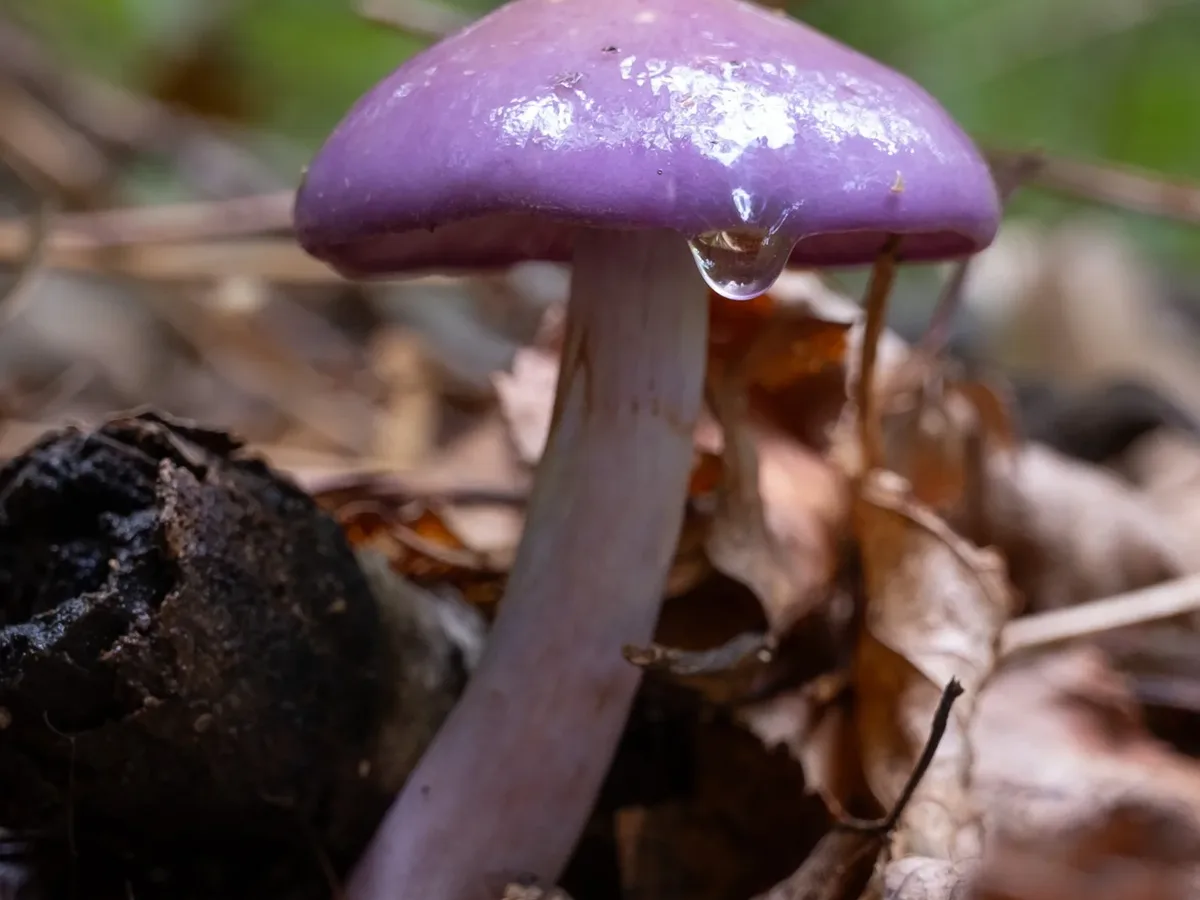
Cortinarius iodes is one of the most distinctive webcaps of eastern North American forests, immediately recognisable by its combination of rich violet to lavender-purple coloration and conspicuously slimy, glutinous cap surface - traits captured in the common names 'viscid violet cort' and 'iodine cort.'
Cap
When wet, the cap glistens with a thick gelatinous glaze that can be wiped off in a sheet; when dry, the surface is smooth and almost lacquered.
Cap colour is deepest violet at the centre and fades toward the margin. With age or in dry conditions the centre may develop yellowish or ochre tones while the margin retains its lilac hue.
Young caps often show scattered pale veil spots or fibres that disappear by maturity.
Gills
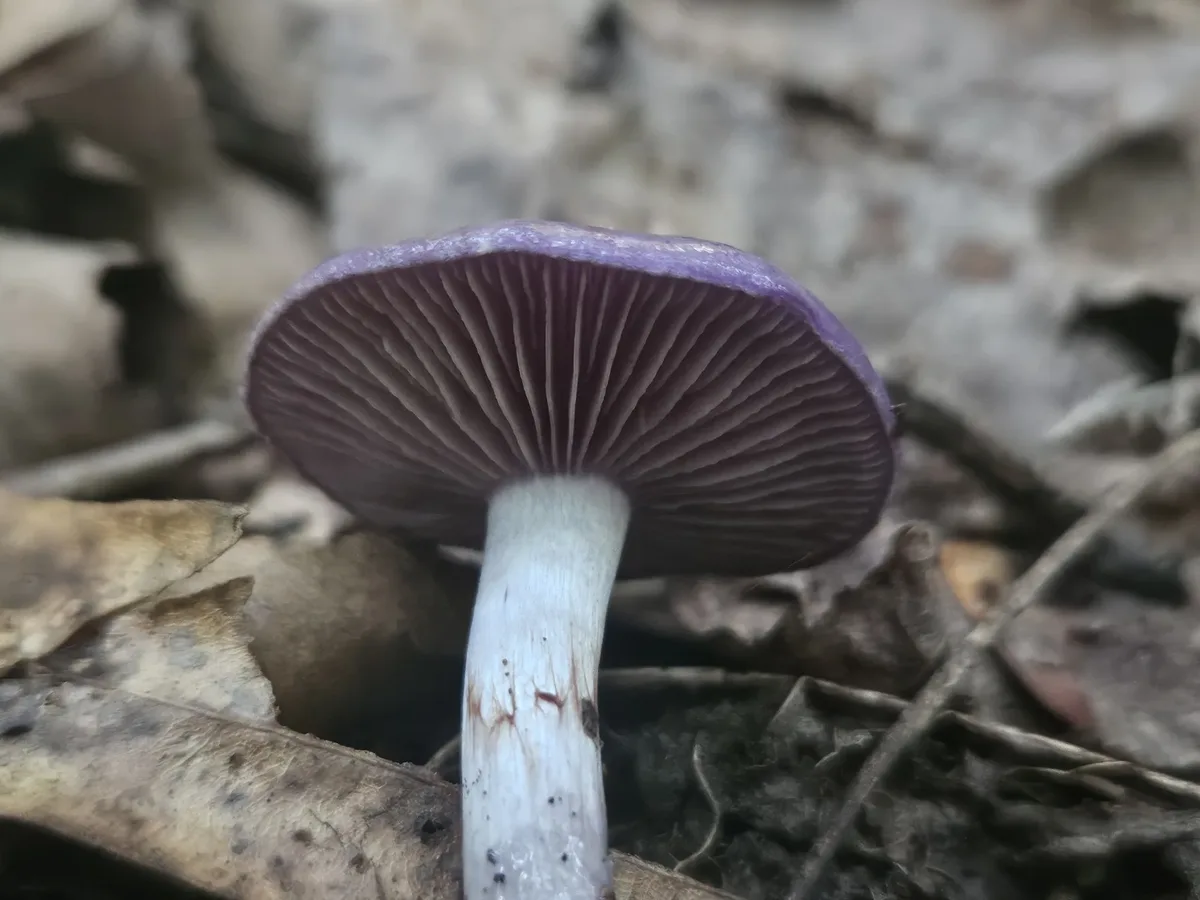
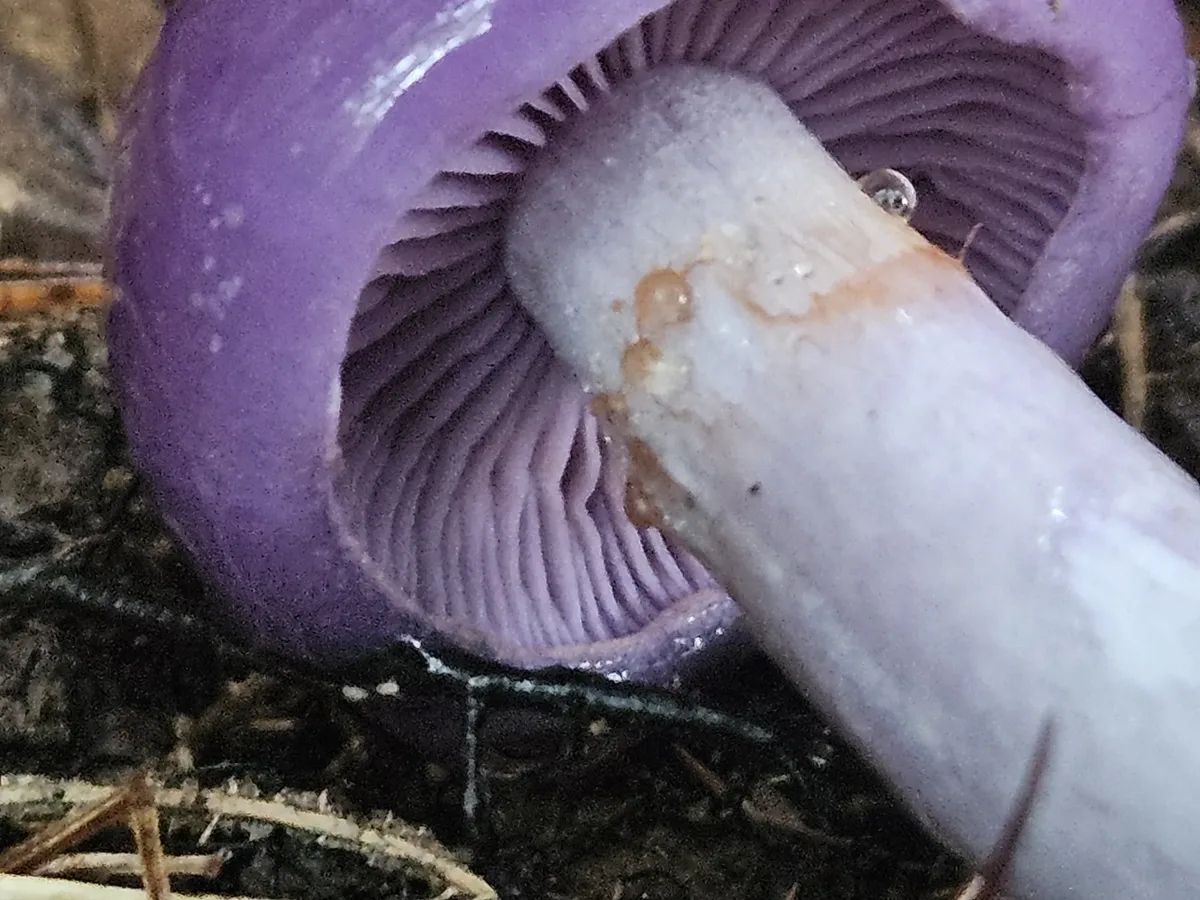
The gills begin a pure pale violet and reliably transform to rusty cinnamon-brown as spores ripen - exemplifying the definitive Cortinarius hallmark: a rusty-brown spore print deposited by gills that begin pale or coloured.
The finely warted ellipsoid spores, in the range of 8-10 × 5-6 µm, are consistent with the Phlegmacium (viscid-capped Cortinarius) group.
Stem
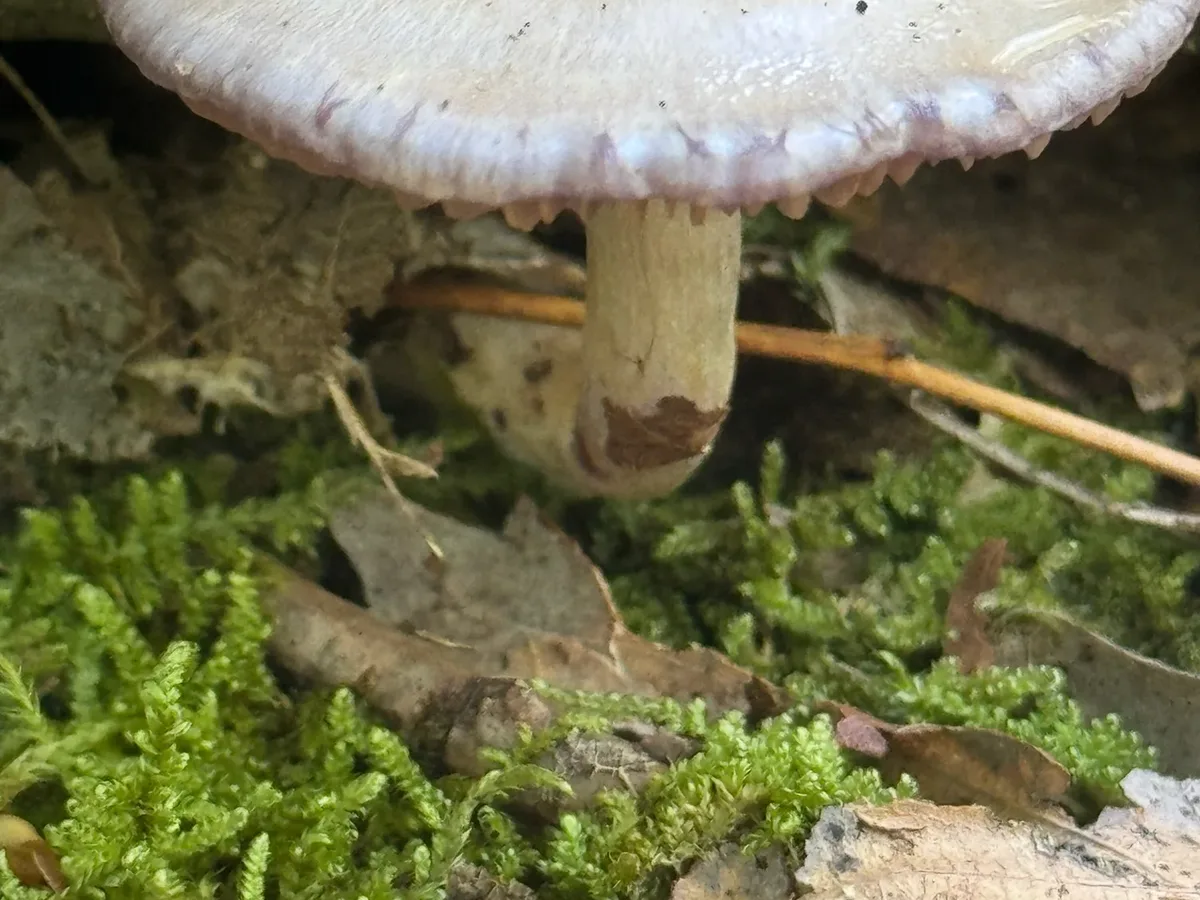
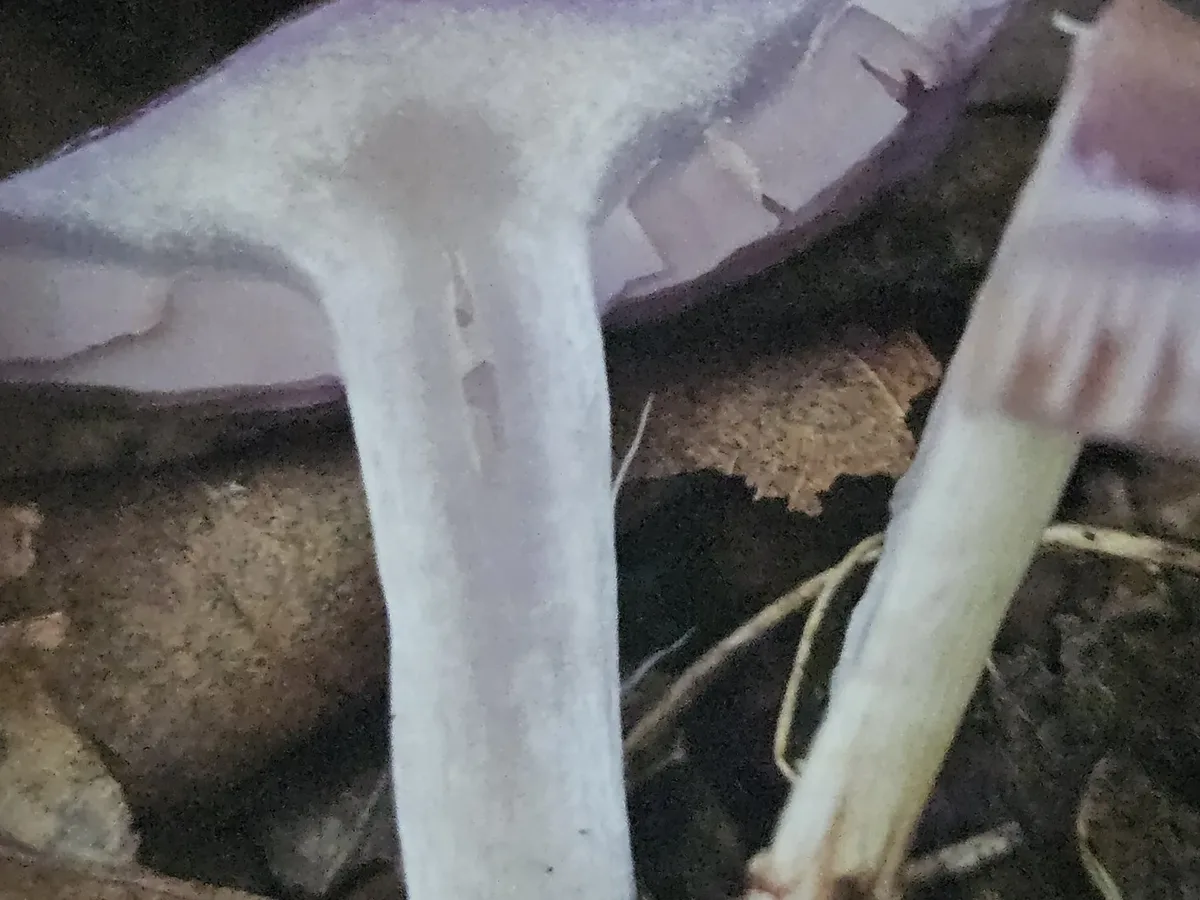
The cobwebby cortina is most visible on young specimens, and its collapsed remnant stains rust-brown on the upper stem.
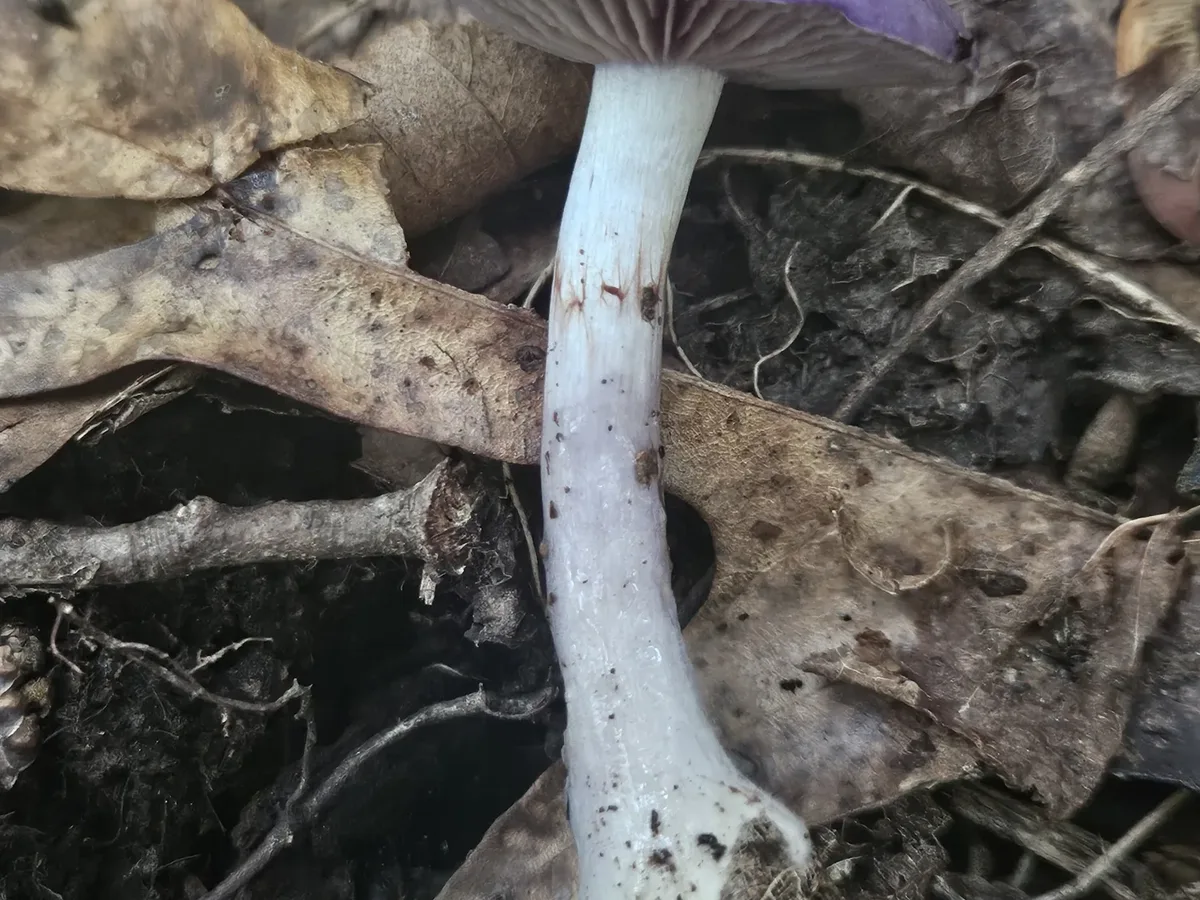
The stem is fibrillose and violet, and the base may carry a faint viscid coating.
Flesh
No colour change in the flesh on cutting.
Smell & taste
No distinctive chemical odour.
Where & when it grows
Habitat
Cortinarius iodes is an obligate ectomycorrhizal species of mature eastern North American mixed woodland.
Its mycorrhizal partners are primarily oaks - white, red, and chestnut oaks being most commonly associated. It also fruits with American beech and hickory in upland forest, and will extend into areas of mixed hardwood-pine when oaks or beeches are present in the canopy.
The preference for mature forest with a well-developed litter layer reflects the species' dependence on established ectomycorrhizal networks; it is essentially absent from recently disturbed sites and young regrowth. Soils are typically moderately acidic and rich in organic matter.
The species ranges broadly across the eastern United States from the Great Lakes south to the Gulf Coast and east to the Atlantic coast, with occurrence extending into adjacent southern Canada.
Look for it in the shaded interiors of parks, nature reserves, and rural woodlands wherever mature oaks persist.
When
Fruiting occurs in late summer through autumn, broadly August to October, with the heart of the season in September and early October.
The fruiting trigger is a combination of cooling soil temperatures following the summer heat peak and adequate soil moisture from late-summer or early autumn rainfall.
In practice, a rain event delivering 20-30 mm during a cooling period when soil temperatures pass through the 12-18 °C window commonly produces a flush 1-2 weeks later.
Warm and wet Augusts occasionally push fruiting earlier; a dry September will suppress or delay it significantly. The season ends as soil temperatures drop toward freezing and killing frosts arrive.
How it grows
As an obligate ectomycorrhizal fungus, Cortinarius iodes depends entirely on a living host tree and cannot complete its life cycle in isolation.
The underground mycelial network that links fungal hyphae to host tree root tips is perennial and may persist at a site for many years, explaining why productive locations tend to be repeatedly fruitful in successive autumns.
Fruiting bodies emerge singly to scattered, occasionally in loose groups of two to five, from leaf litter and forest duff; dense clusters are not typical.
The visible mushroom is the reproductive structure - the fungal organism itself extends below ground as a vast mycelial web forming the ectomycorrhizal sheaths on root tips, exchanging mineral nutrients (especially phosphorus) for photosynthetic carbohydrates provided by the tree.
Fruiting conditions
Late summer to autumn ectomycorrhizal species in eastern North American hardwood forest. Fruiting is triggered when cooling autumn soil temperatures (falling through 18-12 °C) coincide with adequate rainfall (20+ mm over 14 days). Typical flush lag 7-14 days after a triggering rain event. Peak September to mid-October.
Handle with care
Toxin
Cortinarius iodes has no documented toxin compound in the peer-reviewed literature.
It is classified as inedible rather than poisonous based on:
- its unpleasant taste
- the lack of an established edibility record
- the precautionary principle applied to all Cortinarius species
The broader genus contains orellanin (polypyridine N-oxide nephrotoxin, heat-stable and dialysable only with difficulty), with confirmed lethal poisonings from multiple European and Australasian Cortinarius species in the Phlegmacium group to which C. iodes belongs.
Whether C. iodes itself carries any orellanin or other toxic compounds has not been definitively resolved by comprehensive chemical screening. The toxicological gap is itself a safety reason to avoid consumption entirely.
Symptoms
No well-documented cases of human poisoning specifically attributed to Cortinarius iodes are recorded in the literature.
If a related orellanin-bearing Cortinarius were consumed in error, symptoms would typically be absent for two to four weeks (range: a few days to over a month), after which the following develop:
- thirst
- reduced urinary output
- flank pain
- nausea
- fatigue
- progressive kidney failure
The extreme delay between ingestion and symptoms is the defining danger: the victim may not connect the mushroom meal to the illness by the time medical care is sought.
Look-alikes
Several other violet Cortinarius species occur in the same habitat and season and share the lilac-to-purple coloration and rusty-brown spore print.
The most dangerous confusions are with other violet webcaps in the broader Phlegmacium and Telamonia groups, some of which are documented or suspected to contain orellanin (a delayed-onset nephrotoxin responsible for fatal kidney failure).
- Cortinarius traganus - a robust violet webcap with a distinctive unpleasant odour and drier, more scurfy cap, but overlaps in overall appearance.
- Cortinarius violaceus - uniformly deep indigo-violet including its gills at all stages, larger (cap to 12 cm), with a drier, scurfy to velvety cap surface, never viscid or glutinous.
- Laccaria amethystina (amethyst deceiver) - also purple but much smaller, entirely lacking a cobwebby cortina, with a white spore print and widely spaced thick waxy gills that maintain their purple colour throughout, with no rusty browning.
These three features (white spore print, no cortina, permanently violet thick waxy gills) categorically exclude Cortinarius.
Because species-level identification within violet Cortinarius by field characters alone is unreliable, any collection for potential consumption is unjustifiable.
Why it matters
The primary danger of Cortinarius iodes is misidentification: it resembles multiple violet Cortinarius species, several of which are documented to cause fatal orellanin nephrotoxicity.
A forager who confuses a deadly violet webcap with C. iodes and does not seek immediate medical attention faces potential renal failure and the need for haemodialysis or kidney transplantation.
- Never rely on the viscid cap as a definitive identifier for safety, as other Cortinarius species can be glutinous or nearly so.
- Treat any violet Cortinarius as potentially lethal until proven otherwise by a specialist.
- If consumption of any violet webcap is possible, contact poison control without waiting for symptoms.
These European species are tawny to red-brown rather than violet, but broader confusion within the violet Phlegmacium group is well established. The principle is: no field character of Cortinarius color, viscidity, or cap shape is sufficiently diagnostic to separate safe from orellanin-bearing species by eye. Any violet webcap requires specialist identification before any consideration of edibility.
Multiple North American violet Phlegmacium species have been described or are in the process of description using molecular techniques. Several are poorly known toxicologically. Some may carry orellanin or other nephrotoxins not yet characterised. The only safe approach is to treat all violet, viscid-capped webcaps in eastern North American forest as potentially deadly and avoid consumption entirely.
Smaller overall (cap 1-5 cm), with widely spaced, thick, waxy, permanently violet gills that do not develop rust-brown tones at maturity. White spore print (not rusty brown). Absolutely no cobwebby cortina at any growth stage. These three characters - white spore print, no cortina, permanently coloured thick waxy gills - completely exclude Cortinarius. L. amethystina is edible and well regarded but must be confirmed before eating.
C. traganus is also violet to lilac overall but has a distinctly unpleasant odour (often described as sweetish-rancid or reminiscent of pear drops and acetylene), a drier and more scurfy to fibrillose cap surface that lacks the thick gluten layer of C. iodes, and typically ochre-brown gill tones even when relatively young. It is considered mildly to moderately toxic and must not be eaten.
C. violaceus is uniformly deep indigo-violet from cap to stem to gills, larger overall (cap 5-12 cm), and has a distinctly dry, velvety to scurfy cap surface - never the thick gluten of C. iodes. The gills are darker violet and the cobwebby cortina is also violet-blue. Although not documented as orellanin-bearing, it is not reliably edible and should not be consumed.
In the kitchen
Picking & cleaning
Cortinarius iodes should not be collected for eating. It is not an edible species, and the entire genus Cortinarius is one of the most toxicologically complex in mycology.
More importantly, this species grows alongside, and can be confused with, other violet Cortinarius species including ones known or suspected to carry deadly orellanin-class nephrotoxins.
The only appropriate reason to handle a specimen is for scientific study or photography. If collecting for study, note all morphological features while the cap is still fresh and moist, as the viscid gluten and the violet color are strongest in fresh material and fade quickly on drying.
The slippery cap surface makes the mushroom easy to identify on sight alone in the field - but that same viscidity is also present in other violet webcaps, so do not rely on it as a distinguishing mark from all congeners.
Cooking
Not applicable - Cortinarius iodes is not edible and should never be cooked or eaten.
No preparation method has been shown to make this or other Cortinarius species of uncertain toxicity safe, and orellanin (present in related species) is not destroyed by heat, boiling, drying, or freezing.
Good to know
Do not eat Cortinarius iodes. The species is not established as edible, has no documented culinary tradition, and should be left undisturbed.
More critically, it can be mistaken in the field for other violet Cortinarius species that are known or suspected to carry orellanin, a potent heat-stable nephrotoxin that causes delayed kidney failure.
The latency period for orellanin poisoning - potentially two to four weeks between ingestion and onset of symptoms - means that irreversible kidney damage accumulates silently before any warning sign appears.
No field identification of any violet webcap is reliable enough to distinguish safe from deadly species; expert microscopy and chemical analysis are required.
If any Cortinarius has been eaten, contact a poisons control centre immediately regardless of current symptoms:
- In the United States call Poison Control (1-800-222-1222).
- In Canada call your provincial poison centre.
A reference guide - never an edibility guarantee. When in doubt, leave it out.