Dappled webcap
Cortinarius bolarissyn. Agaricus bolaris Pers., Phlegmacium bolaris (Pers.) Wünsche
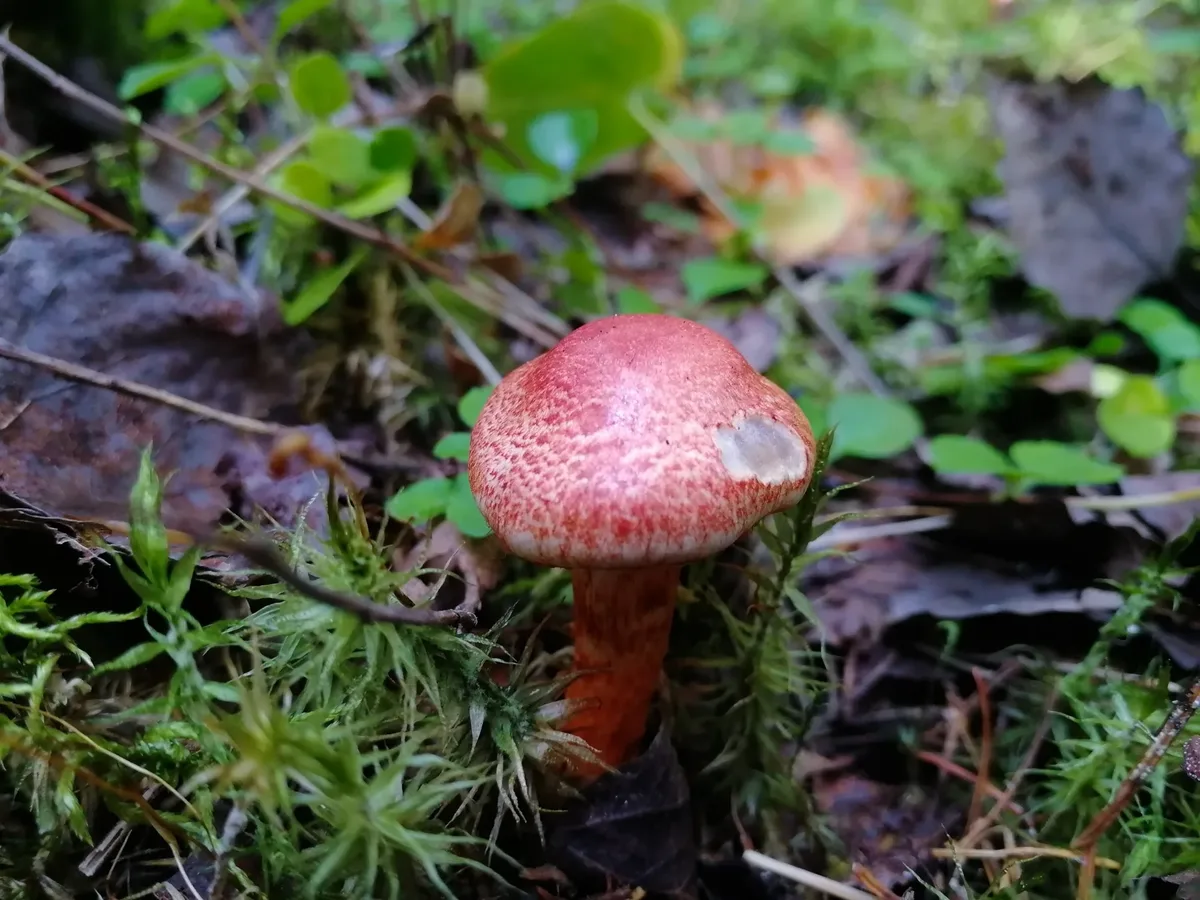 © Kseniya Atuchina (CC BY 4.0)
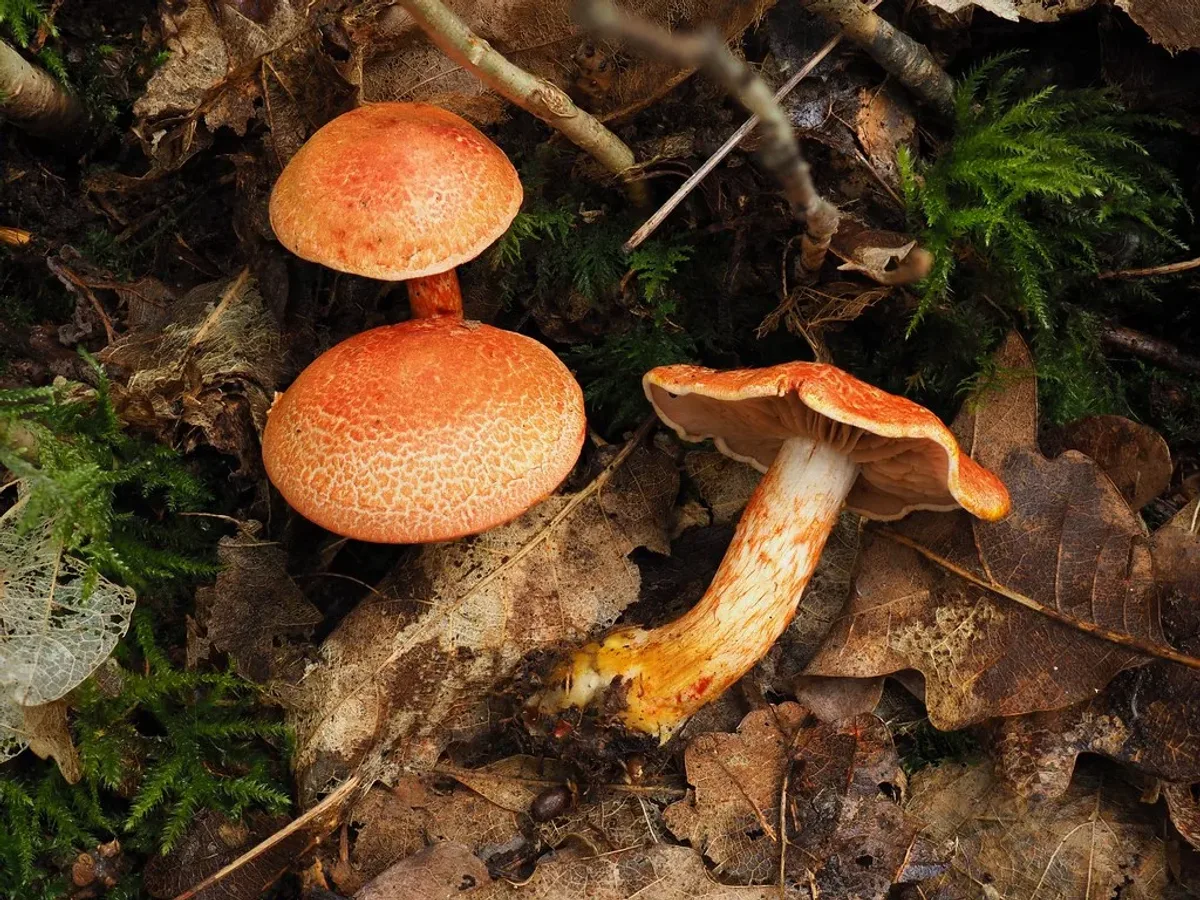 © Lukas Large (CC BY-SA 2.0)
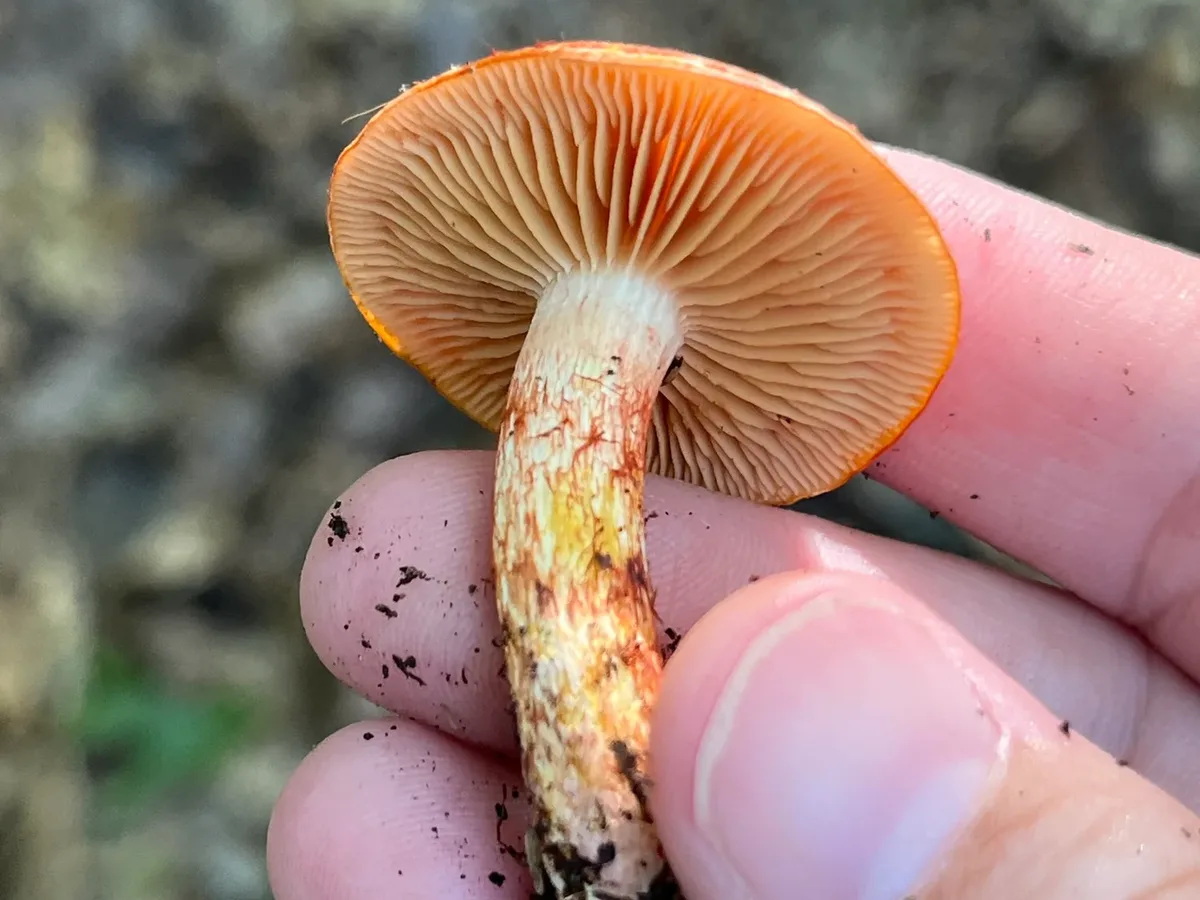 © Julie Travaglini (CC BY)
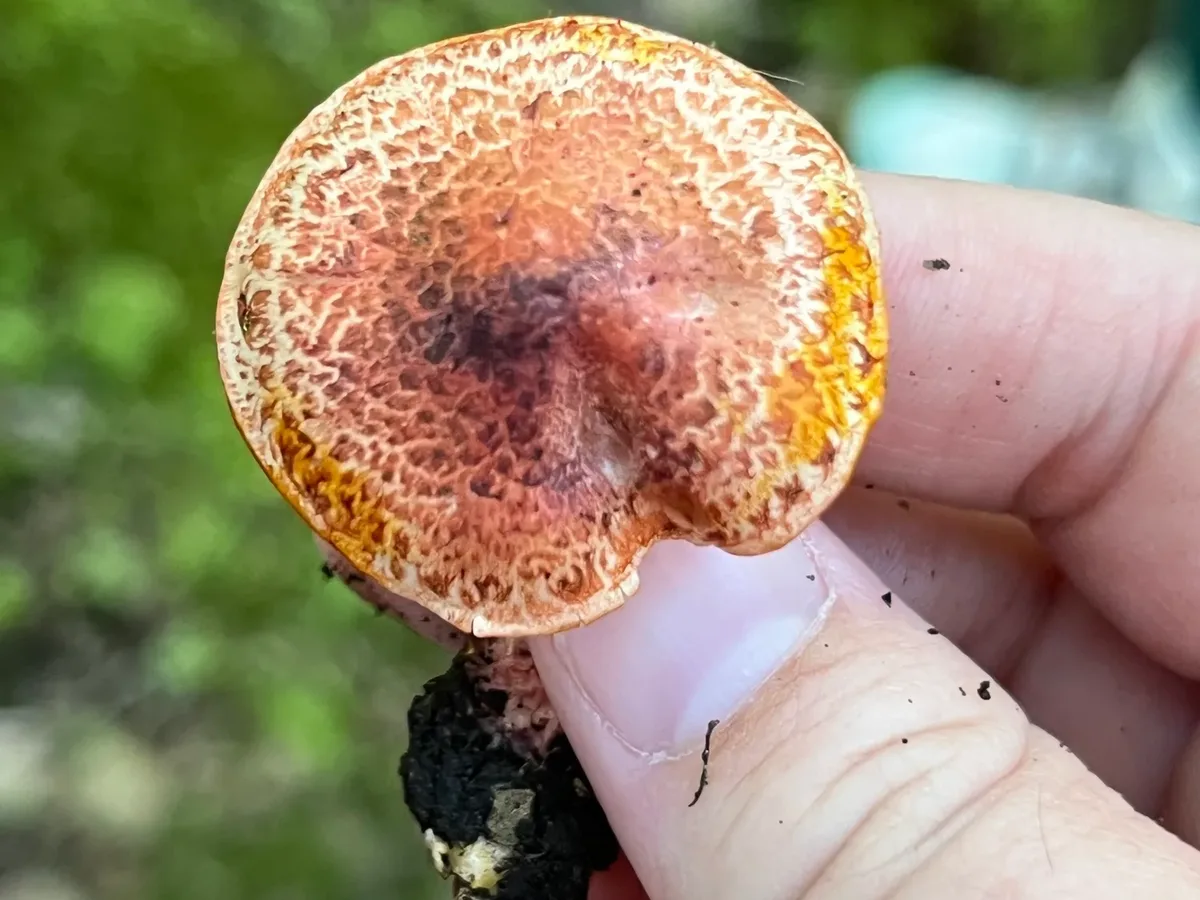 © Julie Travaglini (CC BY)
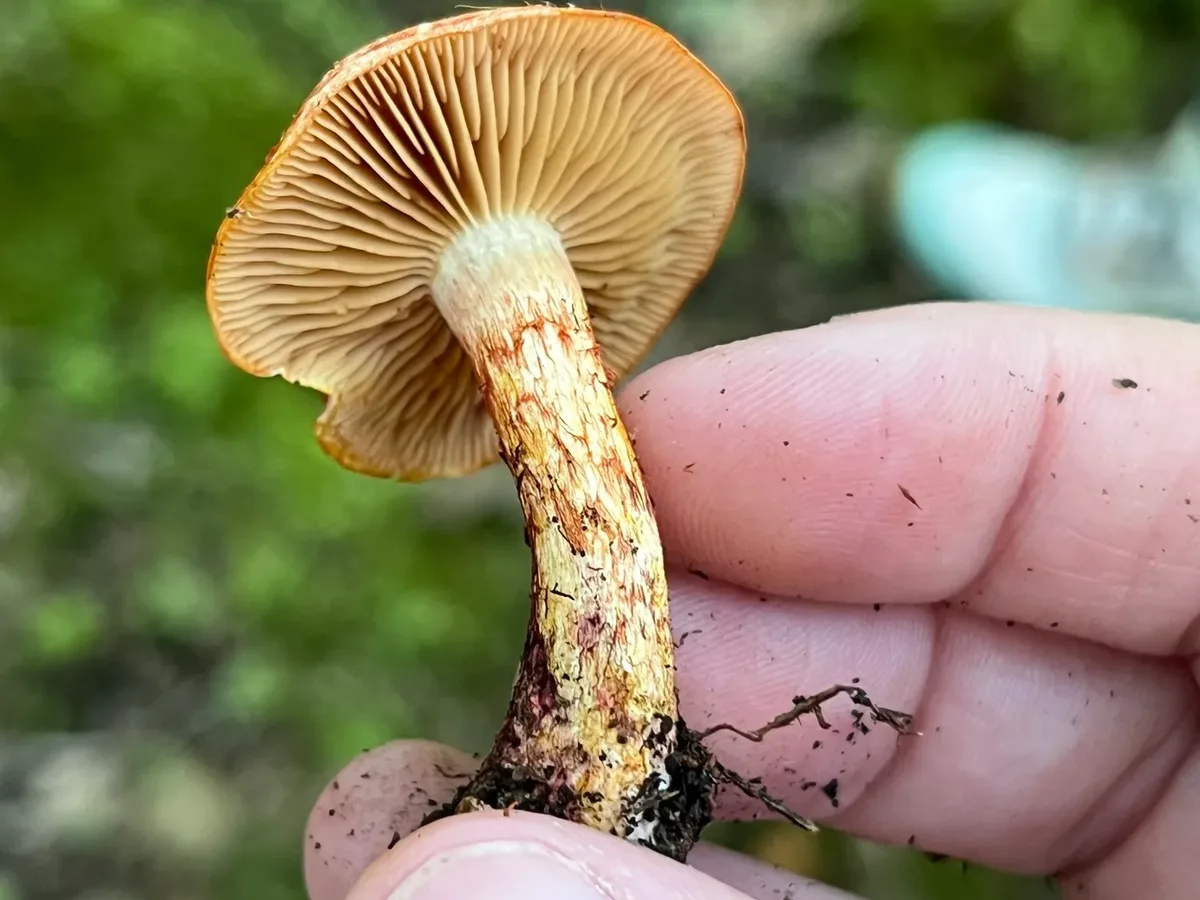 © Julie Travaglini (CC BY)
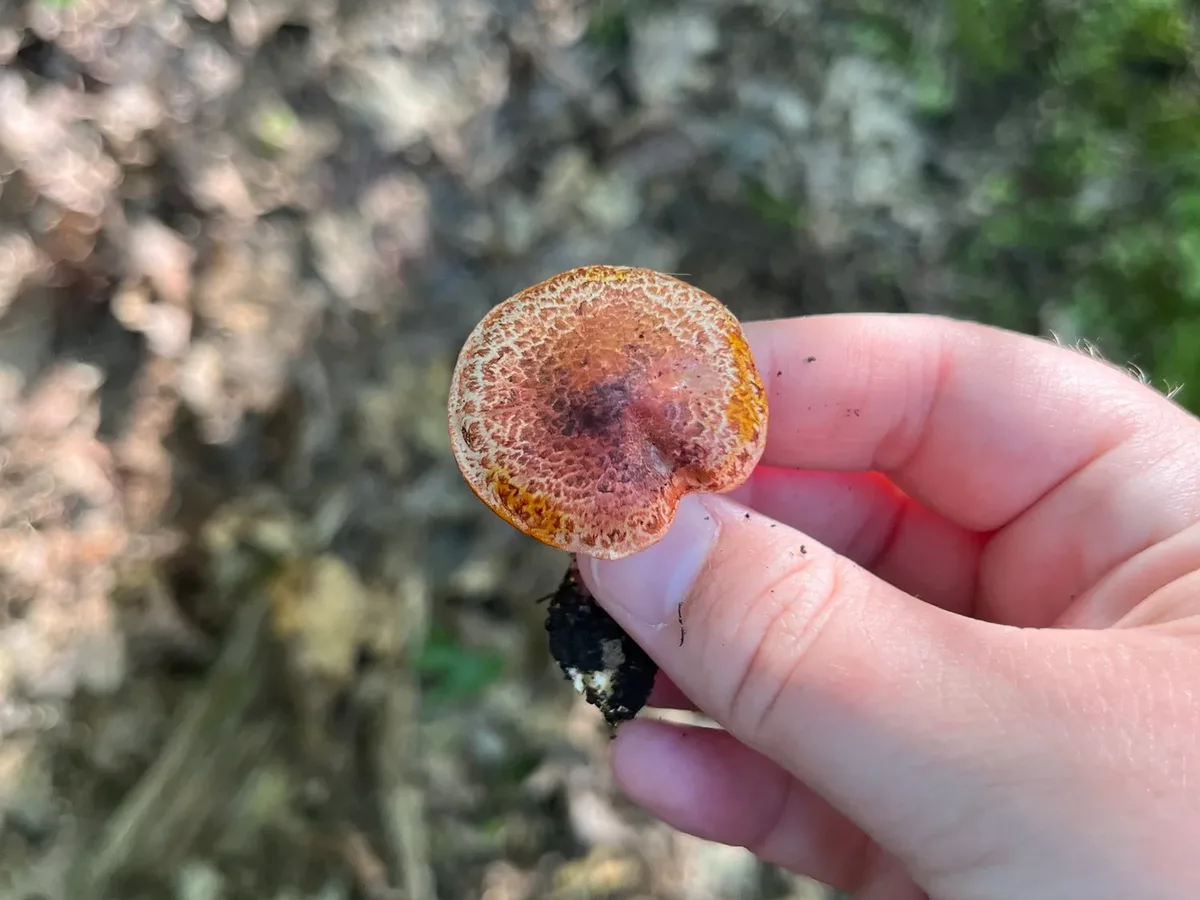 © Julie Travaglini (CC BY)
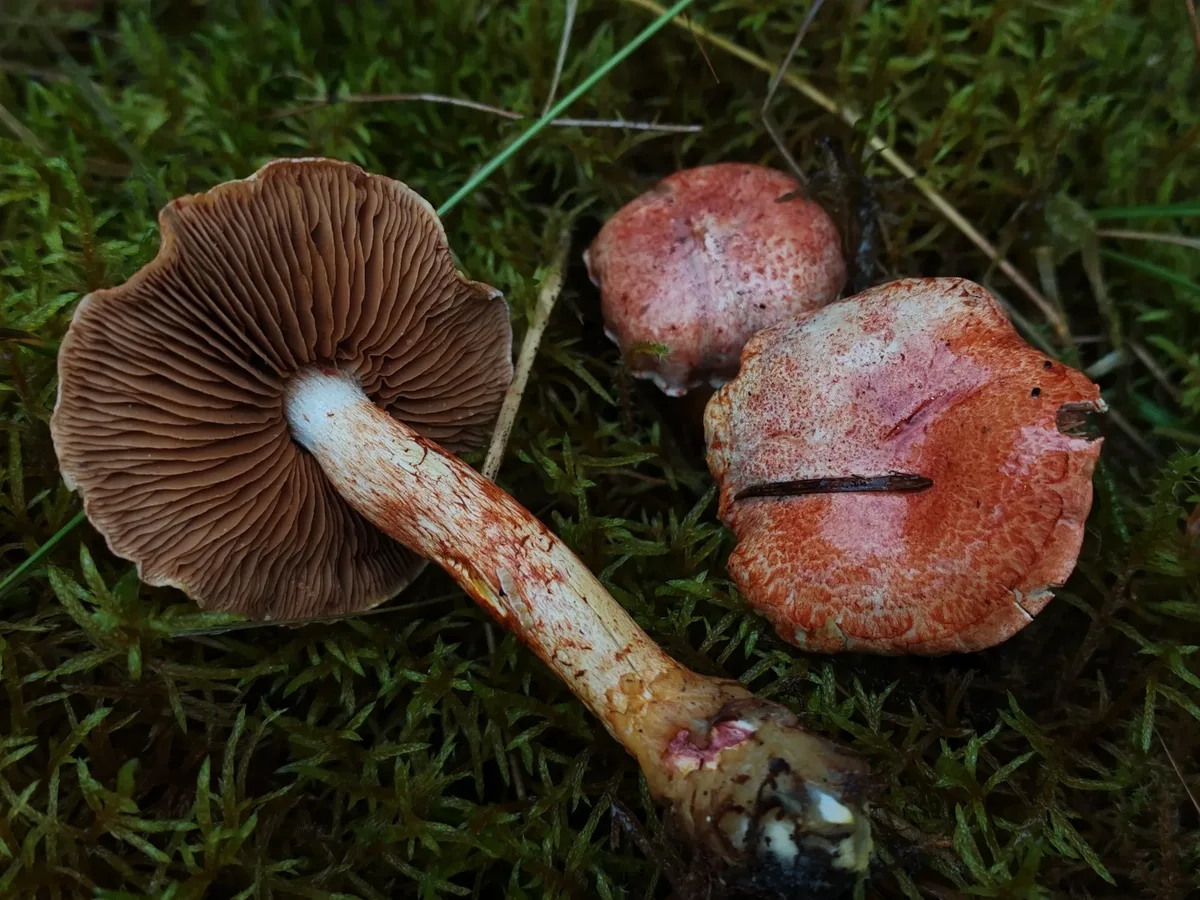 © Bohan Jia (CC BY)
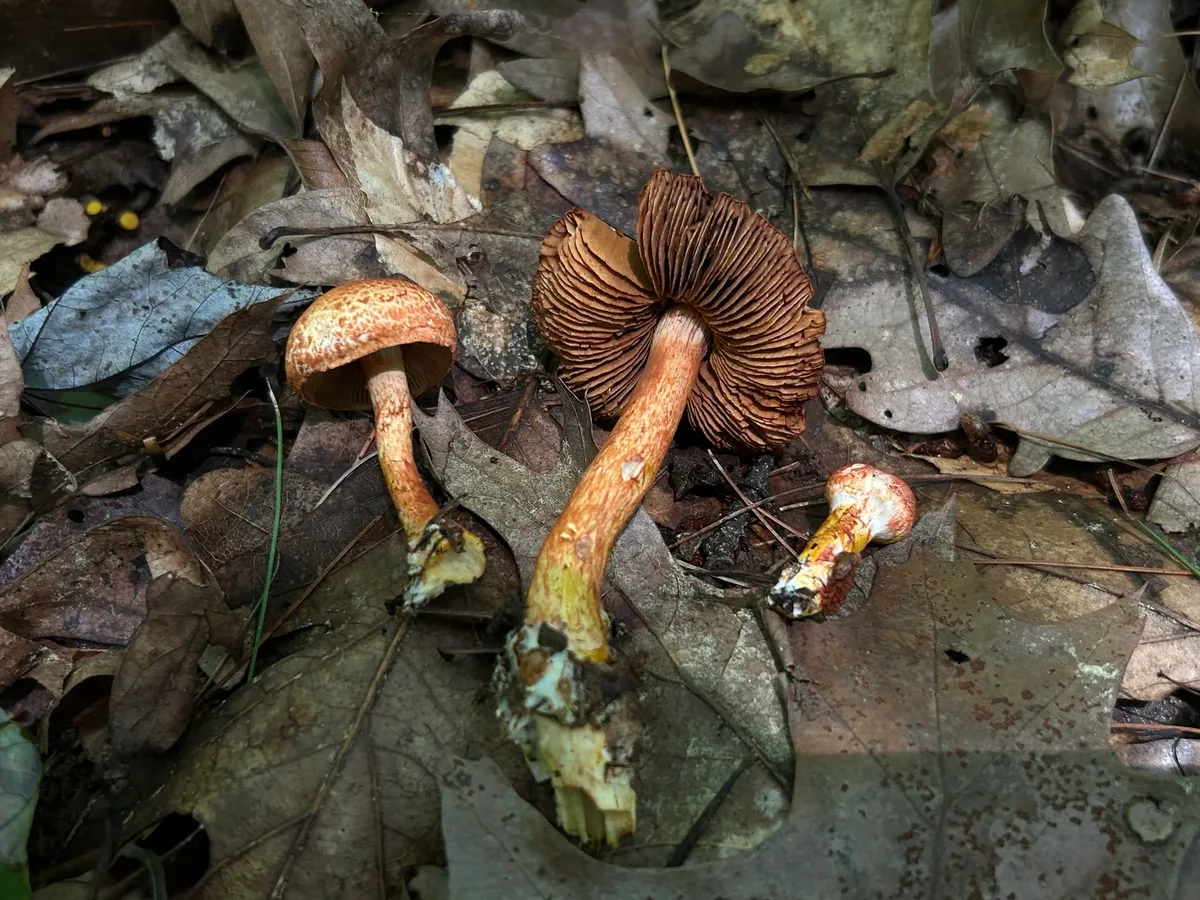 © Nat Gorka (CC BY)
 © Nat Gorka (CC BY)
 © Nat Gorka (CC BY)
 © Alina Martin (CC BY)
 © wkee4ager (CC BY 4.0)© Kseniya Atuchina (CC BY 4.0)© Lukas Large (CC BY-SA 2.0)
Edible only with the right preparation - or safe for some people but not others. Learn the caveats first.
Never eat a mushroom you are not 100% sure of - check the look-alikes below, and always cook wild mushrooms.
How to recognise it
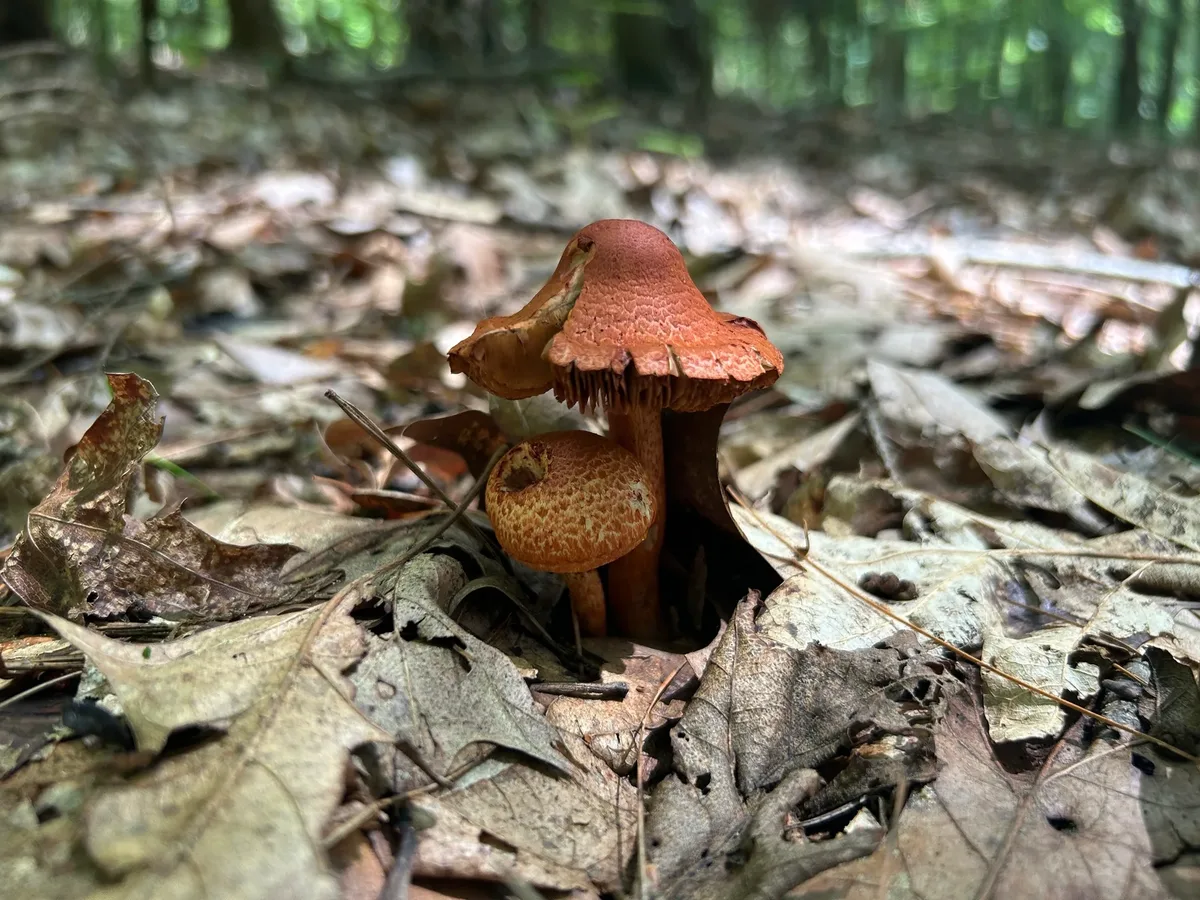
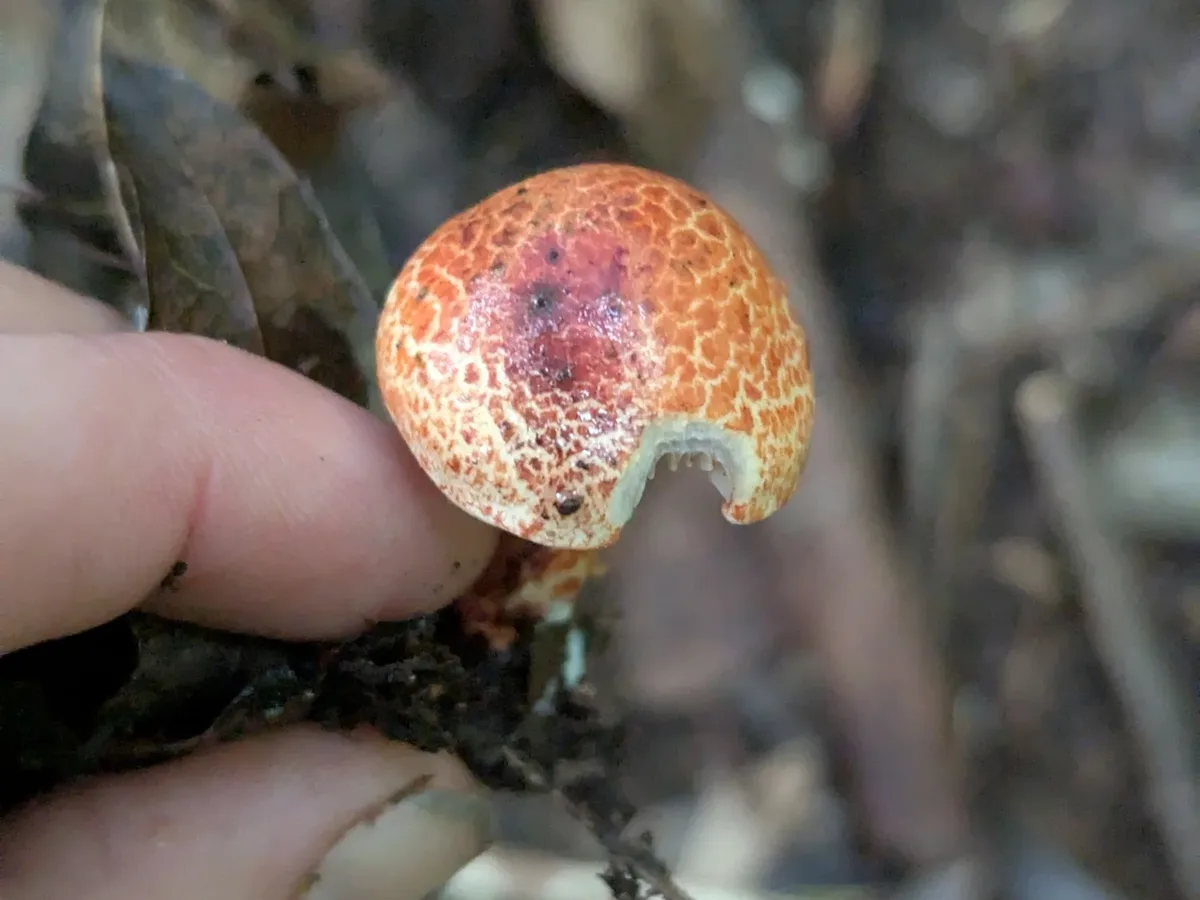
Among the hundreds of webcap species, the Dappled webcap stands out immediately: a pale cream-ochre cap peppered and streaked with vivid brick-red to carmine scales, as though someone flicked a paintbrush across it.
Cap
The cap is 3-8 cm broad, starting convex and slowly flattening to broadly umbonate with age.
That striking two-tone pattern appears from the very earliest buttons and doesn't fade easily, though prolonged wet weather can soften the contrast.
Stem
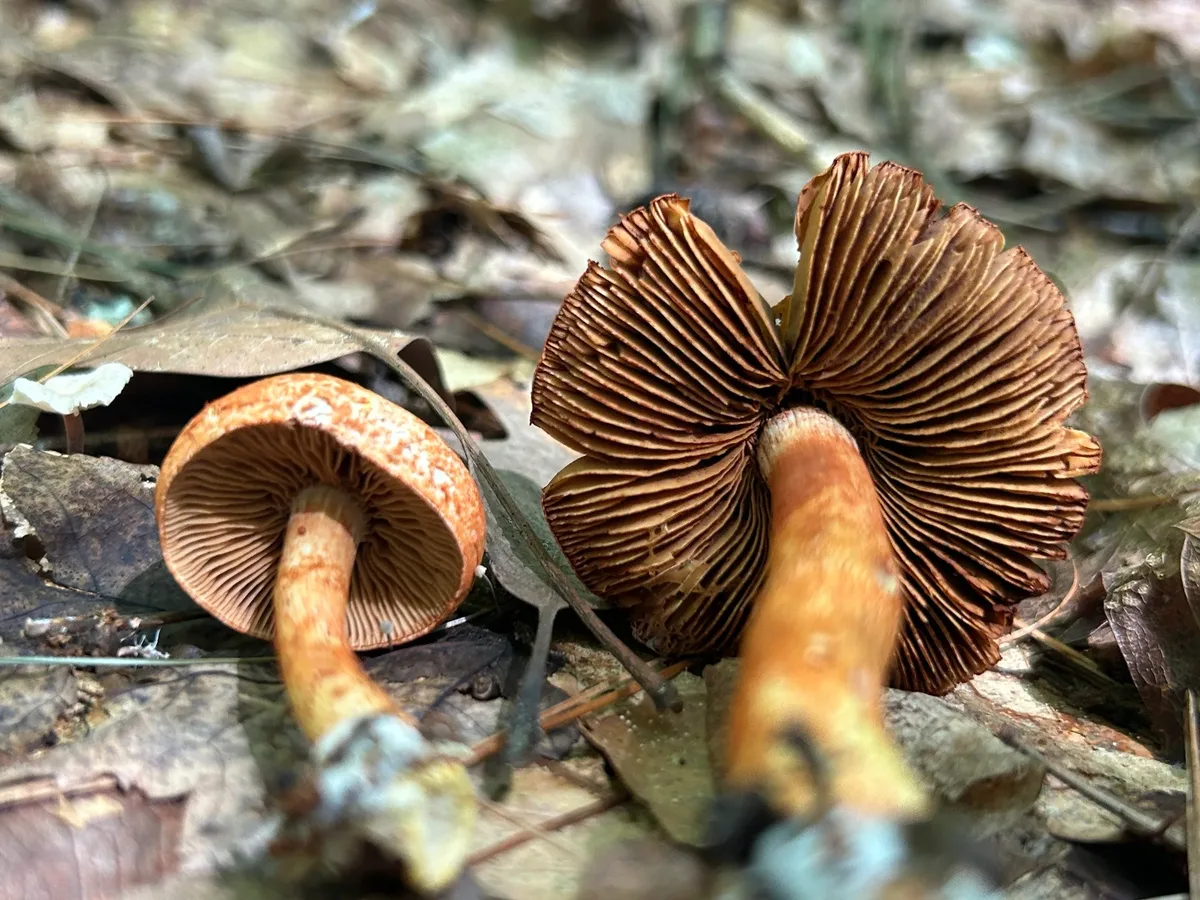
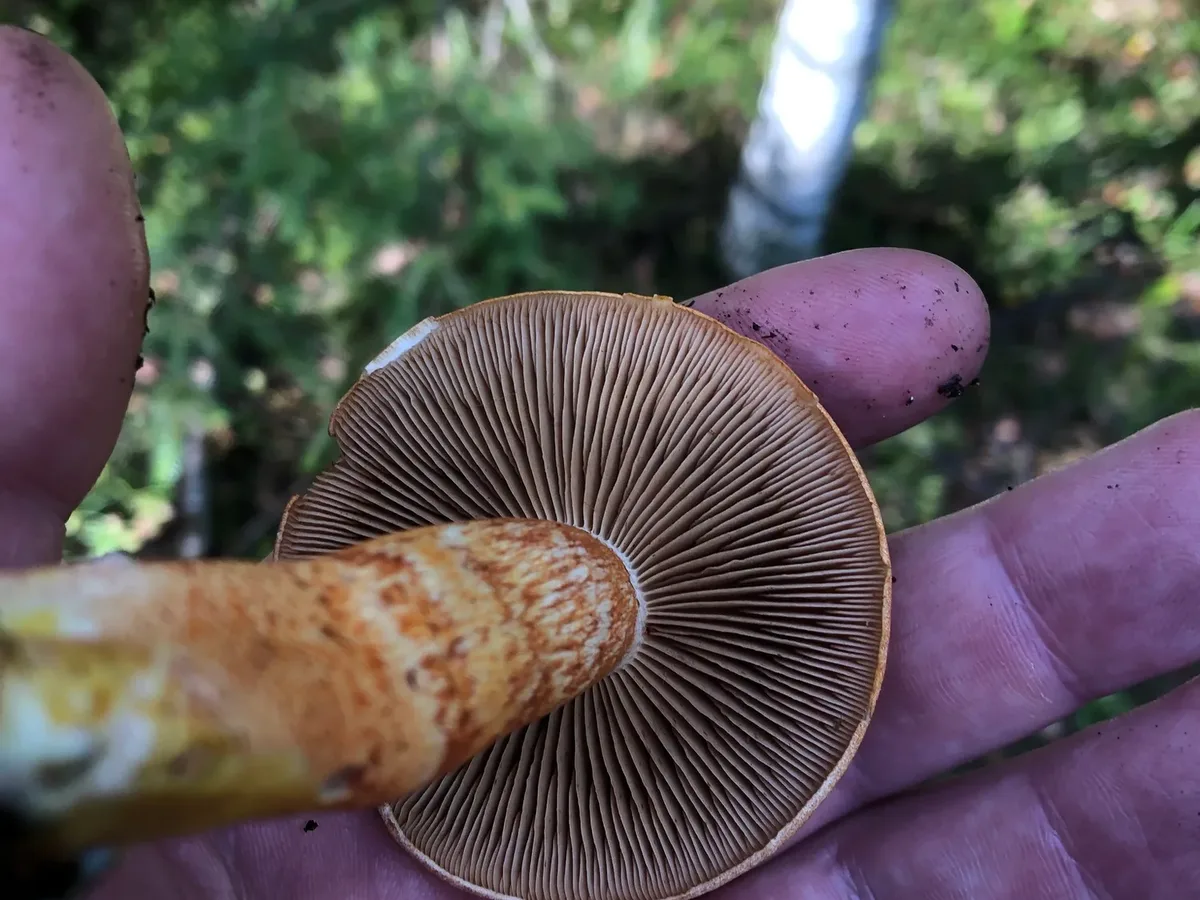
The stem carries the same theme - cream at the top, brick-red scaled patches toward the base - and together cap and stem make this one of the easier webcaps to recognise on sight.
Gills / Pores
The gills open pale ochre-clay and gradually shift to rusty cinnamon-brown as the spores ripen.
This rust-brown colouration - gills, spore print, and the stained remnants of the cortina - is a family trait shared by all Cortinarius species, and it matters: it tells you immediately you are dealing with a large and dangerous genus.
The cortina itself is a cobweb-fine curtain of ochre-cream threads linking the young cap margin to the stem; by the time the cap has fully expanded, it has torn away, leaving only a faint rust-stained ring-zone on the upper stem.
Spore print rusty cinnamon-brown.
Flesh
The flesh is pale and thin, and does not react when cut.
Smell & taste
It smells faintly earthy or of radish.
Why it's dangerous
Cortinarius bolaris is a gastrointestinal irritant, not a kidney toxin. While illness can be significant, it is generally not life-threatening.
The main danger is indirect: C. bolaris grows in the same habitats as orellanine-containing deadly webcaps (C. rubellus, C. orellanus), and a misidentification in that direction would be fatal.
Orellanine poisoning is characterised by a latency of 2 days to 3 weeks before kidney failure becomes apparent - by which time irreversible damage has occurred.
Even a confident identification of C. bolaris should trigger caution: if there is any doubt that the collected specimen might be one of the deadly relatives, it must be discarded and medical advice sought.
Toxin
The specific toxins responsible for the gastrointestinal syndrome in Cortinarius bolaris are not fully characterised.
The species does not appear to contain orellanine (the nephrotoxic compound of the deadly C. rubellus and C. orellanus), but contains unidentified compounds that irritate the gastrointestinal tract.
This is distinct from - and less severe than - the orellanine syndrome, which causes irreversible kidney damage weeks after ingestion.
Symptoms
Gastrointestinal poisoning symptoms typically appear 1-4 hours after ingestion:
- Nausea
- Vomiting
- Abdominal pain
- Diarrhoea
- General malaise
Recovery is usually complete within 24-48 hours with supportive care.
Seek medical attention if symptoms are severe or persistent.
Report the suspected species to healthcare providers so appropriate monitoring for delayed orellanine-type kidney effects can be considered, even though this is not expected with C. bolaris itself.
Staying safe
Cortinarius bolaris is poisonous and causes gastrointestinal illness - nausea, vomiting, abdominal cramps, and diarrhoea - typically within 1-4 hours of ingestion.
The responsible compounds are not fully characterised but are distinct from orellanine, the nephrotoxic toxin of the deadly C. rubellus / C. orellanus group.
Illness from C. bolaris is unpleasant but generally self-limiting; there are no confirmed fatalities specifically attributed to this species.
However, the critical safety point is that C. bolaris grows in the same genus and habitats as species that DO cause fatal delayed kidney failure.
Any forager attracted to Cortinarius bolaris by its striking appearance must understand that the genus as a whole is extremely hazardous.
NEVER eat any Cortinarius species unless you have expert-level identification skills and are 100% certain of the species identity. When in doubt - which should be the default for Cortinarius - leave it alone.
Where & when it grows
Habitat
The Dappled webcap is a mycorrhizal partner of temperate deciduous and mixed woodland across central and western Europe - meaning its mycelium is quietly threading through the soil, sharing water and minerals with the roots of beech, hazel, birch, oak, and hornbeam in exchange for sugars it cannot produce itself.
That partnership can run for many years unseen before a fruiting body ever pushes above the leaf litter.
It shows a particular affinity for beech and hazel woodland on moderately moist, shaded ground with deep accumulated leaf litter.
In the British Isles it is most frequent in ancient beech woods in southern England and Wales. On the continent it is widespread across France, Germany, Benelux, and Scandinavia, reaching its northern limit around southern Sweden and southern Norway.
Fruiting bodies tend to appear singly or in small scattered groups rather than in gregarious troops, and despite the mushroom's striking colours it can be easy to overlook among leaf litter.
When
The Dappled webcap fruits from late summer through autumn - broadly August to October, peaking through September and into early October across most of its range.
The first hard frosts usually end fruiting, though in sheltered or mild maritime sites it can linger into November.
Like most Cortinarius species, it is variable from year to year: a site that produced a dozen specimens last autumn may yield nothing this season, then fruit again abundantly the next.
Good autumn fruiting generally requires sustained late-summer and autumn rainfall (at least 20-30 mm across the two weeks before emergence) combined with cooling soil temperatures below around 15 °C - conditions that signal the wood to begin its brief autumn pulse.
How it grows
Cortinarius bolaris fruits solitarily or in small, widely spaced groups of two to four - it does not form dense clusters, troops, or rings.
Individual fruiting bodies push up through the accumulated leaf debris around the base of host trees, with no visible mycelial cord or substrate clump connecting them.
The very earliest stage - buttons just breaking the litter surface - already carries the defining brick-red scaling on the cap; this colour is present from the outset, not something that develops with age.
At the button stage, the cortina is most prominent: a fine cobweb-like curtain of ochre-cream threads stretches between the cap margin and the upper third of the stem, sealing in the pale gills.
As the cap expands from convex to broadly umbonate, this veil tears and collapses, ultimately leaving only a faint ring-zone on the upper stem that becomes stained rust-brown by the falling spore deposit.
The widely spaced, solitary growth habit is itself a useful field cue: if you find a brightly red-scaled Cortinarius-like mushroom growing alone rather than in a dense cluster, that is consistent with C. bolaris - though it is never sufficient on its own for a safe identification.
Fruiting conditions
Requires sustained autumn rainfall and cooling soil temperatures characteristic of September and October in central-western Europe. Fruiting is irregular between years; warm dry autumns suppress fruiting. Standard mycological estimate - specific data not published for this species.
Look-alikes
The vivid brick-red scaling on a pale background is fairly distinctive and reduces confusion with most other woodland mushrooms. However, several risks remain.
Other Cortinarius species with reddish-brown tones (such as C. rubellus, C. limonius, and C. malicorius) may occur in nearby or overlapping habitats; these include DEADLY orellanine-containing species.
A beginner who merely identifies 'a Cortinarius with reddish colours' and equates it with C. bolaris risks a potentially fatal mistake.
- Cortinarius malicorius has a more uniformly orange-red fibrillose cap without the pale buff ground colour of C. bolaris.
- Cortinarius speciosissimus (a synonym of C. rubellus) is more uniformly rusty-red-brown, lacks the pale dappled ground colour, and is deadly.
- Cortinarius phoeniceus has a more intensely blood-red appearance.
Inexperienced foragers should treat all reddish-brown Cortinarius species as potentially deadly and avoid them entirely.
Cap bright lemon-yellow to orange-yellow, uniformly coloured without the red-on-cream dappled pattern. Contains orellanine. Grows under conifers in boreal zones. The yellow tones differ from the brick-red scales of C. bolaris but in poor light or at distance confusion is possible. Deadly.
Foxy-orange to orange-brown cap, dry, finely fibrillose-scaly but without the pale two-tone dappled pattern of C. bolaris. Stem ochre-orange, not pale cream with brick-red scales. Grows under oak and other deciduous trees in drier woodland. Also contains orellanine. Fatal kidney toxin with 2-3 week latency.
Uniformly rusty-red to cinnamon-brown cap without a pale buff dappled background; the cap lacks the two-tone cream-plus-red-scales appearance of C. bolaris. Grows predominantly under conifers (spruce, pine) on moist ground in boreal and montane settings. Contains orellanine; causes fatal delayed kidney failure weeks after ingestion. Any confusion with a reddish-brown Cortinarius should prompt immediate expert consultation.
More uniformly orange-red to saffron-orange fibrillose cap without a pale buff ground colour; gills orange-yellow to ochre. Grows under conifers. Considered poisonous but toxicology less well documented than orellanine species. Distinguished from C. bolaris by the lack of a pale cream background to the cap scaling.
Intensely blood-red to scarlet-crimson cap and gills - much more saturated red than C. bolaris and without the pale two-tone scaling pattern. Grows under conifers (pine, spruce). Considered poisonous; exact toxicology disputed. Distinguished by the intense red throughout rather than the pale-background dappled pattern.
A reference guide - never an edibility guarantee. When in doubt, leave it out.