Cortinarius austroturmalis
Cortinarius austroturmalis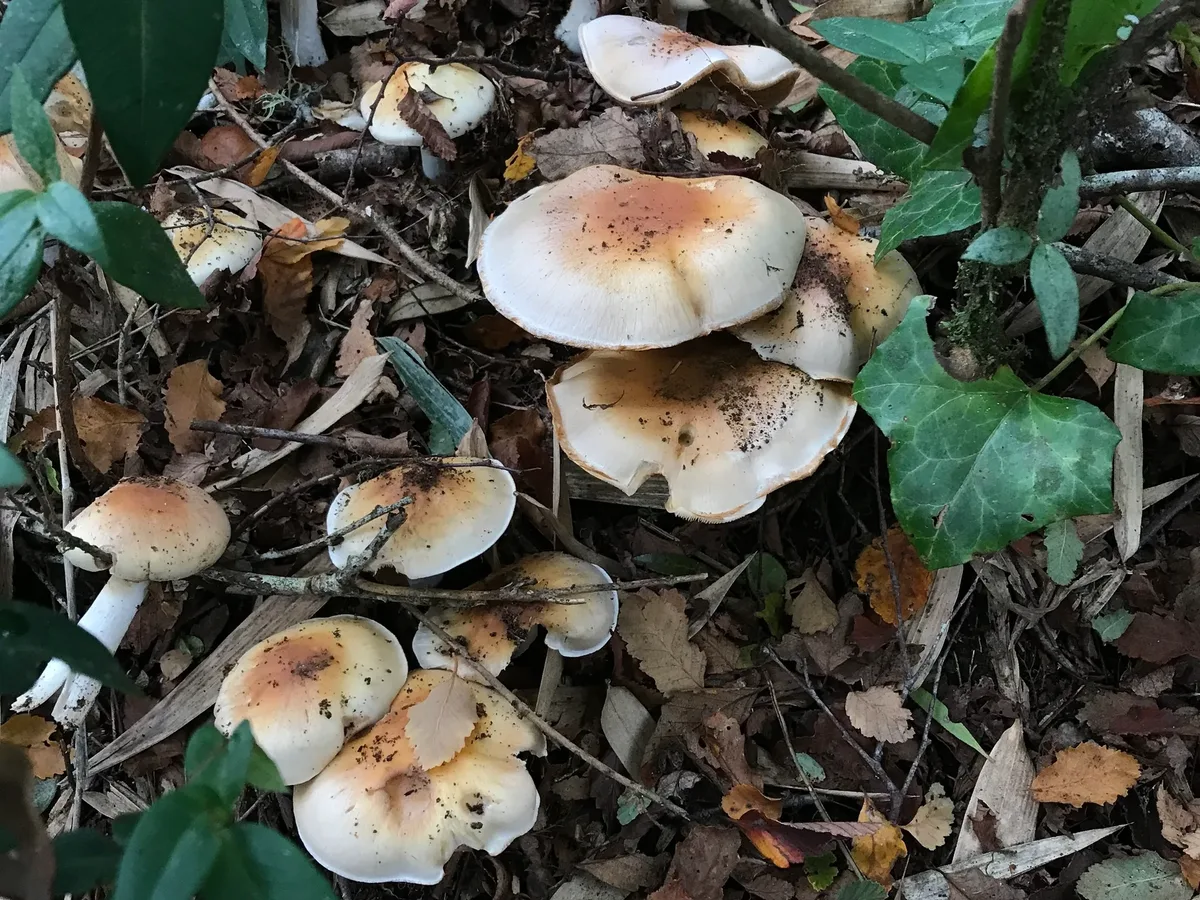 © Cristian Riquelme (CC BY)
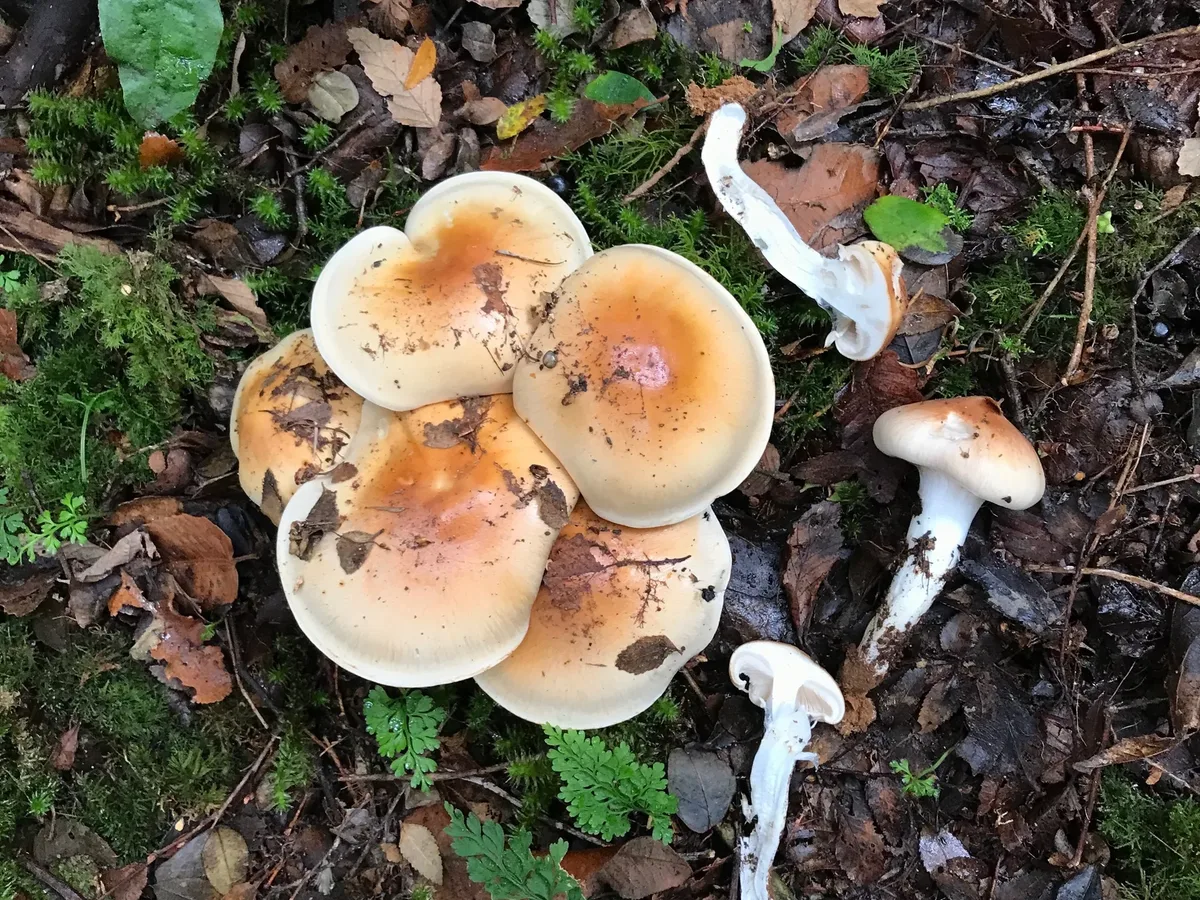 © Cristian Riquelme (CC BY)© Cristian Riquelme (CC BY)© Cristian Riquelme (CC BY)
Toxic - and the most serious cases can be fatal. Never eat it, and wash your hands after handling.
Never eat a mushroom you are not 100% sure of - check the look-alikes below, and always cook wild mushrooms.
How to recognise it
Cortinarius austroturmalis is a medium to large mushroom in the Phlegmacium group - the viscid-capped webcaps. It shares the core morphological grammar of the entire Cortinarius genus: a spiderweb-like cortina in youth, a rust-brown spore print at maturity, and gills that reliably transition from pale to rust-brown as spores develop.
Cap
Its most consistently accessible field character is the viscid to slimy cap surface, which becomes distinctly slippery and shiny in wet conditions. In dry weather the mucus dries to a faint sheen or is lost entirely, making cap colour the more prominent cue.
The cap colour ranges from pale ochre-buff or straw-yellow through tawny-ochre or orange-ochre at the disc, fading toward the margin. Old, dry specimens can look washed-out and dull.
Gills
The gills begin pale and cream or clay-coloured, sometimes with a ghost of lilac-grey in the freshest young specimens - an echo of the pale cortina threads dissolving around them - and age inevitably to rust cinnamon-brown.
Stem
The stem is thick and typically swollen or bulbous at the base, a Phlegmacium hallmark that, combined with the viscid cap and rusty spore print, defines the group.
In young specimens the cortina - that delicate web of pale threads between cap edge and stem - is the most diagnostic character visible. Once collapsed by rain or age, only the rust-brown spore-stained ring-zone on the upper stem remains as evidence.
The epithet 'austroturmalis' alludes to a tendency to fruit in clusters or troops, so encountering a loose group of two to six specimens with these shared characters under Nothofagus is consistent with the species.
Confirm rust-brown spore print on white paper or card if in doubt: this single character excludes many superficially similar genera at a stroke.
Why it's dangerous
FATAL. Cortinarius austroturmalis must be treated as a deadly poisonous mushroom.
The Phlegmacium group of Cortinarius, to which this species belongs, contains some of the most dangerous fungal nephrotoxins known. The South American Nothofagus-associated Cortinarius flora is recognised by mycological authorities as carrying equivalent risk to the confirmed-lethal European webcaps Cortinarius orellanus and C. rubellus.
Three characteristics together make orellanine poisoning among the most treacherous of all mushroom syndromes:
- 1The latency of weeks before symptoms appear, allowing severe renal damage to accumulate before any clinical alert.
- 2The chemical stability of orellanine, which cannot be destroyed by any cooking or preservation technique.
- 3The absence of any antidote or specific treatment once the toxin is absorbed.
Medical management is entirely supportive - haemodialysis to temporarily replace failing kidney function, and kidney transplantation in the most severe outcomes.
The gregarious fruiting habit of C. austroturmalis may increase the risk of accidental confusion with cluster-fruiting edible species.
If any Cortinarius from this region has been eaten - even weeks previously, even only a small taste - emergency medical care must be sought immediately without waiting for symptoms.
- In Chile contact CITUC (Centro de Información Toxicológica UC, +56 2 2635 3800).
- In Argentina contact the Centro Nacional de Intoxicaciones, +54 11 4963-5931.
Toxin
Cortinarius austroturmalis is classified as carrying orellanine-class nephrotoxicity, consistent with the well-established and globally conserved toxicological profile of Phlegmacium-group Cortinarius species.
Orellanine (3,3′,4,4′-tetrahydroxy-2,2′-bipyridine-N,N′-dioxide) is a polypyridine N-oxide. It is absorbed from the gastrointestinal tract, slowly distributed to the kidney, and metabolised there to reactive intermediates - primarily nordihydroorellanine.
These intermediates generate reactive oxygen species and selectively destroy renal proximal tubule epithelial cells by inhibiting protein synthesis and disrupting mitochondrial function. The result is progressive tubular necrosis and, in severe cases, irreversible nephron loss.
Orellanine is chemically stable under all conditions of domestic food preparation: boiling, pressure cooking, frying, roasting, oven-drying, freeze-drying, pickling in acid, and freezing all leave it intact.
C. austroturmalis has not been individually subjected to exhaustive chemical analysis in the published literature. But its placement in Phlegmacium, its South American Nothofagus forest ecology, and the documented presence of orellanine-class nephrotoxins across this clade - including in closely related South American Cortinarius species - make a precautionary orellanine classification obligatory and scientifically defensible.
Symptoms
Orellanine poisoning is defined clinically by a treacherously long latent period between ingestion and the appearance of noticeable symptoms: typically 2 to 4 weeks, with documented extremes ranging from a few days to over a month.
During this entire interval, progressive and potentially irreversible renal tubular necrosis is occurring silently, without causing symptoms the victim would recognise or report.
The first overt phase often begins with non-specific symptoms - intense thirst, malaise, headache, mild nausea - that are easily dismissed as a viral illness.
As renal function deteriorates, more specific signs appear:
- Greatly increased urination that may shift paradoxically to markedly reduced output (oliguria) as filtration capacity falls.
- Flank or lower back pain indicating renal inflammation.
- Anorexia, progressive fatigue, and vomiting.
Laboratory investigation reveals the hallmarks of acute kidney injury: rising serum creatinine and urea, proteinuria, haematuria, and evidence of tubular necrosis on biopsy.
Without timely intervention, end-stage renal failure follows, requiring long-term haemodialysis or kidney transplantation.
The extreme latency creates a severe diagnostic hazard: by the time a patient presents with overt kidney failure, the mushroom meal that caused it may be weeks in the past and may not be reported to physicians.
Staying safe
DO NOT EAT. Cortinarius austroturmalis is a deadly poisonous mushroom.
Its orellanine-class toxin is chemically stable and is not inactivated by boiling, frying, roasting, drying, freezing, or any other culinary or preservation technique.
The most dangerous feature of this poisoning is not the potency of the toxin alone but the interval of up to four weeks between eating the mushroom and the appearance of kidney failure symptoms - a delay that allows severe, partially irreversible renal damage to accumulate before any alert is raised.
If any Cortinarius from Nothofagus forest in South America has been consumed - even a small amount, even cooked, even weeks ago - contact the local poisons centre immediately without waiting for symptoms.
- In Chile: CITUC, +56 2 2635 3800.
- In Argentina: Centro Nacional de Intoxicaciones, +54 11 4963-5931.
Never collect, taste, or experiment with any slimy-capped, rusty-spored webcap mushroom in South American native forest, regardless of apparent resemblance to known edible species from other regions.
Where & when it grows
Habitat
Cortinarius austroturmalis is an obligate ectomycorrhizal species woven inextricably into the ecology of South American Nothofagus (southern beech) forest.
The invisible bulk of this organism lives underground - a web of fungal mycelium interlaced with the roots of its host trees, exchanging water and phosphorus from the soil for the photosynthesised sugars the tree produces. Those hosts are:
- Nothofagus dombeyi (coigüe)
- N. obliqua (roble)
- N. alpina (raulí)
- N. pumilio (lenga)
- N. antarctica (ñire)
- N. betuloides
This is not a passive relationship but an ancient, coevolved mutualism that has shaped the Patagonian forest over millions of years. The mushroom you see above ground is simply the temporary reproductive organ of an organism that may have been alive for decades underground.
Because of this dependence, C. austroturmalis appears exclusively in intact or near-intact native Nothofagus forest, typically in humid, shaded sites where soil moisture persists: valley floors, ravine sides, stream margins, and forest interiors where the canopy prevents rapid summer desiccation.
It does not appear in exotic pine or eucalyptus plantations, disturbed roadsides, or cleared farmland - its presence is itself a useful indicator of relatively undisturbed southern temperate forest.
When
Fruiting follows the classic pattern of Southern Hemisphere mycorrhizal fungi in cool-temperate forest. It is an autumn species, appearing from late February through June, with peak abundance in March, April, and May.
The proximate triggers are declining soil temperature and increasing soil moisture. After the relatively dry and warm Andean summer, the first sustained westerly fronts bring rainfall deep into Nothofagus forest catchments.
When soil temperatures begin falling through the 14-8 °C range and soil moisture has recovered from summer deficits, the established mycorrhizal mycelium redirects resources to fruiting body production. The lag between triggering conditions and visible mushrooms is typically 10-21 days, reflecting the metabolic investment required to build the large, fleshy Phlegmacium fruiting body.
At lower-elevation Valdivian temperate rainforest sites - where winters are milder and rainfall more evenly distributed - fruiting may begin in late February. At high-altitude Nothofagus pumilio (lenga) forest approaching the tree line, the effective season may be compressed into April and May before early snowfalls end the display.
A single site may produce two or more flush events across the season if successive rain episodes are separated by dry intervals.
How it grows
As an obligate ectomycorrhizal species, Cortinarius austroturmalis cannot complete its life cycle without living Nothofagus roots.
Its underground mycelium forms a perennial network that persists in the soil for years or decades, entering a quiet metabolic maintenance phase during summer and winter when conditions are unfavourable for fruiting.
When autumn conditions align, the mycelium initiates fruiting body primordia from the root zone and channels photosynthate carbon - received from its tree partners - into building the large, fleshy caps and stems.
The species epithet 'austroturmalis' captures a notable gregarious tendency: fruit bodies may emerge in loose troops or clusters of several specimens in close proximity, tracing the underground route of a colonised Nothofagus root.
This clustering, while not universal, makes the species more conspicuous than many solitary Cortinarius when it occurs. It may increase the probability of accidental collection by a forager seeking other cluster-fruiting species such as edible Flammulina or Armillaria.
Fruiting conditions
Southern Hemisphere autumn species in Andean-Patagonian Nothofagus forest. Fruiting triggered by declining soil temperatures (below ~14 °C) following summer, combined with sustained autumn rainfall from westerly Pacific fronts (20+ mm over 14 days). Typical flush lag 10-21 days, consistent with the metabolically demanding Phlegmacium fruiting body development under mycorrhizal constraints. Peak March-May; extension to June possible at lower-elevation Valdivian sites.
Look-alikes
In Nothofagus forest in Chile and Argentina, Cortinarius austroturmalis is most likely to be confused with other Phlegmacium-group Cortinarius species sharing the same viscid yellow to ochre-buff cap, rusty spore print, and bulbous stem. These include:
- Cortinarius lebre - more typically tawny-orange to pale cinnamon, similarly viscid, same habitat and season.
- C. patagoniensis - more reddish-brown to tawny, slightly violaceous tints in youth.
- Numerous undescribed or recently described Nothofagus-associated Cortinarius species that share the same overall colour palette and forest type.
All must be treated as carrying full orellanine-class deadly risk - there is no practical benefit in distinguishing between them for safety purposes.
Further afield, Rozites caperatus (the gypsy mushroom, sometimes placed in Cortinarius as C. caperatus) is a well-known edible that superficially resembles Phlegmacium webcaps - it has a rusty-brown spore print and a ring-zone on the stem. But it is distinguishable by its pale, distinctly wrinkled or rugulose-silky cap surface (not slimy) and a more fully developed membranous ring (annulus) rather than mere cortina remnants. Any South American 'caperatus-like' webcap must be verified by a specialist before consumption, not assumed to be the same edible species.
Descolea antarctica, an endemic ectomycorrhizal Nothofagus partner in the same forests, has a more distinctly ochre-yellow to golden-orange scaly-fibrous cap and a membranous persistent ring, rather than the slimy smooth cap and cobweb cortina of Cortinarius. Its edibility is insufficiently established for foraging.
Suillus and other boletes in the region are immediately excluded by their pore surface (tubes) rather than gills.
Any slimy, ochre-buff gilled mushroom with a rusty-brown spore print and a cobweb veil remnant on the stem in Nothofagus forest must be treated as Cortinarius and assumed deadly.
A Cortinarius of the southernmost Nothofagus forests (Magellanic zone, Tierra del Fuego), with a brown to reddish-brown or tawny-ochre dry to slightly hygrophanous cap rather than the viscid ochre-yellow surface of C. austroturmalis. At the same time, the overlapping range in southern Chile and the shared genus, habitat, season, and deadly risk profile mean that both species should be avoided with equal urgency. Field distinction between them carries no safety benefit.
Cortinarius lebre is a closely related South American Phlegmacium webcap in the same Nothofagus forest habitat. It tends toward a more tawny-orange to pale cinnamon-buff cap colour and a sometimes more strongly swollen stem base, but overlaps significantly with C. austroturmalis in overall size, viscid surface, pale to rusty gills, and forest context. Both are treated as carrying full orellanine-class deadly risk; no field character reliably separates them for safety purposes.
Another South American Nothofagus-associated Phlegmacium webcap. C. patagoniensis tends toward more reddish-brown to tawny coloration with faint violet tints in young specimens, while C. austroturmalis is typically more ochre-yellow to buff. Both have viscid caps, bulbous stems, and rust-brown spore prints in the same forest and season. Treat as equally deadly; field distinction is unreliable and irrelevant for safety.
Numerous Cortinarius species in Andean-Patagonian and Valdivian Nothofagus forests share the viscid ochre-buff to tawny-yellow cap, rusty-brown spore print, and cobweb cortina remnants of C. austroturmalis. Many are undescribed, poorly characterised toxicologically, or recently named. All must be treated as carrying full orellanine-class deadly risk. Species-level identification in this complex requires microscopy, chemical analysis, and molecular barcoding; field separation carries no safety benefit because all members of the group are equally dangerous.
An endemic Nothofagus ectomycorrhizal mushroom in southern South America that may co-occur with C. austroturmalis. Descolea is distinguished by a more golden-yellow to ochre-orange cap that is fibrillose-scaly (not smooth and uniformly slimy), a well-developed persistent membranous ring (annulus), and an ochre to dull yellowish-brown rather than pure rust-brown spore print. The scaly rather than slimy cap surface and the distinct ring are the most accessible separating features. The edibility of D. antarctica is not established; it should not be eaten without expert verification.
Rozites caperatus (placed by some authorities in Cortinarius) is an edible mycorrhizal mushroom with a superficially similar rusty-brown spore print and ring-zone on the stem. It is distinguished by a non-viscid cap surface with a characteristic wrinkled, silky or frosted pale appearance and a more developed membranous ring (annulus) rather than mere cortina remnants. Any 'caperatus-like' mushroom in South American Nothofagus forest must be identified by a specialist - the edible C. caperatus is primarily a Northern Hemisphere species, and look-alike South American webcaps cannot be assumed equally safe.
A reference guide - never an edibility guarantee. When in doubt, leave it out.