Australian webcap
Cortinarius australiensis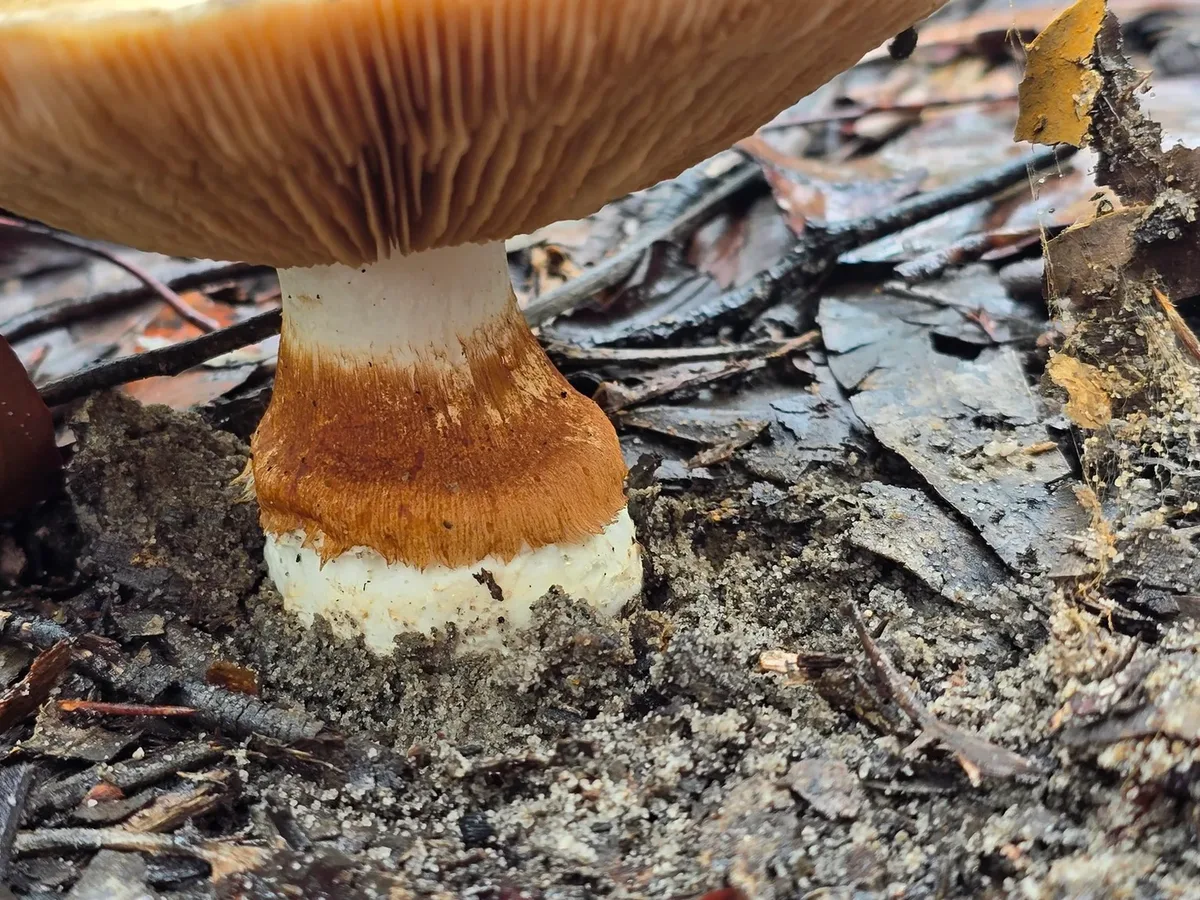 © Petra Holland (CC BY)
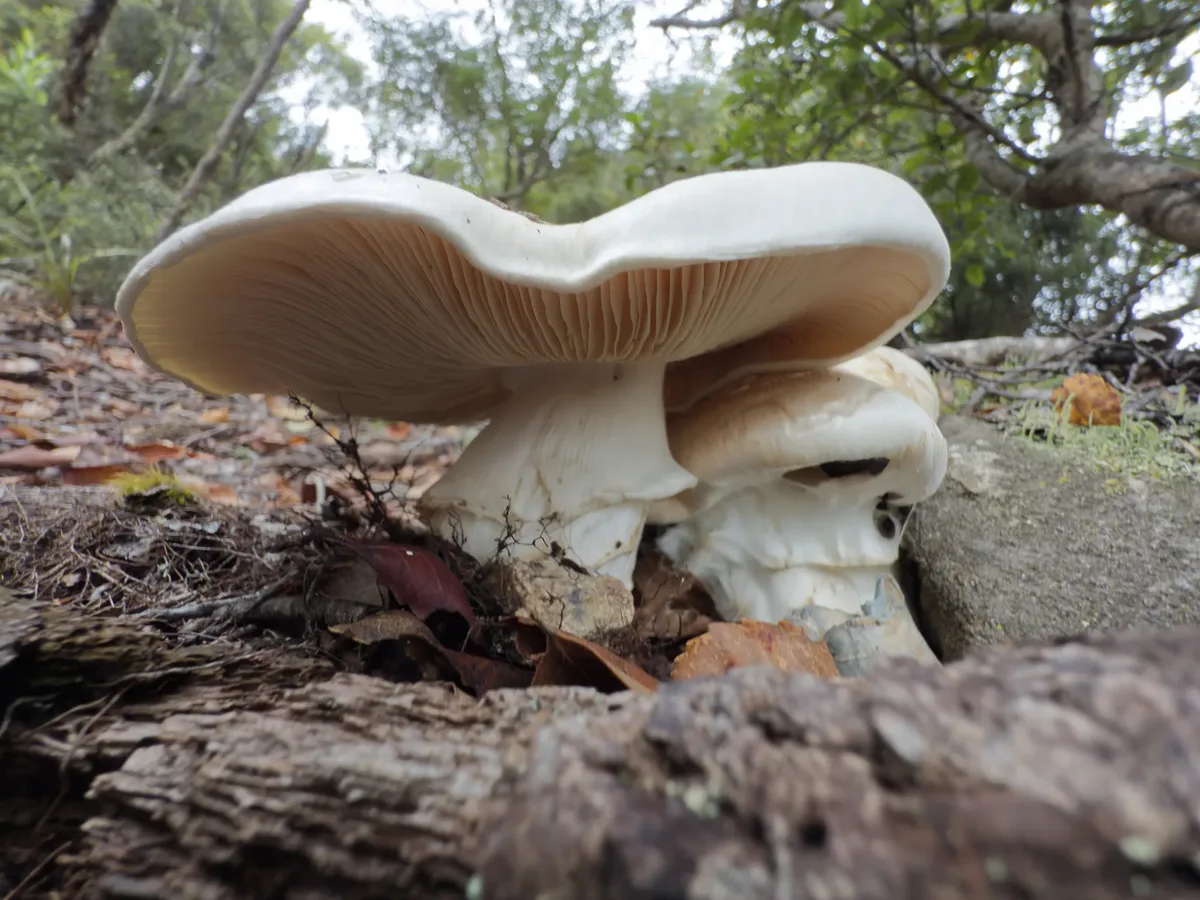 © Jeremy Rolfe (CC BY)© Petra Holland (CC BY)© Jeremy Rolfe (CC BY)
Toxic - and the most serious cases can be fatal. Never eat it, and wash your hands after handling.
Never eat a mushroom you are not 100% sure of - check the look-alikes below, and always cook wild mushrooms.
How to recognise it
Cap
Cap 4-10 cm across, convex then broadly umbonate, dry to slightly viscid, pale violet-brown to ochre-brown, with lilac tones when young that fade to dull buff or tan with age.
Gills
Gills adnate, moderately crowded, initially pale violet then rust-brown at maturity; gill edges pale.
Stem
Stem 5-12 cm tall, 1-2 cm thick, club-shaped to cylindrical, often bulbous at the base, fibrillose, whitish-violet to pale brown.
The most important distinguishing feature of all Cortinarius species is the cortina - a cobweb-like partial veil that spans the gap between cap margin and upper stem in young specimens. It collapses with age, leaving distinctive rust-brown ring-zone remnants on the stem.
Spore print rust-brown to ochre-brown, a critical field character.
Why it's dangerous
Orellanine-containing Cortinarius species rank among the most dangerous mushroom toxins precisely because the latency period (2 days to 3 weeks) allows victims to deteriorate undetected. By the time diagnosis is made, extensive nephrotoxic damage may be irreversible.
Studies on European Cortinarius orellanus and C. rubellus, which share the same toxin class, have documented that a substantial proportion of poisoning victims require dialysis, and some require kidney transplantation.
Australian Cortinarius species have been documented to contain orellanine in analytical studies. C. australiensis and related species should be treated as carrying equivalent risk to the European deadly webcaps.
There is no specific antidote.
Toxin
Orellanine (and related orelline) is a bipyridine N-oxide compound that acts as a selective nephrotoxin, causing irreversible damage to kidney proximal tubule cells.
The mechanism involves generation of free radicals and interference with cellular metabolism.
The toxin is not inactivated by any form of cooking or preservation.
Symptoms
Orellanine poisoning is characterised by an exceptionally long and deceptive latent period of 2 days to 3 weeks, during which the victim may feel entirely normal or only mildly unwell.
Initial symptoms, when they appear, include:
- intense thirst
- frequent urination
- nausea
- headache
- a burning sensation in the mouth
These are followed by progressive kidney failure (acute interstitial nephritis leading to acute tubular necrosis). Some cases progress to permanent renal failure requiring long-term dialysis or kidney transplantation.
The long delay between ingestion and symptom onset is particularly dangerous because by the time poisoning is recognised, the patient may have consumed the mushroom weeks earlier and the medical team must work backwards to identify the cause.
Staying safe
Never consume any Cortinarius species from Australian native forest. Orellanine causes delayed and potentially irreversible kidney damage.
The danger is compounded by the genus's notorious delayed-onset toxicity - victims may feel well for days to weeks before symptoms appear, by which time significant kidney damage has already occurred.
If Cortinarius ingestion is suspected, seek emergency medical care immediately and contact the Poisons Information Centre (Australia: 13 11 26).
Where & when it grows
Habitat
Mycorrhizal with native Australian trees, predominantly Eucalyptus species and Nothofagus (southern beech) in moist sclerophyll forest and montane woodland.
Found in southeastern Australia - Victoria, New South Wales, Tasmania, the ACT - and potentially in comparable Nothofagus habitats in New Zealand.
Grows singly or in scattered groups in deep leaf litter beneath host trees, favouring sites with good moisture retention.
When
Autumn through early winter - March to June in the Southern Hemisphere - is when this species emerges, with fruiting peaking in April and May after the first meaningful autumn rains cool and wet the soil.
It is absent in summer.
How it grows
Like all webcaps, this species lives as an ectomycorrhizal partner threaded invisibly through the soil, its mycelium woven around the roots of eucalypts and southern beeches.
The relationship is obligate on both sides: the fungus cannot complete its life cycle without a living host, and in exchange it extends the tree's ability to draw water and minerals from the soil.
What appears above ground - the mushroom itself - is only the fruiting body of a network that may have been quietly at work beneath the forest floor for years.
Fruiting bodies emerge singly or in loose scattered groups, never in dense clusters.
Fruiting conditions
Fruits in Southern Hemisphere autumn after rain events; soil temperatures falling through autumn trigger fruiting. Conservative standard mycology estimate derived from the known season and general Cortinarius ecology.
Look-alikes
Several native Australian Cortinarius species share similar brownish-violet colouration and habitat, making species-level identification within this genus extremely difficult even for specialists.
The genus Cortinarius is not safely edible in Australia without expert laboratory analysis.
Some collectors have mistaken brownish webcaps for edible species such as field mushrooms (Agaricus) or slippery jacks (Suillus). The rust-brown spore print and cortina remnants are the definitive markers of Cortinarius.
Native Australian species including Cortinarius porphyroideus (purple pouch fungus, gasteroid form) superficially differ but the broader webcap complex presents real identification challenges.
Numerous native Australian Cortinarius species are morphologically similar to C. australiensis and are all presumed to carry orellanine-type risk. Species-level identification within this genus requires microscopy and chemical analysis. All brown to violet-brown webcaps in native Australian forest should be treated as potentially deadly. The shared rust-brown spore print, cortina remnants, and mycorrhizal forest habitat identify the genus; distinguishing the exact species is a specialist task.
Agaricus species have pink-then-dark-brown gills that become chocolate-brown at maturity, and a dark brown (not rust-brown) spore print. They lack a cortina entirely and are typically found in open grassland, not native forest understory. The cobweb-like cortina remnants on the webcap's stem and the rust-brown spore print are the definitive distinguishing markers.
Suillus species are boletes with a spongy pore surface on the cap underside (not gills), typically associated with introduced pines rather than native Australian trees. If gills are present, it is not Suillus. The rust-brown gilled structure and cobweb cortina of Cortinarius are entirely absent in Suillus.
A reference guide - never an edibility guarantee. When in doubt, leave it out.