Glistening Ink Cap
Coprinellus micaceussyn. Coprinus micaceus, Agaricus micaceus, Coprinus micaceus var. micaceus, Pseudocoprinus micaceus
 © Michel Langeveld (CC BY)
 Chuck Wilson (CC0)
 Chuck Wilson (CC0)
 Chuck Wilson (CC0)
 Chuck Wilson (CC0)
 Chuck Wilson (CC0)
 © Dan Killam (CC BY)
 © Michel Langeveld (CC BY)© Michel Langeveld (CC BY)Chuck Wilson (CC0)
Edible only with the right preparation - or safe for some people but not others. Learn the caveats first.
Never eat a mushroom you are not 100% sure of - check the look-alikes below, and always cook wild mushrooms.
How to recognise it
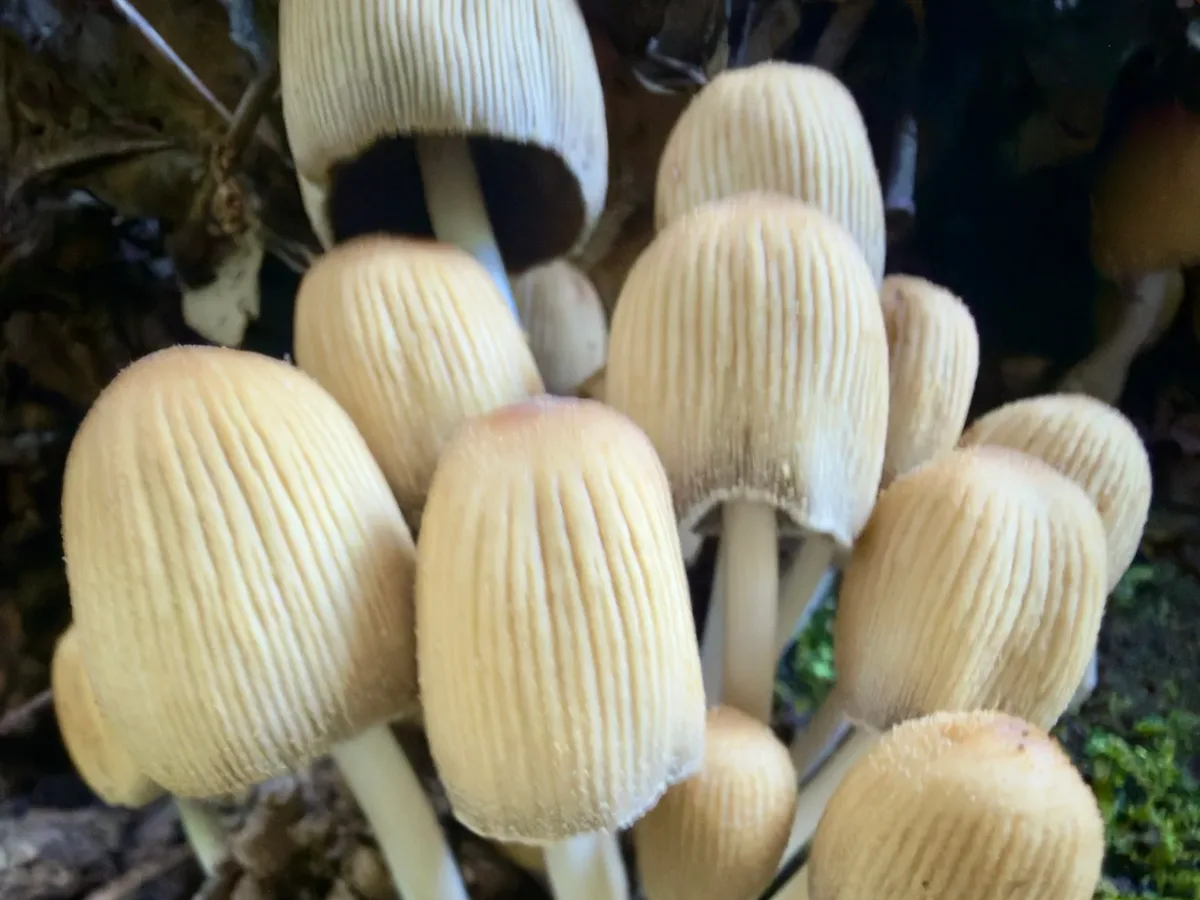
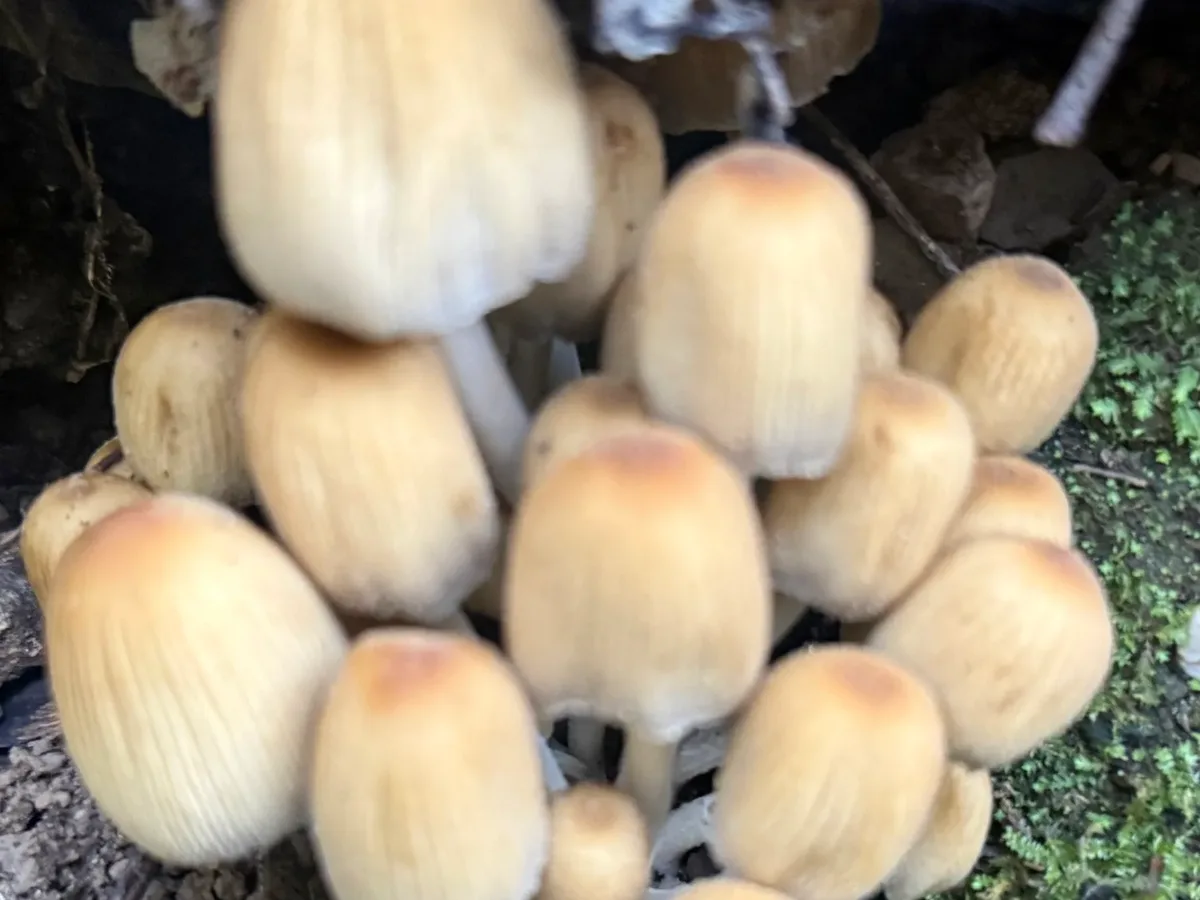
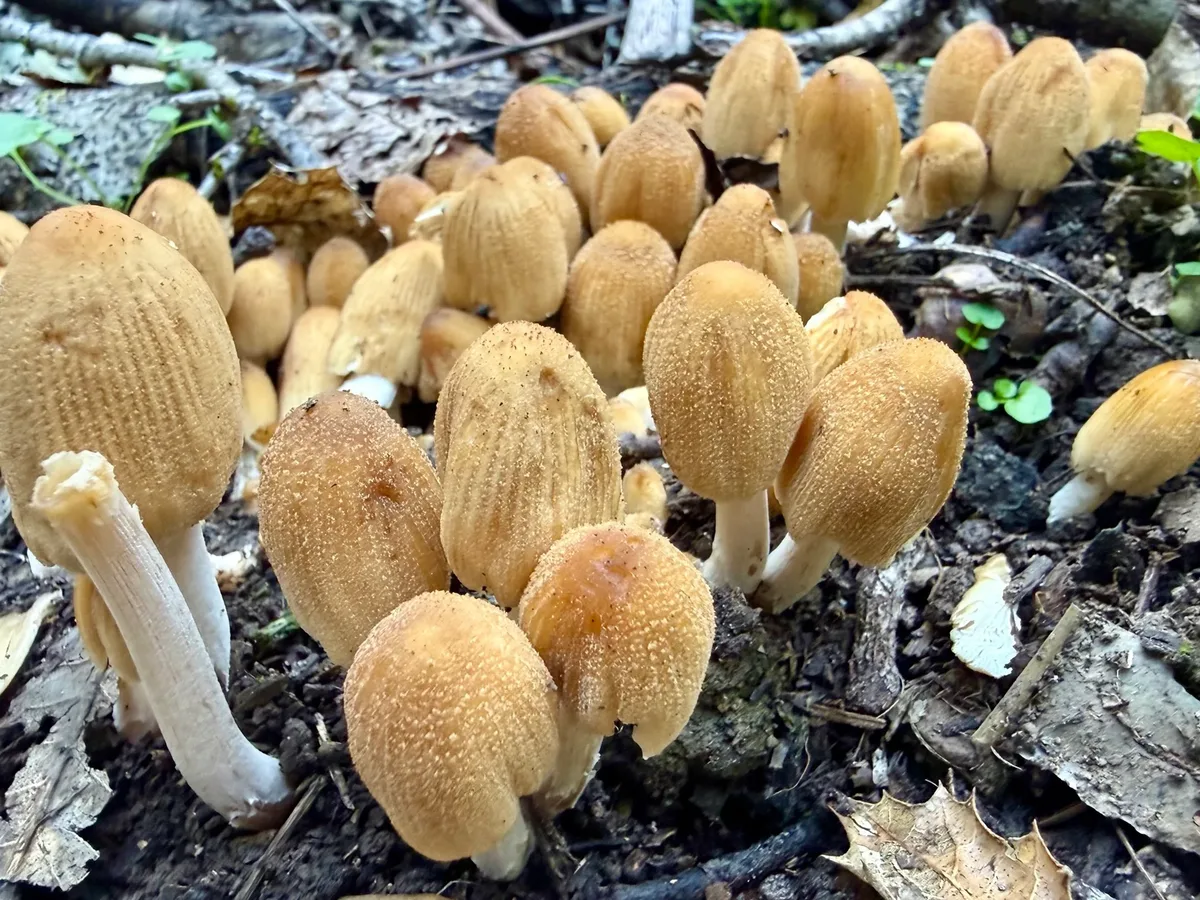
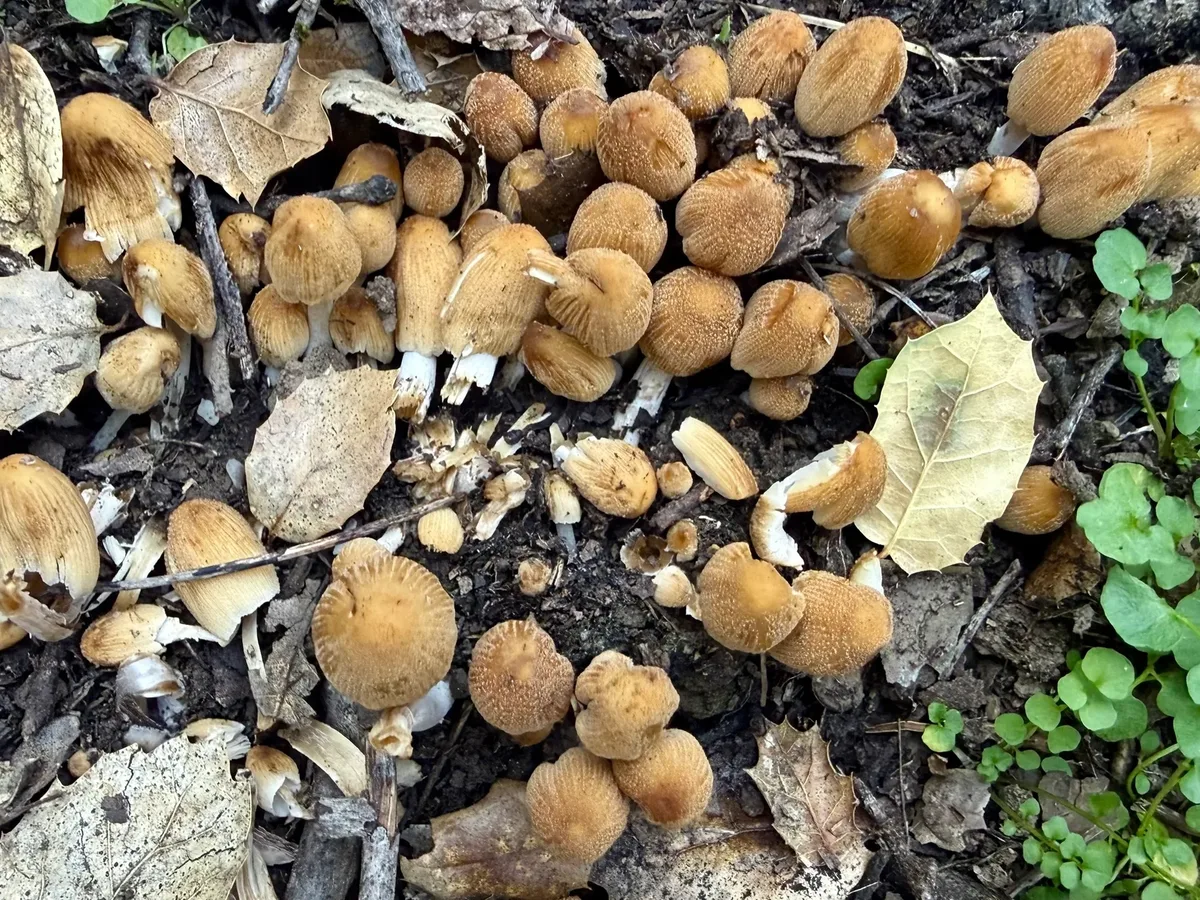
The Glistening Ink Cap earns its name from the sparkling, silvery granules that dust the cap surface of fresh young specimens - look at them in slanting light and they glitter like frost or scattered mica crystals.
These granules are remnants of the universal veil (a thin membrane that enclosed the developing mushroom as an egg), broken into microscopic cystidia that catch and scatter light. They are most prominent on buttons and young bells; rain and handling wash them off quickly, so mid-aged and old specimens can lack them almost entirely.
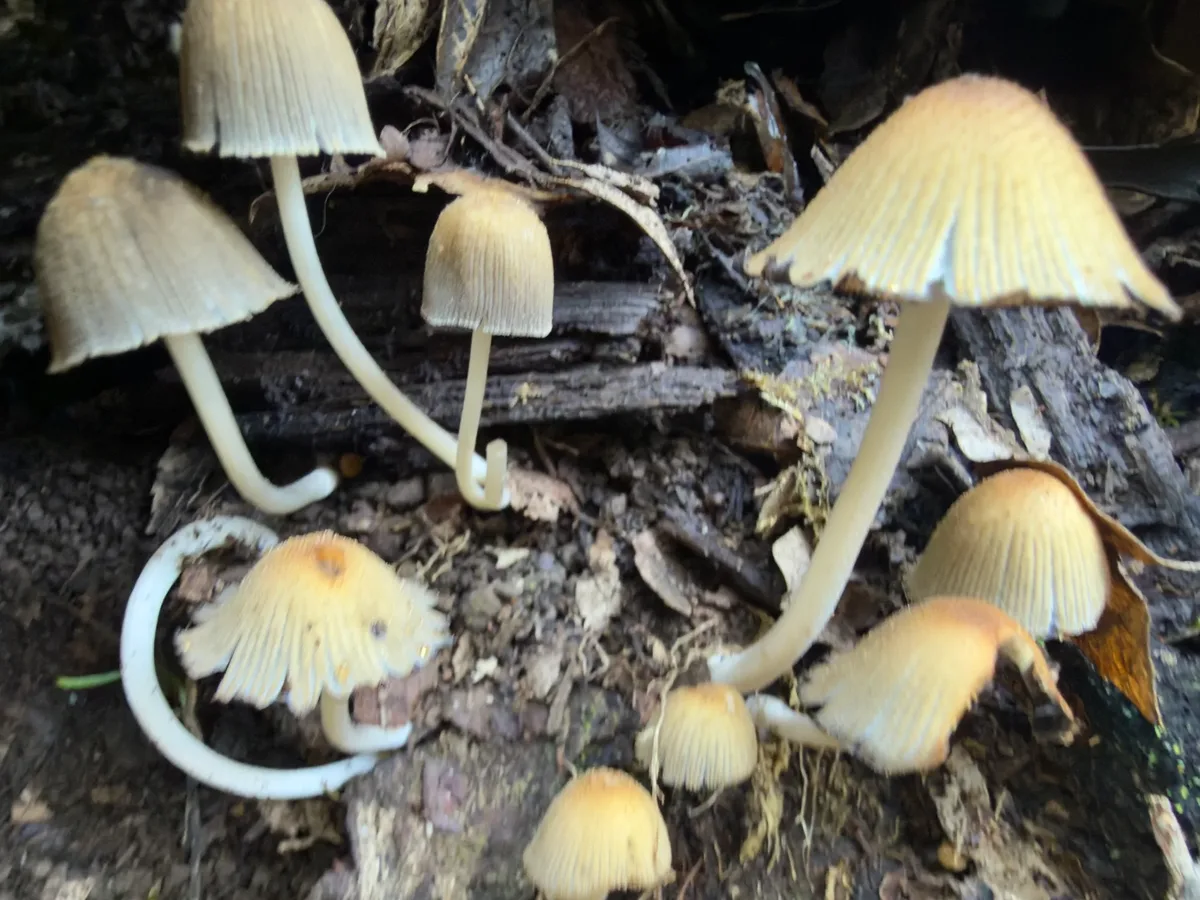
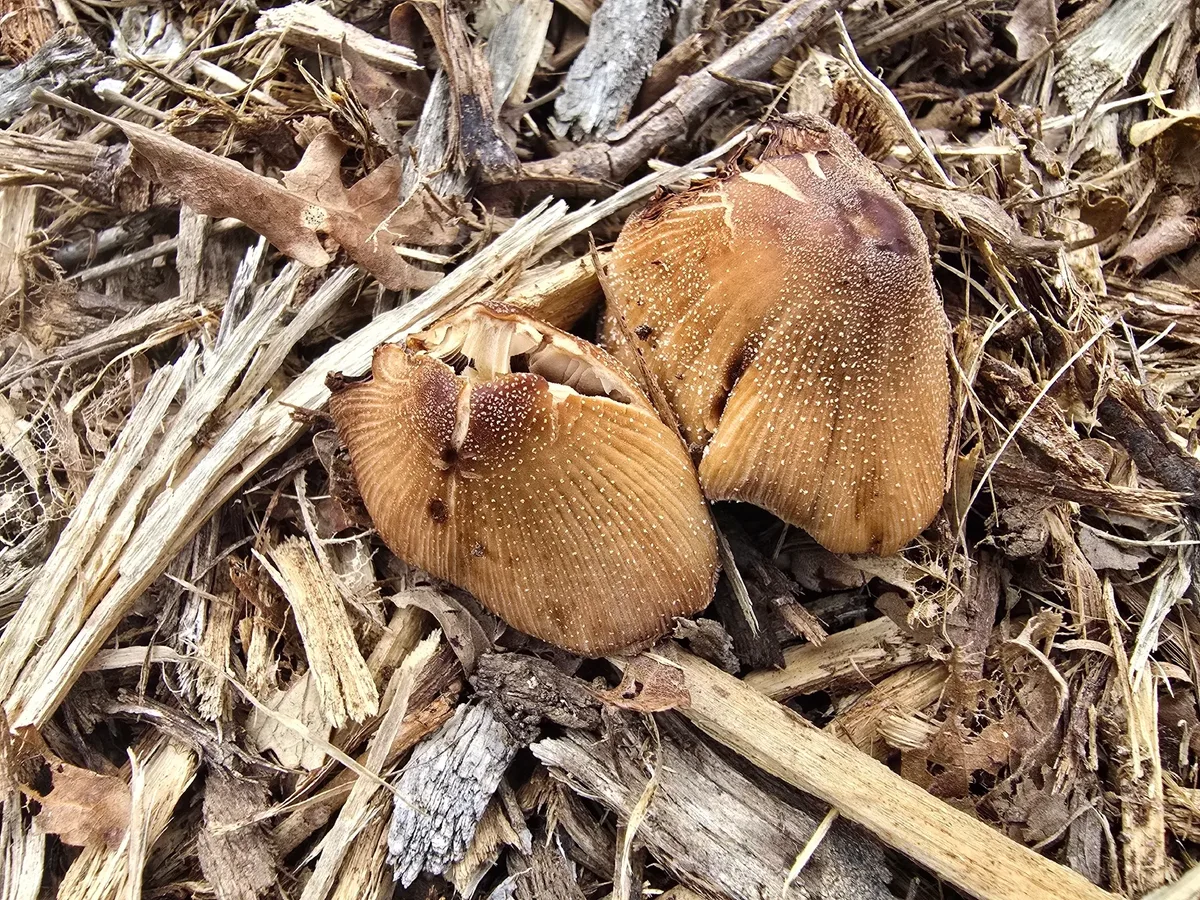
The cap itself is honey-buff to pale ochre-brown, deepening slightly at the centre, and begins tightly egg- or cylinder-shaped before expanding to a broad bell with a characteristically irregular, radially grooved or pleated margin that eventually tears and rolls upward.
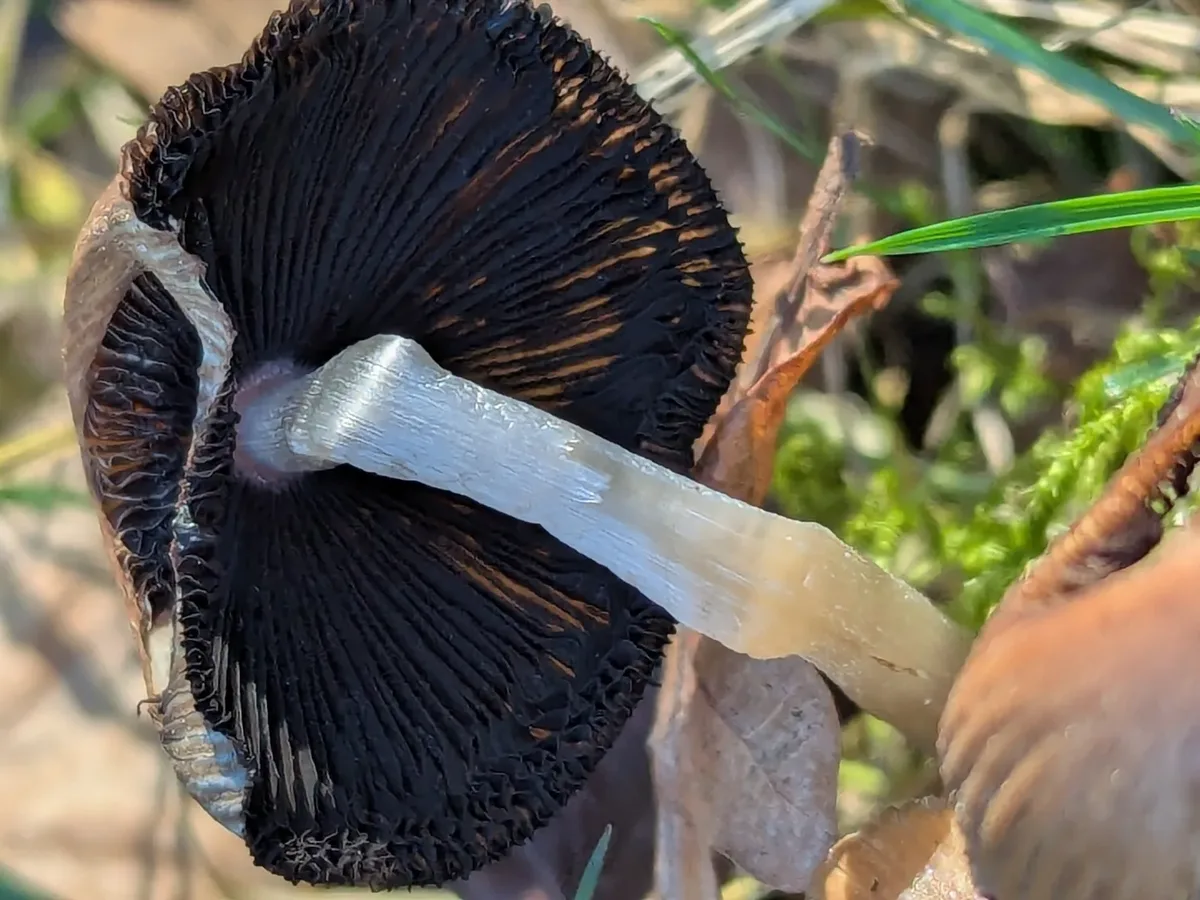
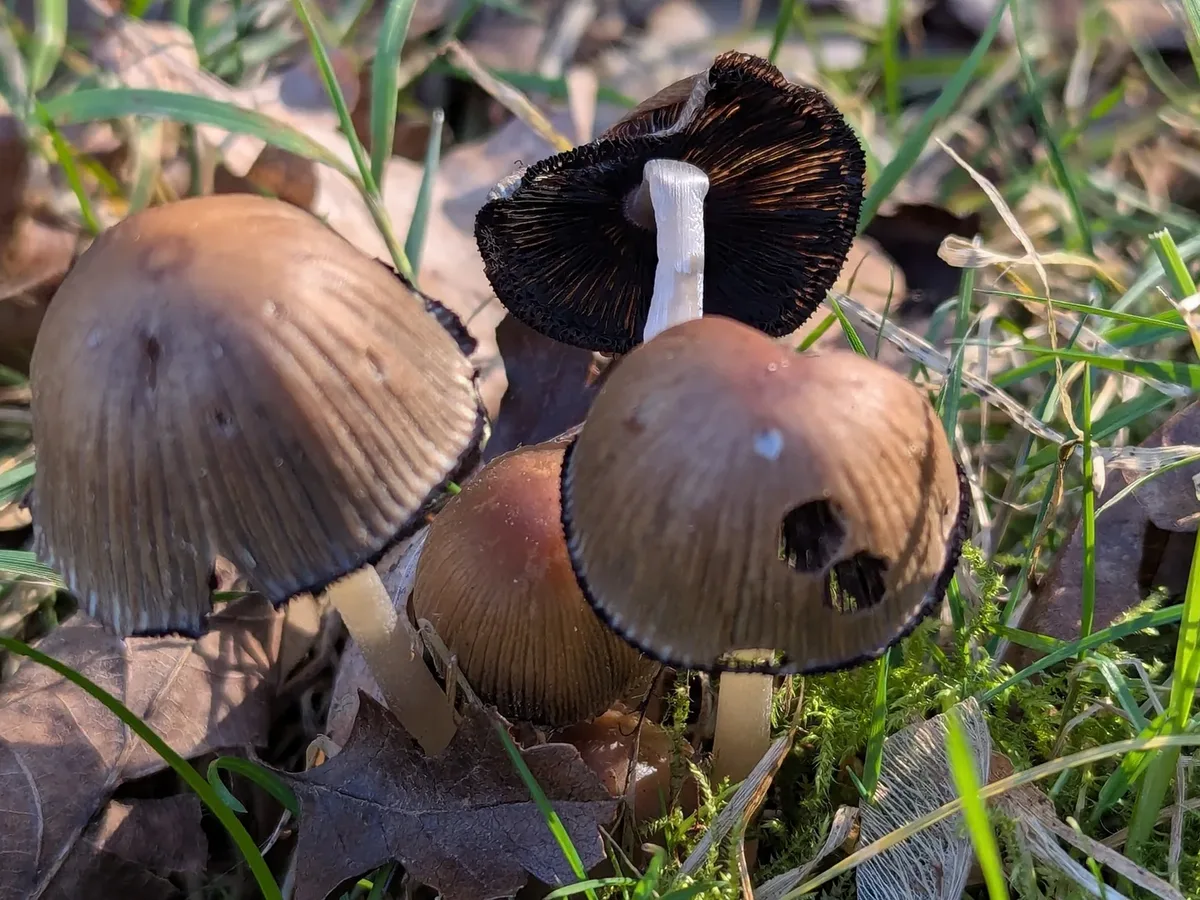
The most striking feature of the whole development sequence is autodigestion (deliquescence): starting at the gill edges and progressing inward and upward, the cap tissue and gills dissolve enzymatically into a shining black liquid - this is a spore-dispersal strategy, converting the mushroom into a self-digesting ink that drips from beneath the cap edge and carries millions of spores with it.
A dense cluster of Coprinellus micaceus at various stages simultaneously shows caps still pale and glistening, others already darkening at the margin, and the outermost and oldest reduced to black-stained, collapsing remnants - all in the same tuft.
The stem is slender, hollow, fragile, and brilliantly white against the buff cap; there is no persistent ring (unlike the related Coprinopsis atramentaria), though young buttons bear ephemeral white fibres from the partial veil.
The spore print is jet black.
Where & when it grows
Habitat
This is fundamentally a wood decomposer, though it hides this identity well because it so often erupts from apparently bare ground in lawns and gardens.
The mycelium is invariably attached to dead wood - buried roots, a stump just below the surface, the base of a dead or stressed tree - and the clustered fruit bodies emerge directly from this substrate. It has an extraordinarily wide host range, colonising virtually any dead or dying deciduous tree.
In Australia and New Zealand it is abundant wherever European deciduous trees have been planted:
- urban parks
- avenues of elms or planes
- old orchards
- suburban gardens
- hedge rows
- cemetery plantings
- golf courses
It also occurs in native and mixed bushland wherever woody debris accumulates.
This broad ecological tolerance and its willingness to fruit in fully urban settings make it one of the most frequently encountered 'ink cap' fungi in temperate regions globally.
When
In Australia and New Zealand the main fruiting periods are autumn (March-May, peaking April-May) and spring (August-October), loosely mirroring the flush of growth and death cycles of deciduous host roots.
However, this species is an opportunist: almost any significant rainfall event during mild weather - from late summer through to late autumn - can trigger a flush. In warm coastal regions with year-round moisture it may fruit in almost any month.
Individual clusters develop and complete their full life cycle (emergence → autodigestion) in as little as 24-48 hours, so checking a productive site regularly is essential.
Practically, the best collection window is the morning after a warm rain: visit at first light, harvest young bells before the gills begin to darken, and expect the spot to be liquefied by the following day.
How it grows
Coprinellus micaceus is a saprotrophic species - it derives all its nutrition from dead and decaying wood, breaking down lignin and cellulose and returning nutrients to the soil. Unlike mycorrhizal fungi, it forms no partnership with living roots; it is strictly a decomposer.
The mycelium colonises buried woody material and can remain latent in soil for years, erupting in dramatic dense clusters when conditions - moisture and mild temperature - align. Clusters of 10 to 50 or more fruiting bodies of different ages are the rule rather than the exception, each individual developing rapidly and completing its full life cycle within one to three days.
The black inky liquid produced by autodigestion is not waste but a spore-delivery mechanism. The enzymatic self-dissolution begins at the outermost gill edges where spore maturation is complete, progressively exposing and releasing mature spores rather than having them all compete to drop from a single cap surface simultaneously.
This elegant strategy maximises spore dispersal but imposes a strict harvest window for foragers.
Fruiting conditions
Rain-responsive saprotroph with rapid fruiting. Flushes within 1-4 days of significant rainfall (15+ mm over 14 days) across a broad temperature range (5-22 °C soil). In the Southern Hemisphere, primary flushes occur in autumn cooling (March-May) and spring warming (August-October); opportunistic year-round in mild maritime climates. Individual fruit bodies complete their life cycle in 24-48 hours due to autodigestion, so monitoring of productive sites must be frequent.
Look-alikes
The most serious confusion is with Galerina marginata (the Funeral Bell or Deadly Galerina), which shares the same substrate (dead wood or buried roots), the same clustered growth habit, and a superficially similar small brown cap.
Galerina marginata is deadly - it contains amatoxins identical to the Death Cap - and it may grow in mixed clusters alongside or immediately adjacent to Coprinellus micaceus.
The key differences are:
- Galerina has a persistent, distinct membranous ring on the stem (in fresh specimens).
- Brown gills that remain brown and do NOT blacken or autodigest.
- A rusty-brown spore print (not black).
- Typically grows on coniferous wood more than deciduous, though both occur on either.
The critical rule is to take a spore print - a rusty-brown print from a wood-inhabiting clustered mushroom with a ring means Galerina or a close relative and is potentially deadly; a jet-black print confirms the ink cap.
Within the ink caps, Coprinopsis atramentaria (the Common Ink Cap) is similar but larger, greyer, less clustered, grows from thicker buried wood or stump bases, and - most importantly - contains coprine, an antabuse-like compound that causes a toxic reaction (flushing, palpitations, nausea) when consumed with alcohol. Coprinellus micaceus does NOT contain coprine and does not have this alcohol interaction, but the distinction matters when explaining the genus.
Coprinellus disseminatus (Fairy Bonnet) is closely related and often grows near C. micaceus in similar habitats; it is smaller (cap under 1.5 cm), paler grey-white, does not autodigest fully, and is also edible but insubstantial.
Psathyrella species can resemble early-stage ink caps on wood but have grey-brown to purple-brown spore prints and do not autodigest.
Various small brown fungi on wood (Hypholoma species, Kuehneromyces mutabilis) can also be confused, but none share the glistening veil granules combined with black spore print and autodigestion.
DEADLY - contains amatoxins identical to the Death Cap. Grows on dead wood (particularly conifers but also deciduous) in clustered or scattered groups, overlapping in habitat and sometimes growing directly alongside Coprinellus micaceus. Separated by: a distinct, persistent membranous ring on the stem (present in fresh specimens); gills that are rust-brown and remain brown without blackening or autodigesting; a rusty-brown spore print (never black); and the absence of glistening mica granules on the cap. Take a spore print - black = ink cap; rusty brown = potential Galerina and do not eat.
Edible, but contains coprine - an antabuse-like compound that causes toxic symptoms (facial flushing, rapid heartbeat, nausea, vomiting) if consumed within several days of drinking alcohol. Larger than C. micaceus (cap 4-8 cm), greyer in colour rather than honey-buff, typically less clustered, without mica-like glistening granules, and usually growing from a more robust stump or thick buried root. The lack of glistening veil remnants and larger, greyer cap are the best visual guides; the species differs crucially in the alcohol interaction that C. micaceus lacks.
Edible but insubstantial. Extremely similar in habitat and growth habit, often found in even larger colonies alongside C. micaceus. Smaller (cap usually under 1.5 cm), greyer and more ribbed-pleated, does not fully autodigest to black liquid, and has finely hairy (flocculose) rather than glistening granular cap ornamentation. No practical safety concern - both are harmless - but confirms the need to identify by granule type and size.
Edible (same harvest-young rule applies). Much larger (cap 5-15 cm tall), strikingly shaggy with coarse upturned white scales and a distinct persistent ring, growing singly or in loose groups from lawns and grass over buried organic matter rather than directly from wood. No glistening mica granules; easily distinguished by size and shaggy cap texture.
Edible but can be confused with Galerina marginata more than with C. micaceus; mentioned here as a cluster-forming wood mushroom. Has a warm tawny-brown cap, a distinct scaly lower stem with a ring zone, cinnamon-brown spore print, and no autodigestion. No mica granules. Relevant primarily because it underscores the importance of spore-printing any clustered wood mushroom before eating.
Toxic (gastrointestinal irritant). Also grows in dense clusters on dead wood, but has a sulphur-yellow to olive-yellow cap and stem, yellow to greenish gills, a purple-brown spore print, and distinctly bitter taste. No mica granules, no blackening, no autodigestion. The strongly yellow coloration and bitter taste readily separate it.
In the kitchen
Picking & cleaning
Pick only the youngest, most tightly closed bells - ideally those still fully campanulate with pure white gills or only the very faintest grey tinge at the margin. These young buttons are firm, fragrant, and excellent.
Once any significant blackening is visible at the gill margin, autodigestion is well under way and the texture becomes unpleasantly slimy; past this point the mushroom is not worth harvesting.
Because development is so rapid, aim to collect in the early morning, on the day of or the day after significant rainfall.
The clusters are fragile: cut the whole tuft at the base with a knife and separate individuals in the hand. Transport in a paper bag or open trug rather than a closed plastic bag, where the heat and moisture will accelerate autodigestion dramatically.
Specimens should be cooked within a few hours of picking; they do not store well overnight even under refrigeration.
Always confirm the substrate - Coprinellus micaceus grows from wood or buried wood, not from soil; if in doubt about the substrate, do not eat it.
Critically, always scan for any Galerina marginata or other brown-capped, wood-growing gilled fungi in the same cluster or immediate vicinity, which is a potentially deadly confusion (see Lookalikes).
Cooking
Coprinellus micaceus is a pleasant edible with a mild, delicate flavour that intensifies agreeably with brief heat. The texture is soft and silky in young specimens.
Because autodigestion begins within hours of picking, these mushrooms demand immediate use: cook them the same day they are harvested.
- Sort and trim the cluster, discarding any individual that shows significant black staining; a faint grey tinge at the gill margin is acceptable.
- Wipe clean rather than washing (they absorb water readily).
- Sauté quickly over medium-high heat in butter or olive oil with garlic or shallots; the mushrooms release considerable moisture and should be cooked until this liquid has evaporated and the flesh is just beginning to colour.
Excellent on toast, in omelettes, added to pasta, or folded into risotto at the end of cooking.
They do not dry or preserve well. Their rapid seasonal availability - a flush may last one to two days - makes them a mushroom that rewards attentive foragers rather than casual ones.
Good to know
Coprinellus micaceus is a genuine edible species with a good safety record. Unlike the closely related Common Ink Cap (Coprinopsis atramentaria), it does NOT contain coprine and has no reported alcohol interaction - it can be eaten with a glass of wine without risk.
It must always be eaten cooked; eating any ink cap raw is inadvisable due to potential gastric irritation from cell wall compounds in raw form.
The single most important safety rule is the substrate and spore-print check: always confirm growth from wood (or buried wood), and if there is any doubt, take a spore print before eating.
- A jet-black spore print confirms Coprinellus.
- A rusty-brown print means potential Galerina marginata - a deadly species that grows in the same habitat.
Never eat small, clustered, brown-capped, wood-inhabiting fungi without confirming a black spore print.
Harvest only young specimens before significant autodigestion begins; the blackened, half-dissolved material is not toxic but is unpalatable and may cause mild gastric upset in quantity.
As with all wild mushrooms, try a small portion on first acquaintance to assess individual tolerance.
A reference guide - never an edibility guarantee. When in doubt, leave it out.